
Online Marketing for Law Firms: A Guide for UK and Irish Solicitors
Table of Contents
Online marketing for law firms has become the main route to new instructions across the UK and Ireland. Prospective clients search, compare and decide long before a phone rings, and the practice that looks credible at that moment wins the work.
Legal marketing also carries a constraint most digital guides skip. Every campaign sits inside a professional conduct framework set by the SRA, the Law Society of Northern Ireland or the Law Society of Ireland. A breach costs more than a wasted budget.
What follows covers how clients pick a solicitor online, how to build search visibility, where paid and content budgets work hardest, the compliance rules shaping every campaign, and the numbers partners should be asking for.
How Prospective Clients Choose a Solicitor Online

Before a pound goes into any campaign, online marketing for law firms should start with the route a client actually takes. That route is short, and most of it happens on a screen where nobody from the firm is present to influence it.
The Search, Evaluate, Instruct Pattern
A personal injury claimant in Belfast types “no win no fee solicitor Belfast” into a phone. A business owner in Dublin looks for a commercial lease specialist from the office. A family dealing with probate reads three explainer articles before contacting anyone.
Different situations, same three steps: search, evaluate, instruct.
The evaluation step is where a firm’s digital presence either holds up or falls apart. People check Google reviews, scan the website, look for named solicitors with real credentials, and cross-reference the firm against directory profiles. Keeping business listing sites accurate and consistent matters here, because mismatched addresses and dead phone numbers read as carelessness.
Where Firms Lose the Enquiry
Most law firm websites do the first job and fail the second. They get found, then give the visitor no reason to pick up the phone.
Three things cause the drop-off. Fee information is missing entirely, so the visitor assumes the answer is expensive. The people are invisible, with no photographs, no qualifications and no named contact. And the enquiry route is a bare form with eight fields and no indication of when anyone will reply.
That form deserves particular attention. Every field you add reduces completion, and every field you add also collects personal data you then have to justify holding. Designing GDPR-compliant web forms that still convert is a solvable problem, but it needs to be decided at the design stage rather than patched afterwards.
Matching Practice Areas to Search Intent
Not every legal search means the same thing. Someone typing “solicitor near me” is close to instructing. Someone typing “how long does probate take” is weeks away and gathering information.
Firms waste money by treating both the same way. The fix is mapping each practice area to the queries that sit at each stage, then building pages for those queries rather than one generic services page. Practical SEO services start with that mapping exercise, because it determines everything downstream: which pages get built, which get paid traffic, and which earn links.
Search Visibility: The Foundation of Law Firm Digital Marketing
Search is where the majority of legal enquiries begin, which makes it the highest-priority investment in any law firm’s digital marketing plan. Three areas decide whether a firm appears: local signals, technical health, and how well individual pages answer specific questions.
Local Search and the Google Map Pack
Most legal instructions are geographically bounded. People want a solicitor they can meet, in a city they recognise.
That makes the Google Business Profile the single most valuable free asset a firm owns. Claim it, verify it, and keep the name, address and phone number identical everywhere they appear. Add opening hours, practice areas and photographs of the actual office. Then build a steady habit of asking satisfied clients for reviews, because review volume and recency both feed map pack rankings.
Firms with several offices need a separate profile per location, each tied to a distinct landing page rather than the homepage. The mechanics of local SEO reward that kind of specificity and punish shortcuts like duplicated city pages with the place name swapped.
Site Speed, Mobile and Technical Health
A slow site loses rankings and visitors at the same time. Google’s Core Web Vitals measure loading speed, responsiveness and visual stability, and legal searches skew heavily towards mobile, where those weaknesses show up worst.
“When a law firm’s website loads slowly or isn’t optimised for mobile, it sends a negative signal to both Google and the prospective client,” says Ciaran Connolly, founder of ProfileTree. “In competitive practice areas like personal injury or conveyancing, that friction can cost you the instruction.”
The usual culprits are uncompressed hero images, a stack of tracking scripts nobody audits, and a theme carrying features the firm never uses. Fixing them is web development work rather than marketing work, which is precisely why it gets deferred year after year.
Writing Pages That AI Answer Engines Can Quote
Google’s AI Overviews, ChatGPT and Perplexity now sit between the searcher and the firm’s website. They pull short, self-contained passages from pages that answer a question directly.
This changes how legal content should be written. Lead with the answer in the first two sentences, then add the qualification, the jurisdiction and the caveats. Break long guides into sections that stand alone. Use tables for anything comparative, because structured data is easier for a model to lift accurately.
A page that opens with three paragraphs of scene-setting before reaching the point will rarely be cited. Disciplined content marketing for regulated sectors treats that answer-first structure as a formatting rule, not a stylistic preference.
Online Marketing for Law Firms: Choosing the Right Channels
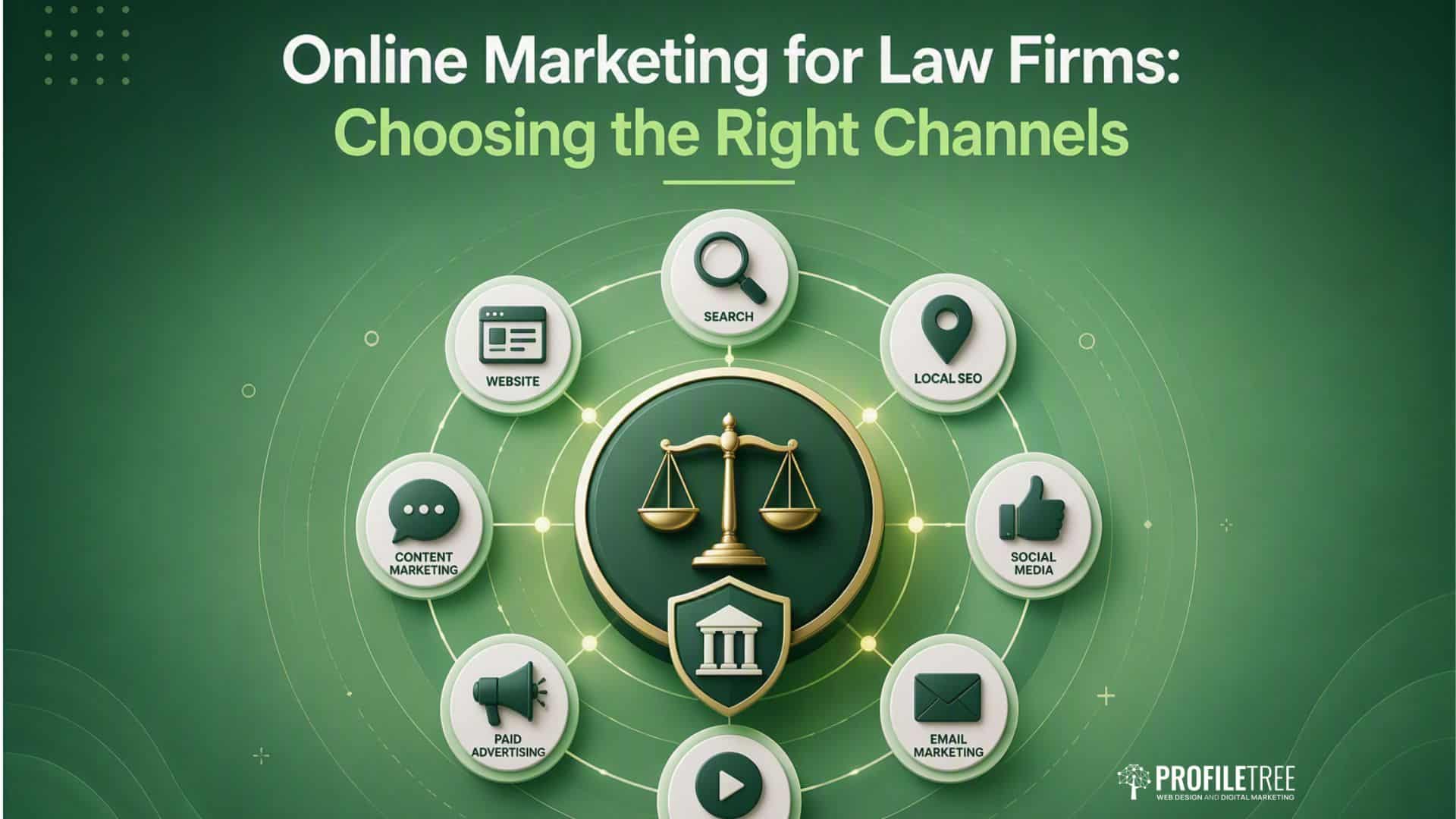
Online marketing for law firms goes wrong most often at the allocation stage, because channel choice follows habit rather than practice area and growth timeline. A conveyancing team chasing volume this quarter and a commercial practice building partner reputation over two years need very different allocations.
Paid Search and Local Services Ads
Google Ads buys immediate visibility, which suits new offices, new practice areas and firms with short-term targets. Legal keywords are among the most expensive in the UK auction, so the discipline matters more than the budget.
Two rules carry most of the value. Send paid traffic to a page built for that specific matter type, never the homepage. And run a negative keyword list from day one, because legal terms attract enormous volumes of research traffic that will never instruct anyone.
Local Services Ads sit above traditional search results and carry a Google Screened badge, which verifies credentials for a regulated profession. That badge does real work. Firms that want to manage this internally often find that digital marketing training for the in-house team pays back faster than a permanent management retainer.
Content That Answers Real Client Questions
Most law firm blogs publish what the firm finds interesting: legislative updates, staff announcements, conference write-ups. Almost nobody searches for those things.
Content that generates enquiries answers the questions clients actually type. “How long does a divorce take in Northern Ireland?” “What does a no-win no-fee solicitor charge?” “Can I sell a house before probate is granted?” Each of those is a page, written in plain English, with a clear route to a consultation at the end.
One practical trap sits inside this work. Illustrating articles with images pulled from a search result creates real exposure, and understanding how non-copyrighted images are actually licensed is cheaper than settling a claim later.
Choosing Social Platforms by Practice Type
Platform choice follows the client, not the trend. LinkedIn is the priority for commercial, employment and corporate practices, where the audience is other professionals and the currency is credibility.
Facebook and Instagram serve consumer-facing work better. Personal injury, family law, residential conveyancing and wills all reach their audiences there, and the targeting supports specific age brackets and postcodes.
Video-led platforms suit firms comfortable putting solicitors on camera, though the compliance review burden rises with the informality of the format. Working through a full list of social media sites against the firm’s actual client base is a faster route to a decision than copying whatever a larger practice is doing.
Video as Proof of Expertise
Text tells a prospective client that a solicitor is experienced. Video shows them.
Short pieces work best: a partner explaining what happens at a first consultation, a two-minute walkthrough of the conveyancing timeline, a plain-English answer to the question the firm gets asked every week. These sit on practice area pages, in Google Business Profile posts, and in social feeds.
Production quality matters less than clarity and accuracy, though poor audio will lose a viewer faster than anything else. Firms without in-house capability can scope this through video production support and reuse a single filming day across a year of content.
Compliance Rules That Shape Legal Digital Marketing
This is the section that generic marketing guides leave out, and for UK and Irish solicitors, it is the one that carries professional consequences. Three regulators cover the islands, and their rules differ enough that a campaign compliant in one jurisdiction can breach another.
| Jurisdiction | Regulator | Key framework | Practical effect on marketing |
|---|---|---|---|
| England and Wales | SRA | SRA Transparency Rules | Mandatory price and service publication for listed practice areas |
| Northern Ireland | Law Society of Northern Ireland | Solicitors (Northern Ireland) Order 1976 | Advertising permitted, must be accurate and not bring the profession into disrepute |
| Republic of Ireland | Law Society of Ireland | Solicitors (Advertising) Regulations 2002, SI 518/2002 | Restrictions on solicitation and on how conditional fee arrangements are described |
SRA Transparency Rules in England and Wales
Since December 2018, firms in England and Wales offering certain services have had to publish price and service information on their websites. The listed areas include residential conveyancing, uncontested probate with UK assets, employment tribunal claims, motoring offences, immigration, excluding asylum, and specified business services such as debt recovery.
Enforcement is active rather than theoretical. The SRA has reported that since May 2023, it has issued hundreds of official warnings and dozens of fixed penalty fines in connection with these rules, following a rolling programme of website checks that prompted changes to over 500 non-compliant sites. The current version of the SRA Transparency Rules sets out exactly what has to appear and where.
Published pricing also tends to help commercially. Visitors who find a clear fee range stay longer and enquire more readily than those who hit a page telling them to call for a quote. The wider principles behind the ethics and legalities of digital marketing point the same way: transparency and commercial performance rarely pull against each other.
Northern Ireland and the Republic of Ireland
Solicitors regulated in Northern Ireland work under a separate framework. Advertising is permitted, but it must be accurate, must not mislead, and must not bring the profession into disrepute.
Irish practices are bound by the Solicitors (Advertising) Regulations 2002, which restrict direct solicitation and place specific limits on how conditional fee arrangements are described. The phrase “no win no fee” needs careful handling on an Irish site in a way it does not in England and Wales.
Cross-border firms carry both burdens at once. A Belfast practice advertising to clients in Great Britain and the Republic should have campaigns reviewed against all three frameworks before launch, because the legal implications of misleading advertising apply on top of professional conduct rules, not instead of them.
Reviews, Testimonials and Client Confidentiality
Reviews are the strongest trust signal a firm can build, and also the easiest place to create a problem.
Three rules keep most firms safe. Never publish anything implying a guaranteed outcome. Never make a comparative claim about success rates against other firms. And never name a client, a matter or an outcome without documented written consent, because confidentiality survives the end of the retainer.
Review requests themselves involve processing personal data, which means a lawful basis and a clear route to opt out. Practices whose staff have completed GDPR training make far fewer errors here than those relying on a policy document nobody has read since induction.
AI-Generated Content and Professional Risk
AI drafting tools are now routine in legal marketing teams. The time saving is real, and so is the exposure.
The specific risk is accuracy. These tools produce fluent, plausible statements that are sometimes wrong, and they are wrong most often on exactly the things law firm content covers: procedural steps, jurisdiction-specific rules and recent legislative change. Published inaccuracy in a firm’s name is a professional problem, not a marketing one.
Treat AI output as a first draft requiring qualified review before publication. The efficiency gain sits in drafting speed, not in removing the review step. Teams should also understand how data rights in AI apply before any client information goes near a general-purpose model.
Practice Areas, Measurement and Delivery Models
Digital marketing for solicitors is not one discipline. The tactics that suit a personal injury practice in Belfast do not suit a commercial firm in Dublin. Getting the allocation right depends on knowing what each practice area needs and then measuring the result honestly.
Priorities by Practice Area
| Practice area | Client urgency | Typical lead time | Primary channel | Supporting channel |
|---|---|---|---|---|
| Personal injury | High | Days | Paid search and local search | Question-led articles |
| Residential conveyancing | Medium | Weeks | Local search | Fee transparency pages |
| Family law | Medium | Weeks to months | Question-led content | Local search |
| Commercial and corporate | Low | Months | Thought leadership and LinkedIn | Sector pages and case studies |
| Wills and probate | Low | Months | Question-led content | Local search and reviews |
Personal injury rewards visibility at the moment of intent, so paid search and map pack presence carry the load. Family law works in the opposite direction, where quiet, empathetic articles reach people researching privately before they are ready to speak to anyone. Commercial practices sit further out still, comparing four or five firms over several weeks.
Consumer-facing practices offering fixed-fee services increasingly take card payments online for wills, powers of attorney and simple conveyancing quotes, which brings online payment security into scope for the marketing site rather than just the accounts system.
The Numbers Partners Should Ask For
Page views, follower counts and impressions tell a partner almost nothing about whether marketing is working. Five figures do.
Cost per instruction is the headline: total spend divided by new matters opened. Cost per qualified enquiry sits underneath it and separates channels producing real work from channels producing time-consuming calls. Website conversion rate matters. Most law firm sites convert below two per cent, and four to six per cent is achievable with better trust signals and clearer routes to contact. An organic position for two or three core terms per practice area shows whether search investment is moving. Review volume and rating feed directly into map pack visibility.
Anything else is context. Third-party traffic estimates in particular deserve scepticism, and the story of Alexa Rank is a useful reminder of how easily a widely quoted metric can turn out to measure nothing useful.
In-House, Agency or Hybrid
Firms end up in one of three models. A dedicated in-house marketing manager gives responsiveness and internal knowledge, but risks becoming reactive without external strategic input. A full agency arrangement brings specialist capability and scale, and depends heavily on the quality of the brief. The hybrid model, where in-house handles brand and communications, nd communications while an agency runs technical search, paid campaigns and content production, tends to suit mid-sized practices best.
For legal work, the choice carries more weight than in most sectors. A generalist supplier unfamiliar with transparency obligations or the difference between the three regulators will create compliance problems alongside the marketing ones. ProfileTree works with professional services firms across Northern Ireland, Ireland and the UK, and the regulatory detail is part of the brief rather than something discovered mid-project. The full range of agency services covers web build, search, content and training under one accountable team.
Belfast has been a centre for industry, business and law for well over two centuries, and the competition among local practices reflects that history. Standing out in that market takes more than a tidy website.
Turning Visibility Into Instructions
Online marketing for law firms works when three things line up: a site that loads fast and answers questions clearly, search visibility in the places clients actually look, and campaigns built to satisfy the regulator as well as the marketing plan. Start with the compliance audit and the technical fixes, then invest in content and paid channels once the foundations hold. Talk to ProfileTree about a digital plan built for your practice areas.
FAQs
How much should a UK law firm spend on marketing?
Published benchmarks vary widely, and no single figure applies to every practice. A more useful approach is working backwards from cost per instruction in each practice area, then setting budget against the matters the firm actually wants to win.
Is SEO or PPC better for solicitors?
Paid search delivers enquiries immediately and stops when the budget stops. Search engine optimisation takes six to twelve months in competitive legal niches and keeps working afterwards. Supposeost firms run both, using paid search to cover new practice areas while organic rankings build.
Does my firm have to publish prices on its website?
If you are regulated by the SRA and offer any of the listed services, yes. The requirement covers areas including residential conveyancing, uncontested probate with UK assets, employment tribunal claims, motoring offences and immigration, excluding asylum. Check the current SRA Transparency Rules for the full list.
Can law firms use AI to write their legal articles?
For first drafts, yes. For publication without review, no. Solicitors remain responsible for everything published in the firm’s name,e regardless of how it was produced, and AI tools are least reliable on procedural and jurisdiction-specific detail.
Which social media platform works best for law firms?
LinkedIn for commercial, corporate and employment practices where the audience is other professionals. Facebook and Instagram for consumer-facing work such as family law, personal injury and residential conveyancing.