
SEO Examples: What Good SEO Looks Like for UK Businesses
Table of Contents
Search engine optimisation can feel abstract until you see what it actually looks like in practice. Knowing that you need keywords, backlinks, and a fast website is one thing. Watching those elements work together on a real page, in a competitive market, with measurable results, is something else entirely.
This guide pulls together real-world SEO examples across the four main disciplines: on-page, technical, local, and off-page. Each example illustrates a specific tactic, explains why it works, and connects back to what you can do on your own site.
ProfileTree, a Belfast-based web design and digital marketing agency, has worked across all four disciplines with SMEs throughout Northern Ireland, Ireland, and the UK. So, where possible, the examples here draw on British and Irish cases rather than the US-dominated brand stories most other guides default to.
The Four Pillars of Search Engine Optimisation
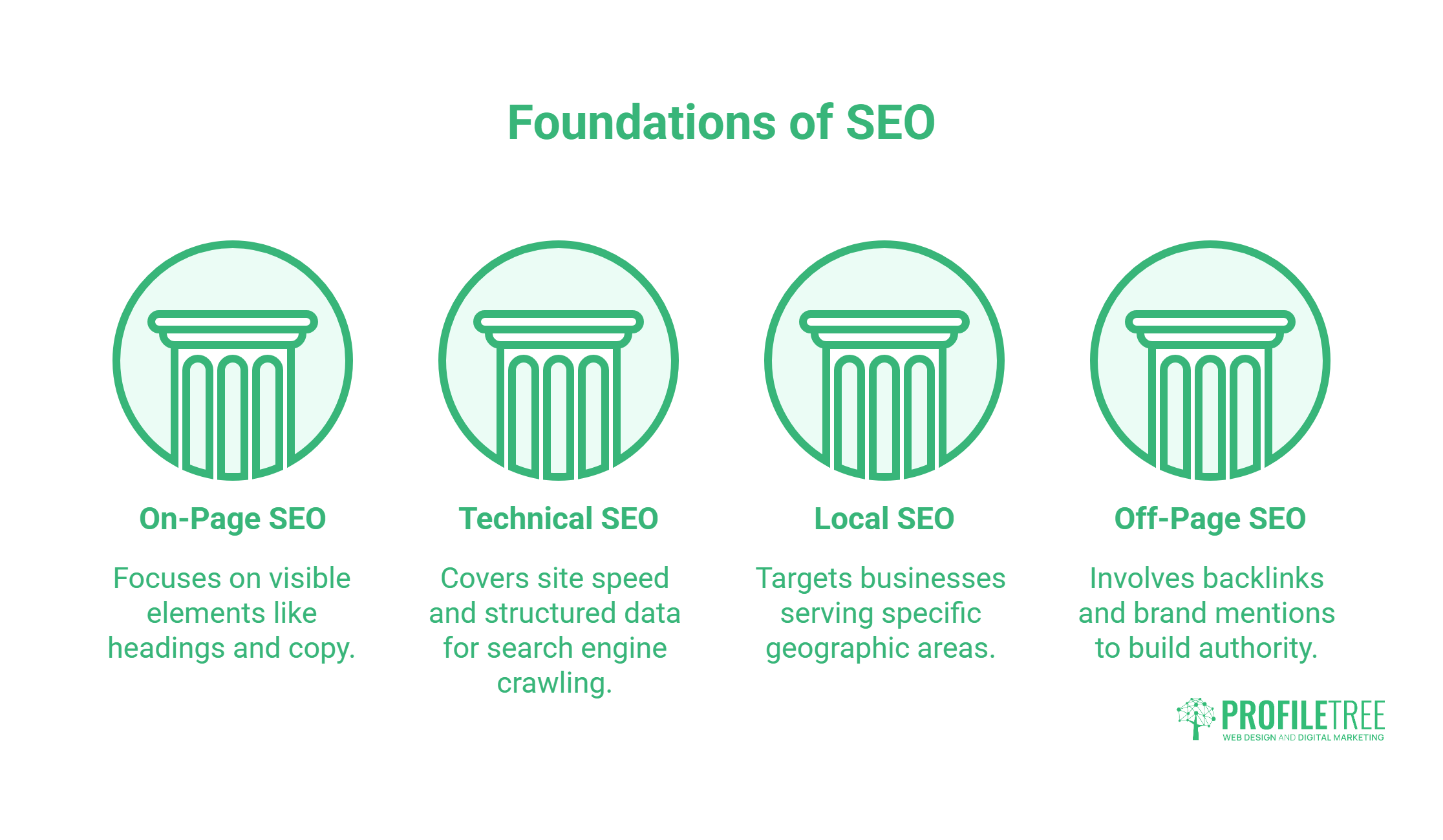
Before working through the examples, it helps to name the four categories that SEO breaks into. Most guides treat them as equal, but in practice they operate at different speeds and require different skills.
On-page SEO covers everything visible on the page itself: headings, copy, keyword placement, internal links, and meta data. It’s the fastest to change and the easiest to measure.
Technical SEO covers how search engines find, crawl, and index your site. This includes site speed, structured data (schema markup), mobile performance, and URL architecture. Changes here take longer to filter through but often produce ranking gains that content alone can’t achieve.
Local SEO applies to businesses that serve a geographic area. It focuses on Google Business Profile, local citations, and location-specific landing pages. For most Belfast and Northern Ireland businesses, this is the highest-return discipline.
Off-page SEO covers everything that happens away from your site: backlinks, brand mentions, and the authority signals that tell search engines other websites trust yours.
Each example below sits within one of these four categories.
On-Page SEO Examples: Content and Structure
On-page SEO is where most businesses start, and where most mistakes happen. The examples here show what good looks like across keyword integration, topic clustering, and content architecture.
Gymshark: Category Pages and Headless Architecture
Gymshark grew from a West Midlands garage operation into one of the UK’s most-visited e-commerce sites by treating category pages as ranking assets rather than navigation shortcuts.
Most online retailers write thin, template-driven category pages. Gymshark invested in page-specific copy, structured heading hierarchies, and internal linking patterns that pull authority through from their strongest product pages to their mid-range ones. Their headless architecture allowed the content and technical layers to be optimised separately, which is why the product pages load quickly without sacrificing the on-page depth that helps them rank for high-intent apparel queries.
The takeaway: if your category or service pages are holding a single H1 and three sentences of description, they’re not ranking pages, they’re navigation pages. These need to be treated as individual ranking targets with their own keyword focus, structured headings, and genuine content.
Patagonia: Keyword Integration in Product Descriptions
Patagonia’s product descriptions work because they’re written for buyers, not for algorithms. When someone searches for “insulated hiking jacket waterproof rating UK,” they want to know exactly what the product offers. Patagonia answers that directly in the product copy, using the specific technical vocabulary buyers actually search for rather than generic adjectives.
This is a form of keyword integration that doesn’t feel like keyword stuffing. The terms appear because they’re the most accurate description of the product. Search engines reward this precision because it matches the specificity of long-tail search queries.
Image alt text follows the same principle. Rather than “jacket image” or a filename like IMG_4521.jpg, descriptive alt text names the product, its key feature, and where relevant the intended use. This creates a secondary keyword signal that most e-commerce sites overlook entirely.
Monzo: Topic Clustering for Transactional Value
Monzo’s content operation is one of the more studied examples of topic clustering in UK digital marketing. Their hub and spoke model organised content around central pillar pages (for example, a detailed guide to business banking) surrounded by spoke pages covering specific subtopics: invoicing for freelancers, business account fees, and sending international payments.
Each spoke page linked back to the pillar and to related spokes, creating an internal linking architecture that distributed authority across the cluster and signalled to search engines that Monzo had depth on this subject, not just a single page.
The commercial effect was that organic traffic to their transactional product pages rose as readers moved through the content cluster. The content wasn’t just educational; it built trust and created a natural path toward account sign-up.
For businesses in Northern Ireland and Ireland, this model works just as well at a smaller scale. A web design agency covering one pillar page on WordPress sites, with supporting pages on speed optimisation, plugin selection, and e-commerce configuration, builds topical authority that a single general page never achieves.
Ahrefs: Strategic Internal Linking
Ahrefs publishes detailed guides on SEO topics and connects them carefully through internal links. The pattern is consistent: when a concept is mentioned in one article, it links to the most authoritative piece on that topic within their site. The anchor text is descriptive and keyword-relevant, not generic.
This creates a network effect. New pages benefit from the authority of established ones. Older pages stay relevant because they’re pointed to from newer content. The site as a whole becomes harder to displace in rankings because the internal architecture reinforces every page’s relevance signal.
The practical version of this for smaller sites is straightforward: every new page you publish should link to your most important service pages using natural anchor text, and your service pages should link back to the content that explains the problems they solve.
Technical SEO Examples: Infrastructure and Markup
Technical SEO is where many businesses lose rankings they should be holding. The examples here cover structured data, programmatic pages, and the kind of infrastructure decisions that affect how search engines process your site.
Jobrapido: Scaled Structured Data
Jobrapido is a job aggregator operating across 58 countries. Their core SEO challenge was getting millions of individual job listings indexed, displayed with rich results, and ranked for specific job title plus location queries.
They solved it with JobPosting schema markup applied at scale. Schema markup is code added to a page that tells search engines exactly what type of content it contains and what its key properties are. For job listings, this communicates the job title, employer, location, salary, and application deadline in a structured format that Google can read directly and display as a rich result in search.
The result was that Jobrapido listings began appearing with enhanced SERP features including star ratings, job details, and direct application links. Organic visibility increased substantially because the listings occupied more visual space in search results.
Here’s what a basic JobPosting schema block looks like in JSON-LD format, which can be placed in the <head> of any relevant page:
{
“@context”: “https://schema.org/”,
“@type”: “JobPosting”,
“title”: “Digital Marketing Manager”,
“description”: “We’re looking for an experienced digital marketing manager…”,
“identifier”: {
“@type”: “PropertyValue”,
“name”: “CompanyName”,
“value”: “12345”
},
“datePosted”: “2026-01-15”,
“validThrough”: “2026-03-01”,
“employmentType”: “FULL_TIME”,
“hiringOrganization”: {
“@type”: “Organization”,
“name”: “Example Company”,
“sameAs”: “https://example.com”
},
“jobLocation”: {
“@type”: “Place”,
“address”: {
“@type”: “PostalAddress”,
“addressLocality”: “Belfast”,
“addressRegion”: “Northern Ireland”,
“addressCountry”: “GB”
}
},
“baseSalary”: {
“@type”: “MonetaryAmount”,
“currency”: “GBP”,
“value”: {
“@type”: “QuantitativeValue”,
“minValue”: 35000,
“maxValue”: 45000,
“unitText”: “YEAR”
}
}
}
You can validate any schema implementation using Google’s Rich Results Test tool before publishing.
Zapier: Programmatic SEO at Scale
Zapier’s most commercially significant SEO investment was building programmatic landing pages for every integration combination in their product. “Connect Slack and Google Sheets,” “Sync HubSpot with Mailchimp,” “Automate Trello and Gmail.” Each combination has its own URL, its own structured page, and its own keyword opportunity.
The database-driven approach meant that as Zapier added new integrations, new ranking pages were created automatically. No individual content team could have produced this volume manually.
Programmatic SEO isn’t only for large technology companies. Any business with consistent structural data, whether property listings, service area pages, or product variants, can apply the same principle at a smaller scale.
ProfileTree has helped clients build location-specific service pages that follow a consistent structure while containing genuinely differentiated local content, which is programmatic thinking applied to a small business context. For businesses exploring what this looks like in practice, ProfileTree’s web design services in Belfast include location page architecture as a standard deliverable.
Taylor Swift’s Official Site: Event Schema for Visual SERPs
This example is cited frequently in SEO discussions because it’s unusually clean. Taylor Swift’s official site implemented Event schema on every concert date, including venue, date, and ticket availability data. The result was rich results in Google showing event cards with structured information directly in search results.
The SEO lesson isn’t about the celebrity. It’s about the principle: when your website contains a specific type of structured information (events, products, recipes, FAQs, reviews), there’s almost always a schema type that makes that information readable to search engines. Most websites contain structured information that hasn’t been marked up, which means they’re missing rich result opportunities.
FAQ schema is particularly relevant for service businesses. Marking up a frequently asked questions section with FAQPage schema gives Google the option to display individual questions and answers directly in search results, which can significantly increase click-through rates.
Local SEO Examples: Mapping and Regional Dominance
For businesses in Belfast, Northern Ireland, and across the UK and Ireland, local SEO is often the highest-impact discipline. The examples here cover both the infrastructure decisions and the content strategies that drive map pack visibility.
Domino’s: Local Schema and Map Pack Capture
Domino’s ranks in the map pack for “pizza delivery near me” in effectively every town and city they operate in across the UK. The technical foundation behind this is a combination of consistent NAP data (Name, Address, Phone Number) across every directory and citation site, a well-optimised Google Business Profile for each location, and LocalBusiness schema markup on each store page.
What makes the Domino’s example instructive isn’t the scale. It’s the consistency. Every location page has the same structured data. Every Google Business Profile has complete information. Every citation across Yelp, Bing Places, and local directories uses identical NAP data. Search engines weight consistency heavily in local rankings because it signals that the business information is accurate and trustworthy.
For a Belfast restaurant, accountancy firm, or tradesperson, the same principles apply. A complete, verified Google Business Profile with regular posts, photos, and review responses is the single most impactful local SEO investment most small businesses can make.
Simon Roofing: Multi-Location Landing Pages
Simon Roofing operates across the United States and has built a location page for every city and region they serve. Each page targets a specific geographic query (“roofing contractor [city]”), contains genuinely localised content about the local climate’s impact on roofing materials, and includes locally relevant proof points.
The key SEO decision was building unique content for each location rather than swapping a city name across a template. Search engines penalise near-duplicate location pages, and the penalty compounds across a large set of locations. Simon Roofing avoided this by treating each location page as a genuine content investment.
For Northern Ireland businesses serving multiple towns, this matters. A web design service covering Belfast, Derry, and Newry shouldn’t create three identical pages with swapped city names. Each page needs unique content, local references, and a genuine connection to what makes that market different.
ProfileTree’s own location-specific pages for web design and SEO services across Northern Ireland and Ireland follow this principle: each page addresses the specific business environment, funding conditions, and competitive pressures in that area rather than applying a uniform template.
Off-Page SEO Examples: Authority and Link Building
Off-page SEO is about the trust signals that originate away from your website. Links from relevant, authoritative sites remain the strongest signal, but brand mentions, PR coverage, and strategic partnerships all contribute to the authority profile search engines use to rank your pages.
Canva: User-Generated Resources and Natural Link Acquisition
Canva built a free design tool and a vast library of templates, both of which attracted natural links from bloggers, educators, and content creators who recommended the tool to their audiences. The product itself was the link acquisition strategy.
Not every business can build a product that attracts links organically, but the principle scales. Free audit tools, downloadable checklists, original research, and genuinely useful guides all attract links from sites that wouldn’t link to a standard service page. ProfileTree’s content marketing services are built around this principle: creating resource-grade content that earns citation and links rather than relying solely on outreach.
Lectric eBike: Competitor Round-Up Backlinks
Lectric eBike achieved substantial link growth by appearing in “best e-bikes under $1,000” round-ups and comparison articles. Their strategy was to be link-worthy by offering a genuinely competitive product at an accessible price point, which made them a natural inclusion in comparison content.
The SEO lesson is that links come from being citation-worthy. In many competitive UK markets, the fastest way to earn relevant backlinks is to produce a piece of content or a piece of research that comparison sites, trade publications, and industry bloggers will naturally want to reference.
AI-Proof SEO: Optimising for AI Overviews and Answer Engines
One of the fastest-shifting parts of search right now is how Google’s AI Overviews and tools like Perplexity and Gemini select content to cite. This is sometimes called AEO (Answer Engine Optimisation), and it requires a slightly different structural approach from traditional SEO.
Cleveland Clinic: Structured Medical Definitions
Cleveland Clinic’s pages are among the most frequently cited health sources in Google AI Overviews. The structural reason for this is consistent: their pages lead with a direct, definition-style answer to the question the page targets. The first paragraph is almost always a clear, factual statement in 40 to 60 words that stands on its own.
AI systems extract these answer blocks because they’re self-contained and directly address the query. Pages that bury the answer in their third paragraph, or that start with a generic introduction before getting to the point, are less likely to be cited.
The practical change for any website is to apply BLUF (Bottom Line Up Front) structuring to every major page section. Start each H2 with a direct answer to the question that heading implies, then provide the supporting detail. This serves human readers and AI citation systems simultaneously.
Monzo: Conversational Query Capture
Monzo’s content team writes for the questions people actually type, not keyword-first abstractions. “Can I use my Monzo card abroad?” gets a direct answer in plain language before the page elaborates on fees and limits. “What happens if I go overdrawn?” is answered in the first two sentences of the relevant page.
This conversational structure captures voice search traffic and AI citation traffic alongside traditional organic search. As search behaviour shifts toward longer, more question-like queries, pages structured around direct answers to specific questions are better positioned than pages optimised for short, generic keyword phrases.
The structural marker that correlates most strongly with AI citation is a 40 to 60 word answer block at the start of each section, written in plain language with the key fact or recommendation stated first.
SEO Content Writing: A Before and After Example
One of the most-asked questions in SEO is what optimised content actually looks like compared to unoptimised content. Here’s a direct comparison using a web design scenario.
Before (unoptimised):
“We are a web design company that provides services to businesses of all sizes. Our team is passionate about creating beautiful websites. We have many years of experience working with clients across various industries.”
After (optimised):
“ProfileTree designs WordPress websites for SMEs in Belfast and across Northern Ireland. Projects typically run four to eight weeks, depending on the number of pages and whether e-commerce functionality is needed. Our team has completed over 1,000 projects since 2011.”
The optimised version includes the specific service (WordPress websites), the audience (SMEs), the location (Belfast, Northern Ireland), a practical detail that matches buyer queries (project timelines), and a verifiable proof point (project count). Each of these elements corresponds to something buyers actually search for.
This is what SEO content writing means in practice: writing copy that is simultaneously useful to a reader and structured to match the way buyers search.
The SEO Execution Matrix
The table below maps each example in this guide to its SEO pillar, the specific tactic used, and the primary commercial outcome.
| Brand | SEO Pillar | Tactic | Primary Outcome |
| Gymshark | On-page | Category page depth and heading architecture | Higher-intent apparel rankings |
| Patagonia | On-page | Product keyword integration and alt text | Long-tail product page visibility |
| Monzo | On-page | Topic cluster architecture | Organic path to transactional pages |
| Ahrefs | On-page | Strategic internal linking | Site-wide authority distribution |
| Jobrapido | Technical | JobPosting schema at scale | Rich results and expanded SERP presence |
| Zapier | Technical | Programmatic landing pages | Long-tail query capture at volume |
| Taylor Swift | Technical | Event schema | Enhanced SERP features |
| Domino’s | Local | NAP consistency and GBP optimisation | Map pack visibility across locations |
| Simon Roofing | Local | Differentiated multi-location pages | Geographic query coverage |
| Canva | Off-page | Free tool as natural link magnet | Diverse, high-authority backlink profile |
| Lectric eBike | Off-page | Inclusion in comparison round-ups | Relevant contextual backlinks |
| Cleveland Clinic | AI/AEO | Direct answer structure | AI Overview citations |
| Monzo | AI/AEO | Conversational H3 architecture | Voice and AI citation traffic |
SEO Tools You Can Use Today
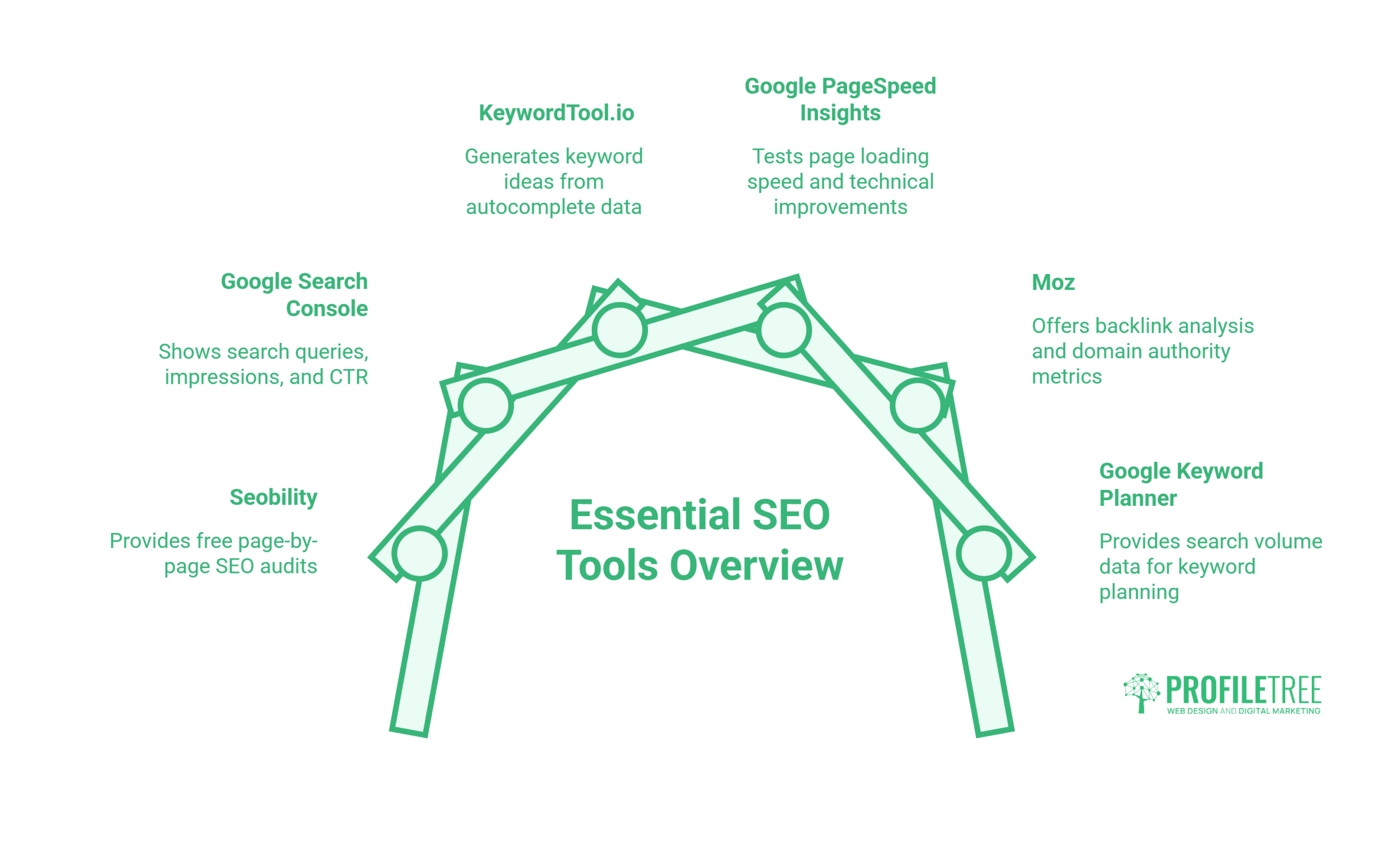
The examples above describe what brands achieved. These tools help you replicate the approach on your own site.
Seobility: Audit Any Page in Under a Minute
Seobility provides a free page-by-page SEO audit. Paste in a URL and it returns a structured analysis covering meta titles, descriptions, headings, crawlability, and image alt text. The traffic-light scoring system (red, yellow, green) makes it straightforward to prioritise fixes. It analyses one page at a time, so work through your most commercially important pages first.
Google Search Console: See Your Site Through Google’s Eyes
Google Search Console shows you the queries your site currently ranks for, which pages receive impressions, and where your click-through rates have room to improve. It’s the most direct signal you have of what search engines already think about your content. For any page with high impressions and low clicks, the solution is usually a more compelling meta title and description.
KeywordTool.io: Find the Questions Your Buyers Are Asking
KeywordTool.io generates keyword ideas from Google’s autocomplete data. The free version returns keyword suggestions grouped by question type (who, what, when, how), which is useful for FAQ planning and identifying conversational queries your content should address.
Google PageSpeed Insights: Fix the Speed Issues Holding You Back
Google PageSpeed Insights tests your page loading speed on mobile and desktop and returns a prioritised list of technical improvements. Core Web Vitals are now a confirmed ranking factor, and pages that fail the mobile performance threshold consistently underperform against equally relevant pages that load faster.
Moz: Understand Who Links to You and Why
Moz provides backlink analysis, domain authority metrics, and competitor link profiles. For businesses exploring link building, it’s useful for identifying which sites link to competitors but not yet to you.
Google Keyword Planner: Match Content to Search Volume
Google Keyword Planner offers search volume data grouped by keyword and seasonality. It’s primarily built for paid advertising, but the search volume data is directly relevant to organic SEO planning.
These tools work best in combination. Seobility and Search Console address on-page and crawl issues. PageSpeed Insights covers technical performance. Moz and Keyword Planner inform strategy and opportunity identification.
WordPress SEO Plugins
For businesses running WordPress, which accounts for a substantial portion of SME websites in Northern Ireland and the UK, two plugins dominate the SEO optimisation workflow.
Yoast SEO: The Most Widely Used Starting Point
Yoast SEO is the most widely installed SEO plugin. It adds a panel to every post and page editor showing a live preview of how your title and meta description will appear in search results, a readability analysis, and a basic keyword optimisation check. The free version generates an XML sitemap automatically and identifies missing or over-length meta descriptions. The premium version adds redirect management and internal linking suggestions.
Rank Math: More Features Free Than Most Paid Alternatives
Rank Math has grown rapidly as an alternative to Yoast. Its free version includes features that Yoast reserves for paid tiers, including keyword density tracking and redirect management. The scoring interface breaks down into Basic SEO, Additional Errors, Title Readability, and Content Readability, with question marks beside each recommendation linking to relevant documentation. For SEO beginners, the guided approach makes it easier to understand why each change matters.
Both plugins complement rather than replace the need to understand SEO principles. A plugin can tell you that your meta description is too short; it can’t tell you whether your content genuinely addresses the search intent behind your target keyword. ProfileTree’s digital training programmes cover both the technical and strategic dimensions for business owners who want to manage their own SEO confidently.
“The businesses we see gaining ground in search are the ones treating SEO as an ongoing investment rather than a one-time setup,” says Ciaran Connolly, founder of ProfileTree. “A plugin gives you the checklist. Understanding what good looks like on each point is what separates sites that improve from sites that stay static.”
Frequently Asked Questions
What is a simple example of SEO?
Writing a blog post titled “Web Design Services Belfast” that includes the phrase “web design services in Belfast” in the H1 heading, opening paragraph, and one subheading, with an internal link to the relevant service page, is a basic on-page SEO example. The page is built around a specific search query and structured to give search engines a clear signal about what it covers and for whom.
What is an example of SEO content writing?
SEO content writing means structuring copy to match how buyers search, not just how a business wants to describe itself. An optimised service page for a Belfast accountancy firm would lead with the specific service and location (“Corporation tax returns for limited companies in Northern Ireland”), include the practical detail buyers look for (timelines, fees, what’s included), and use the natural language of the target audience rather than formal accounting terminology throughout. Keywords appear because they’re the most accurate description, not because they’ve been inserted at a target density.
What are technical SEO examples?
Technical SEO includes: XML sitemaps submitted to Google Search Console so all your pages are discoverable; SSL certificates ensuring your site loads on HTTPS; schema markup adding structured data to pages containing products, events, FAQs, or local business information; page speed optimisation compressing images and reducing render-blocking scripts; and canonical tags preventing duplicate content issues when multiple URLs serve similar content.
How does programmatic SEO work?
Programmatic SEO uses databases to generate large numbers of structured pages targeting specific search query combinations. Zapier, for example, has a landing page for every integration between software products on their platform. Tripadvisor generates individual pages for “hotels in [city]” across thousands of cities. For small businesses, the programmatic approach applies at a smaller scale: generating location pages for each service area, or product pages for each product variant, using a consistent template with genuinely differentiated content per page.
What is an example of local SEO?
A Belfast plumber optimising for local search would: claim and complete their Google Business Profile with accurate opening hours, service areas, and photos; collect Google reviews and respond to each one; make certain their business name, address, and phone number are identical across their website, Yelp, Yell, and local directory listings; and create a service page targeting “emergency plumber Belfast” with locally specific content rather than a generic services description.
What is Answer Engine Optimisation (AEO)?
Answer Engine Optimisation structures content so it can be extracted and cited by AI systems like Google AI Overviews, Perplexity, and Gemini. The key structural requirement is a direct, concise answer (40 to 60 words) at the start of each major section before supporting detail is added. Pages that begin sections with background context rather than direct answers are less likely to be cited. AEO and traditional SEO aren’t in conflict: the structural clarity that helps AI citation also improves human readability and traditional organic rankings.
If you’re running a WordPress site and looking at how your current SEO compares against competitors in your market, ProfileTree’s SEO services for Northern Ireland businesses include a technical audit that covers all four disciplines outlined in this guide.