
Recovering from SEO Penalties: Diagnosis and Restoration Blueprint
Table of Contents
A sudden drop in organic traffic is one of the worst things a website owner can wake up to. Rankings that took months to build can vanish overnight, and recovering from SEO penalties is rarely as simple as flipping a switch. Before you can fix the problem, you need to know exactly what you’re dealing with: a manual penalty issued by a human reviewer at Google, or an algorithmic devaluation triggered by an automated quality filter.
At ProfileTree, a Belfast-based web design and digital marketing agency, the team has audited SME sites across Northern Ireland, Ireland, and the UK, where traffic losses traced back to exactly these two scenarios. The diagnosis stage is where most businesses lose time, jumping straight into fixes without confirming which type of issue they’re dealing with.
This guide walks through both scenarios with a clear, practical workflow. You’ll learn how to diagnose the type of SEO penalty affecting your site, what steps to take for each recovery path, and how to manage expectations honestly so you’re not chasing a baseline that no longer exists. UK-based businesses will also find guidance on a regulatory angle that most recovery guides completely ignore.
Manual Action vs. Algorithmic Drop: The Critical Diagnosis
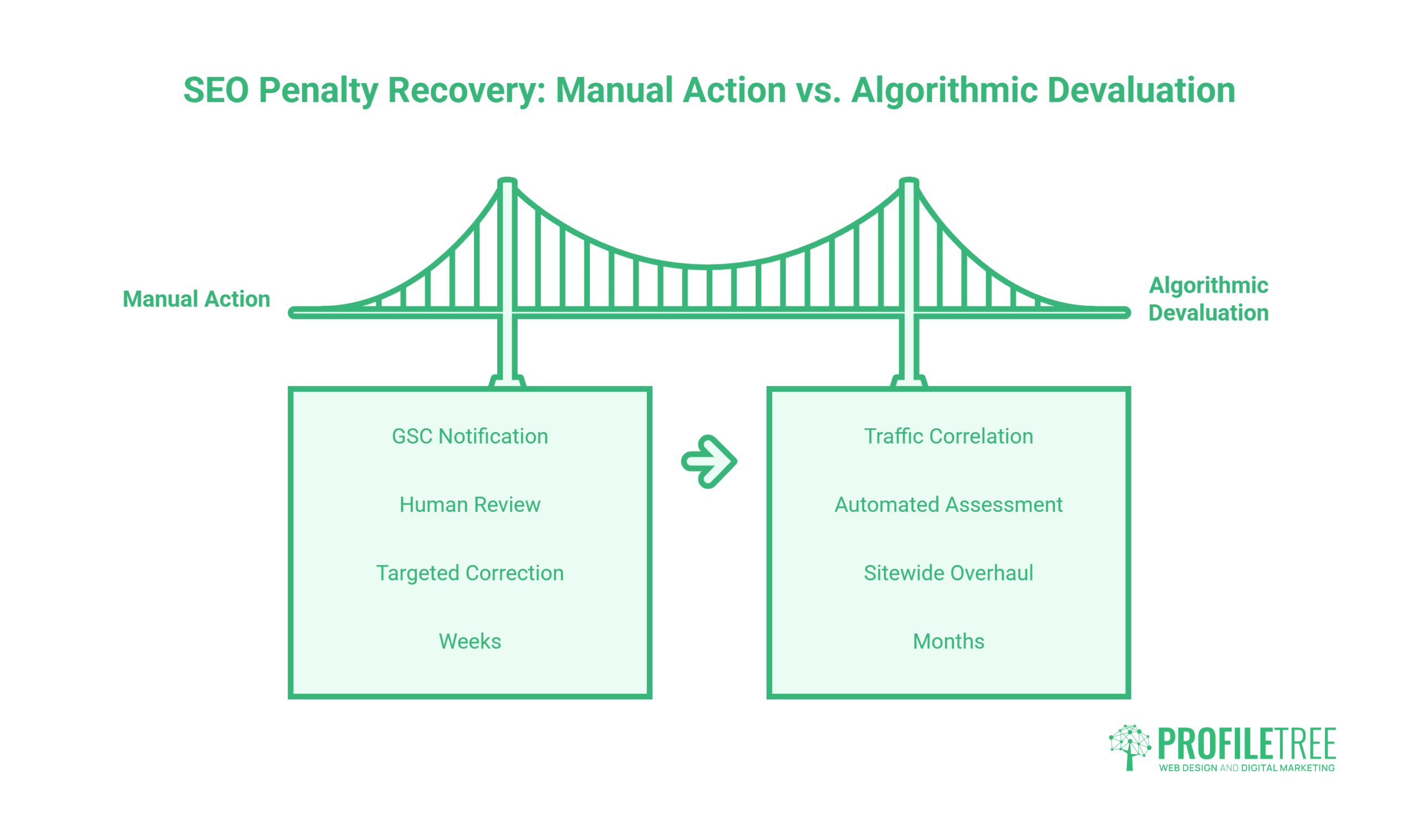
Getting the diagnosis right is the most important step in SEO penalty recovery. The two types of issue look similar on the surface (traffic down, rankings gone) but require completely different responses. Treating an algorithmic devaluation like a manual penalty wastes weeks and achieves nothing.
Checking for a Manual Action in Google Search Console
Log in to Google Search Console and go to Security & Manual Actions, then Manual Actions. If Google’s webspam team has reviewed your site and found a violation, you’ll see a notification here with a description of the specific issue: unnatural inbound links, thin content with little or no added value, pure spam, and so on.
Manual actions come with a notification. That’s actually useful: you know exactly what you’re being penalised for and you can take targeted corrective steps. Pages without a manual action notification in Google Search Console have not received a manual penalty, regardless of how far their traffic has dropped.
Identifying an Algorithmic Devaluation
If Google Search Console shows no manual action but your organic traffic has fallen sharply, you’re likely looking at an algorithmic adjustment. Open Google Analytics and plot the traffic drop against a timeline of confirmed Google core updates. Sites hit by a Core Update or the Helpful Content system tend to see a cliff-like drop that coincides almost exactly with a known update date.
Algorithmic devaluations are harder to fix because there’s no specific notification, no checklist of violations, and no reconsideration request you can submit. Google’s systems have assessed the quality, helpfulness, and trustworthiness of your site and downgraded it accordingly. The fix is a sitewide quality overhaul, not a targeted patch.
| Factor | Manual Action | Algorithmic Devaluation |
| Detection | Google Search Console notification in Manual Actions tab | Traffic drop aligned with update date |
| Cause | Human reviewer finds guideline violation | Automated quality signal assessment |
| Recovery process | Fix issue, submit reconsideration request | Sitewide content and UX quality improvement |
| Timeline | Weeks after reconsideration approval | Months; next major core update cycle |
| Reconsideration request | Required | Not applicable |
The Step-by-Step Manual Penalty Recovery Playbook
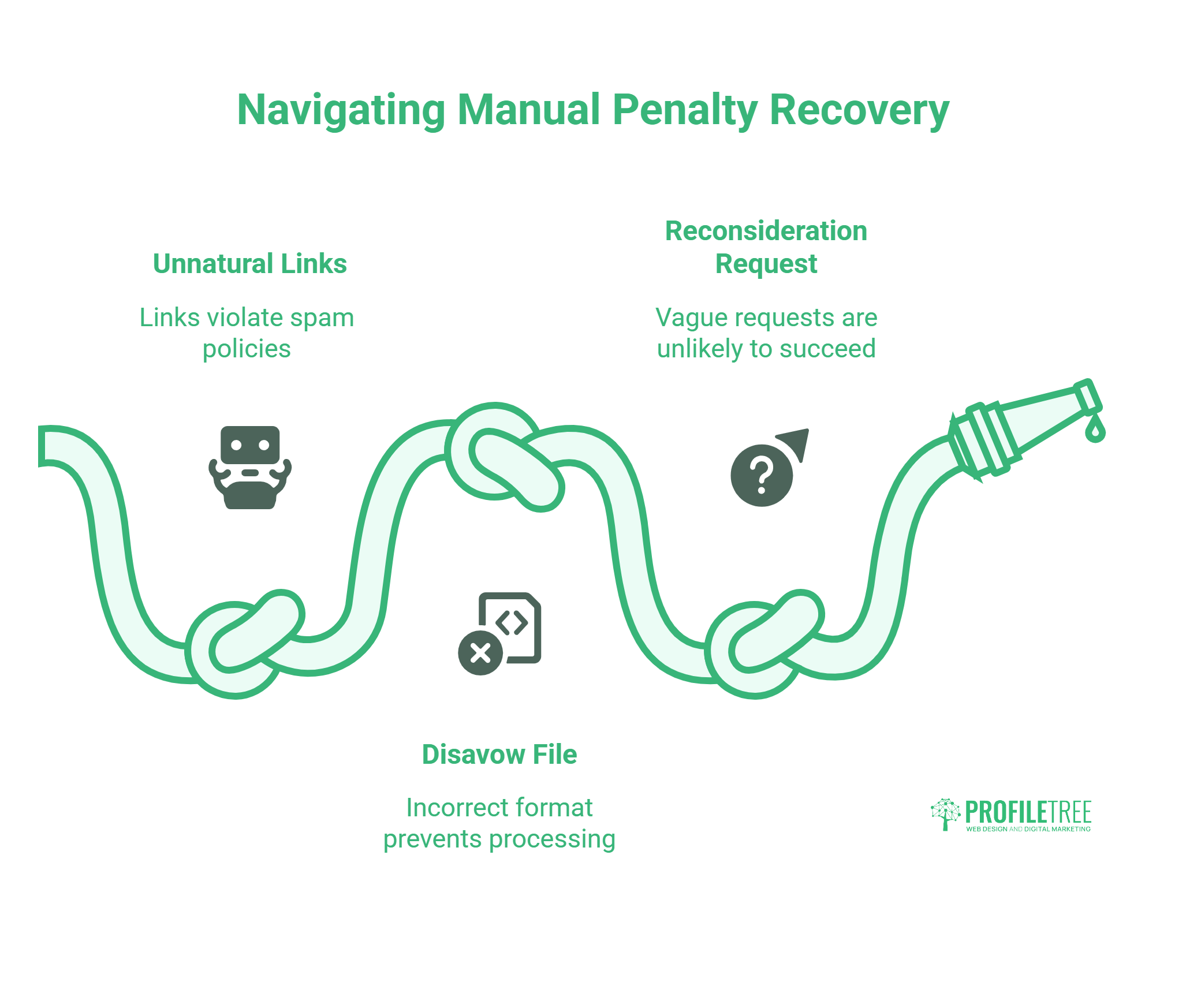
If Google Search Console has confirmed a manual action, the path to SEO penalty recovery is structured and concrete. It takes work, but the steps are clear.
Auditing Your Backlink Profile for Unnatural Links
The most common cause of manual penalties is an unnatural link profile: links built through private blog networks, bulk directory submissions, paid schemes, or link exchanges that violate Google’s spam policies. Start by exporting your full backlink profile from Google Search Console (Links report) and cross-referencing it with a tool like Ahrefs or Semrush.
Look for patterns: a high proportion of exact-match anchor text, links from sites with no topical relevance, links from known link farms, and domains that appear to be created purely to sell links. Group the toxic links by domain so you can assess the scale before deciding whether to contact webmasters or go straight to the disavow file.
For a professional technical SEO audit of your backlink profile, ProfileTree works through this process systematically with clients across Northern Ireland and the wider UK.
How to Correctly Draft and Format a Disavow File
Attempt manual removal first. Email the site owners of the most harmful linking domains and request removal. Document every outreach attempt: the date, the contact used, and whether you received a response. Google expects to see evidence of this effort in your reconsideration request.
For links where removal isn’t possible or where the webmaster doesn’t respond, compile a disavow file. The format must be exact, or Google won’t process it correctly:
# Disavow file for profiletree.com – [date]
# These domains were identified as unnatural, and outreach was unsuccessful
domain:spammy-link-farm.com
domain:low-quality-directory.net
https://specific-page-only.com/bad-link-page/
Use domain: to disavow all links from an entire domain, or list individual URLs if only one or two pages on an otherwise legitimate site are the problem. Do not disavow legitimate links: a link from a real local business or industry publication should never appear in your disavow file.
Upload the completed file via Google’s Disavow Tool in Search Console.
Writing a Reconsideration Request That Google Actually Approves
Google’s manual review team wants to see accountability, not excuses. A reconsideration request that blames the previous SEO agency, claims ignorance, or is vague about what was fixed is unlikely to succeed.
Your request should cover: what the problem was, how it happened, what you’ve done to fix it (with evidence), and what you’ve put in place to prevent recurrence. Attach or reference your outreach documentation and your disavow file.
“When writing a reconsideration request, the tone that works is matter-of-fact and evidence-led,” says Ciaran Connolly, founder of ProfileTree, a Belfast-based digital marketing agency. “Reviewers are looking for a clear paper trail that shows you understood the problem, took genuine steps to fix it, and aren’t going to do it again. Defensive or vague requests sit in a queue a long time.”
Once submitted, Google typically responds within three to six weeks, though complex cases can take longer. If the request is denied, the response will explain why, and you can address any remaining issues before resubmitting.
The Algorithmic Drop Recovery Framework
Recovering from an algorithmic devaluation is slower and less predictable than recovering from a manual penalty, but the underlying logic is consistent: Google downgraded your site because it assessed the quality signal as insufficient. You need to raise that quality signal across the board.
Deconstructing the Modern Helpful Content Quality Filter
Google’s Helpful Content system, now integrated permanently into its core ranking infrastructure, evaluates whether content was created primarily to serve users or to rank. The signals it uses include whether the content demonstrates genuine expertise, whether it covers a topic with enough depth to be genuinely useful, and whether the site as a whole has a clear purpose and audience.
Sites that published large volumes of lightly edited AI content, generic informational articles with no unique angle, or “best X” listicles without real evaluative criteria took significant hits in the January 2026 core update. Impressions collapsed on these content types by 95% or more across many domains.
The following Google Search Console data for an article illustrates the position well: 312 impressions over six months with no clicks and an average position of 48 indicates the page has some relevance signal but doesn’t yet have the depth or authority to earn rankings. That’s fixable, but it requires genuine content investment.
Auditing, Pruning, and Rewriting Low-Value Content
Start with a full content audit of your site. Export every indexed URL from Google Search Console and sort by impressions. Pages with zero impressions and zero clicks over 12 months are candidates for either improvement or removal. Don’t remove them impulsively: check for inbound links first, and check whether they serve internal linking purposes.
For each underperforming page, ask three questions:
- Does it cover the topic with genuine depth?
- Does it include original insights, real examples, or first-hand expertise that competitors don’t have?
- Does it clearly serve a specific audience?
If the answer to all three is no, the page is a drag on your site’s quality signal.
Options for weak content: rewrite it with genuine depth and original angle, consolidate it into a stronger related page, or remove it with a 301 redirect to the most relevant live page. For sites that published large volumes of thin AI content, aggressive pruning often produces faster algorithmic recovery than attempting to upgrade every page.
ProfileTree’s content strategy services include full content audits for SMEs dealing with post-update traffic declines, combining Google Search Console data analysis with live page quality assessment.
Resolving UX and Technical Issues
Algorithmic quality filters also weigh user experience signals. Intrusive interstitials (pop-ups that block content on mobile), poor Core Web Vitals scores, slow page load times, and cluttered ad layouts all contribute negatively to how Google assesses page quality.
Run a Core Web Vitals report in Google Search Console and address any pages flagged with poor scores. For most SME sites, the biggest wins come from image compression, reducing third-party script load, and ensuring mobile layouts are clean. These aren’t glamorous fixes, but they deliver real results for quality signals.
The UK and European Regulatory Angle: CMA Compliance
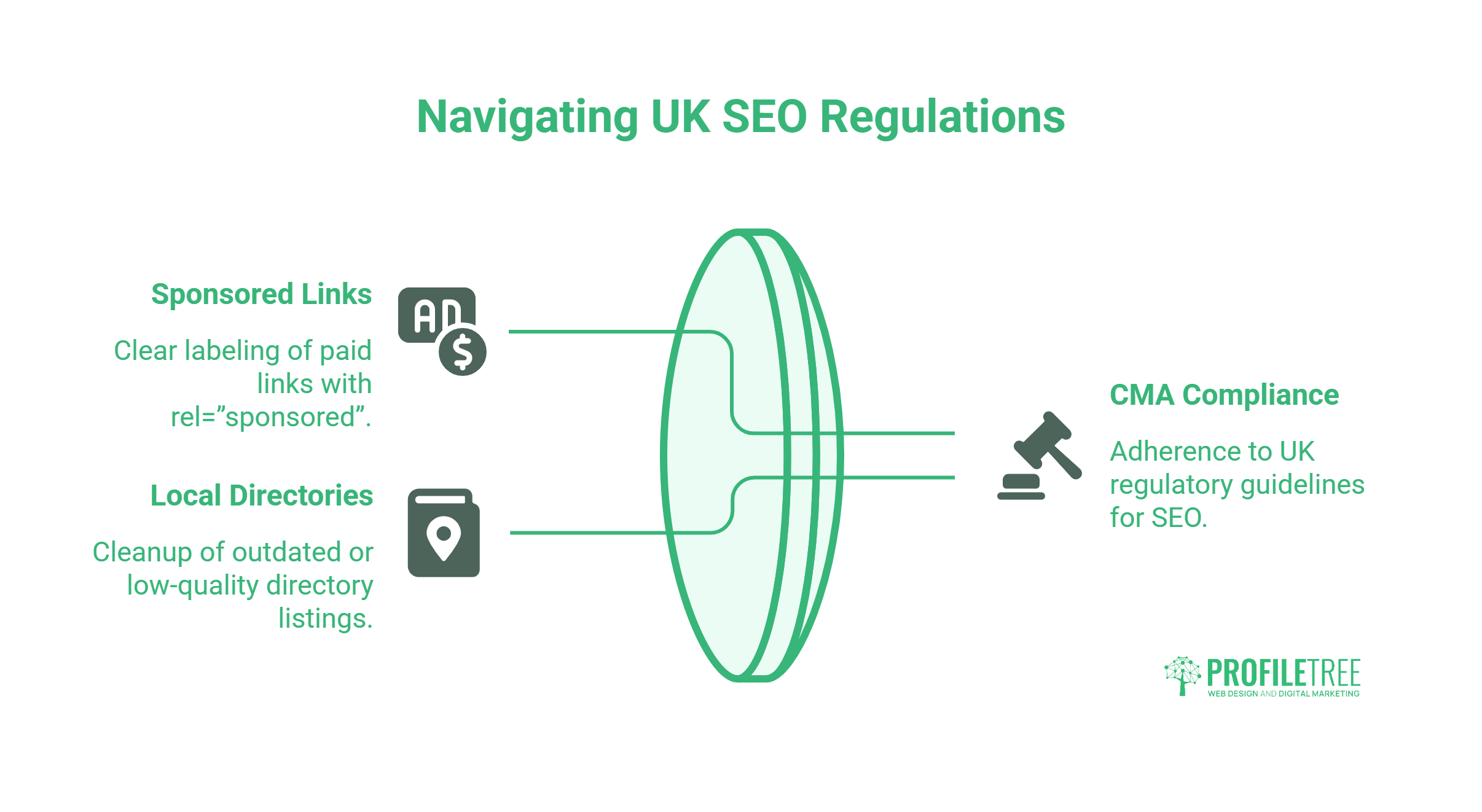
Most SEO penalty guides are written for a US audience and skip entirely over regional regulatory risks. For UK-based businesses, this is a genuine blind spot that can create both legal and SEO exposure.
Sponsored Links and the rel=”sponsored” Tag Mandate
The UK Competition and Markets Authority (CMA) requires that paid or incentivised promotional content, including paid guest posts and sponsored directory listings, must be clearly disclosed. Failure to label outbound paid links correctly with the rel=”sponsored” attribute can put you in violation of both CMA guidelines and Google’s spam policies simultaneously: a double exposure.
If your site has purchased guest post placements on UK regional news sites, local directories, or industry publications without labelling those links correctly, you’re carrying two separate risks. Auditing your outbound paid link profile and updating link attributes is a relatively quick fix, but it requires knowing which links were paid placements in the first place.
| Link Type | Required HTML Attribute | UK Regulatory Risk if Missing |
| Standard editorial link | None (dofollow) | Low |
| Paid advertorial or guest post | rel=”sponsored” | High |
| User-generated content | rel=”ugc” | Medium |
| Affiliate link | rel=”nofollow sponsored” | High |
Local Directory Cleanup and Regional Citation Risks
Northern Irish and Irish businesses often have citation profiles built up through regional directories that have since declined in quality or been sold to link farms. A citation that was legitimate five years ago may now point to a domain that Google flags as low-quality or manipulative.
Run a citation audit using a tool like BrightLocal to identify the full range of directories where your NAP (name, address, phone) data appears. Look for inconsistent citations (wrong address formats, outdated phone numbers) and flag any directories that have been acquired or downgraded since the citation was placed. ProfileTree’s local SEO services include citation audits for clients across Belfast, Northern Ireland, and the Republic of Ireland.
Managing Expectations: The Reality of Full Traffic Recovery
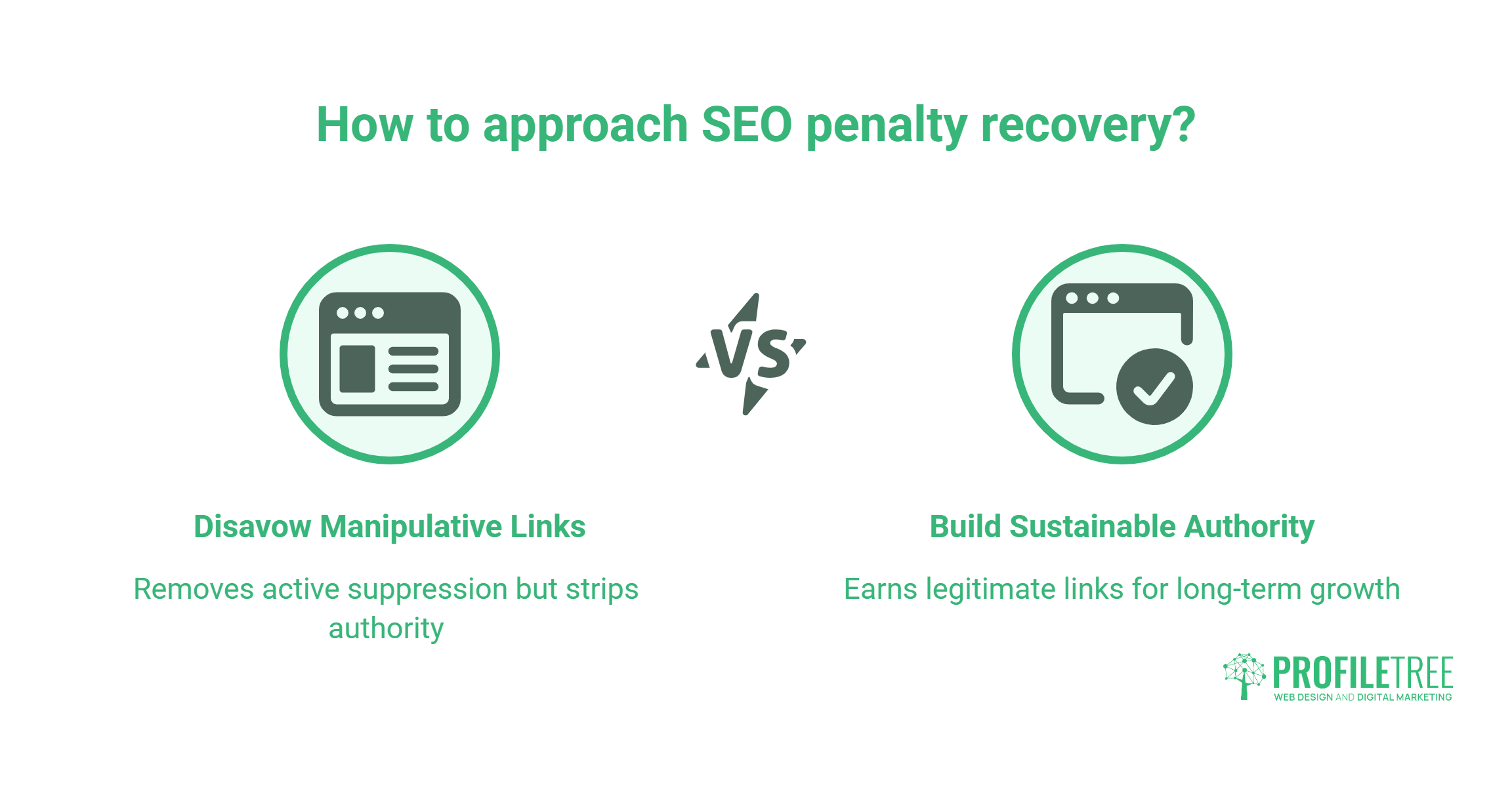
This is the section most guides get wrong. The honest answer to “will I get my traffic back?” is: it depends on where that traffic came from in the first place.
The Lost Link-Equity Deficit
If your site previously ranked because of a strong backlink profile, and a significant portion of those links were manipulative (paid placements, private blog networks, reciprocal link schemes), then disavowing those links removes Google’s active suppression of your site. That’s positive; however, it also strips away the authority those links provided.
The maths is uncomfortable: if 60% of your domain authority was built on links you now need to disavow, lifting the SEO penalty won’t return you to 60% of your previous traffic. You’ll recover from active suppression, but you won’t recover the ranking positions that were built on artificial authority. Those positions have to be re-earned with legitimate links.
This is not a reason not to disavow. Carrying a manual penalty while hoping the traffic returns is worse. But it is a reason to plan for a sustained link-building programme alongside any SEO penalty recovery work.
Rebuilding with Sustainable Authority
White-hat link acquisition takes longer and costs more than shortcuts, but it compounds rather than creating liability. Earned links from digital PR (appearing in industry publications, comment pieces in regional media, data-driven research that earns citations), guest content on genuine editorial sites, and directory listings in real curated resources all build authority that won’t need to be disavowed.
For SMEs in Northern Ireland and across the UK, ProfileTree’s digital marketing services include link-building programmes that focus on editorial coverage, regional press, and industry associations relevant to each client’s sector.
Preventing Future Search Performance Declines
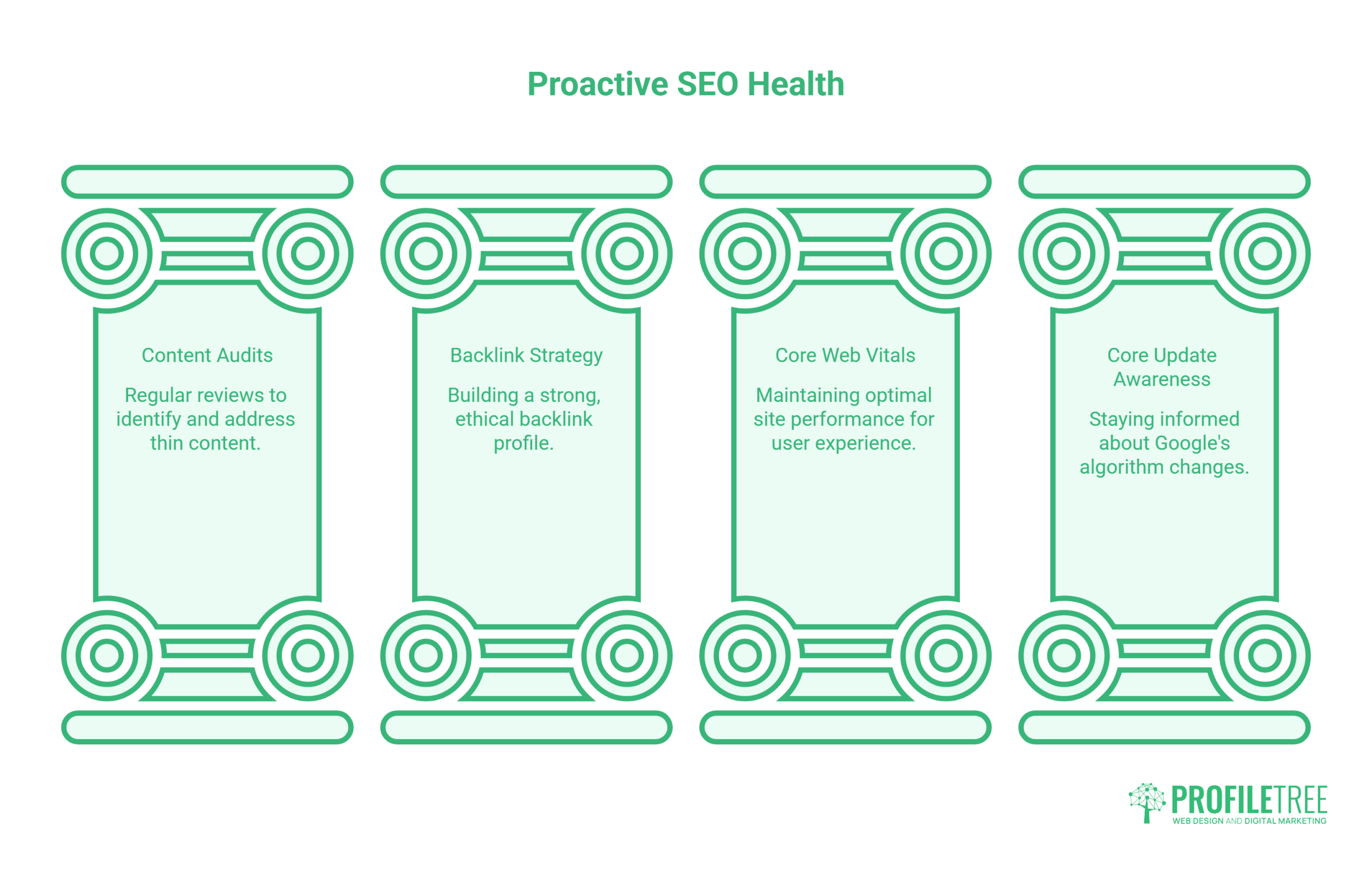
The best SEO penalty recovery strategy is one you never need to use. A few operational habits can significantly reduce your exposure.
Conduct regular content audits at least twice a year. Export all indexed URLs, sort by impressions, and identify pages that are declining before they become a drag on your site’s quality signal. Act on thin content early, before it triggers a broader quality assessment.
Build your backlink profile conservatively. Every link that originates from a paid scheme, a low-quality directory, or a reciprocal arrangement is a future liability. The effort of outreach for genuine editorial links pays dividends in stability.
Keep Core Web Vitals in good shape. Performance isn’t just a user experience issue; it’s a quality signal that feeds into how Google’s systems assess your pages.
Stay informed about core update timelines. When Google announces or confirms a core update, cross-reference your traffic data immediately. Early diagnosis means faster response.
Summary and Next Steps
Recovering from SEO penalties requires an accurate diagnosis before anything else. Manual actions and algorithmic devaluations need different responses, and conflating them wastes time. For manual penalties, fix the specific violation, document your efforts, and submit a reconsideration request. For algorithmic drops, audit your content quality and UX signals across the whole site and plan for a recovery cycle that aligns with Google’s update schedule.
UK businesses face an additional layer of exposure from undisclosed paid links: review your outbound link attributes against CMA guidelines and Google’s sponsored links requirements. Wherever your recovery takes you, set realistic expectations about traffic baselines, particularly if your previous rankings were built on links you now need to disavow.
Stop Guessing, Start Recovering!
Traffic drops are stressful, and the longer an SEO penalty goes unaddressed, the harder the recovery. Whether you’ve spotted a manual action notification in Google Search Console or you’re watching organic sessions fall with no clear explanation, the right next step is a proper diagnosis before anything else.
ProfileTree’s team has worked through SEO penalty recovery and content quality overhauls with SMEs across Belfast, Northern Ireland, and the wider UK. If you’d like a straight answer about what’s happening with your site and a clear plan for fixing it, request a free SEO consultation today, and a member of the team will be in touch within one business day.
FAQs About Recovering From SEO Penalties
What is the main difference between a manual action and an algorithmic devaluation?
A manual action is issued by a human reviewer at Google who has assessed your site against Google’s spam policies. It shows up as a notification in Google Search Console’s Manual Actions tab and explains what the violation is. You can fix the issue and submit a reconsideration request. An algorithmic devaluation is an automated quality assessment: Google’s systems have determined that your content, link profile, or user experience falls below the threshold for the rankings your site previously held. There is no notification, no reconsideration request, and no shortcut. Recovery requires a genuine improvement in sitewide quality and patience through the next core update cycle.
How do I know if my site has been penalised by Google?
Check the Manual Actions tab under Security & Manual Actions in Google Search Console first. If it’s clear, open Google Analytics and look at your organic traffic timeline. A sudden, steep drop that coincides with a confirmed Google core update date points to algorithmic devaluation rather than a manual SEO penalty.
How long does it take to recover from an SEO penalty?
For manual actions, Google typically responds to reconsideration requests within three to six weeks. For algorithmic devaluations, recovery is slower: your site’s quality improvements need to be recrawled, re-evaluated, and compared against competitors, which often means waiting for the next major Core Update or Helpful Content system refresh. That can take anywhere from two months to over a year, depending on the severity of the issues and the speed of your remediation.
Can a website fully recover to its previous traffic level?
Yes, but with a significant caveat. Lifting a manual SEO penalty stops Google’s active suppression of your site. Recovering from an algorithmic drop returns your pages to fair consideration in the ranking process. However, if your previous traffic was partly driven by manipulative links that you’ve since disavowed, or by content types (mass-produced listicles, thin AI content) that Google now actively downgrades, you’re not returning to the same baseline. The traffic those signals generated has to be replaced with traffic earned through genuine authority and quality content.
Will disavowing links immediately fix my rankings?
No. Disavowing links is processed after Google recrawls the affected URLs, which takes time. More importantly, disavowing only addresses manual link penalties. For modern algorithmic drops, disavowing links rarely triggers recovery unless the specific issue is egregious, manipulative link spam. Algorithmic recovery requires improving the quality of your site across the board, not just cleaning up your backlink profile.
Does AI-generated content trigger a Google SEO penalty?
Google doesn’t penalise content simply for being AI-generated. The issue is quality and helpfulness. Mass-produced AI content that lacks original insight, genuine expertise, or a specific audience purpose fails Google’s Helpful Content criteria. Sites that published large volumes of this content saw algorithmic devaluations in the 2024 and 2026 Core Updates: not because the content was produced by AI, but because it failed to meet the standard of genuine helpfulness. Well-researched, expert-reviewed content produced with AI assistance and properly edited for accuracy and originality does not carry the same risk.
What is an seo penalty audit, and when should I commission one?
An SEO penalty audit is a structured assessment of your site’s backlink profile, content quality, technical health, and compliance with Google’s guidelines. It identifies whether a manual action or algorithmic issue is present, what the likely causes are, and what remediation steps are needed. Commission one any time you see an unexplained traffic drop, before launching a new link-building campaign, or as part of an annual site health review. For businesses in Ireland and Northern Ireland, ProfileTree offers seo penalty audit services as part of its technical SEO work.