
Google Business Profile Statistics: What Your Data Tells You
Table of Contents
Google My Business statistics (now called Google Business Profile performance data) are among the most underused tools available to small and medium-sized businesses in the UK and Ireland. Most business owners check that their profile exists, upload a few photos, and leave the data untouched. That is a missed opportunity.
Your Google Business Profile generates a performance report showing exactly how customers find you, what they do when they arrive, and whether your profile is working hard enough to compete in local search. Reading that data correctly is the first step toward improving your ranking on Google Maps, driving more traffic to your website, and converting profile views into genuine enquiries.
This guide explains what each metric means, what action it suggests, and when the data indicates a problem that requires more than a profile update to fix.
What is Google Business Profile Performance Data?
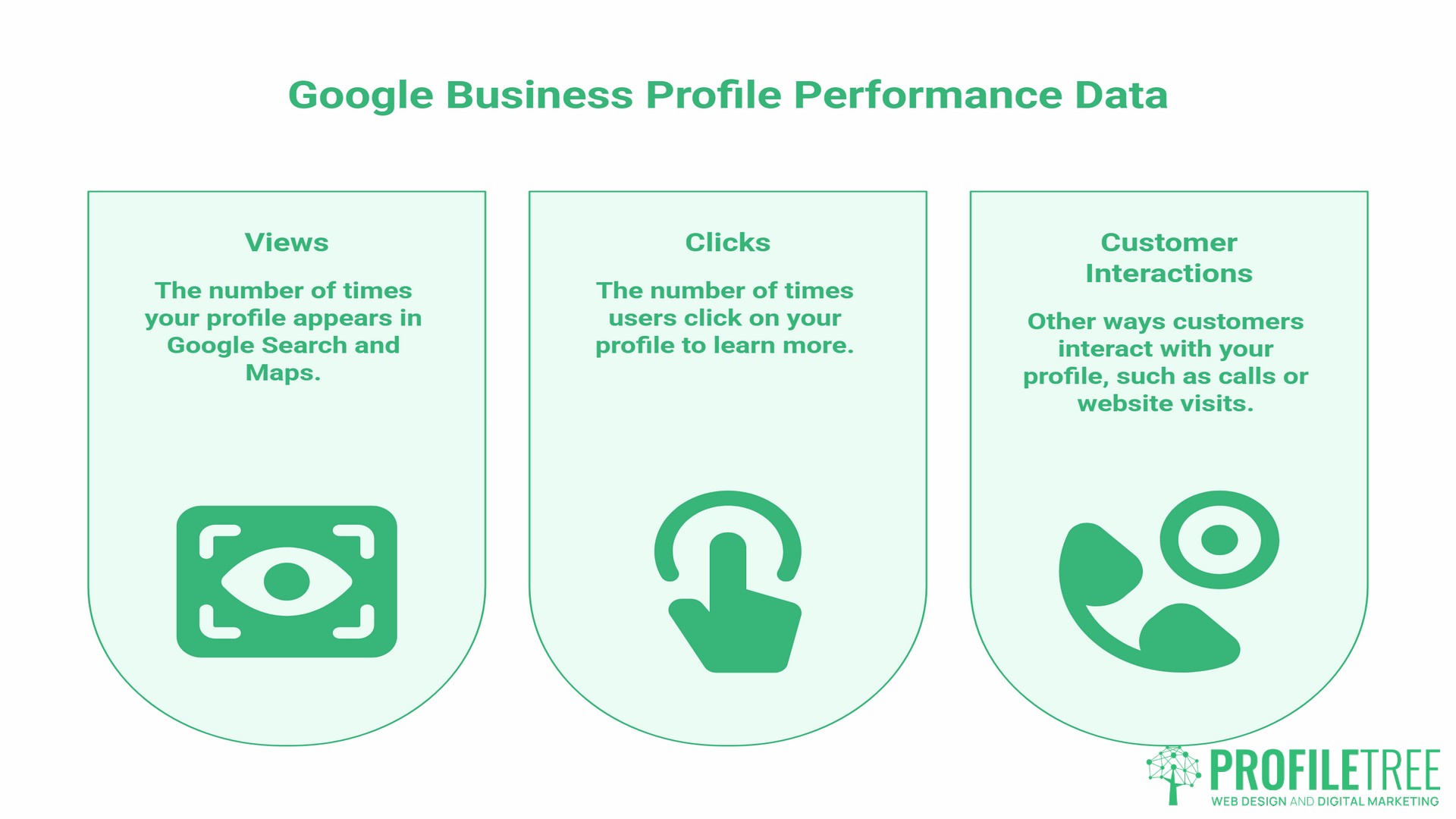
When Google rebranded Google My Business as Google Business Profile in late 2021, it also restructured the insights dashboard. The old “Insights” tab was replaced with a “Performance” report that breaks down how users interact with your listing across both Google Search and Google Maps.
This performance data is the Google My Business statistics layer that tells you the story behind your visibility. A profile can appear thousands of times a month and still generate almost no calls or website visits. Understanding why requires reading each metric individually and in context.
Business Profile owners and managers can check the number of views, clicks, and other customer interactions with their profile on Search and Maps, and can use this performance information to track how popular their business is with customers. The data covers a rolling six-month window. If you are not exporting it monthly, you will lose older records. Setting up a simple monthly export to a spreadsheet is one of the most cost-effective habits any SME can build into its marketing routine.
How to Access Your Performance Report
To find your Google Business Profile performance data, go to your Business Profile and click Performance. At the top, select a time period for your report. On mobile, open the Google Maps app, tap Business at the bottom right, and select “See more” next to Performance.
Alternatively, visit business.google.com, select your location, and open the Performance section from the left-hand menu. Multi-location businesses will need to switch between individual profiles or use the bulk dashboard.
To access your data in a spreadsheet, you can download your Business Profile performance data. For any business that wants to track trends over time, monthly exports into a consistent spreadsheet are the most reliable approach, as the dashboard only displays a six-month window.
Decoding Your Google My Business Statistics
The Performance dashboard organises your Google My Business data into several distinct metric groups. Each one tells you something different about where your profile is succeeding and where it is falling short.
Search Type: How Customers Find You
The Searches section shows how customers found your profile: via direct search (they searched your business name), discovery search (they found you through a category, product, or service query), or branded search (they searched a brand related to your business).
Discovery searches are the growth metric. A high ratio of Direct searches suggests your existing customers can find you, but new customers are not discovering you through category searches. The average SMB receives 1,009 searches per month through their Google Business Profile, of which 228 are direct views and 781 are discovery views, according to BrightLocal research. For most SMEs, increasing Discovery search visibility is the goal, driven primarily by category selection, keyword-rich service descriptions, and consistent Google Posts activity.
Customer Interactions: What They Do Next
The interactions report shows the total number of times users took an action on your profile: calls (the number of times a customer clicked the call button), website clicks (the number of times people clicked the website link), messages (the number of conversations through messages), and bookings (the number of bookings completed through a booking provider).
This is the most commercially significant set of Google Business Profile metrics because it connects visibility to intent.
| Metric | What it measures | What a low number suggests |
|---|---|---|
| Calls | Users who tapped your phone number | Weak call-to-action, poor visibility for high-intent searches |
| Direction requests | Users who asked for navigation to your location | Low local foot traffic intent or weak Google Maps ranking |
| Website clicks | Users who clicked through to your site | Profile content does not match website expectations |
| Messages | Users who opened the messaging function | Feature may be disabled or response time is poor |
| Bookings | Users who booked through the profile | Booking integration not set up or service type mismatch |
Direction requests are particularly valuable for hospitality, retail, and trades businesses. A high number of direction requests from a specific area can confirm where your physical customers are coming from, which in turn informs where it makes sense to run paid local campaigns or distribute print materials.
According to BrightLocal and Google research, 56% of all actions on Google Business Profiles are website visits, making it the largest single action category. This means GBP optimisation drives traffic to your website directly.
Search Terms: The Keyword Intelligence Layer
The Searches section of the Performance report shows the search terms people used to find your business. This is one of the most overlooked pieces of Google My Business data. It shows the actual phrases users typed when Google showed your profile, giving you direct insight into the language your target customers use.
A trades business in Belfast might find that searches for “emergency plumber Belfast” surface the profile regularly, while searches for “bathroom installation Belfast” return nothing. That gap identifies an opportunity: update the services section and post content using that language, and the profile becomes visible for a broader set of commercial searches.
The same principle applies to website content. If your Google Business Profile search terms report shows consistent searches for a service you offer but do not currently rank for, that is a strong signal to create or expand a page on your website. This is how ProfileTree approaches local SEO strategy for clients: profile data and site content work together, informing each other. Learn more about how search data drives content decisions in our guide to Google Analytics for content marketing.
Photo Views: The First Impression Metric
Photo views show how many times your profile images have been seen. Profiles with photos get 35% more clicks to their website, and businesses with more than 100 photos receive significantly more phone calls and direction requests than the average business, according to Google data. If your photo views are low relative to your profile views, it usually means the images are outdated or the profile isn’t appearing in enough visual searches on Maps.
For businesses in food, hospitality, retail, or any service with a physical environment, original, well-lit on-site images will outperform stock photography. Google recommends uploading at least three photos per category.
Google Reviews: The Metric That Pays the Bills
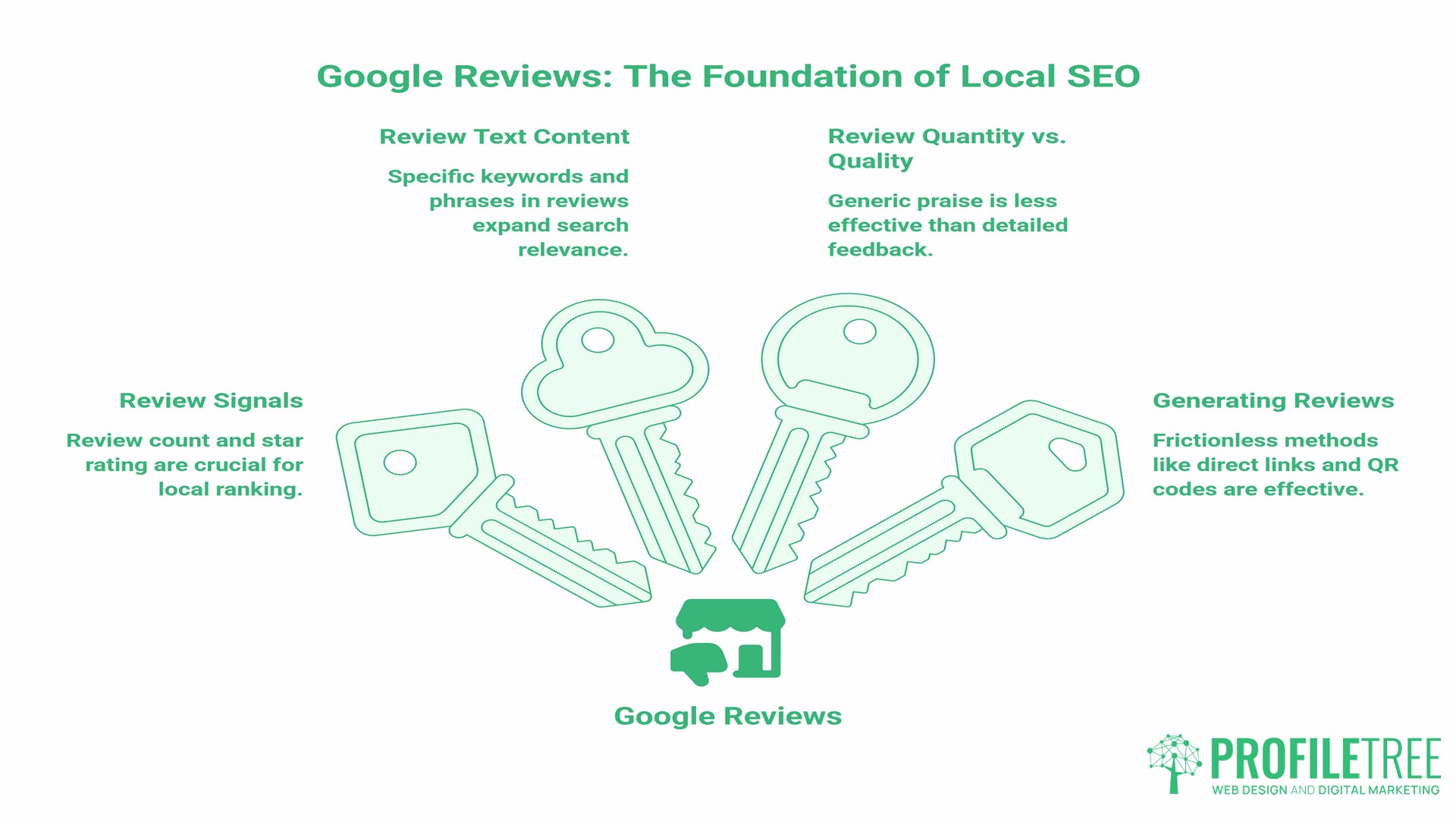
Review count and average star rating are among the most significant signals in Google’s local ranking algorithm. Review signals account for up to 17% of local pack ranking weight, with volume, velocity, recency, star rating, and review text content all contributing directly to ranking position.
When customers use specific service terms, product names, or location references in their review text, Google indexes that language and uses it to expand the range of searches your profile is considered relevant for. A Belfast joinery business whose customers frequently mention “fitted wardrobes” or “bespoke kitchen units” in their reviews will begin appearing in searches for those specific phrases, driven by the language customers use rather than anything the business owner has written themselves.
Review quantity alone does not drive local SEO ranking. Google analyses context, keywords, and sentiment depth within reviews. Generic praise provides weaker signals than detailed, service-specific feedback.
Practical Ways to Generate More Reviews
Asking for reviews is permitted under Google’s guidelines, provided you do not offer incentives in exchange. The most effective approach is to make the process as frictionless as possible.
A direct review link is the single most effective tool. From your Google Business Profile dashboard, select “Get more reviews” to generate a short link you can share by text, email, or WhatsApp. Sending this within 24 to 48 hours of a completed job or purchase produces significantly better response rates than bulk requests sent weeks later.
If you use email marketing to stay in touch with customers, including a review request in your post-purchase sequence is a natural fit. ProfileTree’s content marketing approach treats this as part of a joined-up customer communication strategy rather than a standalone ask.
For businesses with physical premises, a QR code printed on receipts, packaging, or a counter card gives customers an immediate route to leave feedback without needing to search for the profile manually.
Turning Data into Local SEO Actions
Reading your Google My Business statistics is the easier half of the work. The more valuable skill is knowing what each pattern means and what to change in response.
- High profile views, low interactions: Your profile is appearing in searches but not prompting action. Review your primary category, opening hours, and the first few images. Ensure your phone number and website link are correct and visible. If these are all in order, the issue is more likely competitive: other profiles in the same category are better optimised and capturing the click.
- High website clicks, low conversions: This is a web design problem, not a profile problem. Users are arriving at your site from the profile and leaving without enquiring. The page they land on needs to match what the profile promises, load quickly, and present a clear next step. This is one of the clearest cases where profile data and web design are directly connected.
- Search terms showing categories you do not rank for: Add the missing service or category language to your services section, post about it using Google Posts, and ensure the corresponding page on your website covers the topic in depth.
- Direction requests from unexpected areas: If you are seeing a concentration of direction requests from a town or area you did not expect, that is a signal to investigate whether local demand justifies a dedicated location page on your website.
As Ciaran Connolly, founder of ProfileTree, puts it: “High numbers do not always mean high profits. A profile with 5,000 views and 10 calls is underperforming. What matters is the quality and volume of interactions relative to your market, not the view count in isolation.”
The 15-minute monthly audit below gives SMEs a structured way to act on this data without it becoming a full-time task.
The 15-Minute Monthly Audit
- Export your performance data as a CSV and note month-on-month changes in calls, direction requests, and website clicks.
- Review your search terms report. Identify any new phrases appearing that you are not currently targeting in your services section or website.
- Check your review count and average score. If either has dropped, prioritise sending review request links to recent customers.
- Review photo views. If they are declining, upload two or three new images from your premises or recent work.
- Check your message response time if you have the function enabled. Replying to reviews within 24 hours signals to Google that the business is active and managed, which is treated as a positive ranking signal.
For businesses managing multiple locations, this process compounds quickly. ProfileTree’s AI tools for Google My Business optimisation article explains how automation is making multi-location management more manageable.
Troubleshooting: When Your Data Looks Wrong
- Data showing zero for recent days: There is a standard processing delay for Google Business Profile performance data. Google notes that performance data can take time to process, so recent days may show incomplete figures. If a longer gap appears, check whether your profile has been flagged, suspended, or if a recent change to your business information triggered a review.
- Performance data disappearing after a profile edit: Editing your business name, category, or address can trigger a re-verification process. During this period, some performance data may be temporarily unavailable. Avoid making multiple significant changes at once, and keep a copy of your most recent CSV export before editing.
- Discrepancy between GBP data and Google Analytics: Google Business Profile metrics measure interactions on the profile itself. Google Analytics measures website sessions. A user who calls you directly from the profile will appear in your calls data but not in GA4, because they never visited the site. The relationship between GBP and your website is complementary: GBP drives discovery and first contact (call, direction request, website click), while your website converts that interest into a lead or sale. These two data sources measure different parts of the same customer journey and should be read together. Our Google Analytics for content marketing guide explains how to connect these data sources effectively.
- Six months is the limit: You can set a date range to track your Business Profile performance over a period of time, but the dashboard only displays a six-month window. If you want to track trends over a longer period, export monthly and store the data externally.
- UK bank holidays and seasonal events: Performance data will naturally shift around bank holidays, school holidays, and seasonal closures. August and the Christmas period both produce patterns that can look like a decline but are simply seasonal. Compare the same month year-on-year where possible, rather than month-on-month across a seasonal boundary.
When to Bring in Professional Help
Monitoring your Google My Business statistics and making incremental changes is something most business owners can manage independently, especially with structured training. ProfileTree’s digital training programme covers Google Business Profile management alongside wider local SEO skills, giving in-house teams the tools to manage their own optimisation.
For businesses with complex data patterns that are losing ground to competitors in local pack rankings or that manage more than one location, the volume of work required can exceed what a business owner can handle without dedicated support.
The clearest signal that professional local SEO help is needed is when profile views are high, but interactions remain stubbornly low across multiple months, despite internal changes. At that point, the issue is typically competitive optimisation: other businesses in your category are being managed more aggressively, and the gap requires a more systematic response than monthly audits can provide.
ProfileTree works with SMEs across Northern Ireland, Ireland, and the UK on local SEO strategy, including Google Business Profile optimisation as part of broader search visibility campaigns. If your Google My Business data is pointing to problems you cannot resolve with the steps above, get in touch with the team to discuss what the numbers are telling you.
Frequently Asked Questions
How far back can I see Google Business Profile performance data?
The Performance dashboard shows a rolling six-month window. Data beyond that point is not accessible through the interface. To retain longer-term records, export your data as a CSV each month and store it in a spreadsheet. This gives you a year-on-year comparison that the dashboard cannot provide.
What is the difference between Views and Impressions in Google Business Profile?
Google Business Profile reports show views on both Google Search and Google Maps as separate data points. Views and Impressions refer to the same underlying metric: the number of times your profile appeared in results. The terminology shifted when Google transitioned from the old Insights interface to the Performance report. Both describe profile visibility rather than interactions.
Why does my Google Business Profile data show zero for certain days?
Google processes performance data over time, so recent data may not yet be reflected in the dashboard. If a longer period appears blank, check for profile verification issues, recent edits that triggered a review, or category changes that temporarily affect data collection.
Can I see exactly which keywords customers typed to find my profile?
Yes: the Searches section of the Performance report shows the search terms people used to find your business. However, it does not show every query or include individual click and impression volumes for each term. For deeper keyword analysis, cross-referencing with Google Search Console data from your website gives a more complete picture.
How do I download or export my Google Business Profile performance report?
To access your data in a spreadsheet, you can download your Business Profile performance data from the Performance tab. Select your date range, then use the download option to export as a CSV. For multi-location accounts, each location must be exported separately via the standard dashboard.
Why is my GBP performance data different from my Google Analytics data?
The two tools measure different things. GBP drives discovery and first contact, such as calls, direction requests, and website clicks. Your website converts that interest into a lead or sale. A customer who calls directly from your profile will appear in GBP interaction data but will not create a session in GA4. Neither source alone gives the complete picture.
How do I get more Google reviews?
Generate a direct review link from the “Get more reviews” button in your GBP dashboard and send it to customers after a completed sale or service. Consistency matters: a steady flow of reviews over time signals ongoing customer satisfaction more effectively than a large number of reviews in a short burst. Responding to every review within 24 to 48 hours, with personalised rather than templated responses, also supports your profile’s standing. Do not offer discounts or gifts in exchange for reviews, as this violates Google’s review policies.