
On-Page vs Off-Page SEO: Building a Balanced Strategy
Table of Contents
Most search visibility problems come down to a single imbalance: a business pours months into one side of SEO and barely touches the other. On-Page vs Off-Page SEO is not a choice between two tactics. It is the difference between proving your relevance to a search engine and proving your reputation to the wider web. Get the split wrong and even excellent content sits on page eight, or strong backlinks point at pages that fail to convert. This guide explains what each side actually does, how they feed AI-driven search, and how to decide where your first chunk of time or budget should go. The framework is built for UK businesses weighing limited resources against competitive search results.
On-Page vs Off-Page SEO Explained
On-Page vs Off-Page SEO describes the two halves of search optimisation that work on different things. On-page covers everything you control inside your own website: content, headings, internal links, page speed, and structured data. Off-page covers the signals built outside your site: backlinks, brand mentions, reviews, and citations. Search engines need both to rank a page well, because one proves the page answers the query and the other proves the wider web trusts the source.
What On-Page SEO Covers
On-page SEO is the work you can change today without anyone else’s cooperation. That includes the words on the page, the way headings are structured, the title tag and meta description, image alt text, internal linking, and the technical health of the page. Because you control these elements directly, on-page is usually where a new site should start. You cannot earn a reputation for a page that loads slowly or answers the wrong question.
What Off-Page SEO Covers
Off-page SEO is the part you influence rather than control. A backlink from a respected industry publication, a positive Google review, a mention in a regional newspaper, or a listing in a relevant directory all tell search engines that other people find your business credible. You can earn these signals, but you cannot simply set them. That dependence on third parties is what makes off-page slower and harder to scale than on-page.
Why the Distinction Is Blurring
The clean line between the two halves is softening. A brand mention with no link still carries weight as an entity signal, sitting somewhere between on-page and off-page. AI search systems read your on-page structure to decide what your business is, then weigh off-page signals to decide whether to recommend it. Treating On-Page vs Off-Page SEO as one connected system, rather than two separate projects, is closer to how search now works.
On-Page SEO: The Variables You Control
On-page SEO gives you the fastest feedback loop in search because nothing depends on outside parties. Every fix, from a rewritten title tag to a faster-loading image, lands the moment you publish. For a new or struggling site, this is where the first 80% of effort usually belongs. The sections below break the work into the parts that move rankings most.
Content That Matches Search Intent
Strong on-page SEO starts with content that answers the exact question a searcher typed. Keyword density stopped mattering years ago; intent is the metric now. Map every page to one of four intents: informational (“how to claim R&D tax credits”), navigational (“HMRC login”), commercial investigation (“CRM for UK SMEs”), or transactional (“buy EV charger UK”). A page that tries to serve all four usually serves none. Matching content to intent is the foundation of any search engine optimisation programme, and it is also where a sound digital marketing strategy begins. UK terminology matters too, since “flat” rather than “apartment” or “labour” rather than “labor” keeps a British audience reading instead of bouncing.
Title Tags, Meta Descriptions, and Headings
Each page needs a unique title tag under roughly 60 characters that front-loads its main topic. Meta descriptions, around 150 to 160 characters, do not rank a page directly but lift click-through rates when they read like a useful answer rather than filler. Headings then carry the structure: one H1 for the main topic, H2s for major sections, and H3s for the detail underneath. Clear heading hierarchy helps both readers skimming on a phone and AI systems extracting a self-contained answer. Getting these basics right is core to good website design work.
Internal Linking and Site Structure
Internal links spread authority around your site and show search engines which pages matter most. Link from a broad guide to the specific service it relates to, using descriptive anchor text rather than “click here”. A solid build matters here too, since clean website development determines how easily a site can be crawled in the first place. A logical structure, with related pages grouped into clusters, also makes it easier for a visitor to find the next thing they need.
Technical Health and Core Web Vitals
On-page SEO is no longer only about text. Loading speed, interactivity, and visual stability are direct ranking inputs through Core Web Vitals, and mobile performance carries extra weight given that mobile makes up the majority of UK search traffic. A slow page that causes a visitor to tap back to the results tells Google the experience failed, no matter how good the writing is. Compress images, cut unused scripts, and confirm the mobile layout is genuinely usable, not just shrunk. Reliable website hosting management underpins these speed scores, since a slow server caps every other gain. Google’s own guidance on this is set out in the Core Web Vitals documentation.
Off-Page SEO: Authority Beyond Your Domain
Off-page SEO builds the reputation that on-page work alone cannot manufacture. Where on-page proves a page is relevant, off-page proves the business behind it is trusted. The signals take longer to earn and sit partly outside your hands, but they are often what separates two technically similar pages competing for the same query. The sections below cover the signals that carry the most weight.
Backlinks as Votes of Trust
Backlinks remain the strongest off-page signal. A link from an authoritative, topically relevant site acts as an endorsement, and the more respected the linking domain, the more that endorsement counts. Quality beats volume by a wide margin. A handful of links from genuine UK industry sites does more than hundreds from unrelated directories, and spammy links can actively drag a domain down. Earned links from digital PR now tend to outperform the older tactic of mass guest posting, and a coordinated social media marketing presence helps that coverage travel further.
Brand Signals, Reviews, and Citations
Not every off-page signal is a link. Reviews on Google, mentions of your brand name across the web, and consistent listings in relevant directories all build trust. For local and B2B businesses, a strong Google Business Profile and a steady flow of genuine reviews feed directly into local pack visibility. These brand signals also shape how AI systems describe your business when they answer a query about your sector. Tools such as AI chatbots can capture reviews and answer customer questions, while email marketing keeps existing customers returning and reviewing.
Digital PR and Earned Coverage
Digital PR is the modern engine for off-page SEO. A data study, a useful tool, or a timely comment on an industry issue can earn coverage from publications your audience already reads. That coverage brings links, brand mentions, and referral traffic in one move. A strong video marketing asset is one of the most linkable formats for this, and AI marketing tools can speed up the research and outreach behind a campaign.
On-Page vs Off-Page SEO and AI Search
AI-driven search has changed how On-Page vs Off-Page SEO interact. Tools such as Google AI Overviews, ChatGPT, and Perplexity now route real commercial traffic, and they read your site differently from a traditional ranking algorithm. They lean heavily on clear on-page structure to understand what you offer, then use off-page signals to decide whether to cite or recommend you. For AI search, On-Page vs Off-Page SEO is less a split and more a sequence: structure first, trust second. The structural choices that help an AI extract your content are mostly on-page decisions.
How On-Page Structure Feeds AI Answers
AI systems favour pages that answer a question directly and early, then break a topic into self-contained sections. Clear H2 and H3 headings, short answer-first paragraphs, and a table where comparison helps all make content easier to lift into an AI answer. Pages covering several sub-questions within one topic are markedly more likely to be cited than pages answering only one. This is on-page work, and it is some of the highest-return on-page work available right now. Teams new to this can build the skills through structured digital training.
How Off-Page Signals Build AI Trust
On-page structure gets you read; off-page signals decide whether you are trusted enough to be named. When an AI Overview cites sources for a query, it draws on an average of around five, and it favours sites with recognised authority and fresh, well-sourced content. Brand mentions and links across reputable sites build the entity associations these systems rely on. A page can be perfectly structured and still go uncited if the domain behind it has no off-page reputation.
On-Page vs Off-Page SEO Priority Matrix
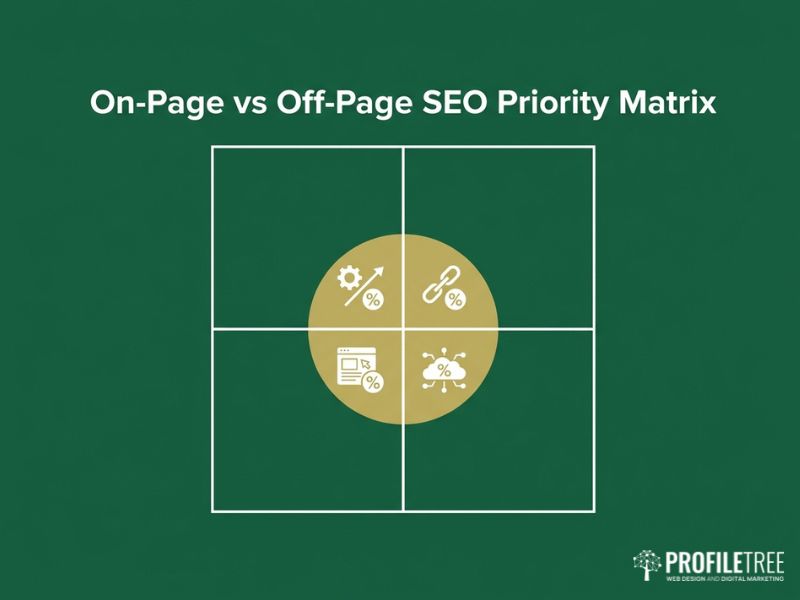
The most common question in On-Page vs Off-Page SEO is simply where to start. The answer depends on the stage your site is at, not on a fixed rule. Spending on links before the on-page foundation is sound wastes budget, while polishing on-page forever without building authority leaves competitive rankings out of reach. Use the guide below to set your split.
If Your Site Is New
For a site under roughly twelve months old, put around 80% of effort into on-page and technical foundations. You cannot build a reputation on a broken base, and early links pointing at thin or slow pages waste their value. Get the content, structure, and speed right first through solid web design services, then start earning signals.
If You Have Strong Content but No Rankings
When the content is genuinely good but pages still will not rank, the problem is usually a trust gap that only off-page work closes. Shift toward 70% off-page: digital PR, earned links, and reviews. The on-page work has done its job, so the lever now is external authority.
If You Are Stuck on Page Two
Pages that hover at the bottom of page one or the top of page two usually need a balanced push. Split effort roughly evenly between technical refinements and digital PR. Small on-page gains plus a few quality links are often enough to move into the top three, where the clicks actually are.
| Site stage | On-page focus | Off-page focus |
|---|---|---|
| New site (0 to 12 months) | 80% | 20% |
| Good content, no rankings | 30% | 70% |
| Stuck on page two | 50% | 50% |
Measuring On-Page vs Off-Page SEO Together
You cannot manage On-Page vs Off-Page SEO without tracking both halves against the same goals. Looking at rankings alone hides which lever is actually working. The aim is to connect changes you make to movements you see, so resources shift toward whatever is producing results. The metrics below cover both sides without drowning you in dashboards.
On-Page Metrics to Watch
Google Search Console is the core tool here. Track impressions, clicks, average position, and click-through rate for your priority pages. A jump in position after a content or speed fix tells you the on-page change worked. A high impression count with a low CTR usually points at a weak title tag or meta description, which is a quick on-page fix.
Off-Page Metrics to Watch
For off-page, monitor referring domains and link quality through a backlink tool, alongside review volume and brand search growth. A rise in branded searches is one of the clearest signs that off-page reputation is building. If a PR campaign lands, watch for new referring domains and a matching lift in referral traffic. Quality matters more than raw link count, so check that new links come from relevant, credible sites. Pairing this with ongoing social media campaigns keeps brand search growing month on month.
“On-page and off-page SEO feed into each other directly. Solid site fundamentals keep visitors on the page, while external endorsements pull new visitors in. Skimp on either and page-one visibility stays out of reach.” Ciaran Connolly, founder of ProfileTree.
Common On-Page vs Off-Page SEO Mistakes
Even a sensible On-Page vs Off-Page SEO plan can be undone by a few recurring errors. Most stem from over-focusing on one side, chasing shortcuts, or ignoring the technical base that both halves depend on. Knowing the common failures makes them easier to avoid before they cost rankings.
Over-Optimising Anchor Text
Too many exact-match anchors from external sites look manipulative to search engines. Keep a natural mix of branded, partial-match, and descriptive anchors. The same caution applies to your internal links, where repeating one keyword phrase everywhere can cause Google to discount it.
Ignoring Technical SEO
Technical SEO sits between on-page and off-page and is the part competitors most often skip. Slow pages, broken links, missing structured data, and crawl problems quietly cap everything else. A page can have great content and strong links and still fail if a search engine struggles to crawl or render it. Professional website development services catch these crawl and rendering problems before they cost rankings.
Chasing Links Before Fixing the Page
Driving referral traffic to a poorly built landing page wastes the effort that earned it. If visitors arrive from a guest post or a piece of coverage and hit a slow, unclear page, they leave. Confirm the destination page is fast, focused, and built to convert before you point any off-page activity at it. If a business wants help auditing both halves, ProfileTree’s SEO audit services cover the full process, and a wider digital strategy review ties the two sides together.
Combining On-Page vs Off-Page SEO Into One Plan
The businesses that win at On-Page vs Off-Page SEO stop treating the two as separate projects and run them as one programme. On-page work makes a page worth linking to, and off-page work brings the visitors who then judge that page. Each side raises the ceiling of the other. A practical plan sequences the work rather than splitting a team in two and hoping both halves meet in the middle.
Make On-Page Work Link-Worthy
The strongest off-page results start with on-page assets worth referencing. A genuinely useful guide, a piece of original data, or a clear comparison gives other sites a reason to link without being asked. This is where On-Page vs Off-Page SEO stops being a tug of war: the better the on-page asset, the easier the off-page links are to earn. Build the resource first, then promote it, rather than chasing links to thin pages. A standout asset often comes from strong video production or interactive content.
Sequence the Work by Stage
A balanced On-Page vs Off-Page SEO plan moves in order. Fix the technical base and core content, publish the assets worth citing, then run digital PR and outreach to earn the signals that lift them. Reviewing the split every quarter keeps resources pointed at whatever is producing movement. If branded search is climbing but rankings are flat, the on-page side likely needs attention; if pages rank but earn no links, the off-page side does. Ongoing digital training courses help internal teams keep both sides moving. On-Page vs Off-Page SEO is a balance you adjust, not a setting you fix once.
FAQs
What is the difference between on-page and off-page SEO?
On-page SEO covers elements inside your own site, such as content, headings, and page speed. Off-page SEO covers external signals like backlinks, reviews, and brand mentions.
Which is more important, on-page or off-page SEO?
Neither works well alone. On-page proves a page is relevant, while off-page proves the site is trusted, and a page needs both to rank competitively.
Should a new website focus on on-page or off-page SEO first?
Start with on-page. A new site should get content, structure, and speed right before earning links, or those links point at weak pages.
Are backlinks still important for SEO?
Yes. High-quality, relevant backlinks remain one of the strongest off-page signals, though quality matters far more than quantity.
How does AI search use on-page and off-page signals?
AI systems read your on-page structure to understand what you offer, then use off-page signals to decide whether to cite or recommend you.
How long does off-page SEO take to work?
Off-page SEO is slower than on-page because it depends on third parties. Meaningful results from links and reviews usually take several months.