
How to Choose a Web Design Agency in the UK
Table of Contents
There is no single best web design agency in the UK, and any ranking that claims to have found one is usually selling placement. The agency that suits a twelve-person accountancy practice in Belfast is not the one that suits a national retailer with 4,000 SKUs. What you can do is assess candidates against criteria that actually predict the outcome: technical performance you can verify yourself, conversion thinking rather than decoration, SEO written into the build scope, genuine knowledge of your regional market, and a stated plan for the six months after launch.
Three things worth knowing before you start:
- The strongest signal of a capable agency is not the portfolio. It is whether the sites in that portfolio rank, load quickly, and pass Core Web Vitals, all of which you can check in ten minutes without asking anyone’s permission.
- Under £8,000 in the current UK market, you are usually buying a visual refresh. Above it, you start buying strategy.
- Accessibility is no longer a design preference. Since June 2025 it has been a legal obligation for a large share of businesses selling into the EU, including plenty based in the UK.
Most businesses commission a new website once every three to five years, which makes it one of the higher-stakes decisions a business owner or marketing manager makes without much practice. Get it right and the site becomes a steady source of enquiries. Get it wrong and you can find yourself locked into a proprietary platform, sitting on a slow site Google will not rank, and paying day rates to fix problems that should never have shipped. The five criteria below are the same ones ProfileTree applies when scoping web design services for a new client, and they work just as well when you turn them on us.
The Five Criteria That Separate a Capable Agency From a Good Presentation
Most agencies perform well on one or two of these. Very few perform well on all five, and the gap between one and five is where the money goes.
1. Technical performance you can verify yourself
A slow site loses customers before they read a word, and Google treats Core Web Vitals as a ranking input through its page experience systems. This is the easiest criterion to check and the one buyers most often skip.
Google’s current thresholds are Largest Contentful Paint of 2.5 seconds or less, Interaction to Next Paint of 200 milliseconds or less, and Cumulative Layout Shift of 0.1 or less, each measured at the 75th percentile of real user visits. INP is the one worth asking about specifically. It replaced First Input Delay on 12 March 2024 and measures how quickly the page responds across every interaction, not just the first one, which makes it considerably harder to pass. Any agency still quoting FID scores has not looked at this since 2023.
The scale of the problem is documented. The HTTP Archive’s 2025 Web Almanac, drawing on Chrome User Experience Report field data from July 2025, found that just under half of mobile origins pass all three metrics.
| Metric | Google “good” threshold | Share of mobile origins passing |
|---|---|---|
| Largest Contentful Paint (LCP) | 2.5 seconds or less | 62% |
| Interaction to Next Paint (INP) | 200 milliseconds or less | 77% |
| Cumulative Layout Shift (CLS) | 0.1 or less | 81% |
| All three together | All three in the “good” band | 48% |
Sources: thresholds from Google’s web.dev Core Web Vitals documentation; pass rates from the HTTP Archive Web Almanac 2025 Performance chapter (CrUX, July 2025).
Loading speed, not responsiveness, is what fails most sites. That matters for how you interrogate an agency, because the fixes for LCP sit largely in hosting quality, image delivery and render-blocking resources, which are build decisions rather than plugin decisions.
There is a related point about platforms. The same HTTP Archive data shows WordPress passing at a far lower rate than managed platforms like Duda or Wix, which is often used as an argument against WordPress. Look closer and the picture is more specific: WordPress INP is strong, around 86%. The weakness is loading, which tracks back to cheap shared hosting and bloated theme stacks rather than anything inherent in the CMS. A well-built WordPress site on decent infrastructure passes comfortably. A badly built one does not, and that difference is entirely down to the agency.
What to ask: show me PageSpeed Insights field data for three sites you built in the last year. Not lab scores, field data. Ask whether they optimise images on delivery, defer non-critical JavaScript, and run a caching layer with a CDN. Vague answers here mean inconsistent work.
2. Conversion architecture, not just visual design
There is a real difference between a designer who thinks about aesthetics and a team that thinks about user journeys, funnels and where the primary call to action sits on a 6.1 inch screen.
Ask any agency to walk you through how they approach conversion on a new build. Where does the primary CTA go on a service page, and why there? How do they structure the page to move someone from awareness to enquiry? If the answer is about mood boards and brand feel, you’re talking to a studio rather than a strategic partner. Both have their place; you should know which one you’re hiring.
Visual decisions still matter, they just need to be justified against behaviour rather than taste. Contrast, hierarchy and how colour choices affect conversion are measurable variables, not preferences, and an agency that can explain its reasoning on those is usually an agency that tests its work.
3. SEO written into the build scope, not sold afterwards
A site that is not built for search will need remedial work later, usually in the first year, usually at the point the client asks why nothing is happening in Google.
SEO-first development means clean URL structures, correct heading hierarchies, schema markup that matches visible content, crawlable internal linking, and an XML sitemap submitted at launch. It also means the developer and the SEO strategist are not two people working in sequence, but one brief. Ask directly whether SEO is a line item in the build or a separate service quoted afterwards. Agencies that bundle it almost always produce better organic results, because the decisions that matter most for search get made before anything is coded. That integration is how ProfileTree’s integrated web development team is structured, and it is a reasonable thing to demand of anyone you shortlist.
What to ask: which SEO deliverables are itemised in this proposal, and which are chargeable later? Get it in writing. “SEO-friendly design” is a phrase, not a deliverable.
4. Regional market knowledge
For SMEs across Northern Ireland, Ireland and the UK, an agency’s understanding of your market can matter as much as its technical skill. A London studio with a portfolio of global brands may have very little experience of what it takes to rank in Belfast, Cork or Glasgow, or of the cross-border questions that come up for businesses trading in both jurisdictions.
Local knowledge shapes keyword strategy, citation building, content tone and even which platforms your customers actually use. An agency that has delivered local results in your region, and can show those sites ranking for terms you recognise, is a materially different proposition from one applying a template.
5. What happens in month two
The most underasked question in any pitch. Most agencies deliver the site and move on.
Post-launch support should cover, at minimum: WordPress maintenance and security updates, a defined process for requesting changes, access to performance reporting, and ideally a content or SEO plan for the following two quarters. Ask what a typical client relationship looks like six months after launch. If the answer is a support ticket portal, the relationship ends at handover, whatever the proposal says.
What Different Budgets Actually Deliver
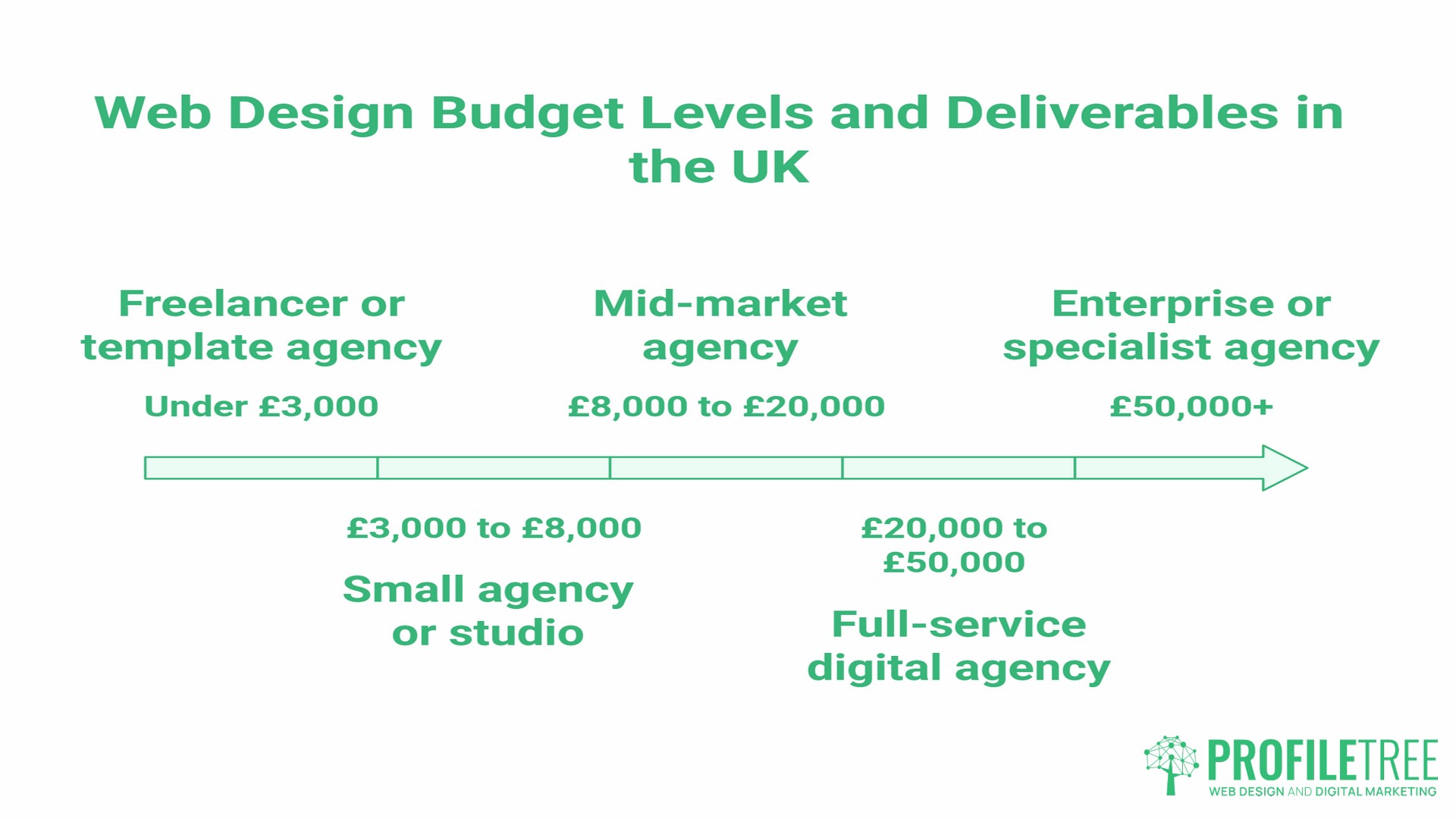
Published UK price ranges vary so wildly that they are close to useless: the same brochure site is quoted at £900 and £11,000 by two firms who cannot clearly explain the difference. The table below reflects what ProfileTree sees when quoting against other agencies in the Northern Ireland, Ireland and UK market, and what each band tends to produce.
| Budget range | Typical provider | What that usually buys |
|---|---|---|
| Under £3,000 | Freelancer or template shop | WordPress theme with light customisation, minimal SEO setup, no strategy phase |
| £3,000 to £8,000 | Small agency or studio | Custom design on WordPress, basic on-page SEO, limited post-launch support |
| £8,000 to £20,000 | Mid-market agency | Full custom build, SEO integrated into development, conversion architecture, analytics configured |
| £20,000 to £50,000 | Full-service digital agency | Custom development, content strategy, SEO from day one, CRO, ongoing growth support |
| £50,000+ | Enterprise or specialist agency | Complex custom development, multi-platform integration, dedicated account management |
For most SMEs in Northern Ireland and Ireland, the £8,000 to £20,000 band is where a build stops being a visual refresh and starts being a strategic one. Below it, you are frequently buying a template with a custom skin, which presents beautifully in a pitch deck and underperforms in search.
One request applies at every budget level: ask for a line-item breakdown. How an agency responds tells you a great deal. A single lump sum with no detail is a quote from someone who would rather you didn’t ask what each element costs.
How AI Search Changed the Way Agencies Get Shortlisted
This is the part of the process that has moved fastest, and most agency-selection guides have not caught up with it.
Buyers now build shortlists inside AI assistants before they contact anyone. Forrester’s 2026 Buyers’ Journey Survey of roughly 18,000 business buyers found that 94% used AI somewhere in their most recent purchase process, and 55% compared vendors inside AI tools. G2’s April 2026 research reported that 51% of B2B software buyers now begin their research in an AI chatbot rather than a search engine, and that 69% ended up choosing a different vendor than they had originally planned on the strength of what the chatbot said. Both studies cover software buying rather than agency selection specifically, so treat the figures as directional. The behaviour they describe is not in doubt.
We see the same pattern in our own Search Console data. Queries reaching this page now include full sentences: “can you recommend a web design service that specialises in SEO-friendly websites”, “compare web design agencies that build SEO-ready websites”. Those conversational queries land this page at average positions around 19 to 37. The short head terms it was originally written for average around position 48. People are asking questions, not typing keywords, and the pages that answer questions properly are the ones being surfaced.
What this means for you as a buyer. When an AI assistant recommends an agency, it is synthesising what third parties have published about that agency, not what the agency says about itself. That makes it a genuinely useful filter, and a slightly unnerving one. Run this before your first call:
Ask two different assistants the same question, phrased the way you would actually ask a colleague. Something like “which web design agencies in Northern Ireland build sites that rank well for local search”. Note which names appear, and more importantly, which sources get cited. An agency that turns up with citations from industry publications, review platforms and named authors has an evidence trail. One that only appears via its own website does not.
Then cross-check. AI assistants confidently recommend firms that have closed, merged, or never had a portfolio worth the name. Treat the output as a starting list, never a verdict.
What this means for the agency you hire. If you cannot be found in an AI answer, neither can your customers find you there. Ask any shortlisted agency how they would approach that for your business, and whether they can show you a site where they have done it. The answer separates agencies that have adapted from agencies still selling 2019’s playbook.
Accessibility Is Now a Legal Question, Not a Design Preference
If a proposal does not mention accessibility, that is worth a direct conversation before you sign.
The European Accessibility Act, Directive (EU) 2019/882, has applied since 28 June 2025. It covers e-commerce, banking, transport ticketing, e-books and a defined list of other consumer-facing digital services. The deciding factor is who buys from you, not where your office is, which means a Belfast or Birmingham business selling to consumers in Ireland or elsewhere in the EU falls within scope. Ireland transposed the directive through the European Union (Accessibility Requirements of Products and Services) Regulations 2023 (S.I. No. 636 of 2023), commencing on the same date. Penalties in Ireland run to fines of up to €60,000 and, on indictment, imprisonment of up to 18 months for company officers.
The technical standard behind it is EN 301 549, which for websites points to WCAG 2.2 at level AA. In the UK domestically, the Equality Act 2010 already creates a duty to make reasonable adjustments, so this is less of a change than it first appears; the EAA simply gives it teeth and a deadline. Service contracts concluded before 28 June 2025 have until 28 June 2027 to comply.
What to ask an agency:
Does the build scope include an accessibility audit against WCAG 2.2 AA, or is that a separate engagement? Will they produce the accessibility statement the regulations require? And, the question that separates the serious from the box-tickers: is accessibility tested with keyboard navigation and a screen reader, or only with an automated scanner? Automated tools catch a useful but limited share of issues. Colour contrast and missing alt text they will find. Whether a form can actually be completed without a mouse, they will not.
Warning Signs to Check Before You Sign
These are the things experienced clients consistently say they wish they had noticed earlier.
Proprietary CMS lock-in. Some agencies build on their own platform rather than an open-source CMS. If you ever want to leave, the site cannot come with you: you either stay indefinitely or rebuild from scratch. Ask plainly whether you own the code and can move it to another host or agency at any point.
No itemised SEO in the proposal. If the document does not specify what SEO work is included, it is probably not being done. Ask for the specifics: technical audit, URL structure, on-page optimisation, schema, Search Console setup.
Timelines with no milestones. A professional agency can break a project into discovery, wireframes, design approval, development, content population, testing and launch, with approval gates between. A single end date is not a timeline, it is a hope.
Portfolio sites that don’t rank. Take three sites from any portfolio and check whether they appear in search for obvious terms. Run one through PageSpeed Insights while you are there. A site that looks good and receives no organic traffic has not done its job.
A quote before any discovery. Nobody can price your project accurately without understanding your business, audience, existing performance and goals. A quote arriving within 24 hours of a first conversation is a quote for a generic website, not for yours.
Undisclosed outsourcing. Some UK agencies sell projects and subcontract the development offshore without saying so. That is not automatically a problem, but it changes communication timelines, quality control and your ability to escalate. Ask who builds the site and where they sit.
No training or handover. If nobody shows your team how to run the CMS, you will be dependent on the agency for every content change, at their rate, on their schedule. ProfileTree’s digital training programme exists for exactly this reason: businesses should be able to operate their own tools. Ask what training is included and what it covers before you sign.
Regional Context: Northern Ireland, Ireland and the UK
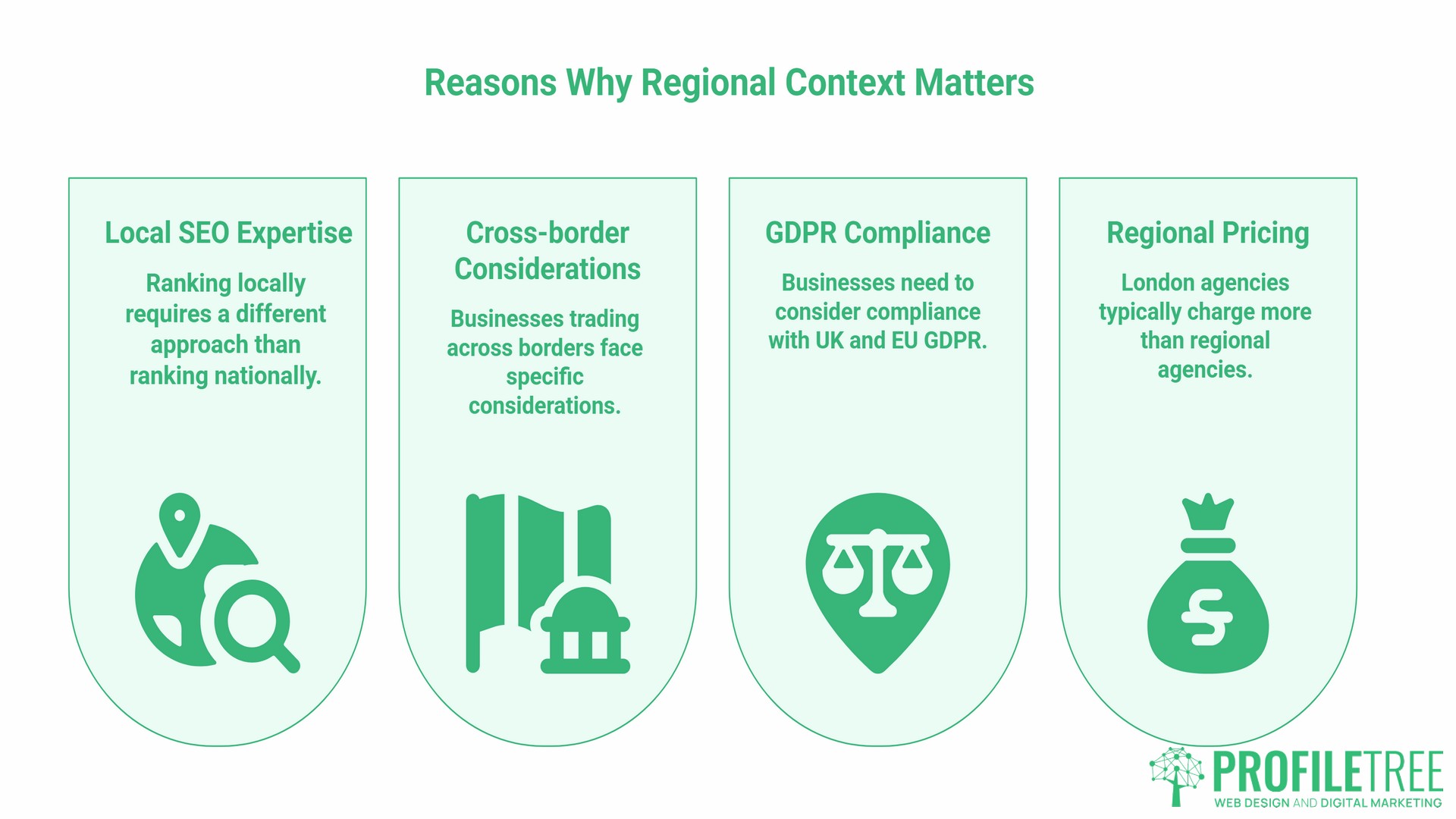
Most published UK agency rankings skew heavily towards London. For an SME in Belfast, Derry, Glasgow or Cork, that creates a practical problem, because the firms at the top of those lists often have no experience of your market at all.
Four things make regional knowledge worth paying attention to.
Local search is a different discipline. Ranking in Google Maps and local organic results requires a specific approach to keyword targeting, citation building and on-page signals. An agency that has not delivered local results in your region is guessing at the competitive picture.
Cross-border trade has its own requirements. Businesses selling into both Northern Ireland and the Republic face decisions about currency display, VAT treatment, and the tone and expectations of two distinct markets. A generic agency is unlikely to flag these, never mind plan for them.
Data protection now runs on two tracks. Since the UK left the EU, businesses operating in both jurisdictions have to consider UK GDPR and EU GDPR. Cookie consent, privacy policies and processing disclosures need to reflect where your customers actually are.
Regional pricing reflects overheads, not capability. London agencies routinely quote materially higher than regional firms for the same specification, and the difference is largely office costs and location. For an SME with a fixed budget, working with a Belfast agency instead can be the difference between a templated site and a properly custom one. ProfileTree has worked from Belfast since 2011, delivering projects for businesses across Northern Ireland, Ireland and the UK, and currently holds a 5-star Google rating across 463 reviews.
Running Your Evaluation Process
Once you have a shortlist, a structured process beats gut feel after a good presentation. Here is a ten-point framework.
| # | Checkpoint | What good looks like |
|---|---|---|
| 1 | Portfolio relevance | Sites for businesses similar to yours in scale and sector |
| 2 | Organic performance | Portfolio sites that rank for terms you recognise |
| 3 | Core Web Vitals | Field data, not lab scores, passing on mobile |
| 4 | Code ownership | Confirmed in writing that you own all code and assets |
| 5 | SEO deliverables | Itemised in the build scope, not quoted later |
| 6 | CMS platform | Open source, no proprietary lock-in |
| 7 | Accessibility | WCAG 2.2 AA audit in scope, manual testing included |
| 8 | Discovery process | Structured discovery before any quote is issued |
| 9 | Project milestones | Phased timeline with approval gates |
| 10 | References | At least two clients you can contact directly |
Three questions will tell you more than any pitch deck.
Describe a project that went wrong and how you handled it. An agency that has never had a difficult project is either inexperienced or not being straight with you. How they describe the problem and the resolution tells you what their communication culture is like when things get uncomfortable.
What would you change about this site? Show them your current site, or a site you admire, and ask for a candid assessment. An agency that says it all looks fine is not paying attention. One that gives you specific, well-reasoned criticism is showing you the thinking you would be buying.
What will this site need in six months? A good agency has a view on what happens after launch: what content is needed, what will need testing, what technical maintenance looks like. No answer means no thinking about your outcomes beyond the invoice.
As Ciaran Connolly, founder of ProfileTree, puts it: “The agencies that deliver the best results are the ones that treat a website as a revenue tool with ongoing inputs, not a finished product that gets handed over and forgotten. The businesses we see succeed online are the ones that stay engaged with their site after launch.”
If you are working through this process and want a second opinion on a proposal in front of you, the ProfileTree team is happy to look at it.
FAQs
How much does a web design agency charge in the UK?
It depends on scope, location and whether the work includes strategy, SEO and content or only the build. Published UK ranges run from a few hundred pounds for a template site to £30,000 and beyond for complex custom development, which is so wide as to be unhelpful without context. For a custom WordPress site for an SME, most quotes land between £3,000 at the entry level and £20,000 or more for a fully integrated build with SEO, content architecture and conversion work. London firms quote materially higher than regional ones for comparable specifications, and the gap reflects overheads rather than output. The number that matters is not the day rate. A designer at £40 an hour who takes three times as long costs more than one at £100. Always ask for a line-item breakdown and a fixed total against a defined scope.
How long does it take to build a business website?
A straightforward brochure site of five to ten pages usually takes six to ten weeks from kick-off to launch. Add e-commerce, custom functionality or a large content migration and that stretches to twelve to sixteen weeks. The variable that moves timelines most is not development speed, it is how quickly the client supplies content and signs off design stages. Delays on the client side are the most common cause of overrun by a wide margin, so agree a content deadline at kick-off and treat it as seriously as the launch date.
Should I use a UK agency or outsource offshore?
For businesses in Northern Ireland, Ireland and the UK there are real advantages to a UK or Irish agency: shared time zones, familiarity with local search dynamics and regulatory requirements including UK GDPR and the European Accessibility Act, and a clearer legal position if something goes wrong. Offshore development can cut upfront cost, and sometimes that is the right trade. It tends to introduce communication lag, more variable quality control and harder post-launch support. Where ongoing strategy, content and SEO form part of the brief, a UK-based partner generally produces better long-term results. Where the brief is a tightly specified build with no ongoing component, the calculation is different.
Do I own the website after it is built?
You should, but it is not always the default and it is worth confirming in writing before you sign. Three things to get in the contract: that you own all code, design files and content; that the site sits on hosting in your own account rather than the agency’s; and that you can move the site to another developer at any time without penalty. Be particularly careful with agencies building on proprietary platforms, or insisting that hosting stays with them as a condition of the project. Neither is automatically bad faith, but both make leaving expensive, and you want to know that before you commit rather than three years later.
Will my new website automatically rank on Google?
No. A new site built to a high technical standard will not rank on its own. Search visibility requires continuing input: keyword-targeted content, digital PR and link acquisition, technical maintenance and regular monitoring. What a well-built site does is remove the technical obstacles and give that activity a foundation to work from. Ask any agency to distinguish clearly between SEO-friendly development, which is a property of the build, and active SEO services, which is ongoing work. Proposals that blur the two usually include the first and charge separately for the second.
Does my website need to be accessible by law?
Quite possibly, yes. The European Accessibility Act has applied since 28 June 2025 to a defined list of consumer-facing digital services including e-commerce, and it applies based on who you sell to rather than where you are based. A UK business selling to consumers in Ireland or elsewhere in the EU is within scope. The relevant standard is EN 301 549, which for web content means WCAG 2.2 at level AA. Separately, the Equality Act 2010 has long required reasonable adjustments in the UK. Ask any agency whether accessibility testing is in the build scope, and whether it includes manual keyboard and screen reader testing rather than an automated scan alone.
How do AI assistants decide which agencies to recommend?
They synthesise what third-party sources have published, weighted towards material they treat as credible: industry publications, review platforms, documented case studies and content with named, verifiable authors. An agency’s own marketing copy carries relatively little weight, which is why some well-known firms are invisible in AI answers while smaller ones with a strong publishing record appear consistently. As a buyer, this makes AI a useful first filter and a poor final arbiter. Use it to generate a list and to see which sources vouch for whom, then verify everything independently. As a business owner, it is worth asking any agency you hire how they would approach making your business visible in those answers.
What should I ask before signing with a web design agency?
Six questions cover most of the ground. Can I see three sites you built that currently rank well in Google? Who specifically will build my site, and where are they based? Which SEO and accessibility deliverables are itemised in the build scope? Do I own all code and assets, and can I move them freely? What does a typical client relationship look like six months after launch? And can you give me two references I can contact directly? If an agency answers all six clearly and in writing, you are dealing with a professional operation. Hesitation on any of them is worth following up before money changes hands.