
How to Get Your Pages Cited in Google AI Overviews
Table of Contents
To appear in Google AI Overviews, do three things: rank in the underlying results, structure your answers so they can be extracted, and keep the content current. Overviews draw heavily from pages that already rank near the top, so classic search work comes first. Clear, self-contained answers, backed by current information, give a page its best chance of being quoted.
Three Things to Take Away before You Read On:
- Ranking well in normal search is the price of entry, not an optional extra.
- A short, direct answer near each heading is what gets lifted into an Overview.
- Structured data and freshness support the page; they do not replace good writing.
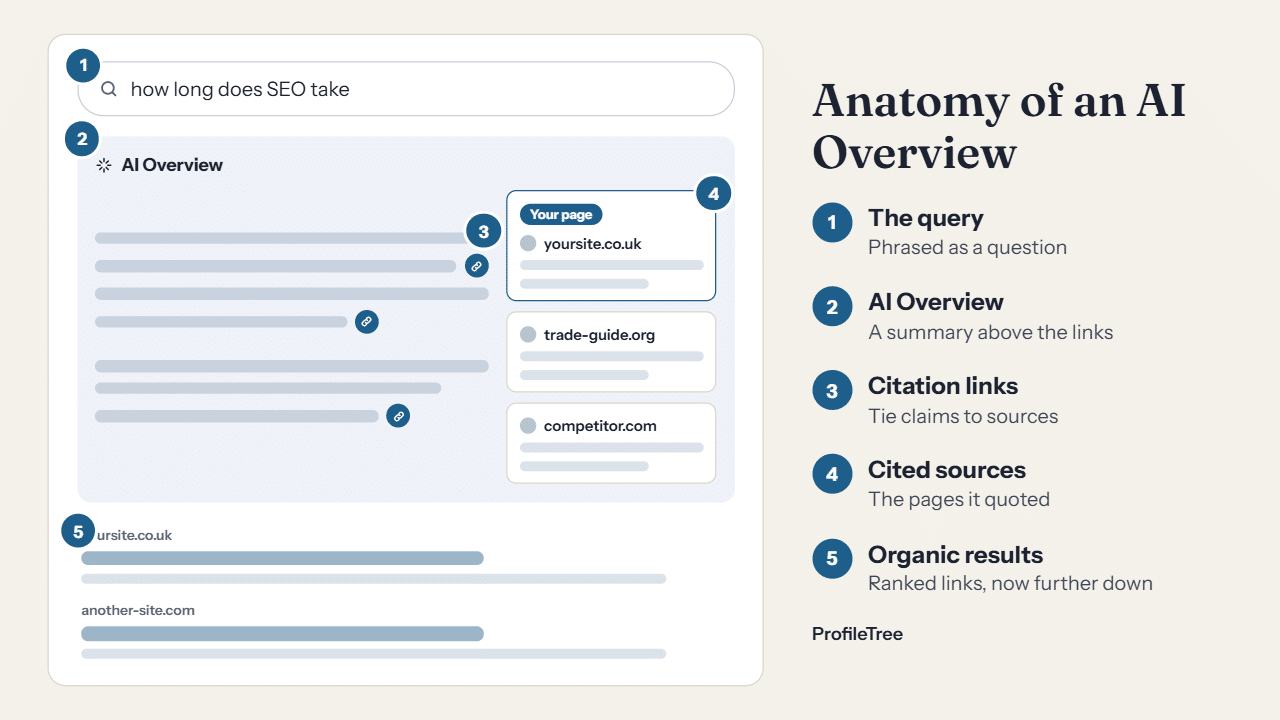
Google AI Overviews now sit at the top of many search results, summarising an answer and quoting a few web pages beneath it. When your page is one of those quoted, you earn visibility and clicks before a searcher ever scrolls. When it isn’t, a competitor’s page usually is.
There’s no secret switch. Overviews pull from pages that already perform well in ordinary search, then favour content that answers a question cleanly. The work is practical and repeatable, which is why it sits at the core of AI SEO.
This guide is a plain answer to how to appear in Google AI Overviews: how the feature picks its sources, how to structure content so it gets extracted, which structured data actually helps, worked examples of the formats that tend to get quoted, and a ten-point checklist you can run today.
How Google AI Overviews Choose Which Pages to Cite
Before you change a single line of copy, it helps to know how the feature decides, and it’s where every one of our AI SEO projects for Irish businesses begins. AI Overviews run on Google’s own search index, so the selection is closer to ranking than to anything new. The four points below cover eligibility, where the quotes come from, why one page wins over another, and how other assistants differ.
Eligibility Begins with Ranking
Google is unusually direct on this. Its documentation on AI features and your website states there are no extra requirements and no special optimisation needed to show in AI Overviews; the same search fundamentals apply. In practice, a page that never reaches the first results for a query has little chance of being quoted above them.
So the starting point is boring but true: earn strong organic positions first. If you already work on AI SEO, treat Overview appearance as a payoff of that work rather than a separate project.
Where the Quotes Actually Come From
Overviews are generated, but they are anchored to real pages through a retrieval step. The system finds relevant passages in the index, then writes a summary grounded in them and links back to the sources it leaned on.
That grounding step is why passage quality matters as much as page quality. The model behind the feature, Gemini, is choosing sentences it can trust and reuse, so a clean, factual passage travels further than a paragraph a reader has to untangle.
Recency plays in here too. Cited sources tend to be pages that have been updated lately, so a passage reflecting the current state of a topic is easier to pull than one that has quietly drifted out of date.
Why One Page Is Chosen over Another
Given several ranking pages, Google tends to quote the one that answers the specific question most directly, covers the surrounding sub-questions, and reads as current. Relevance and clarity do the heavy lifting.
This is also where thin or padded pages fall away. If you have ever wondered how Google ranking weighs depth and intent, the same judgement decides which passage is worth lifting into an answer box.
Trust feeds the choice as well. Clear authorship, accurate claims, and a page whose content matches its own headings all make a source safer to quote, and safer sources get picked more often.
How Other AI Search Engines Choose Sources
Google is not the only assistant citing web pages, and the pattern differs by tool. Understanding how AI search engines cite websites helps you write once and appear in several places.
Assistants like ChatGPT and Perplexity lean on live retrieval and named citations, while Google’s feature stays closest to its ranking index. Which engine is most likely to cite your website depends on where you already rank and how quotable your passages are, which is the core idea behind generative engine optimisation. Write for extraction, and you widen your reach across all of them.
Structure Content So AI Overviews Can Extract It
Once a page ranks, structure decides whether a machine can lift a clean answer from it. The aim is passages that stand on their own, headings that match real questions, and facts arranged so they are easy to read back. Four habits do most of the work.
Lead Every Section with the Answer
Put a direct, 40- to 60-word answer immediately under each heading, then add the detail. This answer-first order mirrors how an Overview quotes: it wants the conclusion, not the wind-up.
The same discipline that makes a strong opening for a human reader makes a passage easy for a model to extract. Say the useful thing, then support it.
Ciaran Connolly, founder of ProfileTree, puts it plainly: “Write the answer a person actually wants in the first two lines, then earn the rest of their attention. Overviews reward the same clarity your readers do.”
Write Headings as the Questions People Ask
Phrase your H2s and H3s as the queries a searcher would type, then answer them underneath. Matching the wording of real questions gives the system a clear signal about what the section resolves.
You can gather that phrasing from the way people build search queries and from tools that surface intent. A grounded primer on keyword research shows how to align headings with what your audience actually asks rather than what you assume they want.
Put Comparable Facts in Tables
Tables are easy for both people and models to read. When you have prices, timelines, options, or specifications, a clearly labelled table beats a wall of prose and tends to be quoted more often.
A pricing table with three tiers, or a two-column table setting a method against its outcome, gives a model rows it can quote without rewriting them. That is often the exact shape an Overview reaches for.
Depth still matters more than raw length, and getting the content length right means covering the question fully, not padding it. A tight table inside a thorough page is a strong combination.
Answer the Cluster of Related Questions
Overviews favour pages that resolve a topic, not just a single query. Ahrefs found that pages covering several sub-questions of a topic were far more likely to be cited, so map out the follow-up questions a reader has and answer them on the same page.
For the commentary and reasoning behind this cluster approach, the companion piece on Overview strategies sits alongside this how-to. Together they cover the why and the how.
Structured Data: What Helps and What Does Not
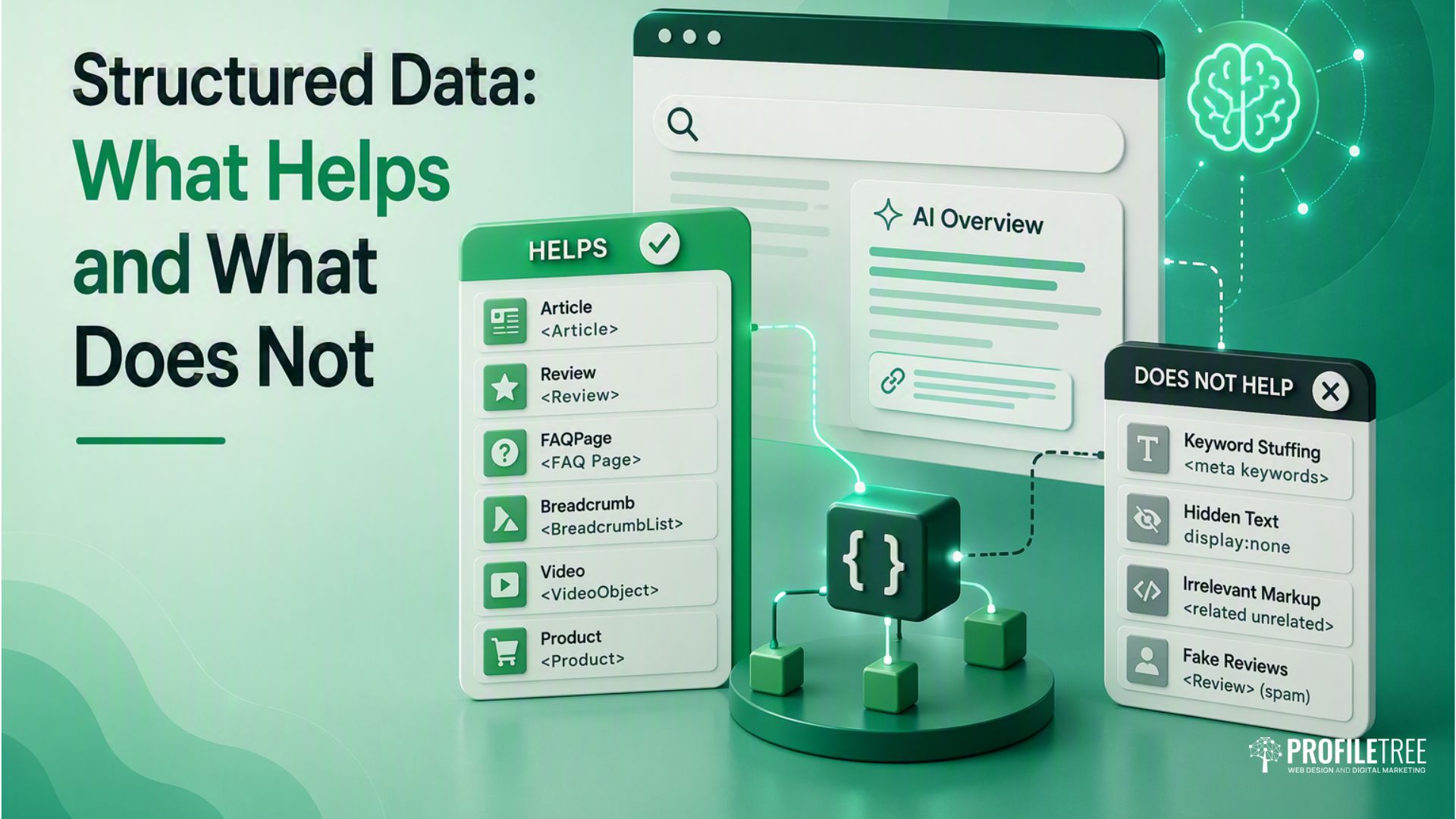
Structured data will not force a page into an Overview, but the right markup gives Google cleaner context about your content. The trick is knowing which types earn their keep and which are wasted effort. Here is the honest split.
Schema That Adds Real Context
Article, FAQPage, HowTo, Organisation, and Author markup all describe your content in a machine-readable way. Author markup is worth extra attention now that credentials are a ranking input.
Connect that markup to a real, credentialed author profile rather than an anonymous byline. A named expert with a track record is easier for any system to trust.
Match the type to the page. FAQPage suits question pages, HowTo suits step-by-step guides, and Article covers most blog posts. Pick the one that genuinely fits rather than stacking several that only half-apply.
Schema That Will Not Move the Needle
Not every tag helps. Markup that describes nothing visible, or that tries to game a category, adds risk without reward.
The classic example is the old meta keywords tag, which Google has ignored for ranking for years. Stuffing invisible signals is effort spent in the wrong place.
Keep Markup Matched to the Page
Structured data must reflect what a visitor can actually see. Marking up reviews, prices, or steps that are not on the page invites manual action and lost trust.
Google has a long history of demoting mismatched or manipulative signals, a pattern that runs back to the quality updates aimed at low-value pages. Accurate markup is safe markup.
Local and Organisation Signals
For businesses with a physical presence or a service area, Organisation and LocalBusiness data help Google connect the page to a real entity. That entity clarity feeds how you are described in answers.
Pair it with a well-kept Business Profile so the name, location, and services line up across the web. Consistency is what makes an entity legible.
Worked Examples of Formats That Get Cited
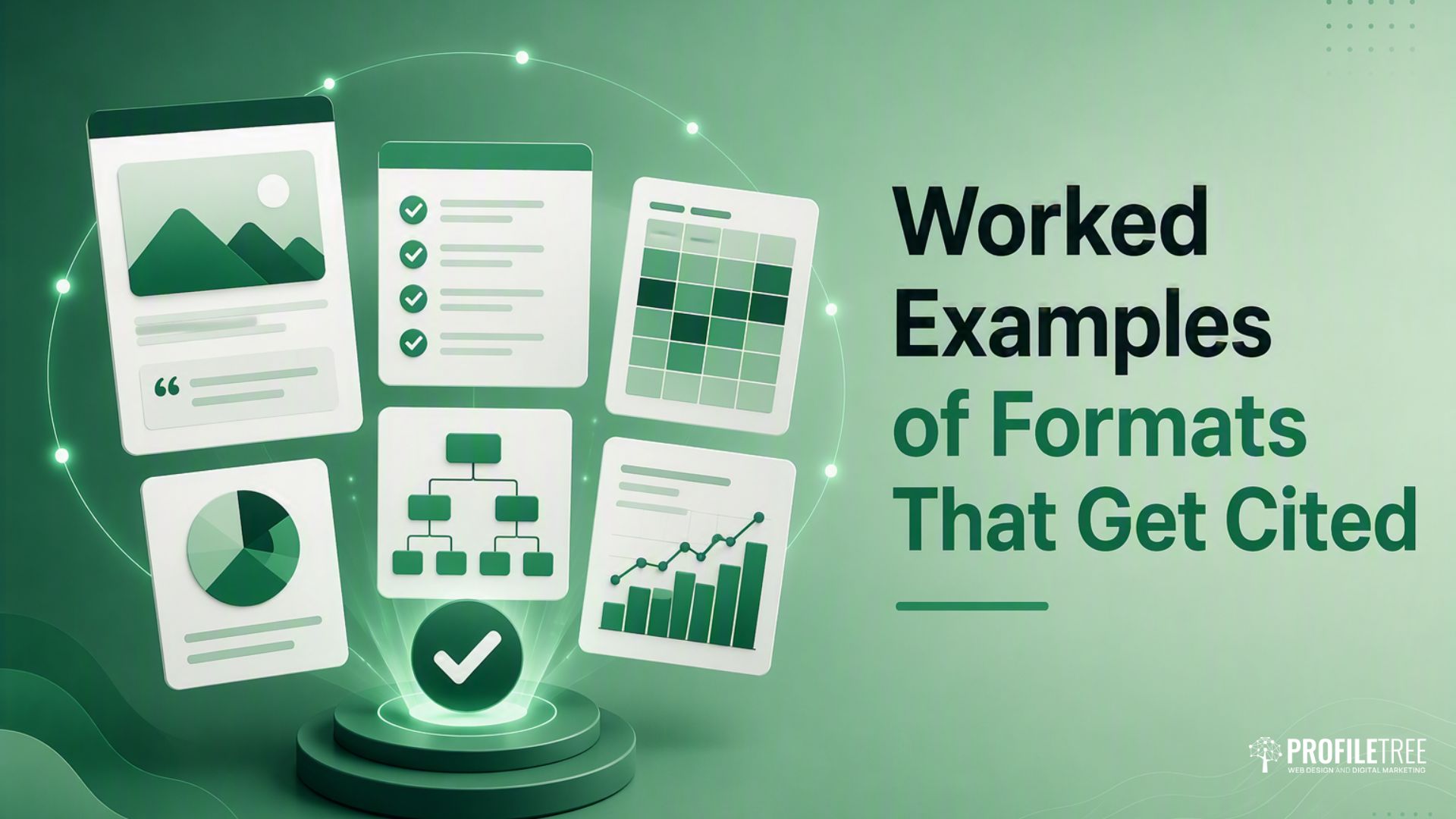
It is easier to write for extraction when you can picture the shapes that tend to get quoted. None of these needs special tooling; they are just disciplined ways of laying out an answer. Four formats recur again and again.
The Concise Definition Block
For “what is” queries, open the section with a two-sentence definition that a reader could repeat back correctly. Overviews often lift exactly this kind of self-contained explanation.
A page explaining a term such as language models works best when the first lines define the thing plainly, before any history or nuance. Definition first, context second.
Keep the opening free of jargon so it can stand alone in an answer box, then expand into the finer points a specialist reader wants further down. The plain version is the one that gets quoted.
The Side-by-Side Comparison
For “X vs Y” questions, a labelled table comparing the two on the criteria buyers care about is highly quotable. Rows become the points of difference; the header row names the options.
The same format suits round-ups of approaches or content formats, where a reader wants the trade-offs at a glance rather than buried in paragraphs.
The Numbered How-To
For procedural queries, a numbered list of clear steps is the natural fit, and it maps neatly onto HowTo markup. Each step should be a single action, phrased in the imperative.
A practical set of steps, in the spirit of these AI prompts, is easy to follow and easy to extract. Keep the steps short and in order.
The Figure-Led Claim
Statistics earn higher citation rates than vague statements, so back key points with a specific, sourced number stated in the text. A figure a model can quote with confidence is worth more than a general assertion.
This suits data-led content especially well, where a single strong figure can anchor the whole passage. Name the source in the same sentence so the claim stands up.
Round numbers with no origin read as filler and get skipped. A precise figure with a named study behind it is the version a summary will happily reuse.
Your Ten-Point Checklist to Run Today
Everything above condenses into a short list you can work through on any page. Each item is something you can check or fix now, without waiting on a redesign. Below the list, three habits keep the results improving over time.
The Ten Checks
Run these against the page you most want quoted, then move on to the next. Pages you already promote through SEO services are the sensible place to start, since they are closest to ranking.
- Confirm the page ranks on or near page one for the target question in normal Google Search.
- Place a 40 to 60 word direct answer immediately under each main heading.
- Phrase at least three headings as the exact questions people type.
- Add one comparison or data table with clearly labelled rows and columns.
- Answer the related sub-questions a reader would ask next, on the same page.
- Add Article and FAQPage structured data that matches the visible text.
- Attach Author markup linked to a real, credentialed author profile.
- Include at least one verifiable statistic with its source named in the sentence.
- Check the page loads quickly and reads cleanly on a phone.
- Review the Generative AI performance report in Search Console to see which pages already appear in AI Overviews, then apply what works to the pages that don’t.
Fix the Basics before Anything Clever
If a page is not being quoted, the cause is often plain: it does not rank, or the answer is buried. Sort those two things before touching schema.
Diagnosing weak rankings first saves hours, because no amount of markup rescues a page that never reaches the results in the first place. Ranking, then clarity, then structure.
Track Appearances and Iterate
Search Console’s Generative AI performance report, available to all sites since August 2026, shows which URLs earn impressions inside AI Overviews and AI Mode. It reports impressions only, not clicks or queries, but it is still your best feedback loop for seeing which pages Google is pulling into answers.
Feed what you learn back into your content strategy, doubling down on the formats that get quoted and reworking the ones that stall. Small, regular edits beat one big overhaul.
Keep Pages Current
Freshness is a real signal for AI answers, which skew towards recently updated pages. A page that has not changed in two years is easy to overlook.
Refresh genuinely rather than cosmetically: add new sections, update figures, and remove anything stale, which also keeps the page clear of the thin content that AI systems tend to skip. Real updates, not date swaps.
Where to Start Today
Pick the one page you most want quoted, check it against the ten points, and fix the two weakest. Rank first, answer clearly, mark it up honestly, then keep it current. That order is the whole method, and none of it needs a rebuild. If you would rather have specialists run this across your site, ProfileTree can help you plan and build content that ranks and gets cited. Talk to the team to get started.
FAQs
How long does it take to appear in Google AI Overviews?
There is no fixed timeline. Once a page ranks well and answers a question clearly, it can appear quickly, but Overviews are generated per query, so appearance varies by search and by day. Focus on ranking and clarity, then monitor Search Console.
Why does my competitor show in AI Overviews and I do not?
Usually because their page ranks higher for that query and answers it more directly. Overviews draw heavily from top-ranking sources, so check where you sit in normal search, then tighten your answer, headings, and coverage of the related sub-questions.
Do I need special schema to be included?
No. Google states there are no extra requirements beyond standard search best practices. Accurate Article, FAQ, and Author markup gives cleaner context, but it supports the page rather than forcing it into an Overview.
Can I opt out of Google AI Overviews?
Yes. A toggle in Search Console removes your content from AI Overviews and AI Mode without affecting your rankings in traditional search results. You also lose the impressions and traffic those features bring, so most site owners are better served by optimising than by opting out.
Will appearing in AI Overviews cost me clicks?
It can, since some searchers get their answer without clicking. Being the cited source still earns visibility and qualified visits, and pages that answer deeper questions tend to pull readers who want the full detail.