
Local SEO: How to Optimise Your Website for Local Search
Table of Contents
Local SEO is the process of making your website visible to customers who search for products and services in your geographic area. For SMEs across Belfast, Northern Ireland, and the wider UK, getting local search right means showing up at the moment someone nearby is ready to buy. This guide covers the practical steps involved.
Local SEO involves optimising your website and online presence so your business appears in geographically relevant search results. Key elements include your Google Business Profile, local keyword targeting, consistent business citations, and localised content. ProfileTree, a Belfast-based digital agency, helps SMEs across Northern Ireland and the UK put these strategies into practice.
Understanding Local SEO and Why It Matters
Local SEO sits at the intersection of search intent and geography. When someone types “accountant near me” or “web design Belfast” into Google, the results they see are shaped by a combination of relevance, proximity, and prominence. Local SEO is the practice of making your business the strongest possible candidate across all three.
For SMEs, this matters more than broad organic SEO in many cases. A plumber in Derry does not need to rank nationally for “plumbing services.” They need to appear when someone within a ten-mile radius searches for an emergency call-out. That is a fundamentally different problem, and it requires a different approach.
Local Search vs Organic Search: The Key Differences
Organic SEO targets broad, non-location-specific queries. Local SEO targets searches with geographic intent, either because the user has typed a location (“solicitors in Belfast”) or because Google has inferred one based on their device location (“coffee shop open now”).
The most visible outcome of strong local SEO is appearing in the Local Pack, the block of three business listings that sits above the organic results for local queries. Getting into that pack requires a well-maintained Google Business Profile, a strong local citation profile, and a website that clearly signals your service area.
Three factors drive local ranking: relevance (how well your listing matches the query), distance (how close your business is to the searcher), and prominence (how well-known and trusted your business appears across the web). You have the most control over prominence, which is why the steps below focus heavily on it.
Why Local SEO Is Worth Prioritising Right Now
Mobile search is the dominant channel for local intent queries. When someone is out and about looking for a service, they are not sitting at a desktop; they are on a phone, expecting results that reflect where they are. Google’s own data has shown for several years that “near me” search volume continues to grow year on year, particularly in service industries.
At the same time, Google’s AI-powered features, including AI Overviews, are starting to pull directly from well-structured local business content. Pages that are clearly structured, cite specific geographic information, and demonstrate genuine expertise are more likely to be surfaced in these responses. The SEO fundamentals and the AI visibility fundamentals are the same.
“For most of the SMEs we work with across Northern Ireland, local search is where the commercial opportunity is. National rankings look impressive on a report, but local visibility is what actually brings enquiries through the door,” says Ciaran Connolly, founder of ProfileTree.
If your business serves specific towns, cities, or regions, local SEO should sit at the top of your digital marketing priorities. Investing in your website’s broader digital marketing strategy and tying it to your local presence creates a compounding effect that generic online advertising rarely matches.
Setting Up and Optimising Google Business Profile
Your Google Business Profile (GBP) is the single most important local SEO asset you control outside of your own website. It is what populates the Local Pack, the knowledge panel, and Google Maps results. An incomplete or unverified profile is one of the most common reasons businesses fail to appear in local search despite having a functional website.
Completing Your Profile Accurately
Start with the basics: your business name, address, phone number, and website URL. These must match exactly what appears on your website and across every directory where your business is listed. Any variation, an abbreviated street name, a different phone number, or an outdated address weakens your local authority. This consistency is referred to as NAP (Name, Address, Phone), and it is foundational to local SEO.
Once the basics are in place:
- Add your full list of services and products, using the language your customers actually use
- Set accurate opening hours, including holiday exceptions
- Write a business description that includes your primary service and location naturally, not as a keyword string, but as a sentence that makes sense to a human reader
- Upload photographs of your premises, team, and work. Profiles with photos receive significantly more direction requests and website clicks than those without
Using Posts and Updates
GBP includes a “Posts” feature that lets you publish short updates directly to your listing. These appear in search results and on Maps. While their ranking impact is debated, they signal an active, well-managed business and give you a way to highlight seasonal offers, new services, or recent work.
Update your profile at least monthly. Google uses activity signals as one indicator of a legitimate, operating business.
Managing and Responding to Reviews
Reviews influence both your local ranking and your click-through rate. A profile with 50 reviews at 4.7 stars consistently outperforms a profile with 10 reviews at 5.0 stars, because volume and recency both matter.
Ask customers to leave a review after a positive experience. Make it easy by sending a direct link to your review form. When reviews come in, respond to all of them, positive and negative. Responses to negative reviews demonstrate professionalism and are read carefully by prospective customers who want to know how you handle problems.
Never incentivise or purchase reviews. Google’s policies on this are strict, and the penalties for manipulation are significant.
Local Keyword Strategy for SMEs
Keyword research for local SEO follows the same principles as organic keyword research, but with an additional layer: geography. You are not just targeting the right topic; you are targeting the right topic in the right place.
How to Find Local Keywords
Start with your core services and add geographic modifiers: “web design Belfast,” “accountant Northern Ireland,” “plumber Lisburn.” These combinations reflect the way real customers search when they have immediate intent.
Tools like Google Keyword Planner, Ahrefs, and Google Search Console all allow you to filter by location and analyse the search volume for geographic variants of your target terms. Pay attention to the phrasing, not just the volume. Someone searching “affordable web designer Belfast” is giving you both intent and budget signals.
Long-tail local queries are often the most valuable. “Small business web design company Belfast” has lower volume than “web design Belfast,” but anyone searching it is further along in their decision process and more likely to convert.
Applying Local Keywords to Your Website
Every page on your website that targets a specific location should include that location signal in:
- The H1 heading
- The first 100 words of body content
- The meta title and meta description
- At least one H2 subheading where it reads naturally
- The URL slug (e.g. /web-design-belfast/ rather than /services-page-1/)
This is not about forcing keywords into every sentence. It is about making sure the page clearly communicates its geographic relevance to both search engines and the human reading it.
Location Pages Done Well
If your business serves multiple towns or cities, separate location pages can significantly improve your local visibility, but only when they contain genuinely differentiated content. A page that changes only the city name while keeping everything else identical is a thin-content problem, not a local SEO solution.
Effective location pages include references to the specific area, relevant local context, and content that a person in that location would actually find useful. ProfileTree’s own web design and development services pages follow this approach, with distinct content for Belfast, Derry, Antrim, and other areas we serve.
Localised Content Beyond Service Pages
Blog content can support local SEO by building topical authority around location-relevant subjects. A Belfast accountancy firm writing about upcoming changes to business rates in Northern Ireland is more locally relevant than one producing generic articles about tax planning. A web design agency writing about digital adoption rates among Belfast SMEs creates entity associations that a purely service-focused site cannot.
This is where a broader content marketing strategy connects directly to local SEO outcomes. Content that answers real local questions earns both organic traffic and the kind of local authority signals that improve your position in map results.
Building Local Citations and Authority
A citation is any mention of your business’s name, address, and phone number online, whether on a directory, a review platform, a local news site, or a partner’s website. Citations tell search engines that your business is real, established, and operating at a specific location.
Why Citation Consistency Matters
Search engines cross-reference your business data across dozens or hundreds of sources. When they find consistent information everywhere, the same trading name, the same address format, the same phone number, confidence in your legitimacy increases. When they find inconsistencies (an old address, a different phone number on an old directory listing, a business name spelled differently), that confidence drops.
Before building new citations, audit what already exists. Tools like BrightLocal and Whitespark can scan the web for existing mentions of your business and flag any inconsistencies that need to be corrected. Fix before you build.
Where to Build Citations
Priority directories for UK and Irish businesses include Google Business Profile, Bing Places, Apple Maps, Yelp, Yell.com, Thomson Local, and any industry-specific directories relevant to your sector. For Northern Ireland businesses, nidirect business listings and local chambers of commerce directories carry additional weight given their geographic specificity.
Aim for quality over quantity. A citation on a relevant, well-maintained directory is worth more than twenty listings on low-quality link farms. A single citation from a local newspaper or business association website can carry more weight than dozens of generic directory listings.
Earning Local Backlinks
Backlinks from locally relevant websites are among the strongest local ranking signals available. Unlike national link building, local links are often more accessible: you can earn them by sponsoring a local event, partnering with a complementary business, contributing to a local publication, or getting listed on a local business association’s website.
Think about organisations your business already has relationships with. A professional body, a trade association, a local sports club. These are all potential sources of locally relevant links that no competitor-targeting strategy can replicate.
Measuring and Improving Local Search Performance
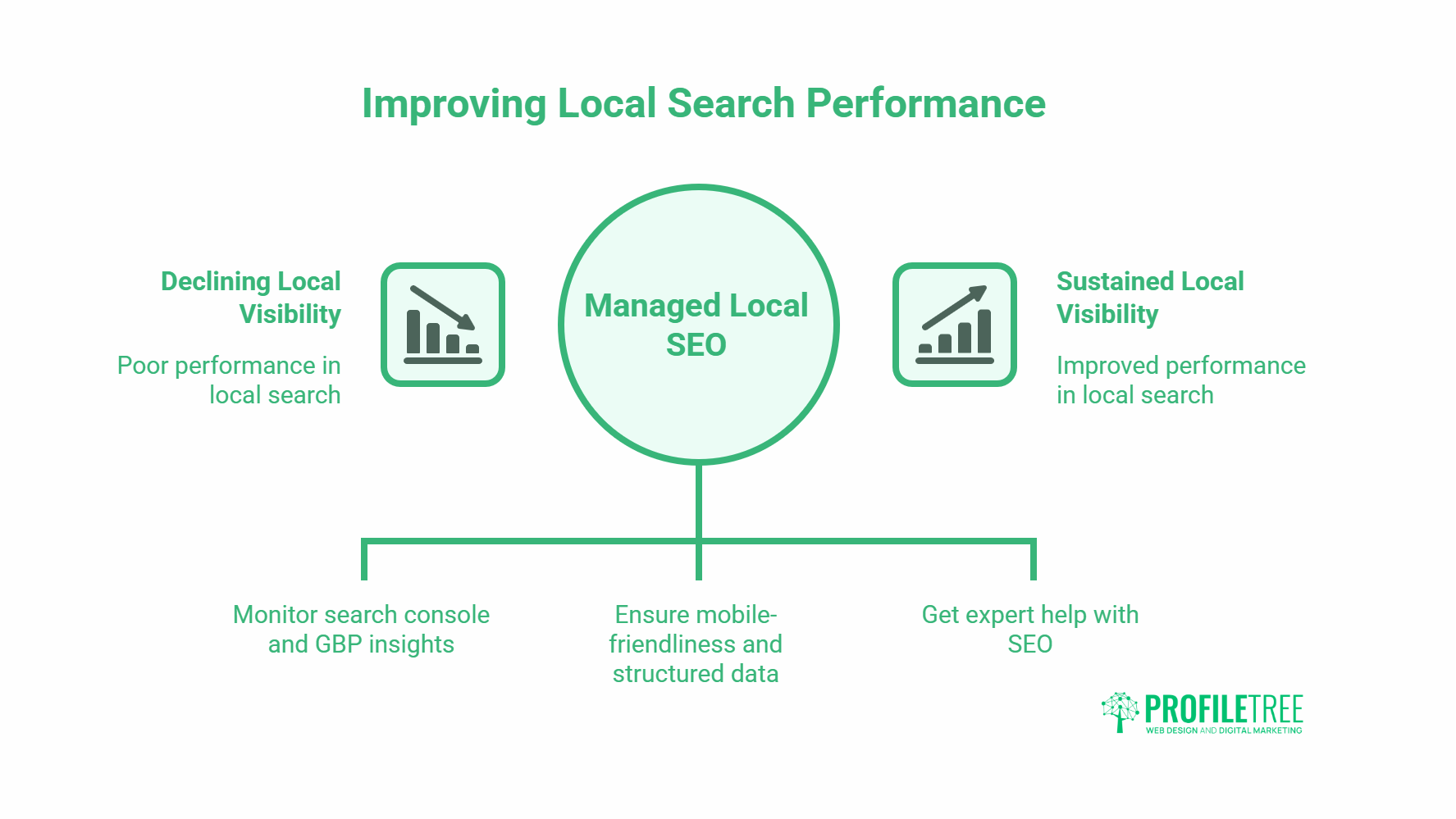
Local SEO is not a one-time task. It is an ongoing process of monitoring, adjusting, and building on what is working. The businesses that sustain local visibility over time are those that treat it as a managed activity, not a project they completed once.
What to Track
Google Search Console shows you which queries your website appears for, at what positions, and how often people click through. For local SEO, filter by location and look for geographic queries where your positions are improving or declining. A page that ranks at position 35 for “accountant Belfast” has a clear path to growth. A page that ranks at position 82 for that same term needs a more fundamental review.
Google Business Profile Insights gives you data on how customers found your listing (direct search vs discovery search), how many called, requested directions, or visited your website from the listing. These metrics tell you whether your GBP presence is actually generating real-world action.
BrightLocal and similar tools allow you to track your Local Pack rankings specifically, which do not always match your organic rankings for the same query.
Technical Website Factors That Affect Local SEO
Your website needs to be mobile-friendly. This is not optional for local SEO because local intent searches disproportionately happen on mobile devices. A site that loads slowly or displays poorly on a phone is losing local customers at the point when their intent to buy is highest.
Page speed, responsive design, structured data (specifically LocalBusiness schema), and a clear, logical URL structure all contribute to how well your site performs in local search. These are the kinds of technical factors that a specialist web design and development team addresses as standard, rather than afterthoughts.
Adding LocalBusiness schema markup to your contact and location pages helps search engines extract your NAP data accurately and display it correctly in rich results. It also contributes to your entity signals in AI-powered search features.
When to Bring in a Specialist
Local SEO can deliver significant results when managed systematically, but it takes time and consistent attention. Many SMEs find that the combination of citation management, content production, GBP maintenance, and technical optimisation stretches their internal resources.
ProfileTree’s digital marketing services include local SEO as part of a broader strategy that ties together your website, your content, and your online presence. For businesses that want a clearer picture of where their local visibility currently stands, an SEO audit is a useful starting point.
Increasingly, AI tools are also playing a role in local search strategy: from analysing competitor profiles at scale to generating location-specific content frameworks. If you want to understand how AI can support your digital marketing, ProfileTree’s AI transformation services offer structured guidance for SMEs at any starting point.
Frequently Asked Questions
What is local SEO and why does it matter for small businesses?
Local SEO is the practice of optimising your online presence so your business appears in geographically relevant search results. It matters for small businesses because the majority of local intent searches, things like “restaurant near me” or “plumber Belfast,” happen on mobile devices from people who are ready to take action. Appearing prominently in those results, particularly in Google’s Local Pack, directly affects how many enquiries and visits your business receives.
How long does it take for local SEO to show results?
Most businesses see measurable movement in local rankings within three to six months of consistent effort, with citation building and GBP optimisation typically producing the fastest results. Content and link-building strategies take longer. That said, results depend significantly on how competitive your sector is locally and the current state of your website and GBP profile. A business starting from a weak baseline may see faster early gains; one in a highly competitive market may take longer to break into the Local Pack.
What is the difference between Google Business Profile and my website for local SEO?
Your website and your Google Business Profile serve different but complementary roles. Your GBP is what appears in Google Maps and the Local Pack. It is optimised through accurate information, reviews, photos, and regular activity. Your website provides the deeper content and authority signals that support your GBP ranking and convert visitors once they click through. You need both, and they need to be consistent with each other.
How important are online reviews for local SEO?
Reviews are a significant ranking factor for local search, particularly for Local Pack positions. Google weighs review quantity, recency, and the quality of business responses. Beyond rankings, reviews also influence click-through rates: most people read reviews before contacting a local business. Actively asking satisfied customers to leave reviews, and responding to all reviews professionally, is one of the highest-return activities in local SEO.
Do I need separate pages for each location I serve?
If you serve multiple distinct locations and there is genuine search demand for your service in each one, separate location pages can improve your visibility significantly. The key requirement is that each page contains genuinely differentiated content, not just a template with the city name swapped. Pages that are too similar to each other are often treated as thin content, which can harm rather than help your rankings. If you are not sure whether separate location pages are the right approach for your business, an SEO consultation can help you make the right call.
What is a local citation and how do I build them?
A local citation is any online mention of your business name, address, and phone number. Citations on directories, review platforms, industry sites, and local publications all contribute to your local authority. To build them effectively, start by auditing and correcting any existing inconsistencies in how your business details appear online. Then prioritise reputable, relevant directories; generic quantity is far less valuable than quality placement on well-regarded local and industry-specific platforms.