
Local Marketing Strategies: 12 Tactics to Grow Your UK Business
Table of Contents
Small businesses across the UK spend money on marketing every month, yet many struggle to prove it’s actually working. The challenge isn’t a lack of advice; it’s a lack of relevant advice. Most local marketing guides are written for US audiences, referencing directories nobody in Belfast or Bristol uses and treating regional legal compliance as someone else’s problem.
This guide reflects a different reality. ProfileTree, a Belfast-based digital marketing agency supporting SMEs across the UK and Ireland, knows that local marketing requires a distinct approach on this side of the Atlantic. The tactics that move the needle here look entirely different from what works in Chicago or Seattle.
What follows is a practical breakdown of 12 local marketing strategies built specifically for UK and Irish business conditions, alongside a framework for measuring what actually works for your bottom line.
What is Local Marketing?
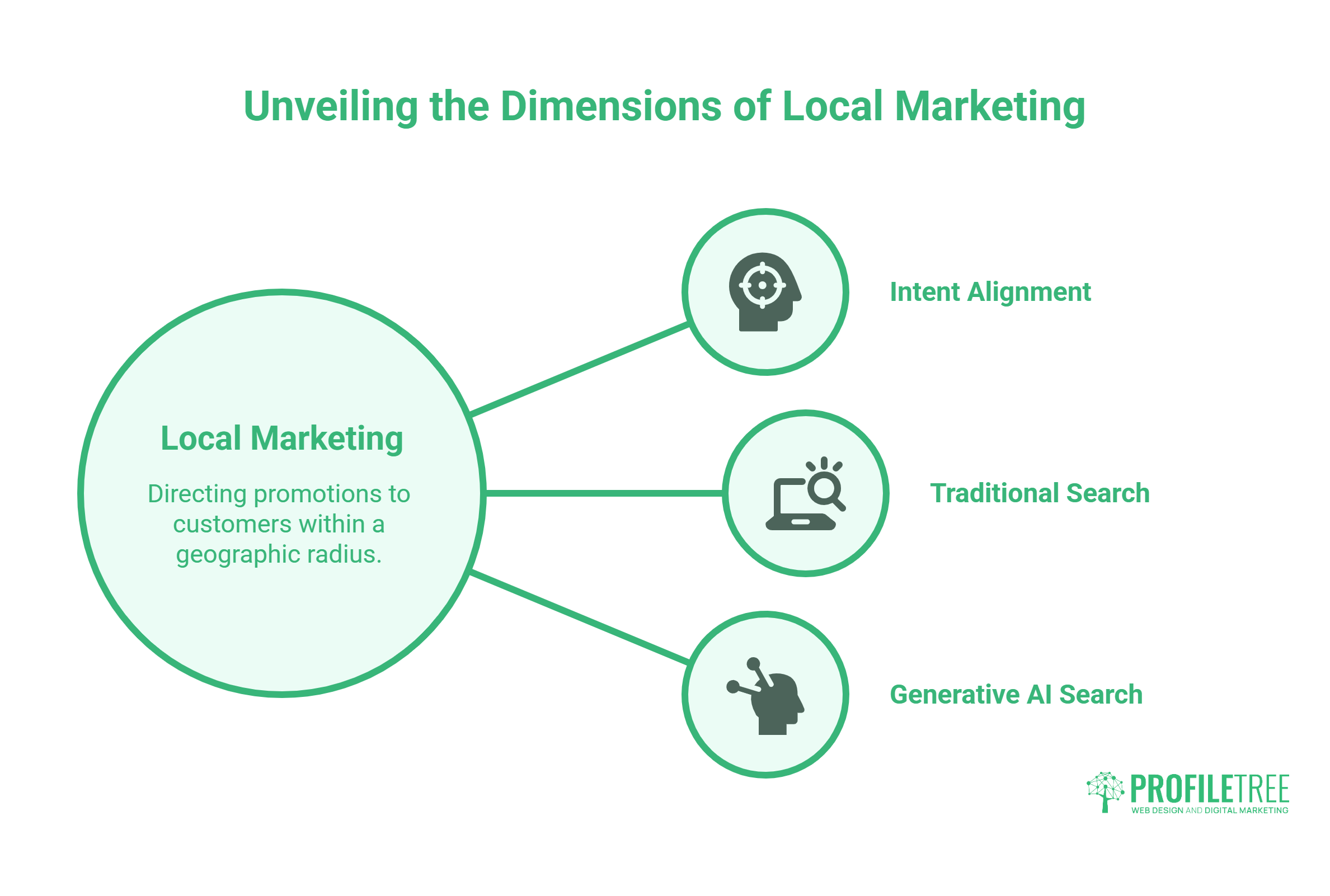
Local marketing is the practice of directing your promotional effort at customers within a defined geographic radius of your business, whether that’s a specific postcode district, a city, or a region. The goal is visibility and conversion within a bounded area, not national reach.
The key distinction from broader digital marketing is intent alignment. When someone searches “plumber BT7” or “accountant Belfast city centre,” they’re ready to act. Local marketing strategies are designed to put your business in front of that intent at the right moment.
For UK businesses, local marketing spans two overlapping environments: traditional search (Google’s local pack, Maps, and organic results) and generative AI search (ChatGPT, Gemini, Perplexity, and Google AI Overviews). In 2026, showing up in AI-generated answers for local queries is as commercially significant as appearing in the map pack.
Why a Local Focus Drives Business Growth
The economics of local marketing are difficult to argue with. “Near me” searches have grown substantially year on year, and Google’s own data consistently shows that the majority of users who conduct a local search visit a business within 24 hours. For service businesses without a national marketing budget, local focus isn’t a fallback; it’s the most efficient path to qualified leads.
Local marketing also compounds over time in ways that national campaigns don’t. Reviews accumulate, directory citations build trust signals, and community relationships generate referrals. Each of these assets strengthens over months and years rather than resetting when a campaign budget runs out.
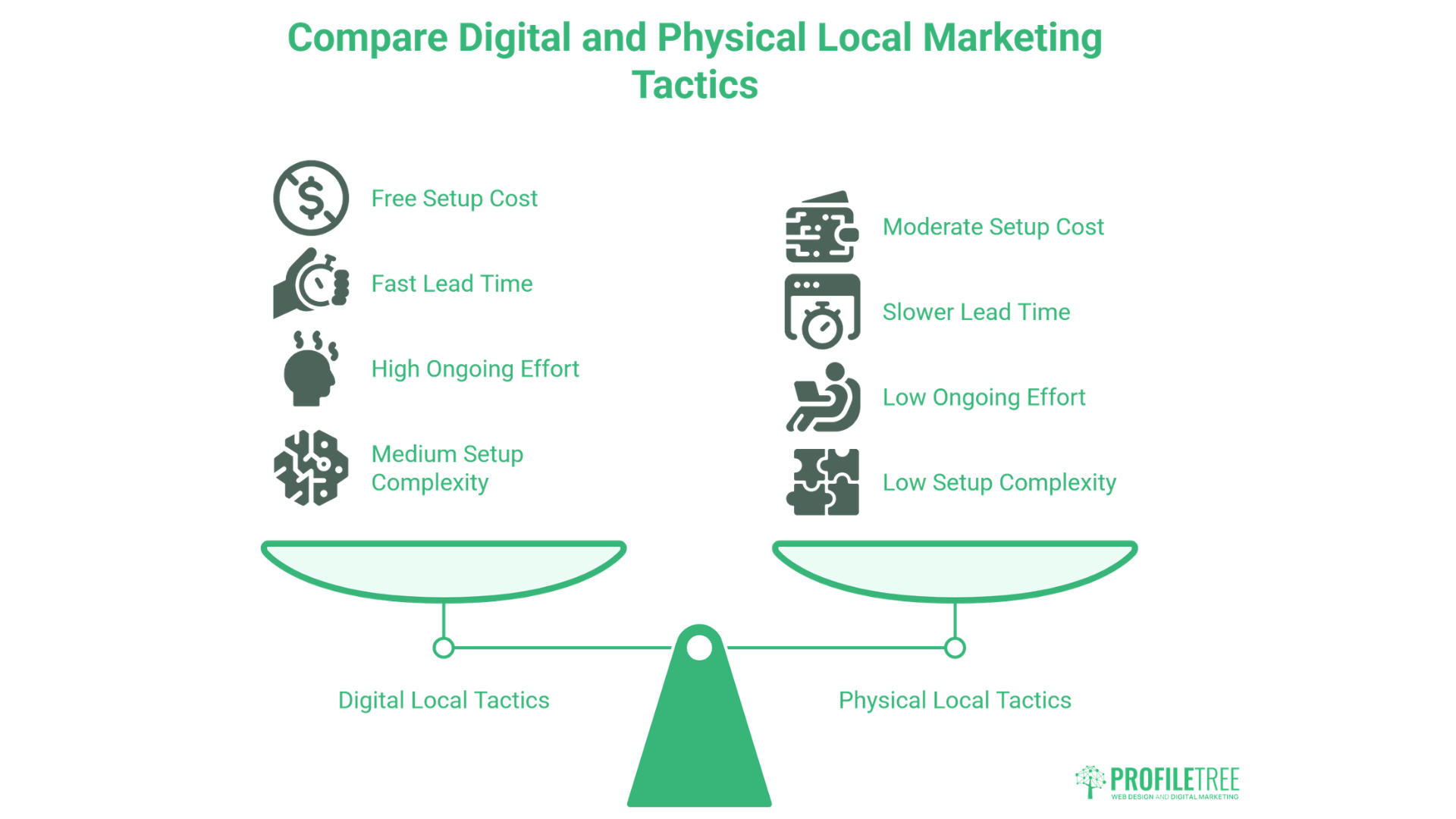
The table below contrasts the main digital and physical local tactics across the dimensions that matter most to a small business owner making budget decisions.
| Local Tactic | Avg. Setup Cost | Time to First Lead | Ongoing Effort | Setup Complexity |
| Google Business Profile | Free | Days | Low | Low |
| Local SEO (on-site) | £500–£2,000 | 3–6 months | Medium | Medium |
| Local Services Ads | £200–£500/mo | Days | Low–Medium | Low |
| PPC (Google Ads) | £300–£1,000/mo | Days | High | Medium |
| Local directories | Free–£100/yr | Weeks | Low | Low |
| Social media (organic) | Free | Weeks | High | Low |
| Micro-influencer partnerships | £100–£500 | Weeks | Medium | Low |
| Flyer/print with QR tracking | £50–£300 | Days–weeks | Low | Medium |
| Community sponsorship | £200–£2,000 | Months | Low | Low |
| Email/SMS marketing | £30–£100/mo | Days | Medium | Medium |
| Local events/workshops | £100–£500 | Days | High | Medium |
| Referral programme | Free–£50/mo | Weeks | Low | Low |
The Core 12 Local Marketing Strategies
The local marketing tactics below are ordered by a combination of accessibility and impact for businesses starting from a modest baseline. They can be applied independently or in combination.
1. Optimise Your Google Business Profile for Maps and AI
Your Google Business Profile (GBP) is the single most important local marketing asset you control directly. When someone searches for your service category in your area, GBP data determines whether you appear in the map pack (the three results shown above organic listings).
Complete every available field: business name, address, phone, website, hours, service categories, service areas, and description. Add photos regularly (Google favours accounts with recent photo activity). Enable the Q&A section and answer questions proactively. Post updates at least twice a month to signal activity.
Critically for 2026: AI systems, including Gemini and Google’s AI Overviews, draw directly from GBP data when generating local recommendations. A well-structured, complete profile provides those systems with the structured information they need to recommend your business in conversational searches.
2. Claim the Local Directories That Actually Matter in the UK and Ireland
US guides push Yelp. In the UK and Ireland, Yelp has negligible market penetration. The directories that matter here are different, and treating them with the same attention you’d give a generic US list wastes time.
Priority UK directories:
| Directory | Primary Audience | Submission | SEO Value |
| Google Business Profile | All | Free | Very High |
| Apple Maps | iOS users | Free | High |
| Bing Places | Bing/Copilot users | Free | High |
| Yell.com | UK consumers | Free/Paid | Medium-High |
| Thomson Local | UK consumers | Free/Paid | Medium |
| Scoot | UK consumers | Free | Medium |
| TripAdvisor | Hospitality/leisure | Free/Paid | High (sector) |
| Checkatrade | Trades/home services | Paid | High (sector) |
| Golden Pages | Republic of Ireland | Free/Paid | High (IE) |
| Trustpilot | All sectors | Free/Paid | Medium-High |
Consistency matters more than volume. Your business name, address, and phone number must appear in exactly the same format across every listing. Variations (Ltd vs Limited, Street vs St) create conflicting signals that weaken local rankings.
3. Capitalise on Local Generative Engine Optimisation (GEO)
Generative Engine Optimisation (GEO) is the practice of structuring your online presence so that AI systems can accurately extract and cite your business when answering local queries. This is where local marketing in 2026 diverges most sharply from what worked in 2020.
When a user asks ChatGPT, “which web design agency should I use in Belfast?”, the model pulls structured data from multiple sources: your GBP listing, your website’s LocalBusiness schema markup, third-party directory citations, and review platforms. Businesses with coherent, consistent information across all these sources get recommended. Those with patchy or contradictory data don’t.
“AI search engines are building local recommendations from structured signals: reviews, schema markup, and citation consistency across directories. If your data contradicts itself across platforms, the model has no confident answer to give, so it picks someone else,” says Ciaran Connolly, founder of ProfileTree.
Practical GEO steps for local businesses: implement LocalBusiness schema on your website (including name, address, phone, geo coordinates, opening hours, and service area), maintain NAP consistency across all directories, and actively generate reviews on platforms that AI systems index heavily, principally Google and Trustpilot.
4. Build Legally Compliant Email and SMS Lists Under GDPR and PECR
This is where most local marketing guides written for US audiences will get UK businesses into serious legal trouble.
The UK’s Privacy and Electronic Communications Regulations (PECR), which sit alongside UK GDPR, impose strict opt-in requirements for marketing emails and SMS messages sent to individual consumers. Unlike the US CAN-SPAM Act, which allows opt-out marketing, PECR requires clear, specific, prior consent before you can send a marketing message to a consumer.
What this means in practice:
- You cannot legally buy a list of local business contacts and email them without prior consent.
- You cannot send SMS marketing to a mobile number collected at a point of sale without explicit opt-in to marketing at the time of collection.
- Pre-ticked consent boxes do not count as valid consent under UK GDPR.
- You must tell people what they’re consenting to at the point of sign-up: “marketing emails about our services” is acceptable; a buried clause in terms and conditions is not.
For B2B communications, PECR is slightly more permissive, and you can contact businesses at corporate email addresses under soft opt-in rules if there’s a genuine business relationship; individual sole traders and partnerships are treated the same as consumers.
Build your list the right way: use sign-up forms with specific consent language, offer genuine value (a local discount, a useful guide, event invitations) in exchange for sign-up, and keep a record of how and when consent was given.
5. Target Hyper-Local Areas Using Postcode-Level SEO
US guides tell you to build campaigns around ZIP codes. In the UK and Ireland, the equivalent is the outward code of a UK postcode: the first half of the full postcode that identifies a specific district (BT7 in south Belfast, SW1A in Westminster, M1 in central Manchester).
Postcode targeting has two practical applications for local businesses:
On-site: Build individual service area landing pages for each postcode district you serve, with genuinely localised content: local landmarks, specific business challenges in that area, and relevant case studies. A page targeting “web design BT9” should contain materially different content from one targeting “web design BT7,” not just the same template with the area name swapped.
In paid search:Google Ads allows location targeting by postcode radius or by specific postcode lists. Upload your target outward codes as a location-targeting list and bid higher for searches originating in your highest-value postcodes.
For businesses in Northern Ireland, covering BT postcodes systematically in your service area content is one of the clearest ways to signal geographic relevance to both Google and AI search systems.
6. Build Local Presence Through Social Media and Micro-Influencers
National social media reach is largely irrelevant for a local business. What matters is engagement from people who live, work, or buy within your service area.
On Instagram, geotags are the most underused tool available. Tagging your location on every post and story makes your content discoverable by users browsing that location. Localised hashtags like #BelfastEats, #ManchesterBusiness, #DublinStartup, which extend that reach to people following local conversations.
Micro-influencers with 2,000 to 15,000 followers and a geographically concentrated audience typically generate higher engagement rates than large accounts for local campaigns, and their rates are accessible for smaller budgets. A local food blogger, a community sports personality, or a well-connected local business owner with an active social presence can introduce your business to a concentrated, relevant audience for a fraction of what a display campaign would cost.
Facebook remains the most effective platform for hyper-local paid social. Its geo-targeting options allow you to serve ads to users within a specific radius of an address, down to one kilometre. Local awareness campaigns work well for new business launches, seasonal promotions, and event announcements.
7. Sponsor Local Sports Clubs and Community Initiatives
Community sponsorship is one of the most cost-effective local marketing tactics available, and it’s consistently overlooked in guides written for a US context.
In Northern Ireland and Ireland, GAA clubs (Gaelic Athletic Association) command enormous local loyalty and have active adult membership spanning a wide age range. A sponsor logo on a GAA jersey appears at training sessions, match days, and social events across the community. The cost of kit sponsorship for a local club is often £500–£2,000 per year, comparable to a single month of paid search spend, but with ongoing community visibility.
Across the rest of the UK, local football clubs at grassroots level offer similar value. Many operate pitch-side advertising, programme advertising, and social media mentions as part of sponsorship packages. The audiences are geographically precise, the community goodwill is genuine, and the brand association is positive by default.
Youth sport sponsorships (junior football, rugby minis, swimming clubs) reach parents (often the primary household decision-makers) in a non-commercial context. That trust is harder to buy through any digital channel.
8. Execute Trackable Offline Print Campaigns
The standard advice (“hand out flyers”) is useless without a measurement framework. No physical marketing material should be produced without a mechanism for tracking its digital impact.
The simplest effective approach: create a unique QR code for each print campaign that resolves to a dedicated landing page URL with UTM parameters built in. A flyer distributed in a specific area might link to:
yoursite.com/local-offer/?utm_source=flyer&utm_medium=print&utm_campaign=belfast-south-may
When that URL is visited, Google Analytics 4 records the source, medium, and campaign.
Breaking it down:
yoursite.com/local-offer/— the landing page the person lands on after scanning the QR code- The parts after the
?are UTM parameters, which are tracking tags that tell Google Analytics where a website visit came from utm_source=flyer— tells GA4 the visit came from a flyerutm_medium=print— tells GA4 the channel was printutm_campaign=belfast-south-may— tells GA4 which specific campaign it was (a south Belfast drop in May)
Over the life of the campaign, you can see exactly how many people scanned that flyer, what they did on the site, and whether any converted.
Apply the same logic to:
- Window stickers (unique QR from printed sticker)
- Leaflet drops by postcode (different QR per postcode zone)
- Local magazine ads (unique QR or vanity URL per publication)
- Banners at sponsored events (QR code with event name as UTM campaign)
This framework turns every offline channel into a measurable digital attribution point. It doesn’t require expensive technology. Free QR generators and GA4’s campaign URL builder are sufficient.
9. Set Up a Local Referral and Loyalty Programme
Referral programmes work because they convert your existing customers’ social capital into new business. For local businesses, where many customers already know each other through community, school, or workplace networks, this social capital is densely concentrated and highly trusted.
A simple referral programme needs three things: a clear incentive (typically a discount or credit for both the referrer and the new customer), a frictionless mechanism (a unique referral code or link), and consistent communication to remind customers it exists.
Loyalty programmes serve a different but complementary function: they increase repeat purchase frequency and create a structural reason for customers to choose you over a competitor. A digital stamp card (using apps like Stamp Me or Loyalzoo) is more trackable and less easily forged than a physical card, and many integrate directly with email marketing platforms.
10. Run Targeted Local Services Ads
Local Services Ads (LSAs) appear above standard Google Ads in search results for service-based queries like “plumber near me” or “electrician Belfast.” They display a “Google Guaranteed” or “Google Screened” badge, which requires a background check and licence verification process, but the conversion benefit is significant. That badge signals vetted legitimacy to a cautious consumer.
LSAs operate on a pay-per-lead model rather than a pay-per-click model, which changes the economics considerably. You pay only when a customer contacts you directly through the ad. For service businesses in competitive local markets, this can deliver a lower cost per acquisition than equivalent PPC spend.
Eligibility varies by business category. Trades, home services, legal, financial, and healthcare businesses are generally eligible. Check Google’s LSA eligibility list for your specific category before building this into your budget.
11. Host High-Value In-Person Events and Workshops
Running a local event positions your business as an active, contributing member of the community rather than just a service provider. The content of the event matters: a free 90-minute workshop on a topic your customers genuinely need help with delivers far more goodwill than a thinly veiled sales presentation.
For B2B businesses, lunch-and-learn sessions, industry briefings, or skills workshops attract qualified attendance from decision-makers who self-select based on interest. For consumer businesses, demonstrations, tastings, classes, or community meetups serve the same purpose.
Local events also generate secondary marketing value: social media coverage before and after, local press coverage if the event is genuinely newsworthy, and the opportunity to build an email list of attendees with proper consent capture at registration.
ProfileTree’s digital training sessions for SMEs across Northern Ireland have consistently generated high-quality leads from business owners who attend to learn and subsequently recognise the gap between where they are and where they could be.
12. Cultivate Authentic Online Reviews and Schema Markup
Reviews function as both a ranking signal and a conversion factor. For local businesses, Google reviews carry the most weight in local pack rankings, but review volume and recency on Trustpilot, Facebook, and sector-specific platforms (Checkatrade for trades, TripAdvisor for hospitality) contribute to the overall trust picture, including how AI systems represent your business.
The most effective way to grow review volume is simply to ask, at the right moment and in the right channel. A follow-up text message with a direct review link sent within 24 hours of a completed job consistently outperforms asking in person or including a request on an invoice.
On the technical side, LocalBusiness structured data (schema markup) tells search engines and AI systems exactly what your business is, where it is, what it does, and when it’s open. A basic implementation covers:
json
{
“@context”: “https://schema.org”,
“@type”: “LocalBusiness”,
“name”: “Your Business Name”,
“address”: {
“@type”: “PostalAddress”,
“streetAddress”: “1 Example Street”,
“addressLocality”: “Belfast”,
“postalCode”: “BT1 1AA”,
“addressCountry”: “GB”
},
“telephone”: “+44 28 XXXX XXXX”,
“openingHours”: “Mo-Fr 09:00-17:30”,
“geo”: {
“@type”: “GeoCoordinates”,
“latitude”: 54.5973,
“longitude”: -5.9301
}
}
This markup doesn’t change what visitors see; it communicates directly with crawlers, feeding the structured data that AI search engines rely on for local recommendations.
How to Measure the ROI of Offline Local Marketing
Measuring the ROI of offline local marketing is the gap where most competitor guides fall short. They recommend offline local marketing tactics and then suggest vague measurement methods like “track traffic changes” or “use a unique phone number.” Neither is sufficient for a business owner who wants to understand which channels are actually generating returns.
A practical offline measurement framework uses three tools in combination: unique QR codes, UTM parameters, and GA4 conversion tracking.
Step 1: Build a UTM matrix before any material goes to print. Assign a unique combination of utm_source, utm_medium, and utm_campaign to each distinct physical channel. Use a consistent naming convention:
| Material | utm_source | utm_medium | utm_campaign |
| A5 flyer, BT9 drop | flyer | belfast-bt9-june | |
| Sponsor banner, Cliftonville FC | sponsorship | banner | cliftonville-season |
| Local magazine, June issue | connacht-tribune | june-issue | |
| Window sticker | storefront | sticker | permanent |
Step 2: Generate unique QR codes for each UTM URL. Free tools like QR Code Generator or Google’s Campaign URL Builder handle this in minutes. Each QR code resolves to your target landing page with the UTM parameters appended.
Step 3: Set up GA4 conversion events. Define what a conversion looks like for your business: a form submission, a phone number click, a booking page visit. In GA4, mark these as conversion events so that session data from your print campaigns is attributed to the correct channel in your acquisition reports.
Step 4: Calculate Return on Offline Spend (ROOS).
ROOS = (Revenue from offline-attributed conversions) / (Total offline campaign cost) × 100
If a £300 flyer drop in BT9 generated 8 QR scans, 3 form submissions, and 2 closed jobs worth £900 combined, the ROOS is 300%. That’s a channel worth repeating. If the same spend in BT4 generated 1 scan and no conversions, redirect the budget elsewhere.
This framework applies to any physical channel. It won’t capture every conversion. Some people see a flyer and search for your name directly, but it gives you directional data where you previously had none.
Choosing the Right Local Marketing Software
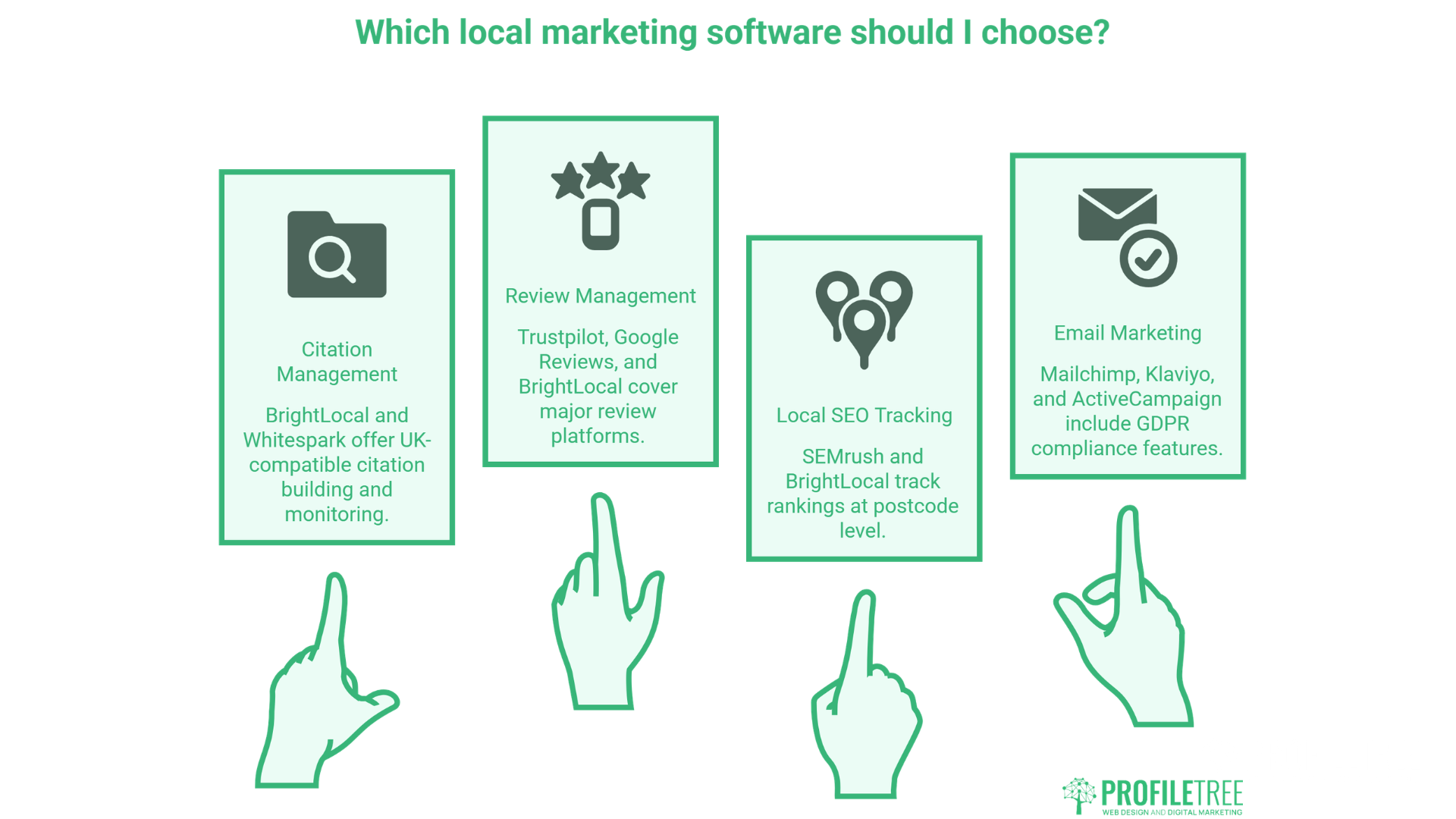
The right tools depend on where you are in the process of building your local marketing infrastructure.
For citation management and directory monitoring: BrightLocal and Whitespark both offer UK-compatible citation building and monitoring. They track consistency across directories, flag conflicting NAP data, and identify citation opportunities you haven’t claimed yet.
For review management: Trustpilot’s business tools, Google’s review reply interface, and BrightLocal’s review monitoring dashboard cover the main review platforms. For trades businesses on Checkatrade or Rated People, those platforms have their own review notification systems.
For local SEO tracking:SEMrush’s Position Tracking feature and BrightLocal’s Local Rank Tracker both support local ranking tracking at postcode level. This matters because national ranking tools don’t accurately reflect what a user in a specific area sees.
For email marketing with GDPR compliance built in:Mailchimp, Klaviyo, and ActiveCampaign all include consent management features. Use their native sign-up forms, which automatically record consent timestamps. This is essential if you’re ever asked to demonstrate how and when you obtained permission.
Summary: Where to Start
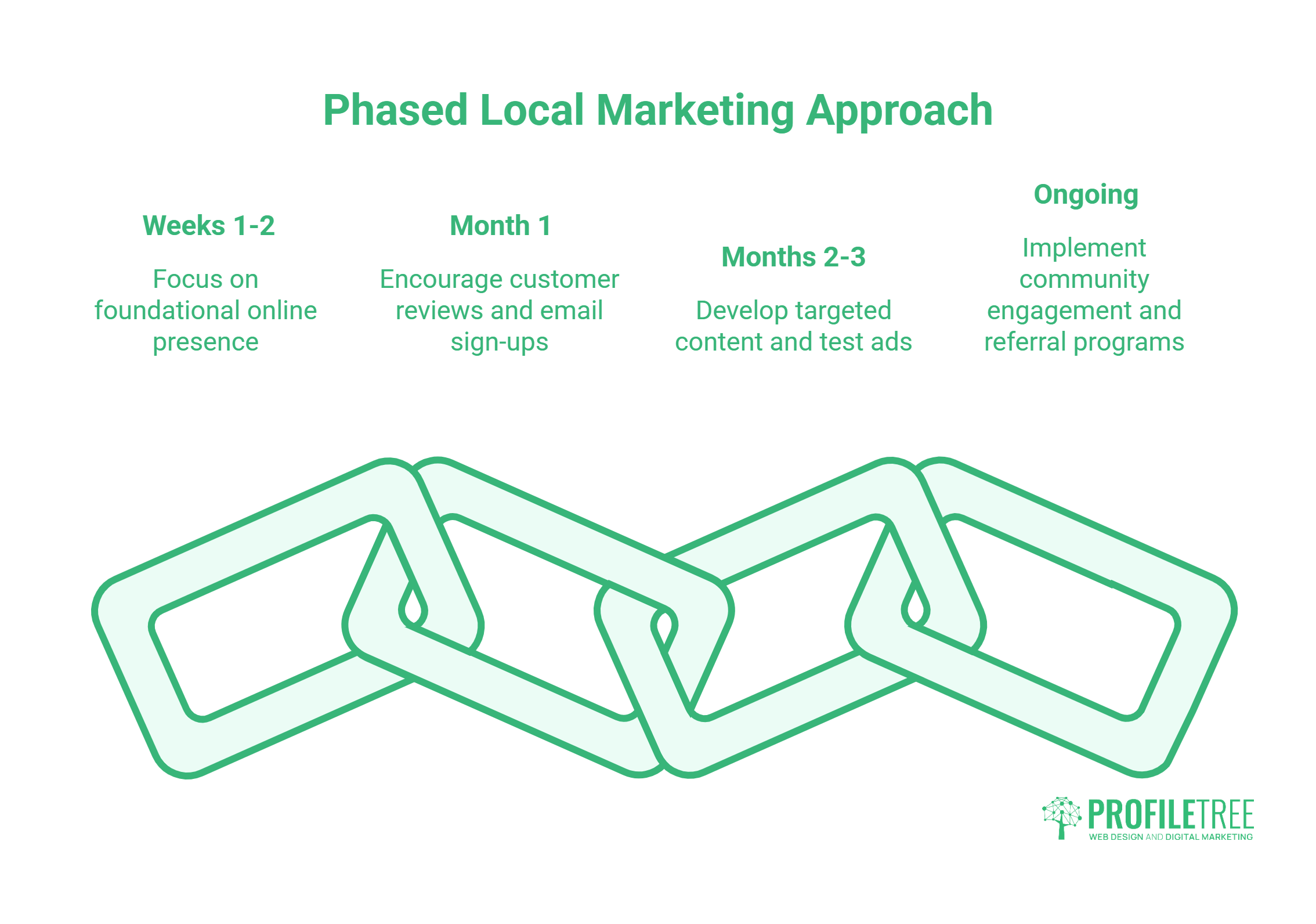
Running all 12 strategies simultaneously isn’t realistic for most small businesses. A practical starting sequence focuses on the high-impact, low-cost foundations first.
Weeks 1–2: Claim and fully complete your Google Business Profile. Audit your existing directory listings for NAP consistency and fix discrepancies. Implement LocalBusiness schema on your website.
Month 1: Begin asking for Google reviews systematically after every completed job or purchase. Set up a GDPR-compliant email sign-up with a genuine incentive.
Months 2–3: Launch a postcode-level content strategy for your top two or three service areas. If budget allows, test Local Services Ads for your highest-value service category.
Ongoing: Add community sponsorship, referral programmes, and trackable offline campaigns as your baseline infrastructure matures.
Local marketing for UK businesses rewards patience and consistency over one-off campaign spend. The businesses that appear in the map pack, in AI-generated recommendations, and in their community’s trusted networks are the ones that built those signals steadily over time, not the ones that ran a single campaign and hoped for the best.
Ready to Build a Local Marketing Strategy That Works?
Most local businesses don’t lose customers to better competitors. They lose them to businesses that are simply easier to find. If your marketing spend isn’t generating leads you can trace back to a source, the problem usually isn’t the budget; it’s the strategy.
ProfileTree works with SMEs across Northern Ireland, Ireland, and the UK to build local marketing strategies grounded in data, not guesswork. Whether you need help with local SEO, digital marketing, or a content strategy targeting your specific service areas, we can help you identify exactly where the gaps are.
Talk to our team, and we’ll take an honest look at where your local visibility stands and what’s worth addressing first.
FAQs About Local Marketing Strategies
What is a local marketing strategy?
A local marketing strategy is a plan that aligns your promotional activity with the specific geographic area where your customers live, work, or search. It combines digital tools (local SEO, Google Business Profile, directory listings, paid local ads) with physical and community-based tactics (sponsorship, events, referrals) to generate qualified enquiries from a defined radius. Unlike national marketing, it prioritises proximity and relevance to a bounded audience over broad reach.
How do I market my business locally in the UK?
Start with the digital foundations: claim and complete your Google Business Profile. Your business name, address, and phone number must be consistent across UK directories (Yell, Thomson Local, Scoot, Apple Maps, Bing Places), and implement LocalBusiness schema markup on your website. Then build content targeting specific postcode areas you serve and work on generating a steady flow of Google reviews. Once those foundations are in place, layer in paid local ads (Google Local Services Ads or geo-targeted PPC), community sponsorship, and a GDPR-compliant email list.
Is cold SMS or email outreach legal for local marketing in the UK?
No, for consumer audiences. Under UK PECR and UK GDPR, you must obtain explicit, specific, prior consent before sending marketing emails or SMS messages to individual consumers. Buying a contact list and emailing it, or collecting a phone number in-store without a clear opt-in to marketing, both breach these regulations. The penalties from the Information Commissioner’s Office (ICO) can reach £500,000 for serious breaches. B2B outreach to corporate email addresses has slightly more flexibility under the soft opt-in rule, but sole traders and partnerships are treated as consumers.
How do I track the return on investment for offline marketing, such as flyers?
Generate a unique QR code for each print campaign that resolves to a landing page URL with UTM parameters (utm_source, utm_medium, utm_campaign). When someone scans the QR code, GA4 records the visit and attributes it to that specific campaign. Set conversion events in GA4 (form submissions, phone number clicks, booking completions) and calculate your Return on Offline Spend using: (revenue from attributed conversions) / (total campaign cost) × 100. This gives you channel-level data you can use to allocate future spend.
Which UK business directories matter most for local rankings?
In priority order: Google Business Profile (by far the most important), Bing Places (increasingly significant as Copilot grows), Apple Maps, Yell.com, Thomson Local, Scoot, and Trustpilot. For sector-specific businesses: TripAdvisor (hospitality and leisure), Checkatrade or Rated People (trades), and Houzz (home improvement). For the Republic of Ireland: Golden Pages. Do not invest significant time in Yelp, which has very low market penetration in the UK and Ireland compared to these alternatives.
Do I need a physical premises to run local marketing effectively?
No. Google allows service-area businesses (SABs), which travel to customers rather than receiving them at a fixed address, to hide their address on their GBP listing and instead define their service area by region or postcode districts. A plumber, cleaning company, or mobile consultant can maintain a strong local presence without a public-facing address. What matters is a verified GBP account, a clear service area definition, and consistent customer reviews in those areas.