
Generative Engine Optimisation: A Working Guide
Table of Contents
Generative engine optimisation (GEO) strategies work best inside an existing marketing plan, not beside it. The businesses getting mentioned in ChatGPT, Perplexity, and Google’s AI Overviews are rarely the ones that bought a separate GEO product. They’re the ones that tightened up work they were already doing.
This guide is the practical side of GEO: what the work involves, what GEO services include, how to measure whether any of it is working, what the research actually supports, and where a small business should start.
What Does GEO Mean, and How Is It Different From SEO?
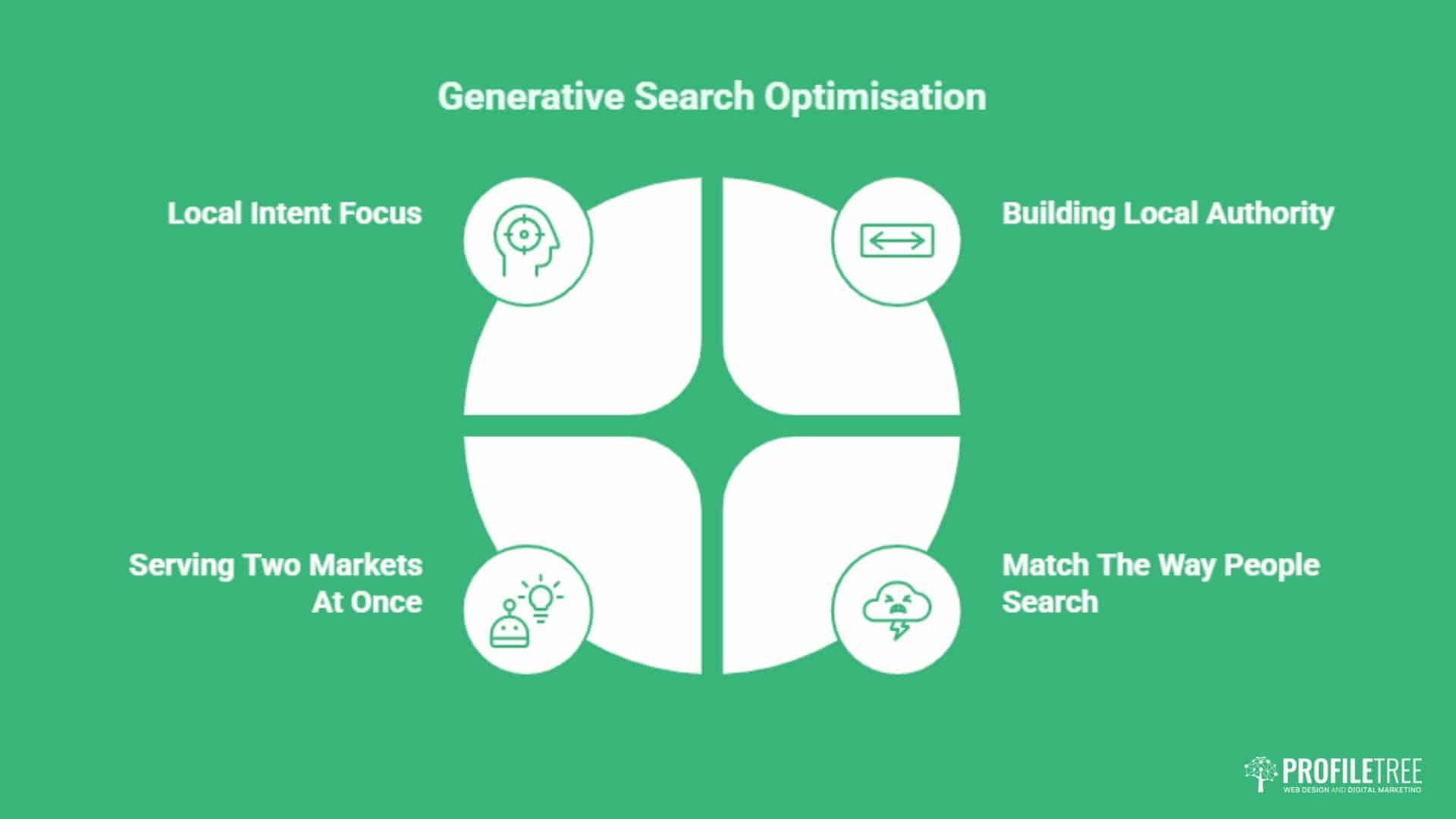
Generative engine optimisation is the work of shaping content so that AI answer engines can extract it, trust it, and cite it in the response they give a searcher. Where SEO ranks whole pages on a results page, GEO wins citations for individual passages inside an AI answer, and it rewards a business described consistently everywhere it appears rather than one that repeats the right keywords.
For a small business, the practical difference is the size of the shortlist. A results page shows ten options and lets the buyer choose. An AI answer often names two or three businesses and moves on, and a buyer rarely asks which ones were left out. What the two disciplines share matters more for planning: both depend on crawlable pages, genuine authority and clear structure, which is why GEO is best run as part of AI SEO rather than as a separate programme. The full definition and comparison are covered in what generative engine optimisation is.
Where Does GEO Fit in a Marketing Plan?
GEO isn’t a separate line on an invoice. It’s an extra lens applied to work that’s already happening: the technical audit now checks schema completeness as well as crawl errors, the content review now checks whether each passage can stand alone, and monthly reporting now includes a directional view of AI mentions alongside rankings and traffic. That’s also how ProfileTree runs it in its AI SEO programmes for businesses in Ireland, where trading across the border adds its own layer of detail.
That’s why GEO touches almost every channel in a plan. Entity consistency depends on how the website is built and how listings are managed. Quotable passages come from content marketing services and service page copy. Third-party mentions come from digital PR, reviews, and guest contributions. Video counts too: transcripts and metadata from video production feed the same signals as written content. A business with a consistent presence across formats builds a clearer picture for AI systems than one relying on text alone.
Proof pages matter more than most businesses realise. A case studies page and a well-built “why choose us” page are exactly the kind of consolidated, fact-dense pages that AI tools draw on when asked to recommend a business, so they deserve the same careful treatment as any article.
What Are the Main Generative Engine Optimisation Strategies?
There are four generative engine optimisation strategies that do most of the work: describing your business identically everywhere it appears online, structuring content so a passage can be lifted whole, backing every claim with something a reader can check, and keeping the page genuinely current. None of them require new software. They require rewriting habits.
Entity Consistency
Generative engines cross-reference how a business describes itself across the web. Before touching schema or writing anything new, audit every place the business name, address, phone number, and service description appear: the homepage, the about page, Google Business Profile, social bios, and directory listings. If your NAP and core offer are worded differently, a model has to guess which version is current. It also tends to default to whichever source it trusts most, which might not be you.
Standardise the wording, so “a Belfast-based web design and digital marketing agency” reads the same way wherever it appears, rather than being rewritten on every page. Old addresses, pre-rebrand names, and duplicate listings come out. It’s unglamorous work, but it removes a source of doubt that costs you citations for no good reason.
“Most businesses we look at have three or four different versions of their own name floating around the web. Fixing that costs nothing, and it’s the single biggest lever most sites have never pulled.” Ciaran Connolly, founder of ProfileTree
Content Structure
Answer engines favour passages that stand on their own. That means a heading phrased as the question a person actually asks, followed immediately by a direct answer in the first sentence or two, with supporting detail after. A paragraph that opens with three sentences of context before it gets to the point gives a model nothing clean to lift. Tables help for the same reason: a comparison laid out in rows and columns is far easier for a system to reuse than the same information buried in prose.
Structured data supports the same goal. Organisation schema site-wide, Service schema on each service page, and FAQPage and Review schema where that content is visible give AI systems a machine-readable version of facts a human reader would otherwise infer from the prose. A schema markup guide covers the properties that matter most for a service business. This is a developer task rather than content, so brief whoever manages the site’s code early.
Source-Worthiness
A model favours content it can treat as evidence rather than opinion. That means named figures with a linked source, direct quotes attributed to a real person with a real title, and specific detail about process, cost, and outcome rather than a general claim of quality. “We deliver excellent results” tells a model nothing it can check. “This kind of project typically takes six to eight weeks, based on the last twenty jobs we’ve completed” gives it something concrete to weigh, provided it’s actually true and you’re willing to stand behind it.
Outside the site, independent confirmation carries heavy weight. Mentions in the trade press, citations in directories, reviews on third-party platforms and references in other people’s guides all tell a model that someone other than the business vouches for it. Those mentions work best once your own details are consistent because external references pointing at conflicting information simply spread the confusion across more sources.
Freshness
Generative engines lean towards material that has been genuinely updated, not just republished with a new date. A page written well once and then left untouched tends to lose ground over time even if nothing about the underlying facts has changed. The fix isn’t a cosmetic timestamp. It’s a scheduled review of the pages that matter most, usually quarterly: adding a new section, updating a figure, or expanding coverage as the topic itself moves on, and then noting plainly when that last happened.
The order matters more than any single tactic. Fix your business details first, because everything else depends on a model being able to identify you. Add schema and restructure pages second, build outside mentions third, and keep freshness running as a routine rather than a one-off project. Doing them in reverse means redoing earlier work later.
What Do Generative Engine Optimisation Services Include?
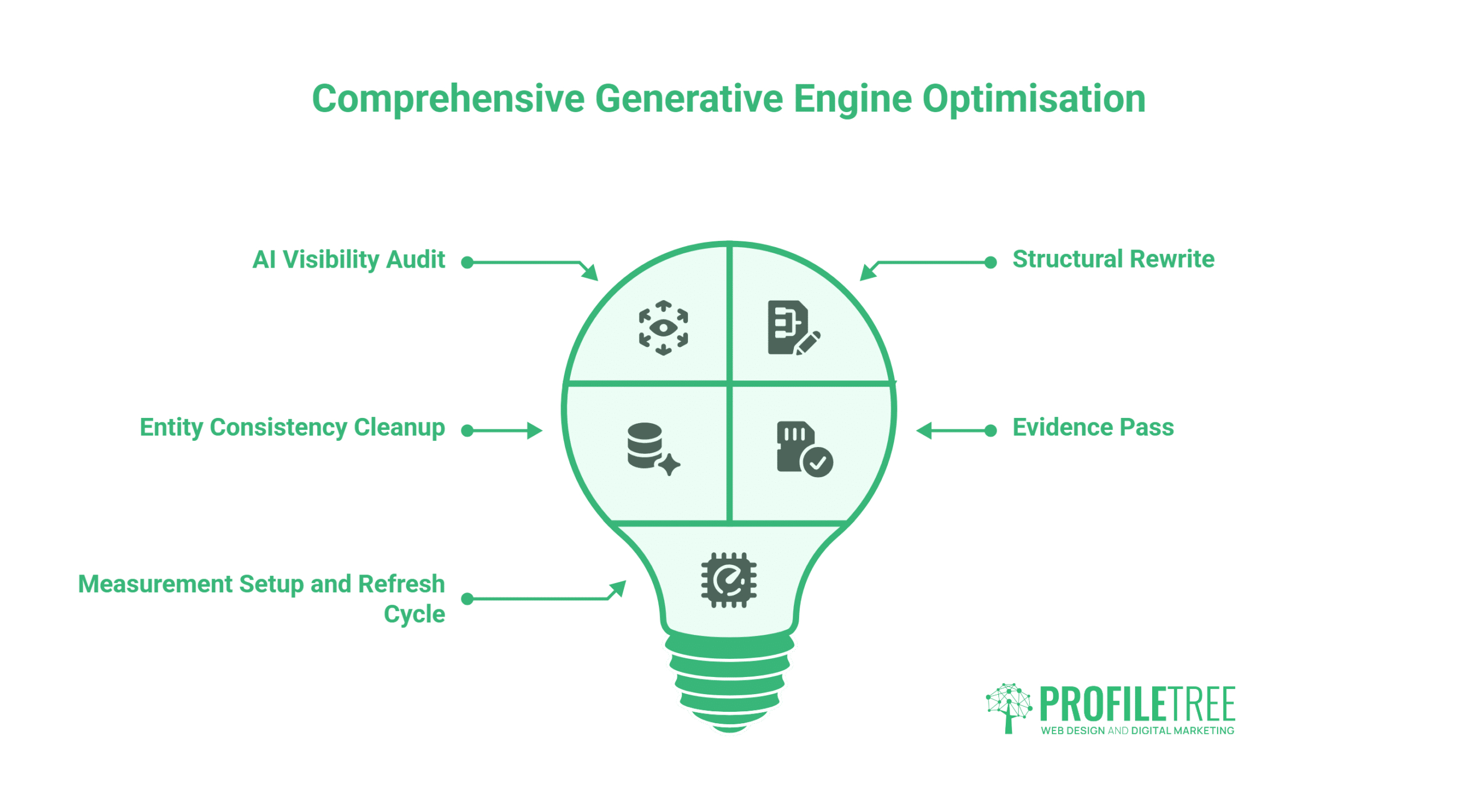
A generative engine optimisation service is a programme of auditing, rewriting, and measuring pages you already own, so that AI assistants can extract and cite them. It is not a separate channel running alongside search engine optimisation, and any provider selling it as one is selling you the same work twice. In practice, a GEO service covers five things.
An AI visibility audit. The provider runs your priority questions through ChatGPT, Perplexity, Copilot, and Gemini, records whether you are named and what is said about you, and establishes a baseline before anything changes. Without that baseline, there is nothing to measure against later.
An entity consistency clean-up. Your business details made identical across the website, Google Business Profile, directory listings, and social bios. Largely one-off, and done early because everything else depends on a machine being able to identify you confidently.
A structural rewrite of priority pages. Headings rewritten as the questions customers ask, answers moved into the first sentence or two of each section, and comparisons moved into tables, on the pages that matter most commercially. This is the bulk of the hours on most engagements.
An evidence pass. Every claim on the priority pages checked: vague statements replaced with named, sourced specifics, and anything that cannot be substantiated taken out.
A measurement setup and refresh cycle. Bing Webmaster Tools connected and its AI Performance report monitored, branded search and AI referral segments set up in analytics, a schedule for manual assistant checks, and an agreed cadence for updating the pages once they are live.
How Is Generative Engine Optimisation Work Usually Scoped?
Most GEO work is scoped by the number of pages rewritten rather than as an open-ended monthly retainer, at least to begin with. The usual shape is a fixed-scope audit first, covering a defined set of pages and target questions, followed by a rewrite phase priced against that page count, and then a lighter ongoing cycle to keep the work current once the initial rewrite is done.
That sequence matters more than the price. An audit that produces a prioritised list is cheap relative to a rewrite, and it stops you paying to restructure pages that were never going to earn a citation in the first place.
What Should You Ask a Generative Engine Optimisation Provider?
Ask which specific questions they will test against, and how often. Ask to see the baseline they recorded before they started. Ask whether the rewrite touches pages that already earn commercial traffic, and what the plan is if rankings on those pages move. Ask what they will do when a claim on your site cannot be sourced. Ask which of the four measurement signals they will report on, and how they will present a month where the numbers do not move.
A provider who answers those cleanly is doing the work. A provider offering a single AI visibility score without explaining what feeds it is simplifying more than the available data allows. Be wary of a strategy built around one platform’s current behaviour; ChatGPT, Gemini, Perplexity, Copilot, and AI Overviews weigh sources differently and change without notice. Also be wary of any offer to buy links or mentions, which carry the same risks for GEO as they always have for SEO.
Businesses exploring what this looks like in a live marketing plan can also look at ProfileTree’s AI marketing services, which cover how structural work like this sits inside a broader campaign rather than as an isolated content exercise.
How Do You Measure the Success of Generative Engine Optimisation Campaigns?
You measure GEO success by combining four partial signals. No single tool covers every AI platform, so the framework relies on patterns that agree with each other rather than one number.
Assistant Mention Tracking
The most direct method is also the most manual: put your target questions to ChatGPT, Perplexity, Copilot, and Gemini on a set schedule, and record whether your business gets named, whether the details are right, and who appears instead. Use the same wording each time and run each question more than once because answers vary between sessions. This won’t scale to hundreds of queries without dedicated software; but for a handful of priority questions, it’s free, accurate, and immediate.
Bing Webmaster Tools’ AI Performance Report
Microsoft launched AI Performance in public preview in February 2026, showing when a site is cited in AI-generated answers across Copilot, Bing’s AI summaries, and select partner integrations, including which URLs are referenced and how citation activity changes over time. It also lists the grounding queries behind those citations. These are the search phrases the AI generated internally to retrieve content, not the questions users typed, so read them as a guide to topics rather than a keyword list. The report covers Microsoft’s surfaces only, not ChatGPT, Perplexity, or Google’s AI Overviews. For Google, Search Console’s Generative AI performance report shows impressions from AI Overviews and AI Mode by page, though not clicks.
Branded Search Lift
If GEO work is landing, more people encounter your business name inside an AI answer even when they don’t click through, and some of them later search for you by name. In Search Console, filter the Performance report to queries containing the business name and compare quarters. A steady rise that coincides with a content push, and isn’t explained by advertising or seasonal demand, is a reasonable, if indirect, sign that citations are translating into awareness.
Referral Pattern Shifts
Since May 2026, GA4 has grouped visits from recognised AI assistants into its own AI Assistant channel, with no setup required. Watching that channel grow, however small it starts, tells you whether citations are converting into actual visits, which is the outcome that eventually has to justify the work. One caution: the channel applies forward only, so a comparison that spans the date it started populating on your property will show growth that is really a reclassification. The method for checking that date is in how to track traffic from AI Overviews.
| Signal | Where to find it | What it tells you | How often |
| Assistant mentions | Manual checks across four or five tools | Whether you’re named, and accurately | Monthly |
| AI citations | Bing Webmaster Tools, AI Performance | Which pages Copilot and Bing cite | Monthly |
| Branded search | Search Console, filtered to brand queries | Whether AI visibility is building demand | Quarterly |
| AI referrals | GA4, AI Assistant channel | How many visits AI answers send, and where | Monthly |
Put together, those four checks answer the question that brought most people to this page: there isn’t a single “GEO score” yet, but there is a workable framework, and a business tracking all four will know considerably more about its AI visibility than one tracking none of them.
What Does the Research Actually Show?
The clearest evidence still comes from the paper that named the discipline: “GEO: Generative Engine Optimization” by Aggarwal and colleagues, published at the KDD 2024 conference, with authors from Princeton, Georgia Tech, the Allen Institute for AI and IIT Delhi. The researchers built a benchmark of around ten thousand queries across multiple domains and tested nine rewriting strategies, among them adding statistics, adding quotations, and citing sources. They found GEO could boost a source’s visibility in generative engine responses by up to 40%, while keyword stuffing, the old SEO reflex, did not improve visibility and could reduce it.
Two findings from that paper matter more than the headline number.
- First, effectiveness varied by subject area. Statistics help most in areas such as law and government, and quotations work best for explanatory and historical content. So there’s no single trick that works everywhere equally.
- Second, the strategies that worked all added evidence rather than keywords, which suggests generative engines reward depth over surface matching, the same shift SEO practitioners have seen through a decade of updates that penalised thin pages.
The 40% figure also needs honest context. It’s an upper bound measured within the study’s own benchmark, and on a live engine, Perplexity, the lift was up to around 22%. Later work suggests the effect depends on a page already being retrieved in the first place, and that many rewrites lose their advantage under competition. The research supports the direction of GEO work, particularly source-worthiness and structure, but it’s not a promise of any particular result for any particular business.
Where Should a Business Start?
A small business should start with the handful of pages that already carry its most valuable commercial intent, not with a site-wide overhaul. A page that already ranks reasonably well and answers a genuine buying question is a far better first candidate than a low-traffic blog post, because it has already proven that people find the topic worth answering.
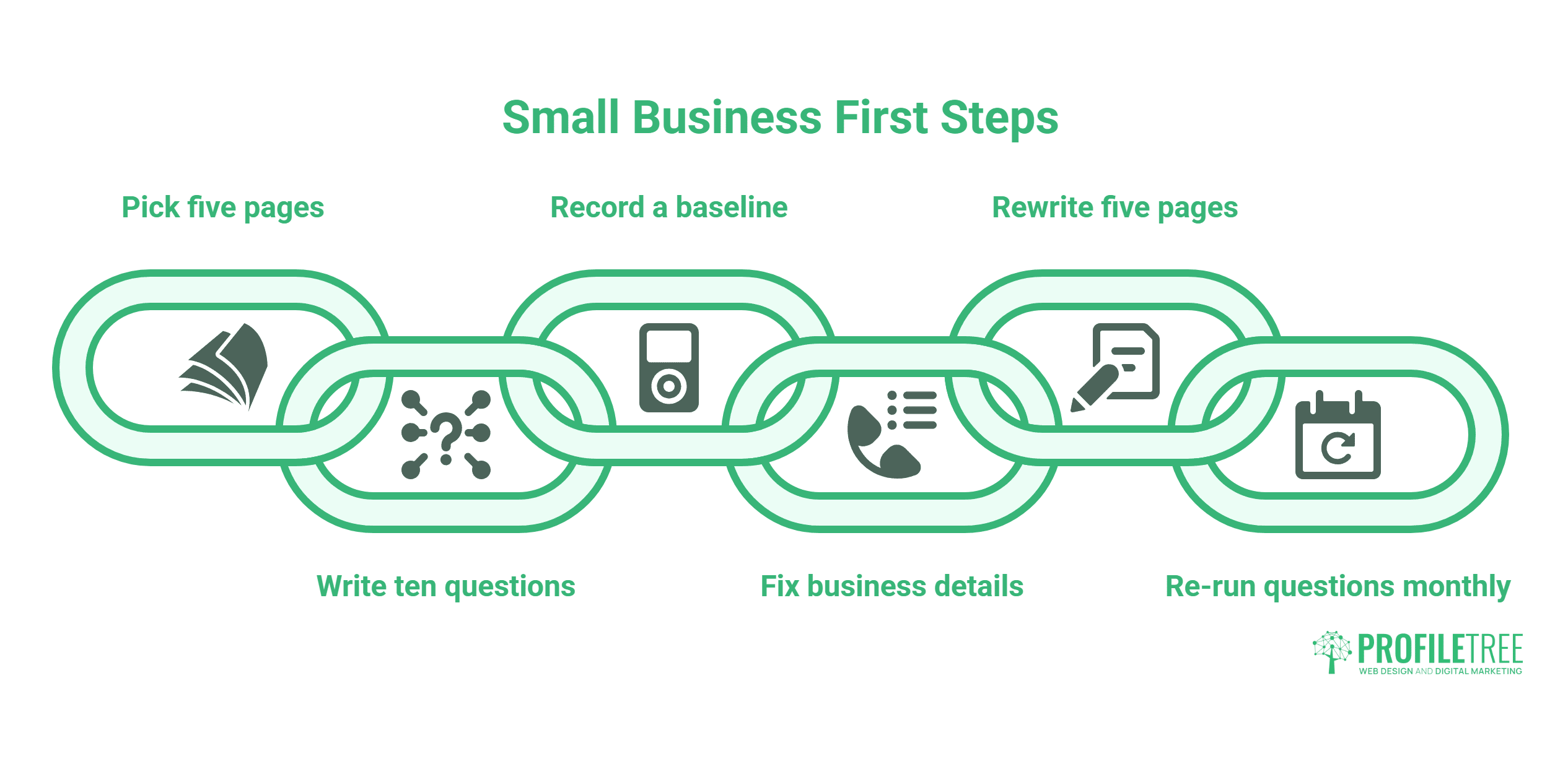
From there, a workable first 90 days looks like this.
- Pick 5 pages. Choose the ones tied to what you actually sell, not the ones with the highest traffic. A service page that converts at a low volume is worth more here than a popular guide that converts at nothing.
- Write down 10 questions. Use the real ones, phrased the way a customer would say them out loud to an assistant. These become both your rewrite brief and your measurement list.
- Record a baseline. Put those 10 questions to ChatGPT, Perplexity, Copilot, and Gemini and write down what comes back, including who gets named instead of you. This takes an afternoon.
- Fix your business details. Make your name, address, phone number and core service descriptions identical everywhere they appear online. This is the cheapest item on the list, and the one most often skipped.
- Rewrite the 5 pages. Make each section open with a direct answer, and back every number with a named source.
- Re-run the 10 questions monthly. Nothing else changes until you have 3 months of those checks to look at because a single month tells you very little.
For a small business, this is a few days of concentrated work rather than a budget line. The habits it asks for improve ordinary search performance at the same time, which means the downside if AI citations take longer than expected is close to nil.
Generative Engine Optimisation Checklist
Use these questions on each page before and after the rewrite.
- Does each section heading match a question a customer would actually ask?
- Does each section answer that question in its first two sentences?
- Is any comparison on the page laid out as a table rather than prose?
- Is every number on the page traceable to a named, linked source?
- Is every quotation attributed to a real person with a real job title?
- Are your business name, address, phone number, and service area identical on your website, Google Business Profile, and social bios?
- Does the page show a visible date for when it was last genuinely updated?
- Has the page had new material added, not just a new timestamp, since its last scheduled review?
- Is Bing Webmaster Tools connected, with its AI Performance report being checked?
- Do you have a written list of target questions, and a record of what assistants currently answer for them?
What Matters Most for Local Businesses?
For businesses that rely on nearby customers, local signals often deliver the quickest wins because a small firm can appear in local AI answers well before it can compete on domain authority.
| Local signal | What to get right | Why AI leans on it |
| Google Business Profile | Every field complete, with a description that names the town | It’s the verified local record checked first for “near me” questions |
| Reviews | A steady flow, with replies, and the rating shown as text | A star rating from a known number of customers is a quotable fact |
| Named places | Towns and areas served, written in plain sentences | Models link a business to a place only when it’s written down |
| NAP consistency | Identical name, address and phone everywhere | Conflicting details weaken the location link |
| Local listings | Main UK and Ireland directories claimed and corrected | Independent listings confirm where a business operates |
| Local proof | Publish work, coverage or case studies tied to the area you serve | First-hand local detail is hard for a competitor to copy and easy for a model to cite. |
Getting Help With the First Steps
If you’d rather have the baseline and priorities worked out for you, ProfileTree’s AI visibility audit runs the four-signal measurement framework against a specific site and set of target questions, and ends with a prioritised list of fixes rather than a score. For the closely related work of earning a place in Google’s own generative results, see the guide to appearing in Google AI Overviews.
What’s the Bottom Line?
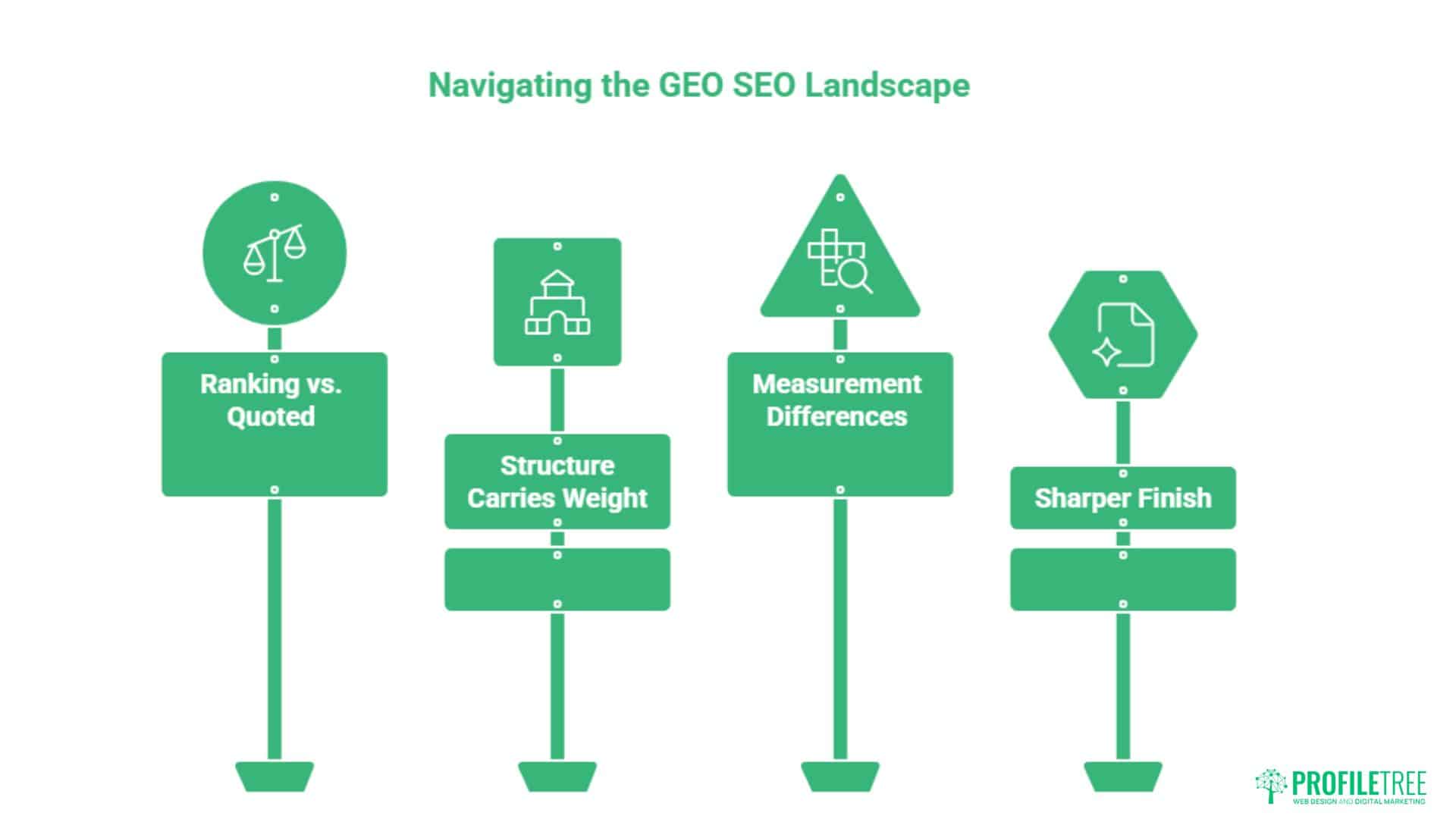
Generative engine optimisation is what happens when you finish your existing SEO work to a standard that also satisfies a machine reading for evidence rather than a person skimming for relevance. Structure your answers clearly, keep your business details consistent everywhere they appear, back every claim with a real source, and keep your best pages genuinely current. Measure progress with a combination of manual assistant checks, Bing’s citation data, branded search, and referral tracking because no single tool yet tells the whole story. None of it requires you to set SEO aside. It asks you to do it properly, for two readers instead of one.
“GEO is not a new skill to learn. It is the old discipline of proving your claims, applied to a reader that happens to be a model instead of a person. The businesses getting cited are the ones who were already writing honestly, and everyone else is just catching up.” Ciaran Connolly
What Do People Actually Ask About GEO?
Is GEO worth investing in yet?
For most businesses, yes, as an extension of existing SEO work rather than a separate budget line, because the same habits improve normal search performance too. What isn’t yet worth a large investment is expensive AI-tracking software, since manual assistant checks, Bing’s citation data and Search Console tell a small business most of what it needs.
What is the difference between GEO and AI SEO?
AI SEO is the broader practice of optimising for search that now includes AI features, while GEO is the part focused on getting passages cited inside AI-generated answers. The two overlap so heavily that ProfileTree delivers them as one connected discipline.
Do I need to abandon my current SEO strategy for GEO?
No. GEO shares the same technical foundation as SEO, so treat it as a sharper finish on work you’re already doing, not a replacement for it.
How long does it take to see GEO results?
A rewritten page can start appearing in assistant answers within weeks for narrow questions, but broader ones take longer. Track assistant mentions, citations, branded search and AI referrals for at least two to three months before drawing conclusions.
Can a small business realistically compete for AI citations against larger brands?
Yes, because generative engines favour specific, evidenced, first-hand detail over broad brand authority. A local business with genuine expertise in a narrow area can out-answer a national competitor’s generic page on that exact question.
Why does my page rank on Google but ChatGPT never mentions us?
Usually, it’s structure rather than authority: the page ranks on backlinks and technical strength but buries its answer under introductory paragraphs. Check whether each section answers its question in the first two or three sentences.
Does adding an llms.txt file help get cited more often?
There’s no published evidence so far that it does, and no major AI platform has confirmed that it reads the file consistently. It’s harmless to have, but it shouldn’t take priority over structure and evidence.
What content format has the best chance of being lifted into an AI answer?
A short, self-contained passage with a direct answer in its first sentence, followed by specific detail, performs best. Tables work well for comparisons, and attributed quotations performed strongly in the original GEO research.