
Long-Form Content Marketing Strategies That Drive Real Results
Table of Contents
Long-form content marketing strategies are the most reliable route to building search authority, attracting qualified leads, and generating organic traffic that compounds over time. For SMEs across Northern Ireland, Ireland, and the UK, they represent a practical and measurable investment rather than a speculative one.
This guide covers how long-form content works, how to build a strategy around it, and how to measure whether it is actually delivering for your business.
What is Long-Form Content Marketing?
Long-form content is any written piece that provides depth on a subject rather than a surface-level overview. In practice, that means articles, guides, case studies, and resource pages that typically run to 1,500 words or more. The threshold matters less than the intent: does the piece actually answer the reader’s question thoroughly?
For businesses considering whether it is worth the effort, the evidence is straightforward. Research from Ahrefs found that long-form content (2,000 words or more) earns three times more backlinks than shorter posts. Pages covering multiple sub-questions within a topic are 161% more likely to be cited in AI Overviews (Ahrefs, Spearman correlation 0.77). That has direct implications for any SME trying to appear in Google’s AI-generated answers.
The Core Types of Long-Form Content
The format you choose depends on what your audience actually needs. Four types consistently perform well for SMEs:
- In-depth guides walk readers through a topic from start to finish. A guide on “how to choose a web design agency” serves someone in research mode who needs a framework before making a decision.
- Case studies demonstrate results. They show prospective clients what a project looked like in practice, what the challenges were, and what the outcome was. They are the strongest trust-building content type for service businesses.
- Comparison articles help readers evaluate options. A piece comparing two approaches, platforms, or strategies answers a real decision-making question and naturally earns search traffic from people who are close to a purchase.
- Pillar pages provide broad topic coverage with internal links to more specific supporting articles. They sit at the top of a content cluster and distribute authority downward.
Each type serves a different point in the buyer journey. A well-structured content marketing plan uses all of them, rather than defaulting to generic blog posts.
Building Your Content Strategy
A content strategy is a plan for what you publish, why you publish it, and how each piece connects to your commercial goals. Without one, most businesses end up with a collection of disconnected articles that attract the wrong audience or rank for terms that never convert.
If you are working with a content marketing agency, the strategy conversation typically happens before any writing begins. If you are building it internally, start with three questions.
Who are you actually writing for?
The most common mistake in content planning is writing for everyone. A piece aimed at marketing managers in manufacturing companies in Northern Ireland will outperform a piece aimed at “businesses” every time, because specificity is what earns genuine engagement.
Define your primary reader. What does their working day look like? What decisions do they need to make? What would a really useful piece of content actually help them do? The answers shape everything: topic selection, word count, tone, and structure.
What do you want each piece to do?
Long-form content can serve different goals. Some pieces exist to attract new visitors from search. Others build trust with people already on your radar. Some are designed to answer the objections that slow sales conversations. Knowing the purpose before you write determines what you include and what you leave out.
“The businesses that get the most from content marketing are the ones who connect each article to a specific commercial outcome,” says Ciaran Connolly, founder of ProfileTree. “They know whether a piece is meant to attract, educate, or convert, and they build it accordingly rather than writing for the sake of having something to publish.”
How does each piece connect to your services?
Every article you publish should have a clear line to your business. That does not mean every paragraph should be a sales pitch. It means the topic should be one your ideal clients care about, and the content should naturally position your expertise as relevant.
A digital marketing agency publishing a guide on content strategy reinforces its credentials in that area. A web design agency writing about what makes a good landing page demonstrates relevant expertise. The connection does not need to be stated; it is made through the quality and relevance of the content itself.
Managing an Editorial Calendar
An editorial calendar is a publishing schedule that keeps content production consistent and connected to broader business goals. It specifies what gets published, when, and why, including any seasonal or campaign timing that is relevant.
For most SMEs, a realistic calendar looks like one to two pieces of long-form content per month. That is enough to build authority over time without overwhelming a team that also has client work to deliver. Consistency over a 12-month period outperforms a burst of five articles followed by six months of silence.
SEO, Keywords and Backlinks
Search engine optimisation is built into long-form content from the planning stage, not added afterwards. The goal is to understand what your audience is actually searching for and build content that genuinely answers those queries.
Keyword Research for Long-Form Content
Keyword research for long-form content works differently from keyword research for service pages. The intent is usually informational or research-based rather than transactional. Someone searching “how to create a content strategy for a small business” is not ready to buy yet, but they are exactly the type of person a content marketing or digital agency wants to be in front of.
Useful tools for keyword research include Google Search Console (which shows what terms your existing pages already appear for), Google’s “People also ask” boxes, and Answer the Public. These surface the actual language your audience uses, which is far more valuable than guessing at industry terminology.
When selecting keywords for a long-form piece, prioritise:
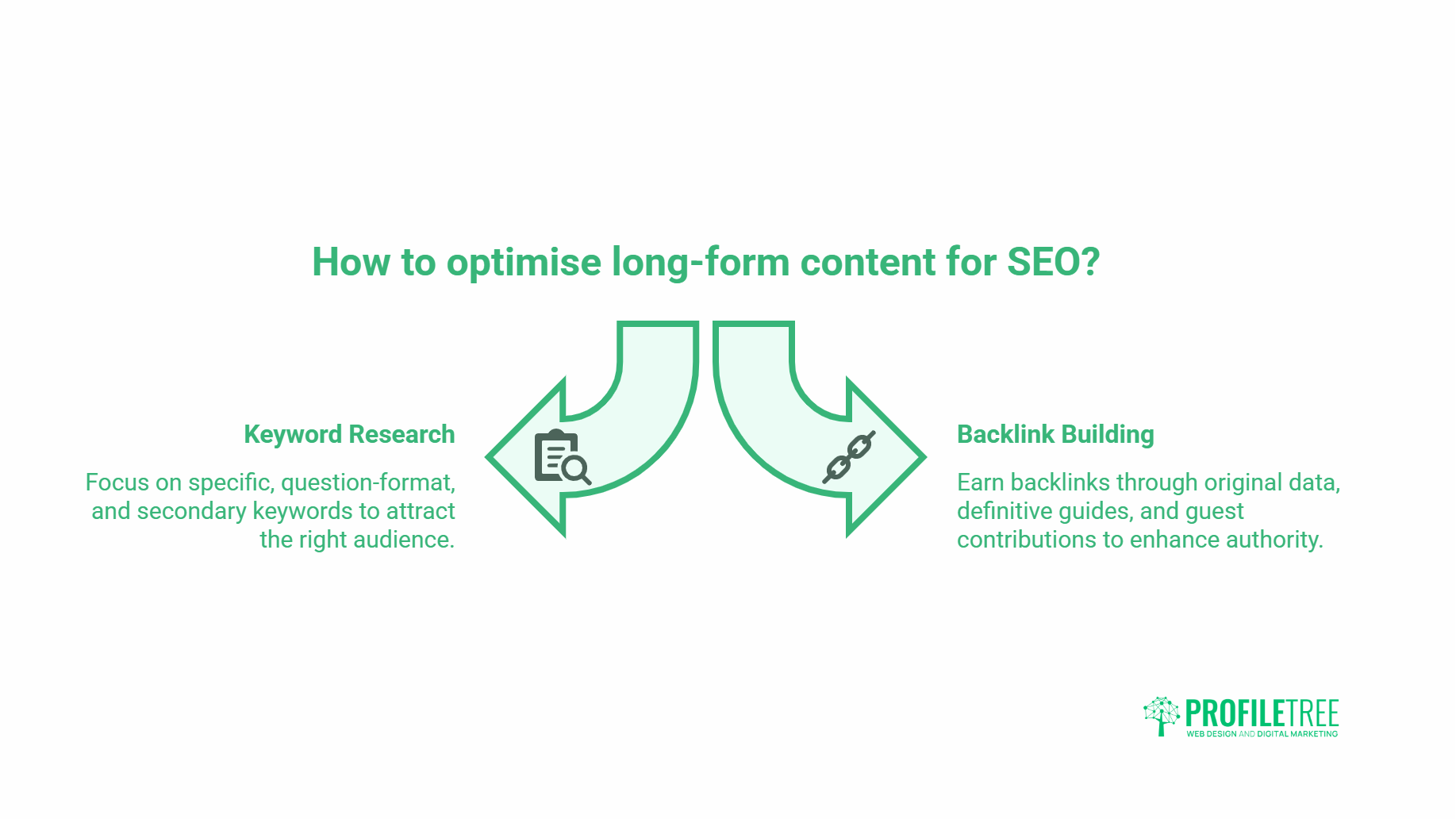
- Specificity over volume. A query with 200 monthly searches that exactly matches your audience is more valuable than a 5,000-search query where most of the traffic is from the wrong sector.
- Question-format queries. These tell you precisely what the reader needs to know and make it easier to structure your content around a direct answer.
- Secondary keywords. A well-written guide on content strategy will naturally include related terms like content calendar, editorial planning, content audit, and buyer persona. These create additional ranking opportunities without requiring separate articles.
Backlinks and Authority Building
Backlinks remain one of the strongest ranking signals in Google’s algorithm. Long-form content earns them at a higher rate than short posts because it gives other websites something genuinely worth referencing.
The most reliable ways to earn backlinks for long-form content are:
- Original data. A piece that includes a survey, audit findings, or proprietary analysis gives journalists and other writers a source to cite. This takes more effort to produce but generates links organically.
- Definitive guides. A thoroughly researched guide that covers a topic better than anything else available becomes the go-to reference. These accumulate links over months and years.
- Guest contributions. Publishing expert articles on relevant industry sites builds authority and generates inbound links to your main content. This works best when the contribution is genuinely useful rather than thinly disguised self-promotion.
Building a content strategy that supports link acquisition requires web design and development services that make pages fast, well-structured, and easy for other sites to link to cleanly.
Structuring Content for AI Citation
AI systems, including Google’s AI Overviews, ChatGPT, and Perplexity, now generate a significant portion of the answers users see for research-intent queries. Being cited in those answers drives traffic and authority.
Pages that get cited consistently share a few characteristics. They open with a direct, complete answer to the primary question within the first 60 words. Each section is self-contained, meaning it answers a specific sub-question without requiring the reader to have read every preceding section. Tables and structured data appear at least once per article.
These are not formatting tricks. They are structural choices that make content more useful to both human readers and AI systems.
Measuring Content Performance
Content marketing is only useful if you can tell whether it is working. The metrics that matter depend on the goal of each piece.
Traffic and Search Visibility
Google Search Console shows which queries your pages appear for, how often they appear, and how many people click through. For long-form content, the relevant signals are:
- Impressions: how often the page appears in search results. Rising impressions usually precede rising clicks by several weeks.
- Average position: where the page ranks across the queries it appears for. Positions 11 to 20 (page two) is a signal that the content is relevant but needs strengthening.
- Click-through rate (CTR): the percentage of people who see the page and click on it. A low CTR with reasonable impressions usually points to a title or meta description that does not match what the reader is looking for.
Engagement and Time on Page
For long-form content, time on page matters. A guide that earns three minutes of reading time is performing well. One that earns 30 seconds suggests the content does not match the expectation the title created.
Scroll depth (how far down the page readers get before leaving) gives you similar information. If most readers leave before reaching a key section, the opening is not compelling enough to pull them through, or the article is not structured logically.
Conversion Rate
Conversion rate measures how many visitors take a meaningful action: filling in a contact form, downloading a resource, or clicking through to a service page. For informational long-form content, conversion rates are typically lower than for service pages, but they still matter.
Placing a clear, relevant call to action within the content rather than only at the end gives readers the opportunity to act at the point where they are most engaged. A guide on content strategy that links to a content marketing consultation at the point where the reader has just understood the scope of the work is far more effective than a generic contact button in the footer.
Organic Backlinks
Track how many external sites link to each piece over time. This is the clearest signal that the content has genuine authority. Tools like Ahrefs and Google Search Console both show inbound links.
Promoting and Distributing Content
Publishing is the start of the work, not the end of it. Long-form content requires active distribution to reach its intended audience, especially in the first weeks after publication.
Social Media Distribution
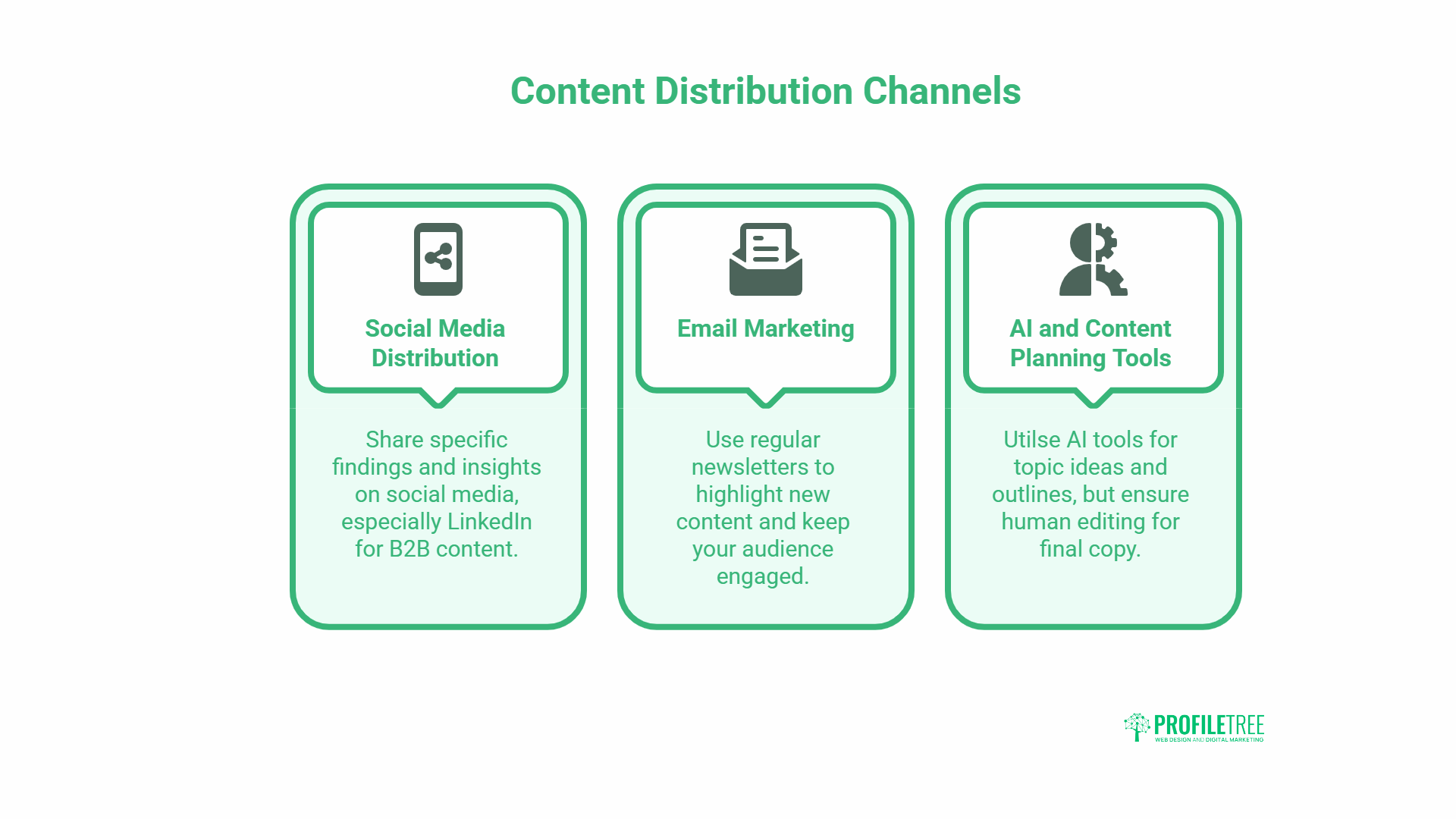
Sharing long-form content on social media works best when each post highlights a specific finding, insight, or practical tip from the article rather than just linking to it. A LinkedIn post that shares the most interesting data point from a guide, with a link for readers who want the full context, performs better than a generic “new post” announcement.
For SMEs in Northern Ireland and across the UK, LinkedIn is the most relevant platform for B2B content. A social media content strategy that treats LinkedIn as a distribution channel for long-form work, rather than a separate content stream, makes the overall programme more efficient.
Email Marketing
Email remains one of the most reliable distribution channels for long-form content. A regular newsletter that highlights new guides and articles keeps your existing audience engaged and drives repeat visits to the site.
The key is matching the content to the audience segment. A manufacturing company on your list does not need the same article as a hospitality operator. Where your list is large enough to segment, personalising the content selection makes a measurable difference to open rates and click-throughs.
AI and Content Planning Tools
AI tools have changed how content teams plan and produce long-form material. They are genuinely useful for generating topic ideas, identifying content gaps, and drafting initial outlines.
They are less reliable for producing final copy without significant human editing. Google’s systems are increasingly good at identifying content that has not been materially reviewed or enriched by a human. The practical approach is to use AI to accelerate the planning and research phase while applying human judgment to the writing and the specific examples and data that give content its authority.
If you are considering how AI fits into your content marketing, ProfileTree’s AI transformation services cover both the tools and the implementation approach for SMEs.
Building Authority Through Long-Form Content
Authority in a subject area is not claimed; it is demonstrated. A business that consistently publishes well-researched, practical guides on topics its clients care about builds a track record that search engines recognise and that prospective clients notice.
The timeline is longer than most businesses expect. A new long-form content programme typically takes six to twelve months to produce meaningful search traffic. The compounding effect then accelerates: articles that rank pull backlinks, backlinks improve authority, and improved authority helps newer articles rank faster.
For SMEs, the practical implication is that content marketing is most effective when it is treated as a medium-term investment rather than a campaign. The businesses that sustain it consistently outperform those that publish in bursts and stop.
Getting Started With Long-Form Content Marketing
A practical starting point is a content audit of what you already have. Identify which existing articles or pages are attracting traffic, which ones are underperforming relative to their potential, and where there are obvious gaps in your topic coverage.
From there, select three to five priority topics based on what your ideal clients are actually searching for and where you have genuine expertise to contribute. Write one strong, well-researched piece per topic before spreading your effort across a wider range.
ProfileTree works with businesses across Northern Ireland, Ireland, and the UK to develop and execute content marketing programmes that connect organic traffic to commercial outcomes. If you want to discuss what a content strategy might look like for your business, the team is available for an initial conversation through the contact page.
Frequently Asked Questions
How long should a long-form content piece be?
There is no fixed minimum, but most pieces that rank for competitive informational queries run to 1,500 words or more. The actual length should be determined by how much the reader genuinely needs to understand the topic, not by a word count target. A 2,000-word article that covers its subject thoroughly is more valuable than a 3,500-word article padded with repetition.
How long does it take for long-form content to rank?
Most long-form articles take three to six months to reach their stable ranking position, assuming the site has reasonable domain authority and the content is well-structured. Highly competitive queries may take longer. Content on newer or lower-authority sites typically takes longer to gain traction than content on established domains.
What makes long-form content different from a standard blog post?
Length is part of it, but depth is the more important distinction. Long-form content provides genuinely thorough coverage of a topic, including sub-questions, practical examples, and specific data. A standard blog post often introduces a topic without developing any aspect of it in real detail. The difference is whether a reader could act on what they have just read.
Does long-form content work for all types of businesses?
It works best for businesses where the purchase involves some research or consideration, which covers most B2B services and higher-value B2C products. It is less effective for impulse purchases or commoditised products where the buyer already knows what they want. For service businesses, professional services, and any business where trust matters, long-form content is one of the most cost-effective marketing investments available.
How often should we publish long-form content?
Consistency matters more than frequency. Publishing one well-researched piece per month over 12 months will outperform publishing 12 articles in one month and then stopping. Most SMEs find that one to two pieces per month is sustainable alongside their other work. Quality should take priority; a poorly researched article published frequently can actually damage search authority.