
Hotel Email Marketing Strategy: A Practical Guide for UK and Irish Hotels
Table of Contents
A guest books a room, gets a confirmation, and then hears nothing until check-in. That silence is where most independent hotels lose revenue. A working hotel email marketing strategy fills it: a sequence of confirmation, pre-arrival, post-stay and win-back messages that turns a single booking into a repeat guest and reduces reliance on online travel agency commissions.
This guide covers the five email types every property needs, the seven steps to build the strategy behind them, and the UK and Irish compliance rules (GDPR and PECR) that most US-written guides skip. It is written for boutique hotels, guest houses and B&Bs across Northern Ireland, Ireland and the UK working without an enterprise marketing budget.
ProfileTree, a Belfast-based digital agency, has built content and automation systems for service businesses since 2011, and the practical examples below reflect that hospitality-adjacent work.
Why Email Stays the Highest-Value Channel for Hotels
Email earns its place because it reaches guests you already own, not an audience you rent from a platform. Industry benchmarks widely cited across hospitality marketing put the return on email at roughly £30 to £35 for every £1 spent, and the reason is simple: a direct email booking avoids the 15 to 25% commission a property pays an OTA like Booking.com or Expedia on the same reservation.
For a 15-room guest house in County Antrim or a coastal hotel in Donegal, that commission gap is the difference between a profitable shoulder season and a flat one. Every guest who rebooks through an email rather than a third-party site keeps that margin in the business.
Email also compounds. A social post disappears in a feed within hours. A well-segmented guest list keeps working for years, and it pairs naturally with an organic search strategy: the same local content that draws visitors to your site can be repackaged into the newsletter that keeps them booking. If you are building that wider picture, our search engine optimisation work and broader digital marketing strategy support sit alongside email as the retention engine.
The Five Hotel Emails Every Property Needs
Most hotel email programmes come down to five core messages, each tied to a stage of the guest journey. Get these right before you worry about anything more advanced.
The Promotional Newsletter
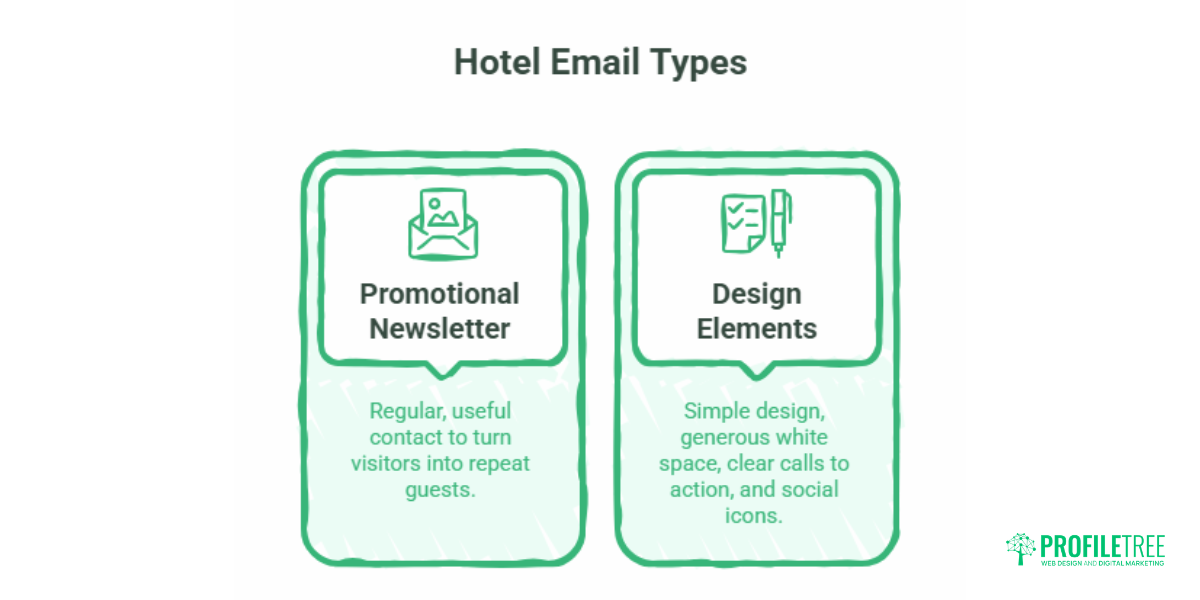
Turning a one-time visitor into a repeat guest starts with regular, useful contact. A weekly or monthly newsletter keeps your property in mind between stays, and the discipline that matters most is consistency: pick a sending frequency you can sustain and hold to it.
Strong hotel newsletters go beyond seasonal offers. Share facility upgrades, new dining options, or things to do nearby. Recommend local walks, events and attractions so the email reads as an experience rather than another sales push. That framing is what prompts a guest to return, stay longer, or pick a higher package.
What makes a promotional newsletter template work:
- A simple design with distinct sections for different guest needs
- Generous white space so readers focus on the key points
- Clear calls to action paired with images that let recipients picture themselves there
- Social icons are placed to give subscribers more than one way to engage
The Booking Confirmation Email
After booking a room, guests expect a confirmation in their inbox within minutes. It tells them the reservation went through and lets them check the details. A reusable template means you send those details quickly, cut the queries your front-of-house team would otherwise field, and free up time for actual guests.
Include at least these details in every confirmation:
- Guest name and booking reference
- Check-in and check-out dates and times
- Room type and what the package includes
- Directions to the property, allowing for different transport options
- Stay-specific instructions, such as pet or parking policies
- Anything else useful, like on-site services or local arrival tips
What a good confirmation template does well:
- A single-column layout centred on the booking details
- A clean, high-contrast design that is easy to scan
- Short sentences and a few visual elements showing top amenities
- Clear inclusion of cancellation and house policies
The Post-Visit Email
Bringing a past guest back is usually cheaper than winning a new one, which is why the post-stay email matters. Send a follow-up to guests who have recently checked out, thank them, and then do more than express gratitude.
A post-visit email is your best chance to collect feedback. Reviews tell you how to improve, and they show prospective guests why people recommend you. Ask readers to leave a review or complete a short survey, and if take-up is low, offer a small incentive such as a discount on the next stay.
Then personalise. A first-time guest gets a return discount; a repeat customer gets an invitation to your loyalty programme with its exclusive offers. The detail that lifts response rates is a design that respects the reader: minimal layout, calm colours, and a CTA that signals the survey is quick.
The Loyalty Programme Invitation
How does a hotel turn one-time guests into regulars? A loyalty programme, communicated in its own dedicated email rather than buried in a footer. The email has one job: answer the question “what do I get if I join?”
Common rewards include points for every stay, redeemable against room upgrades, extra nights or free services. Guests also value early check-in, late check-out, and access to events or activities. A referral element works well too: give members something, such as a discount, each time they recommend the property to a friend.
If your loyalty members are past guests, their booking history lets you personalise the reward. A guest who returns every Valentine’s weekend, for example, is a natural fit for a complimentary in-room dining offer. That kind of tailored touch is what convinces people the programme is worth joining.
The Booking Cancellation Email
Cancellations feel like the worst case, but they are one to prepare for properly. A cancellation email should state the guest’s name and reservation dates, and set out the cancellation policy and any fees plainly, for transparency and credibility. A simple, professional design suits a transactional message; a clean, plain-text layout often works fine.
A cancellation is not the end of the revenue opportunity. Once the guest has the information they need, offer options to reschedule. A limited-time discount on the original booking, or an added extra such as a meal in your restaurant, a spa treatment or a guided local tour, can prompt a rethink. Match the offer to their preferences and make it time-sensitive so it carries some urgency.
This is the point where many properties hand the writing to an agency rather than reinventing each template internally. Our content marketing team builds the copy and structure for sequences like these, so the tone stays consistent across every guest touchpoint.
Seven Steps to Build Your Hotel Email Marketing Strategy
The five emails above are the output. This is the system that produces them. Work through these steps in order.
Step 1: Build a Clean List and Connect It to Your PMS
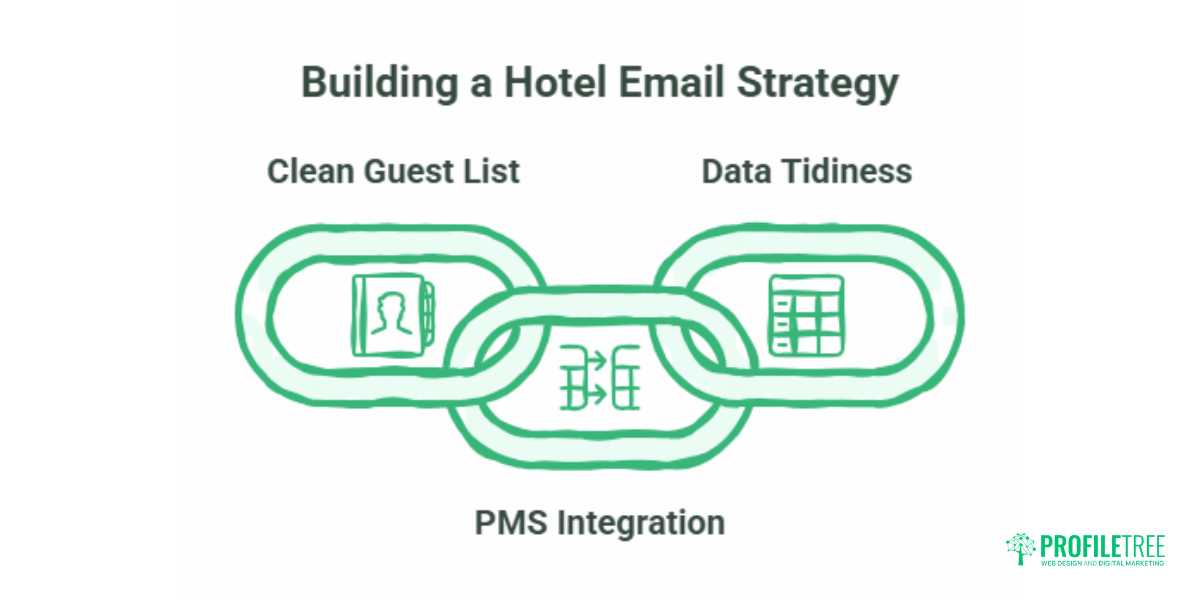
Everything starts with a clean, consented database. Your property management system already holds guest contact details from bookings; the task is moving them into your email platform legally and accurately. Modern PMS platforms often integrate natively with email service providers. Older systems may need an API connection, a Zapier bridge, or a weekly manual CSV export. Whichever route you take, keep the data tidy: deduplicate, remove bounced addresses, and tag the source.
Step 2: Segment by Behaviour, Not Just Demographics
A single list that sends the same message is a wasted list. Segment by who the guest is and how they behave: business versus leisure, first-time versus repeat, summer versus off-season, family suites versus couples’ breaks. A business traveller wants mid-week rates and fast Wi-Fi; a leisure guest wants the spa package and local guides. The same booking data that sits in your PMS makes this segmentation possible without any complex modelling.
Step 3: Apply the 80/20 Hospitality Content Rule
The most common newsletter mistake is making every email a sales pitch. The 80/20 rule fixes it: roughly 80% of your content should give the reader value with no ask, and only 20% should be a direct booking pitch. For a hotel, the 80% is local destination content: the top coastal walks near the property, a guide to the area’s restaurants, and a piece on the best time to see a nearby attraction.
The 20% is the room offer. This ratio keeps open rates high and unsubscribe rates low, because guests open emails that help them rather than ones that only sell to them. Sourcing that local content is the same skill as ranking for local search terms, which is why a local SEO approach and your newsletter content tend to feed each other.
Step 4: Write Subject Lines That Earn the Open
The subject line decides whether the rest of the email exists. Keep it under about 50 characters so it shows in full on mobile, lead with the value, and avoid spam-trigger punctuation. A few patterns that work for hotels: a named local hook (“Three quiet beaches 20 minutes from us”), a clear offer with a deadline (“Mid-week dinner-and-stay, this month only”), and a personalised return prompt (“Your room is ready when you are”). Test preview text as carefully as the subject; together they are the whole pitch in the inbox.
Step 5: Set Up Behavioural Triggers
Automation is what makes this sustainable for a small team. Set emails to fire on guest actions rather than sending everything by hand: booking confirmed, seven days before arrival, 24 hours before check-in, two days after departure, six months later. Once built, these run continuously without staff time, delivering the right message at the right moment in the guest journey. Wiring these triggers reliably is a development task as much as a marketing one, and our website development, website hosting and management services cover the integration and uptime that automated sequences depend on.
Step 6: Design Off-Season and Mid-Week Campaigns
Empty mid-week and winter rooms are the UK and Irish hospitality sector’s biggest revenue leak, and email is the cheapest tool to address them. Build a drip campaign aimed at your local drive-to market: regional retirees for a quiet mid-week dinner-and-stay, or nearby business travellers for a weeknight rate with breakfast included. Segment the offer to the people most likely to fill a Tuesday in November, and send it when they are planning, not when the room is already vacant.
Step 7: Test and Measure Continuously
Treat every campaign as a test. The discipline behind this is sometimes called the five Ts of email marketing: timing, targeting, testing, tracking and tone. Run A/B tests on sender names, send times and layout, track open rates, click-through rates and, most importantly, bookings and revenue attributed to email, then feed what you learn back into the next send. If your in-house team wants to own this rather than outsource it, our digital training courses teach exactly this kind of campaign analysis.
UK and Ireland Compliance: GDPR and PECR for Hoteliers
Most hotel email guides are written by US software brands and gloss over the rules that actually govern UK and Irish properties. Getting this wrong risks an ICO fine; getting it right gives you access to a large, legally safe pool of past guests to market to.
The Soft Opt-In Rule for Past Guests
Under the UK’s Privacy and Electronic Communications Regulations (PECR), you generally need consent before sending a marketing email to an individual. There is a narrow but valuable exception, commonly called the soft opt-in. You can email a past guest about your own similar services without prior explicit consent if you collected their details during a booking or negotiation, you gave them a clear chance to opt out at that point, and you include an opt-out in every email after. That covers most of your existing guest database. It does not cover bought-in lists or contacts obtained from a third party.
A common and costly misunderstanding is assuming GDPR demands double opt-in for everything, which leads hotels to throw away marketable contacts they were entitled to keep. The Republic of Ireland applies the same EU-derived ePrivacy framework with its own national implementation, so cross-border properties should treat both jurisdictions as in scope.
Collecting Consent at the Front Desk
Most of your sign-ups happen offline: reception, the booking form, the restaurant reservation, the Wi-Fi login. Each is a chance to collect a consented email properly, with a clear, unticked opt-in and a plain explanation of what the guest will receive. Train your front-of-house team to ask once, record the consent and its source, and never pre-tick the box.
“Most small hospitality businesses are sitting on a perfectly legal marketing list and don’t realise it, because they assume the rules are stricter than they are. The soft opt-in exists for exactly this situation. The mistake we see is the opposite one too: collecting addresses with no opt-out and no record of consent, then using them anyway.” Ciaran Connolly, Founder, ProfileTree
Choosing the Right Tools for Your Property Size
There is no single best platform, only the right fit for your size and budget. A boutique inn or B&B does well on a low-cost, easy email service provider with native automation and templates. A larger or multi-property group with a complex tech stack may justify a hospitality-specific CRM that syncs deeply with the PMS and reports on revenue per guest.
The decision comes down to three questions: how many contacts you hold, whether your PMS integrates with the platform, and how much automation you actually need. Start lean, prove the return, then upgrade. If you would rather have the segmentation, syncing and first campaigns set up for you, that is the kind of hands-on work our digital marketing strategy and AI-enhanced marketing services handle.
Where AI Fits
AI tools now help small teams punch above their weight: drafting subject-line variants to test, summarising guest feedback for the post-stay segment, and personalising newsletter content at scale without a copywriter for every message. Used with human review, they cut the time a one-person marketing team spends on routine drafting. Our AI training and AI chatbot work shows hospitality teams how to use these tools responsibly, and the same content can be turned into video marketing assets, from property tours to local area guides, that lift email engagement.
Segmenting Your Hotel Emails Effectively
Inspiring templates are only the starting point. To make them perform, track guest preferences and habits and write content that actually resonates. Be mindful of time zones and family needs so emails land when people are likely to read them, and resist sending too often: over-mailing disengages the very subscribers you worked to win.
Effective segmentation draws on location, booking behaviour, room and amenity preferences, and stay history. As you gather more data, refine the segments further. The principle holds throughout: offer consistent value tailored to the person, rather than blasting the whole list to drive short-term revenue.
| Guest segment | Source PMS data | Recommended campaign | Sending frequency |
|---|---|---|---|
| Business traveller | Mid-week stays, single occupancy | Mid-week rate, fast check-in | As vacancy arises |
| Leisure couple | Weekend stays, spa add-ons | Seasonal package, local guides | Fortnightly newsletter |
| Repeat guest | Two or more past stays | Loyalty invite, anniversary offer | Monthly plus triggers |
| Lapsed guest | No booking in 6+ months | Win-back discount | Quarterly drip |
| First-time booker | Single recent booking | Welcome, post-stay review request | Triggered by stay |
Connecting Email to Your Wider Operations
Email works best wired into how the property actually runs. Automate confirmation, reminder and post-visit triggers straight from your PMS or booking engine to save time and cut human error. Track guest interactions and feedback in a CRM and feed those insights back into segmentation. Design every template to render well on mobile, since most guests read on a phone. And watch the numbers that matter: open rates, click-throughs, bookings and revenue per campaign, adjusting content and timing as the data tells you.
A fast, mobile-friendly booking page is the other half of this. An email that earns the click is wasted if the landing page is slow or hard to use, which is where website design directly affects email conversion.
Conclusion
A hotel email marketing strategy is less about clever templates and more about a system: the five core emails, the seven steps that produce them, and the UK and Irish compliance rules that keep your list legal. Build it lean, segment by behaviour, hold to the 80/20 rule, and automate the triggers so a small team can run it. Done well, email turns one-night bookings into returning guests and keeps the margin that OTAs would otherwise take.
Frequently Asked Questions
What is the average ROI of hotel email marketing?
Industry benchmarks commonly cite a return of around £30 to £35 for every £1 spent. The high return comes from owning the guest relationship directly, which avoids the 15 to 25% commission charged by online travel agencies on the same booking.
What is the 80/20 rule in hotel email marketing?
Roughly 80% of your content should give guests value with no sales ask, such as local guides, walks and dining recommendations, while only 20% should be a direct booking offer. This balance keeps engagement high and unsubscribe rates low.
Are UK hotels legally allowed to email past guests without explicit consent?
Often, yes, under the PECR soft opt-in. If you collected the guest’s details during a booking, you are marketing your own similar services, and you offered an opt-out at collection and in every email, you can email them without prior explicit consent. It does not apply to bought-in or third-party lists.
What are the five Ts of hotel email marketing?
Timing (when you send), targeting (how you segment), testing (A/B testing your elements), tracking (measuring revenue and engagement), and tone (keeping your brand voice consistent).
How often should a boutique hotel send newsletters?
Fortnightly or monthly is usually enough to stay top of mind without causing fatigue. Behaviour-triggered emails, such as confirmations and pre-arrival messages, should run continuously regardless of newsletter frequency.
Can I sync my PMS directly with a standard email platform?
Some modern PMS systems integrate natively with major email providers. Older systems may need an API connection, a Zapier bridge, or a weekly manual CSV upload. Real-time syncing matters most for pre-arrival and post-stay automated campaigns.