
Local SEO for Hotels: Win Direct Bookings in Ireland and NI
Table of Contents
Every night, a guest books your hotel through Booking.com or Expedia, and a commission of between 15 and 25 per cent leaves with them. For independent hotels, that is one of the largest single distribution costs in the business. Local SEO for hotels is the most direct way to reduce that dependency, because a guest who finds your property through a Google search and books directly pays no commission at all.
This guide is written for hotel operators and marketing managers across Northern Ireland and Ireland who want to take more control of their booking channel. It covers the practical steps to improve your visibility in local search, from optimising your Google Business Profile to building the kind of location-specific content that OTAs cannot replicate. Where relevant, it points to the digital marketing and web design services that ProfileTree provides to hospitality businesses in the region.
What is Local SEO for Hotels?
Local SEO for hotels is the process of optimising a property’s online presence so that it appears prominently when travellers search for accommodation in a specific location. That includes searches like “hotels near Giants Causeway,” “Belfast city centre hotel,” or “where to stay in Westport.” These are searches with clear booking intent, made by people who are ready to spend money.
Unlike general SEO, local SEO for hotels is shaped by proximity, relevance, and prominence rather than domain authority alone. A well-optimised independent hotel can outrank a large chain in the local pack if its Google Business Profile is complete, its reviews are strong, and its website sends the right local signals.
For hotels in Northern Ireland and Ireland, this matters enormously. Guests planning a break on the Causeway Coast, the Wild Atlantic Way, or in the Titanic Quarter are searching locally. If your hotel does not appear in those results, a competitor or an OTA will. Getting local SEO for hotels right is how independent properties compete on equal terms with bigger brands.
The OTA Commission Problem
OTAs are not the enemy. They provide genuine visibility, particularly for properties that have not yet built strong direct booking channels. The problem is relying on them exclusively.
The “billboard effect” is a documented pattern in hospitality research. Cornell University’s 2009 study found that hotels listed on Expedia saw between 7.5 and 26 per cent more reservations through their own direct channels compared to when they were not listed. A 2017 follow-up confirmed the effect remained active, with over 30 per cent of direct bookers having started their research on an OTA. The pattern is real: a guest discovers your hotel on Booking.com, then searches for your property directly. If your own website does not appear prominently in that direct search, or if your direct booking experience is poor, the guest returns to the OTA and you pay the commission anyway.
Local SEO for hotels interrupts that pattern. When your property ranks well in the local pack and your Google Business Profile is fully optimised, guests have a direct path to your website without passing through a third-party platform. The cost of that click is zero.
Understanding the Google Hotel Pack and the Local Pack
Many hotel operators use these terms interchangeably, but they are two different things and the distinction matters for your local SEO strategy.
The local pack is the map-based block of three results that appears for location queries like “hotels in Derry” or “accommodation near Aviva Stadium.” Rankings here are determined by your Google Business Profile, reviews, NAP consistency, and proximity to the searcher. This is the result type most directly influenced by local SEO for hotels.
The Google Travel interface (sometimes called the Hotel Pack or Hotel Search) is a price-comparison layer powered by Google Hotel Ads and Google Hotel Center. It shows rates pulled from OTAs and direct booking engines. Appearing here requires a direct booking engine that feeds data to Google Hotel Center, which is a separate technical integration from local SEO.
Both matter. The local pack drives brand discovery and direct searches. The Google Travel interface captures price-comparison traffic. For most independent hotels in Northern Ireland and Ireland, the local pack is the higher-priority target because it is entirely within your control and costs nothing to appear in beyond the investment of good local SEO.
Optimising Your Google Business Profile for Hospitality
Your Google Business Profile (GBP) is the single most important local SEO asset your hotel controls. It is what appears in the local pack, in Google Maps, and in the knowledge panel when someone searches your property name directly.
Start with the basics. Claim and verify your listing if you have not already done so. Complete every section: property name, address, phone number, website, check-in and check-out times, price range, and category. The primary category should be “Hotel” or the most accurate descriptor for your property type. Add secondary categories where appropriate, such as “Bed and Breakfast” or “Boutique Hotel.”
Hotel attributes are often overlooked in local SEO for hotels. GBP allows hospitality businesses to list specific amenities, including free Wi-Fi, car parking, restaurant, accessibility features, and pet-friendly policies. These attributes appear in your listing and influence whether your property shows up in filtered searches. A guest searching “pet-friendly hotels Belfast” will only see properties that have that attribute correctly set.
Photography carries more weight in hospitality than in almost any other sector. Upload images of your rooms, common areas, restaurant, exterior, and the surrounding area. For NI and Irish properties, images that connect your hotel to recognisable local landmarks or scenery add value for guests and for the geographic signals they send to Google.
Google Posts allow you to publish updates, offers, and events directly to your GBP listing. Regular posting signals that the profile is actively managed, which is a minor but meaningful ranking factor. For seasonal properties, posts around Bank Holiday weekends, local festivals, or Tourism NI events are worth scheduling in advance.
Video content on your GBP listing is underused by most hotels in the region. A professionally filmed walkthrough of your property builds confidence in prospective guests and increases engagement. ProfileTree’s video production team works with hospitality businesses across Northern Ireland to produce this kind of content, which performs across GBP, social media, and your own website simultaneously.
NAP Consistency and Local Citations
NAP stands for Name, Address, and Phone number. Consistency across every platform where your hotel is listed is a foundational requirement of local SEO for hotels. If your address appears differently on Google, Tripadvisor, Booking.com, and your own website, even minor differences like “St” versus “Street”, search engines receive conflicting signals and your local rankings suffer.
For hotels in Northern Ireland and Ireland, the priority citation platforms are Google Business Profile, TripAdvisor, Booking.com, Expedia, Discover Northern Ireland, Fáilte Ireland, Tourism Ireland, AA Hotel listings, and Bing Places.
Run a citation audit at least once a year. Check that your property name is listed identically across all platforms, that the address matches exactly, and that your phone number and website URL are up to date. Any inconsistencies should be corrected at the source.
Fáilte Ireland and Discover Northern Ireland are particularly valuable sources of citations for regional hotels. A listing on either platform carries authority and geographic relevance that generic directories cannot match. If your property is not listed on both, that is the first citation gap to close.
On-Page SEO: Location-Specific Landing Pages
Your GBP profile gets guests to your door in Google Maps. Your website converts them. The two need to work together, and on-page content is one of the most overlooked elements of local SEO for hotels.
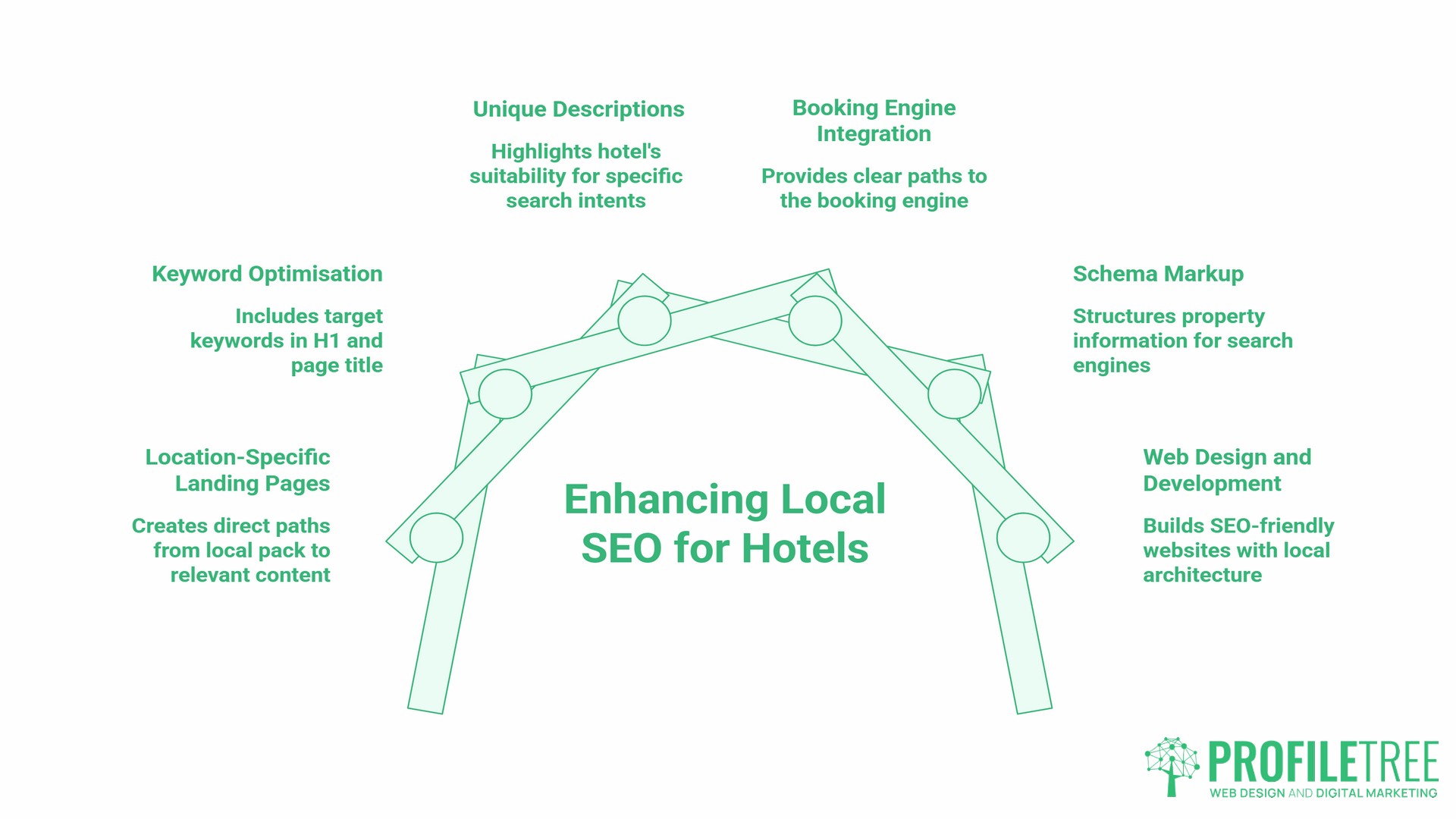
Most independent hotels in Northern Ireland and Ireland run a single homepage with a booking widget, rather than location-specific landing pages. This is a missed opportunity. A dedicated page for each major search intent creates a direct path from the local pack to a relevant on-page experience.
Practical page types worth creating: pages targeting proximity searches (such as “Hotels near Titanic Belfast,” “Accommodation near Giants Causeway,” or “Hotels near Aviva Stadium”); pages targeting staycation intent for specific guest segments (families, couples, business travellers); pages for recurring local events where your hotel is a natural base (major concerts at the SSE Arena, All-Ireland Championship weekends, Galway Races).
Each of these pages should include the target keyword in the H1 and page title, a unique description of why your hotel is the right choice for that search intent, and a clear path to your booking engine.
Schema markup is the technical layer that tells search engines exactly what your property is. Hotel schema allows you to specify your property type, amenity features, check-in policies, price range, and address in a structured format that Google can read independently of your page copy. Most hotel websites in the region do not implement this correctly, which is a straightforward advantage to claim in local hotel SEO.
ProfileTree’s web design and development team builds hotel websites with local SEO architecture built in, including correct schema implementation, fast mobile performance, and location page structures designed to rank. If your current site was built on a generic template without hospitality SEO in mind, it is worth reviewing whether its technical foundations are limiting your visibility.
Reputation Management: Reviews in the NI and Irish Market
Reviews are a confirmed ranking factor in local SEO for hotels. According to Google’s own Business Profile documentation, review count and score are factored into local search ranking, with more reviews and positive ratings likely to improve a business’s local position. The volume, recency, and sentiment of your Google reviews all influence where you appear in the local pack.
The priority platforms for hospitality in Northern Ireland and Ireland are Google, Tripadvisor, and Booking.com. Google reviews carry the most weight for local SEO. Tripadvisor remains the most widely used third-party review platform for hotel searches in the UK and Ireland.
Getting more reviews requires a system, not a hope. The most effective approach is to ask at the right moment: at checkout, via a follow-up email sent 24 to 48 hours after departure, or through a QR code displayed in the room or at reception. The ask should be direct and should link straight to your Google review page.
Responding to reviews matters as much as receiving them. Google’s Business Profile Help documentation confirms that responding to reviews is a recommended practice for improving local visibility and signals that the business is actively managed. A professional response to a negative review can reverse the impression it creates among prospective guests. A response that acknowledges the guest’s experience, explains what has changed, and invites them to return is far more persuasive than a defensive reply.
As Ciaran Connolly, founder of ProfileTree, notes: “For hotels in Northern Ireland, your Google reviews are your digital front desk. Guests read them before they ever see your lobby. How you respond tells them as much about your property as the review itself does.”
The UK Competition and Markets Authority has issued guidance on fake and incentivised reviews, which applies to hotels operating in Northern Ireland. Do not offer discounts, upgrades, or any other incentive in exchange for a positive review. Request reviews ethically and respond to all feedback, positive and negative, with the same professionalism you would apply to a face-to-face guest interaction.
Local Link Building: Tourism Bodies and Community Connections
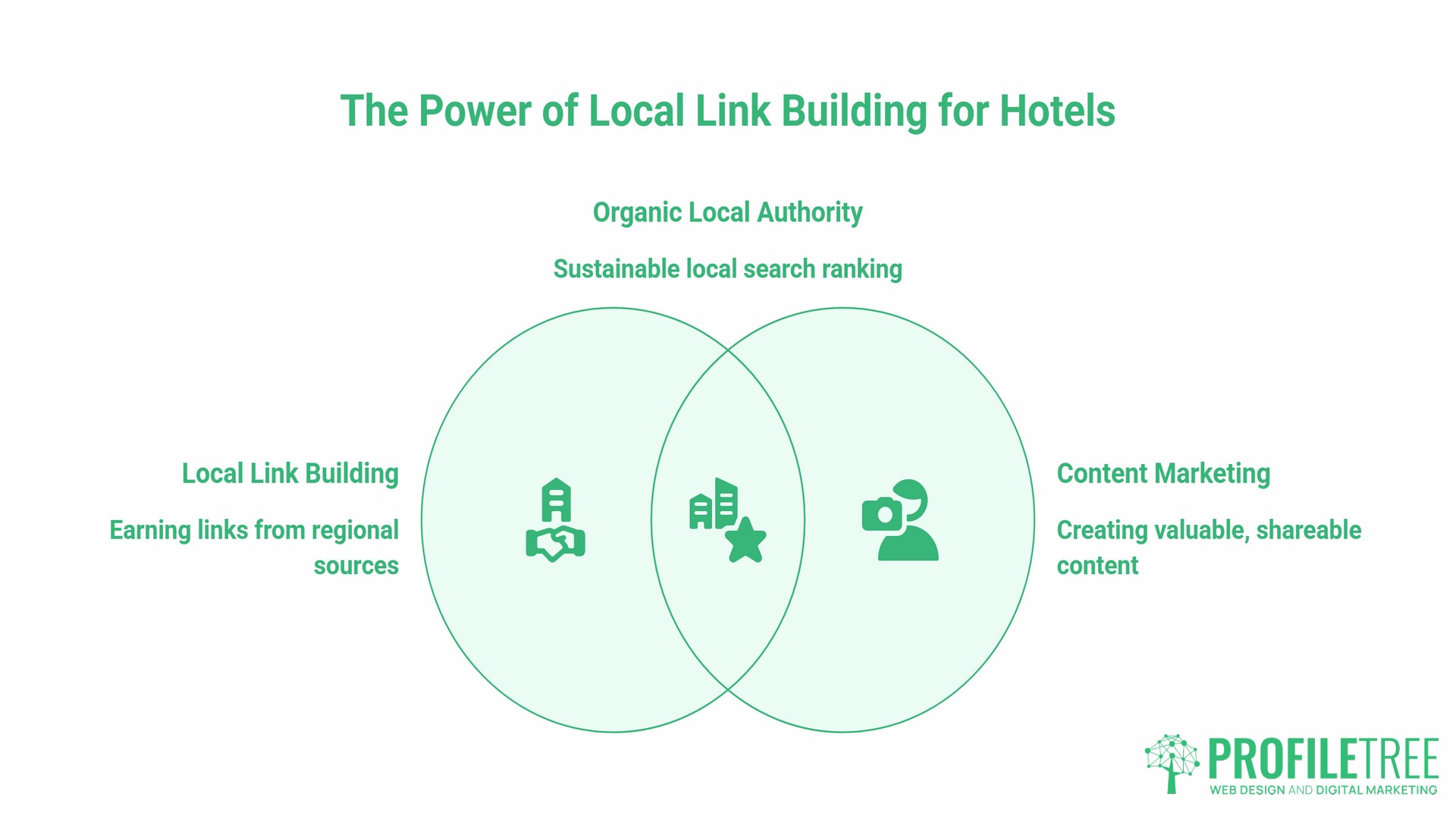
Links from relevant, authoritative local sources strengthen your hotel’s authority in local search. Local link building is an area of local SEO for hotels that many independent properties overlook in favour of GBP and on-page work, but it plays a meaningful role in long-term local pack performance.
For NI and Irish hospitality businesses, the most valuable link sources are Tourism NI and Discover Northern Ireland, Fáilte Ireland and its regional tourism bodies, local council tourism pages, local event organisers that recommend your hotel as a place to stay, and local business associations and chambers of commerce.
Beyond directory submissions, the most sustainable approach to local link building is producing content that local publications and tourism organisations want to reference. A guide to a local walking route, a seasonal events calendar for your area, or a piece on the history of your building all have the potential to earn organic links from regional media and tourism websites.
This is where content marketing and local SEO connect directly. ProfileTree’s content marketing service works with hospitality clients to produce destination-led content that earns links and ranks for long-tail search terms guests use when planning trips.
Tracking Direct Booking Performance
The commercial case for any local SEO for hotels programme depends on being able to measure it. Set up the following before you start, so you have a baseline to compare against.
In Google Analytics 4, create a conversion event for completed bookings made through your direct booking engine. Segment traffic by source to separate organic search, direct, referral (including OTA click-throughs), and paid. As your local SEO for hotels programme matures, you should see organic traffic to location pages increase and, with it, direct bookings attributed to organic.
Use UTM parameters on the URL in your Google Business Profile. This allows GA4 to attribute visits from your GBP listing as a distinct traffic source, separate from general organic search. Without this, GBP-driven traffic is often misattributed to “direct,” making it invisible in your reporting.
| Metric | What it measures | Reporting frequency |
|---|---|---|
| Local pack position | Visibility in map-based results | Monthly |
| GBP profile views | Reach of your listing | Monthly |
| GBP website clicks | Traffic from listing to site | Monthly |
| Direct bookings (organic) | Revenue attributed to SEO | Monthly |
| Review volume and rating | Reputation health | Weekly |
| Citation consistency | NAP accuracy across platforms | Quarterly |
Voice Search and the Conversational Hotel Guest
Voice search queries follow natural speech patterns. Instead of “hotels Belfast,” a voice search might be “what’s a good hotel near the Titanic Quarter with parking?” These longer, more specific queries are easier to rank for than short-tail terms, and they come from guests further along in the decision process.
To capture voice search traffic, your website and GBP listing need to answer specific questions directly. Your FAQ section is particularly valuable here. Questions like “Does the hotel have free parking?”, “What time is check-in?”, and “Is the hotel near the city centre?” should be answered in plain language on your website rather than buried in a booking engine or PDF.
Your GBP listing’s “Questions and Answers” section also feeds voice search results. Populate it with the questions your front desk team is asked most often.
Business Travellers: A Distinct SEO Segment
Business travellers search differently from leisure guests. Their queries tend to be time-specific, proximity-focused, and amenity-driven: “hotel with meeting rooms Belfast,” “hotel near Stormont,” “accommodation near Ulster University.”
A dedicated landing page for business travellers, highlighting Wi-Fi speed, desk workspace, proximity to business parks or conference venues, and flexible check-in options, creates a specific target for these search terms. It is also a straightforward local SEO for hotels, where many properties leave unclaimed: the facilities exist, but the content to surface them does not.
FAQs
How long does local SEO for hotels take to produce results?
Google Business Profile improvements, such as adding photos, completing attributes, and responding to reviews, can influence local pack rankings within a few weeks. Meaningful organic traffic growth from on-page and off-page work typically takes three to six months. The timeline depends on how competitive your location is and how much optimisation work has already been done.
Do I still need to be on Booking.com if my local SEO improves?
Yes, for most hotels. OTAs provide valuable visibility for guests discovering your property for the first time, and the billboard effect means some of those guests will subsequently search for your brand directly. The goal is not to eliminate OTAs entirely, but to shift a higher proportion of bookings to direct, reducing the average commission across your total booking mix.
Does my hotel need a separate page for every nearby landmark?
Only where there is genuine search volume for that landmark combination. Start with the highest-traffic landmarks in your area. For Belfast properties, that includes Titanic Belfast, the SSE Arena, and Ulster University. For properties in rural Northern Ireland or the west of Ireland, it means the specific geographical features or tourist sites that drive your region’s visitor economy.
How should I handle a negative review on Google?
Respond promptly, professionally, and briefly. Acknowledge the specific issue, explain what has been addressed, and invite the guest to return or to contact you directly. Do not be defensive and do not offer compensation or incentives in the public response. The audience for your response is future guests, not the reviewer.
What is the difference between the Google local pack and the Google Hotel Travel interface?
The local pack is the map-based block of three results that appears for location searches. It is driven by Google Business Profile optimisation and local SEO signals. The Hotel Travel interface is a price-comparison feature powered by Google Hotel Ads, which requires a connection between your booking engine and Google Hotel Center. Both can appear for the same search but are managed through different systems.
How can ProfileTree help hotels with local SEO?
ProfileTree is a Belfast-based digital agency working with hospitality and tourism businesses across Northern Ireland and Ireland. Services relevant to hotel operators include local SEO strategy and implementation, Google Business Profile management, hotel website design and development, destination-led content marketing, and digital training for in-house marketing teams. To discuss how local SEO for hotels could work for your property, [get in touch with the ProfileTree team].