
Effective Email Marketing: How to Build a Funnel That Converts
Table of Contents
Most small businesses have an email list sitting somewhere. A few hundred contacts from a trade show, a newsletter signup that never got a proper follow-up, a CRM full of past customers who haven’t heard from you in months. The list exists. The funnel does not.
Effective email marketing is not about sending more emails. It is about sending the right ones to the right people at the right point in their relationship with your business. An email marketing funnel is the system that makes this possible: a structured sequence of touchpoints that takes someone from first contact to a paying customer, and ideally to a repeat customer.
This guide covers how to build that system from the ground up, with specific attention to what works for SMEs in the UK and Ireland, where GDPR and PECR compliance shape what you can and cannot do.
What an Email Marketing Funnel Actually Is
Before building anything, it helps to understand what the funnel is doing and why each stage exists.
A funnel describes the narrowing journey from awareness to purchase. Many people hear about your business. Fewer engage with it. Fewer still buy. Email sits in the middle and lower stages of that journey, where the goal shifts from reaching new people to converting the ones already paying attention.
An email marketing funnel typically has four stages: acquisition (someone joins your list), nurture (you give them relevant, useful content), conversion (you make an offer they act on), and retention (you keep them engaged after the sale). Each stage requires different content, different timing, and a different measure of success.
The mistake most SMEs make is skipping straight to conversion. They build a list and immediately send promotional emails. The result is high unsubscribe rates, low open rates, and a declining sender reputation. A well-structured email marketing funnel earns trust before it asks for anything.
Building a Permission-Based Email List
The list is the foundation. Without a steady flow of new subscribers, an email marketing funnel stagnates. But list size matters less than list quality: a thousand subscribers who signed up because they genuinely wanted your content will outperform ten thousand added without clear consent.
Lead magnets that earn the signup
A lead magnet is the incentive that prompts someone to give you their email address. For eCommerce businesses, this is often a discount code. For service businesses, it is more likely to be a guide, a checklist, a short audit, or access to something genuinely useful.
The more specific the lead magnet, the higher the quality of subscribers it attracts. A solicitor’s practice offering a free guide to commercial lease renewal will attract business owners facing that exact problem. Generic lead magnets, “sign up for our newsletter,” do not self-select for intent in the same way.
Opt-in forms and pop-ups
Pop-ups remain one of the highest-converting opt-in mechanisms when used well. The key variables are timing (exit-intent or scroll-based tend to be less disruptive than immediate triggers), the specificity of the offer, and the call to action. A button labelled “Send me the checklist” will consistently outperform one labelled “Subscribe.”
A two-step opt-in, where the visitor clicks a button before seeing the form, uses the principle of micro-commitment. Having taken one small action, a higher proportion of visitors complete the second. Quizzes and preference-based opt-ins go further still: rather than simply capturing an email address, they collect zero-party data, information the subscriber has voluntarily shared about their needs or situation, which makes the subsequent funnel more relevant from the first email.
Website traffic is the engine
No opt-in mechanism will build a list without traffic. SEO, paid search, social media, and content marketing all feed the funnel at the top. For SMEs across Northern Ireland, Ireland, and the UK, building those traffic channels before designing the funnel is usually the right sequence. ProfileTree’s work on digital marketing strategy often starts exactly there.
UK GDPR and PECR: What SMEs Need to Know
This is the section most email marketing guides skip or handle in a single sentence. If you are based in the UK or Ireland, the rules are more nuanced than “get permission.”
GDPR allows email marketing under two legal bases: explicit consent and legitimate interest. For most direct marketing to individuals, consent is the cleaner and safer basis. Under PECR, electronic direct marketing to individuals requires consent, with one exception: the soft opt-in.
The soft opt-in applies only to existing customers, only for products or services similar to those they previously purchased, and only if you gave them a clear opportunity to opt out at the time of the original transaction. It does not apply to B2B contacts who are sole traders or partnerships.
PECR also distinguishes between individuals and corporate subscribers. Emails to a named individual at a limited company may be sent on the basis of legitimate interest, provided the contact is relevant and a clear opt-out is included. The ICO’s direct marketing guidance is the authoritative source for current rules. When in doubt, build on consent: it is the safest long-term position and causes fewer deliverability problems.
The Four Stages of an Email Marketing Funnel
Each stage has a different goal, a different audience mindset, and different content requirements. Treating them as one undifferentiated list is where most funnels fail.
Stage 1: Acquisition
Acquisition is everything that happens before the first email is sent. The traffic source, opt-in mechanism, lead magnet, and confirmation email all belong here. A double-opt-in setup, where the subscriber confirms their address before being added to any active sequence, reduces list size while improving deliverability and compliance. Every contact has actively confirmed they want to be there.
Stage 2: Nurture
The nurture stage begins immediately after the subscriber joins and continues until they are ready to buy. The goal is not to sell. It is to demonstrate that you understand the subscriber’s situation, have relevant expertise, and can be trusted.
Nurture content includes educational articles, practical guides, and industry-specific insight. For a web design agency targeting SMEs, this might be a series explaining how website speed affects search rankings, what to look for in a brief, or how to decide whether a WordPress site needs a rebuild. Each email builds authority without asking for anything in return. The length of the sequence depends on the sales cycle: shorter for low-consideration products, longer for services with extended decision processes.
Stage 3: Conversion
Conversion emails make an offer. They can be triggered by a specific action (a subscriber visits a service page repeatedly), by time (they have been on the list for 30 days without buying), or by a scheduled campaign. The offer should be specific, the value should be clear, and the call to action should be singular. One email. One offer. One link to click.
Stage 4: Retention
Retention is the stage most businesses under-invest in. Acquiring a new customer costs significantly more than keeping an existing one, yet the post-purchase sequence is often an afterthought. A well-designed retention flow includes a thank-you email that goes beyond a receipt, onboarding content that helps the customer get value from what they bought, and a re-engagement campaign for customers who have gone quiet.
Automation Flows That Do the Work
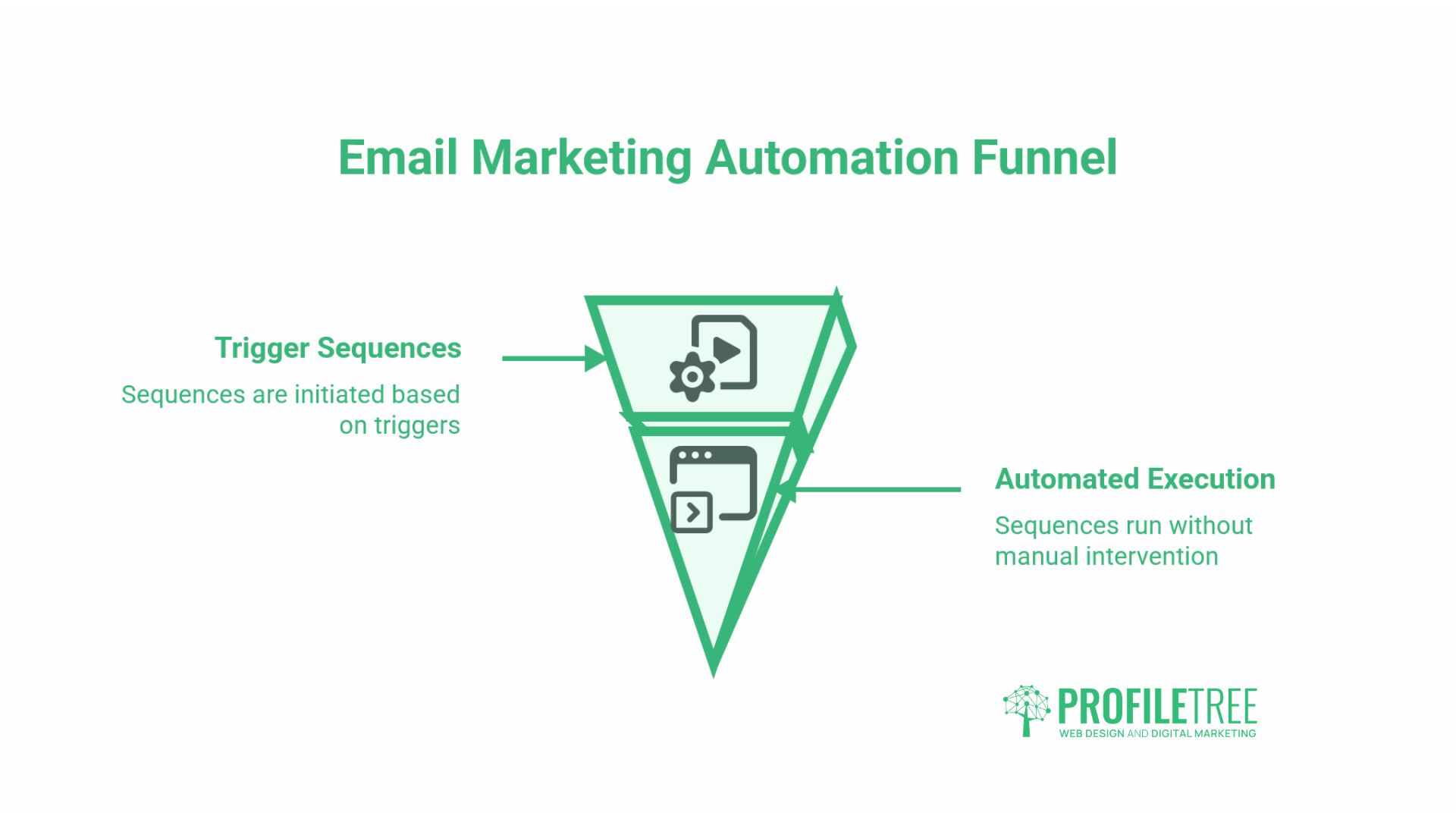
Automation is what turns a good email marketing funnel into a scalable one. Sequences trigger based on subscriber behaviour, time elapsed, or tags applied to their profile, and once built, they run without manual intervention.
The welcome series
The welcome series is the most important sequence in any email marketing funnel. A subscriber who receives a relevant, well-written welcome sequence is far more likely to remain engaged than one who receives nothing for a week and then gets a promotional blast.
A standard welcome series for a service business runs three to five emails over seven to ten days. Email one delivers the lead magnet and sets expectations. Email two introduces the business and establishes credibility with something specific: how long you have been operating, who you work with, a real outcome you have helped clients achieve. Emails three to five provide genuinely useful content. No pitch until the sequence has done its job. If zero-party data was collected at signup, the series should reflect it: a subscriber who indicated they run a hospitality business should not receive the same sequence as one in professional services.
Re-engagement and sunset flows
Subscribers go cold. It happens to every list. A re-engagement flow attempts to reactivate subscribers who have not opened or clicked in a defined period, typically 90 to 180 days. The sequence should be short and direct, asking for a single small action: a reply, a preference update, or a resource download.
Subscribers who do not engage should be moved to inactive status and removed from regular sends. This is called a sunset flow, and it is one of the most counterintuitive but important practices in email list management. A smaller, engaged list outperforms a large, disengaged one every time. For context on how engagement rates vary by sector, the email statistics by industry data is worth reviewing as a benchmark.
Segmentation, Frequency, and List Hygiene
Getting the mechanics right matters, but so does the ongoing discipline of keeping the list in good shape.
Segmentation
Segmentation divides a list into groups based on shared characteristics, such as where the subscriber came from, what they have bought, what content they have engaged with, or what they told you at signup. For SMEs with smaller lists, a basic setup that sends different content to prospects versus existing customers, and to recently engaged subscribers versus lapsed ones, will outperform a single undifferentiated send. Complexity can come later; relevance comes first.
Send frequency
The correct frequency is the one that keeps subscribers engaged without prompting unsubscribes or spam complaints. For most SME service businesses, one to two emails per week is a reasonable ceiling during active campaigns. The best signal is your own engagement data: if open rates and click rates are declining week on week, frequency may be the cause. Consistency matters more than volume. A business that sends reliably every Tuesday trains its audience to expect it.
List hygiene
A clean list performs better than a large one. Bounced addresses and non-engaged contacts harm deliverability. Most email service providers handle hard bounces automatically, but soft bounces and inactive subscribers require a manual review process, which is where the sunset flow earns its place.
Measuring What Actually Matters
Since Apple’s Mail Privacy Protection (MPP) began preloading email content in the background, open rate has become an unreliable primary metric for lists with a high proportion of Apple Mail users. The metrics that still hold up are click rate, click-to-open rate, conversion rate (the percentage of clicks that result in a purchase or enquiry), and revenue per email sent.
Deliverability metrics matter too. An upward trend in spam complaint rate, bounce rate, or unsubscribes is a warning signal that something needs attention, usually list quality, content relevance, or send frequency.
| Funnel Stage | Primary Metric | Secondary Metric |
|---|---|---|
| Acquisition | Opt-in conversion rate | Cost per subscriber |
| Nurture | Click rate | Sequence completion rate |
| Conversion | Conversion rate | Revenue per email sent |
| Retention | Repeat purchase rate | List churn rate |
How Email Fits Into Your Wider Digital Strategy
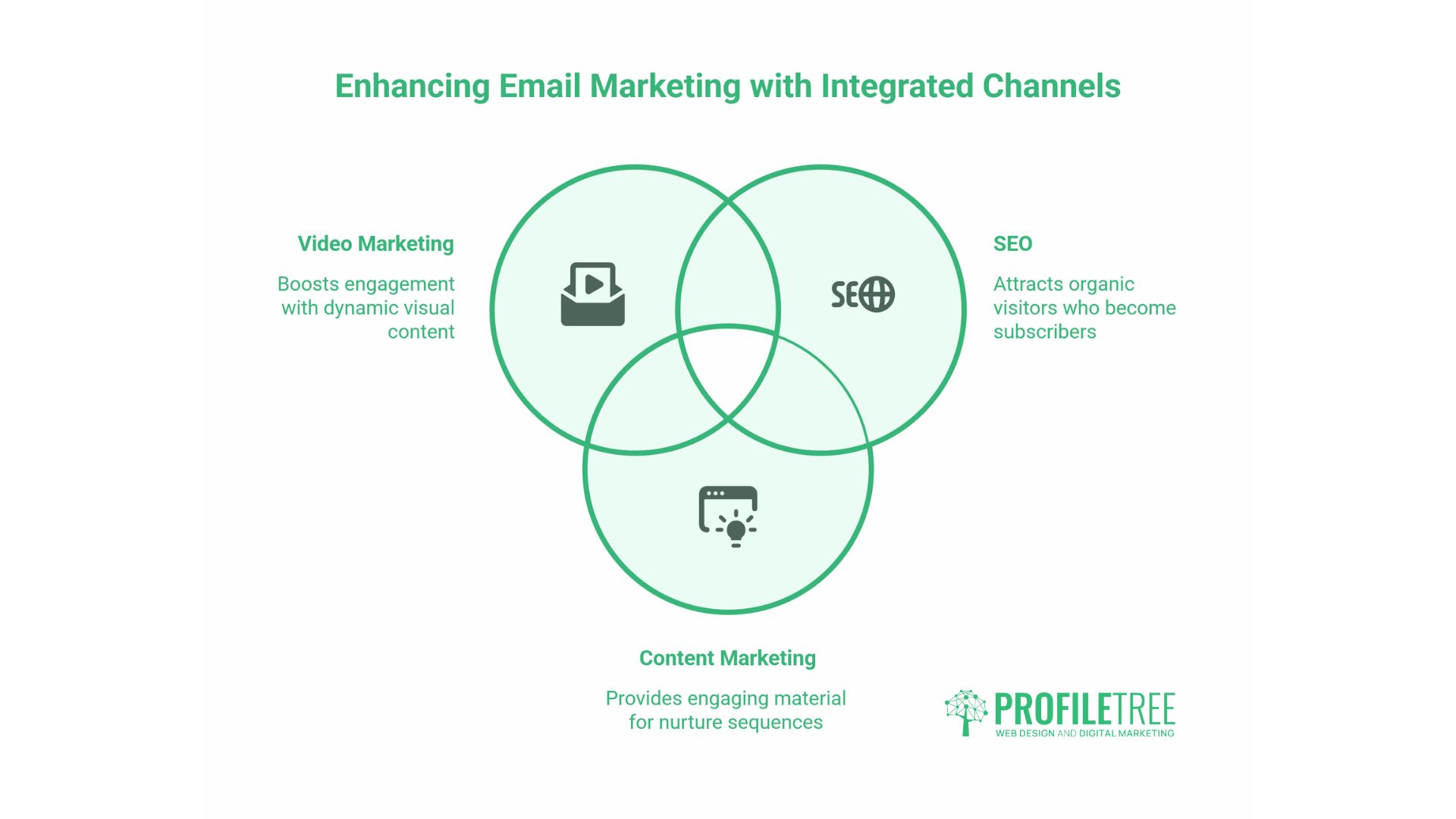
An email marketing funnel performs best when integrated with other channels that build awareness and drive traffic. SEO brings organic visitors who convert into subscribers. Content marketing provides the material that makes nurture sequences worth reading. Video, embedded in emails or linked from them, consistently outperforms static content in terms of engagement.
ProfileTree works with SMEs across Northern Ireland, Ireland, and the UK on this kind of joined-up approach: building traffic channels, producing content, and designing the sequences that convert that traffic into customers. The practical guide to using email for your business covers the platform and setup side in more detail. For businesses concerned about the compliance side of their wider digital activity, the ethics and legalities of digital marketing article covers the broader regulatory picture.
For teams managing this in-house, structured digital training equips marketing staff to build and maintain a funnel without relying on an agency for every change. ProfileTree delivers hands-on digital training for SMEs, covering email strategy alongside SEO, content, and social media as part of a practical programme designed around real business goals.
Putting It All Together: Your Email Funnel Action Plan
Building an effective email marketing funnel does not have to happen all at once. Most SMEs get the best results by starting small, getting one stage working properly, and then building outward.
Start with acquisition and the welcome series. Get the opt-in mechanism live, connect it to a three-email welcome sequence, and make sure every subscriber receives something useful within the first 48 hours. Once that is running reliably, add a nurture sequence. Once the nurture sequence is converted, build the re-engagement and sunset flows.
The businesses that see the strongest results from email are rarely the ones with the most sophisticated setups. They are the ones that maintain consistency: a clean list, relevant content, and a sequence that reflects where the subscriber actually is. That discipline, applied over time, is what separates effective email marketing from an inbox most people ignore.
Conclusion
Email remains one of the most cost-effective channels available to small businesses, but only when the fundamentals are in place. A permission-based list, a structured funnel, content that reflects the subscriber’s situation, and the discipline to keep the list clean: these are the things that determine whether email works for a business or quietly wastes its time. The technology is straightforward. The strategy takes more thought, but it is not complicated. Start with one stage, build from there, and measure what actually moves.
FAQs
What is an email marketing funnel?
A structured sequence of emails that guides a subscriber from first contact to purchase and beyond, covering acquisition, nurture, conversion, and retention.
How do I start building an email marketing funnel from scratch?
Start with an email service provider, an opt-in form, a lead magnet, and a three- to five-email welcome sequence. Get those working before adding complexity.
Is email marketing still effective for small businesses in the UK?
Yes. It remains one of the highest-return channels available to SMEs, particularly when built on genuine consent and a well-maintained list.
What is the best frequency for marketing emails?
One to two emails per week is a reasonable ceiling for most service businesses. Your engagement data is the better guide: declining click rates usually mean you are sending too often.
Do I need to comply with UK GDPR for email marketing?
Yes. GDPR and PECR apply to any business marketing to people in the UK. You need a valid legal basis, a clear opt-out in every commercial email, and a record of consent.
What is a sunset flow in email marketing?
An automated sequence sent to inactive subscribers giving them a final chance to re-engage. Those who do not are removed from active sends, protecting your deliverability and sender reputation.