
How to Create a Marketing Strategy: A UK Guide
Table of Contents
Most businesses start marketing before they have a strategy. They run ads, post on social media, and send emails, then wonder why results are inconsistent. The problem is rarely the tactic: it’s the absence of a clear plan that connects activity to a defined goal and target audience.
This guide covers how to create a marketing strategy from scratch, whether you’re a sole trader in Belfast, a growing SME across Northern Ireland, or an established business expanding into the UK market.
What Is a Marketing Strategy?
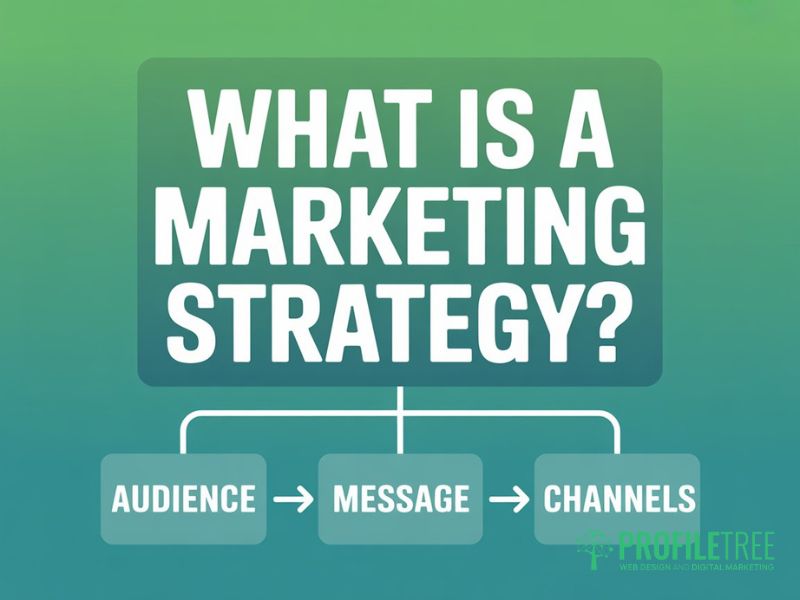
A marketing strategy is your overarching plan for reaching and converting your target audience. It sets out who you are speaking to, what problem you solve, what message you will use, and which marketing channels will carry that message. It is not a list of tactics: it is the reasoning layer that sits above every individual marketing decision you make.
Based on Investopedia, a marketing strategy is a game plan that businesses use to market their products or services and reach prospective customers. In plain terms, that means making deliberate choices about positioning, audience, and messaging before you spend a single pound on promotion. It applies equally to digital marketing activity and traditional channels.
Without a marketing strategy, you’re guessing. You might get lucky once, but you can’t build consistent growth on luck. Businesses that skip this step and go straight to digital marketing activity often spend months wondering why their target audience isn’t responding.
Marketing Strategy vs Marketing Plan vs Marketing Analysis
These three terms are often used interchangeably, but they answer different questions. A marketing strategy defines who you’re targeting and why. A marketing plan turns that direction into campaigns, timelines, and budgets. Marketing analysis is the research that feeds both.
For the full breakdown of how a marketing strategy and marketing plan differ in practice, and why treating them as one document causes problems, see our guide to marketing plan vs marketing strategy.
| Concept | Focus | When to Review |
|---|---|---|
| Marketing Strategy | Who, what, why: direction and positioning | Once a year, or after a major market shift |
| Marketing Plan | What, when, how much: campaigns and timelines | Quarterly or per campaign cycle |
| Marketing Analysis | Research, data, competitor review | Ongoing, with formal reviews every six months |
How to Create a Marketing Strategy: 7 Steps
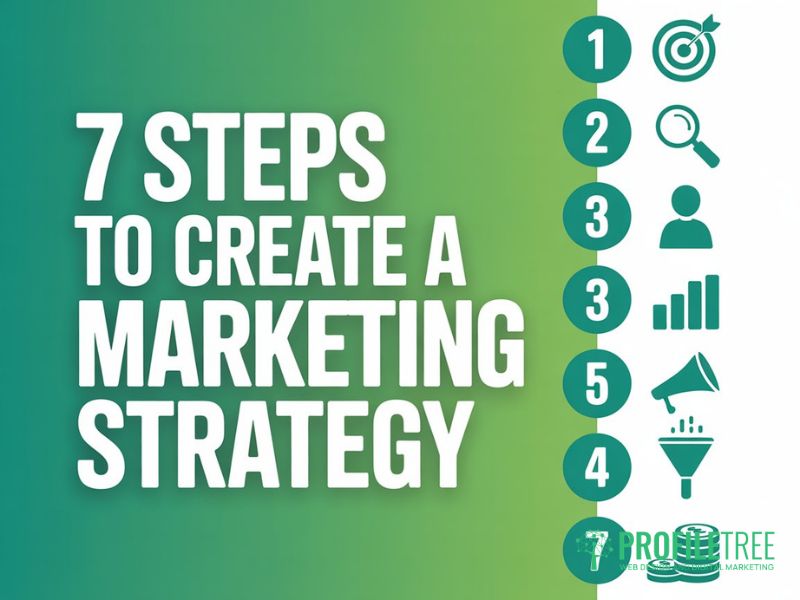
The following framework draws on ProfileTree’s experience with over 1,000 SMEs across Northern Ireland, Ireland, and the wider UK. Use it to create a marketing strategy grounded in research and connected to your commercial objectives, not guesswork.
Step 1: Set SMART Business Goals
Your marketing strategy has to start with clear business goals. If your goals are vague, your strategy will be vague, and your results will follow. Use the SMART framework: every goal should be specific, measurable, attainable, relevant, and time-based.
‘Increase brand awareness’ isn’t a goal a marketing strategy can act on. It is an aspiration with no way to measure success. ‘Grow organic website traffic from Northern Ireland by 30% over the next six months by publishing two SEO-optimised articles per week’ is a SMART goal. It tells you what you’re measuring, how you plan to achieve it, and when you expect to see results.
Define two to four primary goals before you write a word of strategy. These become the benchmarks against which every channel, campaign, and piece of content is measured.
Step 2: Conduct Market Research
Solid market research separates a marketing strategy built on evidence from one built on assumptions. Your research should cover three areas: your target audience, the competitive environment, and the wider market conditions affecting your sector.
For UK and Irish businesses, publicly available data includes the ONS, the CSO in Ireland, Companies House, and sector-specific industry bodies. Supplement these with primary research: surveys of your existing customer base, sales call analysis, and the questions your target audience is already asking online.
If you have Google Search Console access, the Queries report shows the exact language your target audience uses when searching for solutions like yours: phrasing that no survey captures as accurately. For businesses in Northern Ireland and the Republic of Ireland, it also surfaces regional query variants that national-level tools often miss.
Step 3: Build Detailed Customer Personas
A customer persona is a detailed profile of your ideal buyer. It goes beyond demographics to include psychographics: motivations, anxieties, decision-making triggers, and the marketing channels they rely on. The more specific your customer persona, the more focused your messaging will be.
A common mistake is building a customer persona based on who you would like to sell to rather than who actually buys from you. Start with your existing customer data: look at clients who buy quickly, pay on time, and refer others, then identify the patterns in their behaviour, sector, and pain points. This is your actual target audience, and it may differ from the one you assumed.
Aim for two to three primary customer personas, each with a clear problem statement your business solves. Your marketing strategy should address each one specifically, even if the core message stays consistent.
Step 4: Audit the Competitive Environment
Understanding how your competitors market themselves provides essential context for your own marketing strategy. You’re not looking to copy them. You are looking to identify where they are weak, where they are failing their target audience, and where there’s room for your brand to occupy a distinctive position.
Analyse their messaging, marketing channels, and content types. Use Google Search to see what they rank for and review their social media activity to understand audience response. A keyword gap analysis in Ahrefs or Semrush will show you terms your competitors rank for that you don’t, including digital marketing topics they cover poorly or not at all.
The practical output of this step is a short positioning statement: what do you offer that your competitors don’t, and who is it for?
Step 5: Define Your Value Proposition and Messaging
Your value proposition is the clearest single statement of why a customer should choose you over any alternative. It should be specific, credible, and immediately understandable. ‘We build websites’ isn’t a value proposition. ‘We design and build conversion-focused WordPress websites for Northern Irish SMEs, with a five-star rated aftercare service included as standard’ is much closer: it names the target audience and contains a proof point.
Once you have your value proposition, build your core messaging framework from it: your primary headline, three to five supporting claims, and the evidence behind each one. A value proposition that isn’t reflected consistently across your marketing channels will confuse your target audience rather than convert them.
For SMEs looking to develop clearer positioning as part of a wider digital presence, ProfileTree’s digital strategy services work through the value proposition and messaging process alongside you and connect the outputs directly to your marketing activity.
Step 6: Select Your Marketing Channels
Marketing channel selection should follow your target audience research, not trends or convenience. The right mix of marketing channels is the one your audience actually uses to find and evaluate businesses like yours. For most UK and Irish SMEs, the core digital marketing channels to consider are organic search, paid search, email, social media, and content.
Organic search remains one of the highest-return marketing channels for businesses with a clear local or niche market. It takes time to build, but the long-term cost per acquisition is lower than almost any paid channel. ProfileTree’s SEO services focus on building lasting visibility for the terms that drive real commercial enquiries, not just traffic numbers.
Content marketing: publishing useful, well-structured articles, guides, and resources compounds in value over time. It supports your SEO strategy, builds audience trust, and positions your team as the credible voice in your sector. It is particularly effective for Northern Ireland and Irish businesses targeting a UK-wide audience, because well-optimised content can rank nationally for terms that paid marketing channels would price you out of.
Social media works best when platform choice follows audience research. LinkedIn suits B2B and professional services. Instagram and TikTok work well for consumer brands with strong visual content. Facebook remains relevant for local service businesses across Northern Ireland, where community groups still drive real referral traffic. Check that whichever social marketing channels you choose appear in your customer persona research before you commit budget.
Email marketing is consistently undervalued as a marketing channel. For businesses with an existing customer base, a well-run email marketing programme is often the most cost-effective option in the mix, requiring minimal spend to reach people who have already shown interest in what you do.
Step 7: Set Your Budget and Allocate Resources
A marketing strategy without a budget is a wish list. Assign realistic resources to each channel, accounting for both direct spend (ad budgets, tools, content production) and time (internal hours or agency fees).
For most UK SMEs, a sensible starting point is 7 to 10% of revenue allocated to marketing, with the larger share going to digital channels where the return is more measurable. Organic search and content take time to compound, but the long-term economics are far better than paid advertising alone.
Review your allocation every quarter. What’s producing results? What isn’t? Shift resources toward what’s working. A quarterly review cycle is also when you check whether your marketing plan still reflects the direction set in your strategy, and tighten the connection between spend and the goals you set out to create a marketing strategy around.
The Marketing Mix: Applying the 7 Ps
The 7 Ps (product, price, place, promotion, people, process, and physical evidence) give you a practical framework for stress-testing your strategy against the full customer experience. Working through them alongside your value proposition often surfaces pricing or delivery assumptions that would otherwise undermine your results.
For a detailed breakdown of each of the 7 Ps and how they apply specifically to service businesses, see our guide to the components of a marketing strategy.
Measuring the Success of Your Marketing Strategy
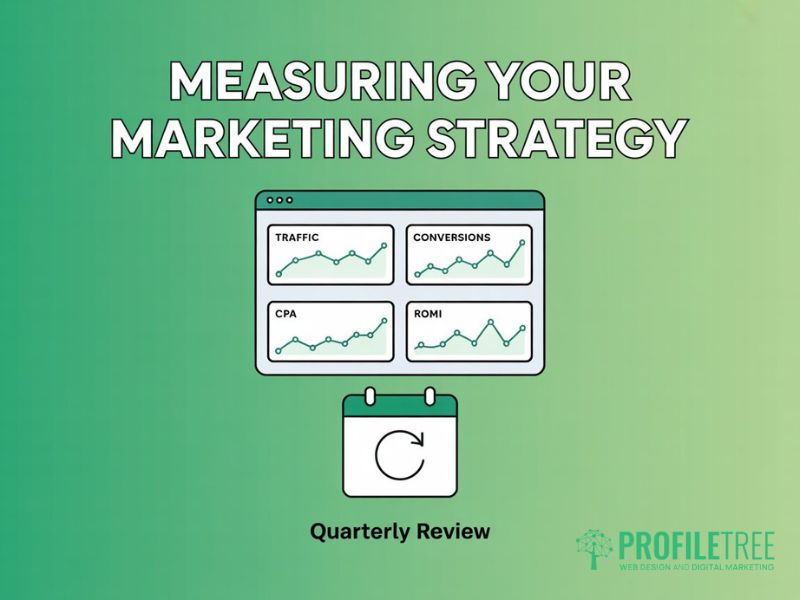
A marketing strategy without measurement will drift. Set KPIs at the same time as your goals. Clear metrics mean you can assess what is working, adjust based on evidence, and demonstrate return on investment.
KPIs Worth Tracking
The right metrics depend on your goals and marketing channels. The following are the most consistently useful for UK and Irish SMEs running a mixed digital marketing approach:
| KPI | Why It Matters |
|---|---|
| Organic search traffic | Measures whether your SEO and content work is building visibility over time |
| Conversion rate (by channel) | Shows whether your messaging and site experience are turning visitors into leads or buyers |
| Cost per acquisition (CPA) | Measures the efficiency of your paid spend and allows fair channel comparison |
| Email open and click-through rate | Signals whether your list finds your messaging relevant |
| Return on marketing investment (ROMI) | The bottom-line measure of whether marketing spend is producing revenue |
| Branded search volume (GSC) | Tracks growing brand recognition, a leading indicator of long-term SEO stability |
Review Cadence
A weekly sense-check on channel performance, a monthly campaign analysis, and a quarterly review of your marketing strategy and marketing plan will catch problems early. If a marketing channel isn’t performing after six to eight weeks, that’s information, not failure. Use it to adjust and make your digital marketing spend progressively more efficient.
Using AI Tools in Your Marketing Strategy Workflow
AI tools are now practical for SMEs at every stage of the marketing strategy process. They don’t replace strategic judgement, but they cut the time spent on research, drafting, and analysis.
Tools such as ChatGPT and Claude can generate initial customer persona drafts, outline competitive SWOT analyses, produce content frameworks, and review messaging for clarity. They work best with a specific context: your sector, your location, your target audience, and your goals. A well-built customer persona fed into an AI prompt produces far more useful outputs than a generic query.
For competitor and keyword research, Google Search Console, Ahrefs, and Semrush remain the most reliable tools. Search Console is free, highly accurate, and surfaces regional query variants that national-level tools underreport, making it particularly valuable for Northern Ireland and Irish businesses.
ProfileTree provides AI training for SMEs through the Future Business Academy, covering practical applications across marketing, operations, and content production. For businesses ready to embed AI more deeply into their workflows, AI transformation services guide the process from initial audit through to implementation.
FAQs
1. What is a marketing strategy in simple terms?
A marketing strategy is your plan for reaching the right target audience with the right message through the right channels. It defines who you are speaking to, your positioning in the market, and the goals you are working toward. A marketing strategy doesn’t tell you what to post on Tuesday: it tells you why you’re posting at all, and what outcome you expect it to drive.
2. What are the 7 steps to create a marketing strategy?
The seven steps to create a marketing strategy are: set SMART business goals, conduct market research, build detailed customer personas, audit the competitive environment, define your value proposition and messaging, select your marketing channels, and set your budget and allocate resources. Working through these in order means your marketing strategy is built on evidence and connected to your commercial objectives rather than assumptions.
3. How do I write a marketing strategy for a small business?
Start with your business goals and work backwards. Build a customer persona around your ideal buyer, identify what specific problem you solve, and establish how you differ from competitors. Choose two or three marketing channels where your target audience is active, set measurable KPIs for each, and allocate a realistic budget. A focused marketing strategy built around one or two channels consistently outperforms an over-stretched plan spread across ten.
4. How does UK GDPR affect my marketing strategy?
UK GDPR requires a lawful basis for processing personal data in any marketing activity. For email marketing, that means obtaining explicit consent before sending commercial messages and providing a clear unsubscribe route. For digital advertising, your cookie consent and privacy notices must comply with the ICO’s guidance. Building data compliance into your marketing strategy at the outset, rather than retrofitting it, is the most practical approach for UK and Irish SMEs.
5. How often should a marketing strategy be updated?
Review your marketing strategy at least once a year and after any significant market change, such as a new competitor, a shift in customer behaviour, or a platform update affecting your primary marketing channels. Your marketing plan should be reviewed quarterly. Your channel KPIs are monthly. A marketing strategy that’s never reviewed becomes a document nobody uses.