
Data Privacy in Digital Marketing: A Practical Guide for SMEs
Table of Contents
Data privacy has reshaped how marketing works. Since the GDPR came into force in 2018, businesses across the UK and Ireland have had to rethink how they collect, store and use customer information. For SMEs running digital marketing campaigns, the practical implications go well beyond adding a cookie banner to a website. They affect how you build your site, how you track your audience, how you run email campaigns, and how you use AI tools in your marketing.
This guide covers the key regulations affecting UK and Irish businesses, what they mean for your digital marketing strategy, and how to build compliant campaigns without sacrificing performance. Whether you are managing marketing in-house or working with an agency, understanding your obligations is the starting point for getting this right.
Key Data Privacy Regulations for UK and Irish Marketers
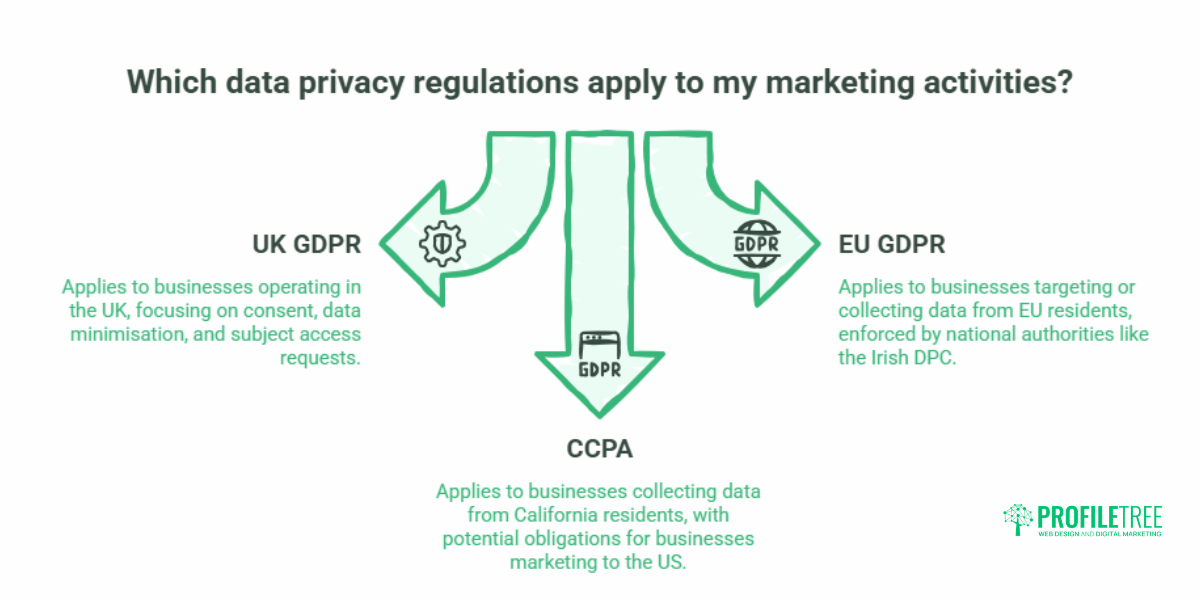
Three frameworks directly affect digital marketing activity for businesses operating in the UK and Ireland. Understanding what each one requires helps you identify where your current practices may need updating.
UK GDPR and the Data Protection Act 2018
After Brexit, the UK retained the principles of the EU GDPR through the UK GDPR and the Data Protection Act 2018, enforced by the Information Commissioner’s Office (ICO). The rules around consent, data minimisation, the right to erasure, and subject access requests all apply. Fines can reach £17.5 million or 4% of annual global turnover, whichever is higher.
For marketers, the most relevant requirements are obtaining a lawful basis for processing personal data, providing clear privacy notices at the point of collection, and respecting opt-out requests promptly. If you send marketing emails, you need either consent or a legitimate interest assessment with a genuine opt-out mechanism.
EU GDPR and the Irish Data Protection Commission
The EU GDPR applies to any business targeting or collecting data from people in the EU, regardless of where the business is based. For Northern Irish businesses with customers in the Republic of Ireland, or UK businesses with EU customers, EU GDPR compliance is not optional. The Irish Data Protection Commission (DPC) enforces EU GDPR across Ireland and has been one of the more active EU regulators, particularly around big tech.
Northern Irish firms operating across the border face dual regulatory exposure: the ICO applies to UK operations and the DPC applies to any EU-facing activity. Under the Windsor Framework, this cross-border dynamic is ongoing. The safest approach is to apply the stricter of the two frameworks consistently.
| Area | UK GDPR (ICO) | EU GDPR (DPC / EDPB) |
|---|---|---|
| Enforcing body | Information Commissioner’s Office (ICO) | Relevant national supervisory authority (e.g. Irish DPC) |
| Cookie consent requirement | UK PECR governs cookies; opt-in required for non-essential cookies | ePrivacy Directive / national PECR equivalent; opt-in required |
| Soft opt-in for email marketing | Permitted for existing customers under UK PECR | Generally stricter; explicit consent preferred |
| Maximum fine | £17.5m or 4% global turnover | €20m or 4% global turnover |
| Data transfers outside UK/EU | Adequacy decisions or standard contractual clauses | Adequacy decisions or standard contractual clauses |
CCPA and Why It May Still Apply
The California Consumer Privacy Act (CCPA) applies to businesses that collect personal data from California residents and meet certain thresholds, including annual gross revenue above $25 million. If your business markets to customers in the US or uses tools that process data from California residents, you may have CCPA obligations. Violations can result in fines of up to $7,500 per intentional violation. For most UK and Irish SMEs, GDPR compliance will satisfy the spirit of CCPA, but it is worth verifying if your customer base includes US residents.
What Privacy Law Actually Changes in Your Marketing
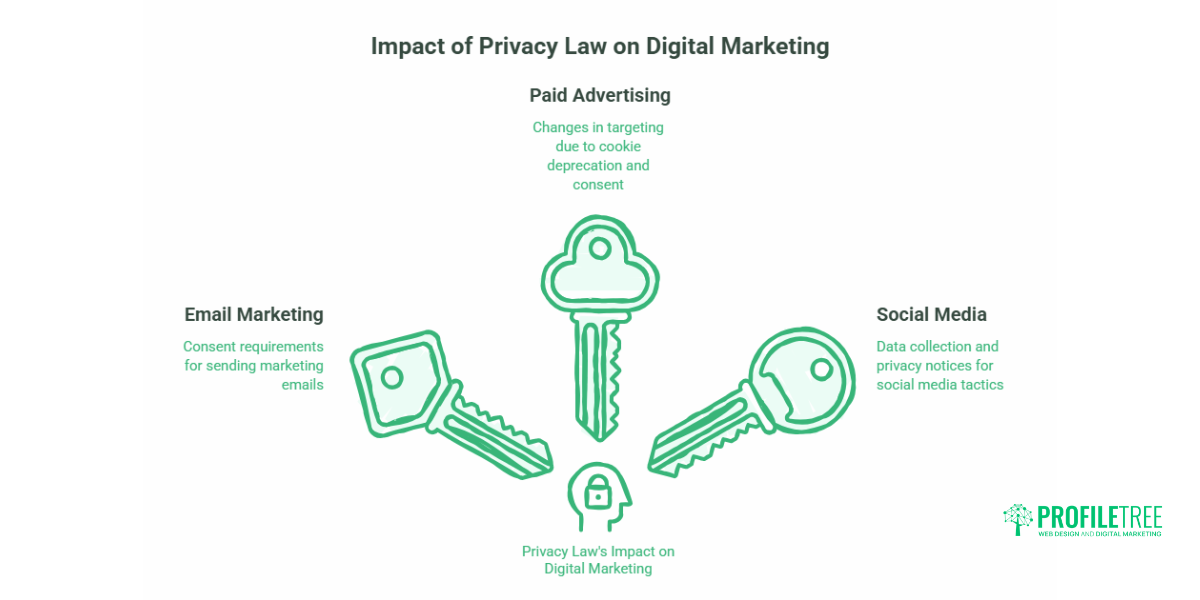
The practical effect of data privacy law on digital marketing is more significant than most businesses realise when they first encounter it. It is not only about having a privacy policy on your website. The regulations affect tracking, targeting, attribution, email, and the tools you use day to day.
Email marketing and the consent requirement
Under UK PECR, sending marketing emails to individuals requires either prior consent or a legitimate interest basis with a soft opt-in for existing customers. In practice, this means your email list should only contain contacts who have actively opted in or who have purchased from you and are being contacted about similar products or services, with a clear opt-out in every message. Bought lists are almost always non-compliant. If your current list cannot be traced back to a clear consent record, it needs to be reviewed before you use it in campaigns.
Your content marketing approach should reflect this. Building a consented email list through genuinely valuable gated content, newsletters, or training resources creates a first-party data asset that is both compliant and commercially durable.
Paid advertising and third-party data
The deprecation of third-party cookies, combined with stricter consent requirements around tracking pixels, has changed how paid advertising targeting works. Retargeting campaigns that previously relied on cookies placed without explicit consent are no longer straightforwardly compliant. Platforms, including Meta and Google, have updated their consent requirements, and advertisers are responsible for ensuring they have a lawful basis to pass audience data to these platforms.
Google’s Consent Mode v2, rolled out fully in 2024, is now a practical requirement for advertisers using GA4 and Google Ads in the EU and UK. It sends consent signals to Google so that conversion modelling can fill gaps where users do not consent to tracking. Implementing it correctly requires both a certified consent management platform (CMP) and correct Google Tag Manager configuration. This is a technical website development task, not just a marketing one.
Social media and data collection
Many social media marketing tactics involve collecting audience data that is subject to GDPR. Running lead generation ads that collect names and emails through a platform such as Meta or LinkedIn requires a privacy notice at the point of collection and a clear statement of how the data will be used. If you export that data to a CRM, the CRM provider becomes a data processor, and you need a data processing agreement in place.
Social listening and audience profiling tools also collect and process personal data. If you use these tools, you should verify that the provider has appropriate data processing agreements in place and that their data sources are lawfully obtained.
Building a Privacy-Compliant Website
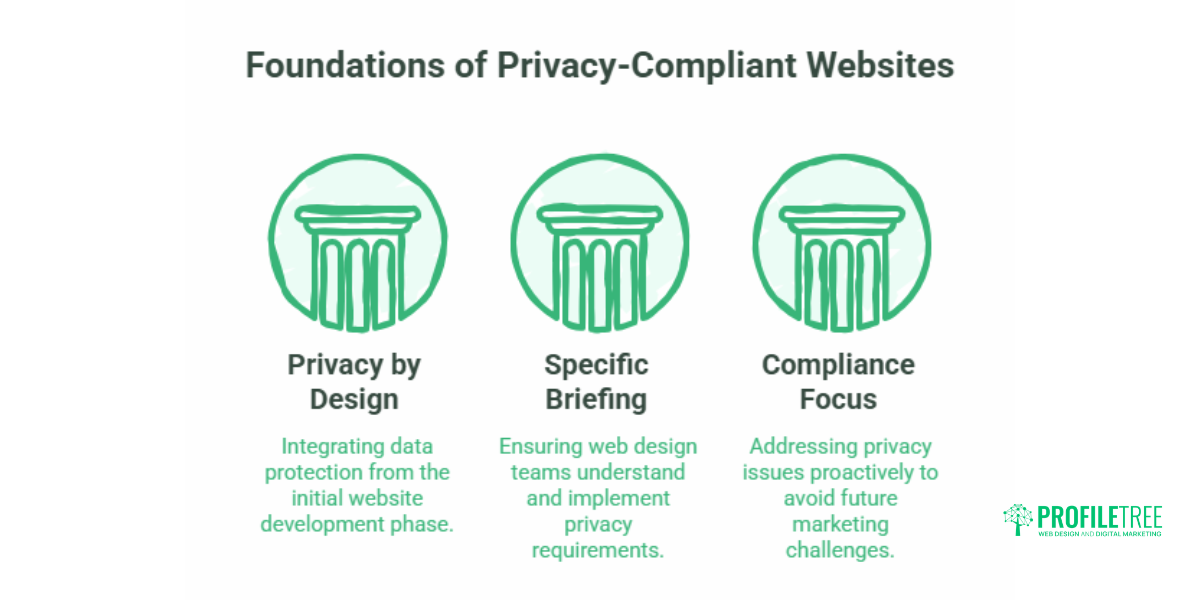
A website that is not built with data privacy in mind creates compliance problems that marketing cannot fix after the fact. Design is the principle that data protection should be built into a website from the start, not added as a layer on top. For SMEs commissioning a new site or a redesign, this should be a specific brief item for your web design team.
Cookie consent banners done correctly.
The ICO’s guidance is explicit: rejecting cookies must be as easy as accepting them. A “Reject All” button must appear on the first layer of a cookie banner with equal visual weight to “Accept All”. Banners that hide the reject option behind a second screen, use low-contrast grey text, or pre-tick non-essential categories are non-compliant. These are called dark patterns, and the ICO has published specific guidance on them.
Beyond the banner design, you need to confirm that your website actually blocks non-essential tracking scripts until the user consents. Many banner plugins apply the banner without blocking the underlying scripts. The only way to verify this is to clear cookies, reload the page in a browser’s developer tools, and check the Network tab to see which scripts fire before any button is clicked.
Web forms and data collection
Every web form that collects personal information, including contact forms, enquiry forms, and newsletter sign-up forms, needs a link to your privacy policy and a clear statement of how the data will be processed. The checkbox confirming this must not be pre-ticked. If you are collecting data for email marketing specifically, that requires a separate, explicit opt-in. A well-structured website with compliant forms is part of the website management responsibilities that should be reviewed regularly, not set once and forgotten.
Third-party asset loading and privacy risks
A less understood compliance risk is the loading of third-party assets before consent is given. Embedding Google Fonts by linking to Google’s CDN sends the visitor’s IP address to Google’s servers the moment the page loads, before any consent interaction. The same issue applies to YouTube video embeds, which load tracking cookies on page load, and to Google Maps iframes. A German court ruled in 2022 that dynamic CDN loading of Google Fonts without consent constituted a GDPR violation.
The technical solutions are straightforward for a development team: self-host Google Fonts, replace live map embeds with static images that link to a map on click, and use click-to-load wrappers for video embeds. These decisions should be standard practice in any new website development brief.
Privacy-first analytics
GA4 with Consent Mode v2 is the most widely used compliant analytics approach. Alternatives, including Plausible.io and Fathom Analytics, are cookie-free by design and do not require a cookie banner for analytics purposes. For SMEs uncomfortable with the complexity of consent mode configuration, these tools offer a simpler path to compliant analytics. The trade-off is less granular attribution data. Your SEO and paid campaigns will still generate useful performance data, though cross-channel attribution will be less precise.
First-Party Data and Why It Matters Now
First-party data is information collected directly from your audience through your own channels: your website, your email list, your CRM, your sales interactions. It is inherently compliant when collected with proper consent, it does not depend on third-party platforms, and it reflects people who have already expressed interest in your business. For these reasons, it has become the most valuable type of marketing data you can hold.
The shift toward first-party data is not only a compliance story. It is a strategic one. Businesses that built their targeting entirely on third-party cookie audiences have had to rebuild their approach as those signals have become less available. Businesses that invested in building consented email lists, customer databases, and website engagement data are less affected.
How to build first-party data compliantly
Building a first-party data asset requires a clear value exchange. You are asking people to share their information with you. They will do so if they receive something genuinely useful in return, whether that is expert content, a tool, a newsletter with relevant information, or early access to something. The value exchange should be clear at the point of sign-up.
From a technical standpoint, the data collection process needs to be compliant from day one. That means a clearly worded consent statement, no pre-ticked boxes, a link to the privacy policy, and a confirmed opt-in flow. Double opt-in, where the user confirms via email after initial sign-up, produces a cleaner, more engaged list and provides a clear consent record.
Zero-party data goes one step further. This is information customers provide intentionally through preference centres, quiz tools, or survey forms. It gives you deeper insight into individual preferences without relying on behavioural inference, and is entirely consent-based by nature. If you are working with ProfileTree on content marketing, building data-capture mechanisms into content assets is a practical way to grow this kind of audience.
“An effective data strategy doesn’t just obey the letter of the law. It embodies a respect for the customer’s privacy as a fundamental business principle. It’s not just about avoiding fines; it’s about building a brand that stands for trust,” says Ciaran Connolly, founder of ProfileTree.
AI Tools, Data and Your Compliance Obligations
AI marketing tools have introduced a new set of data privacy questions that many SMEs have not yet worked through. If you are using AI tools to analyse customer behaviour, generate personalised content, or automate campaign decisions, you need to consider what data those tools are processing, where it is stored, and what your contractual obligations are with the tool provider.
Article 22 and automated decision-making
UK GDPR Article 22 restricts fully automated decision-making that produces significant effects on individuals. If you use AI tools that automatically segment customers and make decisions about what offers they receive without human review, this may trigger Article 22 requirements. You may need to provide an explanation of the decision-making logic and give individuals the right to request human review. The threshold for “significant effect” is not always clear-cut, but marketing decisions around credit offers, personalised pricing, or exclusion from services are the most likely areas to be affected.
AI tools as data processors
Any third-party AI tool that processes personal data on your behalf is a data processor under UK GDPR. You need a data processing agreement (DPA) in place with that provider. Most reputable AI platforms provide standard DPAs, but you need to actively obtain and sign them. If a tool’s terms of service state that it may use your data to train its models, you need to consider whether that is compatible with your obligations to your customers. Anonymising or aggregating data before passing it to AI tools is one practical mitigation.
ProfileTree’s AI training and AI marketing implementation services work through these questions with clients before any tool is deployed, ensuring the use case is both effective and compliant.
AI and bias in marketing
AI profiling tools can produce biased outputs if the training data reflects historical inequalities. In a marketing context, this might mean certain demographic groups are consistently excluded from offers or served different content in ways that could constitute discrimination. The ICO has published guidance on AI and data protection that addresses this. If you use AI for audience segmentation or personalisation, a periodic review of the outputs is worth building into your process.
“We’re shifting the focus back to what matters most in digital marketing: trust and respect for the consumer. By making consent and thoughtful opt-out mechanisms part of the digital dialogue, we’re setting a new standard for customer-focused marketing,” says Ciaran Connolly, ProfileTree Founder.
Privacy-first marketing as a competitive position
There is a commercial argument for treating privacy compliance as a differentiator rather than a cost. Consumers are more aware of how their data is used than they were five years ago, and a business that is transparent about data use and easy to opt out of builds a different kind of trust than one that relies on invisible tracking. For B2B businesses in particular, where procurement processes often include data security questionnaires, demonstrating strong data governance can be a genuine sales advantage.
“Adapting to new privacy laws isn’t just a necessity; it’s an opportunity to build trust with your audience. In an era where brand reputation is important, compliance is a foundation of successful digital marketing,” says Ciaran Connolly, ProfileTree Founder.
Privacy Compliance Checklist for UK and Irish SMEs
Use this as a starting point for auditing your current marketing practices against data privacy requirements.
| Area | What to check | Compliance standard |
|---|---|---|
| Email list | Can you trace every contact back to a consent record or soft opt-in? | UK PECR / GDPR |
| Cookie banner | Does “Reject All” appear on the first layer with equal prominence to “Accept All”? | UK PECR / ICO guidance |
| Tracking scripts | Are non-essential scripts genuinely blocked before consent is given? | UK PECR / GDPR |
| Web forms | Do all forms include a non-pre-ticked consent checkbox and privacy policy link? | UK GDPR Article 7 |
| Third-party assets | Are Google Fonts self-hosted? Are map and video embeds click-to-load? | UK GDPR / PECR |
| AI tools | Do you have a signed DPA with every AI tool that processes customer data? | UK GDPR Article 28 |
| Social lead ads | Do lead forms include a privacy notice at point of collection? | UK GDPR |
| Analytics | Is Google Consent Mode v2 implemented, or are you using a cookieless alternative? | ICO / Google policy |
| Data processors | Do you have DPAs in place with your email platform, CRM, and analytics provider? | UK GDPR Article 28 |
| Privacy policy | Is the policy current, accurate, and written in plain English? | UK GDPR Article 13/14 |
Frequently Asked Questions
What is the difference between UK GDPR and EU GDPR?
UK GDPR is the post-Brexit version of the regulation, incorporated into UK law via the Data Protection Act 2018 and enforced by the ICO. EU GDPR remains in force across EU member states, enforced by national supervisory authorities. The two frameworks are broadly similar but are diverging over time. Northern Irish businesses with customers in the Republic of Ireland may need to comply with both.
Do I need a cookie banner if I only use Google Analytics?
Yes, under UK PECR. Google Analytics uses cookies that are not strictly necessary for the website to function, so you need consent before setting them. Google Consent Mode v2 provides a mechanism to continue using GA4 while respecting consent signals. Alternatively, cookieless analytics tools such as Plausible do not require a consent banner for analytics purposes.
Is a “Reject All” button legally required on a cookie banner?
The ICO’s guidance requires that rejecting cookies must be as easy as accepting them. In practice, this means a “Reject All” option on the first layer of the banner with the same visual prominence as “Accept All”. Banners that require multiple clicks to reject, or that present the reject option in small, low-contrast text, are non-compliant under ICO guidance.
How do privacy regulations affect digital advertising campaigns?
They affect audience targeting, retargeting, conversion tracking, and attribution. Without proper consent signals, retargeting pixels may not fire, custom audiences may be limited, and conversion data may be incomplete. Implementing Consent Mode v2 for Google campaigns and using the Meta Conversions API for Facebook and Instagram campaigns are the standard technical responses. Your digital marketing strategy needs to account for the fact that some users will not consent and that attribution will always be partially modelled.
What are dark patterns in web design, and are they illegal?
Dark patterns are interface designs that manipulate users into actions they would not otherwise take, such as making the “Reject” cookie option visually obscure or using pre-ticked marketing opt-in checkboxes. Under UK and EU GDPR, consent obtained via dDesignve design is not valid. The ICO has issued specific guidance on this and has taken enforcement action against cookie banner dark patterns.
What obligations do I have if I use AI tools in my marketing?
If an AI tool processes personal data on your behalf, you need a data processing agreement with the provider. If the tool makes automated decisions with significant effects on individuals, Article 22 of the UK GDPR may apply. You should also review whether the tool’s terms allow it to use your customer data for model training, as this may be incompatible with your GDPR obligations. ProfileTree’s AI training service covers these questions in practical detail for SMEs.
How do data privacy regulations affect content marketing?
Data privacy rules affect how you collect leads through content, how you follow up with those leads, and what data you can use to personalise content delivery. Gated content, newsletter sign-ups, and lead magnets all need a clear consent mechanism. Behavioural personalisation using cookies requires consent. The shift toward first-party data makes a consented content audience, built through content marketing, one of the most valuable assets an SME can hold.
Taking the Next Step
Data privacy compliance in marketing is not a one-time task. Regulations continue to develop, platforms update their requirements, and the tools you use evolve. The businesses that manage this well treat it as part of their ongoing marketing infrastructure rather than a legal box to tick. If your website, campaigns or data practices need a review, ProfileTree’s digital strategy team can help you identify the gaps and build a compliant approach that still drives results.