
How to Attract Investors With a Digital Marketing Strategy
Table of Contents
A digital marketing strategy attracts investors by making your business findable, credible and visibly in motion before the first conversation ever happens. Investors research you online first, and what they find there decides whether you get the meeting.
Most businesses that struggle to raise money have a product problem or a presentation problem. The ones that struggle quietly, without ever getting in front of the right people, almost always have a visibility problem instead. This guide covers how to use a digital marketing strategy to attract investors at every stage: getting investment-ready online, positioning UK and Irish tax incentives correctly, choosing the right investor type, and proving your marketing works with data.
What Investors Actually Look For Before They Take a Meeting
Before any pitch deck gets opened, most investors have already searched for you. They check your website, scan your LinkedIn profile, assess how your content positions you in the market, and quietly decide whether your brand communicates competence or chaos.
This pre-meeting research shapes their first impression more than most founders realise. A dated website, an inconsistent social media presence and no visible thought leadership can kill interest that would otherwise have turned into a conversation. Most of that damage is fixable, which is why good digital marketing strategy services start with an audit of what an investor would actually find, not with a campaign plan.
Investors use your digital presence to answer three questions quickly: does this business understand its market, does this team know what it’s doing, and is this company actually going somewhere? A strong digital marketing strategy answers all three before you say a word. It shows market understanding through content that addresses real industry problems. It demonstrates capability through the quality and consistency of execution. It signals momentum through an active, growing presence across the right channels.
For SMEs in Northern Ireland and Ireland, this matters more than founders often assume. Investors from Dublin, London or further afield frequently conduct their initial research entirely online before agreeing to travel. Your digital presence is your first meeting, whether you’ve planned for it or not.
What investors look for has shifted, too. KPMG Private Enterprise’s Venture Pulse report for the second quarter of 2026 recorded $25.6 billion of European venture capital investment across 1,636 deals, and attributed a continued investor focus on profitability, capital efficiency and clear paths to scale to a subdued exit market. Seed and Series A investors now routinely ask about burn rate, unit economics and the route to profit, not just the size of the addressable market. That changes what is worth showing. High follower counts impress nobody. Evidence of real traction, inbound leads generated through content, organic search visibility and a community that converts is what gets attention.
Auditing Your Investor-Readiness Before You Start Marketing
Getting investment-ready is not purely a financial exercise. The paperwork matters, but so does the story your digital presence tells before a founder ever submits a deck.
Start with an honest audit. Does your website load in under three seconds on mobile? Does it explain what your business does within the first screen? Is your last blog post, case study or LinkedIn update from this month or from eighteen months ago? Do your team’s LinkedIn profiles say the same thing your website says about what the business does? Most founders can answer these in five minutes, and most are surprised by how many gaps show up.
Businesses that skip this step often assume the gap is financial: not enough traction, not enough revenue. Frequently it’s simpler than that. The business has traction, but it isn’t communicating anywhere that an investor would find it. A free website audit can surface exactly where the gaps sit before you start reaching out.
Building an Investment-Ready Online Brand
Three areas carry most of the weight here: your website, your content, and your consistency across channels. Each one either builds the story an investor is assembling about you or quietly undermines it.
Your Website as a Business Case
Your website is the first thing most investors check independently, and it needs to do two jobs at once: communicate clearly to customers and signal credibility to investors. These goals line up more than founders expect.
A website that loads quickly, explains what you do plainly, demonstrates expertise through content and shows evidence of customer engagement works hard for both audiences. Weak websites built on outdated templates with no original content suggest a business that hasn’t invested in its own growth infrastructure, and investors notice.
The conversation with founders working on web design in Belfast often starts here: a strong product paired with a website that undersells the business. That gap is visible to investors, and it’s fixable faster than most founders think.
Content Marketing as Proof of Concept
Content marketing is one of the most underused tools for investment-readiness. Regular, substantive content addressing the real problems your target customers face demonstrates market knowledge, builds organic search visibility, and gives investors a reason to keep returning to your site between meetings.
The key is specificity. Generic industry blog posts add little. Content that reflects genuine expertise, a Northern Ireland manufacturer writing in depth about a specific supply chain problem it solved, for instance, builds credibility that’s hard to manufacture and easy for investors to spot.
“The businesses that stand out to investors are those that have clearly invested in communicating their expertise publicly,” says Ciaran Connolly, founder of ProfileTree. A well-built content marketing programme shows that you understand your market, can attract an audience, and think beyond the next six months.
Brand Consistency Across Channels
Investors who research your business will cross-reference their findings. If LinkedIn says one thing, your website says another, and social media tells a third story, it creates doubt. Brand consistency isn’t cosmetic; it’s a trust signal.
Your value proposition, team credentials, service descriptions and tone of voice need to align across every channel where you have a presence. ProfileTree’s work on brand storytelling covers how businesses build coherent narratives that hold up under scrutiny.
Tax-Efficient Schemes as a Marketing Asset: SEIS, EIS and EIIS
One of the biggest gaps in generic advice on attracting investors is the near-total absence of UK- and Ireland-specific tax-incentive information. For businesses operating in these markets, SEIS, EIS and EIIS aren’t peripheral details. They can be decisive factors in whether an investor says yes.
The SEIS and EIS Advantage in the UK
The Seed Enterprise Investment Scheme (SEIS) gives individual investors income tax relief on new shares in qualifying early-stage companies. A company can raise up to £250,000 through SEIS across its lifetime, and at the time of investment must be under three years old, hold no more than £350,000 in gross assets and employ fewer than 25 people.
The Enterprise Investment Scheme (EIS) works at a larger scale: up to £24 million across a company’s lifetime, for companies with fewer than 250 employees, no more than seven years since first commercial sale, and gross assets under £30 million. HMRC revised both sets of limits on 6 April 2026, so check the current venture capital schemes guidance before you publish figures or relief percentages on your own site.
Yet most founders either don’t mention SEIS or EIS in their digital content, or bury the detail in small print. Most competing guides treat these schemes as a footnote rather than a marketing asset.
A dedicated page explaining your SEIS or EIS qualifying status, what it means in practical terms for an investor, and how the process works turns a regulatory detail into an active marketing asset. If you’ve secured Advance Assurance from HMRC, say so explicitly and early; it tells an investor you’ve already cleared a compliance hurdle before they’ve had to ask, which reduces their perceived risk before the conversation even starts. Investors searching for SEIS-qualifying opportunities in your sector should be able to find that page.
| Feature | SEIS | EIS |
|---|---|---|
| Maximum a company can raise | £250,000 across its lifetime | £24 million across its lifetime |
| Company age at investment | Under 3 years old | Within 7 years of first commercial sale |
| Gross assets limit | £350,000 | £30 million (£15 million for specified companies) |
| Employee limit | Fewer than 25 | Fewer than 250 |
| Marketing angle | “De-risked first cheque” | “De-risked scale-up capital” |
Source: HMRC venture capital schemes guidance, updated 6 April 2026. Investor relief percentages sit outside this table and should be confirmed against HMRC before publication.
EIIS in the Republic of Ireland
The Employment Investment Incentive Scheme (EIIS) in Ireland offers individual investors tax relief on investments in qualifying companies, at a rate that can be attractive relative to standard equity investment. For businesses based in the Republic or operating across the island, communicating EIIS eligibility clearly in your digital content serves the same purpose as SEIS or EIS communication does in the UK.
Northern Ireland businesses have a specific angle worth using here. Dual access to both UK and EU markets is a genuine differentiator that investors from both jurisdictions tend to weigh heavily, and it’s rarely communicated clearly in existing digital content. If your business qualifies, this is exactly the kind of unexplored angle that separates a generic funding page from one that earns attention.
Regional Funding Support: Invest NI, Enterprise Ireland and Beyond
Most competitor content on attracting investors is written for a generic UK or US audience and ignores regional funding bodies almost entirely. That’s a real content gap, and it’s one that a Northern Ireland or Irish business can use.
Invest NI supports Northern Ireland businesses with grants, equity co-investment and access to angel networks, often alongside private investment rather than in place of it. Enterprise Ireland runs a similar model in the Republic, including its High Potential Start-Up designation for scalable, export-focused companies. Mentioning these bodies by name and explaining how your business has engaged with them, or plans to, signals local market knowledge that a generic funding guide simply can’t offer.
| Body | Region | Typical support |
|---|---|---|
| Invest NI | Northern Ireland | Grants, equity co-investment, angel network access |
| Enterprise Ireland | Republic of Ireland | High Potential Start-Up status, equity, export support |
| Scottish Enterprise | Scotland | Grants, equity, scale-up programmes |
Incorporating these references into your website and content marketing gives investors outside the region a reason to take a closer look, and signals to investors already familiar with these bodies that you’ve done your homework.
Identifying the Right Type of Investor for Your Business
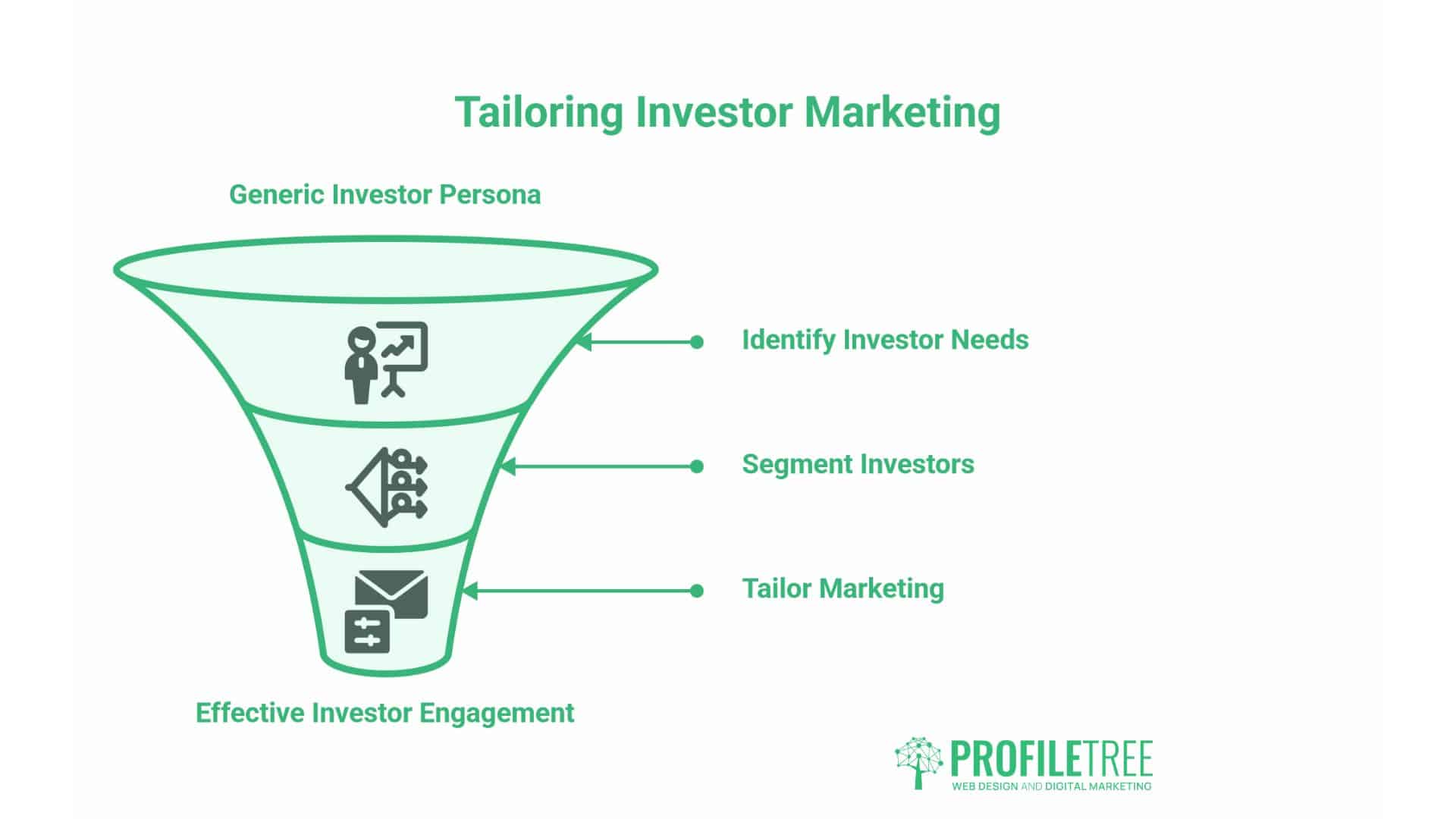
Not every investor is looking for the same thing, and your marketing should reflect that rather than speaking to a generic “investor” persona.
Angel Investors vs Venture Capital
Angel investors typically write smaller cheques earlier, often care about founder relationships as much as spreadsheets, and can move faster than an institutional fund. Venture capital firms typically write larger cheques later, expect a defined path to a much bigger outcome, and run a slower, more structured diligence process. Content aimed at angels can afford to be more personal and story-led. Content aimed at VCs needs to lead harder with numbers, market size and defensibility.
Equity Crowdfunding: Is It Right for You
Equity crowdfunding platforms suit businesses with a strong existing customer base or community willing to invest small amounts each, and they double as a marketing exercise in their own right; a well-run campaign generates its own visibility. It suits consumer-facing businesses better than deep-tech or long sales-cycle B2B companies, where investors expect closer diligence than a crowdfunding platform typically provides.
SEO and Search Visibility as an Investor Signal
Organic search visibility is measurable proof that your marketing works. Investors who understand digital businesses look at whether you rank for relevant queries, what kind of content earns you traffic, and whether your SEO profile shows an improving trajectory over time.
There are two distinct keyword opportunities here. The first is ranking for the queries your target customers use, which directly demonstrates market traction. The second is creating content that speaks to investor-side searches: terms around investment readiness, SEIS or EIS eligibility, or sector-specific funding topics. Neither requires significant domain authority to compete for. Long-tail queries in niche sectors are often poorly served by existing content, and a genuinely useful, well-structured piece can rank within months. This is the work that search engine optimisation services are built around: finding the queries with real intent behind them and building pages that answer those queries properly.
When investors research a sector or look for businesses in a specific niche, they often start by searching. A Northern Ireland technology company that ranks for relevant industry queries is far more visible to a Belfast or Dublin-based angel than a company with no organic search presence at all. This isn’t about gaming search engines; it’s about making sure that when someone searches for what you do, your business shows up, and what they find is worth reading. ProfileTree’s SEO work for SMEs covers the technical foundations that support this kind of content performance, structured data, clear page architecture and content that answers specific questions properly.
Social Media Strategy for Investor Engagement
Social media is where investors watch businesses in motion. The content you publish, the conversations you join and the community you build all tell a story that a pitch deck can’t.
LinkedIn: The Primary Investor-Facing Channel
For most B2B and investment-focused businesses, LinkedIn is where investor engagement actually happens. A well-maintained company page with regular, substantive updates signals an active, growing business. Founder and team profiles that articulate expertise and engage with industry conversations build personal credibility alongside the brand itself.
The most effective LinkedIn approaches for attracting investors aren’t promotional. They share genuine thinking, surface real challenges and how they were solved, and engage seriously with industry topics. Investors pattern-match constantly; a founder who demonstrates clear market thinking publicly is easier to back than one who’s invisible online. ProfileTree’s organic social media management covers strategy, content and channel management across LinkedIn, Instagram, Facebook, TikTok and X, without the noise of paid promotion diluting the message.
Other Platforms Worth Building On
LinkedIn is primary, but other platforms contribute depending on sector. Technology companies often benefit from a presence on X, where sector conversations happen in public and in real time. Consumer brands may find Instagram or TikTok activity demonstrates the kind of market traction that matters to investors focused on brand momentum.
The principle holds across every platform: show evidence that real people engage with what you do. Comments, shares and replies are signals. A smaller audience that interacts with your content genuinely carries more weight than a large, passive following that never responds. The same logic applies commercially, and the mechanics of turning social media activity into measurable sales are worth understanding before you put those numbers in front of an investor.
Email Marketing and Investor Relationship Nurturing
Email remains one of the most effective channels for building sustained investor relationships, particularly for businesses that aren’t yet raising but want to stay on the radar of relevant investors.
A regular investor update, sent even before you’re formally fundraising, builds familiarity and trust over time. Monthly or quarterly updates that share genuine progress, honest challenges and forward-looking plans demonstrate the transparent, founder-led communication investors want throughout a relationship. These work best when they’re short and specific. Three metrics that improved, one challenge you’re working through and one ask beat a lengthy newsletter every time.
Not every investor is the same audience, either. Angel investors often have very different priorities from early-stage venture capital firms. Investors focused on SEIS-qualifying businesses have specific criteria. Those with sector specialisms in technology, manufacturing or hospitality look for entirely different signals. A segmented approach means your communications reflect what each group actually cares about rather than sending the same message to everyone, a level of targeting that’s standard in customer marketing and surprisingly rare in investor outreach. Email marketing built with this kind of segmentation in mind carries over directly into investor communications.
Measuring Digital Marketing ROI for Investor Conversations
Investors will ask how your marketing performs. Backing your claims with specific data is far more persuasive than describing your strategy in general terms.
The metrics that matter most in investor conversations connect marketing activity to business outcomes. Website traffic by itself says very little. Organic traffic growth over 12 months, combined with conversion rate and lead quality data, tells a story about the compounding effects of marketing investment. Key figures worth tracking and being ready to discuss include monthly organic search sessions and growth rate, cost per lead by channel, conversion rate from visitor to enquiry, and customer acquisition cost against lifetime value. Investors in consumer businesses will also look at social media engagement rates and email open and click rates as indicators of audience quality.
Raw numbers need context. A significant year-on-year increase in organic traffic lands better when you can explain what drove it, what it cost and what commercial outcome it produced. A growing email list is more interesting when you can describe the open rate, the click rate and how many of those subscribers converted to customers. If you’re weighing up how much to invest in digital marketing before a raise, building this measurement infrastructure early means you’ll have twelve to twenty-four months of data to draw on when the time comes, rather than starting the conversation from zero.
Narrating your marketing data coherently signals financial literacy, strategic thinking and operational competence, exactly the qualities investors assess during due diligence. ProfileTree’s digital marketing training helps business owners build this kind of data literacy directly, and the wider AI training programme run through Future Business Academy extends the same thinking into forecasting and reporting automation.
Video content plays a role here, too. A short, well-produced explainer covering your business model or your traction to date gives investors something to share internally with colleagues who weren’t in the room. ProfileTree’s video production team builds exactly this kind of asset, and the agency’s own approach to YouTube marketing is a useful reference point for structuring one.
Turning Digital Presence Into Investor Confidence
A digital marketing strategy built with investor readiness in mind doesn’t look dramatically different from one built for customer acquisition. The difference is intentionality: your website should convert customers and investors, your content should demonstrate expertise to both, and your social media and email strategy should build credibility with everyone who finds you.
For SMEs in Northern Ireland, Ireland and the UK, this dual-purpose approach is increasingly standard. A coherent digital presence doesn’t guarantee investment, but its absence is a quiet disqualifier that turns curiosity into silence before you ever get a reply. If you’re preparing to raise, talk to ProfileTree about a strategy built for both audiences, or start with a strategy audit to see where the gaps sit.
FAQs
What digital marketing channels are most effective for attracting investors?
LinkedIn is the most direct channel for B2B and technology businesses. SEO and content marketing demonstrate market traction over time. Email works best for nurturing investor relationships before you’re formally fundraising.
How does SEO help attract investors?
Organic rankings show investors that your marketing delivers results without paid spend. Ranking for relevant sector queries proves you can build an audience cost-effectively, a strong signal of capital efficiency and genuine demand.
What should a website include to appeal to investors?
A clear explanation of the problem you solve, evidence of traction such as case studies or growth figures, and active content showing ongoing engagement. UK and Irish businesses should clearly state any SEIS, EIS or EIIS qualifying status, and the site should load quickly and work on mobile.
What is SEIS, and why should it feature in digital marketing content?
SEIS gives UK investors income tax relief on new shares in qualifying early-stage companies, and a company can raise up to £250,000 through the scheme across its lifetime, subject to HMRC conditions. Stating your qualifying status clearly online turns a regulatory detail into a marketing asset that investors can find organically.
How much traction do you need before investors take you seriously?
There is no universal threshold, and it varies sharply by investor type and sector. What matters more is that whatever traction you do have is visible and verifiable online. An investor who can see consistent content, growing organic search visibility and evidence of customer engagement will read modest numbers far more generously than one who finds a dormant website and a LinkedIn page last updated eighteen months ago.