
Real Estate Website SEO: A Practical Guide for Estate Agents
Table of Contents
Most estate agents in the UK and Ireland rely on Rightmove, Zoopla, or Daft.ie to generate enquiries. That strategy works until it doesn’t; portal algorithms shift, listing fees rise, and your brand remains invisible on Google. A well-optimised property website changes that equation.
SEO for real estate websites is not simply about inserting location keywords into listing descriptions. It involves a coordinated approach covering technical infrastructure, local search signals, and content that aggregator platforms simply cannot replicate at a neighbourhood level.
This guide covers the foundations of real estate SEO for agents operating in the UK, Ireland, and Northern Ireland, with specific attention to the portal conflict that most generic guides ignore entirely.
Technical SEO for Property Websites
Before any content strategy can take hold, the technical foundations of your property website need to be sound. Search engines must be able to crawl, index, and interpret your pages without obstruction. For real estate sites, three issues tend to surface repeatedly: duplicate listing content, missing structured data, and poor performance on mobile devices.
Solving the Property Feed Duplicate Content Problem
The majority of estate agent websites pull listings automatically from a CRM or property feed such as a REAXML or VEBRA export. This creates an immediate and often overlooked SEO problem: the same listing descriptions, often written in bulk by the agency or the vendor, appear on your site, on Rightmove, on Zoopla, and potentially on several aggregator feeds simultaneously.
Google does not penalise duplicate content with a manual action, but it does choose which version to index. In most cases, the portal wins because it has greater domain authority. Your site becomes invisible for the very listing it’s hosting.
The fix requires two layers of effort. First, apply canonical tags to feed-generated listing pages so search engines know which version to treat as authoritative. Second, write a unique “Listing Description 2.0” for each property on your own site. This does not mean rewriting the same information in different words.
It means adding content that the portal cannot carry: a street-level photograph caption explaining what the view actually looks like, local parking information, the specific school catchment boundaries, or the broadband speeds available at that postcode. This is the content that creates genuine information gain.
For agents managing large volumes of listings, prioritising the effort on new instructions and premium properties is a practical starting point rather than attempting to retrofit every historic listing immediately. Our SEO services team regularly addresses this issue during technical audits for property clients.
Real Estate Schema Markup: Structured Data That Works
Schema markup communicates directly with search engines in a structured format, helping them understand what your page represents rather than just what it says. For property websites, schema can encode property type, price, location, number of bedrooms, availability status, and the agent contact details, all without the user needing to read a single word.
The most relevant schema types for estate agents are RealEstateListing, Place, and LocalBusiness. Implementing these in JSON-LD format (Google’s preferred method) and embedding them in the page’s <head> section is the cleanest approach. You can validate your markup using Google’s Rich Results Test tool before pushing changes to a live site.
Rich snippets generated from schema markup can considerably improve click-through rates from search results pages, as they surface key property details before a user even lands on the page. This is particularly valuable for high-intent searches such as “3-bed semi-detached for sale in [town]” where users are actively comparing results.
Mobile Performance and Core Web Vitals
Property searches are increasingly conducted on mobile devices, often during viewings or commutes. Google’s mobile-first indexing means the mobile version of your site is what gets crawled and ranked, regardless of how polished the desktop version may be.
Core Web Vitals, specifically Largest Contentful Paint (LCP), Cumulative Layout Shift (CLS), and Interaction to Next Paint (INP), affect ranking directly. Image-heavy property websites are particularly susceptible to LCP failures. Compressing listing photographs, converting them to WebP format, and implementing lazy loading are immediate performance gains that do not require a site rebuild.
A slow-loading property page loses visitors before they ever see the listing. Page speed also affects Google’s Quality Score for any paid campaigns running alongside organic efforts, making it a factor with both organic and paid consequences. Tools like Google’s PageSpeed data and GTmetrix will identify the specific bottlenecks to address on your site.
Mastering Local SEO for Estate Agents
Local SEO is the single most commercially relevant discipline for estate agents with a physical branch. When someone searches “estate agents in [town]” or “houses for sale [area]”, Google’s response involves a combination of map pack results, organic listings, and increasingly, AI-generated summaries. Appearing in the map pack alone can double the visibility of your business for these searches. The strategies below address both map pack ranking and broader local organic performance.
Optimising Your Google Business Profile
Your Google Business Profile (GBP) is the primary signal Google uses to determine which businesses appear in the local three-pack for property-related searches. An incomplete or inconsistently maintained profile is one of the most common reasons estate agents fail to appear for searches happening directly in their catchment area.
At a minimum, your GBP must include an accurate business name, address, and phone number that match exactly what appears on your website and every other online directory. Google cross-references this data; inconsistencies reduce trust and so ranking potential.
Beyond the basics, the activities that drive local ranking are: publishing regular GBP posts about new listings or local market updates, responding to every review within 48 hours, uploading photographs of actual properties rather than stock imagery, and categorising your business correctly under “Estate Agent” or “Real Estate Agency” rather than a generic “Property” category. The AI local SEO relationship is also evolving rapidly, with GBP profiles now feeding into Bing’s Copilot answers and Google’s AI Overviews.
Local Citations: UK and Ireland Directories That Matter
A local citation is any online mention of your business name, address, and phone number, whether or not it includes a link. Consistent citations across authoritative directories reinforce to search engines that your business is legitimate and active at the address it claims.
For UK estate agents, the most relevant citation sources are Yell.com, Scoot.co.uk, Checkatrade, Thomson Local, and the local chamber of commerce directory. In Ireland, Golden Pages and Eircom directories carry meaningful weight. Northern Ireland agents should make sure their presence on nidirect’s business directory as well as core UK sources. PropertyPal, the dominant listing portal in Northern Ireland, also carries a business profile that contributes to local entity signals even when the backlinks are nofollowed.
Consistency is more important than volume. A business listed under three slightly different versions of its name across 40 directories sends weaker signals than a business with perfectly consistent NAP data across 15 authoritative sources. Auditing your existing citations annually and correcting discrepancies is a maintenance task that pays ongoing dividends for local search performance regardless of geography.
Review Strategy and Reputation Signals
Google reviews contribute to local pack ranking through both quantity and recency. An estate agent with 80 reviews but no new reviews in 18 months will be outranked by a competitor with 30 reviews if that competitor is consistently accumulating fresh feedback.
The most effective approach is to build review requests into standard business processes: send a follow-up email to vendors and buyers at the point of completion with a direct link to your GBP review page. Make it one click, not a multi-step journey. Responding to negative reviews professionally and specifically, rather than with a generic apology, also signals to prospective clients that your agency takes service quality seriously.
Content Strategy: Outranking the Portals
Portals such as Rightmove, Daft.ie, and Zoopla cannot be beaten on volume. They list hundreds of thousands of properties and carry domain authority that independent agency websites will never match at a national level. The mistake most agents make is trying to compete on the same terms. The opportunity lies in competing where portals are structurally incapable of ranking: genuinely hyper-local content that requires human knowledge of a specific area.
Neighbourhood Guides That Portals Cannot Replicate
A neighbourhood guide written by someone who actually knows the area is one of the most durable content assets an estate agent can build. It ranks for long-tail searches that portals never target, such as “best streets to live in [village]”, “what is [suburb] like to live in”, or “council tax band [postcode]”.
The content that creates genuine information gain, and so genuine ranking potential, is the kind that aggregators cannot automate. This includes the specific primary school catchment boundaries and their OFSTED or ETI ratings, the average broadband speeds available by street rather than exchange area, local parking permit zones and their restrictions, planned development applications that affect the area, and honest observations about what different streets within a neighbourhood are actually like to live on.
Northern Ireland agents in particular have an underexplored opportunity here. The region’s towns and villages carry distinct characters that no London-headquartered portal will ever capture in granular detail. Producing area guides for markets such as Lisburn, Ballymena, or the Ards Peninsula, enriched with the kind of local nuance found in resources like Northern Ireland cities, creates content with real depth and genuine search demand.
Market Reports: Using Public Data to Earn Authority
Published market reports are one of the most effective link-earning content formats available to estate agents. When an agent publishes a genuinely useful, data-backed analysis of local property trends, other sites, local news outlets, mortgage brokers, and solicitors link to it as a reference source.
In Northern Ireland, the Land and Property Services (LPS) House Price Index publishes quarterly transaction data by postcode district. In England and Wales, HM Land Registry data is publicly accessible and searchable by area. In the Republic of Ireland, the Property Price Register provides a full record of residential transactions. Each of these represents a free, authoritative data source that an agent can synthesise into a quarterly market commentary that no portal bothers to produce at a local level.
A six-month “Local Property Market Review” article, published consistently, builds topical authority over time. It also feeds directly into the E-E-A-T signals that Google’s helpful content system rewards: Experience, Expertise, Authoritativeness, and Trustworthiness. For property content, which touches on significant financial decisions, these signals carry particular weight.
Blog Content That Serves Buyers and Sellers Directly
Beyond neighbourhood guides and market reports, a consistent publishing schedule addressing the questions buyers and sellers actually ask generates compounding organic traffic over time. These are not abstract marketing topics. They are the questions that arrive in an estate agent’s inbox every week: “Should I sell before I buy?”, “What does a surveyor actually check?”, “How long does conveyancing take in Northern Ireland?”
Every question that a sales negotiator regularly fields is a potential article. Writing 600 to 1,000 words that thoroughly answer one question, with clear, direct language and no padding, serves both the user and the search engine. Structuring these articles with a direct answer in the first paragraph, followed by supporting details, aligns with the format Google uses for featured snippets and AI Overviews.
Portals vs Your Website: Finding the Balance
Portal listings and a strong independent website are not mutually exclusive. The mistake is treating them as equivalent distribution channels with no strategic distinction between them. The portal is a volume channel for immediate exposure to listings. Your website is a brand-building channel for long-term direct enquiries. Conflating the two leads to decisions that undermine both.
The Brand Dilution Risk of Portal Dependency
When buyers and sellers consistently discover your listings through Rightmove or Zoopla rather than through a direct search for your agency name, your brand remains a footnote on someone else’s platform. Portal traffic does not build your organic authority, does not grow your email list, and does not create any asset you own or control.
Ciaran Connolly, founder of ProfileTree, addresses this directly: “An estate agent that builds its entire pipeline on portal listings is building its business on rented land. The platform owns the relationship, the platform owns the data, and the platform sets the rules. A strong SEO strategy for your own website is what creates an asset that compounds in value over time.”
The strategic response is not to abandon portals; buyers expect to find listings there, and the footfall is real. The response is to treat portal presence as a minimum floor and website SEO as the competitive differentiator. For property businesses of all sizes, this distinction shapes every content and technical decision.
How Portal Backlinks Actually Work (and What They Don’t Do)
A common assumption is that being listed on a high-authority portal like Rightmove passes SEO value to the agent’s website through a link on the listing page. In practice, the majority of links from Rightmove and Zoopla to agent websites are either nofollowed or redirect through tracking links that strip link equity entirely.
PropertyPal in Northern Ireland operates similarly. The brand visibility of being listed on the platform is real; the direct SEO benefit passed to your site is minimal. Daft, i.e., in the Republic of Ireland, is more variable by listing type, but agents should not assume any portal link is contributing meaningfully to their domain authority without specifically auditing it.
Understanding this distinction matters because some agents and marketing consultants conflate portal presence with SEO performance. The two are separate. Portal impressions measure how often your listings appear on that platform. Organic SEO performance measures how often your own website surfaces in Google search results. Neither metric predicts the other.
Creating Listings That Work Harder on Your Own Site
For agents willing to invest the effort, treating the property listing page on your own site as a content asset, rather than simply a data dump from the feed, produces measurable ranking gains over time. The approach combines the unique description strategy discussed in the technical section with additional elements: a map embed showing walkable amenities, a paragraph about the specific street’s character, and a link to the neighbourhood guide for that area.
This creates an internal linking structure that reinforces topical authority across your entire site. A listing in Stranmillis links to your Stranmillis neighbourhood guide, which links back to your Belfast property market report, which links to your conveyancing FAQs. Each link passes authority and signals to Google that your site is a coherent, connected resource on Belfast property rather than a collection of unrelated listing pages.
Link Building and Domain Authority
Domain authority is built through links from other websites pointing to yours. For estate agents, the most natural and sustainable link sources are local rather than national. A guest article in a regional business publication, a mention in a local council economic development report, or a feature in a mortgage broker’s “choosing an agent” guide all carry genuine relevance and contribute to your site’s authority in a way that generic link-building tactics never can.
Local PR as a Sustainable Link Source
Local PR for estate agents is more accessible than it may appear. Property market commentary is consistently useful to local news outlets that cover business and community affairs. A quarterly market update positioned as a press release; sent to the Belfast Telegraph, the Newsletter, regional titles in Munster or Connacht, or local online news platforms; costs only the time it takes to write and will generate occasional but high-quality links from news domains with genuine authority.
Sponsoring community events, school fairs, or local sports clubs also builds citations and occasional links. These are not high-DR placements by SEO standards, but they create genuine local entity associations that Google’s algorithms recognise. The cumulative effect of 20 well-placed local links consistently outperforms a single high-authority link from an irrelevant national domain. Our SEO team regularly incorporates local PR strategy into organic growth programmes for property and professional services clients.
Finding and Repairing Broken Links
Broken internal links damage both user experience and crawl efficiency. Search engine bots follow links to discover pages; a broken link is a dead end in the crawl path. For estate agents with large volumes of sold or let listings, broken links are extremely common because pages are often removed or archived without implementing a redirect.
The standard approach is to redirect sold or let property URLs (returning a 404 error) to the relevant neighbourhood guide or a “recently sold properties in [area]” archive page rather than simply returning a dead page. This preserves the link equity that those listing pages may have accumulated and provides a useful destination for users following old links from social media or email campaigns.
Tools such as Screaming Frog SEO Spider can crawl your entire site and export a list of broken links in minutes. For agents without access to developer resources, an SEO audit will surface these issues alongside the full range of technical fixes that are affecting your rankings.
Tracking SEO Performance Over Time
Measuring the outcomes of an SEO strategy requires a consistent, structured approach to data. Google Search Console provides query-level data showing which searches are surfacing your pages, at what position, and with what click-through rate. Google Analytics 4 connects that search traffic to on-site behaviour: how long visitors stay, which pages they visit, and whether they make an enquiry.
For real estate websites, the most commercially relevant metrics are not vanity metrics like total organic sessions. They are conversion events: contact form submissions, phone number clicks, and valuation request completions. Tracking these specifically, and attributing them to organic search as a channel, is what allows you to measure the commercial return on SEO investment and make informed decisions about where to direct ongoing effort.
Setting up a monthly reporting cadence, reviewing ranking movements for target keywords, noting which content has gained or lost visibility, and identifying new query opportunities from Search Console data takes two hours per month and provides the feedback loop necessary to improve continuously rather than optimise once and forget.
Sales vs Lettings SEO Strategy
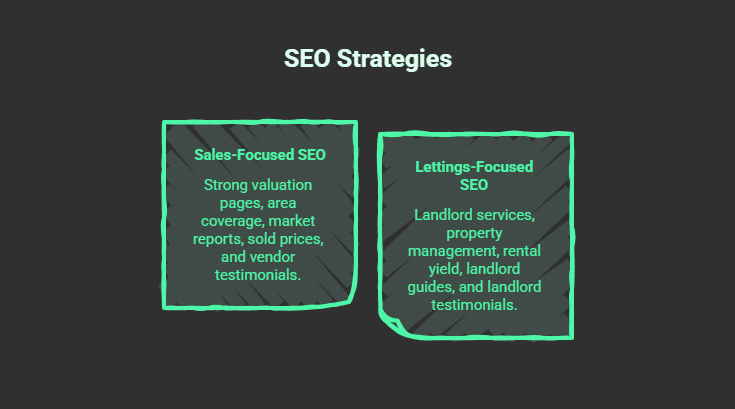
Different approaches for different services:
Sales-Focused SEO
Target Keywords:
| Keyword Type | Examples |
| Agent searches | “estate agent [area],” “best estate agent [town]” |
| Valuation searches | “house valuation [area],” “free property valuation” |
| Selling searches | “selling house [area],” “how to sell my house” |
| Buyer searches | “houses for sale [area],” “property for sale [town]” |
Strategy:
- Strong valuation service pages
- Comprehensive area coverage
- Market report content
- Sold price content
- Vendor testimonial emphasis
Lettings-Focused SEO
Target Keywords:
| Keyword Type | Examples |
| Landlord searches | “letting agent [area],” “property management [town]” |
| Service searches | “How much rent can I charge?” “Landlord responsibilities” |
| Tenant searches | “flats to rent [area],” “houses to rent [town]” |
| Information searches | “How much rent can I charge?” “landlord responsibilities” |
Strategy:
- Landlord services pages
- Property management detail
- Rental yield content
- Landlord guide content
- Landlord testimonial emphasis
Conclusion
SEO for real estate websites in the UK and Ireland is a long game, but it is one that individual agents and independent agencies can win; not by trying to outspend Rightmove, but by building the kind of hyper-local content and technical foundations that portals are structurally incapable of producing.
If your property website is currently invisible on Google, our team at ProfileTree can carry out an audit and build a strategy to change that.
FAQs
How long does it take for a real estate website to rank on Google?
For local, long-tail keywords such as “estate agents in [town]” or “houses for sale [village]”, a well-optimised site with a consistent content programme typically sees meaningful ranking movement within three to six months. Competitive terms at a city or county level take longer, often 12 months or more.
What are the most important keywords for UK and Irish real estate websites?
The highest-value keywords for most estate agents are not the broadest ones. Terms such as “houses for sale [specific village or postcode]”, “estate agent [town name]”, and “property valuation [area]” carry purchase-ready intent and lower competition than national terms.
Should I delete sold property pages from my website?
No. Removing sold property pages without implementing a redirect returns a 404 error and wastes any link equity or organic authority that page had accumulated. Instead, redirect the sold listing URL to a “Sold Properties in [Area]” archive page or to the relevant neighbourhood guide.
Is SEO better than PPC for estate agents?
The two serve different purposes and are most effective together. SEO builds long-term visibility and brand authority, producing leads that compound in value over time. PPC (pay-per-click advertising) generates immediate traffic for specific campaigns, such as promoting a new development or generating revenue during a slow period.
Do portal listings help my own website’s SEO?
Portal listings contribute to brand visibility but offer minimal direct SEO benefit to your site. Most links from Rightmove, Zoopla, and similar platforms to agency websites are no-followed or pass through tracking redirects that strip link equity. Treat portal presence as a lead-generation channel, and treat your website SEO as a separate, parallel investment, rather than assuming one substitutes for the other.