
Google Maps Marketing: A Local SEO Guide for UK and Irish Businesses
Table of Contents
Most small businesses in the UK and Ireland already appear on Google Maps. Far fewer appear in the three results Google shows above the regular listings, the block known as the local pack, where the calls and enquiries actually happen. Google Maps marketing is the work of closing that gap: optimising your Google Business Profile so that when someone nearby searches for what you sell, your business is the one they tap. This guide covers how the ranking system works, the setup steps that matter, the UK and Irish address rules that trip people up, and how to defend your listing when a competitor plays dirty.
A quick orientation before the details. Three things decide how high you appear: how relevant your profile is to the search, how close you are to the searcher, and how prominent your business looks to Google. Get those right, and a complete, well-kept profile costs nothing to run. The team at ProfileTree, a Belfast-based digital agency, sees the same pattern across local clients: the profile is rarely missing, it is just thin, and thin profiles lose to complete ones.
What Is Google Maps Marketing?
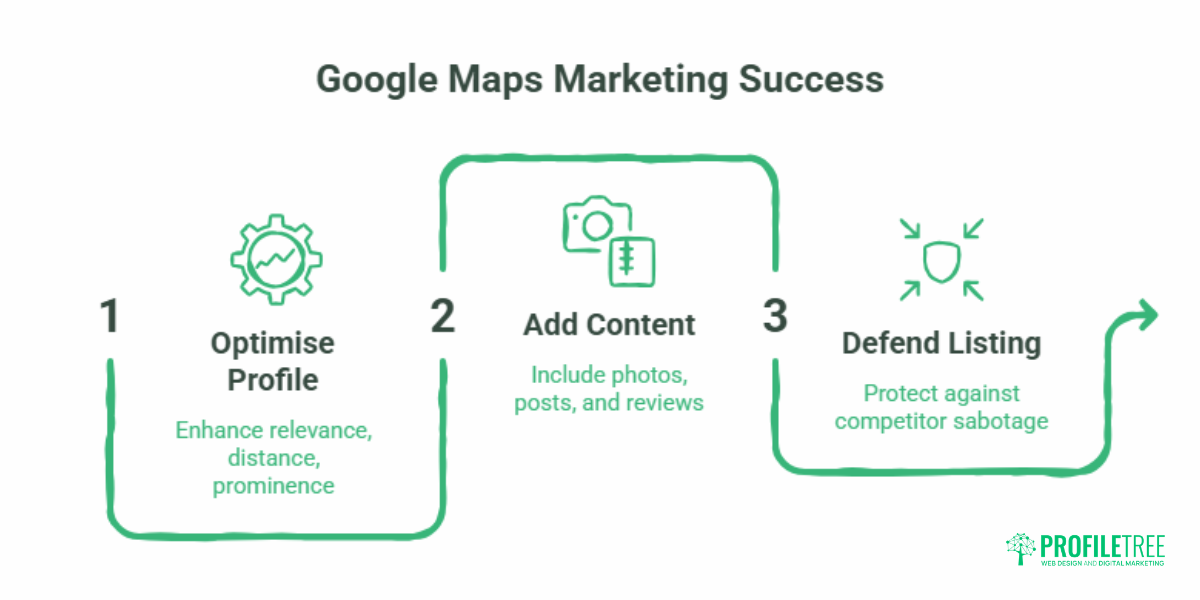
Google Maps marketing is the practice of optimising your Google Business Profile, the free listing formerly called Google My Business, so your business shows up for local searches on Google Maps and in the local pack on standard search results. It captures high-intent traffic: people searching “near me” or naming a town are usually ready to call, visit, or buy soon.
It matters because behaviour has shifted. Phone books and printed directories moved online years ago, and a local search now happens on a phone, in the moment, wherever the person is standing. For a plumber in Lisburn or a cafe in Galway, that local pack is often the first thing a customer sees and the only listings most people consider. The importance of Google Maps marketing for local businesses comes down to this: visibility at the exact point someone decides who to contact.
Is it free? Setting up and optimising the profile is free. You can pay for Local Search Ads to appear above the organic pack, but the organic listing itself, the reviews, the photos, and the posts all cost nothing but time. That makes it one of the few channels where a small budget is no barrier to competing with larger firms.
How Google Ranks Businesses on Maps: Relevance, Distance, Prominence
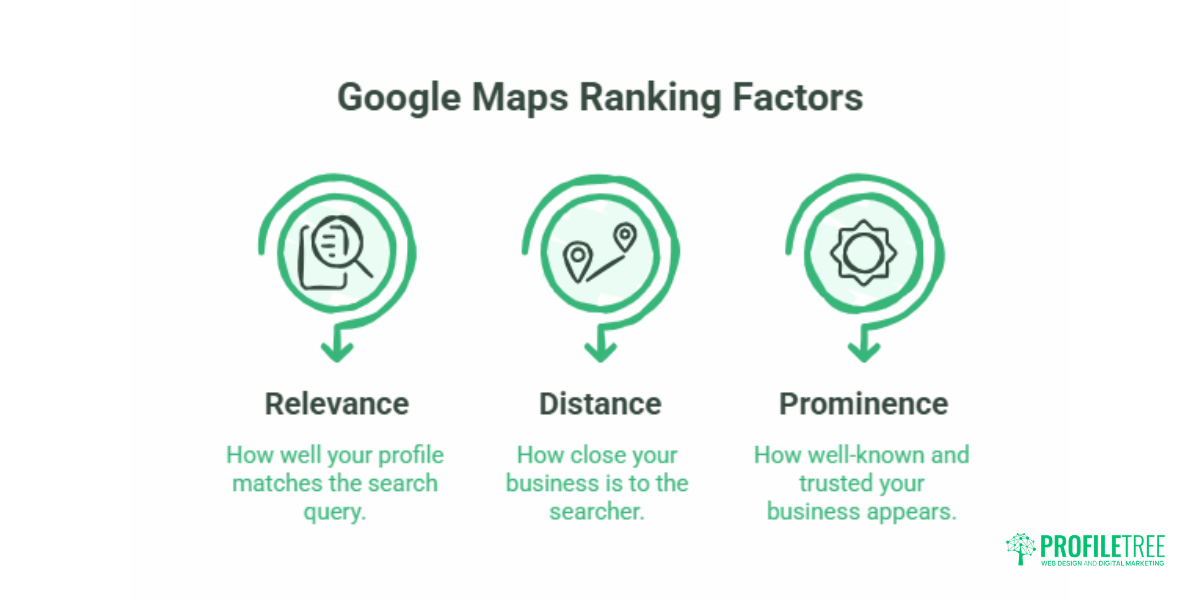
Google ranks local results on three factors it states publicly: relevance, distance, and prominence. Understanding them tells you where to spend effort.
Relevance is how well your profile matches what the person searched for. Complete, accurate information, the right primary category, and a description that reflects what you actually do all raise relevance. A profile listing only “Web Design” when the business also offers SEO, video, and training is leaving relevant searches on the table.
Distance is how close your business is to the searcher or the area they named. You cannot move your premises, but you can define your service area accurately and make sure your address is verified and correct, which is where many UK and Irish listings fall down.
Prominence is how well-known and trusted your business looks. Review volume and sentiment, consistent citations across other directories, and the strength of your own website all feed into it. This is the factor you can most influence over time, and it overlaps heavily with ordinary search engine optimisation work, because a strong website supports a strong Maps presence.
The practical takeaway: relevance and prominence are within your control; distance mostly is not, so the work concentrates on a complete profile, genuine reviews, consistent listings elsewhere, and a website that backs it all up. Independent studies of local ranking factors, such as Whitespark’s annual Local Search Ranking Factors survey, consistently point to the same priorities, which is reassuring when so much SEO advice contradicts itself.
The Google Business Profile Optimisation Checklist
This is the core of the work. A profile that is merely claimed is not optimised. Work through these stages in order.
Claim and Verify Your Listing
Search your business name on Google Maps. If a listing exists, choose “Claim this business”; if not, choose “Add your business”. Verify ownership through the method Google offers you, which may be video, phone, email, or postcard. Use a Google account that has permission to manage the profile, and correct the business name or address during this step if either is wrong. Verification is also where UK and Irish businesses hit problems, covered in the next section.
Choose the Right Categories
Select one primary category that best describes your main business, then add secondary categories for your other services. A digital agency might use “Marketing Agency” as primary, with “Website Designer”, “Internet Marketing Service”, and “Video Production Service” as secondaries. The primary category carries the most ranking weight, so choose it deliberately rather than picking the broadest option available.
Write the Description and Add Visual Assets
Write a description that states plainly what you do, who you serve, and where, using the words customers actually search. Keep it factual rather than promotional. Then add photographs: a logo, a cover image, the premises if you have them, your team, and examples of completed work. Google verifies businesses before allowing photo uploads, and profiles with genuine, current photos look more trustworthy to both searchers and Google’s systems. Matching the keywords in your description to the metadata on your own website strengthens the signal further, which is one reason on-page work and Maps work belong together rather than in separate silos.
Complete every remaining field while you are there: full address, phone number, website URL, opening hours, including any special hours, payment options, accessibility details, and links to your social profiles. Each completed field is a small relevance gain, and together they add up.
Navigating UK and Irish Address and Verification Rules
This is where the standard American guides leave local businesses stranded. The rules below reflect how Google handles addresses in Britain and Ireland specifically.
Storefront Versus Service-Area Business
Google treats two business models differently. A storefront, such as a shop or salon, has a fixed address that customers visit, and that address shows on the map. A service-area business, such as a plumber, electrician, or mobile mechanic who travels to customers, can hide its address and instead list the towns or regions it serves. Many UK and Irish trades run from home and want their residential address hidden, which is allowed: set the business up as a service-area business, define your service area, and Google keeps the address private while still verifying it. Listing a home address as a public storefront when you do not receive customers there risks suspension.
| Feature | Storefront | Service-area business | Hybrid |
|---|---|---|---|
| Address shown on the map | Yes, public | No, hidden | Yes, public |
| Verification address required | Yes | Yes, kept private | Yes |
| Service radius or areas listed | Optional | Yes | Yes |
| Physical signage expected | Yes | No | Yes |
Postcodes, PAF, and Address Matching
UK and Irish addresses cause more verification failures than any single profile setting. Google cross-checks the address you enter against postal data. In the UK, that is effectively the Royal Mail Postcode Address File, and a mismatch between how you type your address and how Royal Mail records it can stall verification. Enter the address exactly as Royal Mail holds it: correct building name or number, correct thoroughfare, correct postcode with the right spacing. Business parks with shared units and rural addresses are the usual culprits, because the unit identifier or property name often differs between your letterhead and the official record.
Ireland adds its own wrinkle. Many rural Irish addresses historically had no house number, and Eircode is comparatively recent, so An Post records and Google’s map data do not always agree. Where they conflict, use the Eircode and the address format An Post recognises, and add a pin adjustment on the map so the marker sits on your actual premises rather than the centre of a townland. Getting this right the first time avoids the suspension-and-appeal cycle that swallows weeks.
Building Prominence: UK and Irish Citations and Reviews
Prominence is the factor you build over months, and it has two main levers: citations and reviews.
Local Citations in the UK and Ireland
A citation is any mention of your business name, address, and phone number on another site. Consistency matters more than volume: the same details, formatted the same way, everywhere. US guides send you to Yelp and Foursquare, which carry little weight here. The directories worth your time across Britain and Ireland include Yell, Thomson Local, Scoot, Central Index, and, for the Republic, Golden Pages. Add your local Chamber of Commerce and any industry body you belong to. Inconsistent details across these listings actively undermine prominence, so audit what is already out there before adding more.
| Directory | Region | Cost | Priority |
|---|---|---|---|
| Yell | UK | Free and paid tiers | High |
| Thomson Local | UK | Free and paid tiers | Medium |
| Scoot | UK | Free | Medium |
| Central Index | UK and Ireland | Free | Medium |
| Golden Pages | Ireland | Free and paid tiers | High (ROI) |
Reviews and Consumer Protection
Reviews feed both prominence and the decision a customer makes once they find you. Build a simple, repeatable process: ask every satisfied customer shortly after the work is done, make the link easy to follow, and reply to every review, positive or negative. Replies that reference the specific job done read far better than a generic “thanks for the review” and show prospective customers you are attentive.
One firm line: do not buy reviews or incentivise them in ways that breach the rules. Beyond Google’s policies, UK consumer protection law treats fake or undisclosed-incentive reviews as a serious matter, and the reputational damage of being caught outweighs any short-term ranking gain. Earn them honestly. If you find managing feedback across platforms a drain, it sits naturally within a wider digital strategy rather than being handled ad hoc.
Defending Your Listing From Competitor Sabotage
Local search is competitive, and not every competitor stays clean. Two tactics are common in UK local markets, and both have a remedy.
The first is name keyword stuffing: a rival adds search terms to their business name, trading as “Emergency Locksmith Birmingham 24hr” rather than their registered name, to inflate relevance. Google’s guidelines forbid this. You can suggest an edit directly on their Maps listing; if that is rejected or the spam persists, submit a Business Redressal Complaint Form to Google with evidence, such as a link to their Companies House record showing the real trading name.
The second is malicious edits to your own listing: a suggested change marking you “permanently closed”, altering your phone number, or moving your pin. Monitor your profile regularly so you catch these quickly, and revert any unauthorised changes through your dashboard. For persistent harassment, including fake one-star reviews from people who were never customers, flag the reviews for policy violation, reply factually noting you have no record of the transaction, and escalate through the Google Business Profile Help Community with screenshots if Google does not act. A short weekly check, ten minutes to scan queries, reviews, suggested edits, and add a photo, is enough to stay ahead of most of this.
Google Maps Advertising: Moving From Free to Paid
Once the organic profile is solid, Local Search Ads let you appear above the pack for chosen searches. You set these up in Google Ads, link the campaign to your Business Profile, and pay per result, such as a call or a direction request. The sequence matters: a paid ad pointing to a thin, low-rated profile wastes money, because the profile is still what converts the click. Optimise first, advertise second. Paid local search works best as one channel inside a broader plan, which is the logic behind treating it as part of paid and social marketing rather than a standalone tactic.
Optimising for AI Overviews and Conversational Search
Google increasingly answers local queries with AI Overviews, and conversational tools summarise businesses rather than just listing them. These systems read your profile and your reviews to decide which business to recommend and why. The practical implications are small but real: write your description in clear, factual language that states what you do and where, encourage reviews that mention specific services by name rather than vague praise, and keep your categories and attributes accurate. When a review says “they rebuilt our Shopify site and trained our staff”, that sentence gives an AI system concrete grounds to recommend you for those searches. The same structured, factual approach that helps AI also reads well to humans, so there is no trade-off.
Where Google Maps Fits in a Wider Plan
A Maps listing rarely works in isolation. The profile sends people somewhere, usually your website, and what they land on decides whether the enquiry happens. A few connections worth making deliberately:
The link in your profile should point to a fast, mobile-first page, because most Maps searches happen on a phone, and a slow page loses the click you worked to earn. That is squarely a job for good website design and solid website development, with reliable hosting and management underneath, so the page stays quick and online.
The Google Posts feature, where you publish short updates on your profile, is an extension of your content marketing: project updates, seasonal offers, answers to common questions. Short video clips of your work or premises lift engagement, which is where video marketing earns its place, even for a small local firm.
Many SMEs prefer to run the profile in-house once it is set up properly, and a short session on responding to reviews, posting consistently, and spotting suspicious edits is often all it takes; that is the sort of practical, hands-on digital training that pays for itself. And as conversational search grows, businesses are starting to use AI to sharpen their marketing, from drafting profile copy to monitoring sentiment across reviews.
According to Ciaran Connolly, founder of ProfileTree, “the businesses that win on Maps are usually the ones who treat the profile as a live part of their marketing, not a form they filled in once and forgot.”
Frequently Asked Questions
Is Google Maps marketing free?
Yes. Creating and optimising your Google Business Profile costs nothing. You can choose to invest in Local Search Ads or in tools to manage multiple directory listings, but the core listing, reviews, photos, and posts are all free to use.
Can I use a virtual office or PO Box to verify my UK business?
No. Google’s guidelines prohibit PO Boxes, virtual offices, and mailbox-rental addresses as business locations. You must use a physical address where you operate or can receive mail. Using a non-compliant address frequently leads to immediate suspension, so a home-based business should set up as a service-area business and keep the residential address private rather than reaching for a virtual address.
How do I rank higher on Google Maps?
Improve the three factors Google uses: relevance, distance, and prominence. Complete every field on your profile, choose accurate categories, keep your name, address, and phone details consistent across other directories, earn genuine reviews and reply to them, and make sure your own website supports the listing. Distance you cannot change, but a complete, well-kept, well-reviewed profile beats a thin one nearby almost every time.
Why has my UK Google Business Profile been suspended?
Suspensions usually follow a change to a core field such as the name, category, or address, which triggers Google’s automated checks. Common causes are using a virtual office, stuffing keywords into the business name, or listing a residential address as a public storefront. To resolve it, bring the profile back in line with the guidelines and submit a reinstatement request with proof of trading, such as a utility bill or your business registration.
How long does it take to see rankings change on Google Maps?
Basic profile updates can appear in local results within 24 to 48 hours. Lasting prominence takes longer: earning steady reviews and building consistent citations typically needs three to six months before you see a clear, sustained rise.
How do I report a competitor keyword stuffing their business name?
Suggest an edit on their Maps listing to correct the name. If they reject it or keep using the spam name, submit a Business Redressal Complaint Form to Google with evidence, such as a link to their Companies House listing showing their actual registered name does not match what appears on Maps.