
Influencer Marketing: Pros, Cons and How to Make It Work
Table of Contents
Influencer marketing has moved from a niche tactic to a mainstream channel for brands across almost every sector. It works by having social media creators, people with established, engaged audiences, endorse or feature a product in their content. Their followers see the recommendation in a context they trust, which can generate awareness and sales in a way that traditional advertising rarely achieves at the same cost. For SME marketing managers across Northern Ireland, Ireland and the UK, the harder question isn’t whether influencer marketing works. It’s whether your website, content and tracking are actually ready to receive the traffic it sends, which is where a lot of campaigns quietly lose their value.
“The appeal is obvious,” says Ciaran Connolly, founder of Belfast digital agency ProfileTree. “You’re borrowing credibility. A well-matched influencer introduces your product to a warm audience that already trusts the person recommending it. But the word ‘well-matched’ is doing a lot of work there. Get that wrong, and you’ve paid for reach without trust, which is worse than useless.”
What Influencer Marketing Actually Is
At its core, influencer marketing is a form of paid endorsement. A brand pays a social media creator to produce content featuring their product or service, and that content reaches the creator’s audience. The payment can be cash, product, commission, or a combination of all three.
The distinction from traditional advertising is the personal element. A billboard promotes a product to anyone who drives past. An influencer promotes a product to people who have actively chosen to follow that creator because they like and trust their judgement. That pre-existing relationship is what gives influencer marketing its commercial value, and it’s worth understanding the psychology behind it in more depth through our guide to the process of social influence.
Influencer Tiers, From Nano to Virtual
Influencer tiers are usually defined by follower count, though the boundaries are rough guides rather than fixed rules:
| Tier | Follower range | Typical use |
|---|---|---|
| Nano | 1,000 to 10,000 | Hyper-local or niche campaigns |
| Micro | 10,000 to 100,000 | Targeted category campaigns |
| Macro | 100,000 to 1,000,000 | Broad awareness campaigns |
| Mega | 1,000,000+ | Mass market or celebrity endorsement |
| Virtual/AI | Varies | Brand-owned or agency-managed digital personas |
A newer category worth knowing about is the virtual or AI influencer: a computer-generated persona run by a brand or agency rather than a real person. These remain uncommon among UK and Irish SMEs, and they raise a straightforward question the older tiers don’t: how do you disclose an endorsement from someone who doesn’t exist? We cover that in the compliance section below.
More followers do not mean better results. Nano and micro influencers typically achieve higher engagement rates than their larger counterparts and often have a more specific, dedicated audience. A food influencer with 8,000 followers in Belfast is more commercially useful for a local restaurant than a lifestyle mega-influencer with a million globally distributed followers; our roundup of food influencers in Northern Ireland shows what that looks like in practice. Our guide to micro and macro influencers goes further into choosing between the two for a UK or Irish SME budget, and our social media influencer marketing statistics page tracks how the different tiers perform across platforms.
The Genuine Benefits of Influencer Marketing
The advantages below hold up under scrutiny, provided the basics are done properly.
Access to a Pre-Qualified Audience
People follow accounts that reflect their interests. A fitness influencer’s audience is, by definition, interested in fitness. A home interiors account attracts people who care about their homes. This self-selection means brands can reach a specific, pre-qualified audience without the blunt targeting tools that paid advertising relies on.
For B2C brands in particular, this is a meaningful advantage. Rather than spending budget testing which audience segments respond to an advert, you’re placing the product in front of people who are already predisposed to find it relevant.
Trust That Advertising Alone Cannot buy
An advertisement tells an audience that a brand thinks its product is good. An influencer tells their audience that they think the product is good. The second carries far more weight, provided the influencer has a genuine relationship with their followers.
This trust builds over time through consistent, authentic content. When an influencer endorses a product that fits naturally into the content they already produce, their audience takes the recommendation seriously. When the endorsement feels forced, audiences notice, and the campaign underperforms regardless of the budget behind it.
Measurable, Near-Immediate Performance Data
Unlike some brand-building activities, influencer campaigns produce data quickly. Affiliate discount codes show exactly how many purchases were made through a specific creator. Tracked links show click-through rates. Follower growth, saves, and shares can all be monitored in real time, which is one reason this channel appeals to marketing managers who need to justify spend.
Scale and Flexibility
Influencer marketing scales in both directions. A small business can run a campaign with two or three nano influencers for a few hundred pounds and reach a genuinely relevant local audience. A national brand can run a coordinated campaign across dozens of micro-influencers at once. The flexibility to match campaign size to budget is one of the channel’s real strengths, and it’s part of why the format suits SMEs as well as it suits large retailers.
One often-cited example of scale done well involves a national doughnut brand running a Snapchat campaign with several micro-influencers timed to a single promotional day, reportedly generating millions of views and a significant one-day spike in new followers. Figures like this circulate widely but are difficult to verify independently, so treat them as illustrative of the mechanism (matching the right influencers to the right moment) rather than as a benchmark to plan against.
The Real Risks of Influencer Marketing
None of these risks is a reason to avoid the channel altogether, but each one has caught our brands that skipped due diligence.
Follower Count Is Easy to Inflate
Fake followers are a persistent problem across every major social platform. Accounts can be purchased with inflated follower numbers that look impressive in a pitch but represent no real audience. A campaign built on a fraudulent account wastes budget and, if the association becomes public, can damage the brand.
The check here is the engagement rate. An account with 100,000 followers but 200 likes per post has an engagement rate of 0.2%, well below what’s typical, and a strong indicator of purchased followers or an audience that has long since disengaged. Any account you consider working with should show consistent engagement relative to their follower count. Tools such as HypeAuditor or Modash make this audit straightforward, and our influencer evaluation guide sets out the full vetting process step by step.
Values Misalignment Creates Reputational Risk
An influencer’s past content and public behaviour reflect on your brand from the moment you associate with them. If an influencer becomes involved in a controversy after a campaign goes live, your brand is part of that story. High-profile examples of this, including festival promotions that turned into fraud cases and creator lawsuits over undelivered sponsored content, have been widely reported over the years; the specifics of any individual case are worth checking directly before you cite them in a client-facing document. Our piece on how famous brands built themselves through influencer association looks at the same relationship from the opposite direction, where the fit worked in a brand’s favour.
Vetting is straightforward but takes time: review at least six months of the influencer’s content, check for previous brand associations that might conflict with yours, and use a contract that specifies exactly what is being produced, when, and under what terms.
Messaging Control Is Limited
You can brief an influencer, but you can’t write their voice for them without the content becoming obviously inauthentic. Some brands find this uncomfortable, particularly those with strict brand guidelines. Creative flexibility is part of what makes influencer content effective. If the post looks like a corporate advert with an influencer’s face on it, audiences disengage.
The fix is to choose influencers whose natural style already suits how you want your brand to sound, rather than hiring someone with a large following and then trying to make them sound like your marketing department.
Attribution Is Messier Than It Looks
Influencer marketing attribution has genuine gaps. A viewer might see an influencer post a product, not click anything, then search for the product directly two weeks later and buy through organic search. That conversion never appears in your influencer campaign data. This means influencer campaigns often understate their actual contribution to sales, which can lead brands to underinvest in a channel that’s working better than the numbers suggest.
Building the Website and Content Infrastructure Influencer Campaigns Depend On
This is the part most guides on this topic skip, and it’s usually where the real return on an influencer campaign is won or lost.
An influencer’s post that drives traffic to a weak landing page wastes the reach. If a Belfast homeware brand runs a campaign with three local micro-influencers and sends every click to a generic homepage, most of that traffic bounces before it reaches the promoted product. A dedicated, fast-loading landing page built around the specific product or offer converts a far higher share of the same traffic, which is a straightforward web design and web development job rather than anything influencer-specific.
Content plays a similar role from a different angle. Influencer content that generates brand searches rewards good SEO and content infrastructure with compounding traffic. If someone sees a product on their feed and searches the brand name a fortnight later, what they find matters as much as the original post. A thin “about us” page loses that visitor. A proper content marketing presence, buying guides, comparison content, and FAQs that answer the questions a new visitor actually has, gives that branded search somewhere useful to land, and it’s the reason an influencer campaign’s real contribution is often bigger than the campaign’s own tracked numbers suggest.
Treat influencer activity as the top of a funnel that your owned channels need to be ready to receive:
- Your website needs to load quickly and present the product clearly enough to convert cold, curious traffic
- Your SEO needs to be strong enough to catch the branded search an influencer post creates, not just the generic category terms
- Your content needs enough depth that someone who arrives via an influencer finds something worth staying for, rather than a single sales page
- Your digital marketing strategy needs to account for the brand lift a campaign creates, not treat influencer activity as disconnected from everything else you do
None of this replaces good influencer selection. It’s what determines whether good influencer selection actually shows up in your revenue.
Disclosure and Compliance for UK and Irish Campaigns
This is where most generic influencer marketing guides, written for a US audience, go quiet, and it’s a genuine gap for SMEs operating across Northern Ireland, Ireland and the rest of the UK.
In the UK, the Advertising Standards Authority and its sister body, the Committee of Advertising Practice, set the rules on when a post needs a clear #ad or “paid partnership” label. Broadly, if a brand has paid for content, given free product in exchange for coverage, or exercised any editorial control over what’s posted, the content needs to be disclosed, whether it’s a single Instagram story from a nano influencer or a sustained partnership with a macro account. You can read the current guidance directly on the Advertising Standards Authority’s website.
In Ireland, equivalent oversight sits with the Competition and Consumer Protection Commission, and the underlying principle is the same: audiences have a right to know when they’re looking at paid content rather than a genuine, unprompted recommendation. Brands running cross-border campaigns in Northern Ireland and the Republic should apply the stricter of the two standards rather than assuming a single set of rules covers both markets.
“Gifted but not paid” is the area that catches out most SMEs. Sending a free product with no payment and no requirement to post doesn’t need disclosure. Sending a free product with an expectation of coverage does. Our dedicated guide to compliance in influencer marketing covers the distinctions in more detail, including what counts as editorial control and how disclosure requirements change for AI-generated or virtual influencer content, an area regulators are still actively working through.
Influencer Marketing for B2B and Professional Services
Most influencer marketing content assumes a consumer, lifestyle or fashion context. For B2B and professional services firms, primarily solicitors, accountants, and other regulated or specialist sectors, that framing doesn’t fit, but the underlying mechanism still applies.
LinkedIn is the natural platform here. Industry commentators, conference speakers, and specialists with genuine authority in a sector can introduce a B2B brand to an audience that trusts their judgement, much as a lifestyle influencer’s audience trusts them on fashion or food. A cybersecurity SME partnering with a recognised IT security commentator, or an accountancy practice partnering with a well-known finance educator, follows the same logic as a fashion brand partnering with a style influencer; the difference lies in the audience and the tone.
This overlaps closely with organic social media marketing as a discipline rather than sitting apart from it. Building relationships with sector voices, co-creating LinkedIn collaborative articles, and maintaining a consistent organic presence on the platform where B2B buyers actually spend time achieves much of what B2B influencer marketing promises, often without the formal influencer contract at all.
Measuring ROI: Tracking That Fits Into a Wider Strategy
Vanity metrics (likes, follower counts, total impressions) tell you about reach. Conversion metrics tell you about results. For most commercial campaigns, the metrics that matter are:
- Affiliate code redemptions or tracked link clicks
- Website traffic from the campaign period, filtered by referral source or UTM parameter
- Cost per acquisition: total campaign spend divided by the number of customers generated
- Engagement rate on the sponsored posts specifically, not the account average
- Branded search volume before and after the campaign, using Google Search Console and GA4 data
Build these into your reporting before the campaign launches so you’re collecting the right data from day one. This works best when it isn’t a standalone exercise. Folding influencer tracking into a wider digital marketing strategy, auditing current performance, planning the campaign against clear goals, delivering it, then monitoring and refining based on what the data actually shows, gives you a far more honest picture than judging a single campaign in isolation.
Where AI and Virtual Influencers Fit
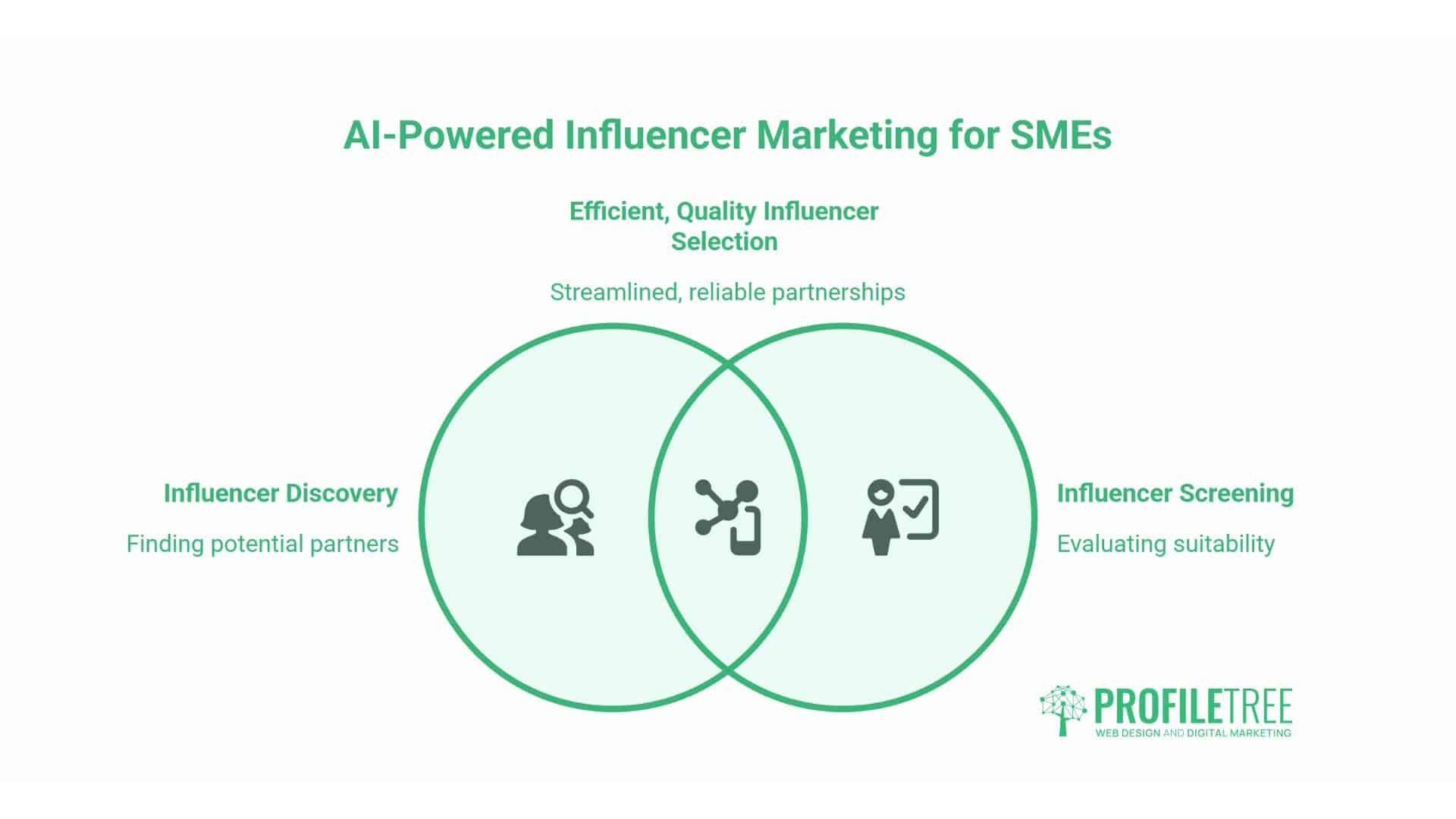
AI tools are changing two parts of this process for SMEs with limited marketing headcount: finding the right influencers and screening them properly once you’ve found them.
Manually reviewing months of an influencer’s content, checking engagement consistency and cross-referencing previous brand partnerships takes real time. AI-assisted screening tools can flag inconsistent engagement patterns and follower growth spikes far faster than a manual review, which matters most for smaller teams without a dedicated influencer marketing function. This is one of several areas where AI implementation and transformation work for SMEs pays off quickly: not through anything exotic, but through automating the screening and reporting work that otherwise eats into a small team’s week.
Fully virtual or AI-generated influencers remain a niche option for most Northern Ireland and Irish SMEs, and the question of disclosure they raise remains genuinely unsettled. Until clearer regulatory guidance exists specifically for AI personas, the safest approach is to disclose an AI-generated endorsement at least as clearly as you would a human one. Our wider piece on what AI tools reveal about customer behaviour covers how broader tools apply beyond influencer screening.
How to Run an Influencer Campaign That Works
The practical steps below are what separate campaigns that deliver from ones that quietly underperform.
Match the Influencer to the Product, Not the Budget
The most reliable predictor of a successful influencer campaign is the fit between the creator’s content area and the product being promoted. A sports nutrition brand promoting with a fitness influencer who genuinely uses similar products is far more credible than the same brand paying a celebrity with a broader, less relevant following.
Draw up a brief profile of your ideal influencer before searching: what category do they cover, what does their audience care about, what tone do they use, and what does a genuine product recommendation look like in their content? Then find candidates who match the brief rather than candidates who fit the budget and hope the match follows.
Set Campaign Goals Before Picking Anyone
Define what you want the campaign to achieve before approaching any influencer. Different objectives need different creative approaches and different metrics. Brand awareness campaigns prioritise reach and impressions. Sales campaigns prioritise clicks and conversion. Community-building campaigns prioritise comments and saves, and our online community statistics page is a useful reference point for what healthy engagement looks like at different audience sizes.
Without a clear objective, there’s no basis for evaluating whether the campaign succeeded. This sounds obvious, but plenty of influencer campaigns are commissioned without specific goals, which makes meaningful measurement impossible.
Use Contracts, Always
Every influencer partnership, regardless of size, should be governed by a written agreement. At minimum, the contract should cover: the specific deliverables (number of posts, format, platform), the timeline, the payment terms, exclusivity clauses if required, brand approval rights over content before posting, and what happens if the influencer fails to deliver.
This protects both parties and removes the ambiguity that causes most influencer relationship breakdowns.
Creating the Video and Content Assets Influencers Need From You
Most SMEs assume an influencer partnership means handing over a product and waiting for content to appear. In practice, the campaigns that perform best usually involve the brand supplying something too: clear product photography, a short brief video showing how the product works, or brand guidelines that keep messaging consistent without dictating the influencer’s tone.
This is where video production work overlaps with influencer marketing more than most brands expect. A short, well-shot product demonstration gives an influencer usable reference material, and the same footage can be repurposed across your own YouTube channel, website and social accounts long after the campaign ends, extending the value of a single production job well beyond the original influencer post. Our guide to social media video content covers the planning side of this in more detail.
The Bottom Line for Northern Ireland and UK SMEs
Influencer marketing has real commercial value when it’s approached with the same rigour as any other channel. The businesses that get it wrong typically skip the vetting stage, pick influencers based on follower count rather than audience fit, and treat a single post as a strategy in its own right. The ones that get it right treat it as a relationship-based channel that requires careful partner selection, clear objectives, honest measurement, and a website and content base that are actually ready to receive the traffic it sends.
The potential return is genuine. So is the potential for wasted spend, and the difference between the two usually comes down to the groundwork done before the campaign launches, rather than the campaign itself.
FAQs
What is influencer marketing and how does it work?
Influencer marketing means paying social media creators to feature or endorse a product to their audience, in exchange for a fee, product, or commission. Their followers see the recommendation within content they already trust.
How much does influencer marketing cost?
Costs vary by platform, follower count, and content type, so published per-follower rate guides are rough starting points rather than fixed benchmarks. Nano and micro influencers generally offer more competitive rates and stronger engagement relative to cost.
What is the difference between micro and macro influencers?
Micro-influencers have roughly 10,000 to 100,000 followers with a more specific, engaged audience. Macro-influencers have 100,000 to 1,000,000 followers, offering a broader reach but usually a lower engagement rate. See our micro- and macro-influencers guide for more depth.
How do I check if an influencer’s followers are genuine?
Check the engagement rate: likes and comments divided by followers. Below 1% on an account with over 50,000 followers is worth investigating. Tools such as HypeAuditor, Modash or Social Blade can flag suspicious growth patterns.