
YouTube Marketing for Small Business: Strategy That Generates Leads
Table of Contents
YouTube is the second-largest search engine on the planet, sitting behind only Google, which owns it. More than 500 hours of video are uploaded every minute, yet the vast majority of small businesses in Northern Ireland and across the UK are still treating it as an afterthought or skipping it entirely. That gap is an opportunity.
This guide covers everything a small business owner needs to start or sharpen a YouTube marketing strategy: how the platform actually works, what kinds of content generate enquiries, how to approach video SEO, and how to measure whether any of it is worth your time.
YouTube for Small Businesses
Most small business owners assume YouTube is for big brands with production budgets. It is not. The businesses that perform best on the platform are often local service providers who answer specific questions their customers are already searching for.
YouTube’s algorithm rewards watch time and relevance over production value. A plumber in Belfast who films a two-minute video answering “how do I know if my boiler needs replacing?” will consistently outperform a polished brand video from a national company that nobody searches for. The intent is specific, the answer is clear, and the viewer already has a problem they need solved.
The Search Engine Most Businesses Ignore
Google and YouTube share an index. A video optimised for a question on YouTube frequently appears in Google search results too, often above the organic listings. That gives a single piece of video content two search surfaces for the cost of one.
For small businesses competing in local markets, this matters more than most people realise. A service page on your website might take six months to rank for a competitive term. A well-optimised YouTube video answering a related question can appear in results within days of being published.
Why Video Builds Trust Faster Than Text
A written article tells someone what you know. A video shows who you are. For service businesses where trust is part of the sale, that difference is significant. Prospective clients who watch a business owner explain their process, answer common questions, or walk through a real project are considerably further along in their decision-making before they ever pick up the phone.
ProfileTree’s founder Ciaran Connolly puts it plainly: “For most SMEs, YouTube is the most underused commercial asset available to them. A business that answers ten questions on camera has ten pieces of content working around the clock. Each one builds credibility, each one shows up in search, and each one does the trust-building work that a sales call usually has to do from scratch.”
Building Your Channel and Content Strategy
Setting Up Your Channel Correctly
Before you film anything, get the channel foundations right. A poorly set-up channel wastes every view you earn.
Your channel name should match your business name exactly as it appears everywhere else online. Consistency across your Google Business Profile, website, and YouTube channel builds entity association, which helps both Google and AI systems understand and recommend your business.
The channel description matters more than most people think. Use the first two sentences to state clearly what your business does and who it serves. Include your location, your primary service, and a credible proof point. This text is indexed by both YouTube and Google.
Add your website URL, a branded banner image, and a contact email in the About section. These signals tell YouTube you are a legitimate business, not a hobby channel.
The Content Types That Generate Enquiries
Not all YouTube content serves the same purpose. For small businesses, three content types consistently generate commercial value:
- Question-and-answer videos target the specific queries your customers type into Google. Think “how much does a website cost for a small business?” or “what does an SEO agency actually do?” These videos attract people with active purchase intent. They are the closest equivalent to a service page but in video form.
- Process and explainer videos walk viewers through how your service works. A web design agency showing the stages from brief to launch, a solicitor explaining what happens at a first consultation, or a joiner showing a project from timber to finished installation. These reduce buyer anxiety and shorten the sales cycle.
- Behind-the-scenes and team videos humanise the business. They are less likely to generate direct search traffic, but they dramatically increase conversion rates among people who found you through other means and are now doing their due diligence.
Building a Realistic Content Calendar
Consistency outperforms volume. Uploading one video a week for twelve months produces better results than uploading twenty videos in January and nothing for the rest of the year.
Start with a realistic frequency: one video per fortnight is achievable for most small businesses without a dedicated video team. Build a list of thirty questions your customers ask, split them by the stage of the buying journey they belong to, and work through them in order.
Batch filming helps. Set aside a half-day each month, film four or five videos in sequence, and edit and schedule them across the following weeks. This approach removes the “what do I film today?” problem and keeps your channel active even in busy periods.
A well-structured content marketing strategy gives your YouTube output direction, so each video connects to a broader commercial goal rather than being created in isolation.
Video SEO: Getting Found on YouTube
YouTube SEO and Google SEO share the same underlying logic: match your content to what people are searching for, signal its relevance clearly, and earn engagement that tells the algorithm the content is worth promoting.
Keyword Research for YouTube
Start with what your customers actually search for, not what you assume they search for. YouTube’s own search bar shows autocomplete suggestions as you type; these are based on real search volume and are the most direct signal of what people want.
Google Trends allows you to compare keyword variants across both Google and YouTube search, giving you a sense of relative demand before you commit to a topic.
For local service businesses, location-specific terms often have lower competition than generic ones. “Web design Belfast” on YouTube has far fewer competing videos than “web design” globally, making it easier to rank and more likely to attract a viewer who is actually in your target geography.
Optimising Your Video Title
The title is the most important SEO element on a YouTube video. It should contain your primary keyword, describe the video’s content accurately, and give a viewer a reason to click.
Avoid vague titles like “Our company story” or “What we do.” These tell neither the algorithm nor the viewer what the video is about. A title like “How Much Does a Website Cost for a Small Business in Northern Ireland?” is specific, searchable, and sets clear expectations.
Keep titles under 60 characters where possible. YouTube truncates longer titles in search results.
Writing Descriptions That Work
YouTube descriptions serve two purposes: they help the algorithm understand your content, and they give viewers context and next steps.
Write the first two sentences as a self-contained summary of the video’s content. Include your primary keyword naturally in the first 100 characters. These opening lines appear in search results before the “show more” truncation point.
In the body of the description, expand on what the video covers, include secondary keywords naturally, and add links to relevant pages on your website. A short biography of your business with location and services helps build entity signals.
Thumbnails, Tags, and Captions
Thumbnails are the equivalent of a headline on a physical poster: they are the first thing a viewer sees before they decide whether to click. Effective thumbnails for business content use a clear visual of the presenter or a relevant product, a short text overlay with the video’s key benefit, and consistent brand colours across all uploads.
Adding captions improves accessibility and gives YouTube additional text to index. YouTube’s automatic captions are usable but often contain errors, particularly with technical terms and proper nouns. Uploading a corrected SRT file takes ten minutes and meaningfully improves both SEO and viewer experience.
Tags have diminished in SEO importance, but are still worth completing. Use three to five accurate tags that reflect your content: your primary keyword, a broader category keyword, and your business location.
Turning Views into Leads
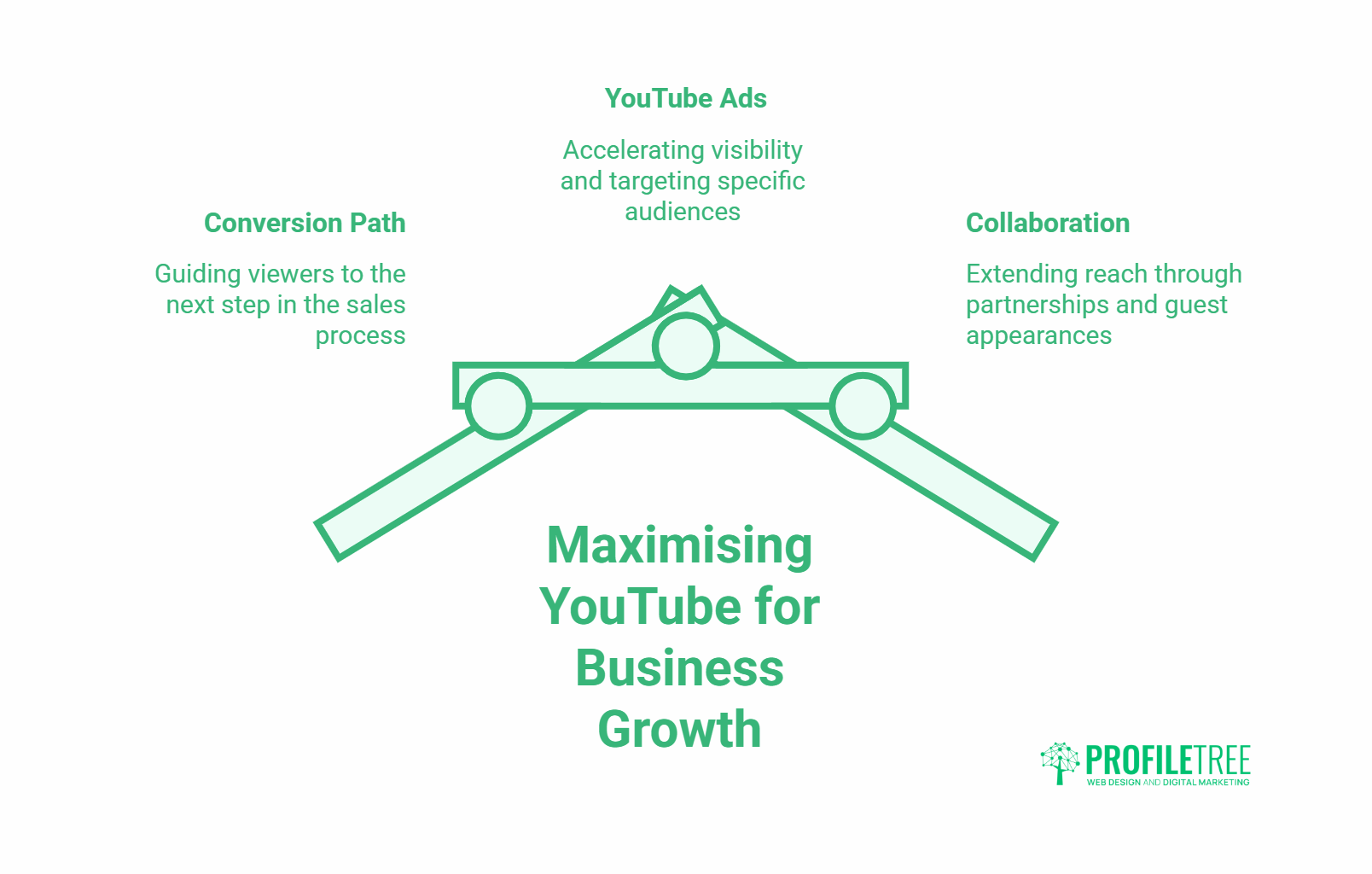
A view without a conversion path is an audience without a business. This is where most small business YouTube channels fail: they generate watch time but no commercial outcome.
Connecting YouTube to Your Sales Process
Every video should have a clear next step built in. For most small businesses, that means directing viewers to a relevant service page, a free consultation offer, or a contact form. Mention the next step verbally in the video, include it in the description, and use YouTube’s built-in end screen feature to link to it in the final 20 seconds.
ProfileTree’s digital marketing services include YouTube strategy as part of a broader channel plan, connecting your video output to your SEO performance and your lead generation goals rather than treating them as separate activities.
The Role of YouTube Ads for Small Businesses
Organic YouTube growth takes time. YouTube advertising accelerates visibility while the organic channel builds, and it gives you precise control over who sees your content.
YouTube ads run through Google Ads. The formats most relevant to small businesses are skippable in-stream ads (which play before or during another video and can be skipped after five seconds) and bumper ads (six-second non-skippable spots used for awareness).
Targeting options on YouTube are notably precise. You can serve ads based on location down to postcode level, by the type of content someone is watching, by their search history, and by demographic profile. A Belfast web design agency can serve video ads specifically to people in Northern Ireland who have been searching for website-related terms in the past 30 days.
The threshold for channel monetisation is 1,000 subscribers and 4,000 hours of watch time over 12 months. For most small businesses, monetisation is a secondary consideration; the commercial value comes from the audience and the leads, not from ad revenue.
Building Authority Through Collaboration
Appearing on other businesses’ YouTube channels through interviews, collaborations, or sponsored content extends your reach to audiences that already exist. Look for non-competing businesses serving the same customer base and propose a joint video that would genuinely help both audiences.
Guest appearances on video podcasts and industry interviews also build your channel’s authority by association, particularly if those channels link back to your content or business in the description.
Measuring What Matters
YouTube Analytics provides more data than most small business owners know what to do with. The metrics that actually matter for a business channel are narrower than the platform’s default dashboard suggests.
The Metrics Worth Tracking
Audience retention shows you the percentage of each video that viewers watch before leaving. A video with 60% average retention is performing well; one where most viewers leave before the 30-second mark almost certainly has a slow or unclear opening.
- Click-through rate from impressions shows what percentage of people who see your video’s thumbnail actually click on it. A CTR below 3% usually signals a weak title or thumbnail. Above 6% is strong for a business channel.
- Traffic source breakdown tells you where your views are coming from: YouTube search, suggested videos, direct links, or external sources. For a business channel focused on search-driven lead generation, YouTube search should be your primary source. If suggested videos are driving most of your views, your content is likely attracting general interest rather than people with purchase intent.
- Subscriber conversion rate tracks what percentage of views result in new subscribers. Low subscriber conversion often indicates that individual videos are performing but the channel as a whole isn’t giving viewers a compelling reason to stay.
Connecting YouTube to Commercial Outcomes
YouTube Analytics does not tell you how many leads came from your channel directly. To track this, add UTM parameters to the links in your video descriptions and end screens, then track those parameters in your website analytics platform. This connects YouTube view activity to contact form submissions or consultation bookings.
If you use a CRM, ask new enquiries how they found you. “Saw your YouTube video” appears more often in this data than most business owners expect, particularly once a channel has been active for six months or more.
Professional web design and development services that include proper analytics integration make this tracking straightforward. Without it, you’re measuring views rather than business outcomes.
When to Invest in Professional Video Production
Self-filmed content is the right starting point for most small businesses. Smartphone cameras are capable of producing perfectly watchable content, and authenticity frequently outperforms polish on the platform.
The case for professional video production strengthens once you have validated that video works for your business, identified the content types that generate the most engagement and enquiries, and have a consistent publishing schedule in place. At that point, investing in properly produced content for your highest-performing topics compounds the results you’re already seeing.
Video production services that understand YouTube strategy, not just production, ensure that higher-quality content is structured and optimised for search rather than simply looking good on screen.
Integrating YouTube into Your Wider Digital Strategy
YouTube should not operate in isolation. A well-integrated digital strategy connects your video content to your SEO performance, your social media presence, and your website’s conversion architecture.
Videos that answer the same questions as your written content reinforce topical authority across both Google and YouTube. Embedding relevant videos on your service pages and blog posts increases time on page and provides an additional content format for visitors who prefer watching to reading.
Short clips from longer YouTube videos perform well as organic social content on LinkedIn and Instagram, extending the reach of each piece of content you produce without creating something new from scratch.
For businesses exploring AI transformation in their marketing, YouTube is increasingly relevant as a training data source for AI systems. Channels with consistent, clear, entity-rich content about their service area are more likely to be cited by AI assistants when users ask about relevant services in a specific location.
Frequently Asked Questions
How long does it take to see results from YouTube marketing?
Most small business channels see meaningful organic search traction after three to six months of consistent publishing. The compounding nature of YouTube means that older videos continue to generate views and leads long after they are published, which makes the channel more valuable over time than platforms where content has a short shelf life.
Do small businesses need professional equipment to start on YouTube?
No. A modern smartphone with a basic external microphone and reasonable natural lighting is sufficient to produce watchable content. Audio quality matters more than video quality; viewers will tolerate average picture but will click away from poor sound within seconds.
How often should a small business post on YouTube?
Consistency matters more than frequency. One well-optimised video per week is better than daily uploads that burn out the creator and drop in quality. For most small businesses without a dedicated video team, one video per fortnight is a sustainable starting point.
What types of videos work best for generating leads?
Question-and-answer videos targeting specific search queries consistently outperform all other formats for lead generation. Viewers who find these videos have a specific problem and are actively looking for someone to help. That intent translates directly into enquiries.
Should small businesses use YouTube ads?
YouTube ads are worth considering once you have a validated conversion path in place. Running ads to a video that doesn’t have a clear call to action or a landing page ready to convert traffic is wasteful. Start with organic, prove the content works, then use ads to accelerate what is already performing.
How does YouTube help with local SEO?
YouTube videos optimised for location-specific terms appear in both YouTube search and Google search results. A business in Belfast that consistently publishes videos about web design, digital marketing, or their specific service area builds search presence across both platforms simultaneously. Google frequently features video results prominently for local service queries.
Conclusion
YouTube rewards businesses that treat it as a search engine rather than a broadcast platform. The small businesses that commit to answering their customers’ questions on camera, publishing consistently, and connecting that content to a clear commercial outcome are building a long-term acquisition channel that compounds over time.
If you’re ready to make video a serious part of your marketing, ProfileTree’s team works with SMEs across Northern Ireland, Ireland, and the UK on YouTube strategy, video production, and integrated digital marketing. Get in touch to discuss what that could look like for your business.