
The Instagram Algorithm: A Guide for UK Businesses
Table of Contents
Instagram’s algorithm decides which UK businesses get seen and which get scrolled past, and in 2026, that decision has little to do with follower count. ProfileTree, the Belfast-based digital marketing agency, works with SMEs across Northern Ireland, Ireland and the UK who ask the same question: why does one post reach thousands while an identical format reaches almost nobody? The answer lies in how Instagram ranks content across three separate systems, each rewarding different signals.
This guide breaks down how the algorithm actually works this year, what changes for a UK audience specifically, and which tactics move the needle for a small business with limited time and no paid media budget.
How the Instagram Algorithm Works
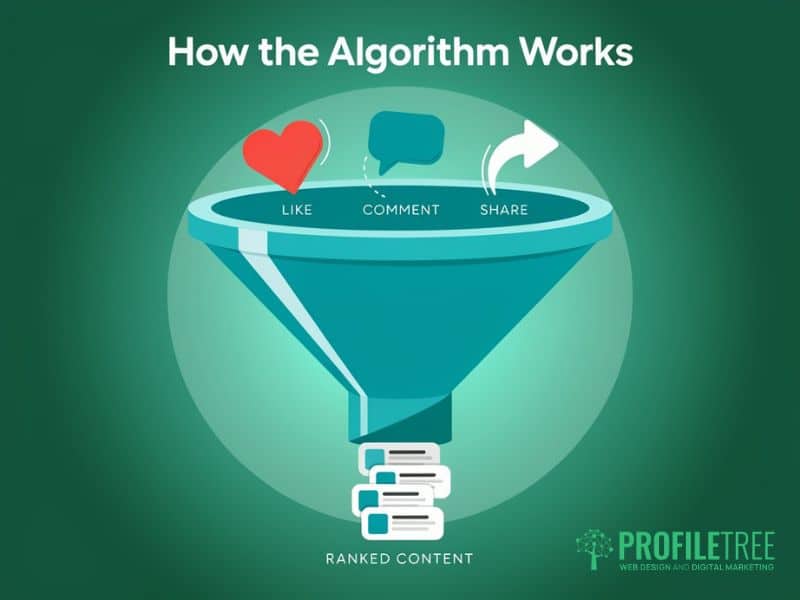
Instagram no longer shows posts in the order they’re published. The Instagram algorithm now predicts what each user wants to see using three signals: how you interact with an account, how much interest you show in similar content, and how recent the post is. For a UK business, that shift matters more than any single posting trick.
The biggest change of the past few years is the move from a social graph, content from accounts you follow, to an interest graph, content that matches your behaviour regardless of who you follow. This opens the door for smaller accounts. A Belfast web design agency or a Cardiff bakery can appear in front of people who’ve never heard of the brand, provided the content matches what those people already engage with.
It’s a shift that particularly benefits SMEs and regional businesses that don’t have the marketing budget to compete on follower count. Instagram now surfaces content based on relevance rather than reach history, so a well-targeted post from a small account can outperform a generic one from a much larger competitor. A local accountant posting a genuinely useful tax deadline reminder can reach more prospective clients than a national firm posting generic financial content nobody asked for.
Key Ranking Signals for Business Accounts
Four factors carry the most weight when Instagram decides how far to distribute a piece of business content.
Engagement velocity looks at how fast a post gathers interactions after it goes live, not how many it collects over time. A post picking up fifty interactions in its first hour outperforms one that slowly gathers a hundred over several days, because early engagement tells Instagram to test the post with a wider audience straight away.
Interaction quality isn’t equal across actions. In descending order of value: a DM share, a save, a comment of four words or more, a short comment, then a like. A single DM share often carries more weight than a dozen likes, which is why prompting people to forward content matters more than chasing a big like count.
Consistency matters more than frequency. Accounts posting three times a week on a dependable schedule tend to outperform accounts posting daily with no pattern, since Instagram reads predictable activity as a sign of account health.
The Three Content Environments: Feed, Reels and Explore
Instagram runs three separate distribution systems, and each judges your content differently. For a UK business, the Instagram algorithm rewards each environment on its own terms, so knowing which one a piece of content is built for changes how you should measure its success.
Feed and Stories: The Relationship Layer
Feed and Stories favour accounts that people already interact with regularly. The algorithm looks at how recently and how often someone comments, sends a DM, or visits a profile, then uses that pattern to decide what shows up first. For a business, this environment works best for nurturing existing clients and warm leads rather than chasing new ones, since the audience already knows the brand.
Reels: The Discovery Engine
Reels behave more like a recommendation engine than a social feed. Watch time, completion rate, and re-watches carry the most weight, so a 20-second Reel that people watch twice signals far more value than one that gets scrolled past after two seconds.
A UK viewer who rewatches your Reel prompts Instagram to test it with similar profiles elsewhere in the country. That’s why businesses producing regular video content, whether through an in-house team or a dedicated video production partner, tend to build this discovery signal faster, simply because they have more material in rotation to test.
Explore: Reaching New UK Audiences
Explore works as a matching system between content and interest groups. Instagram parses captions, on-screen text and audio to decide who might want to see a post, then tests it with a small sample before deciding whether to push it wider. This is also where Instagram’s search function lives: when someone searches for web design tips or AI training for SMEs, results are drawn from caption text and alt text, not hashtags, which means a well-written caption now does more search work than a wall of tags ever did.
UK Factors That Shape Your Reach
Global guides tend to treat posting times and compliance rules as an afterthought. For a UK audience, both directly affect how far the Instagram algorithm lets your content travel, and getting them wrong wastes reach you’d otherwise earn for free.
Best Posting Times in GMT and BST
British audiences show three consistent peaks. The morning commute, roughly 7:30 to 8:45, favours quick industry news and motivational content aimed at people scrolling on the way into work. Lunch, from midday to about 1:15 pm, suits carousels and short Reels under 30 seconds, since the window is short and attention is split. The evening wind-down, 8 pm to 10 pm, holds attention longest and works well for longer-form education and Stories that invite conversation. Sunday evenings between 7 pm and 9 pm often outperform expectations for professional development content, as people mentally prepare for the week ahead rather than switch off entirely.
The exact window shifts by industry. Retail businesses tend to see stronger weekend engagement, B2B content performs best on weekday mornings, and food and drink brands often do well around the Thursday to Saturday evening window when people are planning where to eat.
| Window | Time (GMT/BST) | Best Content |
|---|---|---|
| Morning commute | 07:30–08:45 | Industry news, quick tips |
| Lunch break | 12:00–13:15 | Carousels, short Reels |
| Evening wind-down | 20:00–22:00 | Long-form Reels, Stories |
| Sunday evening | 19:00–21:00 | Professional development content |
The ASA Effect: Disclosure Labels and Reach
Many UK business owners avoid labelling paid content because they assume Instagram penalises it. That assumption doesn’t hold up. Content labelled with Instagram’s Paid Partnership tool, or a simple AD or Gifted label at the start of a caption, performs no worse than unlabelled posts, and UK audiences often save transparent business content at higher rates than content with no disclosure at all. The Advertising Standards Authority still requires clear disclosure regardless of how the algorithm treats it, so getting this right protects you both ways: it satisfies the regulator, and it doesn’t cost you reach.
Localised Signals: Geotags and UK Trending Audio
Geotagging a post and choosing audio that’s trending within the UK both help Instagram place content with a British audience rather than a global one. Referencing UK-specific events, regulations or cultural moments, such as GDPR compliance for a web design business or a Digital Skills Council initiative for a training provider, tends to generate stronger engagement than generic global messaging aimed at no one in particular. A Reel that leans on American slang or references a US-only event will often surface to a US audience first, which defeats the purpose if your customers are in Belfast or Bristol.
Practical Tactics to Increase Your Reach
Understanding the Instagram algorithm only helps if it changes what you actually post. These are the tactics that move reach for a UK small business with a realistic amount of time to invest, rather than a full-time content team.
Direct message shares carry more weight than any other engagement type. When someone forwards your post to a colleague, Instagram reads that as a strong signal of relevance. Content that prompts a tag someone or send this to your team moment earns this signal naturally, and it works particularly well for B2B businesses such as web design agencies, marketing consultancies and training providers, where content becomes the reason for a work conversation rather than a passing scroll. A post that shares a surprising statistic or a genuine framework tends to generate this kind of sharing far more reliably than a polished but generic tip.
“The businesses that succeed on Instagram treat the algorithm as a distribution partner, not an obstacle,” says Ciaran Connolly, founder of ProfileTree. “When you align your content with how the platform actually works, you stop fighting for visibility and start earning it.”
For video, watch time and completion rate outrank every other metric. A Reel that holds 80% of viewers to the end beats one with far higher views but weaker retention. Structure video around a fast hook in the first two seconds, a value section that delivers on that promise without wasted time, and a clear call to action in the final few seconds. UK viewers respond particularly well to familiar cultural references and regional accents, so there’s no need to flatten your voice for a wider audience, and doing so often costs you the very authenticity that made the content shareable.
Instagram’s native features get preferential distribution, too. Polls, question boxes and quizzes in Stories generate direct engagement, and question boxes double as a source of content ideas from real client queries. Carousels outperform single images for anything with multiple steps or comparisons, since they generate higher save rates as people bookmark them for later, and a carousel explaining the five pages every business website needs is a natural fit for a web development audience. Guides let you group related posts into a single resource, something worth building around topics your business already covers, such as choosing a web platform or planning a first AI implementation.
Caption Writing as Social SEO
Caption writing deserves the same care as website copy. Rather than opening with a wall of hashtags, describe your service, location and value proposition in plain language, the way a video production business in Belfast might write about creating content that drives engagement for brands across the UK. This lets Instagram categorise the post accurately and surface it against genuine searches, and it reads better to a human scrolling past than a caption built entirely from tags. Businesses refining this alongside their wider search engine optimisation work usually see the habit carry over faster.
Hashtag Strategy
Hashtags still play a role, just a smaller one than a few years ago. Three to five specific tags aimed at your actual audience, rather than the maximum of thirty, remain useful. A Northern Ireland agency is better served by a tag like BelfastBusiness than by a generic tag like Marketing, which is competing against millions of unrelated posts for attention.
After completing social media training covering Instagram, Facebook, Canva and AI tools, one ProfileTree client running a yoga and wellness business described the experience as so informative, invaluable, and completely on point, crediting the practical, hands-on approach for making the platform feel manageable rather than overwhelming.
Aim for a content mix rather than a single format. Roughly 40% authority content that demonstrates expertise, such as web design best practices or SEO strategy guidance, 40% engagement content like behind-the-scenes looks or client stories, and 20% direct promotion. Businesses that outsource this planning to a dedicated social media marketing service usually keep this balance more consistently than those fitting it in around other work, largely because someone is tracking the ratio deliberately rather than posting whatever feels easiest that week.
Creator vs Business Account: Which Wins for UK Reach?
This question comes up often, and the honest answer depends on what the account needs to do rather than which one the Instagram algorithm quietly favours.
Business accounts provide analytics, contact buttons and ad tools that a creator account doesn’t offer, which matters for a company tracking reach, profile visits and saves against commercial goals. Creator accounts sometimes see marginally better organic reach in testing, though the gap is small and inconsistent, and it rarely holds up once a business starts running ads or needs a contact button on the profile.
For most UK SMEs, the analytics and contact features of a business account outweigh any minor reach difference, particularly once a digital marketing strategy is built around measurable outcomes rather than guesswork. A sole trader testing the water with organic content only might start on a creator account, then switch once the account starts generating real enquiries worth tracking properly.
Troubleshooting: Why Your Reach Dropped
A sudden drop in reach usually has a specific, findable cause. Most UK businesses assume the Instagram algorithm is punishing them, when the real explanation is rarely as complicated as it first appears.
Shadowbanning, the idea that Instagram deliberately hides your content as a penalty, isn’t real in the way most people assume. Reduced reach almost always traces back to content that isn’t generating engagement, which points to a mismatch between what you’re posting and what your audience wants, not a hidden penalty applied behind the scenes.
Posting daily with average content underperforms posting three times a week with genuinely useful material. Saves, shares and comments matter more than volume, so a smaller number of stronger posts beats a packed content calendar of forgettable ones that nobody bothers to engage with.
Buying followers or engagement causes more damage than it fixes. Instagram detects inauthentic activity and reduces distribution in response, and fake followers dilute your engagement rate in a way that signals poor relevance to the algorithm. Five hundred genuinely engaged local followers outperform five thousand inactive international ones on every metric that matters for a business trying to generate real enquiries.
Treating Stories as an afterthought is a common gap. Stories receive their own distribution treatment separate from the main feed, and they offer direct interaction through polls, questions and quick replies that keep a business visible between main feed posts rather than relying on the feed alone to stay top of mind.
Turning Algorithm Insight Into Growth
Understanding how the Instagram algorithm ranks content is the starting point, not the result, for a UK business trying to grow on the platform. Here’s where to start: audit your last month of posts against the patterns in this guide. Are you encouraging DM shares, posting inside UK peak windows, and using Stories actively rather than treating them as an afterthought? Pick two or three changes, apply them for a month, then review what actually moved before adding anything else.
For businesses that want this built into a wider plan rather than handled in spare moments, ProfileTree’s Belfast-based team supports UK and Irish SMEs with social media strategy alongside web design, SEO and AI implementation, so Instagram growth connects to the rest of the business rather than sitting apart from it as a separate task nobody quite owns.
FAQs
1. What determines the order of posts in my Instagram feed?
The Instagram algorithm ranks posts using your relationship with the account, your interest in that type of content, and how recent the post is. It learns from what you’ve engaged with before, including which accounts you interact with and how long you watch videos, to predict what you’ll find valuable next.
2. How can UK businesses improve their Instagram reach?
Focus on content that earns saves and DM shares, post inside UK peak windows, and use natural language in captions rather than relying on hashtags. Responding to comments and DMs quickly also signals an active, engaged account, which the algorithm rewards with wider distribution over time.
3. Do hashtags still matter in 2026?
Hashtags carry far less weight than they used to. Three to five specific, relevant tags still help, but Instagram’s search function now reads full captions, so descriptive writing matters more than hashtag volume for anyone searching for your kind of business.
4. Does using a paid partnership label hurt my reach?
No. Instagram’s own data shows labelled content performs comparably to unlabelled posts, and UK audiences often save transparent business content at higher rates. Clear labelling protects you under ASA rules regardless of any algorithmic effect, so there’s no trade-off between compliance and reach.
5. What’s the best posting frequency for a UK small business account?
Consistency beats frequency. Three to five posts a week on a reliable schedule tends to outperform daily posting, provided each post is genuinely useful to the audience it’s aimed at rather than filler content posted purely to hit a number.