
360 Photos: A Great Way to Bring Your Business to Life Online
Table of Contents
360 photos are spherical images that let viewers look in every direction from a single point. For businesses, they function as virtual tours on Google Maps, websites, and social media. Hotels, restaurants, retailers, and property businesses use them to build trust with potential customers before a visit and to improve local search visibility.
When a potential customer is choosing between two restaurants, two hotels, or two retail spaces they’ve never visited, the business that shows them the inside wins more bookings. That’s the practical case for 360 photos: they close the gap between browsing and buying by giving people a genuine sense of what to expect before they commit.
This guide covers what 360 photos are, how businesses across hospitality, retail, property, and tourism are using them effectively, and what the connection to Google’s local search features means for your SEO. If you’re already managing a local SEO strategy, 360 content is one of the more underused tools available.
What Are 360 Photos?
A 360 photo is a spherical image captured from a single point that lets viewers look in any direction: left, right, up, or down. Unlike a standard panorama, which extends only horizontally, a full 360 photo covers the entire surrounding environment from the photographer’s position.
They work by stitching multiple overlapping images together into a single spherical file. Most dedicated 360 cameras do this automatically. The resulting image can be explored interactively on screen, embedded in websites, uploaded to Google Maps, or viewed in virtual reality.
The Four Types of Panoramic Image
| Type | Coverage | Best Used For |
|---|---|---|
| Partial panorama | Wide horizontal view, not full circle | Landscape shots, interior overviews |
| Cylindrical panorama | Full 360° horizontal, limited vertical | Street-level views, retail walkthroughs |
| Spherical panorama | Full 360° including up and down | Google Street View, virtual tours |
| Stereoscopic panorama | Dual-lens 3D depth effect | VR headset experiences |
For most business applications, spherical panoramas are the relevant format. They’re what Google Maps uses, what virtual tour platforms require, and what produces the most interactive viewing experience on a website or social media.
What Equipment Do You Need?
Dedicated 360 cameras are the most straightforward option. The Ricoh Theta series, Samsung Gear 360, and Insta360 cameras all produce spherical images in a single shot without stitching steps. For higher-quality commercial work, a DSLR with a fisheye lens on a panoramic tripod head produces better results but requires stitching software such as PTGui.
For basic social media content, modern iPhones and Android phones can capture panoramic images using built-in camera modes or the Google Street View app. The quality is sufficient for informal social posts but not for professional virtual tours or Google Business Profile submissions.
7 Ways Businesses Use 360 Photos
1. Virtual Property Tours for Estate Agents
Estate agents were among the first to adopt 360 photography at scale, and the commercial logic is obvious. A prospective buyer who can walk through a property virtually before booking a viewing is a more qualified lead when they arrive. They’ve already seen the layout, the natural light, the condition of the rooms. The viewing confirms rather than introduces.
For lettings, 360 tours reduce the volume of speculative enquiries from people who would have self-selected out if they’d seen the space first. That’s a genuine time saving across a high-volume pipeline.
2. Hotel and Accommodation Previews
Hospitality is one of the highest-stakes categories for 360 content. A guest booking a room they’ve never seen is making a decision under uncertainty. A 360 tour of the room, the lobby, the restaurant, and the outdoor spaces removes most of that uncertainty. Hotels using 360 previews report higher conversion rates from enquiry to booking and fewer negative reviews citing “not as described.”
For smaller guesthouses and boutique hotels in Northern Ireland and Ireland, this is also a way to compete with larger chains that have more review volume. A thorough 360 tour is more persuasive than a higher star count from an unknown source.
3. Restaurant and Café Atmosphere
Choosing a restaurant for a significant occasion (a birthday, a business dinner, a first date) involves assessing atmosphere, not just menu. A 360 photo of the dining room, the bar, and the outdoor terrace lets potential guests make that assessment before they book. For restaurants with distinctive interiors, this is a competitive advantage that static photos can’t replicate.
“For local businesses, 360 photos are one of the easiest ways to reduce the barrier to a first visit. When someone can walk through your space before they leave their house, you’ve already done half the job of building trust.”Ciaran Connolly, Founder, ProfileTree
4. Retail Store Walkthroughs
Physical retail faces sustained pressure from online shopping. One response is to give the in-store experience more visibility online before the visit. A 360 walkthrough of a retail space shows layout, product displays, and atmosphere in a way that a product catalogue cannot. For independent retailers with distinctive store environments, this is particularly valuable.
Smartphone users represent more than half of all online shoppers. A 360 image viewed on a phone closely mimics the physical sensation of being in a space: tilt the phone, and the view tilts with it. That physical interaction creates a stronger psychological connection than a static image.
5. Tourism and Destination Marketing
Tourism depends on inspiring action in someone who hasn’t yet decided to travel. A 360 photo of a location gives potential visitors a preview that is qualitatively different from a photograph: they can look around, find the details that matter to them, and form a personal connection with the place before they book. For tourism businesses in Northern Ireland and Ireland promoting lesser-known destinations, this is a significant tool.
The connection between 360 content and video marketing is also worth noting. 360 video, where the viewer can look in any direction during playback, is increasingly supported by major platforms and produces the strongest immersive response of any format currently accessible without specialist hardware.
6. Event Venue Marketing
Conference centres, wedding venues, sports clubs, and performance spaces all sell an experience of a physical space. Clients choosing a venue are making a significant financial commitment without always having the opportunity to visit in person first. A thorough 360 tour of the main hall, the breakout spaces, the catering areas, and the exterior reduces the risk of that decision and increases the confidence of the buyer.
7. Co-Working Spaces and Offices
Flexible working has expanded the market for co-working spaces, and the competitive differentiation between providers often comes down to environment and atmosphere rather than desk price. A 360 tour of a co-working space communicates the culture of the environment, the quality of the fit-out, and the practical layout in a single asset that works across the website, Google Maps, and social media.
360 Photos, Google, and Local SEO
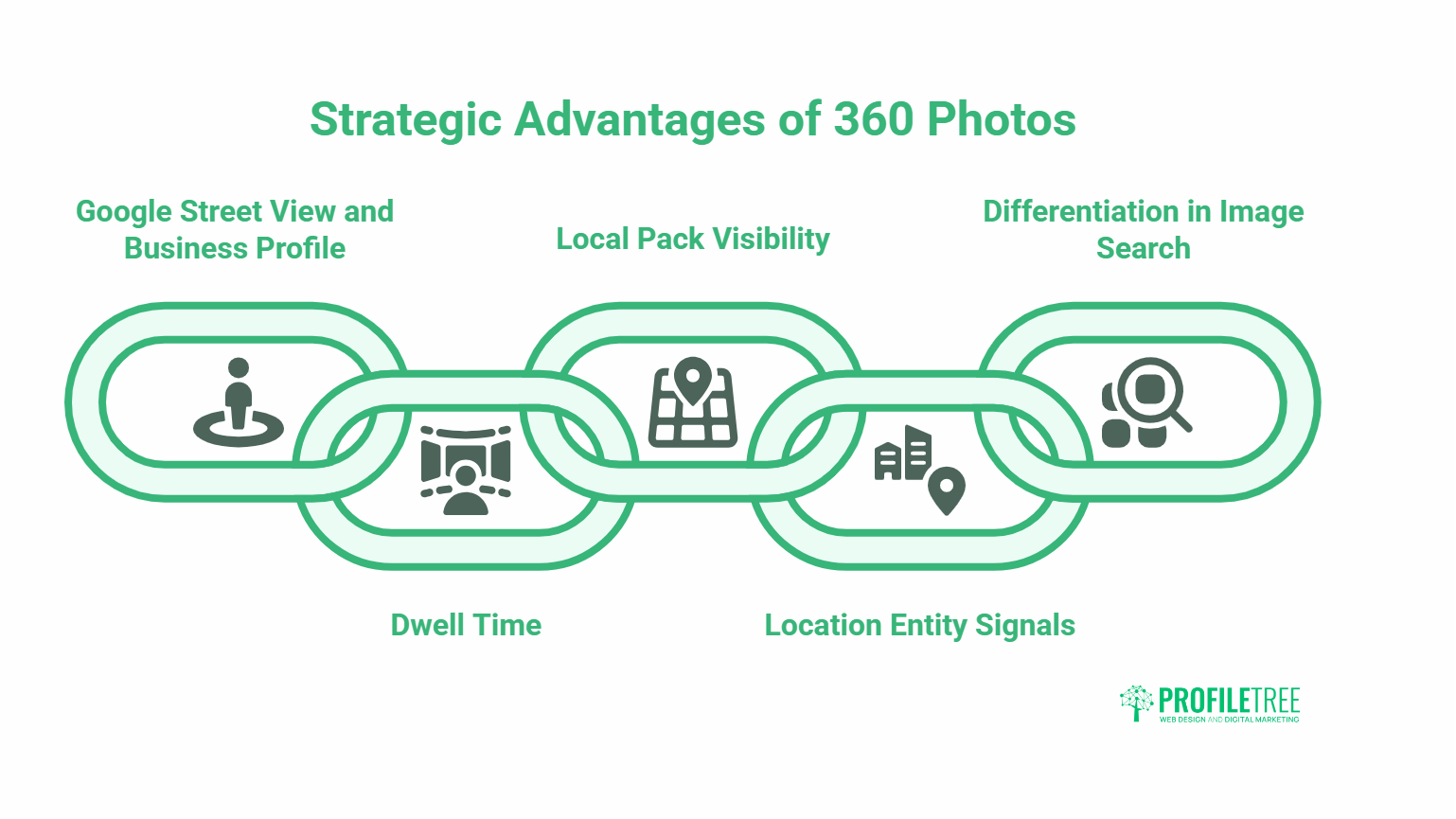
Google’s investment in 360 content is structural, not cosmetic. Street View and Google Business Profile are built around spherical photography, and businesses that supply high-quality 360 content to these platforms receive measurable search benefits.
Google Street View and Business Profile
When a business submits a 360 photo through Google Business Profile, that image becomes accessible directly from the business’s Google Maps listing. Users searching for your business, or searching for businesses like yours nearby, can click “See inside” and take a virtual tour before they visit.
According to Google’s Street View Trusted programme, 55% of UK adults regularly use Google Street View. In the United States, a virtual tour on Google Business Profile is now considered as expected as having a website. The UK market is moving in the same direction.
All 360 photos submitted through Google Business Profile are merged with Street View and Google Maps, increasing the surface area of your business across Google’s products with a single submission.
How 360 Content Supports Local SEO
The SEO benefits of 360 photos work through several channels:
- Dwell time. An interactive 360 photo keeps visitors on your Google Business Profile and website longer than static images. Longer engagement signals content quality to search algorithms.
- Local pack visibility. Businesses with complete, media-rich Google Business Profiles rank more consistently in local pack results. 360 photos contribute to profile completeness.
- Location entity signals. A spherical photo embedded with GPS metadata explicitly connects your business to a physical location, strengthening the location entity signals that local SEO depends on.
- Differentiation in image search. 360 photos appear differently in Google image search results, with an interactive indicator. This produces a higher click-through rate from image search than standard photography.
For businesses investing in a broader digital strategy, 360 content sits alongside review management, local citation building, and website optimisation as a foundational local search asset.
Google Trusted Photographers
Google’s Trusted Photographer scheme accredits professional photographers to upload Street View content and business virtual tours on behalf of businesses. If you want a virtual tour that appears on Google Maps and Google Street View, hiring a Google Trusted Photographer is the most reliable route. Google maintains a directory of accredited photographers searchable by location.
For businesses building their Google presence as part of a wider digital marketing programme, this is a one-time asset investment that continues to work without ongoing maintenance.
Sharing 360 Photos on Social Media
Platform support for 360 content varies:
| Platform | 360 Photo Support | 360 Video Support | Notes |
|---|---|---|---|
| Yes | Yes | Best native support; interactive in feed | |
| YouTube | Limited | Yes | Full 360 video support with metadata |
| Google Maps | Yes | No | Core platform for business 360 content |
| No | No | Use flat “tiny planet” export as workaround | |
| Twitter/X | No | Yes | 360 video via third-party apps only |
Facebook offers the most straightforward 360 photo experience for businesses. Images upload like standard photos and render interactively in the feed. For social media marketing purposes, Facebook remains the primary platform for 360 photo distribution, followed by Google Maps and website embedding.
Getting Started With 360 Photography for Your Business
The barrier to entry for basic 360 photography is lower than most business owners expect. A smartphone and the Google Street View app is sufficient to produce content for Google Business Profile. For professional virtual tours, the investment is a one-off cost for equipment or a photographer’s fee rather than an ongoing budget commitment.
Choosing the Right Camera
For businesses shooting their own 360 content, dedicated 360 cameras are the most practical choice. The Ricoh Theta series and Insta360 range both produce spherical images in a single shot, handle stitching automatically, and connect directly to smartphones for preview and sharing. A small stable tripod is the only additional equipment needed; stability during capture prevents visible seams where images join.
For commercial-quality virtual tours intended for Google Maps or website embedding, a professional photographer using a DSLR with a fisheye lens produces significantly sharper results. The cost of a professional shoot is typically a one-off fee for an asset that remains on Google Maps indefinitely.
Editing and Stitching Software
If you’re shooting with a standard camera rather than a dedicated 360 device, stitching software assembles the individual images into a spherical file. PTGui is widely regarded as the most capable option for professional use: it handles complex shots cleanly and produces output suitable for Google Street View submissions. Hugin is a free alternative with a steeper learning curve. Most dedicated 360 cameras bypass this step entirely.
Editing 360 photos in standard software such as Photoshop requires additional steps compared to flat images; the spherical projection distorts standard tools. Adjustments to exposure, colour balance, and contrast should be applied before stitching where possible.
Embedding 360 Photos on Your Website
A 360 photo embedded on your website produces a significantly longer average session time than a static image gallery. Most website platforms support 360 embeds through plugins or embed codes from platforms such as Kuula or Roundme. For WordPress sites, several dedicated 360 viewer plugins handle this cleanly without custom development.
If your website needs structural work to support richer media effectively, ProfileTree’s website development team works with SMEs across Northern Ireland to build sites that carry video, 360, and interactive content without performance penalties. Connolly Cove is one example of a content-rich site in the travel and tourism space where immersive visual content forms a core part of the audience experience.
Tips for Better 360 Shots
- Check your surroundings on all sides. Unlike standard photography, you can’t frame out an untidy corner. Prepare the full 360-degree environment before shooting.
- Shoot in RAW if your camera allows it. This gives you more flexibility in post-processing, particularly for exposure correction in mixed-light interiors.
- Use manual mode for interior shots. Auto exposure often produces inconsistent brightness between overlapping frames, which creates visible seams.
- Place the camera at eye level. This produces the most natural viewing experience and minimises the visible area of the tripod base.
- Shoot multiple positions in large spaces. A single 360 image covers one viewpoint. A proper virtual tour links multiple spherical images so viewers can move through the space.
Frequently Asked Questions
What Is a 360 Photo?
A 360 photo is a spherical image that captures the full environment surrounding the camera position: left, right, up, down, and behind. Viewers can interact with it by clicking and dragging on screen, or by moving their phone in the direction they want to look. The image is created either by a dedicated 360 camera in a single shot, or by stitching together multiple overlapping images taken with a standard camera.
How Do 360 Photos Help Local SEO?
360 photos improve local SEO through Google Business Profile, where they appear as interactive virtual tours on your Maps listing. Businesses with complete, media-rich profiles rank more consistently in local pack results. The GPS metadata embedded in 360 photos also strengthens your location entity signals, helping Google connect your business to a specific physical address. Interactive content also increases the time users spend on your listing, which signals relevance to Google’s local ranking algorithms.
Do I Need a Special Camera for 360 Photos?
A dedicated 360 camera is the most convenient option, but not the only one. Modern smartphones can capture basic 360 content using the built-in panorama mode or the Google Street View app. For professional virtual tours intended for Google Maps or website use, a dedicated 360 camera or a DSLR with a fisheye lens produces significantly better results. The quality difference matters most when the content will be viewed on large screens or in virtual reality.
Can I Upload 360 Photos to Google Maps Myself?
Yes. You can upload 360 photos to Google Maps via the Google Street View app or through Google Business Profile. Google also maintains a directory of Trusted Photographers who are accredited to upload Street View content on behalf of businesses, which is the recommended route for commercial virtual tours. Google’s Business Profile photo guidelines set out the technical requirements for submitted images.
Which Social Media Platforms Support 360 Photos?
Facebook has the best native support for 360 photos, rendering them interactively in the news feed. YouTube supports 360 video fully. Instagram and Twitter do not support interactive 360 photos natively; on Instagram, a flat “tiny planet” export is the standard workaround. Google Maps and Google Business Profile are the most commercially valuable platforms for 360 business content, regardless of social media support.
How Much Does 360 Photography Cost for a Business?
Costs vary depending on the approach. A dedicated 360 camera capable of professional output costs between £300 and £600 for business use. Hiring a Google Trusted Photographer for a commercial virtual tour typically costs between £150 and £500 depending on the size of the space and the number of positions. This is generally a one-off investment: once the tour is on Google Maps, it remains there without ongoing cost. Smartphone-based 360 content for social media costs nothing beyond the time to shoot it.
How Does 360 Content Connect to Wider Digital Marketing?
360 content works as part of a broader digital strategy rather than in isolation. A virtual tour on Google Maps drives local search visibility. The same asset embedded on your website improves session time and conversion. Shared on social media, it generates higher engagement than static images. For businesses in hospitality, retail, tourism, and property, 360 photography is one of the highest-return visual assets available because a single shoot produces content that works across multiple channels simultaneously.
360 Photos: A Practical Asset for Local Business Growth
360 photos give potential customers the confidence to choose your business before they’ve visited. For sectors where the physical environment is part of the product, that trust advantage translates directly into more bookings, fewer drop-offs, and stronger local search visibility. If you’d like help building 360 content into your digital presence, ProfileTree’s video and visual content team works with SMEs across Northern Ireland, Ireland, and the UK.