
Business Podcast Growth: A UK & Ireland SME Guide
Table of Contents
Business Podcast Growth is rarely about chasing the download numbers that dominate most industry guides. Ofcom’s 2026 Audio Listening in the UK report puts weekly podcast reach at 27% of UK adults in Q1 2026, up from 23% a year before, with monthly reach closer to 35% once lighter listeners are included. RAJAR’s Spring 2026 MIDAS survey puts weekly reach at 25% of the UK population. For a Belfast, Dublin or Manchester business owner, the more useful question isn’t whether podcasting is growing. It’s what business podcast growth should actually look like for a company that isn’t trying to build the next chart-topping show.
This guide covers what podcast growth statistics tell UK and Ireland SMEs in practice, what professional production and distribution costs, and where podcasting fits alongside services like video production, SEO and wider digital marketing strategy.
What “Podcast Growth” Actually Means for UK and NI SMEs
Most podcast growth statistics are written for media companies chasing audience scale. A business podcast has a different job. A law firm, an accountancy practice or a manufacturing supplier isn’t trying to out-download a comedy show. It’s trying to build trust with a specific, often small, group of decision-makers.
That distinction matters more than the topline podcast growth rate. A general contractor with 150 regular listeners, all local facilities managers, has a more valuable show than one with 10,000 anonymous downloads and no clear audience. Podcast growth insights that only track subscriber counts miss this entirely; a B2B show should be judged on who is listening, not only how many.
What the podcast growth statistics actually show
The headline UK numbers are genuinely positive. Weekly podcast reach has grown from 23% to 27% of UK adults in a single year, and Ofcom’s research also points to continued growth in video podcasts specifically, not just audio. That’s a meaningful shift for businesses weighing up whether video production is worth the extra cost, covered later in this guide.
What the data doesn’t support is treating podcast growth as a numbers game in and of itself. Audio remains a crowded channel: radio and music still account for the large majority of listening time in the car and at home, so a new business podcast is competing for attention against established shows with years of following. Realistic expectations, not viral growth, should shape the plan.
Download numbers vs. business value
Business owners researching podcast download numbers UK-wide often find advice written for ad-supported consumer shows, where download volume drives sponsorship revenue. That model rarely applies to a business podcast, where the goal is usually one of:
- Building recognition with a defined professional audience
- Supporting the sales process by giving prospects something to listen to before a call
- Creating source material for wider content marketing
- Establishing the founder or team as a credible voice in their sector
Judged against these goals, a smaller, well-targeted audience can outperform a larger, generic one. Tracking who is listening (by role, sector or location where that data is available) matters more than the raw total.
Podcasting in the UK and Ireland
Most podcast growth advice online is written for a US audience and doesn’t translate cleanly. UK and Ireland businesses work with a different set of platforms and networks, and a different, generally more understated, tone of business communication than the US “hustle” style that dominates a lot of podcast marketing content.
Local distribution options include Acast, which has a strong UK and Ireland presence among independent and business shows, Global’s Global Player, and the mainstream platforms (Spotify, Apple Podcasts, YouTube). BBC Sounds has also shaped listener expectations around production quality, even though it isn’t a realistic distribution target for most SME shows.
Networking matters here in a way that generic growth guides don’t cover. Industry events, sector-specific business groups, and regional chambers of commerce across Northern Ireland, Ireland and the UK provide natural guest pipelines and audiences that a US-focused strategy would miss entirely. A Belfast professional services firm looking for guests is better served by its own sector network than by generic “how to find podcast guests” advice.
Professional Podcast Production for UK Businesses
Recording equipment is accessible to almost any business now, but the gap between a podcast that sounds credible and one that undermines the brand it’s meant to support has widened, not narrowed, as listener expectations have risen alongside production quality across the market.
The video podcasting shift
YouTube has become a primary discovery channel for business podcasts in the UK, in some cases ahead of audio-only directories. This changes the production brief: video isn’t an optional add-on to an audio recording, it’s core infrastructure from the first session.
Video podcasting serves several practical purposes for an SME:
- Discovery: YouTube’s search and recommendation system exposes episodes to people who were never looking for a podcast directory
- Social distribution: short clips from video episodes work well on LinkedIn, Instagram and TikTok
- Completion rates: video content tends to hold attention better than audio-only formats
- Perceived quality: visible production investment signals credibility to a professional audience
At ProfileTree, our video production team‘s work integrates video capture from the first recording session, using pipelines built to deliver output suitable for both YouTube and social cut-downs from the same session.
Studio, remote and hybrid recording
Businesses generally choose between three routes: in-house recording, fully remote production, or studio-based recording.
Remote recording tools have improved significantly, with platforms like Riverside.fm enabling high-fidelity audio and video capture without a studio. For businesses with distributed teams or guests joining from outside Northern Ireland or Ireland, this offers flexibility while maintaining reasonably consistent quality.
Studio recording still tends to deliver better results for flagship episodes. Belfast, Dublin, Manchester and other UK cities have production studios offering acoustic treatment, multiple camera angles and technical support. A hybrid approach, studio for the host and remote capture for guests, is a practical middle ground for shows that record regularly but can’t get every guest into the same room.
Post-production standards
The editing stage is where a recorded conversation becomes a usable episode. This typically covers audio engineering (noise reduction, level balancing and a consistent sound that helps build brand recognition over repeat episodes), narrative editing (tightening pacing and removing filler without losing natural conversation flow), and social content creation, usually three to five vertical clips per episode with captions for sound-off viewing.
Cost Structures for UK Podcast Production
Clear costs help SMEs make an informed decision rather than guessing at what “professional” podcast production should cost.
DIY production requires the smallest upfront spend: a USB microphone (roughly £80-£200), free recording software, and hosting from £10-£30 a month. This works for testing a concept, but the hidden cost is time. Recording, editing and distribution routinely takes 8 to 10 hours per episode for someone doing it themselves, and early episodes often need several attempts before the technical side settles down.
Freelance production sits in the middle, typically £200-£500 per episode, depending on complexity. This suits businesses that already have a clear format and creative direction and need technical execution rather than strategic input. Quality varies among freelancers, so reviewing samples before committing is important.
Agency production covers strategy, recording, editing and distribution, typically from £1,500 to £5,000 or more per episode, depending on scope. This is the right tier for a business treating its podcast as a genuine marketing asset rather than an experiment, and it’s the point at which ProfileTree’s video production and podcast production services become directly relevant, covering everything from format planning through to YouTube optimisation and social cut-downs.
For most SMEs, the deciding factor isn’t just budget. It’s whether the time saved by outsourcing is worth more than the cash cost, given how much executive or marketing team time DIY production actually consumes.
The Content Multiplier: One Recording, Many Assets
A single recording session can produce far more than one episode. Planning distribution before recording, rather than treating it as an afterthought, determines how much value gets extracted from that session.
| Source material | Repurposed asset | Typical channel |
|---|---|---|
| Full episode recording | Long-form podcast episode | YouTube, Spotify, Apple Podcasts |
| Episode transcript | Blog post or topic deep-dive | Website/content marketing |
| Key soundbites | Short vertical video clips | LinkedIn, Instagram, TikTok |
| Guest discussion | Guest spotlight feature | Website, guests’ own channels |
| Episode themes | Email newsletter segment | Email marketing |
| Strong quotes | Static graphics or carousel posts | LinkedIn, Instagram |
This is where content marketing and podcast production overlap directly. Each episode can reasonably generate two or three supporting blog posts and several weeks of social content, which is a better way to judge ROI than download counts alone.
Distribution and Discovery: YouTube, LinkedIn and Search
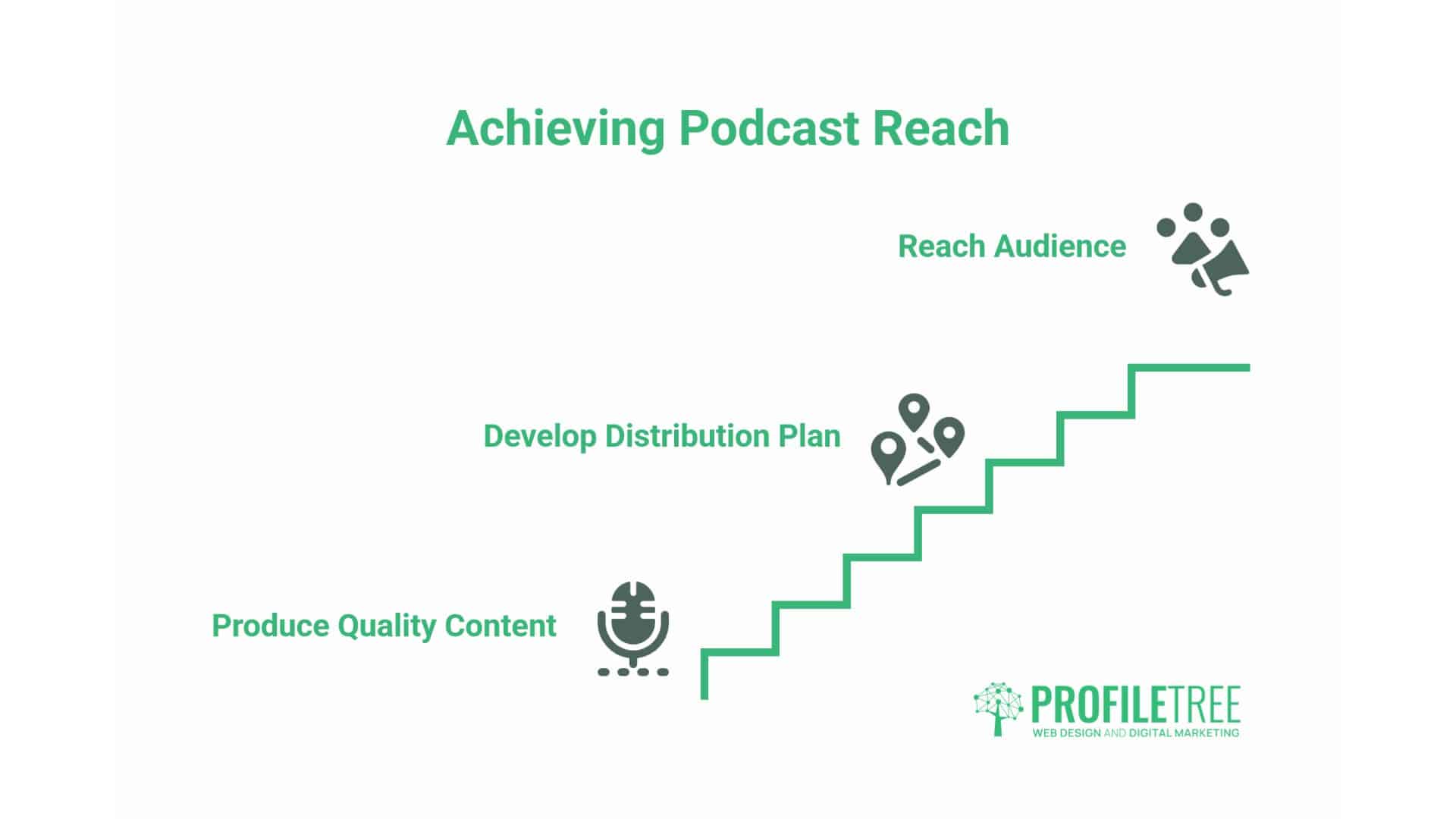
Producing a good episode is only half the job. Without a distribution plan, even well-made content struggles to reach the audience it was made for.
YouTube as a search engine, not just a platform
YouTube functions as a search engine for podcast content as much as a hosting platform. That means thumbnail design (clear subject faces, minimal text, strong contrast), title optimisation that balances search terms with a reason to click, full description text with timestamps, and chapter markers all affect discoverability. ProfileTree’s YouTube marketing service applies the same optimisation approach used for standalone video content to podcast episodes.
LinkedIn and native content
B2B podcasts tend to perform well on LinkedIn, where professional audiences are already looking for sector insights. Native video uploads generally outperform links out to an external podcast page, since most social platforms deprioritise posts that send people away from the platform. Posting a short clip natively, with the full episode linked in the comments or bio rather than the post itself, tends to get more reach than a straight link share. This sits alongside social media marketing as an organic channel strategy, not paid promotion.
SEO for content that search engines can’t hear
Search engines can’t index audio directly, so supporting text carries the SEO weight: full transcripts, show notes written in line with standard SEO practices (clear headings, natural keyword use, internal linking), and schema markup for podcast episode data. ProfileTree’s SEO services treat podcast show notes the same way as any other page: as content that needs to answer a specific search query, not just summarise an episode.
Website Infrastructure for Podcast Content
A podcast needs a home beyond the hosting platform itself. A dedicated section or subsite gives a business an owned channel for discovery and lead generation, independent of any single platform’s algorithm.
A well-built podcast section typically includes an episode archive with search functionality, individual episode pages with an embedded player, show notes and transcript, a newsletter signup for episode notifications, and an about page explaining the show’s purpose, useful both for listeners and for potential guests deciding whether the show fits their own audience.
ProfileTree’s web development and WordPress development work covers exactly this kind of build: integrating a podcast section into a wider business site without it looking bolted on, backed by reliable WordPress hosting so episode pages load quickly regardless of file size. For a business starting from scratch, this is often better planned as part of a broader web design project rather than added later.
AI Tools for Podcast Production Efficiency
AI tools have genuinely reduced the time required for podcast production, particularly in transcription and editing.
Automated transcription tools can convert an hour-long episode to text in minutes rather than the hours manual transcription used to take, and that transcript then feeds directly into the blog posts, social content and show notes covered earlier. AI editing tools can flag filler words and long pauses for removal, speeding up the technical editing pass without replacing editorial judgement on what actually makes the cut. Speech enhancement tools can improve audio in post-production, too, though they don’t fully substitute for proper acoustic treatment and microphone technique at the recording stage.
For a business deciding which of these tools to adopt and how to build them into a working process, this is the kind of practical decision ProfileTree’s AI training and implementation service is built around: choosing tools that fit an existing workflow rather than adding software for its own sake.
Measuring What Matters: From Downloads to Business Outcomes
Vanity metrics (download counts, subscriber growth) are easy to track and easy to misread. For a B2B show, a smaller number of qualified listeners is usually worth more than a larger, undifferentiated one.
| Consumer podcast | B2B/SME podcast | |
|---|---|---|
| Primary success metric | Download volume, ad revenue | Lead quality, brand recognition |
| Ideal audience size | As large as possible | Defined and relevant, often small |
| Monetisation route | Sponsorship, advertising | Indirect, through sales and trust |
| Key risk | Low reach | Reach without relevance |
Beyond raw downloads, useful engagement indicators include website traffic from podcast links or descriptions, email signups generated by podcast calls to action, and social engagement with clips. The commercial layer above that connects specific episodes to enquiries, tracks whether prospects who’ve listened move through the sales process any faster, and monitors branded search volume for the company name after a podcast launch, since an increase there often reflects growing recognition even when it doesn’t show up directly in podcast analytics.
“The podcast landscape has shifted from quantity to quality,” notes Ciaran Connolly, founder of ProfileTree. “Businesses that succeed understand that podcast production is a strategic investment, not just content creation. It requires the same rigour as any other marketing channel: clear objectives, audience research, and measurable outcomes.”
Podcast Growth Marketing: Building It Into a Wider Strategy
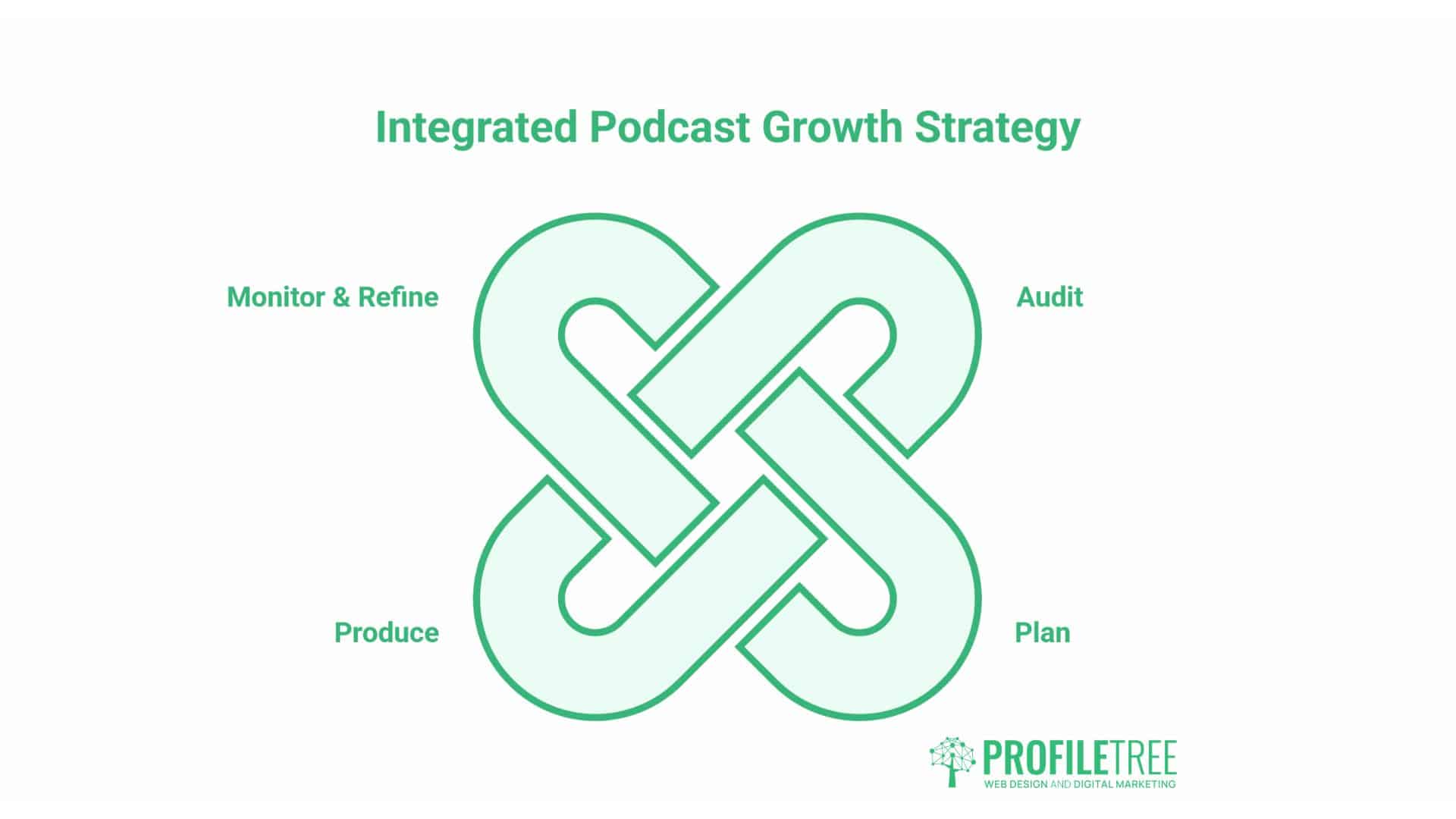
Podcast growth marketing works best as one part of a connected plan rather than a standalone project. That typically means fitting podcast activity into an existing audit, plan, deliver, and monitor-and-refine cycle: auditing what content already exists and where a podcast fits, planning episode themes against genuine audience questions, producing and distributing episodes consistently, and reviewing performance against the business metrics above rather than podcast analytics in isolation.
This is where digital marketing strategy work overlaps directly with podcast planning, and where a business new to podcasting, or to structured digital marketing generally, may benefit from training in how podcast content should feed the rest of a content calendar rather than sit apart from it.
Guest strategy deserves a specific mention here. Featuring guests who have their own engaged following and agreeing upfront on how each side will promote the episode extends reach well beyond a show’s existing audience. Cross-promotion with other, complementary shows in the same sector works on the same principle.
Where This Leaves Your Podcast Growth Plan
UK podcast listening is growing steadily rather than exploding, and that’s actually a reasonable backdrop for an SME weighing up whether to start one. There’s no need to compete with global consumer shows for downloads. The realistic goal is a well-produced, consistently published show that reaches a specific, relevant audience and feeds into the rest of a business’s content and marketing activity.
The decisions that matter most are the practical ones: whether to record in-house or bring in professional production, whether video is worth the added cost from day one, how episodes get distributed once they’re made, and how success gets measured against business outcomes rather than podcast-specific vanity metrics. Getting those right matters more than any growth statistic on its own.
FAQs
How long should business podcast episodes be?
20 to 45 minutes generally works best. Interviews tend to run 30 to 45 minutes, solo commentary works better shorter, around 15 to 25 minutes. Test length against completion rates rather than fixing it up front.
What equipment do you need to start a business podcast?
A USB microphone (£150 to £300), headphones and free recording software will get you started. For a more professional setup, add an XLR microphone, an audio interface and video gear. Outsourcing to a video production team is often a better value than buying and learning equipment from scratch.
How often should a business publish new episodes?
Consistency matters more than frequency. Weekly suits businesses with dedicated resources, fortnightly balances podcasting against other priorities, and monthly maintains a presence but slows growth. Irregular publishing does more damage than a slower, steady schedule.
Should a UK business podcast use video?
Video is nearly essential for YouTube and social discovery, but it adds cost and complexity. Start audio-only to test the format, then add video once quality and consistency are established, or begin with a simple setup and upgrade over time.