
Powerful Digital Marketing Tools to Elevate Your Business
Table of Contents
Powerful digital marketing tools have become a fundamental infrastructure for business growth. For UK companies seeking to compete effectively online, choosing the right platforms can determine whether your marketing efforts drive measurable results or simply consume budget. This guide examines the powerful digital marketing tools and platforms that matter most, drawing from ProfileTree’s experience implementing these solutions for businesses across Northern Ireland, Ireland, and the UK.
The digital marketing tools landscape offers hundreds of options across categories from SEO and analytics to social media management and email automation. Rather than overwhelming you with exhaustive lists, we focus on powerful digital marketing tools that deliver proven results for business growth, with particular attention to how they integrate into comprehensive digital strategies.
Why Digital Marketing Tools Matter for Business Growth
The right digital marketing tools are force multipliers for your team’s efforts. They automate repetitive tasks, provide data-driven insights, and enable sophisticated campaigns that would be impossible to execute manually. For businesses operating in competitive UK markets, these capabilities often determine whether you gain market share or fall behind competitors who have invested in their digital infrastructure.
Digital marketing tools and platforms address several critical business needs. They help you understand customer behaviour through analytics, reach your audience through multiple channels, and measure the return on your marketing investment. More importantly, they free your team to focus on strategy and creative work rather than manual execution.
Three factors make digital marketing tools particularly valuable. First, they scale with your business. A platform that works for reaching 1,000 customers can typically handle 10,000 or 100,000 with minimal additional effort. Second, they provide measurable results. Unlike traditional marketing, digital tools precisely track what works and what doesn’t. Third, they facilitate testing and optimisation. You can experiment with different approaches and quickly identify the most effective tactics.
“The businesses that grow fastest are those that treat digital marketing tools as strategic assets, not just software purchases,” notes Ciaran Connolly, Director at ProfileTree. “When you integrate tools properly and use data to guide decisions, you create a competitive advantage that compounds over time.”
For UK businesses, digital marketing tools help address unique challenges, including regional targeting across England, Scotland, Wales, and Northern Ireland, compliance with UK data protection requirements, and integration with local payment systems and business infrastructure.
SEO and Analytics: Digital Marketing Tools for Visibility
Search engine optimisation remains one of the highest-ROI activities for business growth. The digital marketing tools in this category help you understand what customers search for, optimise your content to rank well, and track your visibility in search results.
Core SEO Platforms
SEMrush is one of the most comprehensive SEO platforms available. It provides keyword research, competitive analysis, site auditing, and rank tracking in one interface. For UK businesses, SEMrush offers location-specific data that helps them target customers in Belfast, Manchester, London, or other specific markets. The platform excels at identifying content opportunities and technical SEO issues that might hold your site back.
The keyword research features in SEMrush help you discover what terms your customers use. Rather than guessing, you can see search volumes, competition levels, and related keywords that might offer easier paths to visibility. The competitive analysis tools reveal which keywords your competitors rank for and identify gaps in their strategy that you can exploit.
Ahrefs provides similar functionality with robust backlink analysis. With its extensive database, understanding your link profile and identifying opportunities for high-quality backlinks becomes straightforward. The platform also offers excellent content research features that help identify topics with traffic potential.
Ubersuggest serves as a more accessible entry point for businesses new to SEO. Created by Neil Patel, it offers keyword suggestions, basic site audits, and rank tracking at lower price points than enterprise platforms. While it lacks advanced features, Ubersuggest provides sufficient functionality for small to medium businesses building their SEO foundation. The platform’s keyword database helps identify opportunities, and the basic site audit flags technical issues that harm your rankings.
Ubersuggest integrates well with the platform for businesses managing WordPress sites and provides actionable recommendations. Upload your file to Ubersuggest for site audits that identify specific pages needing attention, broken links, and optimisation opportunities.
Analytics and Tracking Tools
Google Analytics 4 represents the current standard for website analytics. This free platform tracks how visitors find your site, what they do once they arrive, and where they exit. Understanding these patterns helps identify which marketing channels deliver results and which pages convert visitors into customers.
The shift from Universal Analytics to GA4 brought more sophisticated machine learning capabilities and better cross-device tracking. GA4 provides unified monitoring showing the complete customer journey for businesses operating websites and mobile apps. The platform requires configuration to capture meaningful data, but properly implemented, it reveals precisely which digital marketing efforts drive business growth.
Google Search Console complements Analytics by showing how your site performs in Google search results. It reveals which queries bring visitors, your average position for different keywords, and technical issues that might prevent Google from properly indexing your content. Search Console data often reveals opportunities that aren’t obvious from Analytics alone.
Hotjar adds qualitative data to your analytics through heatmaps, session recordings, and feedback polls. Watching real users navigate your site often reveals friction points that pure analytics miss. Heatmaps show where people click, how far they scroll, and which elements attract attention. This information guides website improvements that increase conversion rates.
Tracking and Measurement Tools
Digital marketing tracking tools help attribute results to specific campaigns and channels. Google Tag Manager simplifies the process of adding tracking codes to your site without requiring developer assistance for each change. You can deploy analytics, advertising pixels, and custom tracking through a single interface.
Proper tracking becomes essential for businesses running multiple marketing campaigns across channels. Tag Manager enables sophisticated tracking setups that show how many visitors came from each source, how they behaved, and whether they converted. This data guides budget allocation towards channels and campaigns that drive business growth.
UTM parameters provide campaign-specific tracking within your analytics. Adding simple URL tags lets you differentiate traffic from email campaigns, social media posts, or specific advertisements. This granular data reveals which specific initiatives deliver results rather than just which channels work broadly.
Optimisation and Testing Tools
Optimizely and VWO (Visual Website Optimiser) enable A/B testing that improves conversion rates. Rather than guessing which page design or copy works better, you can test variations with real visitors and let data determine the winner—even minor improvements in conversion rate compound over time to impact business growth significantly.
These platforms make testing accessible to businesses without technical resources. You can modify page elements through visual editors, set up tests, and receive statistical significance calculations that tell you when you have a clear winner. The insights gained from testing often apply beyond the specific pages tested, improving your understanding of what resonates with customers.
Social Media Management: Digital Marketing Tools for Engagement
Social media platforms offer direct access to your audience, but managing multiple channels efficiently requires dedicated digital marketing tools. These platforms help schedule content, engage with followers, and measure social media performance.
Scheduling and Publishing Tools
Buffer provides straightforward social media scheduling across multiple platforms. Its clean interface simplifies planning content calendars, and the queue system automatically distributes posts at optimal times. For businesses maintaining a consistent social media presence without dedicated staff, Buffer eliminates the need to post content throughout the day manually.
The platform’s analytics show which posts perform best, helping refine your content strategy. Browser extensions make sharing relevant content quick and easy. Buffer’s free plan covers basic needs, while paid plans add team collaboration features and more detailed analytics.
Hootsuite offers more comprehensive social media management, including monitoring features that track brand mentions across platforms. The ability to manage customer service conversations alongside scheduled content makes Hootsuite particularly valuable for businesses where social media serves both marketing and support functions.
Hootsuite’s team collaboration features enable multiple staff members to manage social accounts with appropriate permissions and approval workflows. For larger organisations or agencies managing client accounts, these capabilities prevent errors and maintain brand consistency.
Analytics and Listening Tools
Understanding what your audience discusses and how they respond to your content requires monitoring beyond basic platform analytics. Sprout Social provides sophisticated social listening that tracks brand mentions, competitor activity, and industry conversations. These insights inform content strategy and identify opportunities to engage with potential customers.
Social media analytics from these platforms reveal patterns in what content resonates. Rather than relying on vanity metrics like follower counts, focus on engagement rates, click-throughs, and conversions that indicate genuine business impact. The reporting features help demonstrate social media ROI to stakeholders who might question the value of these channels.
Content Creation for Social Platforms
While not strictly a social media management tool, Canva deserves mention for its role in creating social content. The platform’s templates and design tools enable businesses without graphic designers to produce professional-looking social media graphics, presentations, and marketing materials.
Canva’s free version provides substantial functionality, while paid plans add brand kits that maintain visual consistency across all your marketing materials. The platform’s integration with social media management tools streamlines the workflow from creation to publication.
Content Marketing and Email: Digital Marketing Tools for Nurturing
Email marketing consistently delivers the highest ROI of any digital marketing channel. Combined with content marketing, these tools help nurture prospects into customers and customers into advocates.
Email Marketing Platforms
Mailchimp established itself as the leading email platform for small to medium businesses. Its user-friendly interface makes creating email campaigns straightforward, while automation features enable sophisticated nurture sequences that convert leads over time. Mailchimp’s templates provide starting points for various email types, from newsletters to promotional campaigns.
The platform’s integration with e-commerce platforms like Shopify enables abandoned cart emails and purchase follow-ups that drive additional revenue. Mailchimp’s analytics show open rates, click rates, and conversions, helping refine your email strategy based on what works with your audience.
ActiveCampaign provides advanced features, including complex automation workflows, CRM functionality, and more detailed tagging and segmentation for businesses managing significant email volumes or requiring more sophisticated automation. The platform’s machine learning capabilities predict subscribers’ best send times and subject lines.
HubSpot combines email marketing with comprehensive CRM and marketing automation in an integrated platform. While more expensive than dedicated email tools, HubSpot’s all-in-one approach eliminates the need to connect separate systems. For businesses committed to inbound marketing methodology, HubSpot provides the infrastructure to execute sophisticated campaigns that guide prospects through defined journeys.
Content Management and Creation
WordPress powers more than 40% of websites globally and remains the platform for content marketing. Its flexibility, extensive plugin ecosystem, and SEO-friendly architecture make it ideal for businesses building organic traffic through content. ProfileTree builds most client websites on WordPress specifically because it balances ease of use with powerful functionality.
WordPress’s block editor makes creating rich content layouts accessible to non-technical users. Plugins extend functionality to cover nearly any requirement from e-commerce to membership sites. The platform’s open-source nature means you own your content and aren’t locked into proprietary systems.
For content quality, Grammarly catches errors and suggests improvements that make your writing clearer and more professional. While AI cannot replace human judgment, Grammarly’s suggestions often identify issues that pass manual proofreading. The browser extension works across most web applications, catching errors in emails, social posts, and other business communication.
Digital Marketing Platforms and Integration
Some businesses prefer integrated digital marketing platforms that combine multiple capabilities rather than managing separate tools for each function. These platforms offer efficiency benefits but require more significant investment and implementation effort.
HubSpot represents the most comprehensive option, combining CRM, email marketing, marketing automation, social media management, and content management in one system. For businesses committed to inbound methodology, HubSpot provides seamless workflows from attracting visitors to closing customers.
Salesforce serves larger enterprises requiring extensive customisation and integration with existing business systems. While powerful, Salesforce requires significant implementation resources and ongoing administration. It works best for organisations with dedicated marketing operations teams.
These digital marketing management tools reduce the friction of connecting separate systems but come with trade-offs. They typically cost more than best-of-breed point solutions and may not offer the cutting-edge features of specialised platforms. The decision between integrated platforms and specialised tools depends on your team’s size, technical capabilities, and specific requirements.
Advanced Digital Marketing Tools: AI and Automation
Artificial intelligence has moved from experimental to essential in digital marketing. These tools analyse data, generate content, and optimise campaigns with capabilities that augment human decision-making.
AI-Powered Tools
ChatGPT and similar language models assist with content creation, customer service, and data analysis. While these tools shouldn’t replace human expertise, they accelerate research, draft initial content, and suggest approaches you might not have considered. ProfileTree uses AI tools to enhance our work for clients, particularly in content ideation and initial drafts that our team refines.
AI tools excel at analysing large datasets to identify patterns humans might miss. They can more precisely segment audiences, predict customer behaviour, and personalise content at scale. However, they require human oversight to produce results that align with brand voice and business objectives.
Persado uses AI to generate marketing copy optimised for emotional response. The platform analyses which language drives action and generates variations for testing. While expensive for most small businesses, it demonstrates AI’s potential to improve marketing effectiveness through data-driven language selection.
Marketing Automation Platforms
Marketing automation tools execute sophisticated campaigns that respond to individual user behaviour. When someone downloads a white paper, automation can trigger educational emails that gradually introduce your products. When they visit pricing pages, automation can alert sales teams to reach out.
Marketo serves enterprise clients requiring complex automation workflows and extensive integration with sales systems. The platform enables orchestrating campaigns across email, web, social, and other channels based on detailed customer profiles and behavioural triggers.
ActiveCampaign or Drip provides automation capabilities for smaller businesses without enterprise complexity and cost. These platforms enable building sophisticated nurture sequences that convert leads over time through relevant, timely communication.
Automation works best when combining behavioural data from multiple sources. Integrating your CRM, email platform, website analytics, and other tools creates a complete picture of each prospect’s journey. This data enables personalisation that increases relevance and improves conversion rates.
Choosing Digital Marketing Tools for Your Business
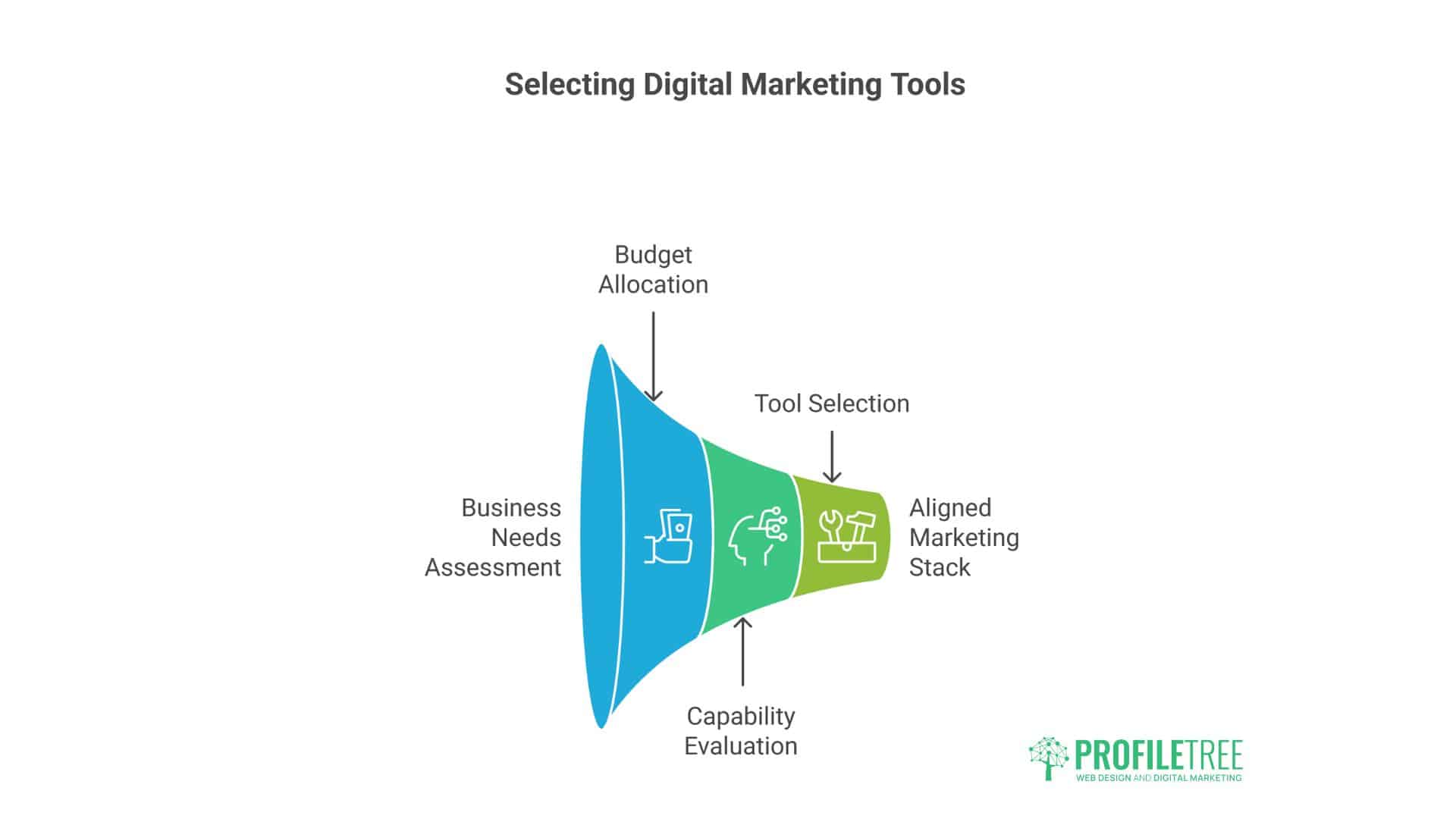
With hundreds of digital marketing tools and platforms available, selecting the right stack for your business requires clear thinking about priorities, budget, and capabilities.
Assess Your Current Situation
Start by auditing what you already have. Many businesses pay for tools they don’t use or duplicate functionality across multiple platforms. Identify gaps where you lack the capabilities needed to execute your strategy. For example, if content marketing drives your business but you have no SEO tools, that gap deserves priority.
Consider your team’s capabilities. Sophisticated tools require learning and ongoing management. A powerful platform that no one knows how to use delivers no value. Sometimes, simpler tools your team will adopt provide better results than enterprise platforms with features you’ll never access.
Budget matters, but shouldn’t drive decisions alone. The cheapest option often costs more in the long run due to limitations constraining growth, poor support, or the eventual need to migrate to better tools. Consider the total cost of ownership, including implementation, training, ongoing management, and subscription fees.
Integration and Data Flow
Digital marketing tools work best when they communicate with each other. Your CRM should connect to your email platform, your website analytics should feed into your reporting dashboard, and your social media management should align with your content calendar.
APIs and native integrations enable data flow between platforms. When evaluating tools, consider how they’ll connect to your existing systems. Tools that don’t integrate create data silos that prevent you from seeing the complete picture of your marketing performance.
Platforms like Zapier bridge gaps between tools without native integrations. These automation platforms enable workflows that trigger actions in one tool based on events in another. While not as elegant as native integration, Zapier and similar services make practically any combination of tools work together.
Start With Core Capabilities
Rather than trying to implement a complete marketing technology stack immediately, focus on core capabilities that address your most pressing needs. For most businesses, that means:
- Website analytics to understand visitor behaviour
- SEO tools to improve search visibility
- Email marketing to nurture leads
- Social media management to maintain a consistent presence
- CRM to track customer relationships
Add additional capabilities as you prove value from these foundations. Businesses that try to implement too many tools simultaneously often use none of them effectively. Master the basics before expanding to advanced tools.
Consider UK-Specific Requirements
UK businesses must comply with data protection regulations, including GDPR and the UK’s Data Protection Act. Your digital marketing tools should support this compliance through features like:
- Consent management for email subscribers
- Data access and deletion capabilities
- Audit trails showing data usage
- Data processing agreements with vendors
Geographic targeting capabilities matter for businesses serving specific UK regions. Look for tools that enable targeting by postcode, city, or region rather than just country-level options. This precision helps if you serve customers in specific areas like Northern Ireland or Scotland rather than the entire UK market.
Payment integration with UK banking systems and support for British currency should be standard, but they are sometimes overlooked with US-based platforms. Verify that the tools you consider handle UK specifics properly rather than assuming you’ll work around limitations.
Professional Implementation Support
Digital marketing tools deliver value proportional to how well they’re implemented. Most platforms offer basic setup but require configuration to align with your specific business model and processes. ProfileTree helps clients implement digital marketing tools as part of comprehensive strategies that drive business growth.
Professional implementation addresses several common failure points. We configure tools to capture the correct data rather than overwhelming you with irrelevant metrics. We establish workflows that fit your team’s processes rather than forcing you to adapt to generic best practices. We integrate tools properly so data flows where needed without manual intervention.
Training ensures your team can actually use the tools you invest in. We provide training tailored to your staff’s current capabilities and the specific features relevant to their roles. This focused approach builds confidence and adoption rather than overwhelming people with everything a platform can do.
Ongoing optimisation improves results over time. The initial setup of digital marketing tools provides a foundation, but refinement based on data and changing business needs delivers compounding benefits. We help clients continuously improve their use of marketing tools through regular reviews and recommendations.
Measuring Digital Marketing Tool Performance
Investing in digital marketing tools makes sense only if they deliver results. Establish clear metrics that tie tool usage to business outcomes.
Define Success Metrics
Different tools serve different purposes and therefore require different metrics. SEO tools should improve search rankings and organic traffic. Email platforms should increase open rates and conversions. Social media management should boost engagement and site traffic.
Connect these intermediate metrics to business outcomes. Traffic and engagement matter only if they lead to leads, customers, or revenue. Track the complete chain from tool output to business result. This might mean measuring not just email open rates but how many opens lead to website visits, how many visits result in form submissions, and how many submissions convert customers.
Track ROI
Calculate return on investment for major tool expenses. Compare the tools cost plus the time required to use them against the value they generate. This analysis often reveals that expensive enterprise platforms deliver less value than simpler tools used effectively, or that spending more on a premium platform pays for itself through time savings and better results.
ROI calculations should include indirect benefits. If a tool frees your team from manual work, what value do they create with that time instead? If better data enables more confident decisions, what’s the value of reduced risk? If automation enables personalisation, which would be impossible manually, what’s the value of improved customer experience?
Regular Audits
Quarterly audits of your digital marketing tools identify redundancy, underutilised capabilities, and opportunities for improvement. This review might reveal:
- Overlapping tools that could be consolidated
- Features you’re paying for but not using
- Missing integrations that would improve efficiency
- New requirements from business changes
- Better alternatives that have emerged
Audits prevent the gradual accumulation of tools that seemed necessary when added, but no longer serve a purpose. They also identify opportunities to expand the usage of tools you already have before purchasing new ones.
Future-Proofing Your Digital Marketing Stack
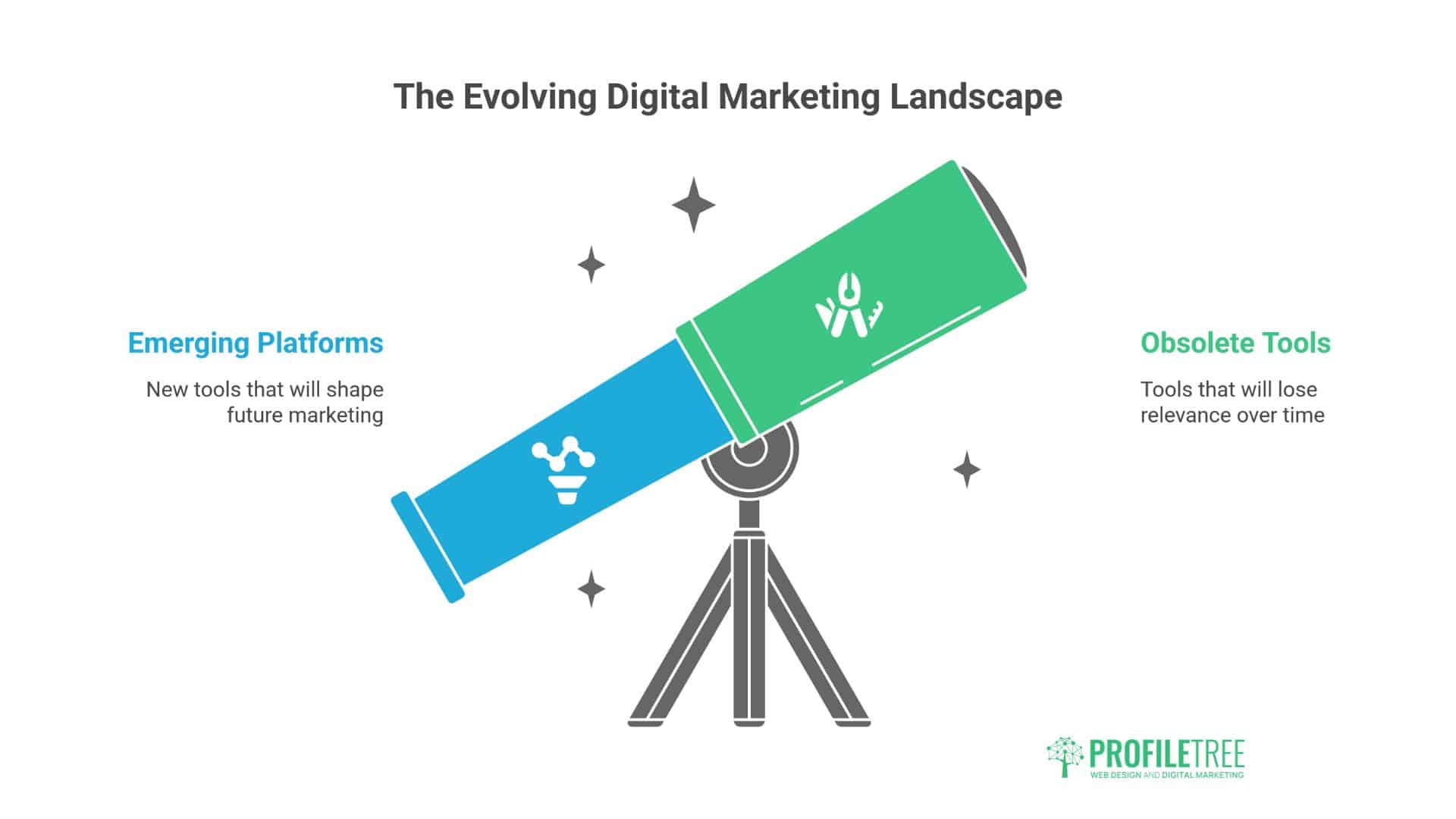
Technology changes constantly. Five years from now, the digital marketing tools landscape will include platforms that don’t exist today and exclude some currently popular tools that will have fallen behind.
Emerging Technologies
Several technologies will likely transform digital marketing over the coming years. Voice search influences SEO strategy and will grow in importance as smart speakers and voice assistants become ubiquitous. Tools that help optimise for voice queries and appear in voice search results will become essential.
Augmented reality offers new ways to showcase products and engage customers. While currently limited primarily to large brands, AR tools will become accessible to businesses of all sizes as the technology matures and platforms emerge to simplify creation and distribution.
Blockchain technology may transform advertising transparency and fraud prevention. Early applications focus on verifying ad delivery and preventing click fraud, but broader applications could reshape how businesses buy advertising and measure results.
Building Flexible Foundations
Rather than betting on specific technologies, build flexible foundations that adapt to change. Prioritise tools with strong APIs that enable integration with new platforms as they emerge. Choose platforms with active development and regular updates rather than stagnant tools that will fall behind.
Develop internal capabilities that transcend specific tools. Understanding marketing principles, data analysis, and strategic thinking matters more than mastering particular platforms. When your team thinks strategically, they can learn new tools and adapt to technological changes.
Staying Informed
The digital marketing tools landscape evolves too quickly for any guide to remain current indefinitely. Stay informed through:
- Industry publications covering martech and digital marketing
- Tool vendor blogs and release notes
- Communities where marketers share experiences
- Testing new platforms as they emerge
ProfileTree continuously evaluates new tools and approaches to serve clients effectively. Our team tests emerging platforms, attends industry conferences, and maintains relationships with tool vendors to understand where digital marketing technology is heading.
Getting Started With Digital Marketing Tools
The path from reading about digital marketing tools to implementing them and driving business growth requires deliberate action. Start with clear objectives for what you want to achieve. “Improve our digital marketing” is too vague. Increase organic traffic by 50% over six months, or “Generate 100 qualified leads per month from email marketing”, provides direction.
Research tools that address your specific objectives. Read reviews from businesses like yours rather than relying solely on vendor marketing. Trial periods let you evaluate whether tools fit your workflow and deliver promised capabilities.
Create implementation plans that include setup, training, process documentation, and regular reviews. Most tools fail not because they lack functionality but because businesses don’t adopt them properly.
Build gradually rather than trying to implement everything at once. Master core capabilities before expanding to advanced features or additional tools. This measured approach builds confidence and creates wins that justify further investment.
Consider working with experts who have implemented these tools many times. We’ve seen what works and what doesn’t across hundreds of implementations, learning that saves you time and prevents costly mistakes.
Conclusion: Building Your Powerful Digital Marketing Tools
Digital marketing tools and platforms provide the infrastructure for business growth in competitive markets. The right combination of SEO tools, analytics platforms, social media management, email marketing, and automation enables you to reach customers efficiently, measure results accurately, and optimise continuously.
Success comes not from buying tools but from implementing them correctly and using data to guide decisions. Start with core capabilities that address your most pressing needs. Build proficiency before expanding to advanced features or additional platforms. Connect tools so data flows smoothly, and you can see the complete picture of your marketing performance.
UK businesses face unique requirements, including data protection compliance, regional targeting, and integration with local systems. Choose tools that support these needs rather than forcing workarounds.
The digital marketing tools landscape will continue evolving. Build flexible foundations and develop strategic thinking that transcends specific platforms. Focus on business outcomes rather than getting distracted by the latest shiny tool.
ProfileTree provides web design, web development, SEO, content marketing, video production, animation, AI implementation, and digital training for businesses across Northern Ireland, Ireland, and the UK. We help clients select and implement digital marketing tools as part of comprehensive strategies that drive measurable business growth. If you need guidance building your digital marketing technology stack or want to improve results from tools you already have, get in touch to discuss how we can help.