
Using X for Customer Engagement: A UK & Ireland Guide
Table of Contents
Reach on X has dropped for most business accounts, and the old habit of broadcasting polished posts no longer earns replies. For UK and Ireland brands, the platform now rewards conversation: fast answers, a recognisable voice, and genuine presence inside communities rather than one more scheduled tweet.
This guide on X for customer engagement is built for social media managers and business owners who have watched their engagement slide and want a practical reset. It covers how X’s algorithm and its AI assistant Grok read brand activity, why a localised approach beats imported US tactics, and the day-to-day habits that turn followers into customers.
You will find sections on the new engagement rules, building a regional strategy, real-time tactics, community-led retention, GDPR-safe customer service, and the metrics worth tracking. Each one ends with a step you can apply this week.
The New Rules of X Engagement: Algorithm and Grok
Engagement on X is now a ranking signal inside the platform itself, not just a vanity count. The algorithm weights replies, reposts and saves more heavily than passive likes, and X’s AI assistant, Grok, increasingly summarises brand activity when users ask it questions. Understanding both systems shapes how to use X for business in 2026.
How the Algorithm Reads Brand Activity
Conversations outrank announcements. A reply that sparks a thread tells the system your account produces discussion, which lifts your later posts in the “For You” feed. Quiet broadcasting does the opposite. The mechanism is straightforward: every reply, repost and saved post adds a small positive weight to your account’s standing, while posts that land flat pull it down. If you manage several channels at once, a structured social media marketing approach keeps the workload realistic so replies do not slip during busy weeks.
One practical consequence: posting less but replying more often beats the reverse. An account that publishes twice a week and answers thirty mentions will usually outperform one that publishes daily and ignores its replies.
That shift from posting to responding is the single biggest change, and it leads directly into how Grok handles the same signals.
The Grok Factor for Discovery
Grok indexes high-quality brand interactions and can recommend accounts inside its answers. When your team replies with clear, accurate information, you train that AI to treat your brand as a credible source on your topic. Thin or bot-like activity has the reverse effect and can quietly bury you. The shift is worth grasping: a user asking Grok for “good homeware brands in Belfast” may be shown accounts that consistently answer related questions well, regardless of follower count.
This rewards depth over reach. A handful of genuinely useful threads on a narrow topic does more for AI visibility than a viral post about something off-brand, because relevance and accuracy are what the model learns to trust.
Because Grok favours substance, the quality of each exchange matters more than the volume, which is where measurement comes in.
Why Likes No Longer Carry the Load
A like signals approval but rarely depth. Reposts and replies show the platform that content moved someone enough to act, so a smaller number of meaningful interactions can outperform a wall of likes. Track which post types earn replies, then make more of those. The data behind that pattern echoes wider social media sales research across UK accounts: action, not approval, predicts revenue. Build a simple weekly view of replies and reposts per post type, and let it steer the content calendar rather than guesswork.
Bridging the Atlantic: Why UK Brands Need a Localised X Strategy
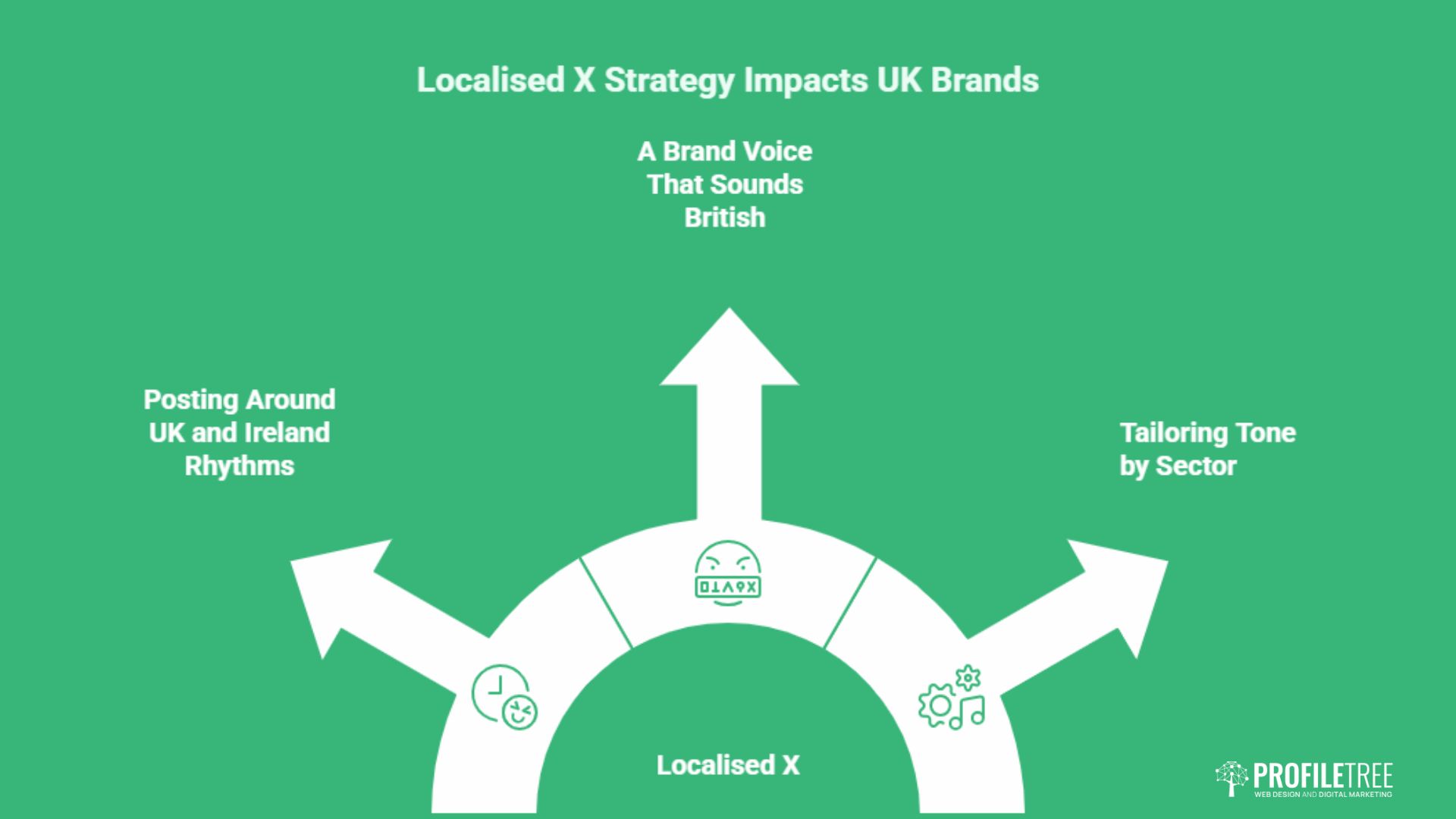
Most high-ranking X guides lean on US consumer giants whose budgets and audiences look nothing like a Belfast retailer or a Dublin software firm. A localised strategy fits British and Irish posting rhythms, humour and regulation, and that fit is where smaller brands win attention.
Posting Around UK and Ireland Rhythms
Audiences here are most active during the morning commute, lunch and the early evening wind-down, all in GMT or BST rather than US time zones. Scheduling replies and posts around those windows lifts visibility without spending more. Sector timing varies too, a pattern clear in proven finance social media work, where weekday business hours outperform weekend posting. Check your own analytics for the exact peaks rather than trusting a generic chart, since a B2B account and a consumer brand rarely share the same rhythm.
One overlooked detail: bank holidays and regional events shift these patterns. A post timed for a normal Monday will underperform on a holiday Monday, so a quick glance at the calendar saves wasted effort.
Timing only works once the voice fits the market, which is the harder part to copy.
A Brand Voice That Sounds British
UK and Irish audiences respond to dry wit and a touch of self-deprecation in ways US audiences often do not. Several British challenger brands have built loyal followings on a personality that feels human and a little cheeky rather than corporate. Borrow the principle, not the exact jokes, and keep it consistent.
That consistent persona then needs sector context to land properly.
Tailoring Tone by Sector
A wellness studio and a fintech firm cannot share the same register. Regulated sectors keep replies precise and compliant, while lifestyle brands can be looser and warmer. That split shapes the proven wellness brand strategies that match tone to audience expectation rather than a generic template. The test is simple: would your customer recognise the account as yours with the logo removed? If the answer is no, the voice is too generic to build loyalty.
With timing and tone settled, the daily tactics decide whether engagement actually grows.
High-Impact Strategies for Real-Time Engagement
Real-time engagement is the practical core of using X for customer engagement. The brands that grow treat the platform as a live conversation channel, not a press-release feed, and a handful of repeatable habits drive most of the results.
Mastering the Brand Reply
A sharp, timely reply often earns more reach than an original post. Answer quickly, keep the tone human, and resolve the question in public, where it helps others. Speed matters: a reply within the hour reads as attentive, while a next-day answer reads as absent. Set up a simple monitoring routine so mentions never sit unseen, and give whoever runs the account permission to answer without a layer of sign-off for routine questions.
The replies that travel furthest tend to be helpful rather than clever. A clear answer to a real question gets saved and shared; a forced joke usually does not.
Replies pull people in, and a short video keeps them watching.
Visual Storytelling With Short Video
Vertical clips and quick demos earn disproportionate placement in the feed, and they travel well across platforms. A fifteen-second product walkthrough or a behind-the-scenes moment gives followers a reason to pause. The wider move toward short-form video applies squarely to X, where native video tends to hold attention longer than a still image or plain link. Keep production light: a clear phone recording with captions usually beats an over-polished advert that reads as a paid campaign.
Captions matter more than they seem. Many users watch with sound off, so a clip that makes sense silently reaches a wider audience and earns more replies asking follow-up questions.
Video earns attention, but B2B brands engage on slightly different terms.
Engagement for B2B Brands
Is X effective for B2B customer engagement? Yes, when the focus shifts from selling to being useful. Answering technical questions, sharing a genuine result, and joining niche discussions position your brand as a peer. For Irish firms, the concentration of Dublin tech employers makes targeted, helpful replies especially worthwhile. B2B buyers research quietly, so the goal is to be visible and credible in the conversations they already follow, not to pitch into their mentions.
A practical move for B2B accounts is to follow and reply within a small set of relevant hashtags and industry voices, building recognition over weeks. By the time a prospect needs what you offer, your name is already familiar, which shortens the path to an enquiry.
Public replies build reach, but retention happens somewhere quieter.
Beyond the Feed: Using X Communities for Retention
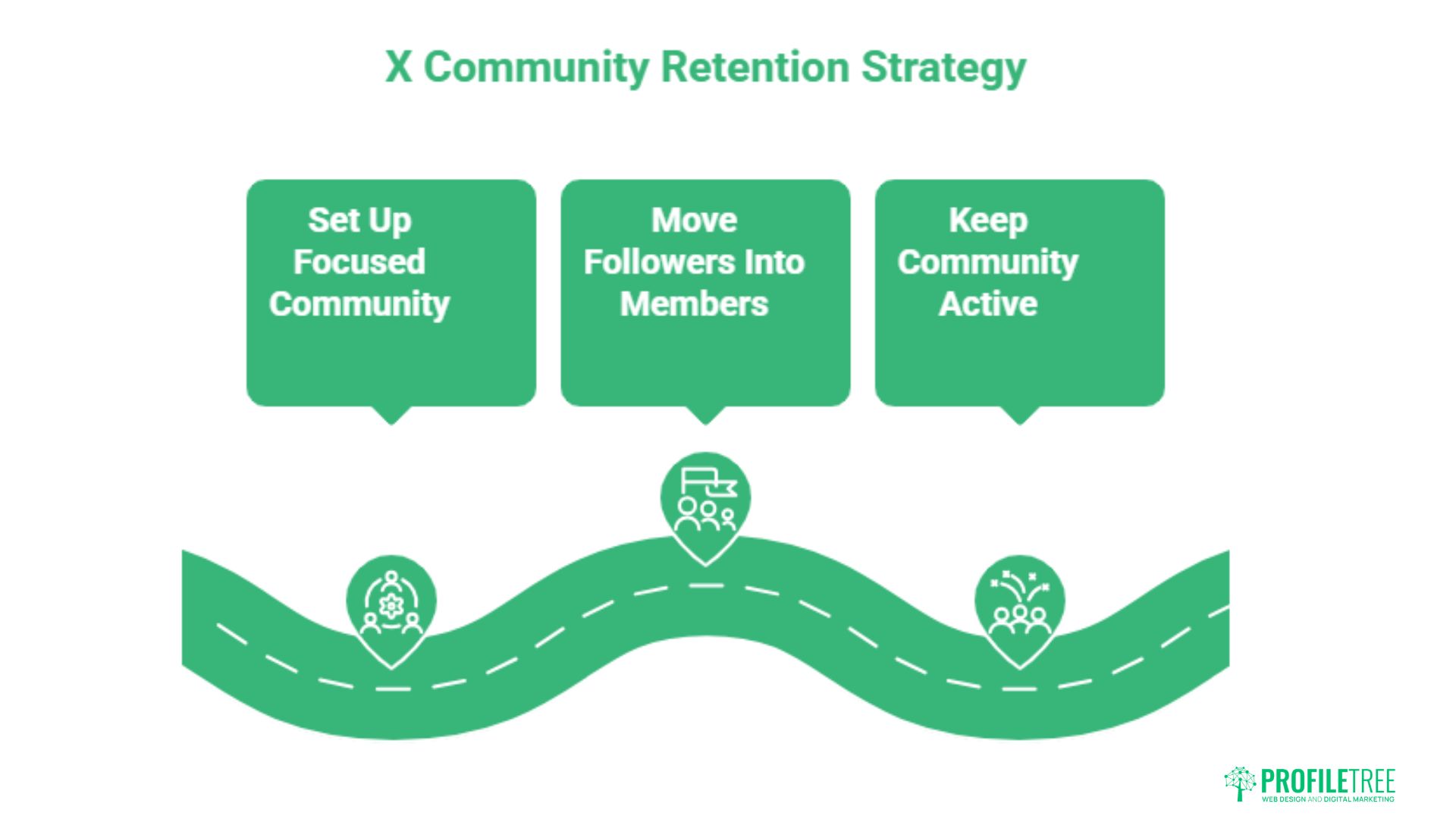
X Communities are the most underused retention tool on the platform. While competitors chase public reach, the closed and semi-closed community space is where casual followers become regulars, which answers a common question: how to create community in X that lasts.
Setting Up a Focused Community
Start narrow. A single, well-defined topic attracts people who genuinely care, and a small active group beats a large silent one. Set clear rules, seed the first discussions yourself, and welcome new members by name in the early weeks to set the tone. A private beta approach works well: invite twenty engaged followers first, let the culture form, then open the doors once the early members are reliably posting.
Resist the urge to grow fast. A community of fifty people who talk every week is worth more to retention than a thousand who joined and never returned.
Once it exists, the community needs a steady reason to return.
Moving Followers Into Members
Treat the community as the next step after a public reply, not a separate project. When you help someone in the feed, invite them in for a deeper conversation. That direct-to-community path turns one good interaction into ongoing contact and supports using X for collaboration between your team and your audience. The invitation should feel natural: a line like “there’s a small group discussing exactly this, you’d fit right in” works far better than a broadcast call to join.
Map the journey deliberately. A casual follower sees a helpful reply, joins a thread, accepts an invitation, and then becomes a regular voice in the community. Each step is small, but together they convert passing attention into a relationship that outlasts any single post.
Retention also depends on keeping the discussion alive without forcing it.
Keeping a Community Active
Post questions, not announcements. Ask members what they are working on, share early access to something useful, and respond inside the thread rather than from your main account. A community that hears only marketing goes quiet fast, so weigh the balance heavily toward genuine help. A useful rhythm is a regular weekly prompt that members come to expect, which gives the group a reason to check in even on slow weeks.
Spotlight members where you can. Sharing a member’s win or question, with their permission, signals that the community is about them rather than the brand, and that recognition keeps people posting.
Active communities generate customer conversations, and those need handling with care.
Customer Service, Metrics and Compliance
Customer service on X is public by default, which raises both opportunity and risk. Handled well, a visible resolution builds trust with everyone watching. Handled carelessly, it exposes data or escalates a complaint, so process and measurement matter as much as goodwill.
The Public-to-Private Move and GDPR
Acknowledge a complaint publicly and fast, then move the details into a direct message before any personal information is shared. Under UK GDPR, customer data must not sit in a public thread, so never request order numbers or contact details in the open. The Information Commissioner’s Office sets out how that data should be handled. A short public reply, such as “sorry to hear that, sending you a DM now”, reassures onlookers while keeping the sensitive part private.
Train anyone with account access on this single rule, because one careless public reply asking for an email address or address can become a data protection problem. A brief written process, agreed in advance, prevents most of these slips.
A clean process protects customers, and metrics tell you whether it works.
Metrics That Move the Needle
Reach and follower counts are flat without informing. Track engagement rate, reply speed, and the share of conversations that lead to a website visit or enquiry. A good engagement rate for UK brands sits in low single digits, so judge progress against your own trend rather than a US benchmark. Add one figure most teams ignore: how many enquiries or sales can be traced back to an X conversation, even loosely, since that is the number that justifies the time.
Review these monthly, not daily. Day-to-day swings are noise; the monthly trend tells you whether the strategy is working or quietly stalling.
Numbers guide the work, but knowing where X sits in your wider plan keeps it proportionate.
Fitting X Into a Wider Plan
X is one channel, not the whole strategy. It works best feeding a broader effort that includes content, email and search. A clear digital strategy stops the platform from eating up time it cannot repay, and structured digital training helps in-house teams run it confidently without external hand-holding. Used this way, an X conversation can start a relationship that an email sequence or a strong website then carries forward to a sale.
Ciaran Connolly, founder of ProfileTree, a Belfast-based digital agency, puts it plainly: “For most SMEs in Northern Ireland, the win on X is not going viral. It is being the brand that actually replies, in your own voice, within the hour.”
For a sense of the wider region these brands serve, Connolly Cove’s overview of the top cities in Northern Ireland is a useful read.
One UK SME example: an independent Northern Ireland homeware retailer shifted its X effort from daily product posts to answering customer questions within the hour and running a small Communities group for repeat buyers. Within a few months, replies and saved posts rose while raw follower growth stayed flat, and most enquiries now arrive through direct messages rather than the public feed.
Conclusion
The era of the viral tweet is over for most brands. Sustainable results on X come from fast, human replies, a voice that fits the UK and Ireland market, and communities that turn followers into regulars, all measured by engagement rather than reach. If you want help building that approach, ProfileTree’s social media marketing team can set the strategy and train your staff to run it. Talk to us about your next step.
FAQs
What is a good engagement rate on X for UK brands?
For most UK brands, an engagement rate in the low single digits is healthy. Judge yourself against your own trend over time rather than headline US figures, since audience size and sector both shift the baseline.
Is X Premium worth it for small businesses?
It can be, if you reply often. The reach boost mainly helps active accounts, so a business posting once a week sees little from it. Weigh the monthly cost against how much you genuinely use the platform.
How do I handle negative customer feedback on X?
Acknowledge it publicly and quickly, then move the detail into a direct message. Speed and visibility build trust, while keeping personal data out of the public thread protects the customer and your compliance.
Can I automate my X engagement?
Automate monitoring and scheduling, but keep a human in the loop for replies. Bot-like responses read as cold and can harm how the algorithm and Grok treat your account.
How do X Communities differ from Facebook Groups?
X Communities are more publicly discoverable and sit inside the same feed your audience already uses, while Facebook Groups are more private. That openness makes X Communities easier to grow but demands clearer moderation.