
Content Marketing Tools: A Vetted Stack for UK SMEs
Table of Contents
Most guides to content marketing tools list fifty products and leave you no closer to a decision. A small business in Northern Ireland, Ireland or the wider UK needs five or six content marketing tools that work together, fit a real budget, and handle personal data in a way that stands up to UK GDPR scrutiny. The rest is noise.
This guide covers the content marketing tools worth paying for in a UK context, the ones worth using free, and the ones that quietly cost more than their advertised price once currency conversion and VAT are added. Prices are given in the currency each vendor actually bills in, because several of the most widely recommended content marketing platforms do not bill in sterling at all. That single detail changes the real cost of a content marketing stack by more than most feature comparisons ever will.
Content Marketing Tools at a Glance
The table below compares the content marketing tools most commonly used by UK SME content teams, scored on the two things global listicles almost always skip: which currency you are billed in, and where your data sits.
| Tool | Primary use | Billing currency | Indicative cost | UK/EU data position |
| Google Search Console | Search research and monitoring | Free | Free | UK/EU processing available |
| Google Analytics 4 | Content performance | Free | Free | Requires active GDPR configuration |
| Canva | Visual content creation | GBP (UK site) | Free tier; Pro approx. £13/month monthly, cheaper annually | EU processing option; AI features US-processed by default |
| Grammarly | Editorial quality control | USD | Free tier; Business from approx. $15/user/month | US-hosted; DPA available |
| Buffer | Social scheduling | USD | Free tier; paid from approx. $6/channel/month | GDPR-compliant, EU processing |
| Mailchimp | Email content distribution | USD | Free tier (250 contacts); Essentials from approx. $13/month | EU processing option available |
| Semrush | SEO and content research | USD only | From approx. $139.95/month | US-hosted; DPA available |
| Ahrefs | Backlink and competitor research | USD | Free Webmaster Tools; paid tiers above | US-hosted; DPA available |
| Yoast SEO | On-page optimisation (WordPress) | EUR | Free tier; Premium paid annually | Runs on your own site |
Pricing was checked in August 2026 and moves frequently, sometimes twice in a single year. Treat every figure here as indicative and confirm on the vendor’s own pricing page before committing budget.
How These Content Marketing Tools Were Assessed
Three questions were applied to each platform, and they are worth reusing whenever you evaluate a new content marketing tool.
First, what is the true UK cost? A tool advertised at $139.95 is not a £100 tool. Add the card issuer’s foreign exchange margin, typically two to three per cent, and any VAT applied at the UK rate of twenty per cent. A non VAT-registered sole trader absorbs that VAT with no recovery, which makes the gap between listed price and real cost wider for the smallest businesses.
Second, where does the data go? Any content marketing platform that touches subscriber lists, form submissions or website analytics is processing personal data on your behalf.
Third, does it produce usable UK English? Several AI writing platforms default to American spelling and phrasing that then needs stripping out by hand, which cancels much of the time saved.
Why the Currency Question Matters More Than the Feature List
Two content marketing tools with near-identical features can differ by thirty per cent in annual cost purely through billing currency, VAT treatment and payment method. For a business spending £2,000 a year on software, that is roughly the cost of an additional tool. Feature comparisons dominate every other guide to content marketing tools; the finance question rarely gets a mention, and it is the one your accountant will ask about.
Research and Content Strategy Tools
Good content starts with accurate search data rather than guesswork. These content marketing tools show what your audience already searches for, which topics are gaining ground, and where your existing pages are underperforming against their potential.
Google Search Console
Before spending anything on paid content marketing software, Google Search Console should be the baseline. It shows exactly which queries bring people to your site, which pages are gaining or losing position, and where impressions are running far ahead of clicks. For a small business managing its own content strategy, there is more usable data inside Search Console than inside most paid platforms.
The highest-value report for content work is the queries view filtered to a single URL. A page sitting at position eleven for a commercially relevant term is usually a rewrite away from page one, while a page with thousands of impressions and no clicks has a title and intent problem rather than a ranking problem. This distinction sits at the centre of a structured content audit framework, which is where most content strategy work should begin rather than with new commissions.
BuzzSumo and AnswerThePublic
BuzzSumo analyses content performance across the web, showing which articles on a topic earned the most shares, links and engagement. It is most useful for finding angles that have already proved they hold attention, so you are not writing speculatively.
AnswerThePublic maps the questions people type around a keyword, grouped by who, what, when, where and why. It is one of the fastest routes to a genuinely useful FAQ section or to H2 angles for a long-form piece. Both sit in the same price bracket, and both reward short intensive bursts of use rather than a permanent subscription. Buy a month, run the research for a full quarter of content, cancel.
Google Trends
For seasonal demand, regional interest and emerging topics, Google Trends remains the most underused free tool available. If your business has any seasonal dimension in tourism, retail, hospitality or construction, overlaying an editorial calendar with Trends data will improve the timing of your content more than any amount of extra word count.
Regional filtering also matters for businesses trading across both jurisdictions on the island of Ireland, where search interest and terminology can diverge between Northern Ireland and the Republic for the same product.
Content Creation Tools, Including AI
The content creation stage is where small businesses over-invest in content marketing tools and under-invest in process. Two or three well-chosen tools with a consistent workflow will outperform a disorganised stack of ten every time.
Canva
Canva is the default visual content creation tool for teams without an in-house designer, and for most SMEs it is the single most-used tool in the stack. Its template library covers social posts, presentation slides, email headers, infographics and short video clips. The free tier is capable enough for a business finding its feet; the Pro tier adds brand kit controls, background removal and the full asset library.
Two points for UK teams. Canva bills UK customers in sterling with VAT applied at twenty per cent, so a £100 annual plan is £120 out of the bank account. Its pricing has also risen more than once recently, so the figure quoted in older guides is likely to be out of date. Canva offers EU data centre processing as an option, though the Magic Studio AI features are US-processed by default; check the privacy settings if your compliance position requires it.
Grammarly and Hemingway Editor
Grammarly catches more than spelling. Its tone and clarity analysis flags overlong sentences, heavy passive voice and shifts in register, which makes it a light editorial layer across multiple contributors before copy reaches a human editor. The free version handles grammar and basic style; the Business plan adds tone detection and team-level style controls.
Hemingway Editor is blunter and better at a different job: cutting prose that has grown padded. Run first drafts through Hemingway to remove the bloat, then Grammarly to refine what survives. Running them in the opposite order means polishing sentences you are about to delete.
AI Content Tools: Where They Actually Help
The AI content tool market expanded faster than most teams could sensibly assess it. Tools launched in 2023 and 2024 largely produced generic Americanised copy full of pattern phrases that Google now treats as a quality signal in the wrong direction. The versions worth using in 2026 work as editing and structuring aids rather than autonomous writers.
Used well, an AI tool restructures an existing draft, generates FAQ answers from a brief, or produces first passes at meta descriptions. Used badly, it produces publishable-looking text that says nothing new, which is precisely what recent Google core updates have targeted. The deciding factor is whether a person with subject knowledge edits the output before it ships.
One practical warning that applies across every AI content platform: most use customer input to train their models by default. Before processing client information, personal data or commercially sensitive material through any AI writing tool, check the privacy settings and switch training off where the option exists.
There is also a newer consideration. Content is increasingly surfaced through AI answers rather than blue links, which changes what content marketing tools need to help you produce: self-contained sections, clear tables and direct answers that an AI system can extract cleanly.
SEO, Optimisation and Analytics Tools
Publishing content without search data is publishing into the dark. These content marketing tools tell you which keywords are worth targeting, how your pages are moving, and where existing content is losing ground.
Semrush
Semrush is the broadest all-in-one SEO platform, covering keyword research, competitor analysis, backlink auditing, on-page optimisation and content performance tracking. Its UK database is deep enough for reliable local and national keyword research.
The important detail for UK buyers: Semrush bills in US dollars only, with no sterling option, and its plan structure was reorganised across 2025 and 2026. Entry pricing sits around $139.95 per month, which is considerably more than the figures quoted in older UK guides. Budget for the exchange rate, not the headline number.
Ahrefs
Ahrefs is the stronger tool for backlink analysis and competitive content research. Its Site Explorer shows which pages on a competitor’s site earn the most organic traffic and links, which feeds directly into a content plan built to compete on specific topics rather than general themes.
Ahrefs Webmaster Tools gives site owners free access to site audit and limited keyword data for a domain they verify. For an SME not yet ready for a paid subscription, this is the highest-value free option in the category.
Yoast SEO and Analytics
For WordPress sites, Yoast SEO gives real-time feedback on keyword usage, readability, internal linking and metadata. It does not replace understanding SEO, but its traffic-light system is a practical prompt to check the basics before publishing. ProfileTree’s SEO services include this configuration as standard on new builds, alongside schema markup and internal link structure.
On measurement, GA4 is the baseline for understanding on-site content performance, and Hotjar adds the behavioural layer through heatmaps and session recordings that show where readers stop scrolling. Choosing between the wider set of platforms available is covered in more depth in this guide to business analytics tools for SMEs.
Distribution Tools: Social Scheduling and Email
Creating content is half the work. These content marketing tools handle scheduling, queuing and cross-platform distribution so publishing stays consistent without consuming the week.
Buffer and Hootsuite
Buffer is the most straightforward social scheduling tool available, covering the main networks from a single dashboard. Its free plan supports a small number of channels and a modest queue, which is enough for a business posting consistently rather than constantly. Paid plans are priced per channel, so cost scales with how many networks you genuinely maintain rather than with team size.
Hootsuite covers more platforms and offers deeper analytics, which suits agencies or businesses running several brands. For a single SME brand it is usually more platform than the job requires, and Buffer is the more proportionate starting point.
Mailchimp and ConvertKit
Mailchimp remains the most accessible email platform for small businesses, with a drag-and-drop builder, segmentation and automation that do not demand technical skill. Its free tier has narrowed considerably: as of February 2026 it covers 250 contacts and 500 monthly sends, down from the more generous limits quoted in most older guides. Paid tiers start from around $13 per month and scale with contact count, so the bill climbs quietly as a list grows.
ConvertKit suits content-led businesses, newsletter operators and independent professionals better than product-focused SMEs. Its visual automation builder and subscriber tagging are stronger than the equivalents at a similar price. For most SMEs the decision comes down to whether email is a distribution channel for content or a sales channel for products.
GDPR and Data Sovereignty for UK Content Teams
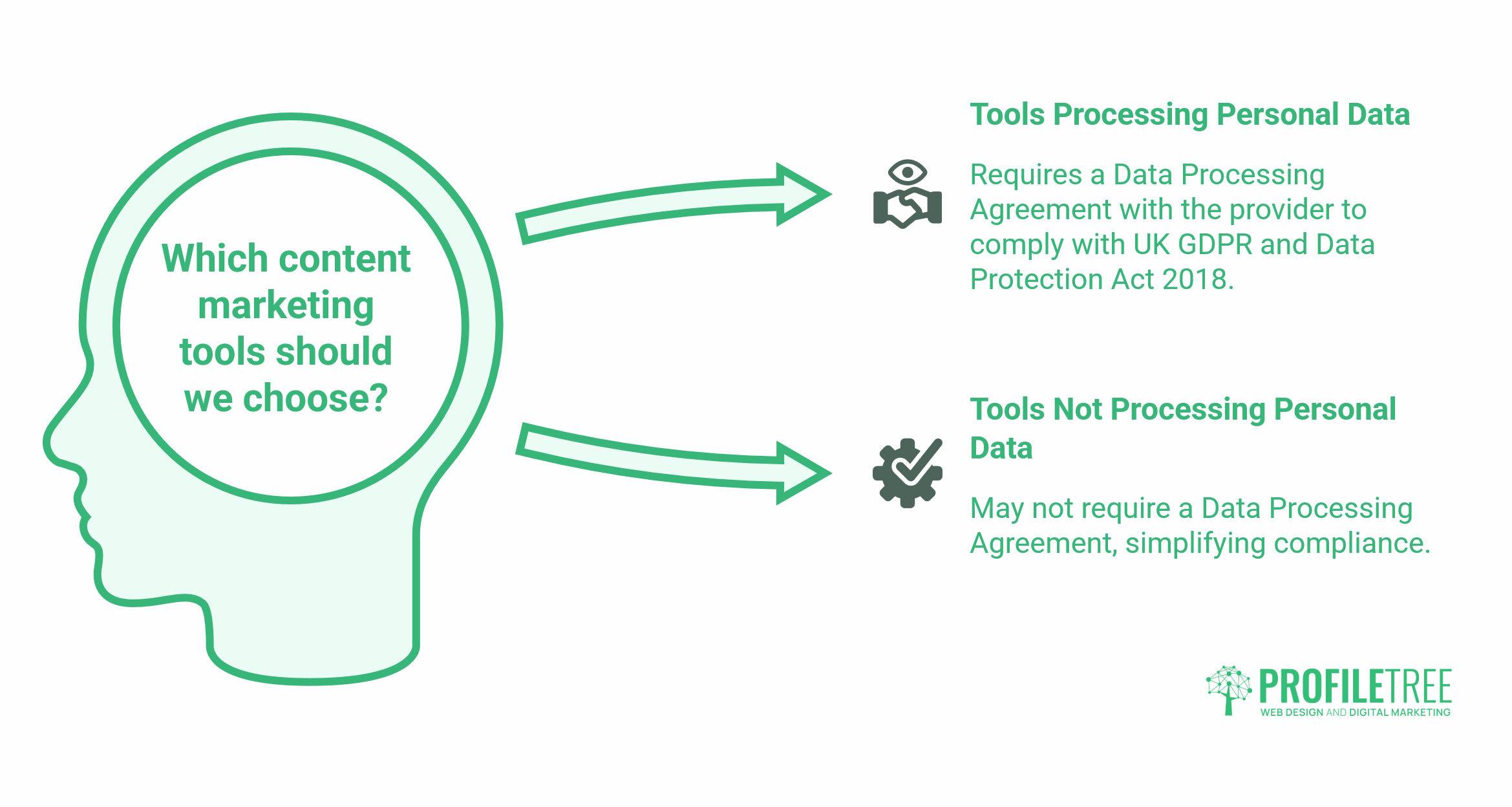
Choosing content marketing tools is not purely a performance decision for a UK business. Under UK GDPR and the Data Protection Act 2018, any tool processing personal data, including subscriber lists, form submissions and analytics, requires a Data Processing Agreement with the provider.
The Three-Step Test
In January 2026 the Information Commissioner’s Office published updated guidance introducing a three-step test for identifying whether a transfer of personal data outside the UK counts as a restricted transfer. In outline: does UK GDPR apply to the processing, is the data going to an organisation outside the UK, and is the recipient a separate legal entity? The full detail sits in the ICO’s guidance on international transfers, which is worth reading before signing with any US-hosted content marketing platform.
Applied to a typical SME content stack, the answer is usually yes on all three counts for at least two or three tools. That is not a reason to avoid them. It is a reason to have the paperwork in place before an ICO query or a client’s procurement team asks for it.
Practical Questions Before You Buy
Four questions settle most of it. Where is the data stored? Is a DPA available and signed? Does the platform offer UK or EU data residency as an option? Can subscriber or user data be deleted on request within the required timeframe?
Most compliance failures in small teams come from configuration rather than choice of vendor. EU processing options frequently exist but sit switched off by default, which means the tool is compliant in principle and non-compliant in practice. Getting the whole team to understand why that distinction matters is usually a training question, and structured GDPR training for your team tends to prevent more problems than any single software decision.
Building a Content Marketing Stack That Fits Your Budget
For a business building a content operation from scratch, the priority is covering four functions properly: research, creation, distribution and measurement. Everything else is optional until those four are running.
The Near-Zero Stack
Search Console, GA4, Canva Free, Grammarly Free, Yoast and Buffer’s free tier together cover the full content lifecycle for the cost of one modest paid channel. Add Mailchimp’s free tier while your list is under 250 contacts. This stack is genuinely sufficient for a business publishing two to four pieces a month, and the constraint it imposes is useful: with no keyword tool beyond Search Console, you are forced to write about what your site already has traction for.
The Growth Stack
Once you are publishing consistently and need competitive keyword data, the first paid additions should be Canva Pro and either Ahrefs Webmaster Tools or a single month of Semrush for research sprints. A full-year SEO platform subscription is rarely justified for an SME publishing under ten pieces a month; the data does not change fast enough to warrant continuous access.
Where Content Marketing Tools Stop Helping
The most common failure is not choosing the wrong tools. It is buying tools to solve a problem that is actually editorial. If your content produces impressions but no clicks, or ranks on page two for every target term, no amount of additional content marketing software will fix it. The issue is the content strategy behind the work: unclear audience, no genuine information gain, and topics chosen by keyword volume rather than commercial value. A content strategy that has not been written down is not a content strategy; it is a publishing habit.
“The businesses that get results from content are not the ones with the biggest software budget,” says Ciaran Connolly, founder of ProfileTree. “They are the ones who decided what they were actually trying to say before they went looking for a tool to say it with. A £15 stack and a clear strategy will outperform a £500 stack and a content calendar full of guesswork every time.”
That order of operations matters. Define the audience, the search intent and the commercial outcome first; the shortlist of content marketing tools then narrows itself, because most of what is on the market solves problems you do not have.
Getting More From Your Content Marketing Tools
The right content marketing tools make a good content strategy faster to execute. They do not create one. Start with the four functions, keep the content creation workflow small enough to actually use, and check the currency and compliance position before the feature list.
If your existing content is producing impressions without clicks, ProfileTree’s content marketing services cover structured audits and rewrite programmes built on Search Console data rather than assumptions, and sit alongside digital marketing strategy work for businesses that need the plan before the production. For teams who would rather build the capability in-house, ProfileTree’s digital training covers these platforms directly. Get in touch to talk through which route fits your business.
Frequently Asked Questions
What are the best free content marketing tools for UK small businesses?
Google Search Console and GA4 are the priority, because they show what your audience actually searches for and how existing content performs. Add Canva Free for visual content creation, Grammarly Free for editorial quality, Buffer’s free tier for scheduling and Yoast for on-page SEO. Together they cover research, creation, distribution and measurement at no cost.
Are AI content tools GDPR compliant?
Most are compliant in principle but require active configuration. Many platforms use customer inputs to train their models by default, and that setting usually has to be switched off manually. Review the privacy settings and the Data Processing Agreement before processing personal data or commercially sensitive material through any AI writing tool.
How many content marketing tools does a small business actually need?
Four to six. You need research, creation, distribution and measurement covered, and one tool can often handle more than one function. Anything beyond six tends to create workflow overhead rather than save time.
Which content marketing tools bill in pounds sterling?
Canva bills UK customers in GBP through its UK site, and Yoast bills in euros. Semrush, Ahrefs, Grammarly, Buffer and Mailchimp all bill in US dollars. Budget an extra two to three per cent for card foreign exchange costs on those, plus VAT where it applies.
Is Semrush or Ahrefs better for UK SEO?
Both handle UK search data reliably. Semrush is stronger for content auditing and editorial brief generation; Ahrefs is better for backlink analysis and competitive research. If cost is the deciding factor, Ahrefs Webmaster Tools is free for a domain you verify and covers most SME needs.
Do I need a Data Processing Agreement for every content marketing tool?
You need one for any tool that processes personal data on your behalf, which covers email platforms, analytics, form handlers and most CRM-connected content marketing software. Tools that never touch personal data, such as a keyword research platform used only for public search data, sit outside that requirement.
How often should I review my content marketing stack?
Annually is enough for most SMEs, with one exception: check pricing whenever a renewal is due. Several major platforms changed pricing or reduced free tier limits during 2026, and renewals process automatically at the new rate unless you act.
Which content marketing tools help content get cited in AI answers?
No tool does this directly. Citation in AI answers follows from structure rather than software: self-contained sections, comparison tables, direct answers near the top of each section and genuine information gain. Any tool that helps you produce that structure consistently, including a well-configured SEO plugin, contributes indirectly.