
Elevate Your Career: Marketing Qualifications 101
Table of Contents
The marketing profession has undergone a profound transformation across the UK and Ireland. Today’s business leaders require marketing professionals who can blend theoretical knowledge with practical expertise in SEO, web design, content creation, and AI implementation. This comprehensive guide explores marketing qualifications that can accelerate your career progression, whether you’re entering the field or advancing to senior positions.
Marketing Qualifications: The Complete Guide for UK Professionals

Marketing qualifications remain valuable credentials, but today’s employers—from Belfast startups to London enterprises—seek professionals who can demonstrate tangible results. The question isn’t simply about acquiring any marketing diploma; it’s about choosing qualifications that translate into measurable business outcomes and digital transformation.
The digital landscape has significantly reshaped employer expectations. Companies across Northern Ireland, Ireland, and the UK now prioritise candidates who can combine strategic thinking with practical execution across multiple disciplines—particularly in website development, SEO, content strategy, and digital analytics.
Marketing Week columnist Mark Ritson presents a compelling perspective worth considering. In his article ‘Do marketing experts need a qualification in marketing?’, he argues that many modern ‘experts’ lack formal training yet significantly influence how marketing is taught. “Before you start creating new rules, you should know the existing ones,” Ritson contends. This highlights the ongoing tension between formal qualifications and practical experience that many business owners face when hiring marketing talent.
“The marketing professionals who succeed are those who understand both the strategic foundations and the practical tools,” notes Ciaran Connolly, Director of ProfileTree. We’ve seen clients transform their businesses when they hire marketers who can implement campaigns, not just plan them—especially when it comes to digital marketing strategies that integrate website optimisation, content development, and performance analysis.
For organisations seeking marketing support, this means evaluating both credentials and demonstrable expertise. A candidate with strong marketing qualifications who can implement technical solutions—such as optimising website performance or developing content strategies—offers substantially more value in today’s digital-first business environment.
The Evolution of Marketing Requirements
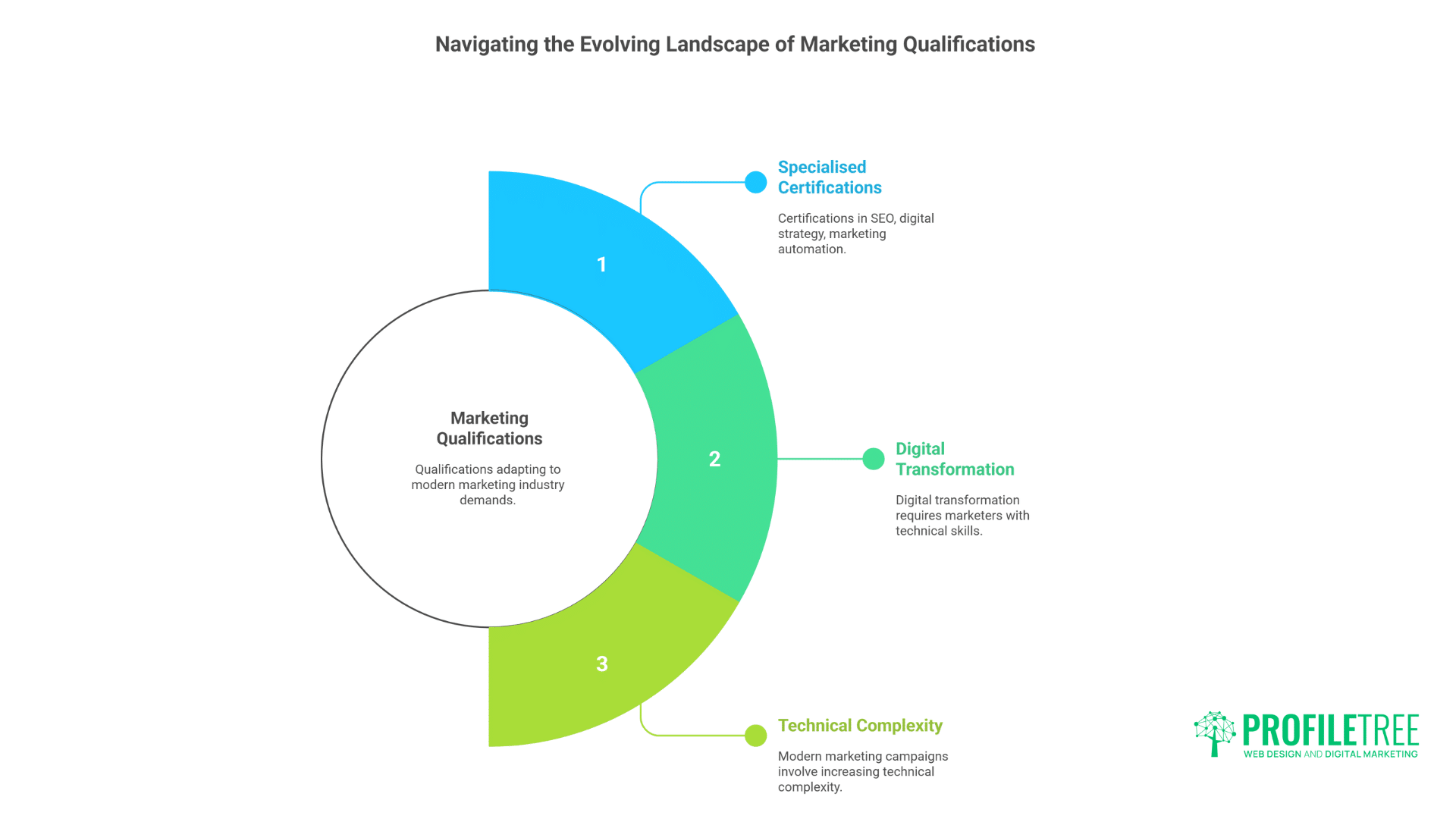
Marketing qualifications have adapted to reflect the changing industry landscape. Where a bachelor’s degree once sufficed, many senior positions now favour candidates with specialised certifications in search engine optimisation, digital strategy, or marketing automation. This shift reflects the increasing technical complexity of modern marketing campaigns, as well as the integration of web design, content creation, and analytics.
Digital transformation has created a demand for marketers who can bridge the gap between traditional marketing principles and technical implementation. Professionals who understand both the strategic elements of marketing and the practical aspects of digital execution—from web development to video production—are increasingly valuable to organisations seeking comprehensive marketing solutions.
Essential Marketing Skills for Success

Marketing roles vary significantly, but specific capabilities remain constant across positions. Understanding these core skills helps you identify which marketing qualifications will best advance your career and deliver value to employers.
Strategic Communication and Stakeholder Management
Marketing managers must articulate complex strategies to diverse audiences, ranging from technical developers to executive boards. This extends beyond presentation skills to include negotiation, particularly when managing budgets or aligning cross-functional teams.
For professionals in client-facing agencies like ProfileTree, this communication extends to explaining technical concepts such as SEO performance, website conversion rates, or video marketing metrics to non-technical stakeholders. The ability to translate complex digital strategies into clear business outcomes is particularly valuable for professionals working with SMEs across the UK.
Analytical and Research Capabilities
Data interpretation separates effective marketers from those who simply follow trends. This includes understanding target markets, analysing competitor strategies, and measuring campaign performance. Modern marketing qualifications increasingly emphasise analytics platforms like Google Analytics 4, teaching professionals to extract actionable insights from complex datasets.
For roles involving web design or development, this analytical thinking extends to user behaviour analysis and conversion optimisation—critical skills for agencies supporting small to medium-sized enterprises. The ability to connect website performance data with broader marketing objectives helps organisations make informed decisions about digital investments.
Technical Proficiency and Digital Tools
Contemporary marketing requires comfort with various technologies. Beyond social media platforms, professionals need familiarity with:
- Content management systems (WordPress, Wix, Shopify, Squarespace)
- SEO tools for keyword research and site audits
- Email marketing platforms and automation software
- Video editing software for content production
- AI tools for content creation and process automation
This technical knowledge allows marketers to work effectively with development teams or, increasingly, to implement solutions directly. The convergence of marketing and technology means that professionals who understand both disciplines can deliver more integrated and effective campaigns.
Creative Problem-Solving
Marketing campaigns demand innovation within constraints—whether budget limitations, time pressures, or competitive markets. This creativity manifests in campaign concepts, content development, visual design, and strategic positioning.
Creative thinking becomes central to deliverables for agencies offering video production or animation services. The ability to develop compelling visual narratives that align with brand objectives and technical requirements is particularly valuable in today’s content-driven marketing landscape.
Commercial Awareness and Market Understanding
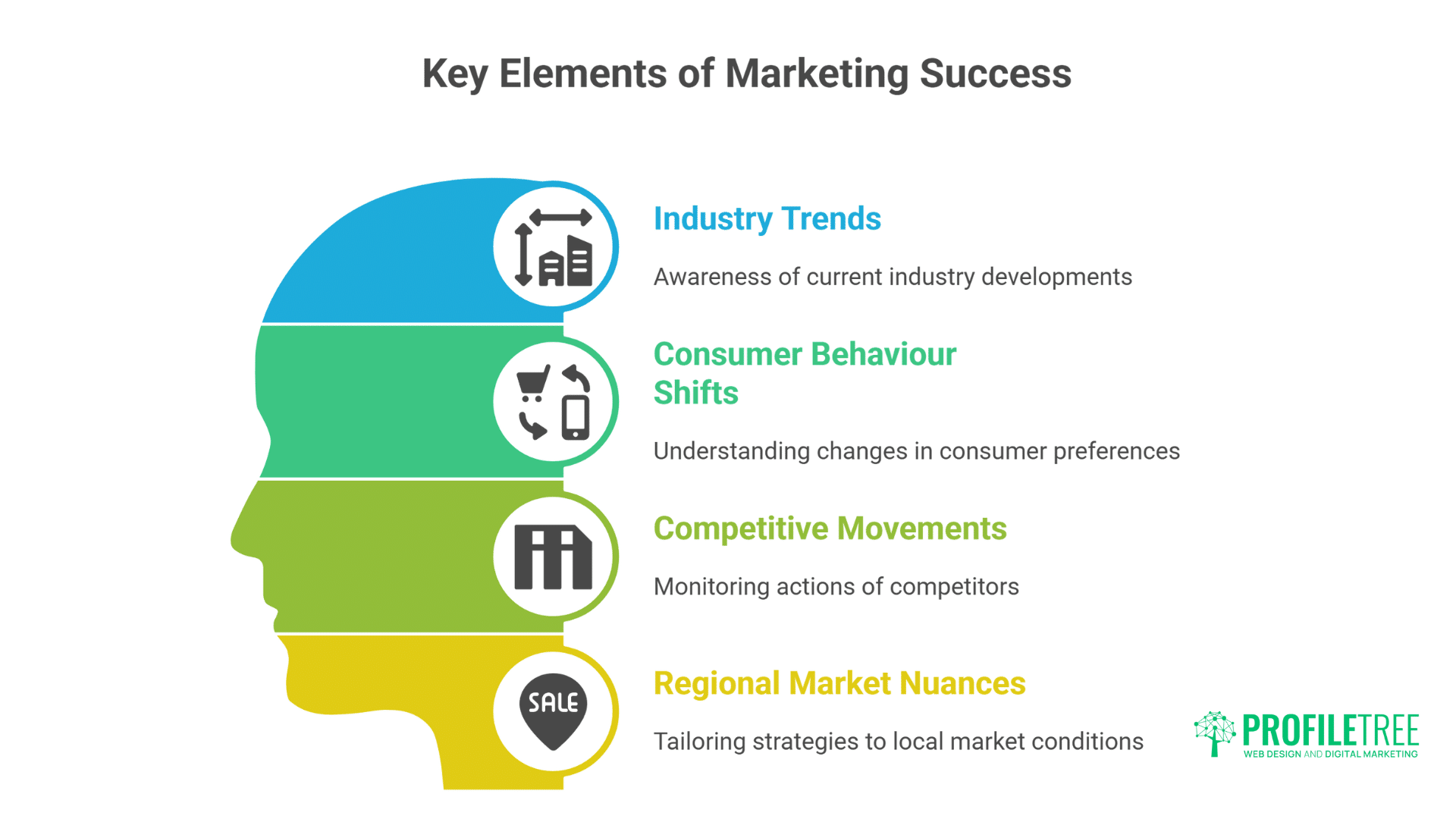
Successful marketers maintain constant awareness of industry trends, consumer behaviour shifts, and competitive movements. This commercial intelligence informs everything from content topics to campaign timing.
Understanding regional market nuances proves particularly valuable for businesses across Northern Ireland and Ireland. Local knowledge helps marketers develop targeted strategies that resonate with specific audiences while addressing unique regional challenges and opportunities.
Collaboration and Team Integration
Marketing rarely operates in isolation. Professionals coordinate with sales teams, work alongside designers and developers, and consult with leadership. This collaborative approach becomes essential in agencies where projects span multiple disciplines—from initial web design through content creation to ongoing SEO management.
The ability to integrate marketing strategies with technical implementation ensures that campaigns deliver consistent experiences across all touchpoints. This integration is particularly important for digital marketing initiatives that combine website development, content creation, and performance optimisation.
Professional Marketing Qualifications: UK Pathways

Business owners seeking to hire qualified marketers—or professionals pursuing career advancement—face numerous qualification options. Understanding these pathways helps match credentials to specific career goals and organisational needs.
Marketing Management Roles: Educational Requirements
From initial research to product positioning and performance measurement, marketing managers orchestrate campaigns across multiple channels. The educational background for these roles varies, but most employers prefer candidates with at least a bachelor’s degree in marketing or business.
Specialised industries may require additional expertise. Technology companies often seek marketing managers with technical backgrounds, whilst agencies focusing on web design and development value candidates who understand website architecture and user experience principles.
Marketing Manager Role Overview:
- Typical employers: Marketing agencies, manufacturing firms, financial services, technology companies, professional services
- Related positions: Marketing executives, digital marketing specialists, content marketing managers, SEO managers
- Key competencies: Strategic planning, budget management, team coordination, performance measurement
- Career progression: Moves from executive roles through management to directorship
Institute of Direct and Digital Marketing (IDM) Qualifications

The IDM offers structured pathways from foundational awards to postgraduate diplomas, all taught by active marketing practitioners who understand the practical challenges of digital implementation.
IDM Awards: Focused Skill Development
These targeted qualifications suit professionals developing expertise in specific disciplines:
- IDM Award in Digital Marketing: Core principles and practical application of digital marketing strategies
- IDM Award in Data & Analysis: Building organisational data strategies
- IDM Award in Digital Copywriting: Creating effective copy across digital platforms
- IDM Award in Direct Mail: Planning and implementing direct mail campaigns
- IDM Award in GDPR: Understanding data protection implications for marketing
For marketing professionals working with SMEs across the UK, these awards provide credentials in areas directly applicable to client work—from content creation to data compliance. They offer a focused approach to skill development that complements broader marketing qualifications.
IDM Professional Certificates
These intermediate-level qualifications focus on disciplines central to modern digital marketing:
- Professional Certificate in Email Marketing: Developing ROI-driven email campaigns
- Professional Certificate in Search Marketing: Mastering SEO and PPC advertising fundamentals
- Professional Certificate in Social Media: Creating measurable social media campaigns
- Professional Certificate in Content Marketing: Managing content strategies and measuring results
These certificates help marketers develop specialised skills that directly support digital marketing initiatives, from website optimisation to content development and campaign management.
IDM Professional Diplomas
Equivalent to undergraduate study, these diplomas suit marketing professionals with approximately 18 months’ experience:
- Professional Diploma in Digital Marketing: Planning and evaluating campaigns across social media, search, email, and affiliate channels
- Professional Diploma in Direct and Digital Marketing: Integrating online and offline marketing platforms
These qualifications appeal to agencies and in-house teams requiring comprehensive digital marketing knowledge alongside practical skills. They provide a robust foundation for professionals who need to understand both strategic marketing principles and technical implementation.
IDM Postgraduate Diplomas
These master s-level qualifications target senior professionals seeking advanced credentials:
- Postgraduate Diploma in Digital Marketing: Advanced digital marketing strategy and implementation
- Postgraduate Diploma in Direct and Digital Marketing: Senior-level expertise across all marketing disciplines
The IDM’s practitioner-led approach keeps course content current with industry developments, which is particularly valuable in fast-moving areas like AI implementation and marketing automation. These advanced qualifications help marketing leaders stay ahead of digital trends and develop integrated strategies that leverage emerging technologies.
Chartered Institute of Marketing (CIM) Qualifications
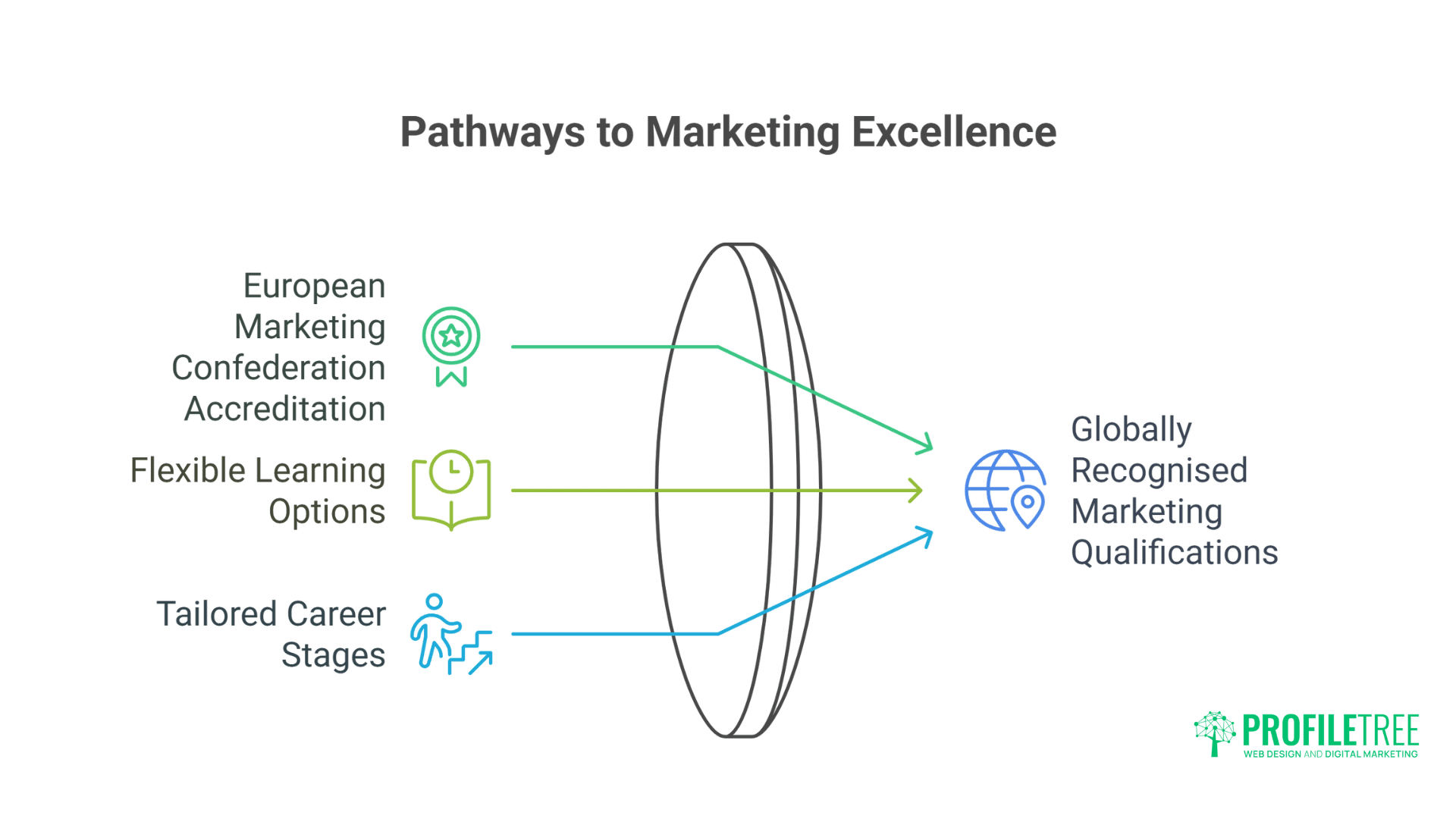
The CIM, accredited by the European Marketing Confederation, provides globally recognised marketing qualifications with flexible learning options that suit professionals at different career stages.
Foundation Certificate in Marketing
This entry-level course suits career starters, entrepreneurs, and non-marketing managers requiring marketing fundamentals. It provides grounding in core principles applicable across industries and establishes a solid foundation for further specialisation.
Certificate in Professional Marketing
This intermediate qualification targets aspiring marketers and professionals whose roles include marketing elements. It bridges foundational knowledge and practical application, helping professionals develop the skills needed to implement effective marketing strategies.
Diploma in Professional Marketing
Equivalent to an undergraduate degree, this diploma suits marketers working at strategic levels who want to deepen their expertise. The curriculum covers advanced marketing strategy, customer insights, and campaign planning, providing a comprehensive understanding of marketing principles and practices.
Digital Diploma in Professional Marketing
Also at the undergraduate level, this qualification focuses specifically on digital marketing strategies and techniques. It suits operational managers, supervisors, and anyone wanting comprehensive digital marketing knowledge—particularly relevant for professionals in agencies offering web design, SEO, and content services.
Postgraduate Diploma in Marketing
This master-level qualification, delivered across two stages, targets experienced marketers and senior business leaders. It provides strategic-level marketing expertise suitable for directorship or consultancy roles, helping professionals develop advanced skills in marketing strategy and implementation.
CIM Marketing Leadership Programme
Also at master’s level, this programme suits experienced marketers seeking professional recognition. It accommodates both employed and independent consultants, though availability is limited to the UK. The programme focuses on strategic leadership and innovation, preparing marketing professionals for executive roles.
UK Apprenticeships: Earning Whilst Learning

Apprenticeships offer an alternative pathway combining employment with structured training. These programmes prove particularly valuable for career changers or those seeking hands-on experience alongside qualifications.
The UK Apprenticeship Levy supports businesses in funding these programmes, making them accessible to employers and candidates. Digital marketing apprenticeships typically cover SEO, content creation, social media management, and campaign analysis—providing practical skills immediately applicable in agency or in-house roles.
For organisations like ProfileTree, apprenticeships offer an opportunity to develop talent with skills specifically aligned to business needs, from website development and SEO to content creation and digital analytics.
University Degrees: Traditional Educational Routes
Undergraduate and postgraduate marketing degrees remain popular, particularly for those entering the profession directly from education. These programmes provide comprehensive theoretical foundations alongside practical projects that develop critical thinking and strategic capabilities.
Modern marketing degrees increasingly incorporate modules on digital strategy, SEO, content marketing, and marketing analytics. Some institutions offer digital marketing or brand management specialisations, allowing students to focus on specific career paths aligned with industry demand.
For marketing professionals seeking comprehensive knowledge and recognised credentials, university degrees offer a structured approach to skill development and career progression.
Professional Development for Established Marketers
Experienced professionals often pursue shorter, targeted qualifications to fill specific skill gaps or stay current with industry developments. These might include:
- Google certifications (Analytics, Ads)
- HubSpot credentials (Inbound Marketing, Content Marketing)
- Platform-specific training (Shopify, WordPress)
- SEO tool certifications (SEMrush, Ahrefs)
- AI implementation courses
For marketing managers in SMEs or agencies, these focused credentials provide practical skills without the time commitment of complete diploma programmes. They enable professionals to develop specific capabilities that enhance their value to employers and clients.
Alternative Learning Approaches for Marketing Professionals

Not every marketing professional follows traditional qualification routes. Online platforms and short courses offer flexible alternatives, particularly valuable for those balancing work commitments or targeting specific skills in rapidly evolving areas like digital marketing and AI implementation.
Online Learning Platforms
Several platforms provide marketing courses ranging from introductory overviews to advanced specialisations:
- Reed: Offers diverse marketing courses at competitive prices, with precise details on study methods, duration, and content scope. Courses cover general marketing principles through specific tactics like email marketing or social media advertising.
- Alison: Provides free online marketing courses that you can complete at your own pace. Topics range from digital marketing fundamentals to specialised subjects like content strategy or marketing analytics.
- edX: Partners with universities to deliver professional certificates and micro-credentials in marketing, often featuring content from recognised institutions with a focus on practical application.
- ShortCoursesPortal: Aggregates short courses from various providers, allowing comparison of different options based on duration, price, and learning approach.
These platforms work well for professionals seeking to develop specific competencies—perhaps learning Google Analytics interpretation or mastering SEO basics—without committing to lengthy diploma programmes. The flexibility of online learning makes it particularly suitable for professionals working in fast-paced agency environments.
Industry-Specific Training
Marketing professionals in specialised sectors often benefit from industry-specific education. For instance, marketers supporting professional services firms might pursue courses on B2B marketing, whilst those in retail might focus on e-commerce strategies.
Agencies offering diverse services—web design, video production, SEO—often encourage staff to develop cross-disciplinary skills. A content marketer might learn basic video editing, while a web designer might study SEO principles, creating more versatile team members who can contribute across multiple service areas.
Industry-specific training helps professionals develop contextual knowledge that enhances their ability to deliver targeted solutions for particular sectors or business models.
Self-Directed Learning and Practical Experience
Many successful marketers supplement formal qualifications with self-directed learning. This might include:
- Following industry thought leaders and publications
- Experimenting with personal projects (blogs, websites, social channels)
- Participating in marketing communities and forums
- Attending industry conferences and webinars
- Contributing to open-source marketing projects
This approach proves remarkably effective when combined with formal education, providing real-world context for theoretical concepts. Self-directed learning helps professionals stay current with emerging trends and technologies, particularly in rapidly evolving areas like digital marketing and AI implementation.
Marketing Qualifications in Practice: Agency Perspectives

For digital agencies supporting SMEs across Northern Ireland, Ireland, and the UK, marketing qualifications serve as indicators of capability rather than guarantees. The most valuable team members combine formal education with practical experience and continuous learning—particularly in technical areas like website development, SEO, and digital content creation.
Qualifications for Integrated Service Delivery
Modern marketing campaigns rarely involve a single discipline. A typical project might require:
- Strategic planning (understanding business goals and target audiences)
- Web design and development (creating conversion-focused websites)
- SEO implementation (optimising content and technical elements)
- Content creation (producing blog posts, videos, or animations)
- Performance analysis (measuring results and refining approaches)
Marketing professionals with qualifications spanning multiple areas—perhaps a CIM diploma complemented by Google Analytics and SEO certifications—can contribute across this spectrum, making them particularly valuable to smaller agencies or in-house teams. This integrated approach ensures that marketing initiatives deliver consistent experiences across all customer touchpoints.
The Role of AI in Marketing Qualifications

Artificial intelligence increasingly influences marketing practices, from content creation to campaign optimisation. Forward-thinking qualifications now incorporate AI tools and strategies, teaching professionals how to use these technologies effectively while maintaining quality and authenticity.
For SMEs exploring AI adoption, marketers with relevant training can guide implementation, identify suitable tools, and develop processes that complement human creativity rather than replacing it. This positions AI literacy as an increasingly important component of marketing education and professional development.
“AI is transforming how marketing teams operate, but the technology requires human expertise to deliver meaningful results,” explains Ciaran Connolly. “At ProfileTree, we’ve found that marketers who understand both AI capabilities and traditional marketing principles can develop innovative solutions that combine the best of both approaches.”
Matching Qualifications to Career Stages
The appropriate marketing qualifications vary by career stage:
Entry-level professionals might pursue:
- Foundation certificates or level 3/4 qualifications
- Platform-specific certifications (Google, HubSpot)
- Apprenticeships combining work with study
Mid-career marketers often target:
- Professional diplomas (CIM, IDM)
- Specialised certifications in SEO, content, or analytics
- Project management or leadership training
Senior professionals typically consider:
- Postgraduate diplomas or master’s degrees
- Executive education programmes
- Advanced certifications in strategic areas
This progression ensures qualifications remain relevant to current responsibilities whilst supporting career advancement and specialisation in high-demand areas.
Selecting Your Qualification Path
Choosing appropriate marketing qualifications requires an honest assessment of your current position, career goals, and learning preferences.
Assessing Your Starting Point
Consider your existing knowledge and experience:
- Complete beginners should start with foundational qualifications covering marketing fundamentals
- Career changers might benefit from comprehensive diplomas providing broad coverage
- Experienced professionals typically gain most from specialised certifications addressing specific skill gaps
This assessment helps you identify the qualifications that will provide the most value at your current career stage and build on your existing knowledge.
Defining Clear Career Objectives
Your qualification choice should align with where you want your career to progress:
- Agency roles often value diverse skills across digital channels
- In-house positions might require deeper expertise in specific areas
- Consultancy work typically demands advanced qualifications demonstrating strategic capability
- Specialist roles (SEO, content, analytics) benefit from focused certifications
Aligning qualifications with career objectives ensures that your educational investments support your professional development and help you achieve your long-term goals.
Budget and Time Considerations
Marketing qualifications vary significantly in cost and time commitment:
- Short courses and certifications: £100-£500, completed in days or weeks
- Professional diplomas: £1,000-£3,000, typically 6-12 months
- Postgraduate qualifications: £3,000-£10,000+, often 12-24 months
- Apprenticeships: Funded by employers, 12-18 months
UK residents may access student finance, employer sponsorship, or professional development budgets to support qualification costs. The Apprenticeship Levy provides additional funding options for eligible businesses, making formal education more accessible for both organisations and individuals.
Learning Style and Format
Consider how you learn most effectively:
- Apprenticeships offer workplace learning with structured education
- Self-paced online courses suit those balancing work commitments
- Structured classroom sessions provide accountability and peer interaction
- Blended learning combines online study with occasional workshops
Choosing a learning format that aligns with your preferences and circumstances increases the likelihood of successful completion and knowledge retention.
Building Your Marketing Career
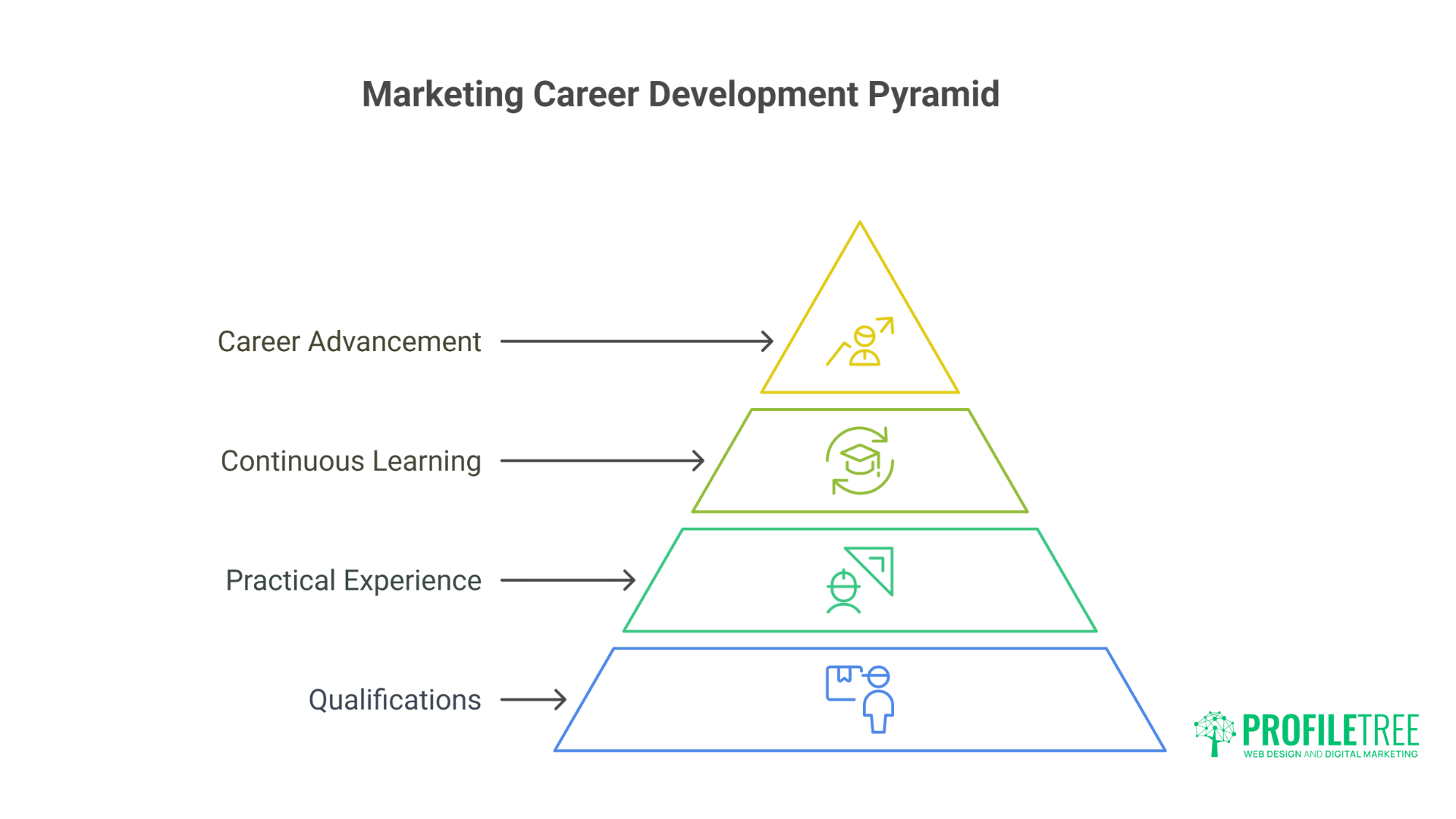
Marketing qualifications provide structure, credibility, and knowledge. However, they function best as components of broader professional development, including practical experience, continuous learning, and skill application in real-world contexts.
Qualifications offer useful indicators of capability for business owners seeking marketing support—whether hiring staff or engaging agencies. The most effective marketers combine formal credentials with demonstrable results, adapting strategies to specific business contexts rather than applying generic approaches.
Professionals building marketing careers should view qualifications as stepping stones rather than destinations. The field evolves continuously, requiring ongoing education regardless of existing credentials. This might mean pursuing new certifications as platforms emerge, attending industry events, or maintaining curiosity about changing consumer behaviours and technological capabilities.
The marketing landscape across Northern Ireland, Ireland, and the UK offers substantial opportunities for qualified professionals. Whether entering the field, developing specialised expertise, or advancing to strategic roles, appropriate qualifications can accelerate your progression—particularly when combined with practical application and commitment to continuous improvement.
Ready to advance your marketing career or strengthen your business’s marketing capabilities? The right qualification pathway can provide the knowledge and credentials needed to achieve your professional objectives, whether mastering SEO fundamentals, developing comprehensive digital strategies, or leading marketing teams in today’s competitive landscape.
FAQs About Marketing Qualifications
Do I need a degree to work in marketing?
No. While many marketing roles prefer degree-qualified candidates, practical experience and professional certifications can provide alternative routes into the field. Apprenticeships, in particular, allow entry without prior degrees. Agencies like ProfileTree often value practical skills and digital expertise alongside formal qualifications.
How long does it take to become proficient in marketing?
Basic competence typically requires 6-12 months of focused learning and practice. Advanced proficiency—particularly in specialised areas like SEO or content strategy—often takes 2-3 years of consistent work. Ongoing professional development is essential as marketing technologies and practices continue to evolve.
What’s the difference between marketing certifications and diplomas?
Certifications typically focus on specific skills or platforms and can be completed in weeks or months. Diplomas provide broader, more comprehensive coverage and usually take 6-18 months. They offer qualifications recognised by employers across multiple industries and contexts.
Can I get funding for marketing qualifications in the UK?
Yes. Options include student finance for degree programmes, employer-funded professional development, Apprenticeship Levy funding, and occasional grants from professional bodies. Many employers support relevant qualifications for existing staff, recognising the value of continuous professional development.
What are job prospects like for qualified marketers in the UK?
Digital marketing remains a growth sector across the UK. Professionals with qualifications in high-demand areas—SEO, content marketing, marketing automation, analytics—typically find strong employment opportunities. The shift towards digital technology across all industries continues to drive demand for marketing expertise.
Which marketing qualification offers the best return on investment?
This depends on your career stage and goals. Comprehensive diplomas (CIM, IDM) provide a broad foundation for career changers. Focused certifications in areas like SEO or Google Analytics often deliver faster career progression for specialists. Mid-career professionals frequently benefit most from postgraduate qualifications that open senior opportunities.
How important are technical skills for marketing professionals?
Increasingly critical. Today’s marketing roles, particularly in digital agencies, require an understanding of website development, SEO, analytics platforms, and content management systems. Technical qualifications that complement marketing knowledge can significantly enhance employability and effectiveness.
What qualifications do I need to specialise in digital marketing?
A combination of broad marketing knowledge and specific digital certifications works best. Consider CIM or IDM digital marketing diplomas, supplemented with platform-specific certifications from Google, HubSpot, or SEO tool providers. For web-focused roles, add WordPress, UX design, or basic HTML/CSS knowledge.