
Women Entrepreneurship: Digital Training, Funding & Growth Resources
Table of Contents
Women entrepreneurship represents one of the fastest-growing segments of business ownership across the UK, yet female founders continue facing distinct challenges when scaling their ventures. From developing essential digital marketing capabilities to securing appropriate funding, women entrepreneurs require practical resources that address their specific circumstances rather than generic business advice.
ProfileTree works with female business owners across Belfast, Northern Ireland, and the wider UK market, providing digital training, web design, and strategic guidance specifically designed to support women entrepreneurship. This guide examines the practical skills, funding mechanisms, and implementation strategies that enable women entrepreneurs to establish digitally capable, profitable businesses.
Digital Skills Essential for Female Business Success
The difference between women-led businesses increasingly depends on digital competence. Female founders who understand search engine optimisation, implement email marketing automation, and make data-driven decisions scale their businesses more effectively than those relying solely on traditional marketing methods.
Research from the Rose Review of Female Entrepreneurship indicates that whilst women start businesses at increasing rates, scaling remains a persistent challenge. The gap isn’t necessarily in product quality or business concept—it’s in the digital infrastructure and marketing systems that enable predictable growth.
Understanding the Digital Skills Gap
Many women entrepreneurs possess strong operational skills and deep market understanding but lack confidence in technical implementation. This gap manifests in several ways: websites that attract traffic but generate few enquiries, social media activity that builds engagement without revenue, and marketing spending without clear return on investment tracking.
“Women entrepreneurs bring unique perspectives to business problems, but they often face additional barriers to being heard,” explains Ciaran Connolly, Director of ProfileTree. “Professional digital presence—strong web design, strategic content marketing, and effective SEO—gives women-led businesses the visibility and credibility they deserve. We’ve seen female founders across Northern Ireland transform their market position simply by investing in their digital foundation.”
The most effective approach to developing digital capabilities focuses on business outcomes rather than technical complexity. Women entrepreneurs don’t need computer science degrees—they need sufficient knowledge to make informed decisions about which tools to implement and when to delegate technical execution.
Time Constraints and Learning Format
Women entrepreneurs often manage multiple caregiving responsibilities and domestic work simultaneously. This reality affects training accessibility, participation in networking, and predictability of work schedules.
Rather than ignoring these constraints, successful women entrepreneurs develop specific strategies that acknowledge them. Effective training prioritises high-leverage skills delivering immediate business value over comprehensive programmes requiring extensive time commitments.
A female founder learning to write product descriptions that rank in search results, implementing abandoned cart email sequences, or optimising her Google Business Profile gains immediate returns on relatively modest time investments. These focused capabilities generate revenue whilst building confidence for tackling more complex digital marketing challenges.
Gender Pay Gap and Digital Investment
The persistent gender pay gap affects female business owners beyond personal income—it directly impacts business investment capacity. Women entrepreneurs often start businesses with less capital, which directly impacts their ability to invest in professional web design, marketing tools, and training programmes.
According to data from the Office for National Statistics, women in the UK earn approximately 14.3% less than men on average. This disparity extends to business ownership, where women-led businesses typically secure less funding and operate with smaller marketing budgets.
Digital skills training represents a remarkably efficient investment because of these budget limitations. A female founder who learns to optimise her own website for search engines or implement email automation internally avoids ongoing agency costs whilst building transferable knowledge that benefits her business long-term.
ProfileTree’s digital training programmes specifically acknowledge these financial realities, focusing on skills that eliminate recurring costs rather than creating ongoing dependencies on expensive software or agency relationships.
Core Digital Capabilities by Business Stage
The digital capabilities required vary substantially depending on where a business sits in its development journey. Training requirements for a newly established business differ markedly from those of an established operation seeking to scale revenue.
Stage One: Establishing Market Presence (Months 0-12)
Businesses in their first year require different digital capabilities than established operations. The priority at this stage centres on proving market demand and acquiring initial customers through organic channels before investing in paid advertising.
Women entrepreneurs at this stage benefit from training focused on:
Visual Brand Development: Creating professional visual assets using accessible tools like Canva enables women entrepreneurs to project credibility without requiring graphic design expertise or expensive contractor relationships. Brand consistency across platforms matters more than elaborate designs.
Local Search Visibility: For service-based businesses and retail operations, appearing in local search results provides immediate access to potential customers actively seeking services. Training should cover Google Business Profile optimisation, gathering and responding to customer reviews, and understanding how local search algorithms prioritise businesses.
Strategic Social Media Presence: Moving beyond personal social media use to a strategic business presence requires understanding platform algorithms, content formats that drive engagement, and how to convert social media interest into business enquiries. The key is selecting one or two platforms rather than attempting to be present everywhere.
Basic Copywriting Principles: Writing website content, service descriptions, and social media posts that communicate value clearly and persuade potential customers to take action represents a foundational skill that influences all other marketing activities.
At ProfileTree, we observe that women entrepreneurs at this stage often overcomplicate their digital presence. The most effective approach focuses on a small number of well-executed activities rather than attempting to maintain presence across every possible platform.
Stage Two: Building Scalable Systems (Years 1-3)
Once market demand is proven and initial customers are acquired, the challenge shifts from validation to scalability. Women entrepreneurs at this stage typically find themselves trapped in constant content creation and perpetual customer communication, limiting their ability to focus on strategic business development.
This stage requires training in systems and automation:
Email Marketing Automation: Implementing automated email sequences that welcome new subscribers, nurture potential customers, and encourage repeat purchases enables revenue generation without constant manual effort. Training should cover email platform selection, sequence design, and integration with websites and e-commerce systems.
Paid Advertising Fundamentals: Understanding how Meta Ads, Google Ads, and other paid platforms function allows women entrepreneurs to make informed decisions about advertising spend. Training should focus on audience targeting, ad creatives that convert, and return on ad spend calculation rather than attempting to master every technical detail.
Search Engine Optimisation for Revenue: Moving beyond basic SEO to strategic keyword targeting that captures customers ready to purchase. This includes understanding search intent, optimising product and service pages for conversion, and building topical authority in specific niches.
Website Analytics and Conversion Optimisation: Learning to interpret Google Analytics data, identify where potential customers exit the sales process, and implement changes that improve conversion rates. Women entrepreneurs need to understand which metrics matter for their specific business model rather than drowning in available data.
ProfileTree’s web design service specifically addresses this stage by building WordPress websites optimised for both search visibility and conversion. Rather than simply creating attractive sites, we implement technical SEO foundations, clear conversion pathways, and analytics tracking that enables business owners to understand their website performance.
Stage Three: Leading and Delegating (Year 3+)
Established women entrepreneurs face a different challenge: transitioning from operator to leader. At this stage, the business owner’s role shifts from executing marketing activities to evaluating agency proposals, hiring specialists, and making strategic decisions about marketing direction.
Training priorities shift accordingly:
Marketing Strategy and Planning: Understanding how different marketing channels work together, setting realistic growth targets, and allocating budget across various activities. This includes knowing when to prioritise SEO versus paid advertising, or when video content delivers better returns than written content.
Data-Driven Decision Making: Moving beyond basic analytics to cohort analysis, customer lifetime value calculation, and attribution modelling. Established women entrepreneurs at this stage require sufficient data literacy to ask agencies intelligent questions and evaluate whether marketing investments deliver appropriate returns.
AI and Marketing Automation:Implementing artificial intelligence tools for content creation, customer service automation, and data analysis. Understanding where AI adds value versus where human expertise remains necessary represents an important capability for established business owners.
Team Building and Strategic Delegation: Knowing what to delegate and how to evaluate freelancers and agencies, and maintaining quality standards without micromanaging every detail. Many women entrepreneurs struggle with delegation, and training that addresses the psychological aspects alongside practical frameworks proves most effective.
ProfileTree’s AI implementation and training services specifically target this stage, helping established women business owners understand how artificial intelligence tools can streamline operations without requiring technical expertise. We focus on practical applications—using AI for content generation, customer enquiry responses, and data analysis—rather than theoretical concepts.
Training Programmes for Women Entrepreneurs
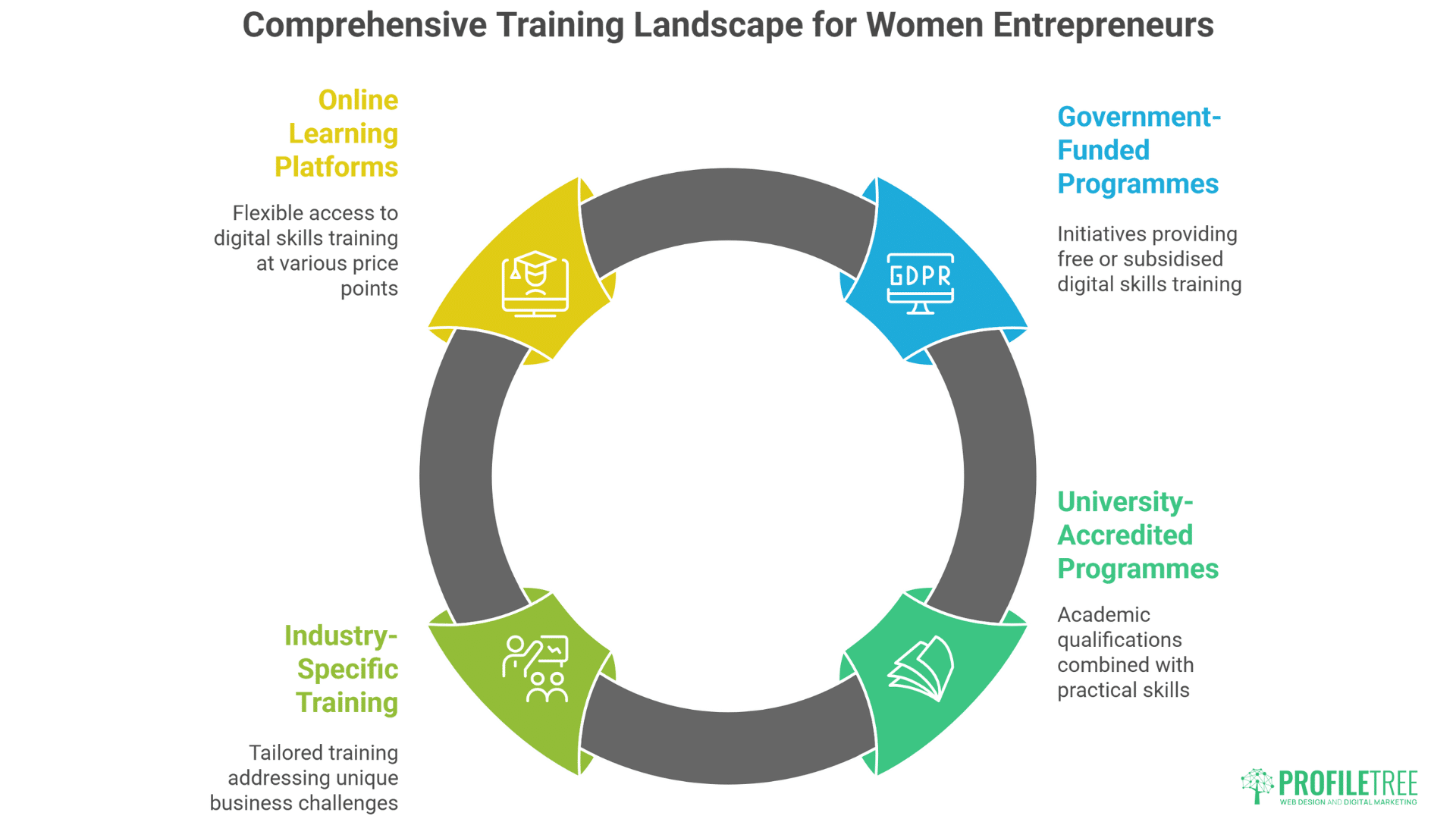
Multiple organisations offer digital training specifically designed for women entrepreneurs. The following analysis examines programmes available to UK-based female founders, evaluating them based on curriculum relevance, time commitment, cost, and support structures.
Government-Funded Digital Skills Programmes
The UK government funds several training initiatives specifically designed to support digital skills development among women entrepreneurs. These programmes often provide free or subsidised training to eligible participants.
Digital Skills Bootcamps:
These intensive programmes offer training in specific digital disciplines, including digital marketing, data analysis, and web development. Bootcamps typically run for 12-16 weeks, requiring a commitment of approximately 20-30 hours per week. Eligibility requirements vary by region but generally target individuals looking to upskill or change careers, including business owners seeking to develop their digital capabilities.
For women entrepreneurs, Digital Skills Bootcamps offer structured learning with practical application. The programmes typically include real-world projects rather than purely theoretical instruction, allowing participants to implement learning directly in their businesses.
Adult Education Budget (AEB) Courses:
Local authorities across England offer training courses funded through the Adult Education Budget. These courses vary widely in subject matter and depth, from introductory social media courses to more advanced SEO and content marketing programmes. Women entrepreneurs can access these courses for free or at reduced cost based on eligibility criteria.
The advantage of AEB courses lies in their flexibility and local delivery. Many programmes offer evening or weekend sessions, accommodating business owners who cannot commit to full-time study.
University-Accredited Programmes for Women Entrepreneurs
Several UK universities offer digital marketing qualifications aimed at business owners and entrepreneurs. These programmes provide academic credibility alongside practical skills.
Goldman Sachs 10,000 Small Businesses (delivered through various UK universities):
This programme combines business fundamentals with digital marketing training. The curriculum covers strategic planning, marketing, financial management, and negotiation skills. Women entrepreneurs benefit from the networking opportunities and alumni community alongside the formal education.
The programme requires a significant time commitment—typically three to four months of part-time study. However, graduates consistently report that the connections made during the programme prove as valuable as the curriculum itself.
Open University Business and Marketing Courses:
The Open University offers flexible distance learning options for women entrepreneurs unable to attend in-person sessions. Courses range from introductory certificates to full-degree programmes, allowing business owners to study at their own pace.
The modular structure enables women entrepreneurs to select specific courses addressing their immediate needs rather than committing to comprehensive programmes. A business owner requiring email marketing skills can complete relevant modules without undertaking unrelated coursework.
Industry-Specific Training Organisations
Several organisations deliver training specifically designed for small business owners and entrepreneurs, with some offering women-focused programmes.
Digital Boost:
This initiative provides free digital skills training and resources to small businesses across the UK. The programme covers social media marketing, email marketing, e-commerce, and digital strategy. Women entrepreneurs can access self-paced online courses or attend live workshops.
Digital Boost programmes specifically address common challenges facing women entrepreneurs, including time constraints and confidence gaps. The training emphasises practical implementation over theoretical knowledge, enabling participants to apply learning immediately.
Federation of Small Businesses (FSB) Training:
FSB members access various training programmes covering digital marketing, business development, and operational efficiency. The organisation frequently runs women-focused networking events and training sessions that address gender-specific challenges in business ownership.
For Northern Ireland-based women entrepreneurs, FSB provides particular value through its advocacy work and connections to local support programmes.
Online Learning Platforms Supporting Women Entrepreneurship
Commercial online learning platforms offer women entrepreneurs flexible access to digital skills training at various price points.
Coursera and LinkedIn Learning:
These platforms host courses from universities and industry experts covering all aspects of digital marketing. Female business owners can select individual courses or pursue more comprehensive specialisation programmes. The self-paced format accommodates irregular schedules, though this flexibility can also reduce completion rates.
Courses range from free audit options to paid certificates. For women entrepreneurs seeking recognised credentials, the certificate programmes provide verifiable qualifications that may strengthen credibility when seeking funding or partnerships.
Skillshare and Udemy:
These platforms offer more practical, project-based courses typically created by working professionals rather than academic institutions. Women entrepreneurs benefit from the applied focus—courses often walk through actual campaign creation or website optimisation rather than discussing theory.
The lower price point (many courses available for £20-50) makes these platforms accessible for women entrepreneurs with limited training budgets. However, quality varies significantly, requiring careful evaluation of instructor credentials and course reviews before purchase.
Funding and Support Options for Women Entrepreneurs
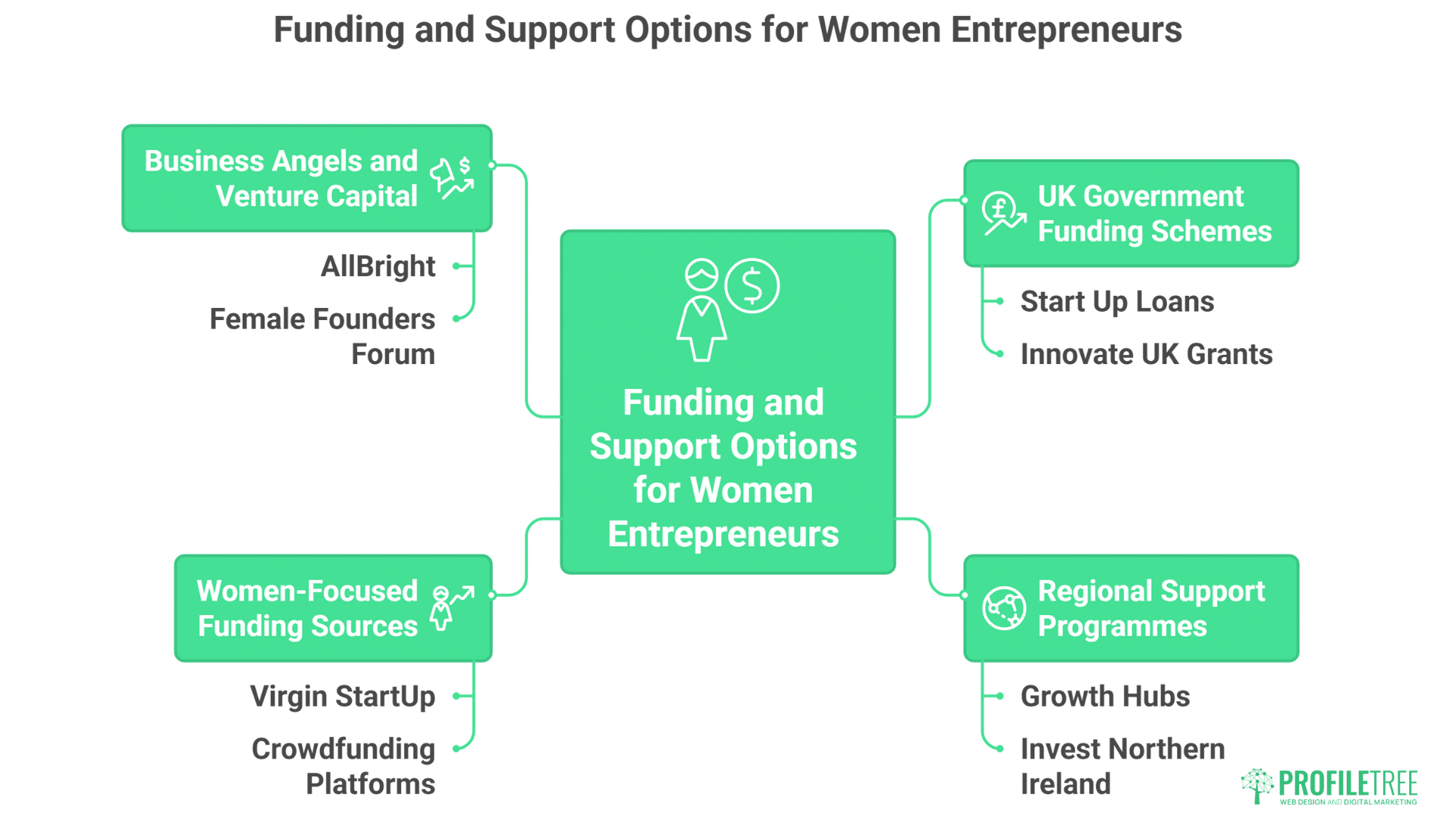
Access to funding remains one of the most significant challenges facing women entrepreneurs. Data consistently shows that female founders receive a smaller percentage of venture capital investment and often face greater scrutiny when seeking business loans. Understanding available funding sources and support mechanisms helps women entrepreneurs navigate these barriers more effectively.
UK Government Funding Schemes
Several government programmes specifically target women entrepreneurs or small businesses that may disproportionately include women-owned operations.
Start Up Loans:
This government-backed programme provides loans of up to £25,000 to individuals starting or growing a business. Women entrepreneurs can access these loans with lower barriers than traditional bank lending, and the programme includes 12 months of free mentoring and support alongside the capital.
The fixed interest rate (6% annually as of 2025) provides predictability, and repayment terms extend up to five years. For women entrepreneurs seeking capital for website development, marketing technology implementation, or initial inventory, Start Up Loans offer a viable alternative to higher-interest personal loans or credit cards.
Innovate UK Grants:
For women entrepreneurs developing innovative products or services, particularly in technology or manufacturing sectors, Innovate UK offers grant funding for research and development. Competition is intense, and applications require substantial preparation, but successful applicants receive non-dilutive funding that doesn’t require equity sacrifice.
The key to successful applications lies in clearly articulating the innovation aspect and demonstrating market potential.
Regional Support Programmes
Local Enterprise Partnerships and regional development agencies across the UK offer targeted support for women entrepreneurs.
Growth Hubs:
Located throughout England, Growth Hubs provide free business advice, connections to funding sources, and access to training programmes supporting women entrepreneurship. Many Growth Hubs run women-focused networking events and mentoring programmes. Business advisors can guide women entrepreneurs through available support options specific to their region and industry.
Invest Northern Ireland:
For women entrepreneurs in Northern Ireland, Invest NI offers various support programmes, including grant funding for business growth, trade development support, and connections to angel investors and venture capital sources. The organisation specifically tracks support provided to women-led businesses and maintains initiatives aimed at increasing female entrepreneurship in Northern Ireland.
Women-Focused Funding Sources
Several organisations specifically target women entrepreneurs with funding programmes designed to address the gender gap in business finance.
Virgin StartUp:
Whilst not exclusively for women, Virgin StartUp provides unsecured loans up to £25,000 and offers dedicated support for underrepresented founders, including women entrepreneurs. The programme includes business mentoring, access to networking events, and educational resources alongside financial support.
Crowdfunding Platforms:
Platforms like Crowdcube and Seedrs enable women entrepreneurs to raise capital directly from customers and supporters. This approach proves particularly effective for consumer-facing businesses where the product or service generates an emotional connection. Women entrepreneurs often excel at community building, making crowdfunding a natural fit for certain business models.
Crowdfunding offers the additional benefit of market validation—a successful campaign demonstrates demand for the product or service, which can strengthen subsequent funding applications or loan requests.
Business Angels and Venture Capital
Whilst women entrepreneurs historically received a disproportionately small share of angel investment and venture capital, several initiatives specifically address this gap.
AllBright: This UK-based venture capital fund invests exclusively in businesses with at least one female founder, directly supporting women entrepreneurship. The fund targets early-stage technology companies and provides both capital and operational support. Beyond funding, AllBright offers networking opportunities and connections to experienced advisors.
Female Founders Forum (FFF): Operating primarily in London with an expanding UK presence, FFF connects women entrepreneurs with angel investors, provides pitch training, and facilitates introductions to venture capital sources. The organisation specifically addresses the confidence and network gaps that often prevent women from pursuing equity funding.
For women entrepreneurs considering equity funding, understanding the trade-offs between growth capital and ownership dilution remains important. Professional advice before entering equity negotiations protects founders from unfavourable terms.
Examples of Women Entrepreneurship Across Industries
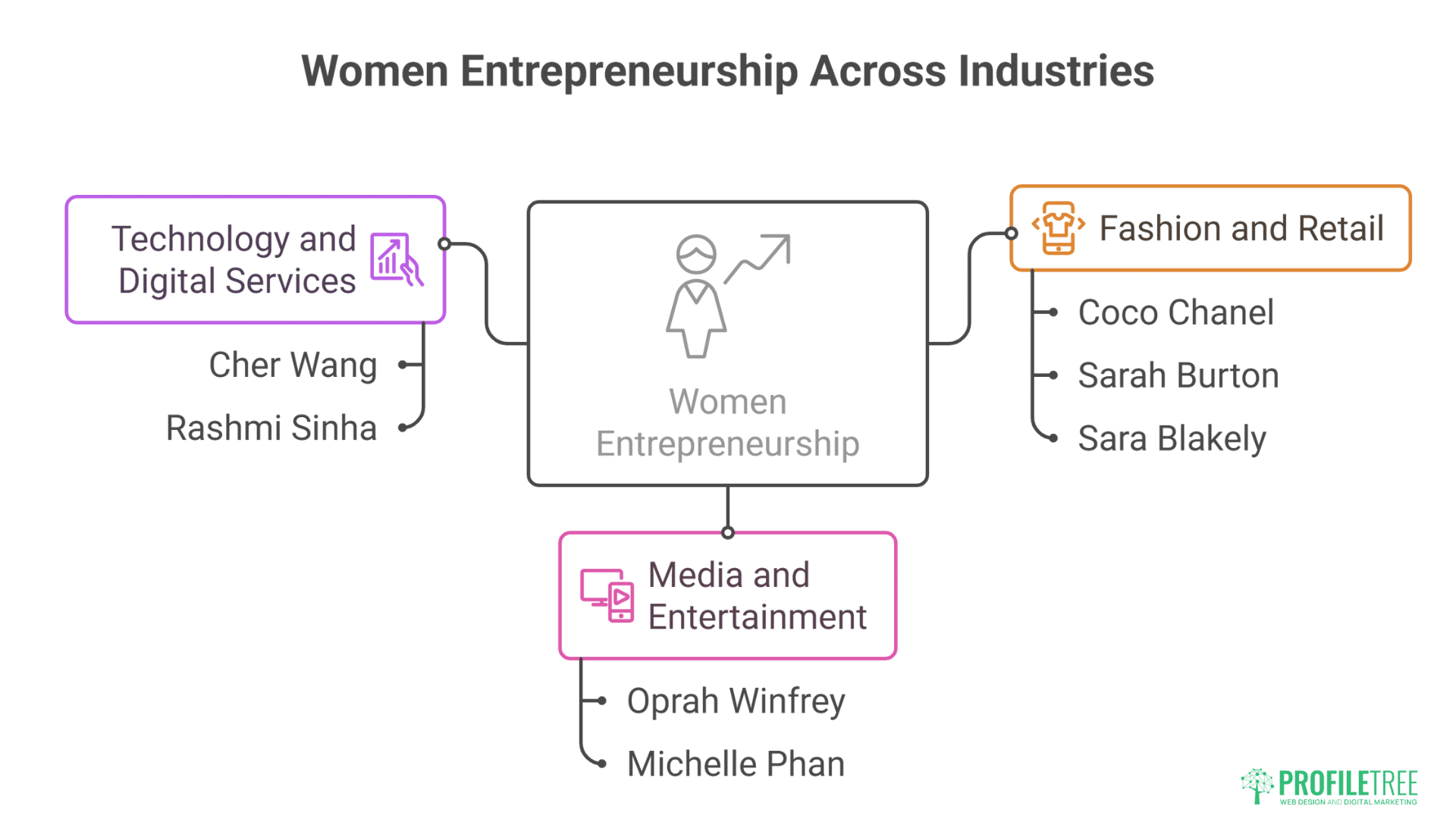
Understanding how other women entrepreneurs have navigated business challenges provides both inspiration and practical insights. The following examples demonstrate diverse approaches to building successful businesses across different sectors.
Fashion and Retail
Coco Chanel revolutionised women’s fashion during the early 20th century, freeing women from restrictive clothing and introducing comfortable, elegant designs that remain influential. Chanel built her empire during World War I, a period when women were entering the workforce in unprecedented numbers and required practical clothing. Her business acumen matched her design talent—she understood market timing and positioned her brand for the emerging modern woman.
Sarah Burton assumed leadership of Alexander McQueen following the founder’s death and has maintained the brand’s creative reputation whilst ensuring commercial viability. Her design of the Duchess of Cambridge’s wedding dress brought global attention, but Burton’s sustained success comes from balancing artistic vision with business pragmatism. For women entrepreneurs in the creative industries, Burton’s career demonstrates that artistic integrity and commercial success can coexist.
Sara Blakely founded Spanx with $5,000 in savings and grew it into a billion-dollar shapewear company without external investment. Blakely’s success stemmed from identifying an unmet market need and pursuing it despite repeated rejections from manufacturers and retailers. Her story particularly resonates with women entrepreneurs because she bootstrapped the business, maintained majority ownership, and built a company specifically addressing women’s needs.
Technology and Digital Services
Cher Wang co-founded HTC and established herself in the male-dominated technology hardware sector. Despite significant challenges in an industry that historically marginalised women, Wang built HTC into a major smartphone manufacturer. Her technical background, combined with business strategy, enabled her to compete against established brands with far greater resources.
Rashmi Sinha combined expertise in neuropsychology and computer science to create SlideShare, a presentation-sharing platform that LinkedIn eventually acquired. Sinha’s background demonstrates how women entrepreneurs can create competitive advantages by bridging different disciplines. Her technical credibility proved particularly important in securing venture capital in the technology sector.
Media and Entertainment
Oprah Winfrey built a media empire from her talk show platform, expanding into magazine publishing, television network ownership, and digital content. Winfrey’s success came from an authentic connection with audiences and business diversification. For women entrepreneurs in content creation and media, Winfrey’s model of owning distribution channels rather than simply creating content provides a strategic framework for building sustainable businesses.
Michelle Phan pioneered beauty content on YouTube, building an audience of millions before translating that into a cosmetics subscription business and product line. Phan’s entrepreneurial journey demonstrates how digital platforms enable women to build businesses without traditional gatekeepers. Her pivot from content creator to business owner illustrates the importance of understanding when and how to monetise an audience.
Business Services and Consulting
Women entrepreneurs work in business services, professional consulting, and coaching sectors. These businesses typically require lower capital investment than product-based companies but demand strong personal branding and digital presence. Women entrepreneurs in these sectors benefit particularly from SEO optimisation, content marketing, and strategic use of LinkedIn and other professional platforms.
Many successful women in consulting and coaching build their businesses through a combination of content creation that demonstrates expertise, strategic networking, and referral systems that turn satisfied clients into business development advocates. Digital skills—particularly website optimisation, email marketing, and social media strategy—prove high-leverage, particularly in these sectors.
Overcoming Challenges in Women Entrepreneurship
Women entrepreneurs face obstacles that their male counterparts encounter less frequently or not at all. Addressing these challenges directly rather than pretending they don’t exist enables women business owners to develop specific strategies for overcoming them.
Confidence and Imposter Syndrome
Research indicates that women entrepreneurs report lower self-confidence than male entrepreneurs despite achieving comparable or superior business outcomes. This confidence gap manifests in several ways: underpricing services, hesitating to pursue large contracts, and excessive preparation before taking action.
Addressing this challenge requires both psychological strategies and practical skill development:
- Skill Acquisition: Confidence often increases through competence. Women entrepreneurs who develop specific digital marketing skills, financial management capabilities, or operational expertise report feeling more confident in their business abilities. Training programmes that focus on practical implementation rather than theory prove particularly effective.
- Peer Networks: Connecting with other women entrepreneurs provides perspective on common challenges and creates accountability structures. Many women business owners report that seeing peers navigate similar obstacles reduces feelings of isolation and inadequacy.
- Reframing Preparation: The tendency toward thorough preparation before action can be reframed as a strength rather than a weakness. Women entrepreneurs who approach this as due diligence rather than procrastination leverage it effectively.
- Celebrating Progress: Women entrepreneurs frequently focus on what remains unfinished rather than acknowledging achieved milestones. Deliberately tracking and celebrating business progress—whether revenue targets, customer acquisition, or capability development—builds confidence through evidence.
Work-Life Balance and Caregiving Responsibilities
Women continue to shoulder disproportionate responsibility for childcare and family caregiving. This reality affects business ownership in practical ways: limited time for networking events, difficulty committing to intensive training programmes, and interrupted work schedules.
Rather than pretending these constraints don’t exist, successful women entrepreneurs develop specific strategies for working within them:
- Time Blocking: Designating specific hours for focused business work, even if those hours are non-traditional, enables progress despite irregular schedules. Many women entrepreneurs report their most productive work happens outside standard business hours when childcare obligations reduce.
- Outsourcing and Automation: Investing in marketing automation, email sequences, and other systems that generate revenue without constant attention provides flexibility for managing caregiving responsibilities. Women entrepreneurs who implement these systems early report significantly lower stress than those who attempt manual execution of all business activities.
- Setting Boundaries: Clearly communicating availability to clients and customers prevents the expectation of constant responsiveness. Women entrepreneurs who establish professional boundaries report greater satisfaction and reduced burnout.
- Flexible Business Models: Choosing business models that accommodate variable schedules—such as asynchronous services, productised offerings, or digital products—enables women entrepreneurs to build successful businesses despite caregiving constraints.
ProfileTree’s web development and AI implementation services specifically support this challenge by creating systems that generate enquiries and nurture customers automatically. A website optimised for search rankings continues attracting potential customers whether the business owner is working or managing family responsibilities.
Gender Bias and Discrimination
Despite progress, women entrepreneurs still encounter bias in various forms: being mistaken for assistants rather than business owners, having expertise questioned more frequently than their male counterparts, and facing different standards in business negotiations.
Addressing this challenge requires both individual strategies and collective action:
- Building Credibility Markers: Professional websites, published content demonstrating expertise, speaking engagements, and media appearances create credibility that preempts some bias. Women entrepreneurs who establish expert positioning before entering negotiations or pitches report more respectful treatment.
- Direct Communication: Some women entrepreneurs find that directly naming gender dynamics when they occur prevents bias from derailing business conversations. This approach requires confidence and carries risks, but many women business owners report that addressing bias directly proves more effective than ignoring it.
- Choosing Partners Carefully: Women entrepreneurs can exercise discretion in choosing investors, partners, and major clients. Selecting relationships with individuals and organisations that demonstrate respect for women’s expertise eliminates some bias exposure.
- Supporting Other Women: Women entrepreneurs who intentionally support other female business owners—through referrals, collaborations, and mentoring—collectively strengthen the position of women in business.
Digital Marketing Strategy for Women-Led Businesses
Effective digital marketing for women entrepreneurs requires understanding which channels and tactics deliver the highest return on investment for specific business models. Rather than attempting to maintain presence across every platform, a strategic focus on high-leverage activities generates better results with less time investment.
Local SEO for Service-Based Businesses
Many women entrepreneurs operate service businesses that serve specific geographic areas, including coaching, consulting, wellness services, professional services, retail, and hospitality. For these businesses, local SEO delivers consistent, high-quality leads without ongoing advertising costs.
Google Business Profile Optimisation: A complete, optimised Google Business Profile appears in local search results and Google Maps, connecting potential customers with your business at the exact moment they’re searching for services. Women entrepreneurs should include accurate business information, service descriptions, high-quality photos, and customer reviews.
ProfileTree specifically focuses on local SEO for Belfast and Northern Ireland clients, understanding that proximity-based search represents the highest-converting traffic source for many women-led businesses. A bakery, salon, consultancy, or retail shop captures more value from ranking in local searches than from national visibility.
Location-Specific Content: Creating website content that addresses local needs and includes geographic keywords improves visibility in location-based searches. A women-owned marketing consultancy in Belfast might create content addressing “digital marketing for Belfast small businesses” or “social media management Northern Ireland.”
Review Generation: Customer reviews directly influence both search rankings and conversion rates. Women entrepreneurs should implement systems for requesting reviews from satisfied customers, respond professionally to all reviews, and address negative feedback constructively.
Content Marketing and Thought Leadership
Women entrepreneurs in professional services and B2B sectors benefit substantially from content marketing that demonstrates expertise and builds trust before potential customers engage directly.
Strategic Blogging: Regular publication of detailed, helpful content addressing customer questions and challenges attracts search traffic whilst establishing expertise for women entrepreneurship. The key is focusing on topics potential customers actually search for rather than subjects the business owner finds interesting.
ProfileTree’s content writing services help women entrepreneurs identify search opportunities in their industries and create comprehensive articles that rank well whilst demonstrating expertise. Rather than brief, superficial posts, we focus on detailed guides that serve as reference resources.
Video Content:Video marketing enables personality and expertise to come through in ways that written content cannot replicate. Women entrepreneurs who are comfortable on camera can build strong connections with potential customers through educational YouTube content, social media videos, or website testimonials.
LinkedIn Strategy: For B2B women entrepreneurs, consistent presence on LinkedIn—sharing insights, commenting meaningfully on industry discussions, and publishing long-form posts—generates business opportunities through network effects. The platform particularly suits professional services where personal credibility drives customer decisions.
Email Marketing Automation
Email marketing consistently delivers the highest return on investment among digital marketing channels. For women entrepreneurs managing multiple priorities, automated email sequences enable relationship building with potential and existing customers without constant manual attention.
Welcome Sequences: New email subscribers should receive a series of automated emails that introduce the business, share valuable content, and guide them toward purchasing or booking consultations. Well-designed welcome sequences can convert 5-10% of subscribers into customers.
Abandoned Cart Recovery: For product-based businesses, automated emails reminding customers about items left in their cart recover 10-20% of abandoned transactions. This single automation often generates enough additional revenue to pay for email marketing platforms.
Customer Nurture Campaigns: Not all potential customers are ready to purchase immediately. Automated nurture sequences that provide value over weeks or months keep your business present until the customer is ready to buy.
ProfileTree implements email marketing systems for women entrepreneurs using platforms like Mailchimp or ActiveCampaign, focusing on automation that requires initial setup but then functions with minimal ongoing management.
Social Media Strategy for Women Entrepreneurship
Social media demands careful strategic thinking for women entrepreneurs, given the time investment required. Rather than attempting to maintain an active presence on every platform, focus on one or two channels where your target customers spend time.
Platform Selection: Choose platforms based on customer behaviour rather than personal preference. B2B service providers typically see better results from LinkedIn than TikTok. Visual product businesses may prioritise Instagram. Local service businesses might focus on Facebook for community connection.
Content Consistency: Regular posting matters more than volume. Women entrepreneurs should establish sustainable posting schedules—even if that means three times weekly rather than daily—and maintain consistency.
Engagement Over Broadcasting: Social media algorithms reward engagement. Responding to comments, participating in discussions, and building community generate better results than simply posting promotional content.
Efficiency Through Batching: Creating content in batches—dedicating a few hours monthly to photographing products, recording videos, or writing captions—reduces the time overhead of social media management.
Implementation: Moving From Learning to Action
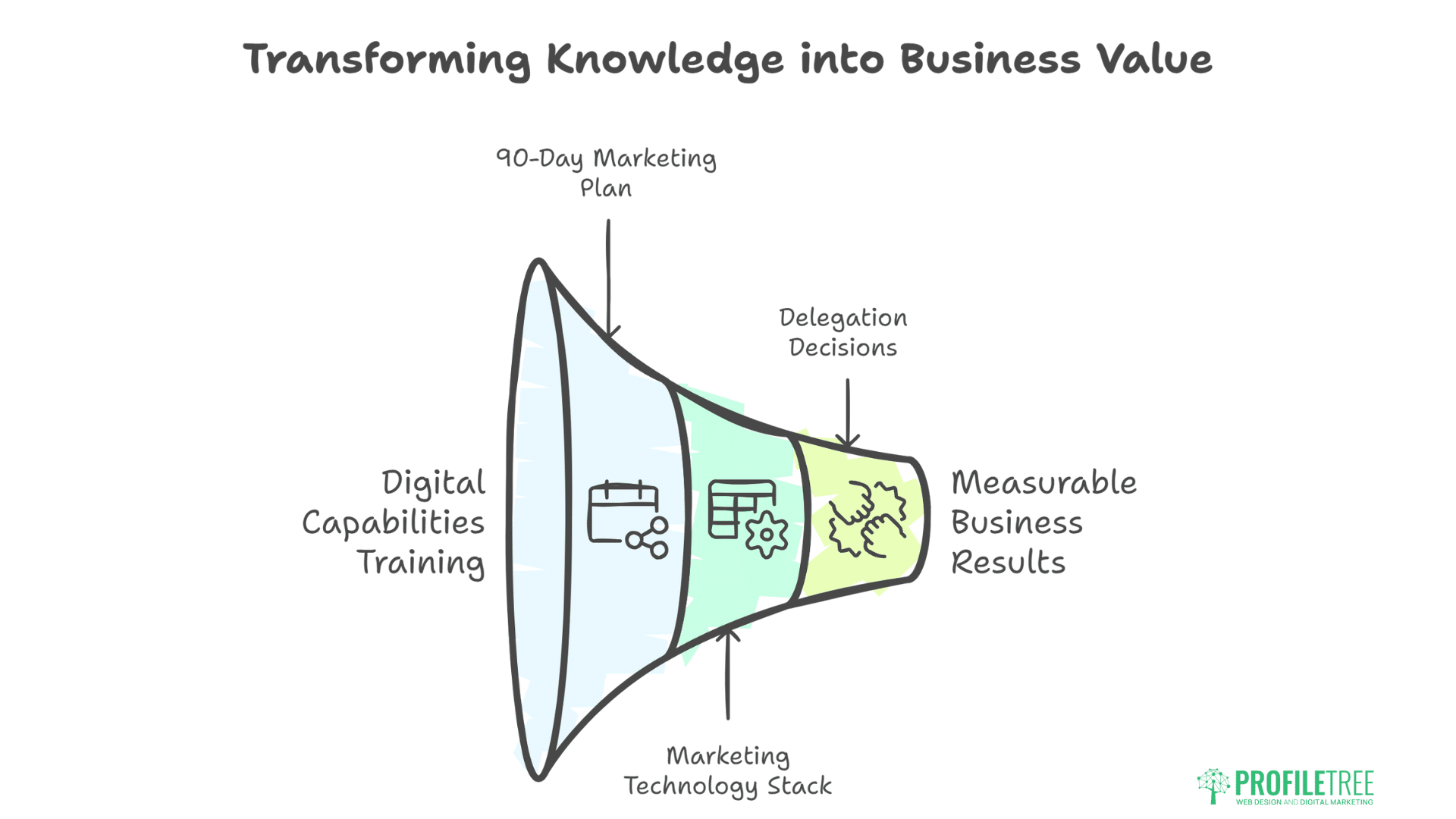
Knowledge without implementation generates no business value. Women entrepreneurs who successfully develop their digital capabilities follow specific patterns that transform training and information into practical business results.
Creating a 90-Day Marketing Implementation Plan
Rather than attempting comprehensive transformation immediately, successful women entrepreneurs focus on the sequential implementation of high-impact activities.
Month One – Foundation:
- Complete Google Business Profile with optimised description, categories, and images
- Set up basic website analytics to understand current traffic and user behaviour
- Create or optimise five core website pages with clear service descriptions and calls-to-action
- Establish email marketing platform and create basic welcome sequence
- Identify primary social media platform and commit to posting schedule
Month Two – Content and Visibility:
- Publish two detailed blog posts addressing customer questions and incorporating relevant keywords
- Gather and publish five customer testimonials on website and Google Business Profile
- Set up an automated email sequence for new enquiries or purchases
- Create a social media content calendar for 30 days and schedule posts in advance
- Begin collecting email subscribers through website opt-in
Month Three – Analysis and Optimisation:
- Review Google Analytics data to identify which pages attract traffic and where visitors leave
- Analyse email open rates and click rates to refine messaging
- Review social media metrics to understand which content generates engagement
- Conduct basic keyword research to identify additional search opportunities
- Make data-driven adjustments to website, email, and social media approach
This sequential approach enables women entrepreneurs to build digital capability progressively without overwhelming time commitments. Each month’s activities establish foundations for the following month whilst generating measurable business results.
Building a Marketing Technology Stack
Women entrepreneurs benefit from selecting tools that integrate well, offer appropriate features without unnecessary complexity, and fit within budget constraints.
Essential Tools:
- Website Platform: WordPress provides flexibility, SEO capability, and extensive plugin options for various business needs. ProfileTree specifically builds WordPress websites for women entrepreneurs because the platform enables future self-management whilst offering professional capabilities.
- Email Marketing: Mailchimp offers free plans for smaller lists, intuitive automation, and solid deliverability. As businesses grow, platforms like ActiveCampaign or ConvertKit provide more sophisticated segmentation and automation capabilities.
- Social Media Management: Later, Buffer, or Hootsuite enable scheduling content across platforms from a single interface, significantly reducing time spent on social media management.
- Design Tools: Canva provides accessible graphic design capabilities without requiring professional design software knowledge, enabling women entrepreneurs to create professional visual content independently.
- Analytics: Google Analytics (free) provides comprehensive website data. Google Search Console shows which searches bring visitors to your website, enabling content strategy refinement.
ProfileTree helps women entrepreneurs select and implement appropriate tools for their specific business needs rather than defaulting to popular options that may not suit their situation. A service-based local business requires different tools than an e-commerce operation shipping nationally.
Delegation and Outsourcing Decisions
Knowing what to manage internally versus outsource represents an important capability for women entrepreneurs. The decision framework depends on several factors:
Delegate When:
- The activity requires ongoing execution but not strategic decisions (social media posting, email newsletter design)
- Specialised technical knowledge is required infrequently (website technical updates, advertising platform setup)
- The business has reached a scale where your time is better spent on high-value activities (sales, strategy, product development)
Manage Internally When:
- The activity directly relates to your expertise or unique value proposition
- Customer communication and relationship building are involved
- Strategic decisions about messaging, positioning, or brand identity are required
ProfileTree’s digital training specifically prepares women entrepreneurs to make these delegation decisions effectively. Understanding enough about SEO to evaluate whether an agency is performing well, or knowing sufficient email marketing principles to review automated sequences created by a freelancer, enables effective outsourcing without loss of quality control.
Resources and Networks for Women Entrepreneurs
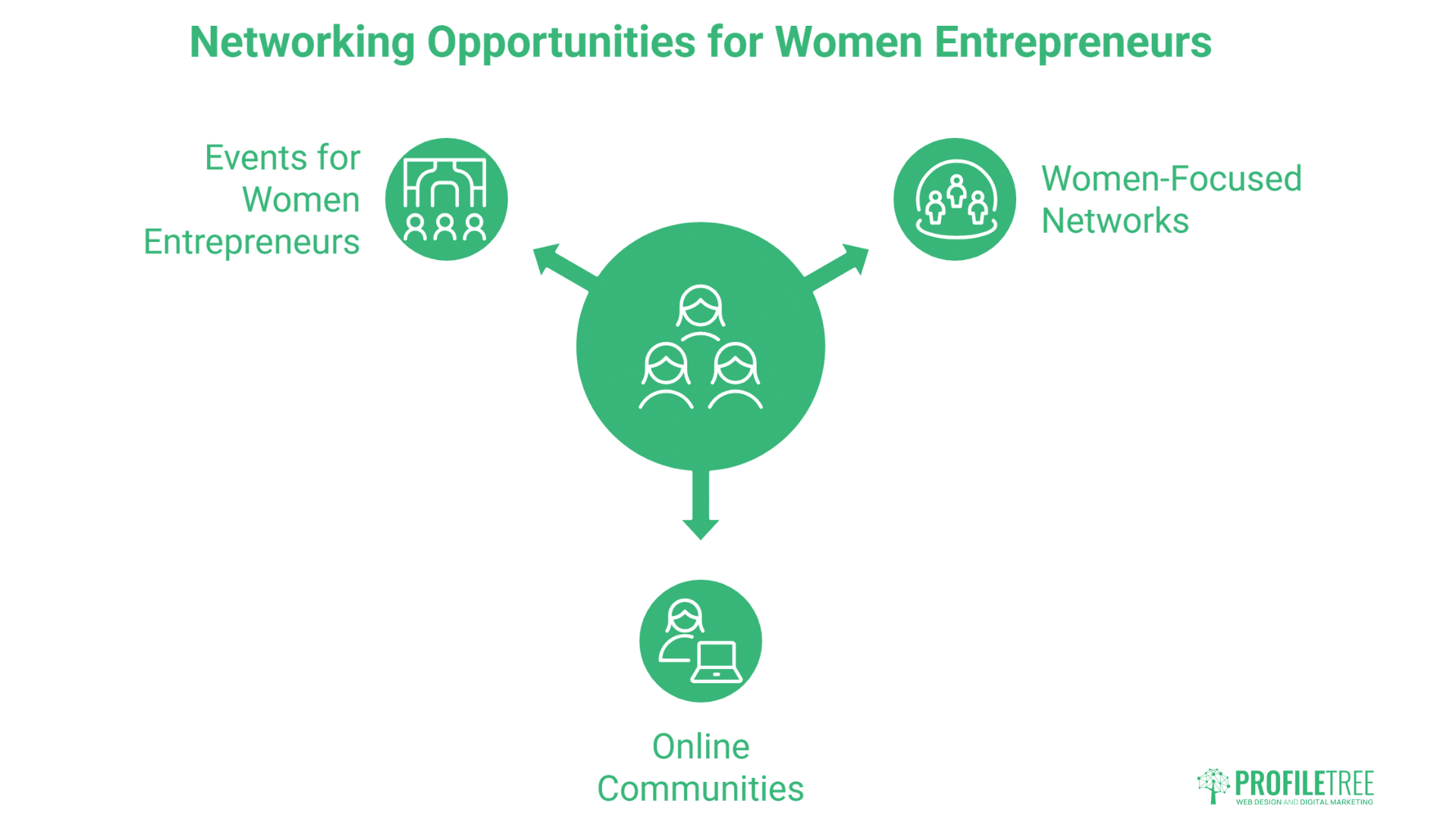
Connection to other women business owners and access to specialist resources accelerate business development and provide support during challenging periods.
Women-Focused Business Networks
Lean In Circles: Small peer groups meeting regularly for mutual support, problem-solving, and accountability. Circles exist across the UK, with many meeting virtually to accommodate geographic distribution and scheduling constraints.
Enterprise Nation: A UK-based small business network offering women-focused events, training programmes, and connections to funding sources. The organisation advocates for small business interests whilst providing practical resources.
Prowess: A UK network specifically supporting women in business through events, information resources, and connections to support programmes. Prowess particularly focuses on connecting women entrepreneurs with funding sources and growth opportunities.
FSB Women in Enterprise: The Federation of Small Businesses runs women-specific networking events and advocacy programmes addressing challenges facing female business owners.
For women entrepreneurs in Northern Ireland, local chambers of commerce and business organisations offer region-specific networking opportunities.
Online Communities Supporting Women Entrepreneurship
Digital Women: An online community connecting women working in digital industries, offering mentoring, job opportunities, and skill-sharing resources. Whilst not exclusively for entrepreneurs, the network provides valuable connections for women building digital businesses.
Female Founder Forum: Connecting women entrepreneurs with investors, advisors, and each other. The forum runs events across the UK focused on funding, growth strategies, and operational challenges.
Women in Tech: Various regional organisations support women in technology sectors, providing networking, mentoring, and advocacy. These organisations prove particularly valuable for women entrepreneurs in technical fields where female representation remains low.
Events for Women Entrepreneurship
Create & Cultivate: Conferences focused on women building businesses, featuring speakers who have successfully navigated entrepreneurship challenges. Events occur in multiple UK cities throughout the year.
AllBright Digital: This organisation runs both online and in-person events for women in business, covering topics from funding to operational scaling to work-life integration.
Local Growth Hub Events: Regional Growth Hubs across England host women-focused networking events, training sessions, and pitch competitions. These local events provide accessible networking opportunities without requiring travel to major cities.
Women entrepreneurs should approach networking strategically, selecting events that align with specific business goals rather than attempting to attend everything. A woman building a local service business benefits more from regional chamber events than national technology conferences, whilst a woman developing a scalable tech product needs different connections.
FAQs About Women Entrepreneurship
What are the main challenges facing female business owners?
Female founders face several distinctive challenges including access to funding (receiving approximately 2% of UK venture capital despite comprising much larger percentage of business owners), confidence gaps manifesting in underpricing services or hesitating to pursue large opportunities, work-life balance challenges with disproportionate caregiving responsibilities, and occasional gender bias in business interactions.
How can women entrepreneurs balance business ownership with family responsibilities?
Successful strategies include time blocking for focused work periods, implementing marketing automation and systems that function without constant attention, setting clear boundaries with clients about availability, choosing flexible business models that accommodate irregular schedules, and outsourcing lower-value activities. Many women entrepreneurs report working non-traditional hours when caregiving responsibilities are lower, rather than attempting to maintain standard business hours.
How do women entrepreneurs secure their first customers?
First customer acquisition typically relies on personal networks, local visibility through optimised Google Business Profiles, consistent content demonstrating expertise, strategic use of social media in relevant communities, partnerships with complementary businesses, and asking satisfied early customers for referrals. Women entrepreneurs should focus on proving market demand through organic channels before investing significantly in paid advertising.
How can women entrepreneurs develop confidence in their business abilities?
Confidence develops through competence acquisition via structured training programmes, connecting with peer networks of other women entrepreneurs, reframing thorough preparation as due diligence rather than procrastination, celebrating achieved milestones rather than focusing only on remaining work, and accumulating evidence of business success through testimonials, revenue growth, and customer outcomes.
What marketing strategies work best for women-led small businesses?
Effective strategies for women-led businesses include local SEO for service-based operations, content marketing that demonstrates expertise, email automation for relationship building, strategic social media presence on one or two relevant platforms, customer referral systems, and partnerships with complementary businesses. The key is focusing on high-return activities appropriate for the specific business model rather than attempting every possible marketing channel.
How can ProfileTree help women entrepreneurs develop their digital presence?
ProfileTree provides web design optimised for search visibility and conversion, digital marketing training focused on practical implementation, SEO services for local and broader UK market targeting, content writing that demonstrates expertise whilst attracting search traffic, AI implementation for operational efficiency, and strategic guidance for women entrepreneurs building digitally-capable businesses across Belfast, Northern Ireland, and the wider UK market.
Next Steps for Women Entrepreneurs
Women entrepreneurship requires both strategic thinking and practical execution. The information in this guide provides frameworks for developing digital capabilities, accessing funding, and building sustainable businesses. Implementation, however, determines whether this knowledge translates into business results.
For female founders at different stages:
- If you’re considering starting a business: Focus on market validation before extensive planning. Speak with potential customers, test your concept through small initial offerings, and use free or low-cost tools to establish your digital presence. Join a women’s business network for peer support and accountability.
- If you’re in your first year of business: Prioritise local visibility through Google Business Profile optimisation, create a professional website that clearly communicates your value proposition, implement basic email capture to build your customer list, and choose one social media platform for consistent presence. Consider government-funded training programmes to develop digital skills without significant financial investment.
- If you’re scaling an established business: Implement marketing automation to reduce time spent on repetitive tasks, develop content that demonstrates expertise and attracts search traffic, consider paid advertising once organic channels are optimised, and begin building a team or network of freelancers to delegate execution whilst maintaining strategic control.
- If you’re leading a mature business: Focus on data-driven decision making, investigate AI implementation for operational efficiency, develop your team’s capabilities through training and clear systems, and consider whether your business model enables scaling without proportional time investment increases.
ProfileTree works with women entrepreneurs across all these stages, providing web design, digital training, SEO services, content creation, and strategic guidance tailored to specific business needs and growth objectives. Our focus on practical implementation rather than theoretical concepts enables women business owners to develop digital capabilities that generate measurable business results.
Women entrepreneurship continues growing across the UK, with female business owners demonstrating innovation, resilience, and strong customer relationships. The combination of appropriate digital skills, access to funding sources, connection to supportive networks, and strategic implementation transforms business concepts into sustainable commercial success.
The barriers facing women entrepreneurs—funding gaps, confidence challenges, work-life balance constraints—remain real but surmountable. Women business owners who develop digital capabilities, build supportive networks, and implement systematically create businesses that not only survive but thrive in competitive markets.
For women entrepreneurs in Belfast, Northern Ireland, and across the UK seeking to strengthen their digital presence, develop marketing capabilities, or implement systems that enable business scaling, ProfileTree offers specialist expertise focused on practical results rather than theoretical possibilities.
Contact ProfileTree at the McSweeney Centre in Belfast to discuss how digital training, web design, SEO services, or strategic guidance can support your business growth objectives.