
Hashtag Strategy Services UK: Data-Driven Social Media Growth
Table of Contents
Hashtags are no longer optional for businesses serious about social media growth. Yet most companies either ignore them entirely or paste the same generic tags onto every post—both approaches that waste opportunity and limit reach.
The social media landscape has changed. Instagram’s algorithm prioritises relevance over volume. LinkedIn penalises excessive hashtag use. TikTok treats hashtags like search keywords. For UK businesses competing in saturated markets, a data-driven hashtag strategy can be the difference between obscurity and consistent organic growth.
This guide reveals our proven 3-tier framework for hashtag success, platform-specific tactics that actually work, and the measurement approach that turns hashtags from random additions into strategic growth tools for your business.
Why Your Hashtag Strategy Needs Professional Support
Hashtags remain one of the most misunderstood elements of social media marketing. Business owners often fall into two camps: those who ignore them completely, and those who copy and paste the same generic tags onto every post. Neither approach delivers results.
The landscape has shifted dramatically. Instagram’s algorithm now prioritises relevance over volume. LinkedIn has introduced hashtag following. TikTok blurs the line between hashtags and SEO keywords. For UK businesses competing in saturated markets, a strategic approach to hashtags can mean the difference between obscurity and organic growth.
A hashtag approach combines audience research, platform-specific optimisation and continuous performance analysis. Don’t guess which hashtags might work—use data to build campaigns that expand reach, drive engagement and generate qualified leads.
The Cost of Getting Hashtags Wrong
Random hashtag selection creates several problems for your business:
- Wasted visibility: Using high-volume hashtags (over 1 million posts) means your content disappears within seconds. You’re competing against established accounts with massive followings.
- Mismatched audiences: Generic tags attract users with no interest in your products or services. Your engagement rate suffers because people scroll past without interacting.
- Platform penalties: Instagram and other platforms restrict accounts that repeatedly use banned or spam-associated hashtags. One contaminated tag can shadowban your entire post.
- Lost opportunities: Without location-specific tags, you miss connections with nearby customers who are actively searching for local businesses.
What Makes a Hashtag Strategy Effective
A professional hashtag strategy addresses three core objectives:
Discovery by the right audience matters more than reaching a massive number of people. We focus on connecting you with users who have a genuine interest in your industry, location and offerings.
Engagement signals to algorithms that your content provides value. Strategic hashtags position your posts in front of users who are more likely to comment, save, and share—not just scroll past.
Conversion tracking links hashtag performance to business outcomes. We measure which combinations drive website visits, enquiries and sales, then refine your approach accordingly.
“Many businesses treat hashtags as an afterthought, adding whatever comes to mind before posting. That approach hasn’t worked since 2019. Today’s algorithms reward precision. The hashtags that perform best are those chosen based on actual search behaviour and community activity,” explains Ciaran Connolly, Director of ProfileTree.
Our Proprietary 3-Tier Hashtag Framework
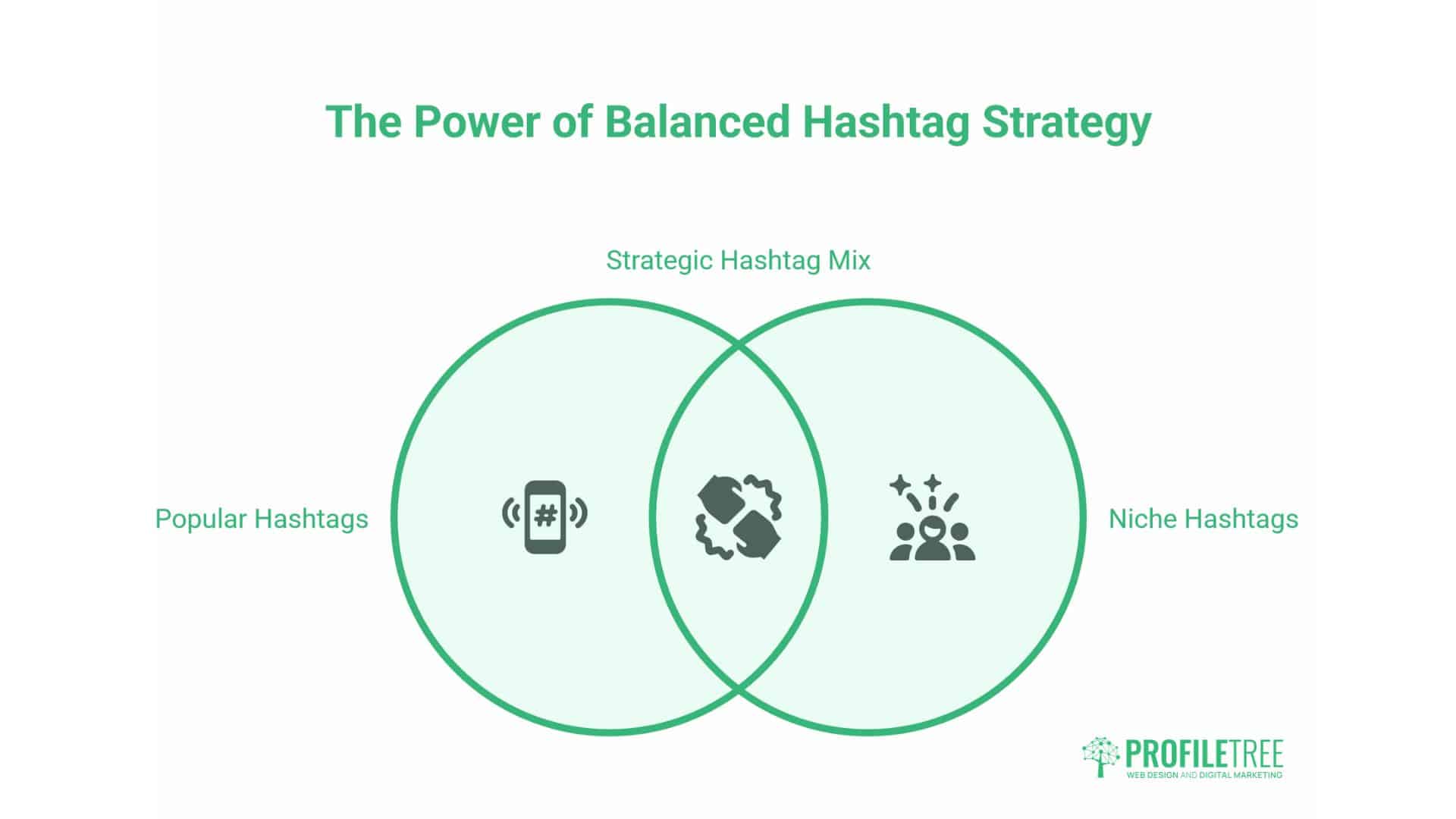
Most hashtag advice tells you to “mix popular and niche tags.” That’s unhelpfully vague. Our framework offers a structured approach that strikes a balance between reach and relevance.
This isn’t a one-size-fits-all solution. We adapt the proportions based on your account size, industry competitiveness and growth goals. But the underlying principle remains constant: layer different hashtag types to maximise your chances of visibility at every level.
Tier 1: Foundation Tags (Broad Categorisation)
Composition: 10-20% of your total hashtags per post
Volume range: 1 million to 5 million posts
Primary function: Platform categorisation and initial content distribution
Foundation tags inform Instagram, LinkedIn, or TikTok about the content’s primary subject matter at the highest level. Think #DigitalMarketing, #SmallBusiness, #ContentCreation.
These tags move quickly. Your post might appear in the “Recent” feed for 30 seconds before being pushed down by newer content. The goal isn’t sustained visibility—it’s to signal to the algorithm what category your post belongs in.
When to use more Tier 1 tags: If you’re an established account with strong engagement rates, you have a better chance of breaking into these competitive spaces. New accounts should use these sparingly.
Tier 2: The Sweet Spot (Community Engagement)
Composition: 50-60% of your total hashtags per post
Volume range: 50,000 to 500,000 posts
Primary function: “Top Posts” placement and sustained visibility
This is where most of your hashtag strategy lives. Tier 2 tags have active communities but aren’t so saturated that your content disappears instantly.
The strategy here is to dominate. If you can generate enough early engagement (saves, shares, comments), your post can reach the “Top Posts” section of these hashtags. Once there, it stays visible for hours or even days, not seconds.
Examples for UK businesses: #MarketingAgencyUK, #BelfastSmallBusiness, #UKEntrepreneur, #DigitalStrategyNI
How we identify strong Tier 2 candidates:
We analyse the “Top Posts” section of potential hashtags. If the leading posts have engagement rates similar to yours, you have a realistic chance of ranking. If they all have 10x your typical engagement, we move to smaller alternatives.
Tier 3: Niche Identifiers (High-Intent Connections)
Composition: 20-30% of your total hashtags per post
Volume range: Under 50,000 posts
Primary function: Attracting qualified prospects and building community
These are your secret weapons. Tier 3 hashtags connect you with particular audiences—people who are actively interested in your exact offering or location.
Examples: #BelfastWebDesign, #NIStartups, #LondonberryBusiness, your branded hashtag (#YourCompanyName)
The search volume is lower, but the intent is far higher. Someone browsing #BelfastWebDesign is likely comparing local agencies. Someone using #NIStartups might be looking for collaboration opportunities or service providers.
Building Your Branded Hashtag: Every business should have a unique, branded hashtag. This creates a searchable archive of your content and enables user-generated content campaigns. Make it short, memorable and distinctive. Monitor it regularly to engage with users.
The Relevancy Check: Visual Alignment
Before finalising any hashtag, we conduct a visual audit. We search the tag and review the “Top Posts” section. If the leading content doesn’t visually resemble your post, we remove it.
Why does this matter? Instagram utilises image recognition technology to verify the relevance of hashtags. If you post a professional headshot with #NatureLover, the mismatch reduces your reach. The algorithm assumes you’re using irrelevant tags to game the system.
Platform-Specific Hashtag Strategies
The rules change depending on where you post. What works on Instagram fails on LinkedIn. TikTok treats hashtags almost like SEO keywords. Understanding these nuances determines whether your hashtag strategy succeeds or wastes effort.
We tailor hashtag approaches to each platform’s algorithm and user behaviour. This section breaks down the specific tactics that drive results on the platforms UK businesses use most.
Instagram: Balancing Volume and Relevance
Instagram allows up to 30 hashtags per post. The common question: Should you use all 30?
Our recommendation: Use 15-25 hashtags, placed in the first comment rather than the caption. This keeps your caption clean while maintaining full hashtag functionality.
Why the first comment works: Instagram indexes hashtags from the first comment identically to caption hashtags. The difference is purely aesthetic—your post looks more professional without a wall of blue text.
Reels require different hashtags: as a separate content type. Your standard post hashtags won’t perform well on Reels. Focus on trending hashtags and entertainment-related tags (#Trending, #ViralReels, #UKTikTok) alongside your niche tags.
Stories are searchable: Hashtags and location tags in Stories make your content discoverable. Use 1-3 relevant hashtags per Story, placed where they don’t obscure your content.
LinkedIn: Professional Targeting and Thought Leadership
LinkedIn recommends 3-5 hashtags per post. This isn’t arbitrary—their algorithm penalises posts that use more.
The strategy difference:LinkedIn hashtags work more like subscriptions. Users follow hashtags to see relevant content in their feed. Your goal is to appear in followed hashtag feeds, not just searches.
Choose hashtags people follow: Before using a hashtag on LinkedIn, check its follower count. #Marketing has millions of followers. #MarketingUK narrows it to your region. #B2BMarketingNI gets hyper-specific.
Mix industry and functional tags: Combine what you do (#SEO, #WebDevelopment) with who you serve (#SMEGrowth, #UKBusinessOwners). This dual targeting increases your relevance to decision-makers.
Create thought leadership hashtags: If you publish regular content on specific topics, consider establishing your own hashtag series. #ProfileTreeTips or #DigitalGrowthNI positions you as a consistent voice in that space.
TikTok: Keywords Disguised as Hashtags
TikTok’s search function treats hashtags almost like traditional keywords. The platform recommends content based on what users search for, not just what they follow.
Use descriptive hashtags: #WebDesignTips performs better than #WebDesign because it matches how people search. They’re looking for specific information, not broad categories.
Front-load your most essential tags: TikTok displays a limited amount of caption text before the “More” button. Place your primary hashtags at the beginning, so they’re immediately visible.
Ride trending waves carefully: Trending TikTok hashtags can boost visibility but attract irrelevant audiences. Only use trending tags if you can naturally tie them to your content. Forced connections damage credibility.
Balance viral and niche: Use 3-5 hashtags total. Include one broad/trending tag, two industry-specific tags, and one location tag if relevant.
Facebook: The Declining Role of Hashtags
Facebook’s algorithm doesn’t prioritise hashtag discovery the way other platforms do. Posts perform based on engagement and sharing, not hashtag visibility.
When to use Facebook hashtags:
- Event promotion (creates a searchable hub for event content)
- Brand campaigns (tracks user-generated content across posts)
- Public groups (helps members find relevant discussions)
When to skip them: Regular business posts and ads. They add no value and make your content look cluttered.
Twitter/X: Real-Time Conversation Joining
Twitter hashtags facilitate joining existing conversations rather than creating discovery opportunities.
Use 1-2 hashtags at most: Using more than this can reduce engagement. Twitter users find heavy hashtag use spammy.
Join trending conversations: Check trending topics daily. If you can add value to a trending conversation, use that hashtag. Please don’t force it.
Event hashtags dominate: Twitter hashtags excel during live events, conferences and broadcasts. Create event-specific hashtags and encourage attendees to use them.
Measuring Hashtag Performance and Continuous Optimisation
Posting with hashtags is just the beginning. The businesses that see sustained growth are those that analyse performance data and refine their approach.
A professional hashtag strategy requires ongoing measurement. We track which combinations drive impressions, which attract engaged followers, and which contribute to conversions. This data informs future content decisions and reveals opportunities competitors miss.
Key Performance Indicators for Hashtag Success
Impressions from hashtags: Most social platforms break down impressions by source. Check the percentage that comes from hashtags versus your followers or the Explore page.
Target: For established accounts, 20-40% of impressions should come from hashtags. Lower percentages suggest poor hashtag selection or shadowbanning issues.
Engagement rate on hashtag content: Track likes, comments, saves and shares on posts with different hashtag combinations.
Target: Compare engagement rates between similar posts with different hashtag sets. A 25% difference indicates one set significantly outperforms the other.
Follower quality: Monitor follower growth during campaigns with specific hashtag strategies. More importantly, check whether new followers engage with future content.
Target: New followers should have engagement rates within 30% of your existing audience. Significant gaps suggest you’re attracting the wrong people.
Conversion attribution: Utilise UTM parameters and campaign tracking to link hashtag strategies with website traffic, inquiries, and sales.
Target: This varies by industry, but hashtag-driven traffic should convert at least 60% as well as other social traffic sources.
Tools and Methods for Hashtag Analysis
We use a combination of native platform insights and third-party tools:
- Instagram Insights: Shows individual hashtag performance, impressions from hashtags, and reach breakdowns.
- LinkedIn Analytics:Tracks engagement on posts with specific hashtags and shows which hashtags your audience follows.
- Sprout Social or Hootsuite: Provides cross-platform hashtag tracking, competitor hashtag analysis, and performance benchmarking.
- Manual tracking spreadsheets: For complete control, maintain a spreadsheet that logs the hashtags you use on each post, alongside performance metrics. This reveals patterns platform analytics might miss.
The Monthly Hashtag Audit Process
Every 30 days, review your hashtag strategy:
- Identify your top performers: Which 10 hashtags generated the most impressions and engagement? Keep these in your core rotation.
- Eliminate dead weight: Remove tags that consistently underperform or attract bot engagement.
- Test new candidates: Add 2-3 new hashtags per post to expand your effective options continually.
- Check for banned hashtags: Platforms regularly update their lists of banned hashtags. A previously safe tag might now be restricted.
- Adjust tier proportions: If you’re seeing consistent engagement growth, you can shift toward more Tier 2 and fewer Tier 3 tags. Your increased authority lets you compete in busier spaces.
Common Hashtag Mistakes and How to Avoid Them
- Using banned or restricted hashtags: Even one banned hashtag can prevent your entire post from appearing in any hashtag feeds.
- Solution: Use a hashtag checker tool before adding new tags to your rotation. Instagram doesn’t publicise its banned hashtag list, but community-maintained databases exist.
- Solution: Use a hashtag checker tool before adding new tags to your rotation. Instagram doesn’t publicise its banned hashtag list, but community-maintained databases exist.
- Repeating identical hashtag sets: Using the same 30 hashtags on every post signals spam behaviour to algorithms.
- Solution: Create 4-5 different hashtag sets for different content themes. Rotate between them based on what you’re posting.
- Solution: Create 4-5 different hashtag sets for different content themes. Rotate between them based on what you’re posting.
- Ignoring regional specificity: If you serve UK customers, international hashtags dilute your reach.
- Solution: Always include location-specific tags. #UKBusiness, #NorthernIrelandSmallBiz, #BelfastMarketing all filter for regional audiences.
- Solution: Always include location-specific tags. #UKBusiness, #NorthernIrelandSmallBiz, #BelfastMarketing all filter for regional audiences.
- Chasing follower count over engagement: High-volume hashtags attract bots and inactive accounts.
- Solution: Review the profiles of people engaging with your hashtagged content. If you notice patterns of bot activity, consider moving to smaller, more engaged communities.
The UK Localisation Factor: Spelling and Geographic Targeting
One critical consideration for UK businesses: the use of British English versus American English in hashtags.
The spelling divide: #Optimisation (UK) and # Optimisation (US) represent different audiences. The US spelling has a higher global volume but attracts predominantly American users.
Strategic choice: If you serve UK clients exclusively, prioritise British spelling variants. You’ll have smaller audience pools but far higher geographic relevance.
Examples of UK-specific hashtags:
- #Jewellery (UK) vs #Jewelry (US)
- #DigitalMarketingUK vs #DigitalMarketing
- #SmallBizUK vs #SmallBusiness
- #BelfastBusiness, #LondonStartup, #ManchesterMarketing
Regional community tags: Every UK region has established business hashtags. Research and use these to connect with local networks:
Northern Ireland: #NIBusiness, #BelfastSmallBusiness, #NorthernIrelandEntrepreneur Scotland: #ScotlandBusiness, #GlasgowStartups, #EdinburghMarketing
Wales: #WalesSmallBusiness, #CardiffEntrepreneur England: #LondonSmallBiz, #ManchesterBusiness, #BirminghamStartup
Integrating Hashtags Into Your Broader Content Strategy
Hashtags shouldn’t exist in isolation. They work best when integrated with your overall content marketing approach.
Content calendar alignment: Plan hashtags alongside your content. If you’re running a campaign centred on a specific theme, create a dedicated hashtag set for that campaign.
Blog content connection: When you publish blog posts, create social posts promoting them with hashtags related to the article topic. This drives social traffic to your website.
Video content hashtags: Video posts (such as Reels, TikToks, and YouTube Shorts) require different hashtag strategies. Focus on entertainment and trending tags alongside your niche markers.
User-generated content campaigns: Encourage customers to use your branded hashtag when posting about your products or services. Feature this content on your profiles to build community and social proof.
Cross-promotion consistency: Use consistent hashtags across platforms when promoting the duplicate content. This builds recognition and makes it easier to track campaign performance.
When to Consider Professional Hashtag Strategy Services
Several scenarios indicate you’d benefit from professional support:
- You’re not seeing growth despite consistent posting: If your follower count is stagnant and engagement remains flat, your hashtag strategy likely needs attention.
- You’re entering a competitive market: New businesses in saturated industries need strategic hashtag planning to break through the noise.
- You’re expanding to new platforms: Each platform requires different approaches. Professional guidance prevents costly trial-and-error.
- Your team lacks time for research and testing: An Effective hashtag strategy requires ongoing analysis. If you don’t have dedicated resources, outsourcing can be a sensible option.
- You’re running paid campaigns: Hashtags can enhance paid social campaigns by improving organic reach alongside paid distribution.
Taking Action on Your Hashtag Strategy
An effective hashtag strategy requires ongoing attention, testing and refinement. The businesses that succeed are those that treat hashtags as a key component of their social media approach, not an afterthought.
Start by auditing your current hashtag usage. Review your last 20 posts and identify patterns. Are you using the same tags repeatedly? Are they too broad or too niche? Do they reflect British or American spelling?
Next, implement the 3-tier framework. Build hashtag sets that include foundation tags (10-20%), community tags (50-60%), and niche identifiers (20-30%). Test different combinations and track which drives the best performance.
Finally, commit to monthly reviews. Social media moves quickly. What works today might underperform next month. Regular optimisation keeps your strategy effective as algorithms and trends evolve.
FAQs
How many hashtags should I use on Instagram in 2026?
Between 15 and 25 hashtags per post deliver optimal results for most accounts. Place them in the first comment to keep your caption clean. Using all 30 available hashtags doesn’t improve performance and may trigger spam filters.
Do hashtags still work on Instagram?
Yes, but their function has evolved. Instagram’s algorithm prioritises relevance over volume. Strategic, targeted hashtags that match your content and audience perform well. Random, generic hashtags provide minimal benefit.
What is the 3 hashtag rule?
The “3 hashtag rule” suggests using just three highly relevant hashtags rather than maximising the allowed number. While this approach can be practical for established accounts with strong engagement, most businesses benefit from the expanded reach of 15-25 strategically selected hashtags.
Should I use the same hashtags on every post?
No. Repeating identical hashtag sets signals spam behaviour to algorithms and limits your content’s reach. Create 4-5 different hashtag sets for various content themes and rotate between them.
Effective social media marketing requires understanding which hashtags help content reach target audiences. ProfileTree’s content marketing and social media services create engaging posts optimised for platform algorithms and audience behaviour. We produce video content, animation, and visual assets designed for social platforms, while our SEO expertise informs content topics that resonate with your audience.
Whether you need a complete social media overhaul or targeted hashtag strategy development, our team brings data-driven expertise to every project. Contact us to discuss how our content marketing, video production, and digital strategy services support your social media goals.