
Video SEO: How to Rank Videos in Google, YouTube and AI Search
Table of Contents
Video now surfaces in more places than the Videos tab. It appears in the main organic carousel, inside AI Overviews, in the mobile Short Videos strip, and increasingly inside answers generated by AI assistants that never show a blue link at all.
Most businesses upload, embed and hope. The gap between publishing a video and ranking one is almost entirely technical, and it is a gap that regional agencies and SMEs can close faster than they expect.
This guide walks through how Google indexes video, the schema and sitemap work that decides whether your content gets seen, the on-page signals that separate a click from a scroll, what changes when you are targeting UK and Irish searchers, and how to judge whether any of it is paying for itself.
How Video SEO Works Across Google, YouTube and AI Search
Video SEO is the practice of optimising video content so it can be found, understood and surfaced by search systems. Three of those systems now matter, and they behave differently enough that a strategy built for one will underperform on the other two. The sections below separate them out.
Why Google and YouTube Rank Videos Differently
YouTube runs its own index and its own ranking model. Watch time, click-through rate, engagement signals and subscriber behaviour drive almost everything. Google’s main index treats video as one format among many, weighing structured data, hosting quality, page speed and whether the page satisfies the query.
The practical consequence catches people out. A video can sit at the top of YouTube search and be entirely absent from Google, or the reverse. Businesses that optimise only for the platform algorithm miss the second opportunity completely, which is why understanding how the YouTube algorithm evaluates a channel should sit alongside, not instead of, your on-site work.
Treat them as two channels that support each other. YouTube builds reach and brand recall. Google video results bring qualified searchers to pages you control.
Where Indexed Video Appears in Search Results
Once a video is indexed, several placements open up. The Videos tab is the obvious one, but the organic carousel on the main results page usually carries more commercial weight because it appears above most text results for how-to, tutorial and review queries.
AI Overviews increasingly cite video alongside written sources. The mobile Short Videos carousel pulls from TikTok, YouTube Shorts and Instagram Reels for content under 60 seconds. Google Images can surface your thumbnail independently of the video itself.
Each placement has its own entry requirements, and they overlap with how search handles other media formats. Anyone auditing a content library will find it quicker to review images, video and audio as a single optimisation job rather than treating video as an isolated project.
How AI Answer Engines Read Video Content
AI systems do not watch videos. They read whatever text is attached to it: the transcript, the caption file, the on-page description, and the structured data. A video with a clean, accurate transcript gives an answer engine something to quote. A video with auto-generated captions full of errors gives it nothing usable.
This is the same shift that reshaped conversational search a few years ago, when queries stopped looking like keyword strings and started looking like questions. The groundwork laid for voice search optimisation applies almost directly here: answer a specific question early, phrase it the way a person would, and keep the answer self-contained.
The practical rule is simple. If a paragraph of your transcript could stand alone as an answer, it can be cited. If it only makes sense with the video playing, it cannot.
Technical Video SEO: Schema, Sitemaps and Indexing
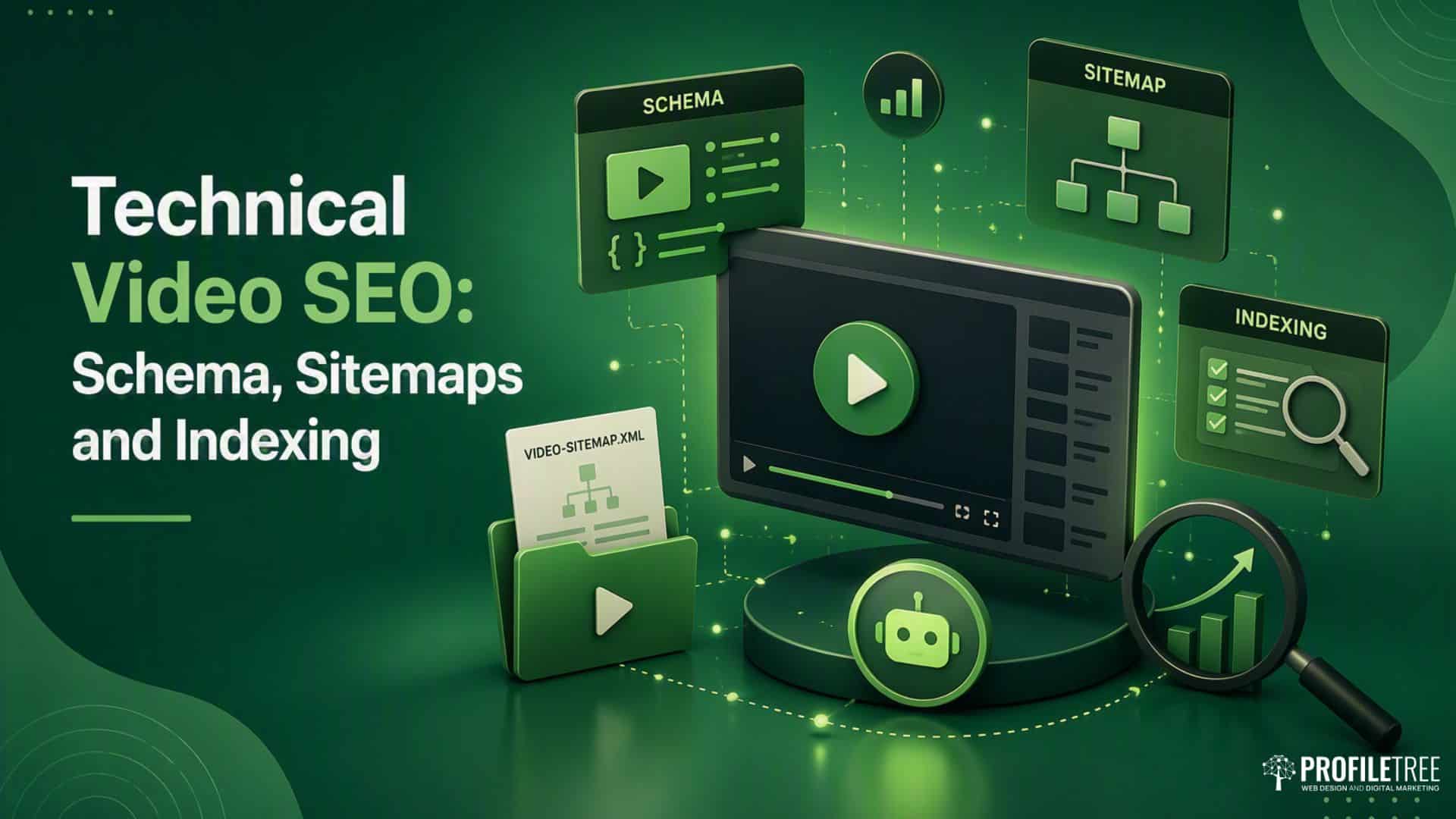
This is where most guides thin out, and it is also where most of the ranking opportunity sits. None of it is difficult, but the implementation details decide whether Google can index your video at all. What follows covers the four pieces that matter.
Building a VideoObject Schema That Validates The
The VideoObject schema tells Google what a video contains without requiring it to guess from surrounding page content. It is the single highest-value technical step in video SEO, and it is also the one most commonly implemented badly.
Here is a clean JSON-LD block to adapt:
{
  "@context": "https://schema.org",
  "@type": "VideoObject",
  "name": "Your Video Title Here",
  "description": "A 150 to 300 word description matching your on-page copy.",
  "thumbnailUrl": "https://yoursite.com/images/video-thumbnail.jpg",
  "uploadDate": "2026-03-15T08:00:00+00:00",
  "duration": "PT4M30S",
  "contentUrl": "https://www.youtube.com/watch?v=YOUR_VIDEO_ID",
  "embedUrl": "https://www.youtube.com/embed/YOUR_VIDEO_ID",
  "publisher": {
    "@type": "Organization",
    "name": "Your Company Name",
    "logo": {
      "@type": "ImageObject",
      "url": "https://yoursite.com/logo.png"
    }
  }
}
Three fields cause most failures. duration uses ISO 8601 format, which PT4M30S means four minutes thirty seconds. thumbnailUrl must point at a publicly reachable image on a stable URL, not a CDN address that expires. uploadDate must match the actual upload, not the page publication date. Automated plugins frequently get at least one of these wrong, which is a routine finding in technical SEO audits for sites that publish video regularly. Validate the output in Google’s Rich Results Test before assuming anything works.
Key Moments and Chapter Markup
Videos longer than three or four minutes benefit from Key Moments, which display chapter markers directly inside the search result and give your listing more vertical space. Google adds these through the hasPart property:
"hasPart": [
  {
    "@type": "Clip",
    "name": "Keyword Research",
    "startOffset": 46,
    "endOffset": 180,
    "url": "https://www.youtube.com/watch?v=YOUR_VIDEO_ID&t=46s"
  }
]
For YouTube-hosted content, there is a shortcut. Timestamps written into the video description, formatted as 0:00 Introduction, 0:46 Keyword Research, get picked up automatically. Most teams should start there and only move to structured data if they need finer control.
Chapters also change how a video gets scripted. Planning distinct, labelled segments before filming produces cleaner markup afterwards, which is one reason a video production process built around search intent tends to outperform footage shot first and optimised later.
Video Sitemaps and When You Actually Need One
A video sitemap is an XML file listing every page containing video, with metadata mirroring your VideoObject markup. Google’s documentation sets out the required tags, and its full video SEO best practices guidance covers the indexing criteria a watch page has to meet before any of it counts.
You do not need one for YouTube embeds. Google crawls the iframe and pulls metadata from YouTube’s own schema. You do need one for self-hosted files, and for video served from Vimeo or Wistia, where the player sits on your domain.
Building and maintaining the file is a development task rather than a marketing one, since it needs to regenerate whenever new video pages are published. Sites that handle this well usually have it wired into the build process by their web development team rather than updated by hand.
Diagnosing Failures in the Video Indexing Report
Google Search Console has a video indexing report that almost nobody opens. It lists pages where a video was found and indexed, pages where a video was found but rejected, and the specific reason for each rejection.
The recurring failures are predictable: no video found because the embed could not be crawled, video not accessible because it sits behind a login, no thumbnail URL supplied, and no duration supplied. Every one of these is fixable through structured data or a hosting configuration.
Check this report before commissioning anything new. There is no point in producing more video if the existing library is invisible, and the same principle applies across a site, which is why a broad website audit usually precedes any content investment.
Video SEO Best Practices for Titles, Captions and Thumbnails
Technical work gets a video into the index. On-page and on-platform optimisation decides how it performs once it is there. Three elements do most of the heavy lifting, and each of them serves both the algorithm and the person deciding whether to click.
Writing Titles and Descriptions That Earn the Click
A video title works as a ranking signal and a click trigger at the same time. Lead with the primary keyword, describe the content accurately enough that expectations match reality, and give the searcher a reason to choose you over the six other results on screen.
Where a YouTube video is also embedded on your site, the YouTube title becomes the title Google reads unless your VideoObject schema overrides it. Set the schema title deliberately.
Descriptions do double duty. They give crawlers indexable text and give viewers enough context to commit a few minutes. Write the first two sentences as a standalone summary, because that is all anyone sees before the truncation point. Demonstration-led sectors show this clearly: video marketing for food businesses lives or dies on whether the first line tells someone what they are about to watch.
Do Captions Help Video SEO?
Yes, and the mechanism is worth understanding. Search engines cannot watch footage. They read text. Captions supply a complete textual representation of everything said on screen, which multiplies the surface area available for ranking well beyond a title and a description.
YouTube generates automatic captions for every upload. They are indexable, and they are often wrong, particularly with technical vocabulary, product names, or Northern Irish and Irish accents. Uploading a corrected SRT file takes minutes and removes the risk entirely.
Full transcripts published on the page itself add more indexable content and improve accessibility for people who would rather read than watch. Teams handling this in-house pick it up quickly through digital marketing training rather than outsourcing every caption file.
Thumbnail Design and Click-Through Rate
Thumbnails drive click-through rate, and click-through rate feeds engagement signals across every platform. Auto-generated thumbnails, which are effectively a random mid-sentence freeze frame, underperform custom designs consistently.
A thumbnail that works has one clear focal point, strong colour contrast, and either a short text overlay for instructional content or an image that communicates value instantly. Consistency across a library builds recognition, so viewers start identifying your content before they read the title.
The scale of the opportunity is easy to underestimate until you look at the numbers behind the platform. The YouTube statistics on audience reach make the case that even a modest improvement in click-through rate compounds across a channel.
Local Video SEO for the UK and Irish Market
Almost every guide ranking for video SEO is written for a US audience, which leaves genuine gaps when the advice is applied in Belfast, Dublin, Manchester or Glasgow. Regional search behaviour, compliance obligations and competitive density all differ. This section covers what changes.
Regional Search Behaviour Across Northern Ireland and Ireland
Search patterns in Northern Ireland differ from both the Republic and Great Britain. Vernacular varies, commercial terminology varies, and some service categories carry different local conventions entirely. Video content aimed at Northern Irish viewers should reflect that in on-screen language, examples and the geotargeting applied in platform audience settings.
Locally grounded footage performs better. Recognisable locations, references to regional trading conditions and interviews with local business owners give a video specificity that generic stock cannot match. Travel publishers demonstrate the principle at scale: ConnollyCove’s coverage of what to do in Belfast pairs filmed material with detailed written context, which is exactly the combination search systems reward.
Local visibility also depends on the signals surrounding your content. Consistent business details across free business listing sites reinforce the geographic association that helps regional video surface for location-qualified queries.
Short-Form Vertical Video and the Mobile Carousel
Google began pulling TikTok clips and YouTube Shorts into a mobile Short Videos carousel from 2023 onwards. It appears across a wide query range and remains mobile-only; desktop searches do not show it.
Ranking signals here diverge sharply from standard video indexing. Google draws mainly on platform engagement data such as views, shares and saves rather than page-level schema, which makes short-form a platform optimisation exercise rather than a technical one. For Shorts, put the keyword in the title, write at least three sentences of description, and deliver something useful within three seconds.
The commercial gap in Northern Ireland and Ireland is wide. Very few regional service businesses produce short-form content with any search intent behind it, and the barrier to entry is a smartphone and decent lighting. Deciding how the two formats feed each other is the harder question, and the case for balancing short-form and long-form video comes down to reaching the top and revenue further down.
Hosting, GDPR and Compliance for UK Businesses
Video hosted outside the UK or EEA falls under GDPR wherever viewer data is collected. YouTube and Vimeo both offer privacy-enhanced embed options and cookie consent modes, but responsibility for correct implementation sits with the site owner, not the platform.
If your site runs a consent solution, embeds must respect the consent state before any tracking script loads. That usually means lazy-loading the player and swapping in the real iframe only after acceptance, which is a front-end implementation detail rather than a marketing setting.
Regulated sectors carry an extra layer. Financial services, healthcare and legal firms should treat video on owned channels as subject to the same advertising rules as written material, because ASA guidance does not stop at paid media.
Choosing a Platform and Measuring Video SEO Results
Hosting choice affects both search performance and page speed, and neither is reversible cheaply once a library is built. Measurement is where most video programmes fall apart, usually because the wrong number gets reported. The three subsections below cover the decision, the metrics and the timeline.
Hosting Comparison: YouTube, Vimeo, Wistia and Self-Hosting
| Platform | SEO impact | Cost | CTA control | Page load |
|---|---|---|---|---|
| YouTube | Strong Google integration, schema often auto-detected | Free | Limited | Fast (CDN) |
| Vimeo | Good schema support, clean embeds | From £7/month | Moderate | Fast (CDN) |
| Wistia | Returns engagement data to your own analytics | From £79/month | Extensive | Fast (CDN) |
| Self-hosted | Full control, sitemap required | Hosting costs | Full | Slow without CDN |
Self-hosting large video files on a standard server is the one option to rule out immediately. File sizes routinely cause Largest Contentful Paint failures, and the Core Web Vitals penalty tends to cost more in rankings than the video gains. If you want full control, serve through a CDN or use a managed platform.
Choose by objective. YouTube for reach and brand discovery, Wistia when the priority is driving traffic and conversions on pages you own, and Vimeo as a middle option. Whichever you pick, the hosting decision needs to sit inside a wider search strategy rather than being made in isolation by whoever uploads the files.
The Metrics That Show Commercial Return
View count tells you how many people started watching. It says nothing about whether watching changed anything commercially, and reporting it as a headline number is how video budgets get cut.
Four numbers do carry weight. Click-through rate from search results, visible in Search Console, tells you whether your title and thumbnail are working. Average view duration and watch time, tracked in YouTube Studio, indicate whether the content holds attention. Traffic from video to site, tagged with UTM parameters in descriptions, shows real referral value. Conversion rate on pages with embedded video, compared against equivalent pages without, is the only figure that connects video to revenue.
Vanity metrics have a long history of misleading marketing teams, and the industry has been through this before with retired ranking metrics like Alexa Rank. Pick numbers you can act on.
Setting Realistic Timelines for a Video SEO Strategy
Google indexes video within roughly 24 to 72 hours of crawling the page, assuming the schema validates. That part is fast and gives an early signal that the technical foundation holds.
YouTube takes longer. Expect two to four weeks before a new upload’s performance stabilises enough to judge, because the platform tests content across audience segments before settling.
Organic gains from video on your own site run slowest of all, typically two to three months, since they contribute to page-level authority rather than ranking independently. Anyone committing to a sustained video production programme should budget for a quarter before drawing conclusions. https://www.youtube-nocookie.com/embed/Tv_GSreYhBU
Where to Start
Open the video indexing report in Search Console before anything else. If existing content is not appearing there, fix the schema and hosting first, because new production will inherit the same faults. Once the technical base is solid, the rule is the same as any format: answer one question better than anyone currently does, and make it easy for search systems to understand what you have done. ProfileTree’s Belfast team works on exactly this. Get in touch to talk it through.
FAQs
What matters most for video SEO?
Valid VideoObject schema paired with an accurate transcript. Schema gets the video indexed; the transcript gives search and AI systems text they can read, quote and cite. Everything else builds on those two.
How do I get my videos cited in AI Overviews?
Publish a clean transcript on the page, write entity-rich descriptions naming the products, places and people involved, and structure answers so each one stands alone without the video playing.
Should I host video on my own site or YouTube?
YouTube for reach and brand visibility. Wistia or Vimeo when the goal is conversions on pages you control, since engagement data returns to your analytics rather than the platform’s.
Do captions help video SEO?
Yes. Captions give search engines a full text version of spoken content, which widens the range of queries a video can rank for. Correct the auto-generated file rather than relying on it.
How long should a video be for SEO?
Long enough to answer the query properly and no longer. Chapter markup makes longer content more usable in search, while anything under 60 seconds targets the mobile Short Videos carousel instead.