
AI Content Generation Marketing: A UK Strategy Guide
Table of Contents
AI content generation marketing now touches almost every stage of the content calendar, from first drafts to subject lines to product copy. The question for most Northern Ireland and UK SMEs has stopped being whether to use it and become how to use it without losing brand control, falling foul of advertising rules, or publishing content that Google and AI search engines quietly ignore.
This guide sets out a practical framework for AI content generation marketing: the workflow that keeps a human editor in charge, the tools worth paying for, the UK-specific compliance points that most generic guides skip, and a way to measure whether any of it is actually working.
What Content Generation Marketing Actually Means Now
Content generation marketing used to mean a single writer producing a blog post over several days. That definition no longer holds. Today, it covers a stack of tools and processes: large language models drafting long-form copy, automated systems producing product variants for e-commerce, and AI-assisted research replacing the manual scan of competitor sites.
The shift that matters for marketing content generation systems isn’t the novelty of the technology. It’s the move from occasional experimentation to structured, repeatable production. A business running a marketing content generation system properly has documented brand voice rules, an approval step before anything is published, and a way of tracking whether AI-assisted pages perform as well as the human-written ones they sit alongside.
Brand content generation, in particular, depends on this structure. Feed a model generic instructions, and it produces generic copy that reads like every other AI-assisted page on the internet. Feed it a documented voice, real examples of past work, and a clear brief, and the output starts to sound like the business rather than like the model. That distinction, more than any single tool choice, determines whether AI content-generation marketing helps a brand or quietly erodes it. A separate comparison of AI content generation platforms covers the available tools in more depth than this guide can.
Why This Matters for UK SMEs Right Now
For a Northern Ireland SME or a wider UK SME, the case for content-generation marketing rests on three practical pressures rather than hype. Competitors are publishing more often. Search and AI answer engines increasingly reward businesses that cover a topic from several angles rather than one thin page. And marketing budgets, particularly for SMEs, rarely stretch to a large in-house writing team.
None of that means publishing AI output unchecked. It means using automation for the parts of content production that genuinely benefit from speed (first drafts, variant generation, research aggregation) while keeping a human firmly in charge of anything that touches a factual claim, a legal position, or the brand’s public voice. A digital marketing strategy built around this split tends to hold up better than one that treats AI as a shortcut around planning.
The Human-in-the-Loop Workflow
A workable content-generation marketing process has five stages, and skipping any of them is where most visible failures begin.
Ideation and briefing. Start with a real content gap, not a random topic. Pull data from Google Search Console and Bing Webmaster Tools to see which queries already bring traffic without a click-through, and brief the AI tool with that specific gap rather than a generic prompt.
Prompt engineering with brand context. A documented brand voice guide, fed into the prompt alongside examples of strong past content, produces noticeably better first drafts than a bare instruction. This is where generative AI content strategy either succeeds or fails; the model can only reflect the context it’s given.
AI drafting. The model produces a full draft rather than a bullet-point outline. Treat this as raw material, not a finished article.
Editorial fact-checking. Every statistic, quote, and specific claim gets checked against a real source before it goes further. AI models can state incorrect information with total confidence, and an unverified claim in a published article is a bigger reputational risk than a slower publishing schedule.
Brand voice and compliance review. A human editor checks the tone, removes anything that reads like every other AI-assisted page, and confirms that the piece meets UK advertising and data protection rules, as covered later in this guide.
This is also where content marketing work benefits from having a documented editorial standard rather than ad hoc judgement calls from whoever happens to be reviewing the draft that week. Businesses using SEO services alongside AI drafting tend to fold keyword and search-intent checks into the same editorial pass, rather than treating SEO as a separate, later step. A beginner’s guide to digital marketing for small businesses is a useful starting reference for teams building this workflow for the first time.
Choosing Tools for Content Generation Services
No single tool covers every content-generation marketing need, and the right stack depends as much on content type as on budget.
Large language models handle long-form drafting and research aggregation. General-purpose models are strong for creative and conversational copy; some are better suited to technical or highly structured content such as product specifications or compliance-heavy explainer pages.
Specialised marketing tools focus on shorter formats: ad copy, subject lines, and social captions, often with built-in A/B testing. Conversational tools, such as those covered in this chatbot application guide, fall into a related category, generating interactive content rather than static copy.
Visual and video tools generate imagery, video, and voice from a written brief, useful for businesses producing video marketing content at a pace a small in-house team couldn’t match alone.
For UK-based content generation services, two practical filters matter more than headline features: does the tool default to UK English rather than US spelling, and does its data processing agreement actually cover UK GDPR requirements? Skipping this check is a common reason businesses end up quietly Americanising their published copy without noticing until a client or an editor flags it.
Where AI Content Generation Marketing Delivers Most
Not every content type benefits equally from automation. Some formats suit AI-assisted drafting well; others still need a human first draft.
Blog posts and long-form guides benefit from AI-assisted outlining and first drafts, with a writer adding real examples, local context, and the specific expertise a model can’t invent. Pillar content built this way tends to hold up better under Google’s Helpful Content System than a fully automated piece.
Social media content suits automation particularly well because the volume requirement is high and the individual risk per post is low. Platform-specific adaptation, caption variation, and hashtag research are all reasonable jobs for an AI-assisted workflow, provided a human still reviews anything that touches current events or sensitive topics. A social media marketing plan that includes an AI-assisted first-draft stage, followed by a human community manager’s review, tends to preserve both speed and tone. Businesses reviewing their own social media content strategy often find this is the easiest place to start.
Email marketing gains from AI-assisted subject line testing and segment-specific variants, though the core value proposition and any pricing or offer details should always be human-checked before sending. Reviewing an email marketing platform with this in mind, rather than purely on price, saves a lot of after-the-fact correction.
Product descriptions for e-commerce are one of the strongest use cases for scale, since a model can turn a technical specification into customer-facing benefit language across hundreds of product variants. Businesses running e-commerce SEO alongside this kind of content generation and optimisation work usually see the biggest gains, since AI-assisted product copy and structured SEO data reinforce each other.
Video scripts benefit from AI-assisted structuring, particularly for recurring formats like explainer or how-to content, though delivery and tone still need a human presenter or voice.
UK Compliance: ASA, GDPR and Intellectual Property
This is the section most US-authored guides skip entirely, and it’s where a UK business genuinely needs to pay attention.
Advertising Standards Authority (ASA) and the CAP Code. There’s no blanket UK legal requirement to disclose that a specific ad was produced with AI, but the existing CAP Code rules on misleading claims, endorsements, and imagery still apply regardless of how the content was made. The ASA’s existing rules apply regardless of how content is generated, edited, or targeted, and it recommends marketers weigh up whether an audience is likely to be misled if AI involvement isn’t made clear. In practice, that means treating an AI-generated testimonial, image, or performance claim with the same scrutiny as a human-written one, not less.
UK GDPR and data privacy. The biggest practical risk for B2B marketers isn’t the published content itself but what gets fed into the AI tool to produce it. Pasting client data, unpublished pricing, or personal customer details into a public AI model can amount to a data processing decision under UK GDPR, and most standard consumer AI tool terms don’t offer the safeguards a business would need for that. Anonymise inputs, check the tool’s data processing agreement, and treat any AI platform the same way you’d treat a new data processor: with a contract, not just a login.
Intellectual property and copyright. UK copyright law on AI-generated content is in a genuine grey area, particularly regarding the authorship of fully automated output. The safest working assumption for a commercial business is that content with meaningful human authorship, editing, and judgement carries a clearer ownership position than content published exactly as the model generated it. This is one more reason the human-in-the-loop workflow above isn’t just a quality step; it’s also a legal one.
Measuring ROI on Content Generation Marketing
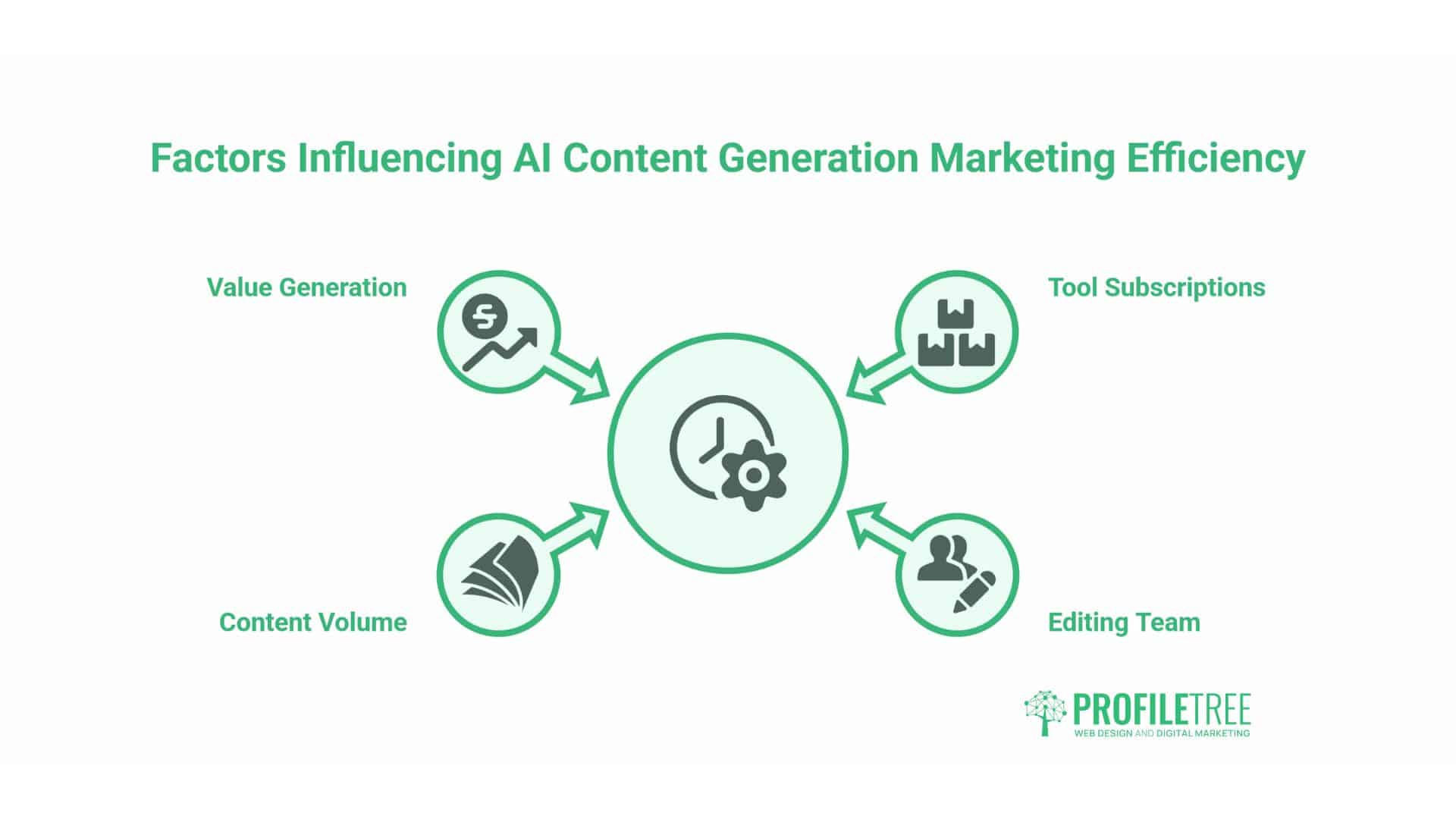
The efficiency argument for AI content generation marketing is straightforward on paper: tool subscriptions plus a smaller editing team should cost less than a fully staffed writing team producing the same volume. The harder part is measuring whether that volume is actually generating value.
A workable ROI framework needs three layers. The first is production cost: tool subscriptions, prompt engineering time, and editorial review hours per piece. The second is content performance: organic impressions and clicks from Google Search Console, citation counts from Bing’s AI page stats, and engagement metrics compared against a business’s existing human-written content. The third is business outcome: whether the content is actually influencing enquiries, sign-ups, or sales, which usually means tracking it through to a CRM or enquiry form rather than stopping at traffic numbers.
Businesses that skip the second layer and jump straight from cost savings to business outcomes tend to overstate the ROI of AI content generation marketing because they’re not accounting for content that’s technically cheap to produce but generates no organic visibility at all. Checking a digital marketing strategy audit against actual Search Console performance, rather than assumed production savings, gives a more honest picture, and reviewing global digital marketing benchmarks for SMEs helps set realistic expectations before comparing against competitors.
Ranking in AI Search: Generative Engine Optimisation
Search behaviour has shifted meaningfully toward AI-generated answers, and content generation and optimisation now need to account for two audiences at once: the traditional search crawler and the AI system that decides what to cite in a generated answer.
The practical difference is structural rather than stylistic. AI answer engines favour content that states a direct answer early, breaks a topic into genuinely separate sub-questions, and includes specific, checkable data rather than vague claims. Long-form guides covering multiple angles of a topic tend to get cited more often than short posts covering one narrow angle, and pages with a comparison table or a clear data point tend to outperform pages built entirely from prose.
For UK businesses specifically, there’s a further advantage available that’s rarely used: regional specificity. A guide that addresses UK advertising rules, UK GDPR, and UK-specific tool comparisons gives an AI system a reason to cite it rather than a generic US-authored guide that answers the same underlying question in a different regulatory environment. That’s the gap this guide is written to fill, and it’s a repeatable approach for any UK business producing its own content generation marketing guide for a specific niche.
Common Pitfalls in AI Content Generation Marketing
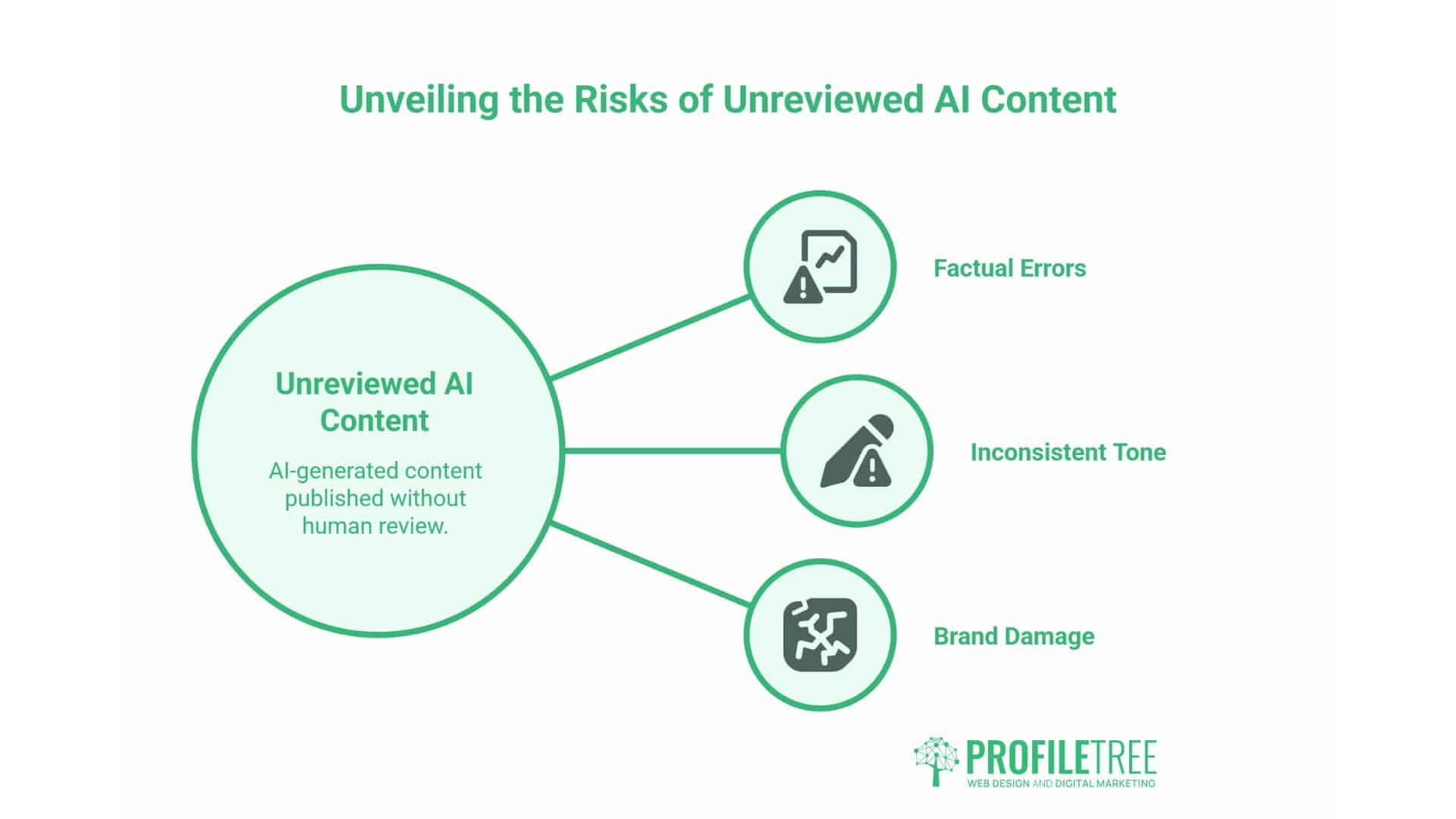
Publishing without review. Raw AI output published straight to a live page is the single biggest cause of factual errors, inconsistent tone, and brand damage. A five-minute human check catches most of the obvious problems; skipping it eventually catches up.
Generic brand voice. Content that reads exactly like every other AI-assisted page loses whatever differentiated the brand in the first place. The fix is investment in prompt engineering and a documented voice guide, not avoiding AI tools altogether. ProfileTree’s own prompt engineering guidance covers this in more depth.
Losing context in longer pieces. Models can drift or contradict an earlier point over the course of a long article. Breaking long-form content into sections, each generated with a full context of what came before, and having a human editor check for coherence across the whole piece, solves most of this.
Treating every claim as verified. A model states incorrect statistics and case studies with the same confidence as correct ones. Every non-obvious factual claim in a published piece needs a real source, no exceptions. Running finished drafts through an AI content detection check is a useful secondary signal, though it should never replace the human fact-check itself.
Over-optimising for search at the expense of the reader. Content stuffed with keyword variants and structured purely for a ranking algorithm reads poorly to an actual visitor and increasingly performs poorly with AI answer engines, which reward information density over repetition.
“AI content generation isn’t about replacing writers. It’s about giving them room to focus on strategy and judgement while AI handles a chunk of the production work,” says Ciaran Connolly, founder of ProfileTree, the Belfast-based digital agency. “We’ve worked with businesses across Northern Ireland, Ireland, and the UK to build AI content processes that keep their own voice intact rather than sounding like every other AI-assisted page.”
Businesses building out this kind of process from scratch often start with structured digital training for the team producing the content, since the workflow depends more on skilled prompting and editorial judgement than on any single piece of software. Properly tracking outcomes also matters: a framework for measuring AI ROI helps separate genuine gains from assumed savings.
Getting Started With Content Generation Marketing
Start small: social media captions or email subject lines make a lower-risk first trial than blog posts, since the volume is high and the individual risk per piece is low. Document a brand voice guide, run the five-stage workflow above, and measure it with the ROI framework before scaling to higher-stakes content. Check performance against an on-page SEO checklist or a full SEO audit to confirm AI-assisted content is improving results rather than just adding volume, and pair the rollout with WordPress SEO services or a local SEO review so the technical foundation keeps pace.
FAQs
Can AI-generated content rank on Google?
Yes, provided it’s genuinely helpful and accurate. Google’s guidance focuses on content quality and usefulness to the reader rather than the method used to produce it, so poorly edited AI content and poorly written human content face the same risk.
What’s a reasonable AI-to-human content ratio?
There’s no fixed rule. Many businesses start with AI handling first drafts and research for a minority of content types, then expand as the editorial process proves reliable. The ratio matters less than whether every piece passes the same human review standard regardless of how it started.
Will AI content damage brand voice?
Not if the model is given a documented voice guide, real examples, and a human review step. Left unchecked, AI content tends toward generic phrasing rather than active brand damage, which is still a real risk worth managing.
How do UK businesses handle AI disclosure in advertising?
There’s no blanket UK legal requirement to disclose AI involvement in an ad, but existing ASA and CAP Code rules on misleading claims and endorsements still apply. The safest approach is to check any AI-assisted claim or image against the same standards as human-produced content and disclose any genuine risk of misleading the audience.