
The Real Risks of AI Content for SEO in the UK and Ireland
Table of Contents
Google keeps saying it does not penalise AI content, yet plenty of sites that lean on it watch their traffic slide anyway. The official message is that quality matters more than how a page was made. The pattern owners keep reporting is messier than that.
The risks of AI content sit less in the writing itself and more in what the generated copy tends to lack: real experience, accurate detail, and a point of view a reader trusts. For brands trading under British and Irish rules, there is a second layer that few guides mention, from advertising standards to copyright.
This guide covers how search engines flag machine-written text, the risks that matter most for UK and Ireland brands, a human-in-the-loop workflow that protects rankings, and the authority signals that survive algorithm updates.
Why Google’s Position on AI Content Is Not What It Seems
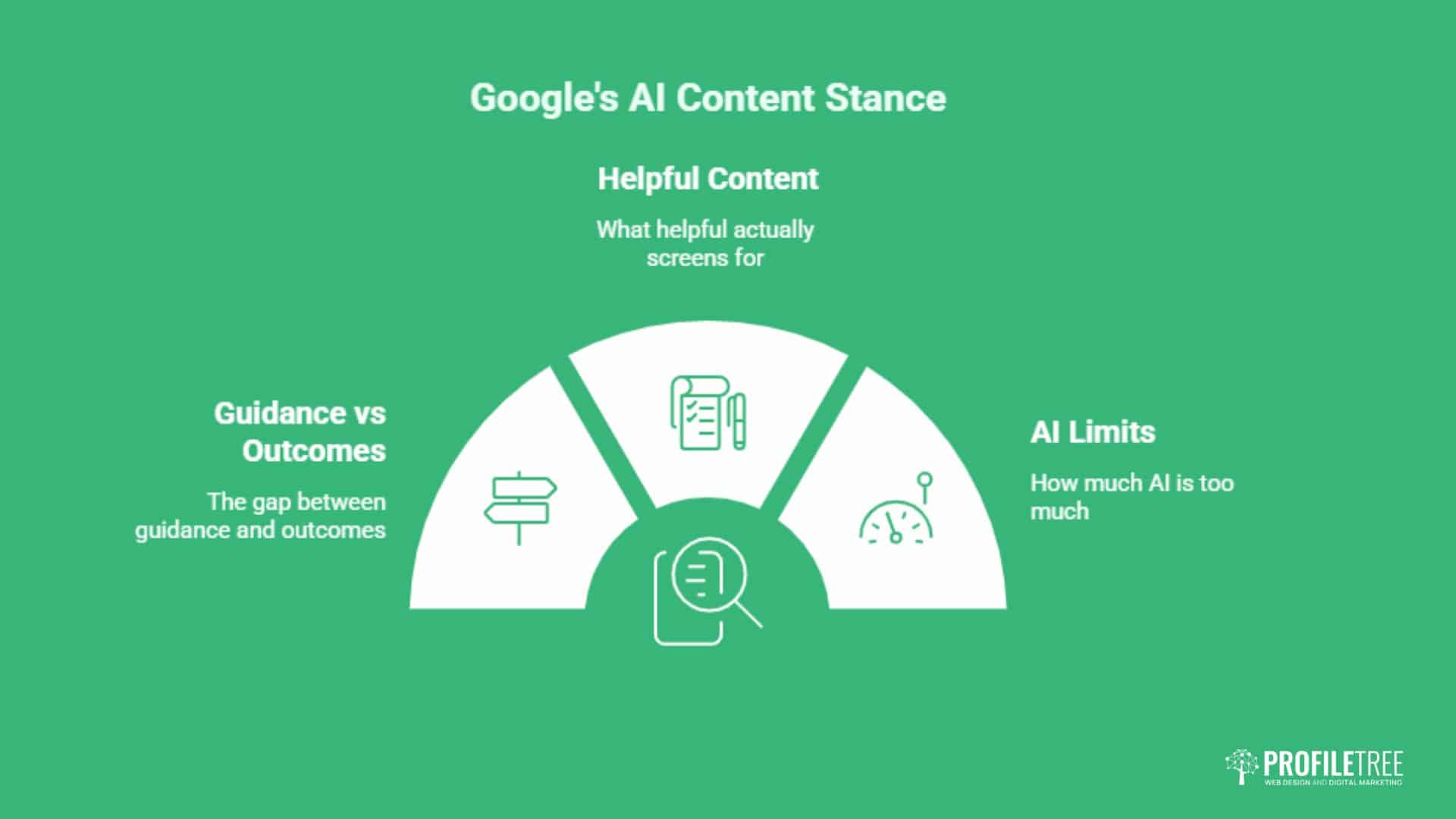
Google’s public guidance and what site owners see in their analytics do not always line up. Reading that gap correctly is the first step to using these tools without harm.
The Gap Between Guidance and Outcomes
Google’s documented position is that it rewards helpful content made for people, whatever tool produced it. In practice, sites that shifted large parts of their library to generated copy have lost visibility after core updates.
The guidance is not a green light. It is a quality test that a lot of raw AI output fails. If you want the fuller picture of what tends to go wrong, our page on wider SEO risks sets out the recurring problems.
Google would call a drop like this a re-evaluation rather than a penalty, and the distinction matters. A manual penalty can be lifted. A quality re-evaluation only reverses when the underlying content genuinely improves, which is why quick fixes so rarely restore lost positions.
There is a firmer signal in Google’s own rulebook. In March 2024, it renamed “spammy auto-generated content” to “scaled content abuse”, a policy aimed at pages produced in bulk mainly to game rankings, whether a machine, a person, or both created them.
The wording shifts the focus from method to intent and volume. Publish a handful of carefully edited AI-assisted pieces,s and you sit well outside it. Spin up hundreds of near-identical posts to chase long-tail queries and you match the exact behaviour it describes, which is why the volume, rather than the tool, is what to watch.
What “Helpful” Actually Screens For
The Helpful Content System, now folded into core ranking, looks for first-hand experience, evidence of real expertise, and information a reader cannot find in ten near-identical posts.
Generated text is good at summarising what already exists. It struggles to add the one thing that earns a citation: something genuinely new. That single limitation explains most of the ranking damage owners describe.
How Much AI Is Too Much
There is no published threshold, and anyone quoting an exact percentage is guessing. What holds up across accounts is simpler: the more your important pages depend on unedited output, the more exposed you become.
Watch the trend across several updates, not any single week. Rankings that wobble after every core refresh usually point to a quality problem the algorithm keeps re-testing. A recognised brand helps here, since sites with real branded search demand tend to hold steadier as readers seek them out by name.
Keep money pages and pillar guides human-led, and treat generated drafts as raw material rather than a finished article. Our SEO services are built around that principle.
How Search Engines Flag Machine-Written Content
Search engines rarely spell out which signals expose generated text, but the categories are well understood. They fall into three groups: patterns in the writing, behaviour from readers, and footprints across a whole site.
Patterns in the Writing Itself
Language models tend to produce even sentence lengths, predictable transitions, and steady vocabulary. Human writing is burstier: a short line, then a long, winding one that changes direction halfway through.
Automated analysis reads that uniformity at a scale no editor could match. This is the same territory covered in our guide to AI content detection, which walks through how the checks actually work.
Behavioural Signals From Real Readers
Flagging goes beyond the words on the page. If visitors land, skim, and bounce straight back to the results, that tells a search engine the page did not answer the query.
Generated copy often reads fluently while saying very little, so it collects weak engagement: short visits, few return readers, almost no shares. Over time, those signals pull a page down, whatever its keyword coverage looks like.
Footprints Across a Whole Site
Single pages are one thing; site-wide patterns are another. A library that suddenly triples its publishing rate, or repeats the same three-part shape on every post, invites closer inspection.
Depth matters here, too, since a stack of very thin pages drags on the whole domain. Our advice on content length tips explains where the useful floor sits and why padding does not help.
Internal linking gives the game away as well. Human writers link where a topic genuinely connects, so their patterns look uneven. Automated builds often link too evenly or too sparsely, and that mechanical regularity is one more thing an algorithm can measure across an entire site.
The Real Risks UK and Ireland Brands Face
The technical risks apply everywhere. What most guides miss is a second set of problems that hit brands trading under British and Irish rules, from advertising standards to copyright.
The Experience and Expertise Gap
The extra “E” in E-E-A-T, experience, was added partly to reward things a model cannot have. It has not used the product, visited the venue, or sat across a table from the client.
You can attach a name to the generated copy, but the missing lived detail shows. Google increasingly rewards pages that prove genuine expertise through specifics: costs, timings, mistakes made, and lessons learned.
Inaccuracy and the Cost of Getting It Wrong
Models state wrong facts with total confidence and sometimes invent sources outright on an ordinary blog, which is embarrassing. On a health, legal, or finance page, it becomes a trust problem that can sink the whole section.
Every generated claim needs checking against a primary source before it goes live. Treat the draft as a confident intern, not a subject expert.
The stakes climb on Your Money or Your Life topics. A wrong medication dose, tax figure, or legal deadline can harm the reader and expose the business, so these pages should carry a named reviewer with the right qualifications on top of the writer.
Advertising Rules and Misleading Claims
In the UK, the Advertising Standards Authority expects marketing to be accurate and not misleading. A model that overstates results or fabricates a review can put a brand on the wrong side of that line without anyone intending it.
The Republic of Ireland has its own equivalent in the Advertising Standards Authority for Ireland, so brands trading across both markets face two sets of expectations. Fabricated testimonials are a particular trap, since a model asked for “customer reviews” will happily invent them.
Our piece on misleading advertising claims and our overview of digital marketing ethics cover the ground in more detail.
Copyright and Data Protection Questions
Ownership of purely AI-generated work is unsettled in UK law, which matters if you ever need to defend a piece as your own. There are also data protection duties when staff paste client information into public tools.
Our comparison of copyright and trademark is a sensible starting point before you write a company policy.
A Human-in-the-Loop Workflow That Protects Rankings
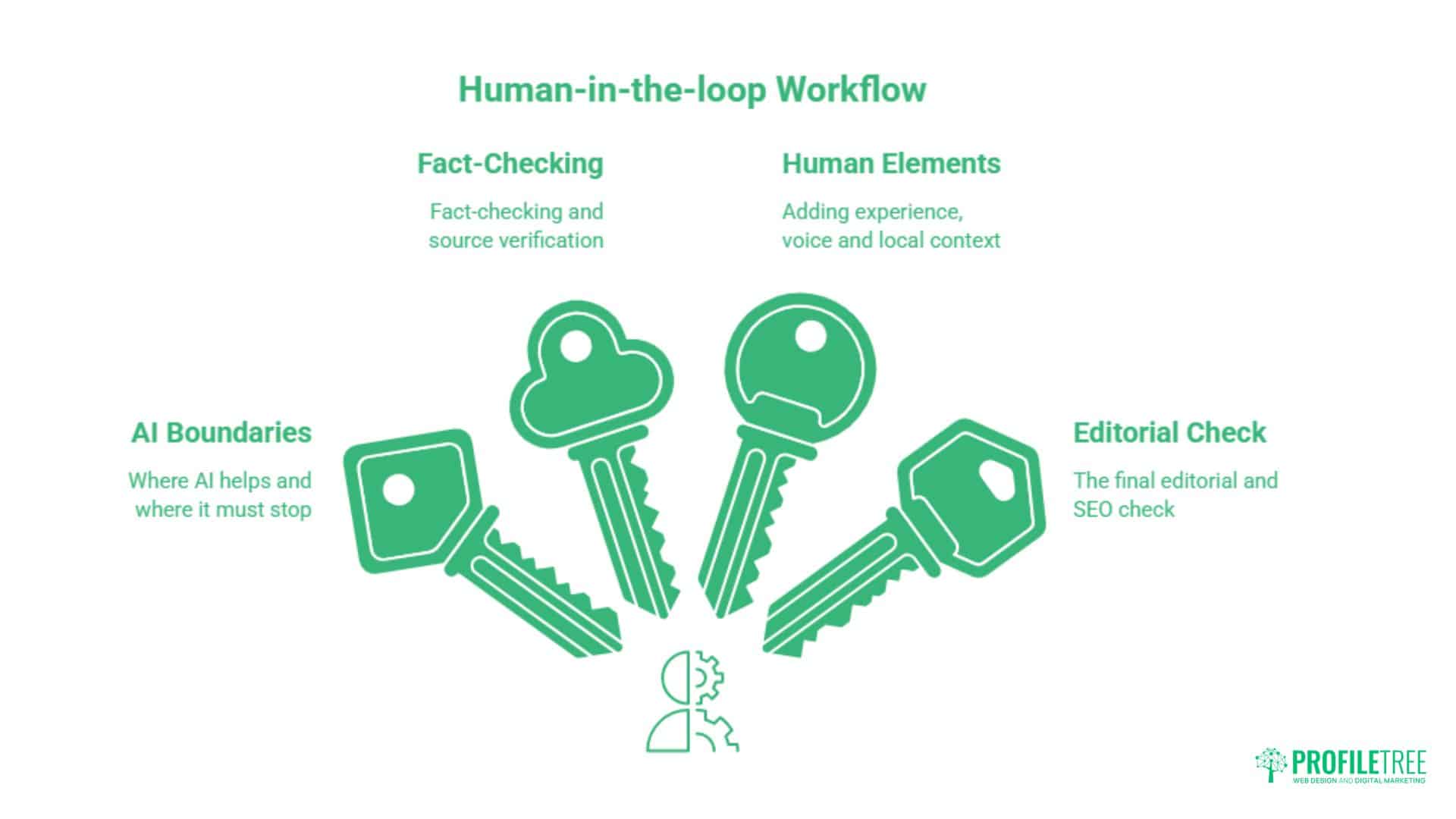
The safe path is not banning AI. It is deciding where it helps and where a person has to take over. A clear workflow keeps the speed while removing most of the risk.
| Attribute | Pure AI output | Human-in-the-loop | Effect on SEO |
|---|---|---|---|
| Factual accuracy | Confident but unchecked | Verified against sources | Protects trust signals |
| Voice and tone | Generic, uniform | Distinct brand voice | Improves engagement |
| Information gain | Repeats existing pages | Adds first-hand detail | Earns citations |
| E-E-A-T | Weak on experience | Named, credible author | Steadier rankings |
| Production speed | Very fast | Fast, with a review step | Scales safely |
How pure AI output compares with a human-in-the-loop process.
Ciaran Connolly, ProfileTree founder, puts it plainly: “AI can draft and research at real speed, but the parts that actually earn rankings, lived experience, judgement, and a point of view, still have to come from a person who knows the subject.”https://www.youtube.com/embed/9F4TS3zb5HEHow a joined-up content and SEO process works in practice.
Where AI Helps and Where It Must Stop
Use it for the unglamorous parts: research, outlines, first drafts, and reformatting. Stop before it becomes the published voice.
The final text on any page that matters should be written or heavily reworked by someone who understands the topic. Handled this way, generated drafts speed you up without leaving an obvious footprint.
The same logic applies to visuals. Original photos, screenshots from real work, and custom diagrams are hard to fake and signal genuine effort. Stock imagery and generic illustrations do the opposite, so budget for at least a few images no competitor can reuse.
Fact-Checking and Source Verification
Treat every figure, quote, and claim as unverified until you have traced it to a primary source. Link out to that source where it helps the reader, and keep a short record of what you confirmed.
This is the step that separates safe content marketing services from risky publishing at scale.
Adding Experience, Voice and Local Context
This is where a page earns its place. Add the anecdote, the client result, the opinion, and the local reference that a model would never reach for on its own.
A Belfast bakery guide that names real streets and seasons reads very differently from a template, much as a guide to the best cities to visit in Northern Ireland draws on genuine first-hand knowledge. Vary how you brief the tool as well; our notes on AI prompts help you get more usable drafts.
The Final Editorial and SEO Check
Before publishing, run the draft past a banned-words and tone check, confirm British spellings, and make sure the piece answers the query directly rather than circling it.
A quick pass with content marketing transparency in mind, being open about how you work, builds reader trust as well. For a wider view of the tooling, see our guide to AI content generation.
Read the finished piece aloud before it goes out. Uniform rhythm, repeated openers, and paragraphs of identical length are the tells an editor catches in seconds and a model rarely fixes on its own. Fixing them by ear is quicker than any detection tool.
Building Authority That Outlasts Algorithm Updates
Detection and workflow protect you in the short term. Lasting results come from signals that generated copy cannot fake, and from a team that knows how to use these tools well.
Original Data and First-Hand Experience
Run a small survey, publish your own numbers, or write up a real project, anonymised where it needs to be. Information that does not already exist in a model’s training data cannot be copied.
That is exactly the kind of material that earns AI citations and holds a ranking steady while thinner pages drift downwards.
Breadth helps as much as originality. Pages that answer several related questions in one place, rather than a single narrow keyword, are far more likely to be pulled into an AI answer. Cover a topic properly, and you give both readers and models a reason to return to you.
Author Credentials and Trust Signals
Give every article a named author with a real bio, qualifications, and links to professional profiles. Google connects those entities across the web.
Consistent, verifiable authorship steadies a site through updates that punish anonymous, lightly edited pages. A face and a track record are hard for a competitor or a mode to imitate.
Those signals live on your site, too. A matching LinkedIn profile, a speaker page, a byline on another respected publication: each one reinforces that a real specialist stands behind the writing. Google reads that wider web of references when it decides how much to trust a page.
Recovering a Site Hit by Thin Content
If generated pages have already cost you traffic, replace them gradually rather than overnight, starting with your highest-value URLs and keeping the same web addresses so you hold any remaining equity.
Sudden mass rewrites can look manipulative in their own right. Understanding the usual AI adoption challenges helps you plan a calmer clean-up.
Track more than rankings while you work. Rising engagement, more returning readers, and better conversions often move first, and they are a sign that the direction is right,t even before positions recover. If nothing shifts after several months of honest effort, a fresh domain may beat a long rehabilitation.
Training Your Team to Use AI Well
Most damage comes from unclear rules, not bad intent. A short internal standard, plus some practical AI training and structured digital training, keeps everyone working the same way.
Well-run AI training programmes tend to pay for themselves in avoided mistakes and reworked pages.
Using AI Without Losing Your Search Visibility
AI is rarely the real problem. Publishing it unedited is. The brands that stay visible treat it as an assistant that drafts and researches, then let a person supply the experience, accuracy, and voice that search engines reward. Set clear rules, check every claim, and keep your important pages human-led. Do that, and you get the speed of automation without gambling the organic traffic you have spent years building.
Ready to make AI work for your rankings, not against them? ProfileTree can audit your existing content and set up an AI transformation plan that keeps your search visibility safe. Speak to our SEO team to get started.
FAQs
Does Google Penalise AI Content?
Not directly. Google says it judges pages on quality, not on the tool that made them. In practice, its Helpful Content System devalues copy that lacks experience, accuracy, or original information, and a lot of unedited AI text falls into that group. The tool is not the trigger; thin, unhelpful output is.
Can Google Detect AI Content?
It does not need a perfect detector. Google reads statistical patterns in the writing, engagement from real readers, and site-wide signals at a scale no person could match. Text that seems flawless to a human can still show the uniformity that pulls a page down over time.
Is AI Content Bad for SEO?
Raw, unedited output usually is, because it repeats what already ranks and rarely adds anything new. AI-assisted content, where a person supplies expertise, checking, and voice, can perform well. The dividing line is human involvement, not the tool.
How Much AI Content Is Safe to Use?
There is no official figure, so treat percentages with caution. A safer rule is to keep money pages and pillar guides human-led, and only use generated drafts as a starting point elsewhere. The heavier the reliance on your most important pages, the greater the risk.
Can AI-Generated Content Be Copyrighted in the UK?
Ownership of purely machine-generated work is legally uncertain in the UK, which can make it hard to defend a piece as your own. Adding substantial human authorship strengthens your position. Set an internal policy before this becomes a live problem.
Is ChatGPT Safe for YMYL Pages?
Not without heavy oversight. For health, legal, and finance topics, accuracy and demonstrable expertise carry more weight, and a confident but wrong answer can do real harm. Use AI for research and structure only, then have a qualified person write and check the final page.