
Consistent Branding for SEO: What Every UK Business Needs to Know
Table of Contents
Consistent branding for SEO is no longer a marketing nicety. It is a technical signal that search engines use to verify whether a business is trustworthy, authoritative, and worth surfacing to users. For SMEs across Northern Ireland, Ireland, and the UK, getting this right can be the difference between appearing in search results and being invisible to the customers you are trying to reach.
This guide moves beyond logos and colour schemes. It covers how brand consistency shapes your E-E-A-T signals, how Google builds an entity understanding of your business, and how to audit and align your brand across every digital touchpoint.
As Ciaran Connolly, founder of ProfileTree, puts it: “A consistent brand creates a narrative that search engines can understand and trust. When every platform tells the same story about your business, you stop being a collection of web pages and start being a recognised entity.”
Why Branding is Now a Technical SEO Requirement
There was a time when branding and SEO sat in different departments. Branding was a design concern. SEO was a technical one. That separation no longer holds.
Google’s search quality systems now evaluate businesses as entities, not just as collections of web pages. When Google encounters your business name on your website, your Google Business Profile, your LinkedIn page, and in third-party mentions, it cross-references those signals to build a picture of what your business is, where it operates, and whether it can be trusted. If those signals contradict each other, your entity profile becomes ambiguous. Ambiguous entities rank poorly.
This shift from keyword-based to entity-based search means that consistent branding for SEO is no longer optional for any business trying to compete organically. It is the foundation on which everything else is built.
The Shift from Keywords to Entities
Google’s Knowledge Graph connects businesses, people, places, and topics through verified relationships. When a business appears consistently under the same name, with the same address, the same description, and the same category signals across the web, Google can confidently connect those data points and may generate a Knowledge Panel. As HigherVisibility explains, businesses need to “send clear, consistent signals across your site and the wider web” to build that foundation for entity recognition.
When those signals are inconsistent, Google cannot make that connection with confidence. Without consistent branding for SEO as a foundation, your business either fails to generate a Knowledge Panel or ranks below competitors whose entity data is cleaner.
How Google Recognises Your Brand Across the Web
Search engines identify your business through a combination of signals: your domain, your structured data markup, your Google Business Profile, the anchor text used in links pointing to your site, your social media profiles, and the language used in online reviews and third-party mentions. Every point where any of those signals deviates from the others creates a discrepancy that weakens your entity profile.
For a business in Belfast targeting both local and national search, the stakes are higher than they might appear. Appearing as “ABC Plumbing” on your website, “ABC Plumbing Ltd” on Google Business Profile, and “ABC Plumbing Services Belfast” on Yell.com is not a minor inconsistency. As entity SEO specialists note, “inconsistent naming or contradictory schema fragments the entity and slows recognition by months.”
Brand Consistency, E-E-A-T, and Google’s Trust Signals
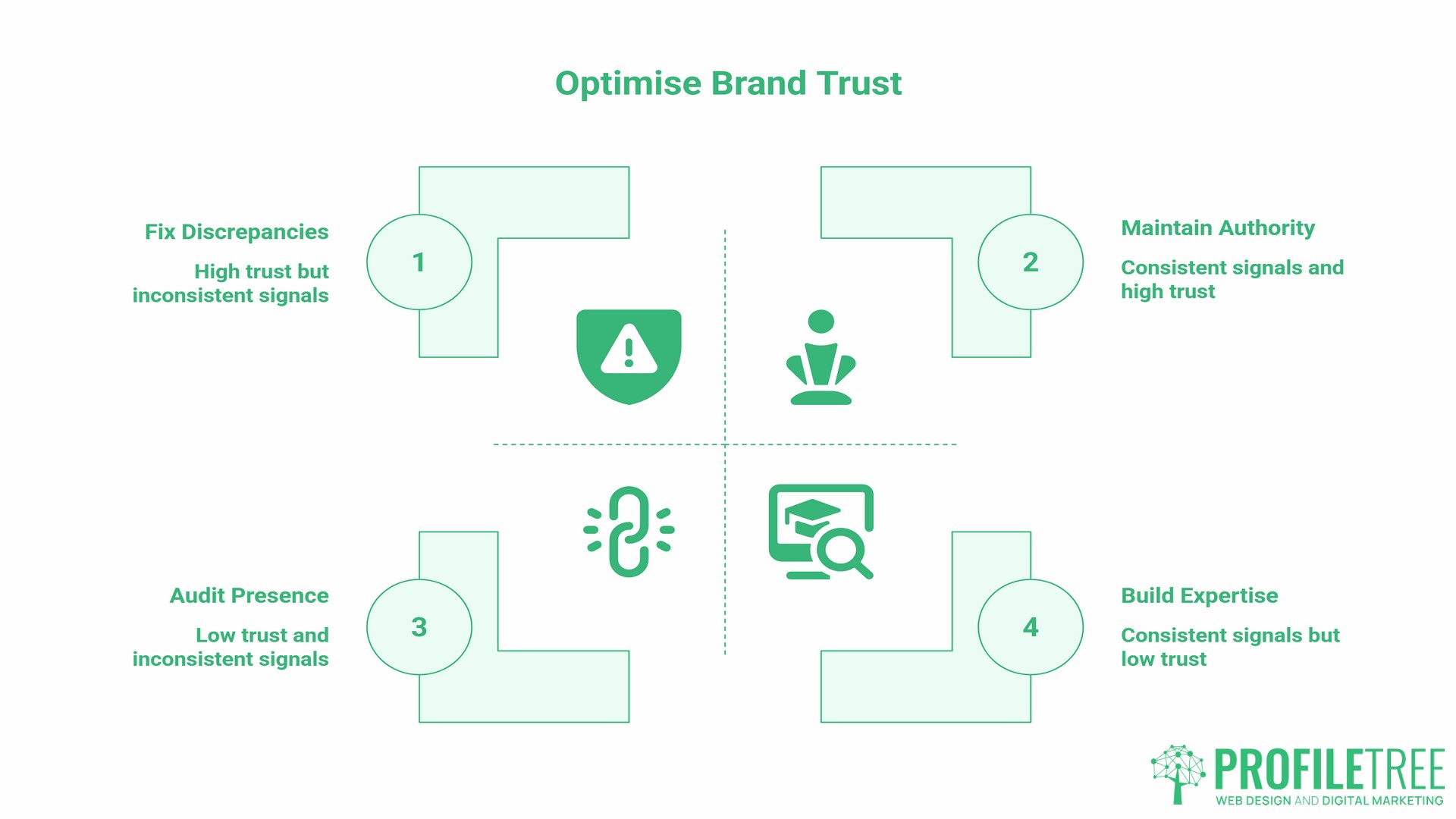
Consistent branding for SEO has a direct relationship with E-E-A-T (Experience, Expertise, Authoritativeness, and Trustworthiness), the primary framework Google’s Search Quality Rater Guidelines use to evaluate whether content deserves to rank. Google’s own documentation confirms that trustworthiness is the most important component: a page can demonstrate experience, expertise, and authority, but if it is untrustworthy, its E-E-A-T evaluation will be low regardless of the other signals.
What most articles on this topic overlook is that E-E-A-T is not evaluated per page. It is evaluated at the brand level. A business that presents expert, authoritative content on its website but has an incomplete Google Business Profile, a dormant LinkedIn page with a different company description, and a Facebook page using an outdated logo version sends mixed signals to Google’s quality systems. The individual page may be strong. The brand entity behind it is ambiguous.
| Brand Signal | Consistent | Inconsistent |
|---|---|---|
| Business name | Matches across all platforms | Varies across directories and profiles |
| Address and contact details | Identical on website, GBP, and directories | Different formats or outdated details |
| Service descriptions | Same core language across touchpoints | Different claims on different platforms |
| Logo and visual assets | Same file, same proportions, correct version | Multiple versions, cropped or outdated |
| Tone of voice | Recognisable across web, social, and email | Switches register between channels |
| Review responses | Consistent brand voice | Ad hoc, unsigned, variable quality |
The brands that rank well for competitive terms are typically those in which every row in the table is consistent. That is not a coincidence.
How Inconsistent Messaging Creates Trust Red Flags
Google’s Quality Rater Guidelines require raters to evaluate what a business says about itself, what customers say about it in reviews, and whether the website’s claims are supported by the wider web. If your website describes your business as a specialist in commercial fit-outs, your Google Business Profile lists you under “General Contractor,” and your LinkedIn page does not mention fit-outs at all, you have created a trust gap that both human reviewers and algorithmic systems interpret negatively.
For SMEs in Northern Ireland and Ireland, where local search is often the primary acquisition channel, this matters acutely. Investing in consistent branding for SEO, starting with a clean, aligned brand presence across your website, your Google Business Profile, and your local directory listings, is one of the most direct steps you can take to improve local search visibility.
Visual Consistency: What Search Engines Actually Read
Visual consistency is one of the most overlooked dimensions of consistent branding for SEO. Search engines read image metadata, alt text, and structured data, and visual coherence also influences the user behaviour metrics that feed into rankings.
Image Metadata and Alt Text
Every image on your site carries metadata: the file name, the alt text, and sometimes EXIF data. When those elements are handled consistently and descriptively across your site, they contribute to your topical authority and accessibility compliance. When they are ignored or treated as an afterthought, you lose signal.
A business that uploads a logo as “logo-final-v3-USE THIS ONE.png” with blank alt text is telling search engines nothing useful. The same image uploaded as “profiletree-belfast-digital-agency-logo.png” with alt text describing the brand and location does real SEO work.
Brand Recognition and Click-Through Rate
Users scanning a search results page make snap judgments about which result to click. According to research published by LSEO, “brand trust is another overlooked driver” of organic CTR, with familiar brands often outperforming higher-ranked but unfamiliar competitors because users evaluate familiarity and credibility almost instantly. A trusted brand at position three can routinely outperform an unknown at position one on branded or near-branded queries.
This is where consistent branding for SEO and paid search intersect. A business that runs Google Ads with a consistent visual identity, then delivers a website that matches that identity, builds familiarity faster than one where the ad and the landing page feel disconnected. ProfileTree’s web design services are built on this principle: the website is the central brand asset that everything else refers back to.
Verbal Consistency: Tone of Voice as an SEO Signal
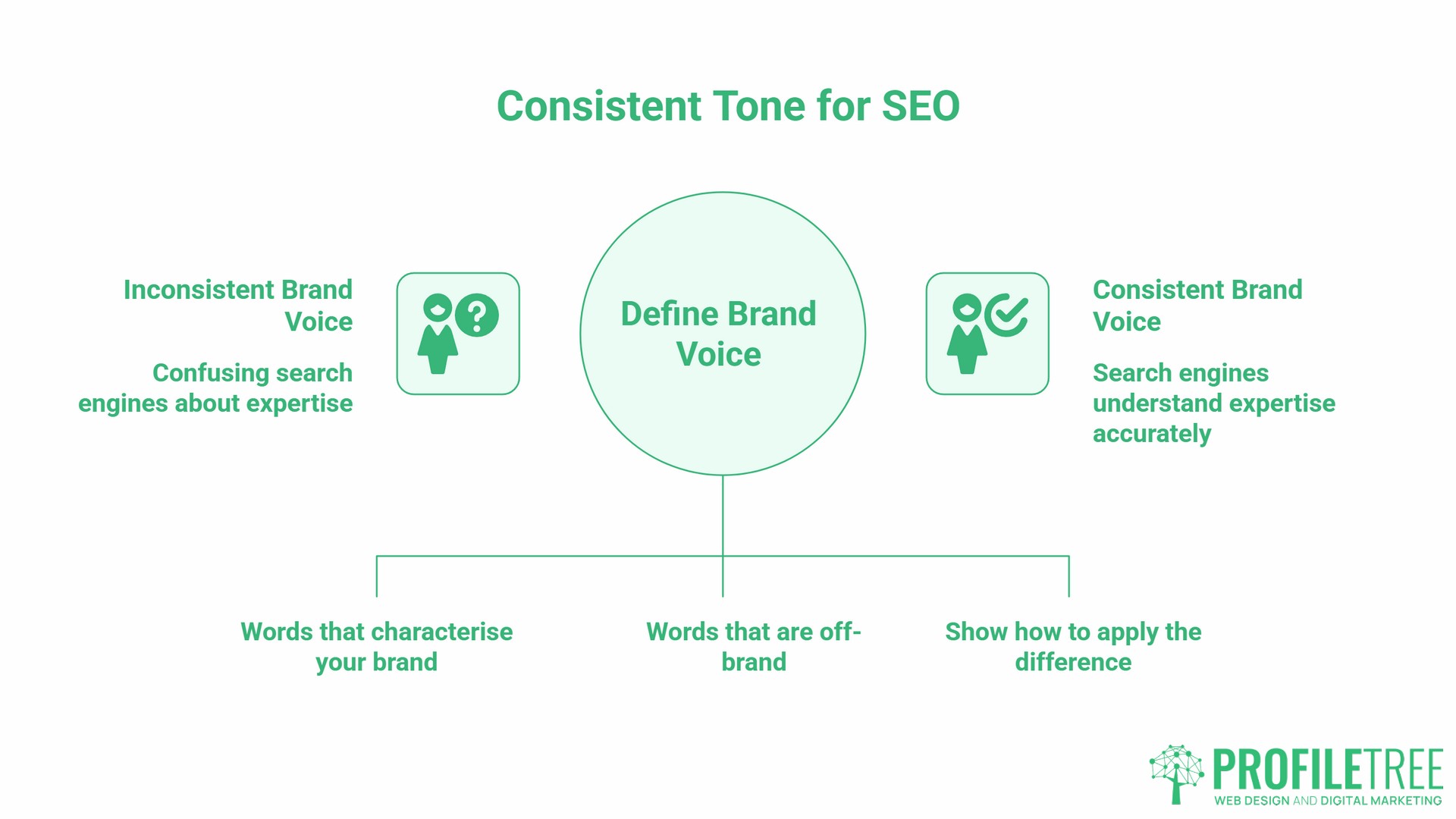
The words you use to describe your business, your services, and your expertise are not just a brand preference. They are a semantic signal that helps search engines categorise your niche and decide which queries your content should answer. Verbal consistency is, in this sense, as much a part of consistent branding for SEO as any visual element.
How Your Vocabulary Shapes Google’s Understanding
Google’s natural language processing systems read patterns in your content to understand what your business specialises in. If your website uses technical, precise language about construction project management but your blog posts use generic phrases about “delivering solutions,” you are giving Google inconsistent signals about your area of expertise.
Businesses that use a consistent vocabulary across their website, blog, social media, and external mentions are easier for search engines to categorise accurately. That accurate categorisation is what enables you to appear for the specific, high-intent queries that drive real business enquiries.
Consider the difference between a Belfast law firm and a creative agency. The law firm uses precise, formal language across every touchpoint because its audience expects it and because that formality is itself a trust signal. A creative agency uses more conversational language, but it should remain consistent from their homepage to their Instagram captions. The register differs, but the brand voice should be unmistakable in both cases.
Building a Tone of Voice That Travels
A tone-of-voice guide does not need to be a lengthy document. For most SMEs, a single page covering three things is enough: the words that characterise your brand, the words that are off-brand, and two or three example rewrites showing how to apply the difference in practice.
ProfileTree’s content marketing service typically begins with this kind of brand voice definition, because producing content at scale without it undermines consistent branding for SEO across every piece published. Every blog post written without a clear tone-of-voice reference is a small divergence from the brand entity Google is trying to understand.
The Local SEO Factor for NI and UK Businesses
For businesses operating in Northern Ireland, Ireland, and across the UK, consistent branding for SEO has a specific local dimension that national guides rarely address.
NAP Consistency: Name, Address, and Phone
NAP consistency, matching your business name, address, and phone number across all online directories, is a well-established local SEO principle. According to BrightLocal, consistent business information is “the backbone of higher local search and voice search rankings” because it gives search engines the confidence to treat your business as a verified, trustworthy local entity.
A Northern Irish business that describes itself as a “web design company” on its website, a “digital agency” on Google Business Profile, and a “marketing consultancy” on Yell.com is not just creating brand confusion. It is creating entity confusion that directly undermines local map pack rankings.
The fix is straightforward: write a 50-word and 150-word description of your business, agree on the exact name format you will use everywhere, and apply both consistently across every platform you appear on. That description should match the language on your homepage and About page.
Managing Regional Identities
Some Northern Irish businesses operate across two markets simultaneously, targeting Belfast and Dublin audiences with different service emphases. This is manageable from a brand-consistency perspective, but it requires careful handling.
The business entity (name, logo, core description) must be identical across both markets. What can differ is the localisation layer: specific case studies relevant to each market, local references, and geo-targeted landing pages. ProfileTree’s SEO services cover this kind of multi-region entity management as part of a structured local SEO strategy.
Consistent Branding for SEO in the Age of AI Search
AI search tools, including Google’s AI Overviews, ChatGPT, and Perplexity, now drive real commercial traffic. Understanding how they interpret brand signals is increasingly important for any business investing in consistent branding for SEO.
AI systems do not index your website the way a traditional crawler does. They synthesise information from multiple sources to build a picture of what your business is and what it is known for. If your brand presents the same clear, consistent identity across your website, your social profiles, your Google Business Profile, and third-party mentions, that synthesis is accurate and useful. If your brand is fragmented, the AI either cannot confidently represent you or produce an inaccurate summary.
This is why entity-based SEO, which ProfileTree has been advising clients on as part of its digital strategy work, is now becoming increasingly important. Research published via Search Engine Land confirms that entity-first content strategies require “the same brand name, founder, location, and positioning” to appear on every page, in every schema block, on the Google Business Profile, and in every external mention. Inconsistency “fragments the entity and slows recognition by months.”
As Ciaran Connolly, founder of ProfileTree, explains: “AI systems are effectively looking for a unifying signature across digital platforms to verify a business’s legitimacy. If Google Gemini or ChatGPT encounters your business name on five different platforms and finds five slightly different descriptions, it will cite a competitor whose brand story is coherent instead.”
ProfileTree’s AI implementation service supports businesses in auditing how they appear across AI search platforms and building the brand consistency infrastructure needed to benefit from AI-driven discovery.
How to Run a Brand Consistency Audit for Your SME
A consistent branding for an SEO audit does not require specialist software. The following five-step process works for most SMEs and can be completed in a few hours.
- Step 1: Fix your business name format. Decide on the exact form of your business name (with or without “Ltd,” with or without a descriptor) and document it. This becomes the canonical name used everywhere.
- Step 2: Audit your NAP data. Search for your business name on Google and check the top ten directory listings that appear. Compare the name, address, and phone number on each against your canonical record. Log any discrepancy and correct it by claiming or editing each listing.
- Step 3: Check your visual assets. Open your website, your Google Business Profile, your LinkedIn page, and your two most active social channels. Are they using the same logo version, colour palette, and profile image dimensions? Flag anything that differs and update it.
- Step 4: Compare your business descriptions. Pull the “About” copy from your website, your Google Business Profile, your LinkedIn company page, and any directory listings where you have written a description. They do not need to be identical, but they should use the same core vocabulary and make the same fundamental claims about what your business does.
- Step 5: Review your tone of voice across recent content. Read your last five blog posts, your last ten social media posts, and your most recent email newsletter. Does the register feel like the same brand? If not, a simple tone-of-voice document is the next step.
| Audit Area | What to Check | Common Issue |
|---|---|---|
| Business name | Consistent across all platforms | “Ltd” added or dropped inconsistently |
| Address | Matches Google Business Profile exactly | Old address still live on directories |
| Logo | Same version, same proportions | Outdated logo on social profiles |
| Business description | Core vocabulary consistent | Different service claims on different platforms |
| Tone of voice | Recognisable across web, social, and email | Blog vs. social feels like different brands |
| Review responses | Brand voice present | Generic, unsigned replies |
ProfileTree’s digital training programme covers brand consistency auditing as part of its SME digital skills curriculum, for businesses that want to manage this process in-house.
Building Brand Authority for the Long Term
Consistent branding for SEO is not a one-time task. Brand signals accumulate over time, and so do the gaps when consistency slips. The businesses that rank well for competitive terms a year from now are the ones building clean, coherent brand entity profiles today across their website, Google Business Profile, social channels, and third-party sources that reference them.
For most SMEs, the practical starting point is the five-step audit above. For businesses that want to build this into a broader digital strategy, ProfileTree works with organisations across Northern Ireland, Ireland, and the UK on the full range of signals that determine search visibility, from web design and technical SEO through to content strategy and AI readiness.
FAQ
How does brand consistency affect Google rankings?
Brand consistency affects Google rankings by influencing entity recognition, E-E-A-T signals, and user behaviour metrics. When Google can clearly identify what your business is and verify that identity across multiple sources, it is more likely to rank your pages for relevant queries. Inconsistent brand signals create entity ambiguity, which suppresses rankings even when individual pages are well-optimised.
What is the difference between branded and non-branded SEO?
Branded SEO refers to search activity where users include your business name in the query, such as “ProfileTree web design.” Non-branded SEO refers to queries where users search for a service or topic without specifying a brand, such as “web design Belfast.” Consistent branding for SEO supports both: a strong, consistent brand presence increases branded search volume over time, and the entity signals it creates improve rankings for non-branded queries as well.
Can inconsistent NAP data hurt my local SEO?
Yes. Google uses NAP data from your Google Business Profile, website, and third-party directories to verify your business’s physical presence and legitimacy. According to BrightLocal, discrepancies across these sources create entity confusion, which directly harms local map pack rankings. Correcting NAP inconsistencies is one of the most reliable quick wins in local SEO.
How do I maintain brand voice across multiple SEO landing pages?
The most reliable method is a brief tone-of-voice document covering three things: the vocabulary that characterises your brand, the vocabulary that is off-brand, and two or three rewritten examples showing the difference applied in practice. With that reference in place, any writer or team member producing landing page content can check their work against a clear standard.
Does brand recognition improve organic click-through rate?
Yes, consistently. Research into organic CTR shows that familiar brands earn higher click-through rates because users evaluate familiarity and credibility almost instantly when scanning search results. A recognised brand at a lower ranking position will often outperform an unfamiliar brand at a higher position, particularly for branded or near-branded queries. This is why consistent branding for SEO and wider digital marketing activity work together: the repetition of a recognisable brand identity across channels builds the familiarity that drives better CTR from organic listings over time.
Why isn’t my brand name showing up on Google?
If your brand is not generating a Knowledge Panel or appearing prominently in branded searches, the most common causes are insufficient, consistent mentions across authoritative third-party sources, inconsistent entity data across your own platforms, or a domain that has not yet built enough authority for Google to treat it as a verified entity. Consistent branding across all your platforms, combined with citations on reputable external sites, is the foundational fix.