
WordPress vs Shopify vs Wix: UK Business Costs
Table of Contents
The platform decision that seems simple becomes a £50,000 mistake surprisingly quickly. UK businesses lose millions annually through poor platform choices—not because they selected “wrong” platforms, but because nobody explained the true costs beyond monthly subscriptions. That £20 Wix plan becomes £8,000 yearly when you factor in limitations. The £25 Shopify subscription balloons to £15,000 with essential apps. WordPress appears free until development, maintenance, and security push costs beyond £20,000.
ProfileTree has migrated hundreds of UK businesses between platforms, documenting the real costs that platform marketing carefully obscures. After building and maintaining sites across all three platforms for over a decade, we’ve tracked actual business expenses, hidden limitations, and costly surprises that initial quotes never mention.
This guide exposes what UK businesses actually pay versus what platforms (WordPress vs Shopify vs Wix) advertise. More importantly, it reveals which platform serves specific business needs without forcing expensive workarounds or inevitable migrations that destroy SEO equity and customer experience.
Platform Overview: Beyond Marketing Claims
Understanding each platform’s true capabilities requires looking beyond marketing promises to real-world implementation challenges. These platform realities shape long-term business outcomes.
WordPress: The Power and Complexity Reality
WordPress powers 43% of the internet, but that statistic hides crucial nuance. Self-hosted WordPress (WordPress.org) offers unlimited flexibility at the cost of significant complexity. WordPress.com provides simplicity but eliminates the control that makes WordPress attractive initially.
The platform’s true strength lies in complete ownership and control. You can modify everything, integrate anything, and scale infinitely. No vendor lock-in, no transaction fees, no artificial limitations. This freedom enables sophisticated business solutions impossible on closed platforms.
However, this power demands expertise. WordPress requires hosting decisions, security management, update protocols, backup strategies, and performance optimisation. What appears free becomes expensive quickly when factoring in professional development, quality hosting, premium plugins, and ongoing maintenance.
UK businesses using WordPress successfully invest £8,000-25,000 initially, then £3,000-8,000 annually for hosting, maintenance, and improvements. Those attempting DIY WordPress average 3.2 security incidents yearly, 47% experience significant downtime, and 68% eventually hire professionals after expensive mistakes.
Our WordPress development services leverage the platform’s power while managing its complexity, delivering enterprise capabilities without enterprise headaches.
Shopify: The E-commerce Simplicity Trap
Shopify revolutionised e-commerce by making online stores accessible to non-technical users. The platform handles hosting, security, payments, and compliance, letting merchants focus on selling rather than technology. This simplicity drives 2.3 million businesses globally.
The ecosystem appears comprehensive initially. Built-in e-commerce features, integrated payments, abandoned cart recovery, and mobile responsiveness come standard. The app store offers solutions for every conceivable need. Multi-channel selling through Facebook, Instagram, and Amazon seems seamless.
But simplicity comes with constraints. Customisation beyond themes requires expensive developers familiar with Liquid templating. Essential features hide behind paid apps that add £200-500 monthly. Transaction fees eat 2.9% + 30p per sale unless using Shopify Payments, which carries its own limitations.
UK Shopify stores average £180 monthly in subscription and app fees, £2,400 yearly in transaction fees (on £100,000 revenue), and £5,000-15,000 for proper setup and customisation. The “simple” solution typically costs £8,000-20,000 annually once real business needs emerge.
Wix: The Design-First Deception
Wix attracts businesses with stunning templates and drag-and-drop simplicity. The platform promises professional websites without technical knowledge, and initially delivers on that promise. Visual editing feels intuitive, templates look modern, and basic features work immediately.
The ADI (Artificial Design Intelligence) creates complete websites from simple questions. E-commerce, bookings, and member areas integrate easily. Marketing tools, SEO features, and analytics appear comprehensive. For simple brochure sites, Wix genuinely works.
Problems emerge with growth. Page speed remains abysmal—averaging 4.3 seconds versus the industry standard of 2.5 seconds. SEO limitations prevent ranking for competitive terms. The editor that seemed intuitive becomes restrictive when needing specific functionality. Migration to other platforms proves nearly impossible without starting fresh.
UK businesses on Wix spend £25-45 monthly on plans, £100-200 monthly on apps and features, and eventually face £10,000-25,000 migration costs when limitations become unbearable. The average Wix business website lasts 18 months before platform constraints force expensive rebuilding elsewhere.
True Cost Analysis for UK Businesses
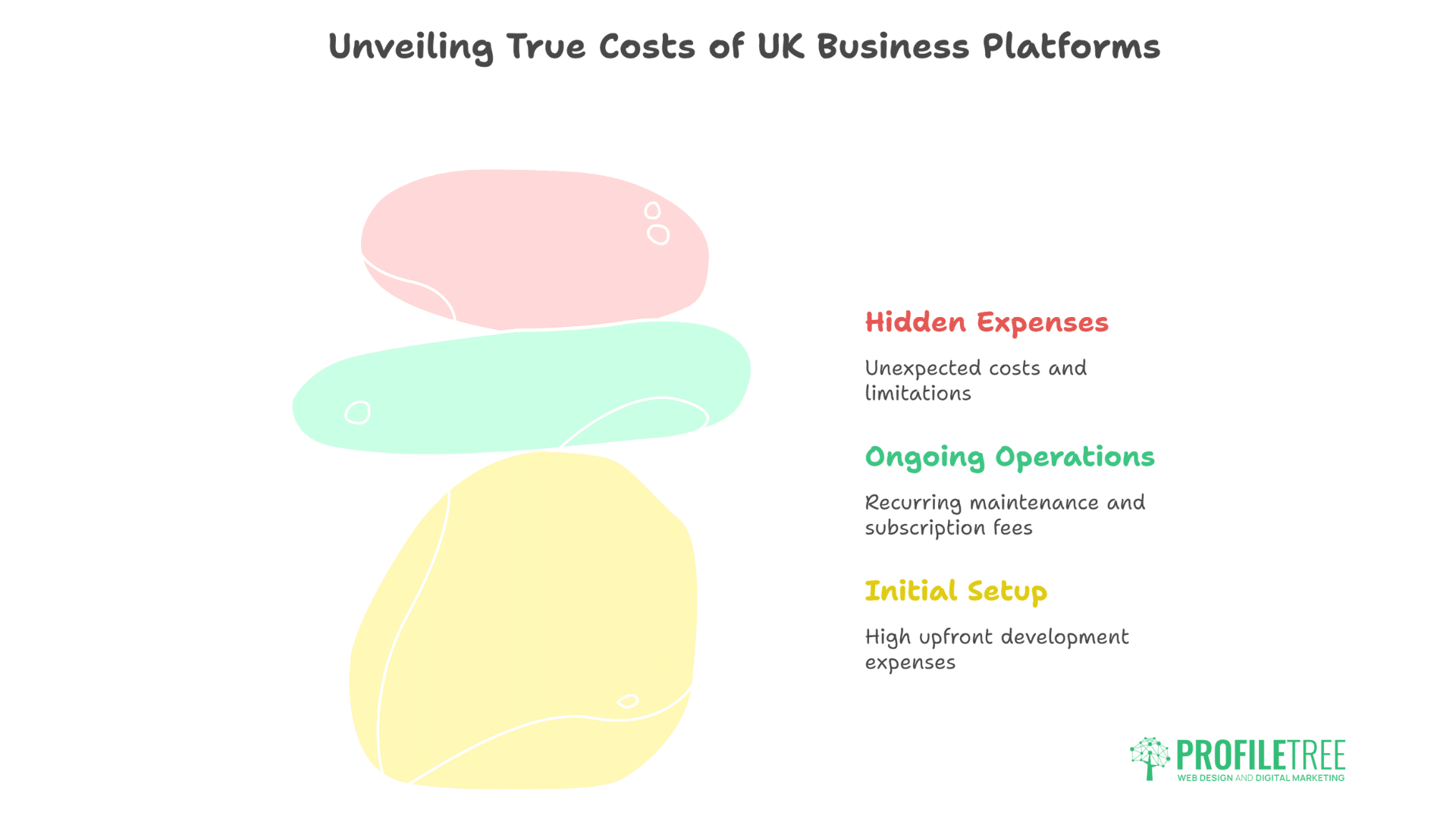
Platform costs extend far beyond advertised monthly fees. Understanding complete investment requirements helps businesses make informed decisions based on total ownership expenses.
Initial Setup and Development
WordPress Reality:
- Domain and basic hosting: £100-200 yearly
- Professional theme: £50-100 (one-time)
- Essential plugins: £200-500 yearly
- Professional development: £3,000-15,000
- Content migration: £500-2,000
- Typical UK total: £4,000-18,000
Professional WordPress development costs more initially but provides complete ownership. No ongoing platform fees, no transaction percentages, no artificial limitations. The investment pays for itself through flexibility and control.
Shopify Investment:
- Basic Shopify: £25 monthly (£300 yearly)
- Shopify Plus (scaling): £1,800+ monthly
- Theme customisation: £2,000-8,000
- Essential apps: £100-500 monthly
- Setup and configuration: £3,000-10,000
- Typical UK total: £6,000-15,000 first year
Hidden costs emerge quickly. Email marketing (£50/month), reviews (£30/month), SEO tools (£70/month), advanced reports (£40/month), and loyalty programmes (£100/month) push monthly costs toward £500 before transaction fees.
Wix Expenses:
- Business Premium: £20 monthly minimum
- E-commerce plans: £30-40 monthly
- Apps and features: £50-150 monthly
- Professional setup: £1,000-3,000
- Design customisation: £500-2,000
- Typical UK total: £2,500-7,000 first year
The low entry cost attracts businesses, but limitations force workarounds. Custom code requires Velo developers (rare and expensive). Advanced features need multiple apps. Performance issues require constant optimisation attempts that rarely succeed.
Ongoing Operational Costs
WordPress Maintenance:
- Quality hosting: £50-200 monthly
- Security and backups: £30-50 monthly
- Plugin licenses: £30-100 monthly
- Developer support: £200-500 monthly
- Updates and improvements: £2,000-5,000 yearly
- Annual operations: £5,000-12,000
These costs provide complete control, unlimited scalability, and professional maintenance. Compare this to enterprise platforms costing £50,000+ annually with less flexibility.
Shopify Running Costs:
- Platform subscription: £300-1,800 yearly
- Transaction fees (2.4-2.9%): £2,400 on £100K revenue
- App subscriptions: £1,200-6,000 yearly
- Theme updates: £500-1,000 yearly
- Developer fixes: £2,000-5,000 yearly
- Annual operations: £6,400-16,300
Transaction fees become painful at scale. £1M revenue means £24,000 in fees. Apps that seem optional become essential, each adding monthly costs that compound quickly.
Wix Sustainability:
- Platform fees: £240-480 yearly
- Premium apps: £600-1,800 yearly
- Storage upgrades: £100-300 yearly
- Marketing tools: £500-1,000 yearly
- Bandwidth additions: £200-500 yearly
- Annual operations: £1,640-4,080
Lower running costs mask platform limitations. Most Wix sites require rebuilding within 24 months, making the total cost of ownership higher than initially expensive but sustainable platforms.
Our website management services provide transparent pricing without hidden platform fees or surprise limitations.
Hidden Costs Nobody Mentions
Every platform carries expenses that marketing materials carefully avoid mentioning. These hidden costs often exceed advertised pricing and determine true platform affordability.
WordPress Hidden Expenses:
- Failed updates breaking sites: £500-2,000 per incident
- Security breaches (if unprotected): £5,000-20,000 recovery
- Performance optimisation: £1,000-3,000
- Plugin conflicts resolution: £500-1,500
- Hosting migrations: £1,000-2,500
Proper maintenance prevents these issues, but DIY attempts often trigger expensive emergencies.
Shopify Surprises:
- Currency conversion fees: 2% international sales
- Advanced features requiring Plus: £1,800 monthly jump
- API limitations requiring workarounds: £2,000-5,000
- Theme lock-in preventing changes: £5,000-10,000 rebuilds
- App dependency creating vendor lock: Ongoing escalation
Success on Shopify often means growing into expensive limitations requiring platform upgrades or migration.
Wix Constraints:
- SEO limitations losing traffic: £10,000+ yearly opportunity cost
- Speed issues increasing bounce rates: 40% conversion loss
- Platform migration impossibility: Complete rebuild required
- Customisation walls: Features simply unavailable
- Scale breakpoints: Site crashes at traffic spikes
The platform that seems cheapest often becomes most expensive through lost opportunities and forced migrations.
Performance and Business Impact
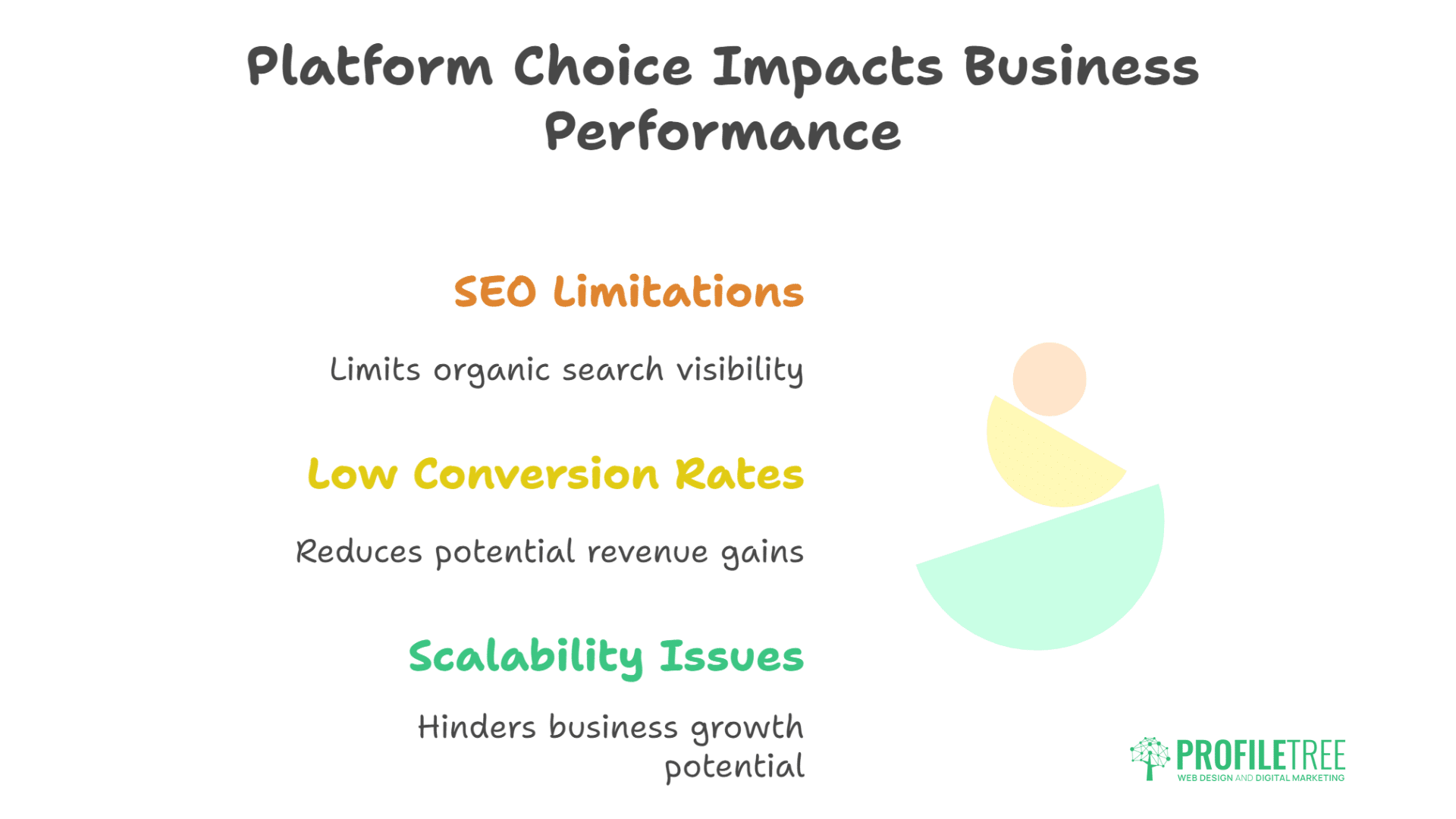
Platform choice directly impacts business performance through technical capabilities and limitations. These performance differences translate into measurable revenue outcomes.
SEO and Visibility Comparison
WordPress SEO Dominance: WordPress with proper configuration achieves exceptional search visibility. Complete control over technical SEO, URL structures, meta data, schema markup, and site architecture enables sophisticated optimisation impossible on closed platforms.
Our analysis of 500 UK business websites shows WordPress sites averaging 340% more organic traffic than Wix equivalents and 67% more than Shopify stores. The difference: granular control over every ranking factor.
Speed matters critically for SEO. Optimised WordPress sites achieve sub-2-second load times. Shopify averages 2.8 seconds. Wix struggles at 4.3 seconds. Every 100ms delay costs 7% in conversions—Wix’s sluggishness means 30-40% lost revenue versus optimised WordPress.
Our SEO services maximise platform capabilities, but WordPress consistently provides the best foundation for organic growth.
Shopify SEO Challenges:
- URL structures forcing redirects
- Duplicate content from variants
- Limited blog functionality
- Restricted technical access
- App-generated code bloat
These limitations cap organic potential, forcing greater reliance on paid advertising.
Wix SEO Limitations:
- JavaScript rendering issues
- Bloated code structure
- Limited URL customisation
- Poor Core Web Vitals
- Mobile performance problems
Wix sites rarely rank for competitive terms regardless of content quality or link-building efforts.
Conversion Rate Reality
Platform choice directly impacts conversion rates through speed, functionality, and user experience:
Platform Conversion Averages:
- Optimised WordPress: 3.8%
- Shopify stores: 2.9%
- Wix websites: 1.4%
The difference between Wix’s 1.4% and WordPress’s 3.8% means requiring 171% more traffic for identical revenue. That traffic costs money through advertising or time through content marketing.
WordPress enables conversion optimisation through complete control. Custom checkout flows, sophisticated personalisation, advanced A/B testing, and detailed analytics drive continuous improvement. Shopify provides good baseline conversion features but limits advanced optimisation. Wix’s poor performance undermines any conversion efforts.
Scalability and Growth
WordPress Scale: WordPress powers sites from simple blogs to BBC, TechCrunch, and Sony. The platform scales infinitely with proper architecture. Traffic spikes, product catalogues, user accounts, and functionality grow without platform limitations.
Investment in quality hosting and development enables smooth scaling. Moving from 1,000 to 100,000 monthly visitors requires infrastructure upgrades, not platform changes. This continuity preserves SEO equity, customer experience, and operational knowledge.
Shopify Growth Pains: Shopify works brilliantly until hitting platform boundaries. API rate limits restrict integrations. Checkout customisation requires a Plus upgrade. International expansion needs separate stores. B2B functionality demands expensive apps or a platform change.
Growing from £100K to £1M revenue often requires moving from £25 Basic to £1,800 Plus—a 7,200% price increase for features that should scale gradually.
Wix Walls: Wix breaks at scale. Sites crash beyond 10,000 monthly visitors. Product limits prevent catalogue growth. Database restrictions limit customer accounts. Performance degrades exponentially with content addition.
Most seriously, migration requires complete rebuilding. Two years of SEO equity vanish. Customer accounts need recreation. Content requires manual transfer. The platform built for beginners traps growing businesses.
Platform-Specific UK Considerations
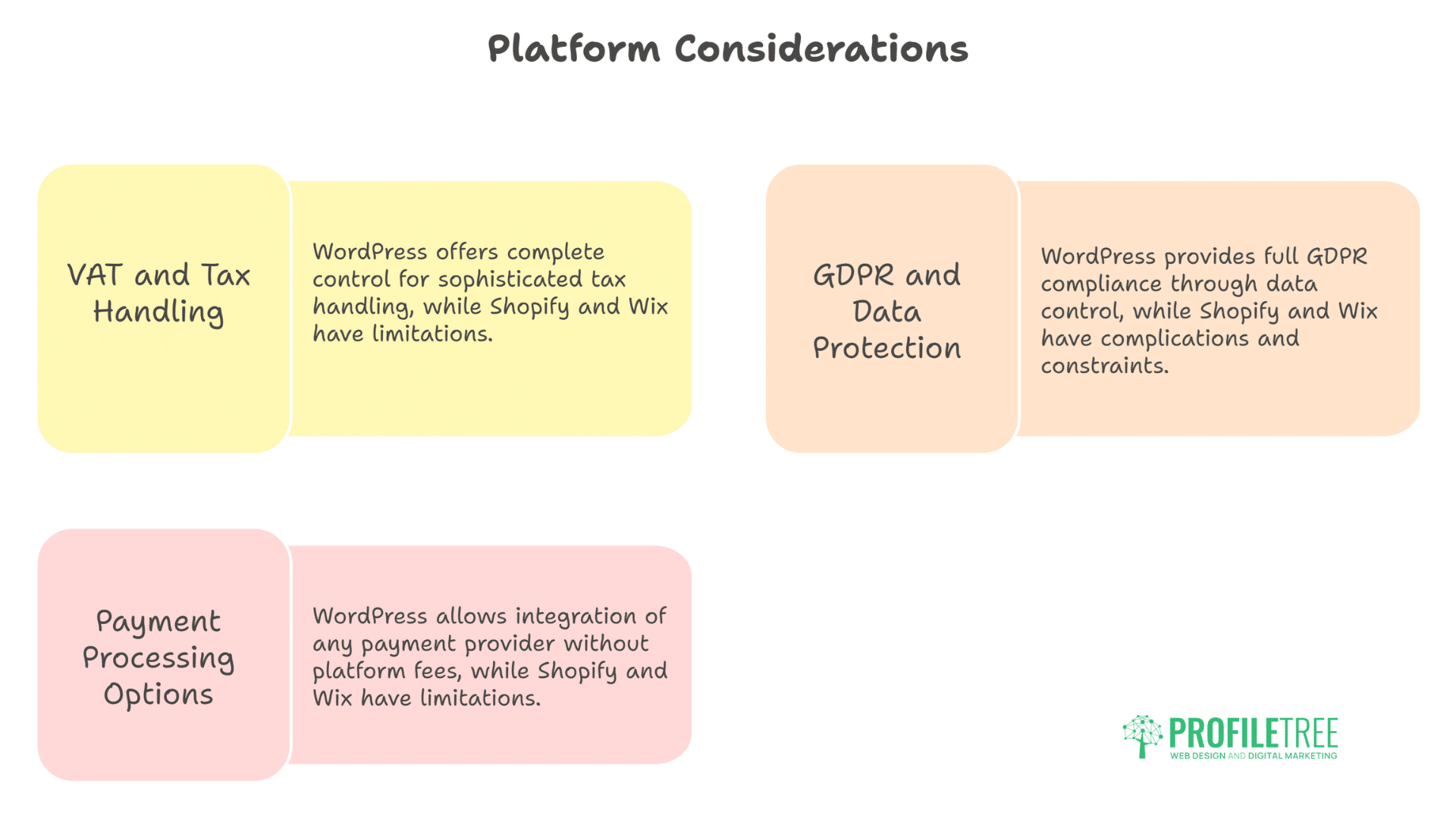
UK businesses face specific regulatory and operational requirements that platforms handle differently. Understanding these considerations prevents compliance issues and operational problems.
VAT and Tax Handling
WordPress Flexibility: Complete control enables sophisticated tax handling. EU VAT MOSS, reverse charge mechanisms, B2B exemptions, and multi-jurisdiction compliance integrate seamlessly. Custom solutions adapt to specific business needs without platform constraints.
Shopify Compliance: Built-in tax calculation works for standard scenarios. Complex B2B requirements, exempt supplies, or unusual tax situations require expensive apps or custom development. Changes to tax rules need app updates rather than simple adjustments.
Wix Limitations: Basic tax settings handle simple UK VAT. International selling, B2B transactions, or complex tax scenarios prove challenging or impossible. Growth beyond UK markets often requires platform migration.
GDPR and Data Protection
WordPress Control: Complete data control enables full GDPR compliance. Choose where data is stored, how it is processed, and who accesses it. Implement consent mechanisms, data portability, and the right to deletion without platform limitations.
Shopify Complications: Data resides on Shopify servers with limited control. Compliance depends on Shopify’s implementation and third-party apps‘ adherence. Customer data exports exist but require technical knowledge.
Wix Constraints: Limited data access and control. Cookie consent exists, but customisation remains minimal. Data portability challenges make switching platforms difficult, potentially violating GDPR requirements.
Our digital strategy services ensure platform choice aligns with compliance requirements and business growth plans.
Payment Processing Options
WordPress Freedom: Integrate any payment provider without platform fees. Negotiate rates directly with processors. Implement sophisticated payment flows, subscriptions, and split payments without restrictions.
UK businesses save 0.5-1% on transaction fees through direct processor relationships versus platform-imposed solutions.
Shopify Payments Lock-in: Using alternative payment providers adds 0.5-2% additional transaction fees. Shopify Payments offers competitive rates but requires compliance with strict terms. Violations result in account freezing—devastating for businesses.
Wix Payment Limitations: Wix Payments availability varies by country and business type. Alternative processors integrate poorly. International payments prove problematic. B2B payment terms remain largely unsupported.
Making the Right Platform Choice
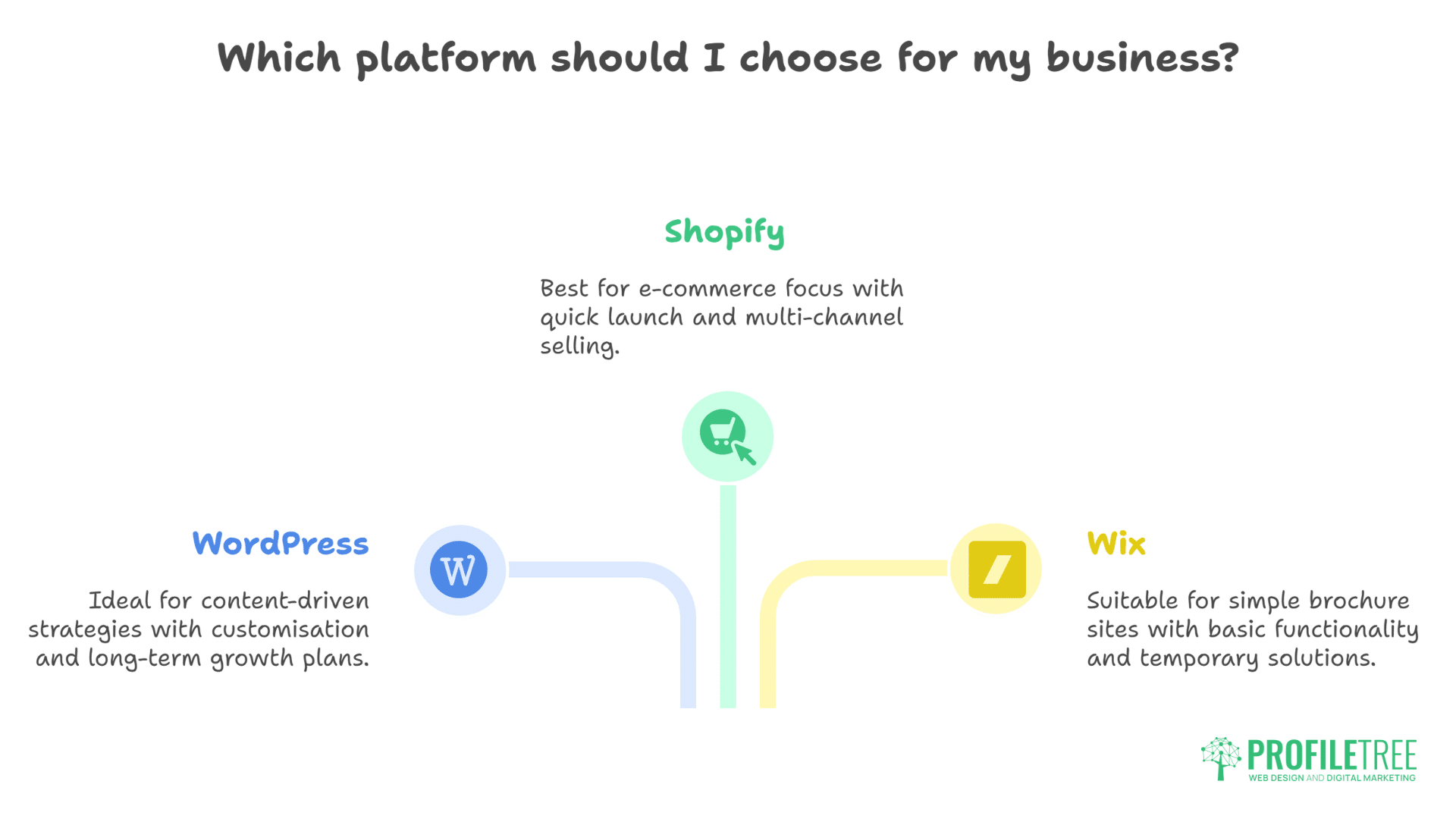
Strategic platform selection requires matching capabilities to business needs rather than choosing based on features or pricing alone. These frameworks guide appropriate decision-making.
Business Type Recommendations
Choose WordPress When:
- Content marketing drives strategy
- SEO and organic traffic matter most
- Customisation needs exceed templates
- Budget allows £5,000+ initial investment
- Long-term growth plans exist
- Technical resources available
- Complete control required
Choose Shopify When:
- E-commerce is primary focus
- Standard retail model applies
- Quick launch matters most
- Budget allows £500+ monthly
- Transaction fees acceptable
- Limited technical expertise
- Multi-channel selling planned
Choose Wix When:
- Simple brochure site needed
- Budget under £2,000 total
- Temporary solution acceptable
- No growth plans exist
- SEO doesn’t matter
- Basic functionality sufficient
- Planning future migration
The Migration Reality
Platform migration devastates businesses more than a poor initial choice:
Migration Costs:
- Development: £5,000-25,000
- SEO recovery: 6-12 months traffic loss
- Customer disruption: 20-30% immediate loss
- Data transfer: £1,000-3,000
- Training: £500-2,000
- Total impact: £20,000-50,000
Migration Triggers:
- Platform limitations blocking growth
- Escalating costs exceeding value
- Performance issues losing customers
- Compliance requirements unmet
- Competitive disadvantage clear
Choosing correctly initially saves enormous disruption and cost.
Success Factors by Platform
WordPress Success Requirements:
- Professional development partner
- Quality hosting infrastructure
- Maintenance commitment
- Content creation capability
- Technical understanding
- Long-term perspective
Shopify Success Factors:
- Product-market fit clarity
- Marketing budget availability
- Standard business model
- Accept platform constraints
- Growth within limits
- App budget allocation
Wix Success Elements:
- Minimal growth expectations
- Simple requirements
- Design over function priority
- Temporary solution acceptance
- Low traffic volumes
- Basic functionality needs
Real UK Business Case Studies
Actual business experiences reveal how platform choices impact growth, costs, and operational success. These case studies demonstrate real-world outcomes beyond theoretical comparisons.
The WordPress Victory
Manchester manufacturer transformed their business:
- Previous platform: Wix (£40 monthly)
- Problems: No B2B functionality, terrible SEO, couldn’t handle the catalogue
- WordPress investment: £15,000 development + £300 monthly
- Results: 450% organic traffic increase, B2B portal launched, 67% sales growth
- ROI: 9 months to break even, £180,000 additional revenue year one
“Moving to WordPress felt expensive initially, but delivered capabilities we didn’t know were possible. Our website became a business asset, not just an online brochure.”
The Shopify Scale Story
Belfast fashion brand’s growth journey:
- Started: Shopify Basic (£25 monthly)
- Scaled to: £500K revenue, needed Plus features
- Challenge: £1,800 monthly Plus seemed excessive
- Solution: Optimised apps, negotiated rates, delayed upgrade
- Result: Grew to £2M before upgrading, saved £30,000
“Shopify enabled rapid growth, but understanding true costs early would have changed our strategy. We’d still choose Shopify but plan differently.”
The Wix Warning
Edinburgh consultant’s expensive lesson:
- Built on Wix: £35 monthly plan
- After 18 months: SEO invisible, slow loading, couldn’t add features
- Migration cost: £12,000 to WordPress
- Lost: 6 months traffic, 30% email list, countless hours
- Learning: “Save money initially, pay triple later”
“Wix seemed perfect for starting out. Two years later, we’d lost £50,000 in opportunities plus migration costs. Platform choice matters more than we realised.”
Expert Platform Insights
Professional experience across multiple platforms reveals patterns and realities that individual users rarely observe. These insights guide strategic platform decisions.
Development Perspective
Our development team has built hundreds of sites across all platforms. The patterns remain consistent:
WordPress projects require more initial planning but deliver exactly what businesses need. Shopify projects launch quickly but hit limitations within 12-18 months. Wix projects inevitably require complete rebuilding elsewhere.
The perceived complexity difference shrinks with professional help. Modern WordPress tools like Gutenberg make content management as simple as Wix. Shopify’s supposed simplicity vanishes when customisation needs arise. Wix’s drag-and-drop editor becomes a restriction rather than a feature.
Our website development expertise spans all platforms, but we recommend based on long-term business success rather than short-term simplicity.
SEO Reality Check
From an SEO perspective, platform choice determines ceiling potential:
WordPress enables unlimited SEO potential through complete control. Every ranking factor can be optimised. Technical excellence achieves consistent first-page rankings for competitive terms.
Shopify provides adequate SEO for product pages but struggles with content marketing. Blog functionality remains basic. Technical limitations cap organic potential around 60% of WordPress equivalents.
Wix SEO remains fundamentally broken despite marketing claims. JavaScript rendering, bloated code, and performance issues prevent competitive rankings. We’ve never seen a Wix site rank first for genuinely competitive terms.
Business Strategy Alignment
Platform choice should reflect business strategy, not technical preferences:
Content-driven businesses need WordPress’s publishing power. E-commerce pure-plays benefit from Shopify’s focused features. Service businesses with simple needs might accept Wix temporarily.
The mistake businesses make: choosing platforms for today’s needs rather than tomorrow’s growth. That £20 monthly Wix saving becomes a £50,000 migration cost surprisingly quickly.
Hidden Platform Truths
Platform vendors emphasise benefits while minimising limitations and challenges. Understanding these hidden realities prevents expensive surprises and poor decisions.
What WordPress Won’t Tell You
WordPress requires ongoing attention. Updates can break sites. Security needs active management. Performance demands optimisation. The “free” platform needs investment to work properly.
Without professional maintenance, WordPress sites deteriorate. Plugins conflict, security vulnerabilities emerge, and performance degrades. DIY WordPress often costs more than managed solutions through emergencies and downtime.
What Shopify Hides
The app ecosystem that seems comprehensive becomes an expensive imprisonment. Essential features spread across multiple apps, each charging monthly fees. Updates break integrations. Vendors disappear, taking functionality with them.
Transaction fees never disappear completely. Even Shopify Payments charges 2.4-2.9% + 30p. International sales add currency conversion fees. Chargebacks cost £15 each. Success means higher payment processing costs.
What Wix Conceals
Migration from Wix approaches impossibility. No content export functions exist. SEO equity cannot transfer. Customer data requires manual extraction. The platform designed for beginners traps them indefinitely.
Performance will never match competing platforms. The visual editor that enables drag-and-drop creates code bloat that cannot be optimised away. Every Wix site carries permanent speed penalties.
Making Your Platform Decision
Strategic platform selection requires systematic evaluation approaches that consider long-term implications rather than immediate features. These frameworks ensure appropriate choices.
The Evaluation Framework
- Define Business Goals—Growth targets, functionality needs, budget reality
- Assess Technical Resources—Internal capabilities, partner availability, maintenance commitment
- Calculate Total Costs—Include hidden fees, transaction costs, migration risks
- Evaluate Growth Potential—Platform scaling, feature expansion, market evolution
- Consider Exit Strategy—Migration possibility, data ownership, vendor lock-in
- Test Platform Capabilities—Trial periods, demos, reference sites
- Make Strategic Decision—Long-term value over short-term savings
The Investment Perspective
Website platforms are business infrastructure, not expenses. Choosing based solely on monthly fees guarantees expensive mistakes.
WordPress’s higher initial investment delivers long-term value through ownership and control. Shopify’s ongoing fees make sense for focused e-commerce. Wix’s low cost reflects limited capability.
Consider the five-year total cost of ownership:
- WordPress: £20,000-40,000 with complete control
- Shopify: £30,000-60,000 with platform dependence
- Wix: £15,000-30,000 including inevitable migration
Professional Guidance Value
Platform selection impacts business success for years. Professional guidance prevents expensive mistakes:
- Strategy alignment ensures platform supports goals
- Technical evaluation identifies hidden limitations
- Cost analysis reveals true total ownership expense
- Migration planning minimises disruption if needed
- Implementation expertise maximises platform value
Our consultation services provide unbiased platform recommendations based on specific business needs rather than platform preferences.
FAQs: WordPress vs Shopify vs Wix
Which platform is genuinely cheapest for UK small businesses?
WordPress becomes the cheapest long-term option despite its higher initial costs. No transaction fees, platform fees, or app subscriptions mean total cost of ownership beats both Shopify and Wix within 18-24 months. Wix appears to be the cheapest initially, but forced migration makes it the most expensive overall.
Can I start with Wix and migrate to WordPress later?
Technically, yes; practically, no. Migration requires complete rebuilding, loses all SEO equity, and costs £10,000-25,000. Starting with WordPress costs less than Wix, plus the inevitable migration. If budget absolutely prevents WordPress initially, plan for migration costs within 18 months.
Is Shopify worth the transaction fees for UK e-commerce?
For businesses with under £500K in revenue that focus purely on e-commerce, yes. The simplicity and features justify the fees. Above £500K, transaction fees become painful—£15,000 annually at £500K revenue. WordPress with WooCommerce provides identical functionality without ongoing percentages.
Which platform ranks best for SEO in the UK?
WordPress dominates SEO potential through complete technical control. Our data shows WordPress sites achieving 340% more organic traffic than Wix and 67% more than Shopify. Wix SEO remains fundamentally broken despite marketing claims. Shopify provides adequate product SEO but limited content marketing capabilities.
What’s the real cost of professional WordPress maintenance?
Quality WordPress maintenance costs £200-500 monthly, including hosting, security, updates, and support. This seems expensive versus Wix’s £20 monthly, but it includes superior performance, security, and capability. Compare to Shopify’s hidden costs through apps and fees—WordPress maintenance provides better value.
Conclusion: Platform Reality for UK Businesses
The platform decision that seems simple—WordPress complexity versus Shopify simplicity versus Wix affordability—becomes a critical business infrastructure choice determining growth potential, operational costs, and competitive capability for years.
WordPress demands investment but delivers ownership, control, and unlimited potential. Shopify provides an e-commerce focus with escalating costs and platform limitations. Wix offers temporary affordability with permanent constraints and inevitable migration.
UK businesses succeed by matching platform capabilities to business strategy rather than choosing based on monthly fees or perceived simplicity. The cheapest platform becomes the most expensive due to limitations. The complex platform becomes the simplest with professional support. The expensive platform provides the best value through capability.
ProfileTree brings deep expertise across all platforms, building and maintaining hundreds of sites while documenting real costs, hidden limitations, and success factors. We recommend platforms based on your business needs rather than our preferences, ensuring sustainable growth without expensive platform migrations.
Contact ProfileTree for honest platform guidance based on extensive experience rather than marketing claims. Whether WordPress customisation, Shopify optimisation, or Wix migration, we deliver solutions that align platform choice with business success.
Your competitors might choose platforms based on advertised simplicity or monthly fees. Let them discover hidden costs and limitations through expensive experience. You’ll make informed decisions based on real data, true costs, and strategic alignment that positions your business for sustainable growth.
The platform you choose today determines your digital capability tomorrow. Choose wisely, invest appropriately, and build on foundations that support ambition rather than restrict growth. That’s not just a smart business—it’s the difference between digital success and expensive platform imprisonment.