
Digital Marketing Landscape for Small Businesses: UK Guide 2026
Table of Contents
The digital marketing landscape for small businesses has reached a critical inflexion point. The global digital marketing sector is projected to reach £472.5 billion in 2025, growing at 13.6% annually through 2033. For UK small businesses navigating economic uncertainty, rising operational costs, and intensifying competition, digital marketing has shifted from an optional investment to a fundamental business requirement. The challenge lies not in recognising this necessity, but in developing practical strategies that deliver measurable returns within the constraints of limited budgets, time, and expertise.
The landscape for small businesses in 2026 presents both unprecedented opportunities and significant complexity. Mobile advertising now accounts for 70% of all ad spend, AI tools have democratised sophisticated marketing capabilities, and privacy regulations continue reshaping how businesses reach and track customers. UK small businesses face unique pressures—54% cite revenue growth as their primary digital marketing objective, reflecting a shift from brand awareness to measurable business outcomes. Every marketing pound must deliver clear returns in an environment where consumer spending remains cautious, and the cost of doing business continues to rise.
This guide examines the digital marketing landscape for small businesses across the UK, from Belfast to Birmingham, providing practical strategies that acknowledge real-world constraints. Rather than presenting an idealised approach requiring unlimited resources, we focus on high-impact activities that small businesses can actually implement. Whether you’re just beginning to develop a digital presence or looking to optimise existing efforts, understanding the current landscape for small businesses—including which channels deliver the highest returns, how to allocate limited budgets strategically, and which emerging trends deserve attention—forms the foundation for sustainable growth in an increasingly digital marketplace.
Why Digital Marketing Matters for UK Small Businesses
The digital marketing sector continues its expansion, with the global market reaching £472.5 billion in 2025 and projected to grow at 13.6% annually through 2033. For UK small businesses, this growth represents both opportunity and challenge—the chance to compete on more equal terms with larger firms, but also the need to navigate an increasingly complex digital environment.
UK small businesses face specific pressures that make digital marketing both necessary and challenging. With 54% citing revenue growth as their primary digital marketing objective, the focus has shifted from brand awareness to measurable business outcomes. Digital channels now deliver superior returns compared to traditional advertising, particularly for businesses operating with constrained budgets.
This shift reflects fundamental changes in consumer behaviour. Over half of company marketing budgets now go to paid media and new technologies, with mobile advertising set to account for 70% of all ad spend by 2028. For small businesses in Belfast, Manchester, Birmingham, and across the UK, meeting customers where they spend their time—on mobile devices, social platforms, and search engines—has become non-negotiable.
The Economic Context for UK SMEs
The current economic climate presents unique challenges. The cost of doing business has risen substantially, consumer spending remains cautious, and every pound invested in marketing must demonstrate clear returns. This environment has forced small businesses to move away from “brand building” approaches toward direct-response marketing that protects cash flow and delivers measurable outcomes.
Unlike large enterprises with substantial marketing departments, small businesses require partners who understand these constraints. The most successful approaches in 2026 combine cost-effectiveness with precision targeting, allowing businesses to reach ideal customers without wasting resources on broad, unfocused campaigns.
Digital Marketing Services Essential for UK Growth
The foundation of successful digital marketing for small businesses rests on several interconnected services. Rather than attempting to maintain a presence across every available channel, smart businesses focus resources on strategies that deliver the highest return for their specific situation.
Search Engine Optimisation for Small Business Visibility
Despite proven effectiveness, 61% of small businesses still don’t invest in SEO, missing out on valuable high-intent traffic from potential customers actively searching for their products or services. For UK businesses serving local markets, SEO represents one of the most cost-effective long-term growth strategies available.
Search behaviour has evolved significantly. With 46% of all Google searches having local intent, businesses serving specific geographic areas must prioritise local SEO. This means maintaining accurate Google Business Profiles, building location-specific content, and appearing in map results when potential customers search for “near me” terms.
The way search results appear has also changed. Google increasingly displays information directly in search results through featured snippets, knowledge panels, and local packs—often without requiring users to click through to websites. Small businesses must adapt their SEO strategies to capture visibility in these “zero-click” results, ensuring their brand appears even when users don’t visit their site.
Technical SEO Foundations
Modern SEO requires more than keyword insertion. Search engines now evaluate technical factors, including site speed, mobile responsiveness, secure connections, and structured data markup. For small businesses without in-house technical expertise, these requirements can seem daunting. However, investing in proper technical foundations pays dividends—faster sites convert better, mobile-friendly designs reach more customers, and proper markup helps search engines understand your content.
AI tools have democratised sophisticated SEO practices that were once available only to large enterprises. These tools identify content gaps, suggest strategic improvements based on competitor analysis, and optimise on-page elements. For small businesses, this means professional-level SEO has become more accessible, though human expertise remains necessary to ensure strategies align with business objectives rather than just technical metrics.
Ciaran Connolly, Director of ProfileTree, notes: “For our small business clients, SEO consistently delivers the highest long-term ROI of any digital marketing channel. The key is approaching it strategically rather than tactically, focusing on content that genuinely answers customer questions while aligning with business objectives.”
Local SEO as a Competitive Advantage
For businesses operating in specific regions—whether that’s Northern Ireland, the Midlands, or local neighbourhoods within larger cities—local SEO provides a significant competitive advantage. Most small businesses compete primarily within their service area rather than nationally, making local visibility more valuable than broad national rankings.
Successful local SEO combines several elements: claiming and optimising Google Business Profiles with accurate information, consistent citations across online directories, location-specific content that addresses local customer needs, and customer reviews that signal trustworthiness to both search engines and potential customers.
Content Marketing That Builds Authority and Traffic
Content marketing forms the foundation of most successful digital strategies, with 76% of marketers using blogs as their primary format. For small businesses, content marketing offers compounding returns—quality content continues working long after creation, attracting visitors, establishing expertise, and supporting conversion efforts across multiple channels.
The shift towards “story-driven content” reflects changes in how customers make purchasing decisions. Authentic stories that connect with audience values and experiences outperform purely promotional content across nearly all metrics. Small businesses have a natural advantage here—they can tell more genuine, relatable stories than larger corporate competitors constrained by brand guidelines and approval processes.
Video Content Evolution
Short-form interactive videos can boost sales and conversions by up to 80%, making video an increasingly essential component of small business marketing. Platforms like TikTok, YouTube Shorts, and Instagram Reels have democratised video creation, allowing businesses to reach large audiences without expensive production equipment or agencies.
For UK small businesses, video content serves multiple purposes. Tutorial videos and product demonstrations educate potential customers while showcasing expertise. Behind-the-scenes content builds authenticity and connection. Customer testimonial videos provide social proof more compelling than written reviews. The key is matching video format and style to platform expectations—what works on LinkedIn differs substantially from what succeeds on TikTok.
ProfileTree specialises in video production and YouTube strategy, helping small businesses develop video content that ranks well in search, engages viewers, and drives business results. Our approach focuses on creating videos that work across multiple platforms while maintaining a consistent brand message.
Content That Serves Business Objectives
The most effective content marketing strategies align directly with business goals. Rather than creating content for its own sake, successful small businesses develop content that addresses specific customer questions, supports the sales process, or demonstrates expertise in ways that build trust.
Educational content typically outperforms promotional material. How-to guides, industry insights, and practical tips establish authority while providing genuine value to potential customers. This approach positions the business as a helpful expert rather than a pushy salesperson, building relationships that eventually lead to sales.
User-generated content—customer reviews, testimonials, and social media mentions—has become particularly powerful. Small businesses that systematically collect and showcase authentic customer content achieve significantly higher conversion rates than those that rely solely on branded content. This content provides the social proof that increasingly risk-averse customers demand before making purchasing decisions.
Social Media Marketing for Customer Connection
Social media has evolved from a simple brand awareness channel to a comprehensive marketing ecosystem. With 54% of internet users researching products and services on social platforms and 76% having purchased something they discovered there, these platforms now influence every stage of the customer journey.
The challenge for small businesses lies not in choosing which platforms to use, but in using chosen platforms effectively. Rather than spreading limited resources across all available social networks, successful businesses focus on one or two platforms where their specific audience is most active and engaged.
Platform Specialisation and Community Building
Different platforms serve different purposes and audiences. LinkedIn works well for B2B services and professional audiences. Instagram suits visual products and younger demographics. Facebook remains effective for local businesses serving older customers. TikTok reaches younger audiences with short, entertaining content. The key is matching platform selection to your specific customer profile rather than following trends.
The most successful small businesses on social media prioritise community building over follower counts. A smaller, engaged community provides more value than large numbers of passive followers. This means responding to comments, starting conversations, sharing customer content, and treating social media as a two-way communication channel rather than a broadcast medium.
Direct messaging has become particularly important, with 42% of UK businesses now using social media DMs for customer service. This shift reflects consumer preferences for convenient, immediate support through familiar platforms. For small businesses, social DMs provide a way to offer personal service at scale, answering questions and solving problems without requiring phone calls or emails.
Influencer Collaboration at Scale
Partnerships with micro-influencers—typically those with 5,000-50,000 followers—now outperform broad, high-cost influencer campaigns for most small businesses. These smaller influencers typically have more engaged audiences, charge lower fees, and operate within specific niches that align with particular business offerings.
Successful micro-influencer collaborations focus on authentic partnerships rather than transactional relationships. Rather than simply paying for posts, effective partnerships involve influencers who genuinely appreciate the product or service and can speak authentically to their audience about it. This authenticity drives better engagement rates and conversion metrics than obviously sponsored content.
Paid Advertising That Delivers Measurable Returns
While 65% of people click on search ads when shopping online, only 40% of small businesses use this channel, dropping to just 27% for those with monthly budgets under £1,000. This underutilisation creates opportunities for businesses willing to invest strategically in paid advertising.
Paid advertising provides immediate visibility and measurable results that organic strategies can’t match. While SEO and content marketing build long-term assets, paid campaigns can generate leads and sales within days. For small businesses seeking quick returns or promoting time-sensitive offers, paid advertising fills a crucial gap.
Search and Social Advertising Strategies
Google’s Performance Max campaigns and similar automation-driven formats have made sophisticated advertising more accessible to small businesses. These campaigns use machine learning to optimise ad placement, targeting, and bidding across multiple Google properties without requiring extensive technical expertise.
However, automation doesn’t eliminate the need for strategy. Successful campaigns still require clear objectives, proper conversion tracking, compelling ad creative, and ongoing monitoring. The difference is that modern automation handles the technical optimisation, allowing small business owners to focus on strategy and creativity rather than bid management.
Local PPC targeting represents a particularly valuable opportunity for small businesses serving specific geographic areas. Geotargeted search and social advertising enable businesses to allocate ad spend exclusively to customers in their service area, dramatically improving campaign efficiency. A plumber in Bristol doesn’t benefit from clicks in Edinburgh—local targeting ensures ad budgets reach only relevant potential customers.
Retargeting and Sequential Messaging
Advanced retargeting strategies now go beyond simple reminders to previous website visitors. Sequential messaging addresses specific objections or provides additional information based on previous interactions. A visitor who viewed pricing pages might see ads highlighting value or offering consultation calls. Someone who abandoned a cart might receive time-limited discount offers.
As privacy regulations tighten and third-party cookies disappear, small businesses must collect and utilise their own customer data for targeting. First-party data—information collected directly from customers through website interactions, email sign-ups, and purchases—becomes increasingly valuable for advertising targeting and tracking campaign performance.
Email Marketing for Direct Customer Communication
Despite the rise of new channels, email marketing remains one of the most effective tools for small businesses, delivering an average ROI of 4,200%. Unlike social media or search, email provides a direct, owned channel for communicating with prospects and customers without algorithmic interference or platform policy changes.
The power of email lies in direct access to engaged audiences. Someone who provides their email address has expressed interest in hearing from your business. This permission-based approach means email audiences are inherently more receptive than cold audiences reached through advertising or social media.
Personalisation and Automation
Modern email marketing extends far beyond basic newsletters. Advanced personalisation allows businesses to customise email content based on previous purchases, browsing behaviour, and engagement patterns. A customer who bought winter clothing might receive emails about complementary accessories. Someone who browsed but didn’t purchase might get a follow-up with additional product information or a limited-time offer.
Automated email sequences triggered by specific customer actions nurture leads and customers with minimal ongoing effort. Welcome sequences introduce new subscribers to the brand and its offerings. Abandoned cart emails recover sales from customers who showed purchase intent but didn’t complete checkout. Post-purchase sequences thank customers, request reviews, and suggest related products.
List Building in a Privacy-Conscious Environment
With tightening privacy regulations, small businesses must develop transparent, value-focused approaches to email list building. The days of buying email lists or hiding subscription checkboxes in small print are over. Successful list building now requires clear value exchange—offering something valuable (discounts, exclusive content, useful resources) in return for email addresses and explicit permission to send marketing messages.
ProfileTree helps small businesses develop email marketing strategies that combine sophisticated automation with genuine value delivery. Our approach focuses on building engaged email lists that drive consistent business results while respecting subscriber preferences and privacy requirements.
AI and Automation for Marketing Efficiency
AI adoption among small businesses has accelerated dramatically, with 52% now using AI for content creation, 39% for social media management, and 34% for customer service chatbots. This democratisation of AI tools has made sophisticated marketing capabilities accessible to businesses of all sizes.
The practical impact of AI on small business marketing cannot be overstated. Tasks that once required hours of manual effort or specialist expertise can now be completed in minutes. Content drafts, social media posts, email copy, and even basic graphic design can be AI-assisted, multiplying the output of small marketing teams while maintaining consistent quality.
AI-Assisted Content and Customer Service
AI writing assistants help small businesses create blog posts, social media content, and email copy that maintains brand voice while significantly reducing production time. These tools don’t replace human creativity and expertise—they augment it, handling first drafts and basic writing tasks so business owners can focus on strategy and refinement.
Conversational marketing automation through AI-powered chatbots provides 24/7 customer service, qualifies leads, and guides website visitors to relevant information based on their specific needs and questions. For small businesses unable to staff customer service around the clock, chatbots fill gaps while maintaining responsive customer communication.
Predictive analytics powered by AI helps small businesses identify emerging opportunities, optimise marketing spend, and predict customer behaviour patterns. Rather than relying solely on historical data and intuition, businesses can use AI-driven forecasting to make more informed decisions about resource allocation and strategy.
Practical AI Implementation
The challenge for small businesses isn’t whether to adopt AI, but how to implement it effectively without becoming overwhelmed by options or over-reliant on automation. Successful AI adoption starts small—choosing one or two tools to address specific pain points rather than attempting to automate everything at once.
ProfileTree specialises in AI implementation and training for small businesses, helping them identify high-impact AI applications and develop practical implementation plans. Our approach focuses on AI tools that deliver measurable efficiency gains without requiring extensive technical expertise or disrupting existing workflows.
With 34% of UK businesses increasing investment in AI-driven marketing automation, small businesses that fail to adopt these technologies risk falling behind more efficient competitors. However, adoption must be strategic—AI should enhance human capabilities and free up time for high-value activities, not replace the human judgment and creativity that differentiate small businesses from larger competitors.
Video Marketing and YouTube Strategy
Video has evolved from optional content to an essential marketing channel. Formats range from professionally produced commercials to casual smartphone recordings, with success depending more on relevance and authenticity than production budget. For small businesses, video marketing offers exceptional engagement rates and conversion potential across multiple platforms.
The proliferation of short-form video platforms has lowered barriers to video marketing. Businesses no longer need expensive equipment or production expertise to create effective video content. However, success still requires strategic thinking about what to create, where to publish, and how to promote video content effectively.
Platform-Optimised Video Content
Successful small businesses create video content tailored to the unique requirements and audience expectations of each platform, rather than using identical content across channels. What works on YouTube—longer-form, educational content—differs substantially from what succeeds on TikTok, where entertainment and brevity drive engagement.
Educational video content—tutorials, product demonstrations, and how-to guides—consistently outperforms purely promotional content for most small businesses. These videos provide genuine value while showcasing expertise, building trust that eventually leads to sales. A plumbing company demonstrating how to fix a minor leak positions itself as an expert whom customers will call for larger problems.
Interactive video elements, including shoppable videos, embedded polls, and clickable elements, transform passive viewing into interactive experiences that drive measurable actions. These features allow businesses to move viewers directly from discovery to purchase without leaving the video platform.
YouTube as a Long-Term Asset
Unlike social media posts that disappear from feeds within hours, YouTube videos continue attracting views for months or years after publication. This longevity makes YouTube particularly valuable for small businesses—properly optimised videos become evergreen assets that continuously attract potential customers through search.
YouTube SEO combines many elements: keyword-optimised titles and descriptions, engaging thumbnails that drive clicks, proper tags and categorisation, and video content that keeps viewers watching. ProfileTree’s YouTube strategy services help small businesses create and optimise video content that ranks well in both YouTube and Google search, multiplying reach and impact.
Current Trends Shaping Small Business Marketing in 2026
The integration of AI into small-business marketing workflows represents perhaps the most significant shift in the digital marketing landscape. From content creation to campaign optimisation, AI tools now handle tasks that previously required specialist expertise or substantial time investment.
For small businesses with limited marketing resources, AI adoption offers several key advantages: reduced time spent on routine tasks, more consistent content production and campaign management, data-driven optimisation without requiring advanced analytical skills, and the ability to implement sophisticated marketing approaches with limited team resources.
However, successful AI integration requires strategic implementation and human oversight to ensure generated content aligns with brand voice and business objectives. AI should enhance human capabilities, not replace the judgment, creativity, and customer understanding that differentiate successful businesses.
Multi-Channel Integration
With 34% of UK businesses increasing investment in multi-channel marketing, integrating various marketing channels has become essential for delivering seamless customer experiences. Rather than treating each channel as separate, successful small businesses develop cohesive strategies that guide customers through a consistent journey regardless of how they interact with the brand.
Effective multi-channel marketing requires consistent messaging and visual elements across all platforms, coordinated campaign timing and themes, channel-specific content adaptations that maintain core messaging, and cross-channel attribution to understand the full customer journey. For small businesses with limited resources, prioritising a few well-integrated channels typically delivers better results than maintaining a presence across every available platform.
Privacy-First Marketing Approaches
As privacy regulations tighten globally and major platforms restrict data sharing, small businesses must adapt marketing approaches to prioritise consumer privacy while still delivering effective campaigns. The phasing out of third-party cookies and increasingly stringent regulations around data collection require fundamental changes to how businesses target and track customers.
Key privacy-focused strategies include first-party data collection through direct customer relationships, clear and transparent communication about data use and benefits, value-based opt-in incentives that clearly communicate benefits to customers, and server-side tracking to enable more accurate attribution without violating privacy standards.
Small businesses that proactively adapt to privacy changes often gain competitive advantages. They’re seen as more trustworthy while simultaneously developing more resilient marketing systems that don’t depend on data sources that may disappear as regulations evolve.
Practical Implementation Tips for Small Business Owners
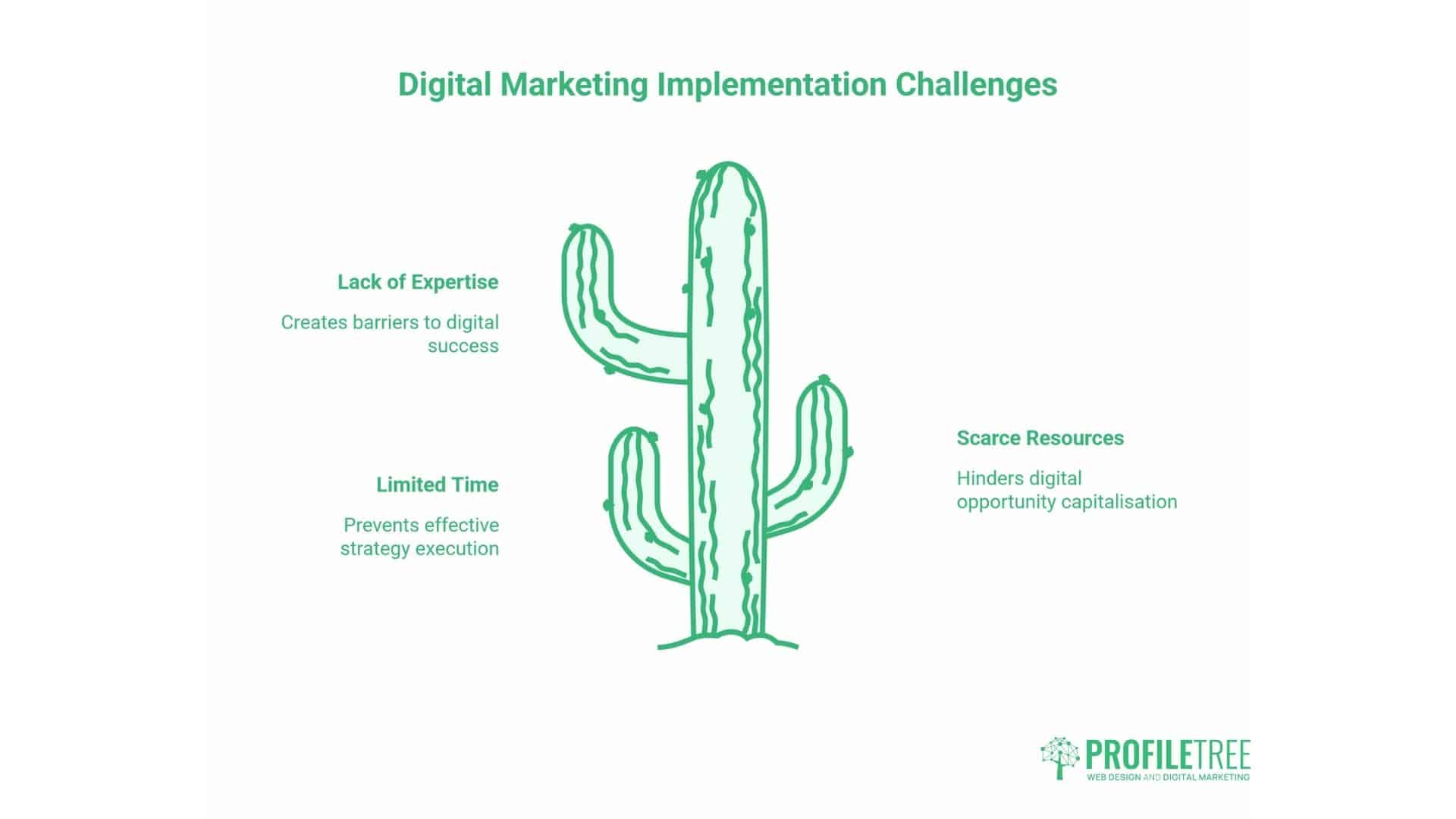
The gap between understanding what should be done and actually implementing effective digital marketing strategies often proves challenging for small businesses. Limited time, resources, and expertise create barriers that prevent many businesses from capitalising on digital opportunities. However, strategic approaches can deliver meaningful results even with constraints.
Starting with Content and Social Media
For most small businesses, content marketing and social media are the most cost-effective starting points for digital marketing. These channels require a relatively low initial investment while building assets that continue to deliver value over time.
Begin with a simple content calendar focused on answering common customer questions. Rather than publishing daily, commit to consistent weekly content that genuinely helps your target audience. Quality and consistency outweigh volume—one excellent piece of content per week delivers more value than daily mediocre posts.
Create educational content that showcases expertise without being overtly promotional. A solicitor might write about common legal issues clients face. A web design agency might explain how website performance affects business results. This approach establishes authority while providing genuine value, building trust that eventually leads to business.
Repurpose core content across multiple formats to maximise return on investment in creation. A detailed blog post becomes multiple social media posts, an email newsletter, a video script, or presentation slides. This approach multiplies reach without requiring constant new content creation.
Adopting AI Tools Strategically
AI tools have dramatically reduced expertise and resource barriers for sophisticated marketing activities. Small businesses can now implement AI-assisted workflows for content creation, customer service, and campaign optimisation without significant technical expertise.
Use AI writing assistants to create first drafts of blog posts, social media content, and email copy. These tools handle basic writing tasks, allowing business owners to focus on refinement and strategic thinking rather than staring at blank pages. However, always review and edit AI-generated content to ensure it accurately reflects your brand voice and business expertise.
Implement basic chatbots to handle common customer questions and qualifications. Modern chatbot platforms require minimal technical setup while providing 24/7 responsiveness that small teams can’t match manually. Start with simple question-answer pairs covering frequently asked questions, then expand functionality as you learn what customers actually need.
Apply AI-powered analytics tools to identify patterns and opportunities in marketing data. These tools surface insights that might otherwise remain hidden in spreadsheets, helping prioritise high-impact activities without requiring advanced analytical skills.
Building First-Party Data Assets
As privacy regulations tighten and third-party data becomes harder to access, small businesses must prioritise building their own customer data assets through direct relationships. Email lists, customer databases, and on-site behavioural data become increasingly valuable competitive advantages.
Create valuable lead magnets that incentivise email sign-ups. Useful resources, exclusive discounts, or educational content provide a clear value exchange for contact information. The key is offering something genuinely valuable rather than generic “newsletters” that few people want.
Implement progressive profiling to collect additional customer information gradually over time rather than demanding extensive information upfront. Each interaction provides opportunities to learn more about customers—purchase history, preferences, interests—building detailed profiles that improve targeting and personalisation.
Clearly communicate the benefits of sharing information to increase opt-in rates. Rather than simply asking for email addresses, explain what subscribers will receive and why it’s valuable. Transparency about data usage builds trust while improving conversion rates.
Using Analytics to Guide Decisions
Even basic analytics implementation can dramatically improve marketing effectiveness by shifting decisions from intuition to data-driven insights. Most small businesses have access to analytics tools but fail to use them strategically to guide resource allocation and optimisation.
Implement proper tracking across all digital properties and campaigns. At minimum, this means Google Analytics on your website, conversion tracking on paid campaigns, and email metrics from your email platform. Without proper tracking, you’re operating blind—unable to determine what’s working and what’s wasting resources.
Establish clear performance benchmarks for each marketing channel. Rather than simply collecting data, define what success looks like for different activities. What conversion rate should your website achieve? What engagement rate indicates successful social content? Benchmarks provide context for interpreting data and identifying areas needing improvement.
Regularly review performance data to identify actionable insights. Monthly or quarterly reviews should answer specific questions: Which channels drive the most valuable customers? What content generates the most engagement? Where are we losing potential customers in the conversion process? These insights guide resource reallocation from underperforming to high-performing channels.
Collaborating with Micro-Influencers
For small businesses, broad influencer partnerships deliver poor returns compared to targeted collaborations with micro-influencers who have established credibility within specific communities. These smaller influencers typically have more engaged audiences, charge lower fees, and operate within niches that align with particular business offerings.
Identify influencers whose audience closely matches your target customer profile. Focus on alignment rather than reach—an influencer with 10,000 highly engaged followers in your target demographic delivers more value than someone with 100,000 followers across various demographics.
Develop authentic partnerships based on genuine product appreciation rather than purely transactional relationships. Influencers who actually use and appreciate your product or service create more compelling, believable content than those who simply read from sponsored scripts.
Measure partnership performance based on engagement and conversion metrics rather than reach. The goal isn’t impressions—it’s meaningful customer actions. Track clicks, sign-ups, and sales generated through influencer partnerships to calculate true ROI and identify the most valuable relationships.
Website Development and Design for Conversions
While driving traffic through SEO, content, and advertising requires substantial effort, that effort is wasted if your website doesn’t convert visitors into customers. Web design and development focused on user experience and conversion optimisation form the foundation of successful digital marketing.
Modern websites must balance aesthetic appeal with functional performance. Slow-loading sites lose potential customers before they even see your content—research shows that 53% of mobile users abandon sites that take longer than three seconds to load. Visual design matters, but performance, usability, and mobile responsiveness matter more.
Conversion-Focused Design Principles
The most effective small business websites prioritise clarity over cleverness. Visitors should immediately understand what you offer, who it’s for, and what action they should take next. Complex navigation, unclear messaging, or buried contact information create friction that reduces conversions.
Clear calls to action guide visitors toward desired actions—requesting quotes, booking consultations, making purchases, or signing up for emails. These CTAs should stand out visually, communicate clear benefits, and appear at multiple points throughout the site as visitors engage with different content.
Trust signals, including customer testimonials, case studies, industry certifications, and security badges, address the hesitation potential customers feel when considering unfamiliar businesses. Social proof reduces perceived risk, particularly for services or high-value purchases where customers can’t evaluate quality before buying.
Mobile responsiveness has shifted from optional to essential—mobile devices now generate more than half of all web traffic. Sites that don’t work well on smartphones and tablets lose substantial portions of potential customers who simply leave rather than struggling with poor mobile experiences.
Technical Performance and SEO
Website speed affects both user experience and search rankings. Search engines prioritise fast-loading sites because they provide better user experiences. Optimising images, using modern hosting infrastructure, implementing caching, and minimising unnecessary code all contribute to faster load times.
Structured data markup helps search engines understand your content, potentially earning enhanced search results, including star ratings, pricing information, or event details displayed directly in search results. These “rich results” increase click-through rates by providing more information and standing out visually from standard search results.
Security through HTTPS connections has become standard—browsers now flag non-HTTPS sites as “not secure,” damaging trust before visitors even view your content. SSL certificates, once expensive and complex to implement, are now often included free with hosting and simple to install.
ProfileTree specialises in WordPress development and web design focused on rankings, traffic, leads, and sales. Our approach combines aesthetic design with technical optimisation and conversion-focused user experience, building websites that serve as effective marketing tools rather than just online brochures.
Digital Strategy and Marketing Training
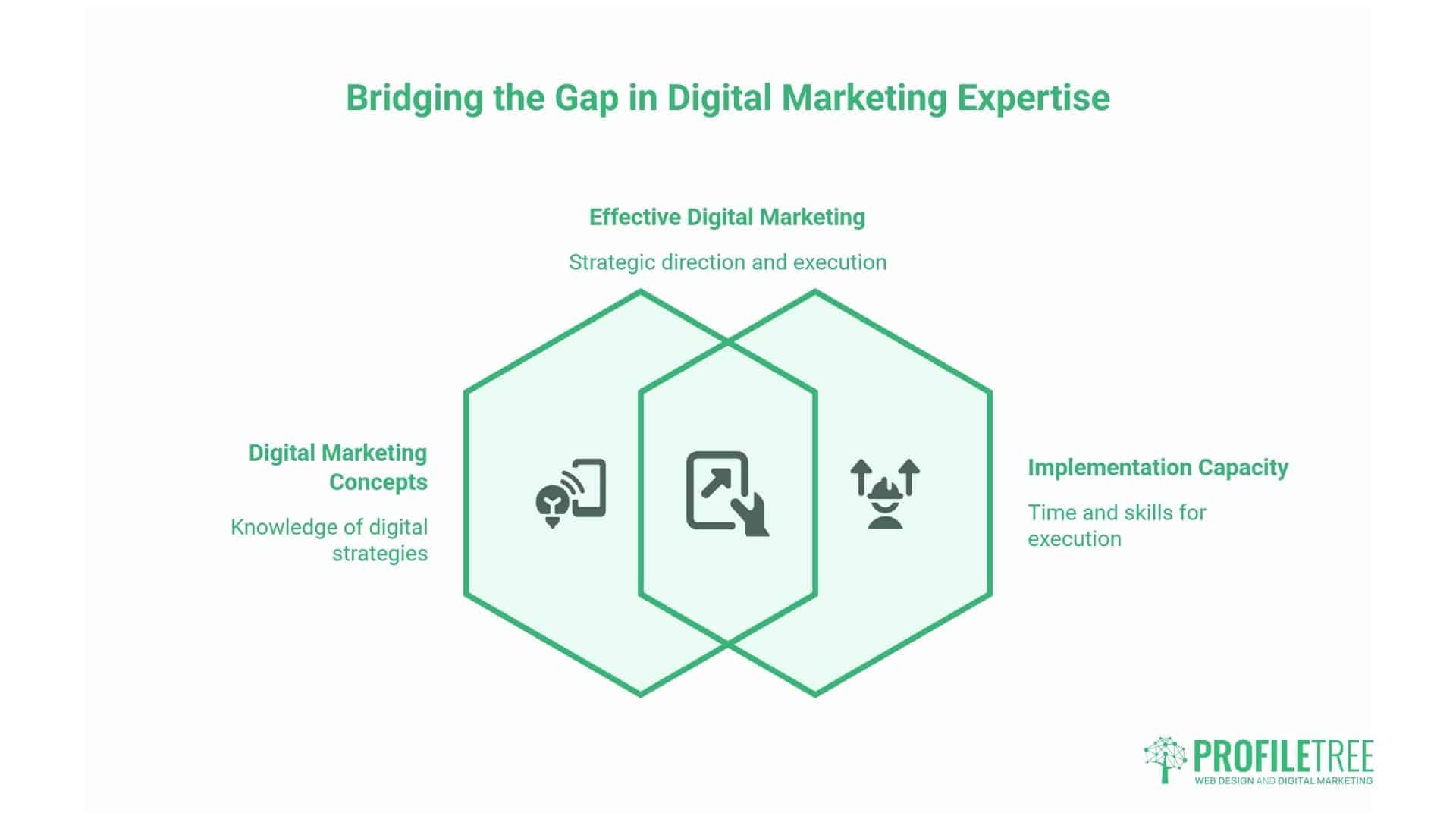
Understanding digital marketing concepts and having the time and expertise to implement them effectively represent two different challenges. Many small businesses benefit from external expertise—not to handle everything, but to provide strategic direction and training that builds internal capabilities.
Digital strategy services help businesses identify high-impact opportunities, develop realistic implementation plans, and avoid common pitfalls that waste time and resources. Rather than simply executing tactics, strategic approaches start with business objectives and work backwards to identify marketing activities most likely to drive desired outcomes.
Building Internal Marketing Capabilities
Marketing training helps small business teams develop skills needed to manage digital marketing efforts effectively. Rather than remaining dependent on external agencies for basic tasks, trained teams can handle day-to-day execution while relying on specialists only for complex or time-intensive activities.
Training in SEO basics helps teams create content that ranks well without requiring constant agency involvement for every page or post. Understanding keyword research, on-page optimisation, and content structure enables internal teams to consistently produce SEO-friendly content.
Social media management training covers platform-specific best practices, content creation workflows, and engagement strategies. With proper training, internal teams can maintain a consistent social presence without requiring daily agency oversight.
Analytics training helps teams interpret data and make informed decisions without needing analysts for every question. Understanding which metrics matter and how to extract actionable insights from analytics platforms improves decision-making across all marketing activities.
ProfileTree offers digital marketing training and AI training designed specifically for small businesses and organisations. Our training programmes focus on practical skills that participants can implement immediately, building capabilities that deliver long-term value rather than just theoretical knowledge.
Overcoming Common Digital Marketing Challenges
Small businesses face specific digital marketing challenges that larger enterprises with dedicated marketing departments don’t encounter. Limited budgets, time constraints, and a lack of specialist expertise create barriers that prevent many businesses from fully capitalising on digital opportunities.
Addressing Resource Constraints
The most common challenge small businesses cite is a lack of time for marketing activities. Business owners already wear multiple hats—operations, sales, customer service, and administration—leaving limited capacity for marketing. However, strategic approaches can deliver meaningful results even with time constraints.
Focus on high-impact activities rather than attempting comprehensive coverage across all possible channels. Identify which marketing activities deliver the most valuable results for your business, then allocate resources there. Doing three things well delivers better results than doing ten things poorly.
Batch similar tasks to improve efficiency. Rather than creating content daily, dedicate specific blocks of time to producing multiple pieces simultaneously. Write several blog posts in one session, create a week’s worth of social content at once, or record multiple videos in a single production day. This approach reduces setup time and maintains consistent quality.
Automation handles routine tasks without requiring ongoing manual effort. Scheduled social posts, automated email sequences, and chatbot responses handle repetitive activities, freeing time for strategic thinking and high-value customer interactions that can’t be automated effectively.
Managing Limited Budgets
Budget constraints force prioritisation decisions—on which channels receive investment, which activities occur in-house versus through agencies, and how to maximise returns from limited marketing spend. Strategic budget allocation becomes essential for small businesses unable to simply outspend competitors.
Start with channels offering owned assets rather than purely rented attention. SEO and content marketing build long-term assets that continue to deliver value after their initial creation. Paid advertising stops working the moment you stop paying. While paid channels serve important purposes, building owned assets should take priority for businesses with limited budgets.
Consider hybrid approaches combining in-house and external expertise. Internal teams can handle day-to-day execution while specialists provide strategy, training, and high-complexity activities. This approach costs less than fully outsourcing while delivering better results than purely DIY efforts.
Measure everything to identify which activities deliver actual business results rather than just vanity metrics. Many small businesses waste budget on activities that feel productive but don’t drive meaningful outcomes. Regular measurement and willingness to reallocate resources from underperforming to high-performing activities maximise limited budgets.
Building Necessary Expertise
Marketing expertise requirements have expanded dramatically—success now requires an understanding of SEO, content creation, social media, paid advertising, analytics, conversion optimisation, and emerging technologies like AI. Few small businesses can hire specialists across all these areas, yet some expertise is necessary for effective marketing.
Strategic partnerships with agencies or consultants provide access to specialist expertise without requiring full-time hires. Choose partners who prioritise knowledge transfer and training rather than creating dependency. The best agency relationships build your team’s capabilities over time rather than keeping you reliant on external expertise indefinitely.
Continuous learning through industry publications, online courses, and professional development helps internal teams stay current with evolving best practices. Digital marketing changes rapidly—strategies effective two years ago may no longer work. Regular learning ensures approaches remain current and effective.
Start with fundamentals before pursuing advanced tactics. Many small businesses jump to complex strategies without mastering the basics. Strong foundations in SEO fundamentals, content creation, and customer communication deliver better results than poorly executed advanced techniques.
The Future of Digital Marketing for UK Small Businesses
The digital marketing environment will continue evolving, creating both new opportunities and challenges for small businesses. While specific tactics and platforms change, several fundamental trends will shape the landscape over the coming years.
AI capabilities will expand dramatically, making sophisticated marketing approaches accessible to an ever-increasing number of small businesses. However, this democratisation also means competitors gain access to the same tools—competitive advantage will come from strategic application rather than simply using AI.
Privacy regulations will continue to tighten, requiring businesses to continuously adapt their targeting and tracking approaches. First-party data strategies and privacy-compliant marketing approaches will separate successful businesses from those struggling to adapt to new restrictions.
Video and interactive content will continue growing in importance as attention spans fragment and expectations for engaging, immediate content increase. Businesses that develop video capabilities early will have an advantage over those that wait until video becomes absolutely necessary.
Voice search and conversational interfaces will change how people find information and interact with businesses. Optimising for voice searches with natural language and question-focused content will become increasingly important for visibility.
Preparing for Continued Change
The only constant in digital marketing is change. Platforms evolve, algorithms update, consumer behaviours shift, and new technologies emerge. Small businesses that build adaptable marketing systems rather than relying on specific tactics will navigate these changes more successfully.
Focus on building core assets—email lists, content libraries, customer relationships—that maintain value regardless of platform changes. Social media platforms rise and fall, but email lists and customer data remain under your control and continue delivering value.
Maintain testing and learning mindsets rather than assuming any strategy will work indefinitely. Regular experimentation with new approaches, platforms, and tactics identifies opportunities while avoiding over-commitment to strategies that may become less effective over time.
Build relationships with trusted experts and agencies that stay current with industry developments and can guide strategy through changes. Attempting to monitor and understand all marketing developments internally becomes increasingly difficult as the environment grows more complex.
Taking Action: Landscape for Small Businesses
Digital marketing for small businesses requires balancing strategic thinking with practical execution. Understanding best practices matters little without implementation, yet jumping into tactics without a strategy wastes resources on activities that may not drive business objectives.
Start by clarifying specific business goals that marketing should support. “Increase online presence” is vague—”generate 10 qualified leads per month” or “increase online sales by 30%” provides clear direction. Specific objectives guide prioritisation and allow measurement of whether marketing activities actually deliver business value.
Audit current marketing activities to identify what’s working and what’s not. Many businesses continue their activities out of habit rather than because they deliver results. Regular audits identify opportunities to reallocate resources from underperforming to high-performing channels.
Develop implementation plans that acknowledge resource constraints rather than aspirational plans requiring unlimited time and budget. Realistic plans that you’ll actually execute deliver more value than comprehensive strategies that never get implemented.
Establish measurement frameworks before launching new activities. Decide how you’ll determine success, implement necessary tracking, and commit to regular review schedules. Without proper measurement, you’ll never know which activities work and which waste resources.
FAQs
What digital marketing services deliver the best ROI for small businesses?
SEO and content marketing typically deliver the highest long-term ROI by building owned assets that continue to attract customers over time. However, the best services depend on your specific circumstances—paid advertising delivers faster results for businesses needing immediate sales, while social media works better for visually appealing products targeting younger audiences.
How much should small businesses budget for digital marketing?
Most experts recommend allocating 7-12% of revenue to marketing. For small businesses, monthly digital marketing budgets typically range from £500 to £3,500, depending on business size, industry, and growth objectives. Starting smaller and scaling based on proven results often works better than large upfront commitments.
Can small businesses handle digital marketing in-house, or should they hire agencies?
Hybrid approaches often work best—handling day-to-day execution in-house while using agencies for strategy, training, and complex activities requiring specialist expertise. This costs less than full outsourcing while delivering better results than DIY efforts without sufficient expertise.
How long does SEO take to show results?
Most businesses see initial SEO improvements within 3-6 months, with substantial results appearing after 6-12 months of consistent effort. SEO is a long-term strategy—businesses that need immediate results should combine it with paid advertising.