
SEO for Security Companies in the UK and Ireland
Table of Contents
Security buyers rarely start with a phone call. A facilities manager who needs guarding for a vacant site, or a builder who wants cameras up before the next break-in, opens a search engine first. SEO for security companies is about being the firm that shows up at that moment, because if you are not on the results page, you are not on the shortlist, and no amount of experience changes that. This page sets out how security companies across Northern Ireland, Ireland and the wider UK can be found for the work they actually want: from day-rate guarding cover to six-figure installation tenders.
How security buyers search, and why the sales cycle runs long
Commercial security is a considered purchase. A retailer choosing a guarding contractor is handing over responsibility for staff safety and stock. That decision goes through procurement, references and often a site visit before anyone signs. The search that starts it, though, is short and specific.
Read the intent behind the query, and you can see the buyer. Someone typing “security guards Belfast” or “manned guarding services” is scoping suppliers, often weeks before a contract starts. Someone searching for “emergency site security” or “vacant property security now” needs a callback within the hour and will pay a premium for speed. A homeowner looking for “house alarm installation” wants trust and a fair price more than scale. These are different people with different budgets, and one page cannot speak to all of them well.
The longer B2B cycle has a practical upside. Because buyers research early, your visibility during that research window shapes the shortlist before quotes are even requested, which is exactly where search engine optimisation earns its place. Firms that provide clear service information, visible credentials, and genuine case examples are invited to tender. Firms that are invisible at that stage are quietly excluded, whatever their track record.
SEO for the four main security sectors
Security is not one market. A firm that fits intruder alarms competes for entirely different searches than a company supplying licensed door staff, even where the same business offers both. Separate, substantive pages for each service line let you rank for the terms that matter and let buyers self-select into the service they need. Here is how the four main sectors differ.
Manned guarding firms
Guarding buyers search by deployment type: static guarding, mobile patrol, key holding, corporate reception, and construction site cover. Build a page for each significant line rather than folding them into a single page. On every page, make officer training, SIA licensing and Approved Contractor Scheme status plain, because professional buyers screen on exactly those points. Contract work usually runs through formal procurement, so the job of your website is to earn the invitation to tender.
Alarm and intruder-system installers
Installers pick up two revenue streams from search: the capital install and the monitoring contract that follows. Searches such as “commercial intruder alarm installation” or “monitored alarm systems” signal a project with a budget attached. NSI or SSAIB certification is the deciding trust signal for insurers and commercial clients, so it belongs in your page copy rather than sitting only on a badge in the footer. Local intent is strong here, which means an accurate Google Business Profile and consistent local citations do much of the work.
CCTV and security integrators
Camera and access-control buyers want proof of technical range and after-install support. They search for specific systems, integration with existing infrastructure, and ongoing maintenance. This is where case studies pull real weight: a short, anonymised account of a completed multi-site install reassures a prospect far more than a feature list. Pages that cover the whole project lifecycle, from survey through to maintenance, also tend to answer more sub-questions, which helps with both Google ranking and AI citation.
Event and specialist security
Event organisers hire on licensing and scale. They need to know your door supervisors hold current SIA licences and that you have handled crowds of a comparable size. A dedicated event security page that references the types and scale of events you have covered does more than any generic “we do events too” line buried on a homepage. Specialist lines such as security consulting and risk assessment deserve the same treatment that you offer them.
The table below summarises where each sector’s search priorities sit.
| Sector | Main search intent | Deciding trust signal | First SEO priority |
|---|---|---|---|
| Manned guarding | Ongoing contracts and one-off cover | SIA ACS status, officer training | Service pages by deployment type |
| Alarm installers | Capital install plus monitoring | NSI or SSAIB certification | Google Business Profile and local citations |
| CCTV and integrators | Projects and maintenance | Technical range, integration proof | Case studies and system pages |
| Event and specialist | Licensed, scalable cover | Door supervisor licensing, scale handled | Event-experience page |
Local contracts and national tenders need different foundations
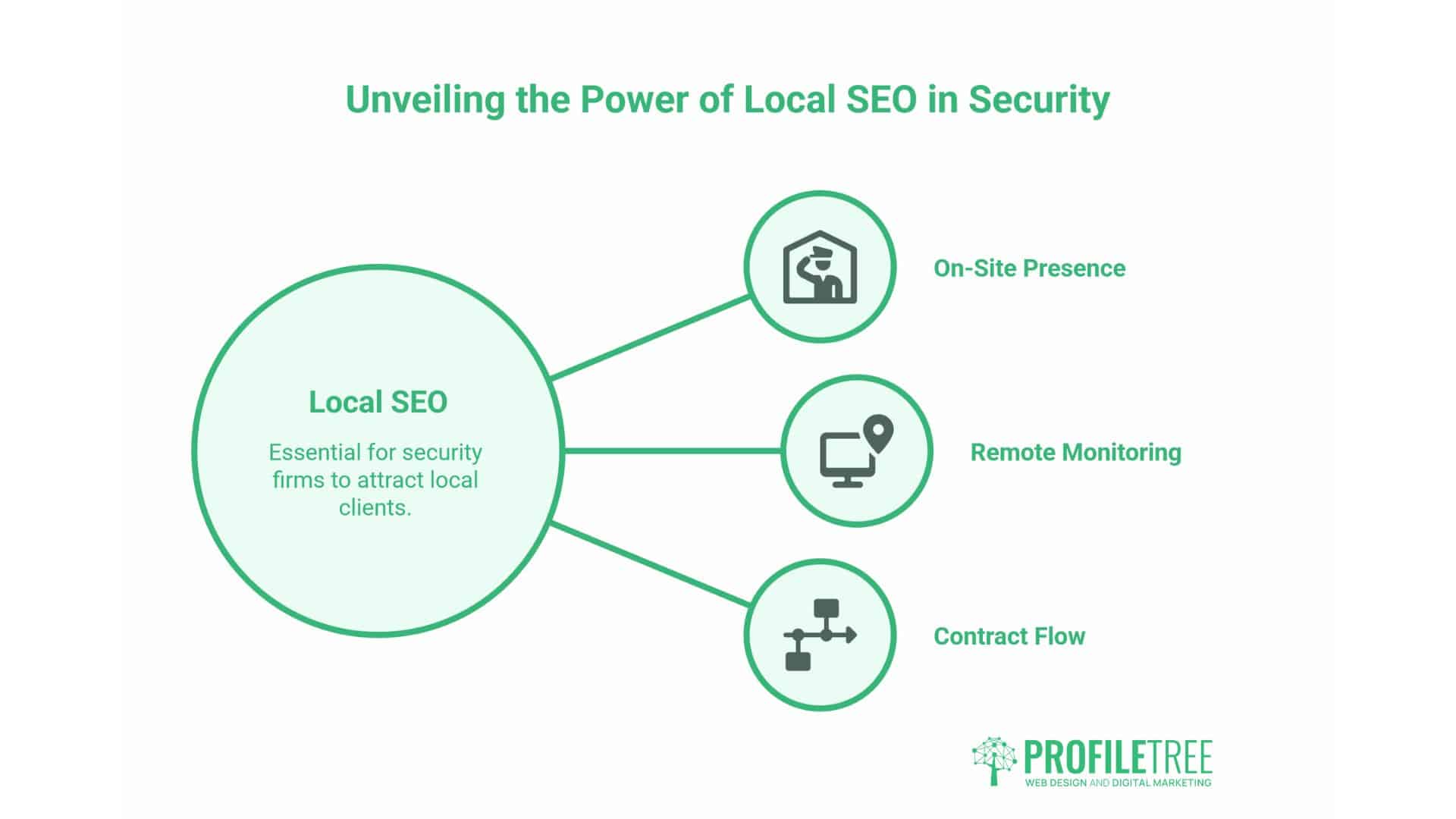
Most security work is local or regional by nature. Guards have to be on site. Engineers have to attend. Even remote monitoring sells better with a credible local response. That geography makes local SEO the backbone of steady contract flow.
Your Google Business Profile is the starting point. Choose the categories that match your primary services, whether that is Security Guard Service, Security System Installer or Burglar Alarm Supplier. Define service areas honestly, list every service you want to be found for, and name your SIA, NSI or SSAIB credentials in the description. Beyond the profile itself, consistent listings across business and industry directories reinforce that you operate where you say you do. Our guide to business listing sites covers where those citations are worth building, and the same principles behind local SEO apply directly to security firms chasing area-based work.
National and public-sector tenders are a different game. Local authority contracts, framework agreements and large multi-site jobs care less about proximity and more about proof: accreditations, insurance levels, case history and scale. Your website is often the first document a procurement team reads before deciding whether to include you. Clear, verifiable credibility content is what moves a firm from unknown to shortlisted, and that content needs to be crawlable text rather than a locked-away PDF.
Accreditation is a ranking signal that Google and AI can read
Here is the point most security websites miss. Accreditation does two jobs at once: it reassures buyers and provides search systems with machine-readable evidence of legitimacy that they weigh when deciding who to show and who to cite. An SIA Approved Contractor logo saved as an image tells a crawler almost nothing. The same claim written in plain text, with the scheme named and your registration referenced, is something both Google and an AI answer engine can quote back to a searcher.
Put your credentials in words, on the page, near the services they relate to. SIA licensing and Approved Contractor Scheme status. NSI or SSAIB certification for systems work. ISO certifications where you hold them. Appropriate insurance levels for commercial and public-sector clients. Membership of recognised industry bodies. Each of these is a factual statement a buyer wants and a search system can index. This is also where UK and Ireland specificity becomes a genuine advantage: the SIA, NSI, and SSAIB frameworks are regional, and content explaining them accurately cannot be lifted wholesale from a US security template. That local accuracy is exactly the kind of first-hand, region-specific detail that earns citations in AI answers.
Content that earns security enquiries, not just clicks
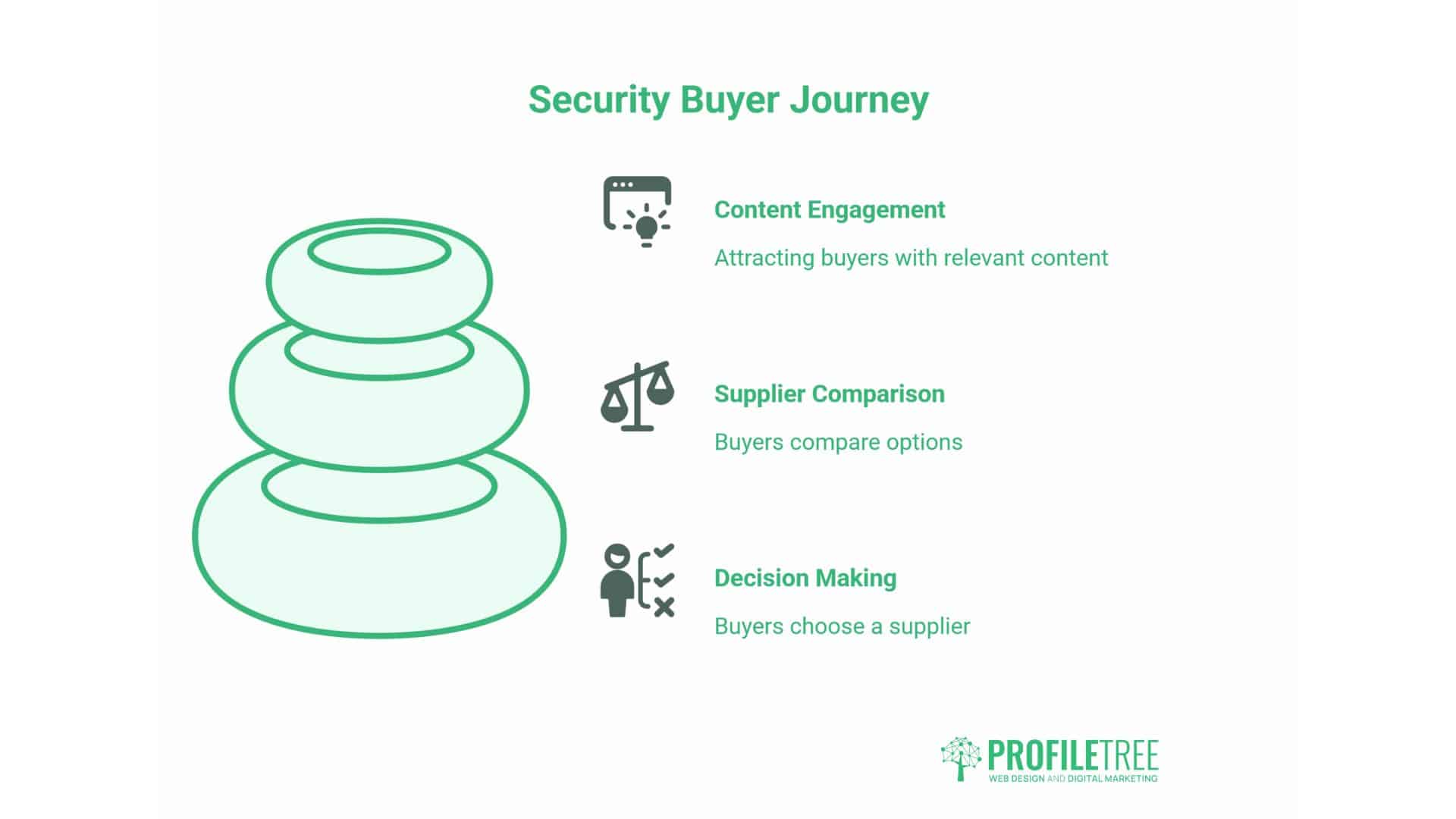
Service pages do the heavy lifting, but they catch buyers late, at the point of comparing suppliers. Plenty of security decisions start earlier, when a business owner is still working out what they actually need. Content aimed at that research stage brings those buyers into contact with your firm before a shortlist exists.
The formats that work are specific to security work. A short guide on assessing a site’s security needs, a plain explanation of when manned guarding beats electronic systems, or a piece on what to check before commissioning a commercial CCTV install all answer real questions buyers type into search. Sector pieces do the same job for a defined audience: construction site security, retail loss prevention, and event planning. Each one shows that you understand a particular client’s world, which matters more to a buyer than a generic capability list.
Local content pulls double duty. An article on business security considerations for a specific town or city captures area searches while signalling that you genuinely operate there. Keep it properly local, with real detail, rather than a template with the place name swapped in. Google has been clear about penalising thin location content, and security buyers can spot a filler page as quickly as an algorithm can.
Where security firms lose SEO ground
Most of the damage comes from a handful of repeatable mistakes. Fixing them is often faster than chasing new rankings.
- Credentials trapped in images. An SIA or NSI badge saved as a graphic is invisible to search. State the accreditation in text, then keep the badge as reinforcement.
- One page trying to sell everything. A single services page covering guarding, alarms and CCTV ranks well for none of them. Split the service lines so each can rank independently.
- A neglected Google Business Profile. Wrong categories, vague service areas and missing services quietly cost local visibility that would otherwise arrive at no media cost.
- Templated location pages. Duplicating one page across twenty towns with only the name changed invites a thin-content problem rather than local reach.
- Chasing vanity terms. Ranking for a broad, high-competition phrase feels good, but it converts poorly. Service-specific searches attract fewer visitors but yield far better enquiries.
None of these needs a big budget to correct. They need someone to treat the website as a sales tool that procurement teams read, not a brochure that sits untouched between rebrands.
Measuring security SEO: track enquiries, not vanity rankings
The only number that pays wages is a signed contract, so measurement should work backwards from there. Rankings and traffic matter as early indicators, but they sit at the start of the chain rather than at the end.
Track four things in order. First, visibility for the searches that describe your actual services and areas, not just your company name. Second, organic enquiries are broken down by service and by page, so you can see which content earns work. Third, enquiry quality: are the leads the kind of contract you want, at a scale you can deliver? Fourth, conversion from enquiry to signed contract, which tells you whether the traffic is the right traffic.
A firm ranking well for a broad term but fielding time-wasting enquiries is worse off than one ranking modestly for precise service searches that convert. Judge the work on the contracts it brings in, and let that decide where the next round of content and local effort goes.
How ProfileTree approaches security-sector SEO
Our starting point is always the buyer, not the keyword. We map the searches your ideal contracts begin with, then build the pages that answer them: a service page per deployment or system type, a local page where you have a genuine physical presence, and credibility content that stands up to a procurement review. We turn your accreditations into crawlable text, structure each page so AI search engines can extract clean answers, and ensure your Google Business Profile and citations point to the areas you actually serve.
The work runs in a clear order. First, an audit of where you currently appear and where the gaps sit. Then the page architecture and priority order are weighted toward the contracts worth most to you. Then the content itself is written to the standards commercial buyers expect. Finally, the local and technical groundwork that helps it rank and stay measurable against real enquiries rather than vanity rankings.
“Security firms win on trust, and that trust has to be visible before anyone picks up the phone. When we build search visibility for a guarding or systems company, our job is to make their accreditation, their track record and their service area easy for people and search engines to read.” Ciaran Connolly, founder, ProfileTree.
Getting cited when buyers use AI search
AI answer engines now sit between a lot of buyers and the websites they used to click straight through to. Someone researching security options may ask ChatGPT, Perplexity or Google’s AI Overview which type of system suits their premises, and the firms named in that answer get a head start the rest never see. Ranking on Google still matters, but being quotable by an AI is becoming a channel in its own right.
The content that earns those citations has a recognisable shape. Self-contained sections that answer one question cleanly are easy for a model to lift. Plain factual statements help too: say who you are, where you operate and what you are accredited for, in words rather than by implication. Pages that work through several related sub-questions on a topic tend to be cited more often than thin ones, because they give the model more to draw on. First-hand detail carries the most weight, and that is where a security firm has a natural advantage over generic content.
This is the payoff from getting your accreditation and service area into crawlable text. The SIA, NSI and SSAIB detail that a UK or Ireland security firm can state accurately is exactly the specific, regional information AI tools reach for, and it is the part a generic overseas template cannot fake. Keep those pages current, because AI systems lean heavily toward recently updated sources.
Conclusion: SEO for Security Companies
Search visibility will not replace the reputation a security firm earns on the ground, but it decides who gets the chance to prove it. The firms that win online treat their website as part of the sales process: a page for each type of work, credentials in plain text that buyers and search engines can both read, and local signals pointing at the areas they serve.
Fix the foundations first, measure against real enquiries rather than vanity rankings, and the work that reaches you starts to match the work you actually want to win.
If you run a security company and want to be found by the businesses looking for exactly what you do, talk to our team about a security-sector SEO plan built around your services and service area.
FAQs
How long does SEO take to bring in security enquiries?
Local visibility can improve within weeks once your Google Business Profile and citations are in order. Competitive commercial terms and tender-grade credibility usually take three to six months, because they rely on content depth and trust signals that build over time.
Do we need separate pages for guarding and for CCTV or alarms?
Yes. Guarding buyers and systems buyers search differently and judge you on different credentials. A combined page dilutes your relevance for both, so give each service line its own substantive page.
Is a Google Business Profile enough on its own?
No. It wins local map and “near me” visibility, which matters, but it cannot carry the credibility a procurement team needs or rank you for service-specific searches. Treat it as the foundation, with a strong website on top.
How do we show SIA, NSI or SSAIB accreditation to search engines?
Write the credential out in text, name the scheme, and reference your registration. Keep the badge image with descriptive alt text, but never rely on it alone. Search systems index words, not logos.