
Digital Content Marketing Trends: A Belfast Business Guide
Table of Contents
Belfast and Northern Ireland businesses ask the same question every year: which digital content marketing trends are worth the budget, and which are noise? The honest answer for 2026 is that personalisation, short-form video and AI-assisted content creation are doing most of the heavy lifting, but the businesses winning locally are the ones adapting these trends to Belfast’s market rather than copying a generic playbook built for London or New York.
Since 2011, ProfileTree has worked with SMEs across Belfast, Northern Ireland, Ireland and the UK, and this guide reflects what we’re seeing directly in client accounts rather than repeating industry press releases. If you want a broader, UK-wide view of content marketing trends, our companion guide covers that ground; this one stays deliberately local, because a manufacturer in Lisburn and a hospitality brand in Dublin are not fighting for the same search results or the same customers.
Where Digital Content Marketing Stands in Belfast
Belfast’s digital marketing scene has grown up. A decade ago, most SMEs treated a blog as an occasional task; now it’s a core part of how customers find and vet a business before they ever pick up the phone. That shift matters more in Northern Ireland than in larger UK regions, because word of mouth and local reputation still carry enormous weight here, and following digital content marketing trends closely is increasingly how that reputation gets built online.
Search behaviour has also changed. People searching for “content marketing Belfast” or “digital marketing strategy Belfast” are rarely looking for a definition; they’ve already decided they need help and are comparing who actually understands the local market. Broader searches for “digital marketing Northern Ireland” and “content marketing NI” tell a similar story: businesses want proof of local experience, not a rebranded national template. Epsilon’s consumer research (linked) found that 80% of consumers are more likely to do business with a company that offers personalised experiences, and that applies just as much to a Belfast joinery firm as it does to a national retailer.
What Makes NI Audiences Different
Northern Ireland businesses often serve customers across two jurisdictions at once, the UK and Ireland, which means content has to work for two sets of regulations, two currencies in some cases, and two slightly different cultural registers. A campaign written purely for a GB audience can miss local terminology, funding schemes such as Invest NI support, or the practical realities of serving both Belfast and Dublin from one team. Businesses that get this right build trust faster than competitors, treating Northern Ireland as an afterthought to a UK-wide strategy.
This cross-border reality also shapes keyword strategy. A single page trying to rank for “digital marketing NI,” “digital marketing Belfast”, and a Republic of Ireland equivalent term usually ends up serving none of them well. Splitting content by audience, even lightly, tends to outperform a single blended page.
Emerging Trends in Digital Media for 2026
The digital content marketing trends shaping this year sit at the intersection of AI-assisted production, video-first search behaviour, and tighter data privacy expectations. None of these is entirely new for 2026, but the way businesses are expected to implement them has matured considerably since even last year, and the gap between businesses doing this well and those still catching up has widened.
Personalisation and AI-Assisted Content Creation
Personalisation used to mean inserting a first name into an email subject line. It now means building content journeys that respond to how someone actually behaves on a site: what they searched for, where they’re browsing from, and what stage of the buying process they seem to be at. When someone in Derry searches for manufacturing solutions in Northern Ireland, their intent differs from a searcher in Dublin looking for the same service, and content built around that distinction converts better than a one-size-fits-all page. It’s one of the clearer content creation trends for 2026: broad, generic pages are losing ground to narrower, better-targeted ones.
AI tools have made this kind of personalisation practical for smaller teams. Content ideation, first-draft generation, and performance analysis that once needed a dedicated analyst can now be handled with the right prompts and a bit of training. That’s a genuine opportunity for Belfast SMEs competing against larger companies with bigger marketing budgets, but it only works when a human still shapes the final output. Content that reads as obviously AI-written, with the stock phrasing and repetitive structure search engines are increasingly good at spotting, tends to underperform against material with a real point of view behind it.
Short-Form Video and Social Media Trends
Short-form video remains the dominant format for social discovery in 2026, and the platforms rewarding it have become more specific about what they favour. TikTok weighs watch time and completion rate heavily. Instagram prioritises saves and shares over simple likes. LinkedIn, increasingly relevant for B2B content in Northern Ireland’s manufacturing and professional services sectors, rewards posts that spark genuine comment threads rather than passive scrolling. Of the social media trends we track for clients, this rewarding of watch time and saves over vanity likes is the one reshaping content briefs the most.
For a Belfast business, this means picking one or two platforms where your actual audience spends time rather than spreading effort thinly across all of them. A trades business might get far more from three well-made TikTok clips a week than from a scattered presence on five platforms. Live streaming and interactive formats, such as product demonstrations and simple Q&A sessions, continue to build the kind of authentic connection that polished, corporate-style video struggles to match.
Content Management Trends: Tools and Workflow
Behind every published article sits a content management workflow, and this is one of the quieter but genuinely emerging trends in digital media for 2026. Businesses tracking digital content trends closely are moving away from scattered spreadsheets and one-off briefs toward proper content calendars, shared keyword trackers, and repeatable production processes. This shift in content management trends matters more than it sounds: a Belfast business publishing consistently, even at a modest pace, tends to outperform one publishing sporadically at higher quality, because search engines reward demonstrated coverage of a topic over time.
Digital content market trends also point toward tighter integration between the tools used to plan content and the tools used to measure it. Rather than treating content creation trends and analytics as separate jobs, the businesses seeing the best results now review performance data monthly and adjust the content pipeline accordingly, rather than waiting until an annual strategy review to notice what isn’t working.
Social Media Trends Worth Tracking Locally
Broader social media trends, from platform algorithm shifts to changing audience habits, get covered extensively by global marketing publications, but the practical takeaway for Northern Ireland businesses is narrower: consistency on the one or two platforms where your audience actually spends time beats a scattered presence everywhere. Among the emerging digital marketing trends for 2026, the clearest is that audiences reward brands that show up reliably with something genuinely useful, rather than brands chasing every new platform feature as it launches.
AI Overviews and Zero-Click Search
A growing share of searches now get answered directly on the results page, through AI-generated summaries, without a click through to any website. For Belfast businesses, that changes what “ranking well” actually means. A page can appear in an AI Overview and drive brand awareness without a single visit being recorded in analytics. Among the digital content trends we’re watching most closely, this shift toward zero-click visibility is the hardest one to measure and the easiest one to ignore.
Content structured with a clear, direct answer near the top of each section, followed by supporting detail, tends to get picked up by these AI summaries more often than pages that bury the answer under a long introduction. This favours businesses willing to answer a specific question thoroughly over those chasing broad, generic topics.
Data Privacy as a Marketing Consideration
Data privacy has moved from a legal checkbox to something customers actively factor into who they buy from. UK GDPR compliance is the baseline, not the goal. According to the UK’s Information Commissioner’s Office (linked), businesses that communicate clearly about how they use customer data see stronger trust and fewer complaints than those treating privacy policies as boilerplate. It’s a quieter thread running through this year’s digital content marketing trends, but it shapes how much personalisation a business can responsibly attempt.
Practically, this means a clear cookie consent process, a privacy policy written in plain English rather than legal jargon, and straightforward ways for customers to access or delete their data. For Belfast businesses handling customer information across both UK and Irish frameworks, getting this right the first time avoids a much more expensive fix later.
Content Formats and Sector Differences
Not every content format deserves equal budget, and the right mix varies more by industry than most generic guides admit. Long-form guides, comparison pages, and genuinely useful tools tend to outperform generic listicles, particularly now that search engines are actively downranking thin “best of” content published purely for link building. Most digital content marketing trends advice treats format choice as universal; in practice, the right format depends on who is buying and how they consider that purchase.
| Content format | Best suited to | Typical NI use case |
|---|---|---|
| Short-form video | Trades, hospitality, retail | Quick project reveals, behind-the-scenes clips |
| Long-form guides | Professional services, manufacturing | Explaining complex processes to B2B buyers |
| Interactive tools | Service businesses with a sales team | Qualifying leads before a call |
| Customer testimonials | Almost every sector | Building trust for first-time local buyers |
| Comparison content | Considered purchases | Helping buyers choose between approaches, not competitors |
Interactive and Value-First Content
Interactive content, such as simple product selectors, cost calculators, or short assessment quizzes, gives visitors a reason to spend time on a page rather than bouncing straight back to the search results. For a Belfast service business with limited sales resources, a well-built qualification tool can filter out browsers from genuinely interested buyers before a salesperson ever picks up the phone. It’s one of the more overlooked content creation trends, since it takes more upfront build effort than a standard blog post, but keeps paying back long after publication.
User-Generated Content and Local Proof
Research from BrightLocal’s consumer review survey (linked) shows that 98% of consumers read online reviews for local businesses, and star ratings strongly influence which ones they choose. For Northern Ireland SMEs, this means active review collection and genuine customer testimonials do more for credibility than almost any other content format, particularly for businesses without a long-established brand name. It’s a point worth repeating to anyone doing content marketing Belfast businesses can trust: a page full of claims convinces nobody, but a page full of named, verifiable reviews does.
One client we’ve worked with, supported through the Go-Succeed programme, put it simply: “Laura provided expert guidance on digital marketing strategies, from SEO to social media, and her insights made a real impact on my own knowledge and skills.” That kind of specific, verifiable feedback carries far more weight with a prospective customer than a polished but generic testimonial.
Manufacturing, Agri-Food and Professional Services Content
Northern Ireland’s economy leans heavily on manufacturing, agri-food and professional services, three sectors with very different content needs from the consumer brands most marketing advice is written for. A manufacturer selling into commercial contracts needs detailed case studies and technical explainer content more than viral social clips. An agri-food business exporting beyond the UK needs content that builds credibility with buyers who have never visited Northern Ireland. Professional services firms, meanwhile, often get the most value from thought leadership content built around a named expert rather than a faceless company blog. Generic digital marketing NI advice rarely accounts for these differences, which is exactly why sector-specific planning pays off.
A named partner or director writing regularly about industry changes tends to build more trust and more enquiries than an anonymous “team” byline, particularly for accountancy, legal and consultancy firms competing for considered, high-value clients.
This sector-by-sector approach also affects which platforms are worth the effort. A manufacturer exporting from Northern Ireland may see far more return from a well-optimised case study page than from social media at all, while a hospitality or retail brand serving local footfall usually gets the opposite result. Treating every business the same, regardless of sector, is one of the most common reasons a content marketing plan underperforms.
Building a Digital Marketing Strategy for Belfast Businesses
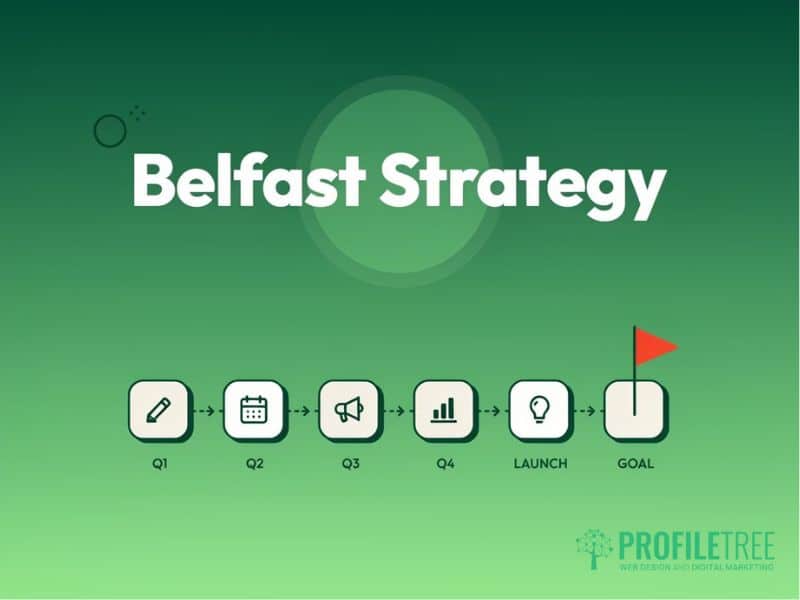
A digital marketing strategy that Belfast businesses can actually sustain needs to start with where your actual customers are searching, not with a template copied from a UK-wide agency blog. That usually means combining local SEO, content built around genuine NI-specific questions, and a content calendar that reflects seasonal patterns in your industry rather than a generic twelve-month plan. Following digital content marketing trends without a local lens tends to produce content that reads well but never quite reaches the right audience.
For most SMEs we work with, the mistake isn’t a lack of content, it’s content that doesn’t answer a specific enough question. “Content marketing tips” is too broad to compete against; “content marketing for a Belfast trades business trying to win commercial contracts” is specific enough to actually rank and convert. Northern Ireland’s market rewards this kind of precision because competition for broad terms is dominated by UK-wide agencies with far bigger content budgets.
Consistency matters as much as quality. A single excellent article published once a quarter does less for a Belfast business than a steady, slightly less polished stream of content answering real customer questions week after week. Search engines and AI systems alike reward sites that demonstrate ongoing coverage of a topic, not a single standout page surrounded by an otherwise quiet site.
Budget allocation follows the same logic. A Belfast business with a modest monthly content budget usually gets more from ten focused, locally specific pieces than from three generic ones aimed at a UK-wide audience it’s competing hardest to reach. Reviewing which existing pages already rank, even at a low position, and strengthening those first tends to produce faster results than starting entirely new content from scratch, since an existing page already has some search visibility to build on.
How ProfileTree Approaches Digital Content Marketing for NI Businesses
ProfileTree combines content strategy, SEO, video production and AI training into work built around what a Belfast or wider NI business can realistically sustain, rather than a generic monthly content package. Our content marketing services start with the questions your customers are actually asking, using search data rather than assumptions to shape what gets written. This is where digital content marketing trends get translated into a working plan rather than staying theoretical, whether that’s for a content marketing NI client with a tight monthly budget or a digital marketing NI campaign spanning several service lines.
Video and SEO tend to work best together. Our video marketing services help Belfast businesses turn short-form clips into a consistent presence across TikTok, Instagram and YouTube, while our SEO services make sure the written content behind that video actually ranks for the terms Northern Ireland customers use. For businesses wanting to build these skills in-house, our AI training programmes teach practical use of AI tools for content ideation and performance analysis, without requiring a technical background.
“By integrating AI into routine content analysis, businesses can spot what’s working faster and adjust before a campaign underperforms,” says ProfileTree founder Ciaran Connolly. “Our AI training helps Northern Ireland businesses put these tools to work without needing an enterprise budget or a technical team.”
If you’re weighing up where to focus your content budget for the year ahead, our team can walk through what’s realistic for your industry and audience. Get in touch with ProfileTree’s digital strategy team to talk through a plan built around your actual customers, not a generic template.
FAQs
1. What is the most important digital content marketing trend for Belfast businesses in 2026?
Of all the digital content marketing trends shaping 2026, personalised, locally specific content built around real search intent matters most, rather than generic UK-wide advice. Belfast and NI audiences respond better to content reflecting local context, funding schemes and cross-border realities than to templated national content.
2. How is social media marketing changing for Northern Ireland SMEs?
Short-form video continues to dominate, particularly on TikTok and Instagram Reels, with LinkedIn growing in relevance for B2B and professional services audiences in NI. Of the social media trends worth tracking, businesses picking one or two platforms where their audience actually spends time consistently outperform those spreading effort across every platform.
3. Do I need to worry about data privacy when personalising content?
Yes. UK GDPR compliance is a baseline requirement, and customers increasingly favour businesses that communicate clearly about data use. This is one area of digital content marketing trends where cutting corners costs more in lost trust than it saves in effort. Clear consent mechanisms and plain-English privacy policies build trust that generic legal boilerplate doesn’t.
4. Is AI-generated content safe to publish for SEO?
AI tools are useful for ideation and drafting, but content that reads as obviously machine-generated tends to underperform. Among current content creation trends, the ones publishing well are pairing AI drafting with real human editing rather than publishing raw output. A human should always shape the final piece, adding local context, genuine opinion and specific examples that AI can’t replicate.
5. How can a Belfast business compete against bigger UK content marketing budgets?
By being more specific. Broad terms are dominated by agencies with far larger budgets, but highly specific, locally relevant content marketing NI businesses can genuinely own, answering the exact question a Belfast customer is asking, can outrank generic national content, even with a smaller budget.