
Essential Guide to Social Media Marketing for Business
Table of Contents
Choosing the right approach to social media can feel overwhelming. Should you focus on creating organic content, invest in paid advertising, or partner with influencers? The answer isn’t simple—and it shouldn’t be. Each type of social media marketing serves a different purpose, reaches different audiences, and delivers distinct results.
For business owners and marketing managers across the UK, understanding these different types of social media marketing isn’t just helpful—it’s essential for making informed decisions about where to invest your time and budget. Whether you’re a Belfast-based retailer looking to build local awareness, a service provider seeking qualified leads, or an e-commerce brand driving direct sales, the types of social media marketing you choose will significantly impact your outcomes.
This comprehensive guide breaks down the three core types of social media marketing: organic content marketing, paid social media advertising, and influencer marketing. You’ll discover how each approach works, when to use them, and—most importantly—how to combine them strategically for maximum business impact. We’ll move beyond generic advice to provide practical insights from our work helping businesses across Northern Ireland, Ireland, and the UK build effective digital strategies that integrate social media with web design, SEO, and content marketing.
By the end of this article, you’ll have a clear framework for selecting the right types of social media marketing for your specific business goals, avoiding common pitfalls, and measuring what actually matters—real business results, not just vanity metrics.
Understanding Social Media Marketing Types for Business Growth
Businesses seeking meaningful connections with their target audience face a critical decision: which types of social media marketing will deliver the best results? With over 4.9 billion active social media users globally, the opportunity to reach potential customers has never been greater. However, success requires understanding the distinct types of social media marketing available and how each serves different business objectives.
The landscape of social media marketing encompasses several core approaches, each with unique strengths. From organic content strategies that build authentic relationships to paid advertising campaigns that expand reach rapidly, and influencer partnerships that add credibility through trusted voices—these types of social media marketing form the foundation of effective digital strategy. At ProfileTree, our experience working with businesses across Northern Ireland, Ireland, and the UK has shown that the most successful brands don’t rely on a single approach. They strategically combine different types of social media marketing to create comprehensive campaigns that drive measurable results.
Why Different Types of Social Media Marketing Matter
The various types of social media marketing serve distinct purposes within your broader digital strategy. Understanding these differences allows you to allocate resources effectively and set realistic expectations for outcomes.
Consider this: organic content marketing builds long-term brand authority and customer relationships, but requires consistent effort and patience. Paid social media advertising delivers immediate visibility and precise targeting capabilities, making it ideal for time-sensitive campaigns or reaching new audiences. Meanwhile, influencer marketing provides social proof and authentic recommendations that resonate with specific demographic groups.
“The businesses achieving the strongest social media results recognise these platforms as business tools, not just broadcasting channels,” notes Ciaran Connolly, Director of ProfileTree. “Success comes from selecting the right mix of social media marketing types based on your specific business goals, audience behaviour, and available resources.”
How Social Media Marketing Connects to Your Digital Ecosystem
Social media marketing doesn’t exist in isolation. The different types of social media marketing should integrate seamlessly with your website design, SEO strategy, content marketing efforts, and overall digital presence. For instance, compelling social content drives traffic to your optimised website, where visitors convert into leads or customers. Video content created for social platforms can be repurposed across your site, improving engagement metrics and search rankings.
This interconnected approach is particularly important for small and medium-sized enterprises. By understanding how various types of social media marketing complement your web development, SEO work, and content strategy, you create a cohesive digital ecosystem that works harder for your business.
Organic Content Marketing: Building Authentic Connections
Organic content marketing is one of the most powerful types of social media marketing for establishing genuine relationships with your audience. This approach focuses on creating and sharing valuable content without relying on paid promotion, allowing your brand to connect with users who authentically engage with your message.
The strength of organic content lies in its ability to demonstrate expertise, build trust, and create lasting impressions. When executed effectively, this type of social media marketing transforms your social channels into valuable resources that audiences actively seek out rather than scroll past.
Core Elements of Effective Social Media Content
Successful organic content marketing requires more than sporadic posting. It demands a strategic approach to content creation that considers your audience’s needs, platform-specific best practices, and your business objectives.
Visual Content Strategies
Visual content forms the backbone of most social media platforms. High-quality images, infographics, and graphics stop users mid-scroll and communicate messages quickly. For businesses, this means product photography that showcases items in real-world contexts, behind-the-scenes content that humanises your brand, data visualisations that make complex information accessible, and custom graphics that reinforce brand identity.
Our web design and development work at ProfileTree emphasises visual storytelling, a principle that translates directly to social media success. The same attention to user experience that drives effective website design applies to creating resonated social content.
Video Content Production
Video has become the dominant content format across social platforms, with short-form video particularly effective for engagement. Different types of social media marketing video content include educational tutorials demonstrating product use or industry expertise, company culture videos that showcase your team and values, customer testimonial recordings that provide social proof, and live streaming for real-time audience interaction.
ProfileTree’s video production services help businesses create professional social media content that stands out. From concept development to final editing, our approach maintains that your video content aligns with platform requirements and brand guidelines.
Written Content and Storytelling
While visual content dominates, written content remains crucial for various types of social media marketing. Compelling written content includes blog post excerpts that drive traffic to your website, thought leadership posts on LinkedIn establishing industry authority, engaging captions encouraging comments and shares, and educational threads on X breaking down complex topics.
Our content marketing strategies integrate social media writing with SEO-optimised blog content, confirming consistent messaging across all digital touchpoints.
Platform-Specific Content Approaches
Different platforms require different content strategies. Understanding these nuances is essential for effective social media marketing.
LinkedIn for B2B Marketing
LinkedIn serves as the primary platform for business-to-business engagement. Content marketing on LinkedIn should focus on industry insights and market analysis, professional development resources, company updates, thought leadership, and case studies demonstrating business value. LinkedIn represents the most effective platform for organic reach and lead generation for B2B service providers, including digital agencies, software companies, and professional services.
Instagram and Visual Brand Building
Instagram’s visual-first approach makes it ideal for brands with strong aesthetic identities. Effective Instagram content marketing includes cohesive grid layouts that reflect brand identity, Stories for time-sensitive updates and behind-the-scenes content, Reels using trending audio and formats, and Shopping features for e-commerce businesses.
Facebook for Community Building
Despite newer platforms capturing attention, Facebook remains valuable for community-focused types of social media marketing. Facebook Groups, in particular, allow businesses to build engaged communities around shared interests or customer support.
TikTok and Short-Form Video
TikTok represents an opportunity for viral organic reach for brands targeting younger demographics or those who are willing to embrace creative experimentation. Success on TikTok requires understanding platform trends, authentic presentation, and a willingness to move quickly on trending topics.
Content Planning and Consistency
Sporadic posting undermines even the highest-quality content. Successful organic content marketing requires strategic content calendars that balance educational content that provides value, promotional content highlighting products or services, engagement-focused content that encourages interaction, and curated content that shares relevant industry information.
Each platform has optimal posting frequencies. Generally, LinkedIn performs well with 3-5 posts weekly, Instagram benefits from daily feed posts plus multiple Stories, Facebook works with 4-7 posts weekly, TikTok favours daily posting for maximum algorithm favour, and X requires multiple posts daily.
Content repurposing maximises value by adapting pieces across platforms. Transform blog posts into carousel posts for LinkedIn and Instagram, extract video clips from longer content for TikTok and Reels, convert webinar content into multiple social posts, and create infographics from data-heavy articles. This approach aligns with our content marketing philosophy at ProfileTree: create once, distribute strategically, and measure continuously.
Measuring Organic Content Performance
Understanding which types of social media marketing content resonate requires ongoing analysis. Key metrics for organic content include engagement rate (likes, comments, shares relative to followers), reach and impressions, click-through rates to the website, follower growth rate, and content saves and shares. These metrics inform content strategy refinement, helping you focus on content types that deliver results for your specific audience.
Paid Social Media Advertising: Accelerating Reach and Conversions
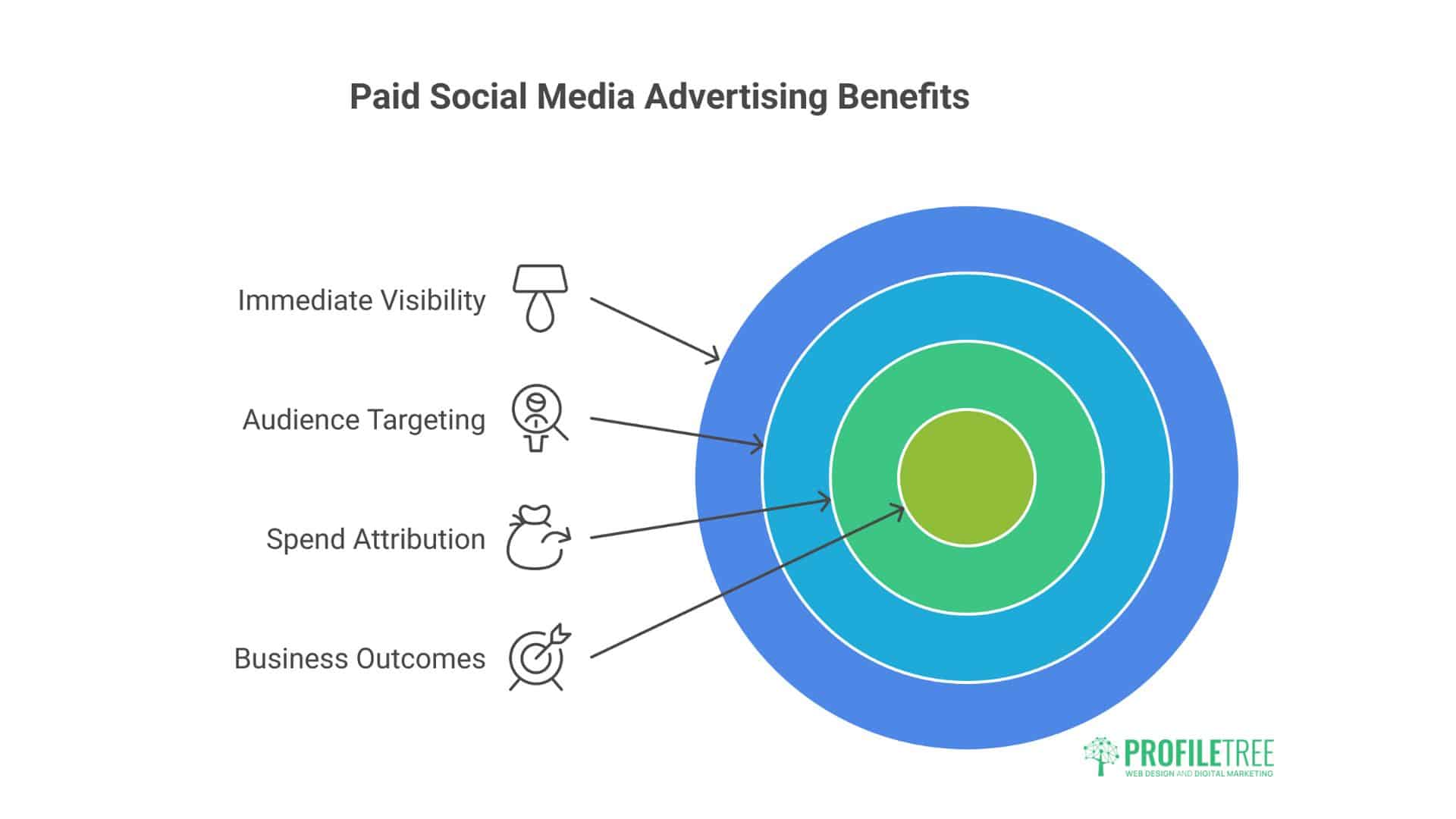
Paid social media advertising represents one of the most targeted and measurable types of social media marketing available to businesses. Unlike organic approaches that build gradually, paid advertising delivers immediate visibility, precise audience targeting, and clear marketing spend attribution to business outcomes.
For businesses seeking rapid growth, launching new products, or entering competitive markets, paid social advertising offers capabilities that organic content cannot match. The sophistication of modern advertising platforms allows you to reach particular audiences based on demographics, interests, behaviours, and even their stage in the customer journey.
Understanding Social Media Advertising Platforms
Each central platform offers unique advertising opportunities for different business objectives and audience types.
Facebook and Instagram Advertising
Meta’s advertising ecosystem spans Facebook and Instagram, offering unified campaign management with extensive targeting options. These platforms excel for e-commerce businesses driving product sales, local businesses targeting geographic areas, lead generation campaigns collecting customer information, and brand awareness initiatives reaching broad audiences.
Ad formats across Meta platforms include photo ads, video ads, carousel ads showcasing multiple products, Stories ads for full-screen mobile experiences, and Collection ads creating immersive shopping experiences. The detailed targeting capabilities allow you to reach audiences based on location, age, gender, interests, behaviours, and connections. Custom Audiences enable retargeting website visitors, while Lookalike Audiences help find new customers similar to your best existing ones.
LinkedIn Advertising for B2B
LinkedIn’s advertising platform targets professionals based on job titles, company size, industry, and seniority—making it invaluable for B2B marketing. LinkedIn ads work particularly well for software and SaaS companies targeting decision-makers, professional services firms building authority, B2B manufacturers reaching procurement professionals, and training providers.
Available formats include Sponsored Content appearing in feeds, Sponsored InMail delivering messages to inboxes, Text Ads in sidebar placements, and Dynamic Ads personalised with user profile data. While LinkedIn advertising typically costs more per click than other platforms, the quality of B2B leads often justifies the investment, particularly for high-value products or services.
YouTube Advertising
As the world’s second-largest search engine, YouTube offers powerful advertising opportunities through Google Ads. Video advertising on YouTube includes skippable in-stream ads allowing viewer choice after five seconds, non-skippable ads providing message delivery, bumper ads delivering six-second messages, and Discovery ads appearing in search results and related videos.
TikTok Advertising
TikTok’s rapid growth and young user base make it attractive for brands targeting Gen Z and younger Millennials. TikTok advertising options include In-Feed Ads appearing in user feeds, TopView Ads dominating the app opening experience, Branded Hashtag Challenges encouraging user participation, and Branded Effects allowing custom filters.
Advertising Strategy Development
Effective paid social advertising requires strategic planning beyond simply boosting posts or creating ad campaigns without clear objectives. Modern social advertising platforms organise campaigns around specific objectives including awareness objectives (brand awareness, reach), consideration objectives (traffic, engagement, video views, lead generation), and conversion objectives (conversions, catalogue sales, store traffic).
Audience Targeting Strategies
Strategic audience targeting separates effective advertising from wasted spend. Advanced targeting approaches include Custom Audiences that upload customer email lists or target website visitors using pixel tracking, Lookalike Audiences where platforms analyse your best customers and find similar users, Interest and Behaviour Targeting reaching users based on their demonstrated interests, and Geographic Targeting for local businesses or region-specific campaigns.
Ad Creative Development
The quality of ad creative significantly impacts campaign performance. Effective social media advertising creative incorporates mobile-first design with bold, clear imagery that remains visible at small sizes, concise copy that communicates quickly, prominent calls-to-action easy to tap, and vertical or square formats optimised for mobile feeds.
Every ad should drive specific action with clear calls-to-action such as “Shop Now” for e-commerce, “Learn More” for informational content, “Get Quote” for service businesses, and “Sign Up” for subscriptions or events.
At ProfileTree, our approach to web design emphasises clear user journeys and compelling CTAs—principles that translate directly to effective social advertising creative. The most successful advertisers continuously test creative variations including different images or videos, headline variations, different CTAs, and various ad copy approaches.
Budget Management and Measurement
Platforms offer both daily budgets (spending limits per day) and lifetime budgets (total campaign spend over a defined period). For ongoing campaigns, daily budgets provide consistent delivery. For time-limited promotions, lifetime budgets allow flexible daily spending while controlling total investment.
Track metrics aligned with campaign objectives. For awareness campaigns monitor impressions, reach, and frequency. Consideration campaigns should track clicks, video views, and engagement rate. Conversion campaigns require monitoring conversions, cost per conversion, and return on ad spend.
Install platform pixels on your website to track conversions and build retargeting audiences. This technical implementation, similar to Google Analytics setup in SEO work, provides crucial data for optimisation.
Influencer Marketing: Harnessing Trusted Voices
Influencer marketing has evolved from celebrity endorsements to become one of the most effective types of social media marketing for reaching engaged audiences. This approach involves collaborating with individuals who have built credible followings in specific niches, allowing brands to access their established communities and benefit from the trust these influencers have cultivated.
The power of influencer marketing lies in authenticity. When a trusted voice recommends a product or service, their audience perceives it as a genuine recommendation rather than traditional advertising. This peer-to-peer recommendation dynamic makes influencer marketing particularly effective for driving consideration and conversions.
Understanding Influencer Categories
Influencers span a wide spectrum in terms of audience size, engagement rates, and niche focus. Understanding these categories helps businesses select appropriate partners.
Mega-Influencers (1M+ followers) offer maximum reach but come with significant costs. They work best for large consumer brands seeking mass awareness and major product launches requiring maximum visibility. However, mega-influencers typically have lower engagement rates and less niche-specific audiences.
Macro-Influencers (100K-1M followers) are professional content creators with substantial followings offering a balance of reach and specialisation. They often focus on specific content categories—beauty, fitness, technology, business—making them suitable for brands seeking visibility within particular markets.
Micro-Influencers (10K-100K followers) represent the sweet spot for many businesses, particularly SMEs. These creators typically maintain higher engagement rates than larger influencers, have more affordable partnership costs, focus on specific niches with passionate audiences, and offer more authentic, relatable content. For businesses serving Northern Ireland, Ireland, or the UK, micro-influencers with regional followings can deliver highly targeted reach to relevant audiences.
Nano-Influencers (1K-10K followers) have small but highly engaged communities, often built around hyper-specific interests or local areas. While their reach is limited, their recommendations carry significant weight within their communities.
Identifying Suitable Influencer Partners
Successful influencer marketing begins with selecting partners whose audiences, values, and content align with your brand. Analyse an influencer’s audience demographics, interests, and engagement patterns. Key questions include: Does their audience match your target customer profile? What is their follower geographic distribution? How do engagement rates compare to industry benchmarks? Are their followers genuine or artificially inflated?
Review the influencer’s content history to assess production quality and aesthetic consistency, posting frequency and reliability, tone and values alignment with your brand, and previous brand partnerships and how they were executed.
At ProfileTree, our content marketing approach emphasises authenticity—a principle equally important when evaluating influencer partnerships. Genuine engagement indicates an audience that actually values the influencer’s recommendations.
Structuring Influencer Partnerships
Clear agreements and expectations prevent misunderstandings. Different partnership structures include Sponsored Posts for single posts promoting your product or service, Long-Term Ambassadorships for ongoing partnerships where influencers regularly feature your brand, Affiliate Relationships with performance-based partnerships where influencers earn commissions on sales, and Content Collaborations where influencers create content for your own channels.
Regulatory Compliance
Influencer marketing is subject to advertising regulations requiring transparency. In the UK, the Advertising Standards Authority (ASA) requires clear disclosure of paid partnerships. Influencers must clearly label sponsored content using terms like “#ad” or “#sponsored” prominently and unambiguously.
Measuring Influencer Marketing ROI
Determining return on investment for influencer marketing requires tracking metrics aligned with campaign objectives. For awareness campaigns track reach and impressions, follower growth during campaign period, brand mention volume, and share of voice. For engagement campaigns monitor engagement rate on influencer posts, comments, shares, and saves, and click-through rates to your website. For conversion campaigns measure conversions attributed to influencer codes or links, revenue generated, cost per acquisition, and customer lifetime value.
Strategic Implementation: Choosing Your Social Media Marketing Mix
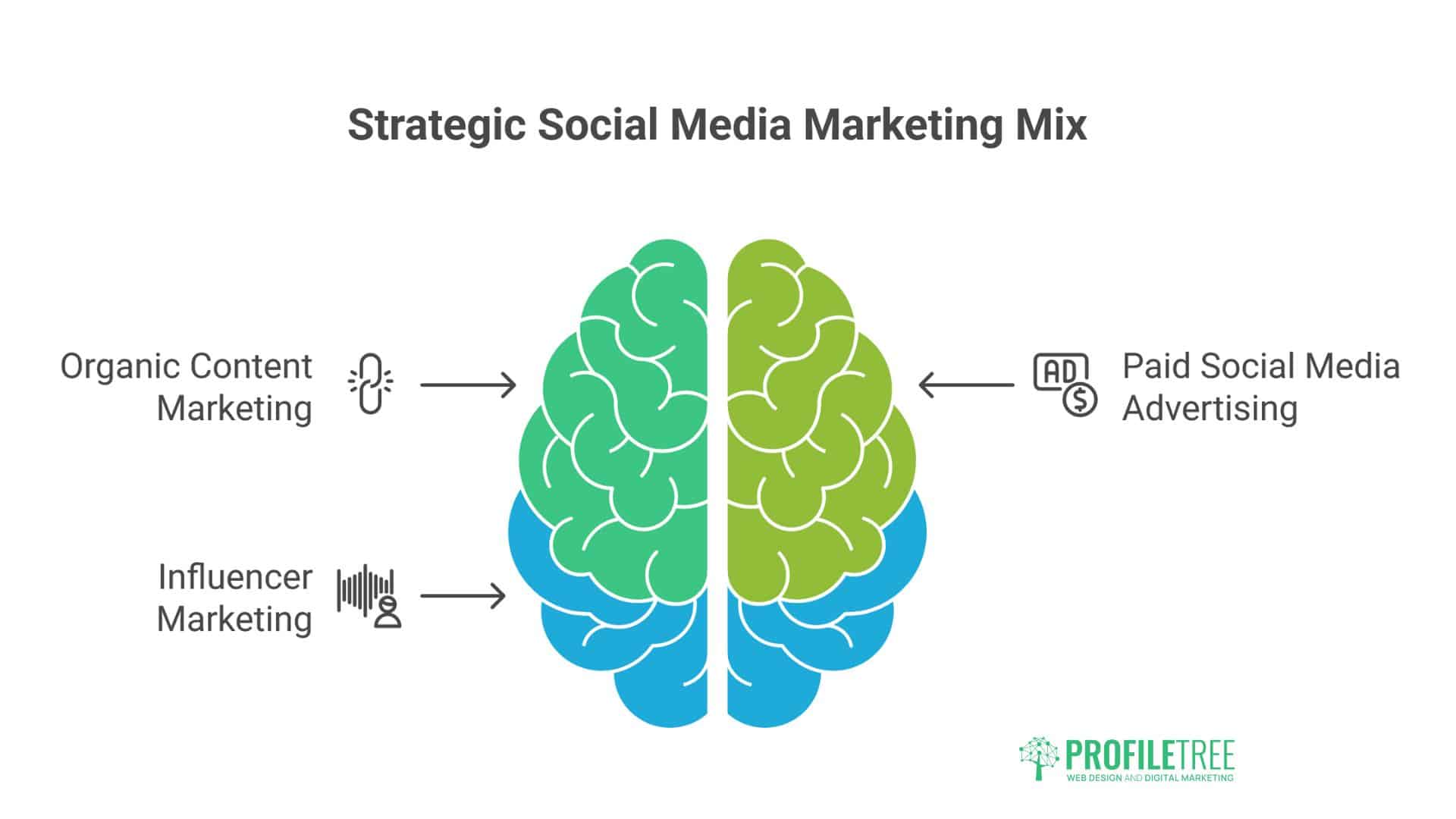
Understanding the different types of social media marketing provides the foundation, but success requires strategic implementation tailored to your specific business context. The most effective approach combines multiple types of social media marketing in proportions aligned with your objectives, audience, resources, and competitive landscape.
Assessing Your Starting Point
Before determining your social media marketing mix, honestly evaluate your current position. Audit your current social media performance: Which platforms host your active audiences? What content types generate strongest engagement? How does your follower growth trend? What posting consistency have you maintained?
Different types of social media marketing require different resource commitments. Organic content marketing demands consistent content creation and community management. Paid advertising requires ongoing optimisation and monitoring. Influencer marketing involves relationship management and campaign coordination.
At ProfileTree, we help businesses assess these resource realities when developing digital strategies, whether for social media, web development, or SEO projects. Honest evaluation prevents overcommitment and focuses efforts where they’ll deliver results.
Building Your Social Media Marketing Strategy
Match types of social media marketing to specific business objectives. For Brand Awareness Goals, businesses should prioritise consistent organic content establishing brand voice, awareness-focused paid advertising reaching broad audiences, and influencer partnerships introducing the brand to new communities.
For Lead Generation Objectives, focus on educational content demonstrating expertise, conversion-focused advertising with lead generation forms, and influencer collaborations highlighting problem-solving capabilities.
For Sales and Revenue Targets, e-commerce and direct sales businesses should emphasise product-focused content showcasing benefits, catalogue sales campaigns and retargeting advertising, and influencer partnerships with affiliate structures driving trackable sales.
Platform Selection Strategy
Not every business needs presence on every platform. Strategic platform selection focuses efforts where your audience is most engaged.
B2B Platform Priorities: Business-to-business companies typically achieve strongest results on LinkedIn for professional networking and thought leadership, Twitter/X for industry conversation, and YouTube for educational content and product demonstrations.
B2C Platform Priorities: Consumer-focused businesses should consider Instagram for visual products and lifestyle brands, Facebook for broad demographic reach and community building, TikTok for younger audiences and trending content, and Pinterest for products with strong visual appeal.
Local Business Focus: Businesses serving specific geographic areas should prioritise Facebook for local community engagement and event promotion, Instagram for visual storytelling and local partnerships, and Google Business Profile integration.
Local SEO and social media marketing work synergistically for geographic businesses. Strong local social presence signals relevance to search engines while directly engaging community members.
Budget Allocation Framework
A proven allocation framework suggests 70% on proven, effective tactics (typically organic content and optimised paid campaigns), 20% on emerging opportunities (new platforms, experimental ad formats), and 10% on high-risk, high-reward experiments (trending content types, new influencer tiers).
The appropriate split between organic and paid efforts depends on your timeline and competitive position. Established brands with time might allocate 70% to organic content and 30% to paid advertising. New businesses or those in competitive markets often need 40% organic content and 60% paid advertising. Seasonal businesses benefit from consistent organic presence year-round with concentrated paid advertising during high-intent periods.
Performance Measurement and Optimisation
Before launching new strategies or campaigns, document current performance including follower counts across platforms, average engagement rates, website traffic from social sources, and leads or sales attributed to social media. These baselines enable accurate assessment of strategy changes.
Track metrics appropriate to each type of social media marketing. For organic content monitor engagement rate, follower growth rate, reach and impressions trends, and click-through rates to website. For paid advertising track cost per click, cost per thousand impressions, click-through rate, conversion rate, return on ad spend, and cost per acquisition. For influencer marketing measure reach and engagement on influencer posts, traffic and conversions from influencer links, and audience sentiment in comments.
Integrating Social Media with Broader Digital Strategy
Social media marketing delivers maximum value when integrated with your complete digital presence. Social media should drive traffic to optimised website experiences. At ProfileTree, our web design and development work considers social media traffic, providing that landing pages match social ad promises, site speed accommodates traffic spikes, and mobile experiences work flawlessly.
While social signals aren’t direct ranking factors, social media supports SEO through increased brand searches following social campaigns, content distribution generating backlinks and mentions, website traffic signals indicating content relevance, and local presence supporting local SEO efforts. Our SEO services incorporate social media presence as part of comprehensive digital visibility strategies.
Social media extends the reach of content marketing investments. Blog posts gain additional distribution through social sharing, video content created for social repurposes for website use, webinars and guides promote through organic and paid social, and customer success stories feature across social platforms. This integrated approach, central to ProfileTree’s content marketing methodology, maximises every piece of created content.
Our AI training and implementation services help businesses adopt technologies strategically, improving efficiency without sacrificing the authentic human connection social media requires.
Taking Strategic Action: Your Social Media Marketing Next Steps
The different types of social media marketing—organic content, paid advertising, and influencer partnerships—each offer distinct advantages. Success comes from strategically implementing the approaches most aligned with your objectives, resources, and audience behaviour.
Begin by clarifying your primary objectives. Are you building brand awareness? Generating leads? Driving sales? Your answers determine which types of social media marketing deserve priority and how success should be measured.
Most businesses benefit from combining consistent organic content with strategic paid advertising. Consider influencer partnerships when authentic recommendations would resonate with your audience. At ProfileTree, we help businesses across Northern Ireland, Ireland, and the UK develop integrated digital strategies that connect social media efforts to web design, SEO, and content marketing for maximum impact.
Start with manageable steps. Choose one or two platforms where your audience is most active. Test paid advertising with modest budgets. Track performance against clear metrics connected to business outcomes, then scale investments in tactics delivering positive returns.
The businesses achieving strongest results identify the types of social media marketing most relevant to their situation, implement consistently, and refine based on evidence. With the right mix tailored to your unique needs, social media marketing can become one of your most effective growth channels.
FAQs
How do I choose between organic content and paid advertising?
The choice isn’t either/or but rather how much of each. Organic content builds long-term brand presence and audience relationships while requiring primarily time investment. Paid advertising delivers immediate reach and precise targeting but requires dedicated budget. Most successful strategies combine both: organic content for consistency and community building, paid advertising for scaling reach and driving specific campaigns. Start with consistent organic presence, then add paid advertising once you understand what content resonates with your audience.
What’s the typical return on investment for social media marketing?
ROI varies dramatically based on industry, objectives, and execution quality. E-commerce businesses often see direct sales attribution, with successful campaigns achieving 3:1 to 5:1 return on ad spend. B2B service businesses may measure ROI through lead generation, with social media marketing generating leads at lower cost per lead than traditional channels. Brand awareness campaigns require longer timelines to show ROI through increased brand searches, website traffic, and customer acquisition over time.
How quickly will I see results from social media marketing?
Timeline expectations should match the types of social media marketing you employ. Paid advertising campaigns can generate immediate traffic and conversions within days of launching. Organic content marketing typically requires 3-6 months of consistent effort before seeing meaningful engagement and growth. Influencer marketing timelines depend on partnership structures, with immediate spikes from campaigns but lasting impact requiring ongoing relationships.
Do I need to be on every social media platform?
Absolutely not. Platform selection should follow your audience, not platform popularity. B2B service providers typically achieve better results focusing efforts on LinkedIn rather than spreading thinly across all platforms. Local retailers might focus on Facebook and Instagram while ignoring TikTok if their customers aren’t active there. Quality presence on 2-3 platforms delivers better results than mediocre presence on six.