
Blunt Copywriting: The No-Fluff Guide to High-Conversion Directness
Table of Contents
Blunt copywriting strips language back to the point where it stops being decorative and starts doing a job. Most SME websites in Northern Ireland, Ireland and the UK still lean on soft, generalised phrasing because it feels safer, but softer copy rarely gets clicked, read or acted on.
This guide covers what blunt copywriting actually is, where the line between direct and rude sits for UK and Irish audiences, and a practical framework for auditing your own website, video and email copy. It draws on the same copywriting principles ProfileTree applies across client website development and content marketing work.
What Is Blunt Copywriting? (And What It Isn’t)
Blunt copywriting removes the padding around a message: no throat-clearing introductions, no metaphors doing the job a plain sentence should do, no three adjectives where one will do. It leads with the outcome the reader cares about, then supports it.
It isn’t the same as being cold or curt. A blunt homepage still needs a tone that fits the brand; it just refuses to hide the point behind clever phrasing. Direct response copywriting and blunt copywriting overlap heavily, but direct response is defined by the action it asks for (a click, a form fill, a purchase), whereas blunt copywriting is a stylistic choice that can make direct response work harder.
Blunt vs Rude: Finding the Professional Line
This is where many UK and Irish businesses get nervous. There’s a common assumption that cutting the fluff makes you sound aggressive, and American-style direct-response copy can tip into that. The line sits at intent, not word count. Rude copy dismisses the reader’s concerns or talks down to them. Blunt copy respects the reader enough to get to the point quickly, which most readers experience as more polite, not less.
A UK service page that says “We’ll quote you a fixed price within 48 hours, no obligation” is blunt. One that says “Frankly, if you’re still shopping around, you’re wasting time” is rude. Same directness, different respect for the reader.
Why Directness Builds Trust
Readers scan before they read. A cluttered sentence forces the brain to do extra work translating intent, and that extra cognitive load is exactly what makes people abandon a page, skip an email or scroll past a video within the first few seconds.
Clear, front-loaded copy reduces that load. When the first sentence answers “what is this and why should I care”, the reader doesn’t have to hold three possible meanings in their head while they decide whether to keep going. This is one reason front-loaded, question-led content tends to perform better in SEO terms too: search engines and AI answer engines both favour pages that state the point early, because it’s easier to extract and easier to trust.
There’s a trust dimension here too, separate from readability. A sentence padded with three adjectives and no specifics reads as evasive, even when the underlying claim is true. “We deliver innovative solutions tailored to your needs” tells a reader nothing they can verify, so they discount it. “We build WordPress sites and typically launch within six to eight weeks”, gives them something concrete to hold you to, and readers tend to trust claims they can check over claims they can’t. Directness works partly because it’s harder to fake.
This matters more, not less, once a business starts using AI tools to speed up first drafts of web copy, email sequences or social captions. AI-generated text defaults toward exactly the kind of safe, padded phrasing this guide argues against, because that phrasing is heavily represented in the data it was trained on. Businesses working through an AI implementation project for their content workflow get more value from treating a blunt edit as a mandatory second pass than from assuming a first AI draft is publish-ready.
“The biggest mistake I see in copywriting is burying the lead,” says Ciaran Connolly, founder of ProfileTree. “Jargon and hedging read as a barrier to the reader, not confidence. If a visitor has to work to find out whether you solve their problem, most won’t bother.”
The Business Case for Directness in UK and Irish Markets
Directness carries a cultural cost that much generic copywriting advice ignores. UK and Irish business culture values understatement and a degree of politeness that pure American direct-response copy often skips over. The businesses that get this wrong end up sounding brash; the ones that get it right combine clarity with what’s best described as professional warmth.
In practice, that means keeping the structure blunt (lead with the point, one idea per sentence, a clear next step) while keeping the tone measured. “Book a free 20-minute audit of your website copy” does the same job as a louder American equivalent without the exclamation marks. For SMEs weighing up a copywriting consultation, this cultural fit matters as much as the technique itself; copy that reads as confident rather than pushy converts better with local B2B and B2C audiences alike, and it fits naturally into a wider digital marketing strategy rather than sitting apart from it.
The table below shows the same principle applied across a few common copy situations. Neither column is wrong on its own; the point is knowing which register a given context calls for.
| Flowery version | Blunt version | Why it works |
|---|---|---|
| “We leverage industry-leading expertise to facilitate your digital transformation” | “We build and manage WordPress websites for SMEs” | States the actual service instead of describing enthusiasm about it |
| “Our team is passionate about creating engaging content experiences” | “We write blog posts and service pages that answer the questions your customers search for” | Names the deliverable and its purpose |
| “We’re committed to helping you unlock your full potential online” | “We’ll audit your site and tell you the three things most likely to improve conversions” | Gives a specific, checkable next step |
Context still matters. High bluntness suits landing pages, pricing tables, and calls to action, where the reader wants a fast answer. Lower bluntness suits situations that carry more emotional weight, such as a service outage notice, a complaint response or a personal apology from a business owner, where softening the delivery is the more respectful choice, not the weaker one.
The Framework: Rules That Make Copy Blunt
Delete, Don’t Fix
If a sentence isn’t working, don’t spend twenty minutes rescuing it. Delete it and write the point again from scratch. Trying to patch a broken sentence usually produces a longer, more convoluted version of the same problem. This applies whether you’re writing web copy, video scripts or social captions: starting fresh is nearly always faster than salvaging a weak first draft.
The “So What?” Test
Read a sentence back and ask, “So what?” If the answer isn’t obvious, the sentence hasn’t earned its place yet. This is particularly useful for:
- Landing page headlines
- Email subject lines
- Video hooks and thumbnails
- Website navigation labels
- Service page introductions
A business owner scanning your site makes a decision in seconds. If they can’t tell what you do and why it matters, they leave. This is one reason content stops ranking even when the topic is right: the value proposition is never stated clearly enough to keep anyone reading.
Front-Load the Information (The Inverted Pyramid)
Put the most important information first, not last. A muddled headline sends readers down the wrong path before they’ve even reached the detail that would have convinced them. This applies to homepage copy, service descriptions, case study titles and sales email openings alike.
Flowery version: “Our team of dedicated professionals works tirelessly to deliver bespoke solutions tailored to your unique business needs.”
Blunt version: “We build websites that convert, typically within six to eight weeks.”
The second version says more with fewer words, and it’s the version a reader can actually act on.
Use the Rule of Three (Occasionally Seven)
People process information grouped in threes more easily. Group features into sets of three, cap pricing tiers around three, and structure testimonials the same way. Longer lists work occasionally (up to around seven items), but beyond that, readers stop retaining anything. This matters directly for web design work: a services page listing eleven undifferentiated bullet points communicates less than one, clearly explained with three.
Make Every Word Earn Its Place
Vague language dilutes a message. “We serve a wide range of clients”, says nothing; “We work with trades, hospitality and professional services businesses across Northern Ireland”, says something specific and checkable. This discipline applies just as much to video production scripts as it does to web copy: a 60-second explainer video wastes half its runtime if the first line doesn’t say what the video is about.
One Strong CTA, Not Five Weak Ones
Lead with the benefit in the call to action itself. “Start your free audit” tells the reader what they get; “Submit” tells them nothing. Limit each section to one clear call-to-action rather than competing options, and place CTAs consistently so returning visitors know where to look.
This is the same principle behind good YouTube marketing: a video description with one clear link performs better than one with four competing calls to subscribe, follow and visit a website all at once.
Blunt Copywriting as an Accessibility Tool
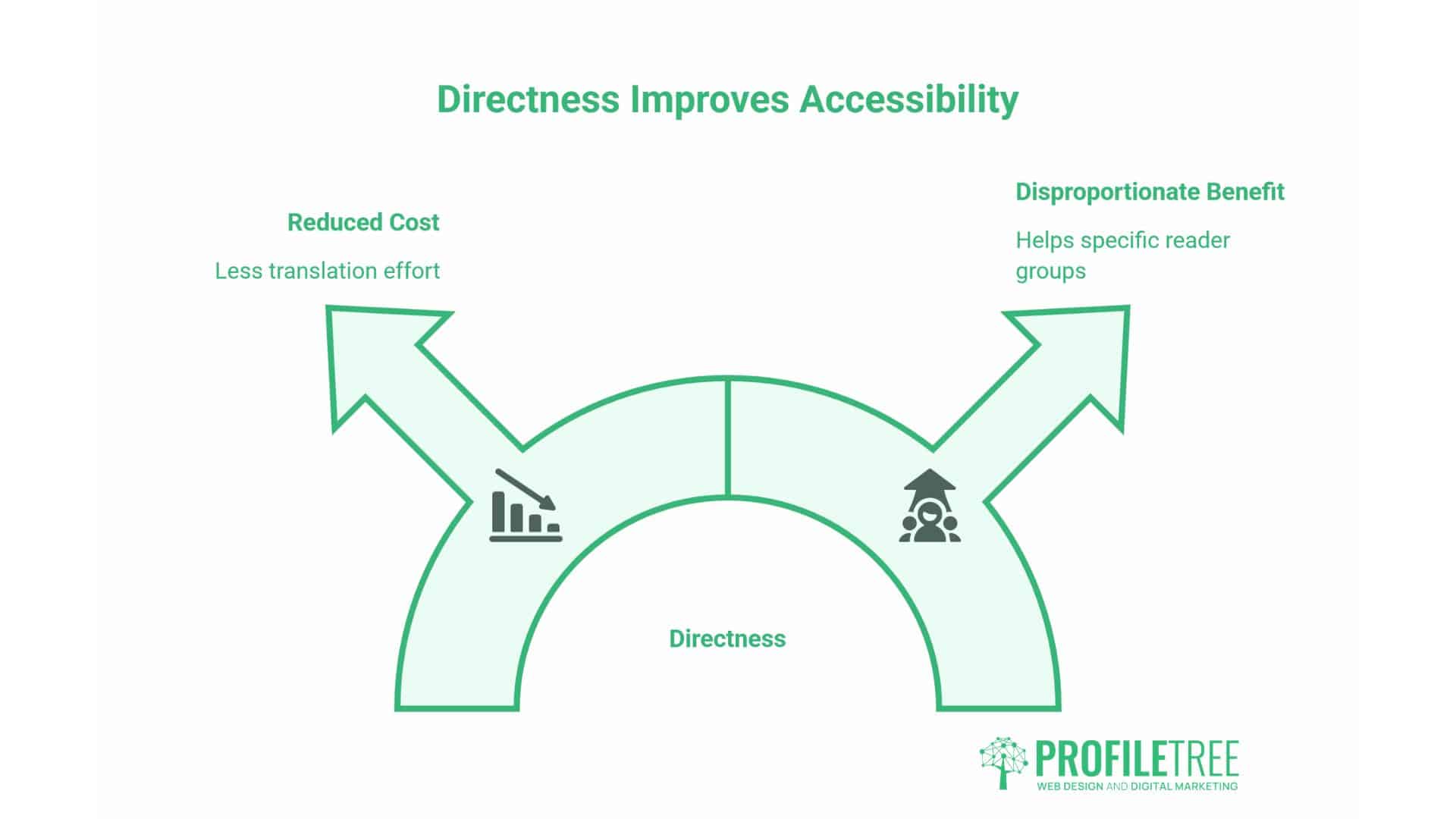
Directness isn’t just a conversion tactic; it’s also an accessibility one, and this is the part most copywriting guides skip entirely. Metaphor-heavy, jargon-dense copy adds a translation step that costs every reader something, but it costs some readers more than others. Dyslexic readers, readers with ADHD, and non-native English speakers all benefit disproportionately from shorter sentences, plain vocabulary and a clearly stated point.
For SMEs building a website with an eye on genuine usability rather than just aesthetics, this is a strong argument for treating blunt copy as a baseline requirement rather than a style preference. It sits comfortably alongside broader accessibility practice; the UK government’s own content design guidance makes a similar case for plain language on public-facing pages, and the same logic holds for commercial sites.
There’s a newer wrinkle worth flagging here, too. As more SMEs draft first versions of their web copy with AI tools as part of a wider AI implementation push, the risk of drifting back into padded, generic phrasing has actually gone up, not down. AI-generated drafts tend toward exactly the hedged, three-adjective sentences this guide argues against. Treating the blunt framework as an editing pass over AI-assisted drafts, rather than assuming the first output is finished, keeps the accessibility benefit intact.
The same logic applies to email copy, which gets far less attention than web copy but suffers from the same padding problem. A subject line like “An update regarding your recent enquiry” makes a reader work to find out whether it’s good news or bad news. “Your website quote is ready” doesn’t. Short, clear sentences in a marketing email or a customer service reply are an accessibility choice as much as a stylistic one, since a busy reader on a phone screen has even less patience for decoding a vague opening line than a reader on a desktop browser.
How to Audit Your Own Copy for Fluff
Run any page, script or email through these five questions before publishing:
- Does the first sentence say what this is? If a reader needs to reach paragraph 2 to understand the offer, move the point up.
- Would “so what?” survive this sentence? If not, cut it or rewrite it with a concrete reason attached.
- Could this word be simpler? Swap “facilitate” for “help”, “utilise” for “use”, “endeavour” for “try”.
- Is there a single, clear next step? One CTA stated plainly that it beats three vague ones.
- Would this survive being read aloud to a stranger? If it sounds like it’s performing rather than communicating, it probably is.
Many SMEs run this kind of audit internally as part of a short workshop rather than outsourcing it entirely; ProfileTree’s digital training sessions cover this exact exercise for marketing teams who want to apply it themselves across future content, and the same principles show up in how AI training can support team collaboration when a team is standardising how it edits AI-assisted drafts.
Video scripts deserve the same five questions before recording, not after. A script padded with a slow, scene-setting introduction loses viewers in the first ten seconds, which is exactly where animated video production and short-form explainers succeed or fail. If the audit questions above don’t survive a script read aloud, they won’t survive being watched either.
Where Blunt Copywriting Goes Wrong
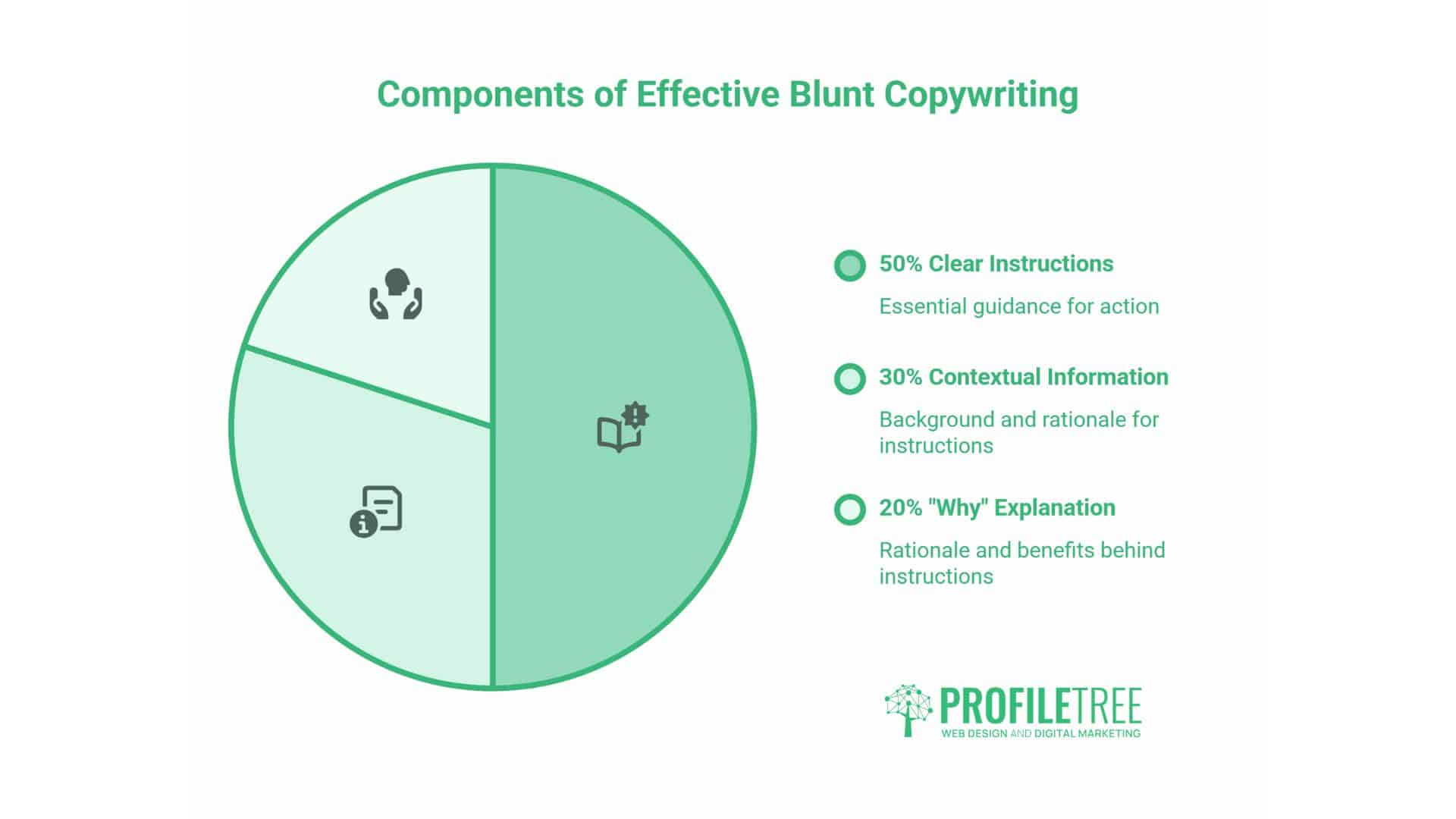
Blunt copywriting has a failure mode of its own, and it’s worth naming before wrapping up. Some businesses take “cut the fluff” as a licence to strip out anything that isn’t a bare instruction, and the result reads as robotic rather than confident. A pricing page that lists numbers with no context, or a service description that skips the “why” entirely, isn’t blunt copywriting; it’s just thin copy wearing the same clothes.
The test is whether a sentence was cut because it added nothing, or because cutting felt like the point. “We build websites” is short, but it tells a visitor less than “We build WordPress websites for SMEs, typically live within six to eight weeks.” Both are direct. Only one gives the reader something to act on.
This matters most in content marketing work that runs across several formats at once, since a blog post, a service page and a video script all lose something different when directness tips into thinness: the blog post loses its answer to “so what”, the service page loses trust signals, and the script loses the detail that made the example worth including in the first place. Bluntness is a discipline for removing padding, not a shortcut for removing substance.
Write Less, Convert More
Blunt copywriting isn’t a gimmick, and it isn’t rudeness dressed up as confidence. It’s a discipline: say the point first, cut the padding, keep one clear next step per section, and respect the reader enough to get out of their way. For UK and Irish SMEs specifically, the version that works keeps this directness paired with a measured, professional tone rather than borrowing wholesale from louder American direct response traditions.
The businesses that apply this consistently across content marketing, web copy and video scripts tend to see it show up in dwell time and enquiry quality before it shows up in raw traffic. It’s a slow-burn signal rather than an overnight one, which is exactly why it gets skipped so often.
None of this requires a rewrite of your entire site at once. Running the five-question audit against your highest-traffic pages first, following the competitive analysis approach used for wider content strategy work, is usually enough to show whether the padding problem is isolated or site-wide.
FAQs
What is the difference between a direct response and a blunt response?
Direct response copywriting is defined by the action it asks for, such as a click, sign-up or purchase. Blunt copywriting is a style choice: short sentences, no jargon, no padding. Most effective direct response copy is also blunt, but the terms describe different things.
How do you write copy that’s blunt but not rude?
Keep the directness of the structure (lead with the point, one idea per sentence) while maintaining a measured tone. Rude copy dismisses the reader’s concerns; blunt copy just gets to the point respectfully and quickly.
Does blunt copywriting help with SEO?
Indirectly, yes. Front-loaded, clearly structured copy is easier for search engines and AI answer engines to extract, and it tends to improve dwell time and reduce bounce rates because readers find their answer faster.
Is blunt copywriting too aggressive for B2B?
Not if the tone stays professional. Busy B2B buyers generally read directness as a sign of respect for their time, provided the copy states benefits plainly rather than making unsupported claims.