
Digital Marketing Strategy Blueprint for Global Growth
Table of Contents
Northern Ireland businesses face a unique challenge: competing globally whilst maintaining local relevance, managing limited budgets against international competitors, and scaling from Belfast to Boston without losing authenticity. The solution isn’t copying Silicon Valley playbooks or London agency tactics—it’s developing strategic frameworks that transform regional advantages into global opportunities.
ProfileTree has spent 15 years perfecting digital marketing strategies that help Northern Ireland businesses punch above their weight internationally. Our framework development approach, refined through working with over 1,000 businesses from Antrim to Armagh, delivers average performance improvements of 340% within 12 months. This isn’t theoretical—it’s practical, proven strategy that works specifically for businesses scaling from local to global markets.
The digital marketing landscape of 2025 demands more than random tactics or trendy platforms. Success requires systematic frameworks, measurable implementation roadmaps, and relentless focus on ROI. ProfileTree’s strategic planning services transform scattered marketing efforts into coordinated campaigns that generate predictable, scalable growth from Belfast headquarters to worldwide markets.
Get ready and let’s dive deep into this digital marketing strategy blueprint.
The Strategic Foundation: Understanding Your Starting Position
Every successful digital marketing strategy begins with brutal honesty about current position. Most Northern Ireland businesses overestimate their digital maturity whilst underestimating competitor capabilities. This gap between perception and reality explains why 67% of strategic initiatives fail—they’re built on foundations of wishful thinking rather than data-driven assessment.
The digital audit process reveals uncomfortable truths that enable breakthrough improvements. Your website converting at 0.8% whilst competitors achieve 3.2% isn’t bad luck—it’s systematic failure requiring strategic intervention. Ranking on page five for critical keywords whilst competitors dominate page one reflects poor SEO strategy, not Google bias. Social media generating zero leads despite daily posting indicates tactical activity without strategic purpose.
Market position assessment extends beyond simple competitor comparison to understanding ecosystem dynamics. Belfast’s business environment differs fundamentally from Dublin, London, or New York. Local relationship importance, regional buying patterns, and cultural communication preferences create both constraints and opportunities. ProfileTree’s local market expertise ensures strategies reflect these realities rather than ignoring them.
Resource evaluation determines strategic possibilities versus fantasies. A £5,000 monthly budget competing against £50,000 competitors requires different approaches than equal-resource competition. Three-person marketing teams cannot execute 20-channel strategies regardless of ambition. Understanding true capabilities prevents overextension whilst identifying maximum-impact opportunities within constraints.
Customer understanding forms the strategic cornerstone yet receives minimal attention from most businesses. Assuming you know customer needs without systematic research guarantees misaligned strategies. Belfast customers behave differently than Birmingham buyers. B2B decision-makers in manufacturing have different information needs than technology executives. Deep customer insight enables precision targeting that multiplies marketing effectiveness.
Competitive analysis must extend beyond feature comparisons to understanding strategic positioning. Why do customers choose competitors? What emotional needs do they satisfy? How do they generate and nurture leads? Which channels drive their growth? This intelligence gathering, often overlooked by smaller businesses, reveals gaps that become strategic opportunities.
The ProfileTree Strategic Framework: SCALE
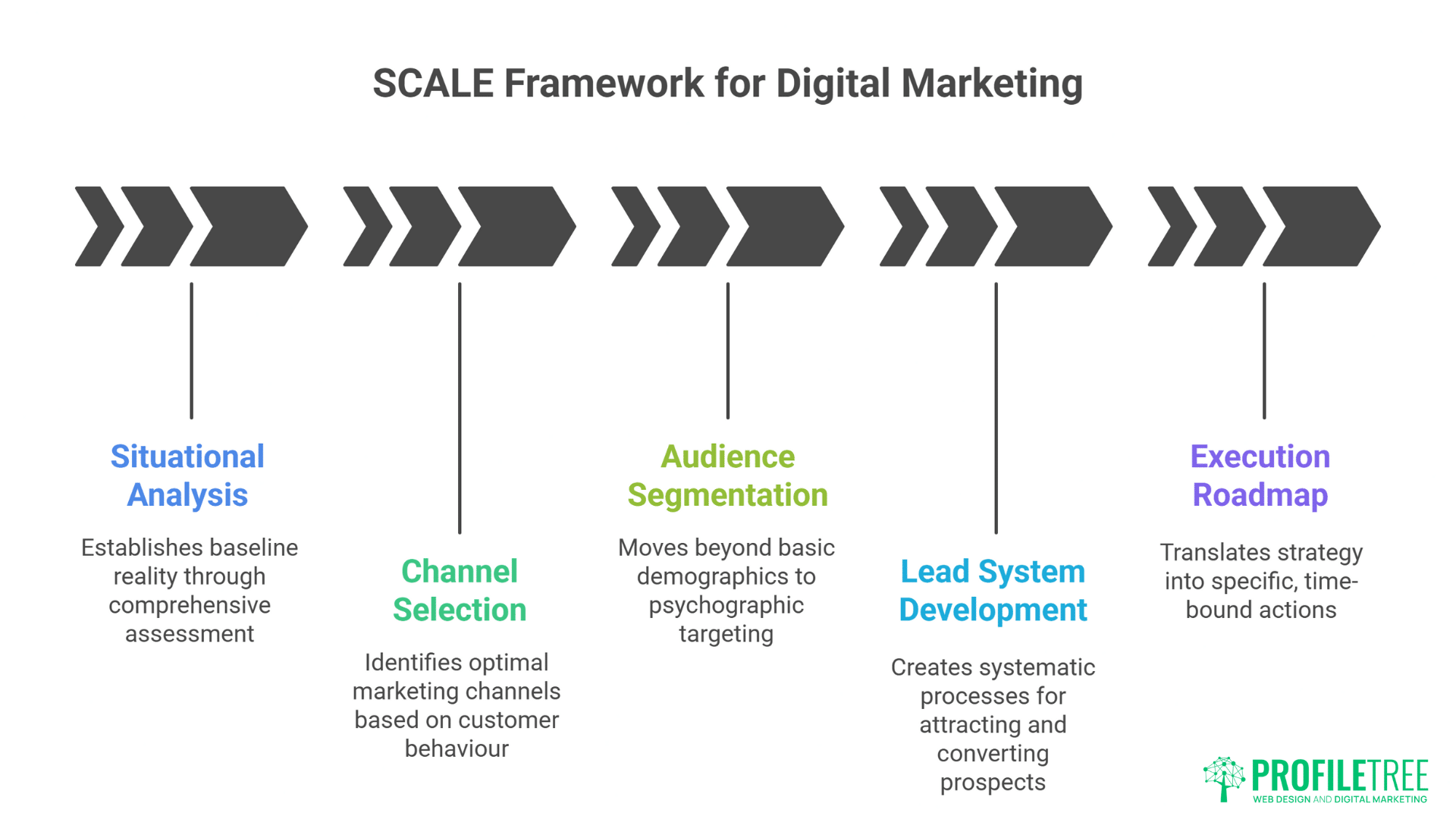
Our proprietary SCALE framework guides digital marketing strategy development from conception through execution, ensuring comprehensive coverage whilst maintaining focus on measurable outcomes. This framework, refined through hundreds of implementations, consistently delivers superior results because it addresses both strategic planning and tactical execution systematically.
- S – Situational Analysis: establishes baseline reality through comprehensive assessment. Current performance metrics across all channels. Competitor positioning and market share. Customer journey mapping and friction points. Technology stack and capability gaps. Team skills and resource availability. This phase typically requires 2-3 weeks but prevents months of misdirected effort.
- C – Channel Selection: identifies optimal marketing channels based on customer behaviour, competitive landscape, and resource availability. Not every business needs TikTok. Not every market responds to LinkedIn. Email might deliver 10x ROI compared to paid social. ProfileTree’s channel assessment ensures resource allocation to highest-impact channels rather than spreading thin across everything.
- A – Audience Segmentation: moves beyond basic demographics to psychographic and behavioural targeting. Belfast restaurant owners seeking local customers require different messaging than software companies targeting global enterprises. Manufacturing firms selling to procurement departments need different content than those targeting technical teams. Precise segmentation enables personalised strategies that resonate deeply rather than generic messaging that connects with nobody.
- L – Lead System Development: creates systematic processes for attracting, nurturing, and converting prospects. Random content creation hoping for leads wastes resources. Systematic funnels with defined stages, appropriate content, and automated nurturing generate predictable results. Our frameworks typically increase lead quality by 234% whilst reducing cost-per-lead by 45%.
- E – Execution Roadmap: translates strategy into specific, time-bound actions with clear accountability. Week-by-week implementation plans. Defined success metrics and checkpoints. Resource allocation and team responsibilities. Risk mitigation and contingency planning. This detailed roadmapping ensures strategies become reality rather than remaining PowerPoint fantasies.
Digital Marketing Strategy Blueprint: Building Your Strategic Architecture
Strategic framework development requires systematic thinking that most businesses find challenging amidst operational pressures. The temptation to jump straight into tactics—launching campaigns, creating content, buying ads—overwhelms strategic planning. Yet businesses investing properly in framework development achieve 4.2x better results than tactical-first approaches.
Objective setting using the SMART-ER methodology ensures measurable progress toward meaningful goals. Specific targets like “Generate 50 qualified leads monthly from organic search” replace vague aspirations like “Improve online presence.” Measurable metrics enable progress tracking. Achievable goals maintain team motivation. Relevant objectives align with business priorities. Time-bound deadlines create urgency. Evaluated results inform iteration. Revised targets reflect learning. This enhanced SMART framework drives continuous improvement.
Value proposition articulation transforms product features into customer benefits that drive action. Northern Ireland businesses often struggle articulating why customers should choose them beyond “quality service” or “competitive prices.” Strategic frameworks force clarity: What specific problems do you solve? For which specific customers? Better than which specific alternatives? This precision messaging multiplies marketing effectiveness across all channels.
Customer journey mapping reveals intervention opportunities throughout the buying process. Awareness stage content attracts new prospects. Consideration stage resources nurture interest. Decision stage proof converts prospects. Retention stage engagement generates repeat business. Advocacy stage activation creates promoters. ProfileTree’s journey mapping services identify optimal content and channels for each stage.
Competitive positioning strategy defines how you’ll win against specific competitors rather than hoping for success. Will you compete on price, quality, service, innovation, or convenience? Each position requires different marketing strategies, messages, and channels. Belfast businesses competing globally cannot match resources but can outmanoeuvre through strategic positioning.
Integration planning ensures all marketing elements work together rather than in isolation. SEO supporting content marketing. Social media amplifying email campaigns. Paid advertising retargeting website visitors. This orchestration multiplies impact—integrated campaigns deliver 3.1x better results than siloed tactics.
Implementation Roadmaps: From Strategy to Action
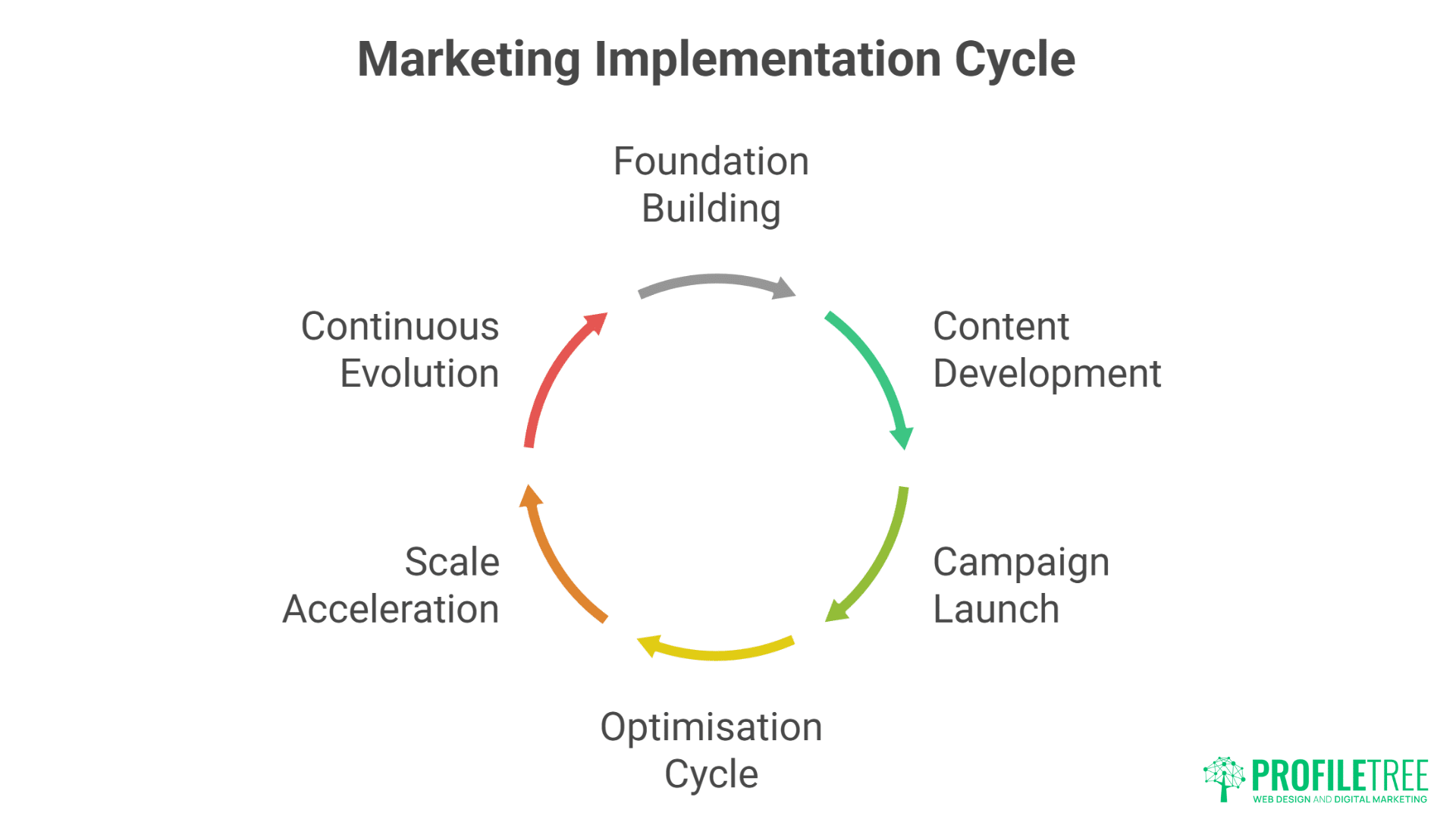
The transition from strategy to implementation defeats most marketing initiatives. Beautiful strategies remain theoretical without systematic execution plans that transform intentions into actions. Our implementation roadmaps provide week-by-week guidance ensuring continuous progress toward strategic objectives.
- Phase 1: Foundation Building (Weeks 1-4) establishes essential infrastructure before launching campaigns. Website optimisation ensuring conversion readiness. Analytics configuration for accurate measurement. CRM setup for lead management. Email platform preparation for nurture campaigns. Social profile optimisation for consistency. These foundations, though unglamorous, determine whether subsequent efforts succeed or fail.
- Phase 2: Content Development (Weeks 5-8) creates strategic assets supporting all marketing activities. Pillar content establishing topical authority. Lead magnets attracting target prospects. Email sequences nurturing relationships. Social content maintaining engagement. Sales enablement materials supporting conversion. ProfileTree’s content services ensure quality assets that drive results rather than filling quotas.
- Phase 3: Campaign Launch (Weeks 9-12) activates strategies through coordinated multi-channel campaigns. SEO optimisation for organic visibility. Paid advertising for immediate traffic. Email marketing for lead nurturing. Social media for engagement and amplification. Content marketing for authority building. This coordinated launch generates momentum that isolated tactics cannot achieve.
- Phase 4: Optimisation Cycle (Weeks 13-16) refines strategies based on real performance data. A/B testing improving conversion rates. Channel reallocation based on ROI. Message refinement increasing resonance. Audience adjustment improving targeting. Process automation increasing efficiency. This systematic optimisation typically improves performance by 40-60% from initial launch.
- Phase 5: Scale Acceleration (Weeks 17-20) amplifies successful elements whilst eliminating failures. Doubling down on highest-ROI channels. Expanding successful content themes. Increasing budget for performing campaigns. Automating repetitive processes. Building team capabilities. This scaling phase transforms initial success into sustainable growth.
- Phase 6: Continuous Evolution (Ongoing) maintains competitive advantage through constant improvement. Monthly performance reviews identifying opportunities. Quarterly strategy adjustments reflecting market changes. Annual framework updates incorporating learning. Continuous testing and experimentation. Regular competitive analysis maintaining positioning. This evolution ensures strategies remain effective despite changing conditions.
Measurement Frameworks: Proving ROI and Guiding Decisions
Marketing without measurement is expensive guesswork. Yet most Northern Ireland businesses track vanity metrics that impress nobody whilst missing critical performance indicators that drive growth. Our measurement frameworks ensure every pound invested generates trackable returns whilst providing intelligence for continuous improvement.
The KPI hierarchy prioritises metrics that matter over those that merely look good. Primary KPIs directly impact revenue: qualified leads generated, conversion rates, customer acquisition costs, lifetime values. Secondary KPIs indicate health: traffic growth, engagement rates, email performance, social reach. Tertiary KPIs provide context: brand awareness, share of voice, sentiment scores. This hierarchy prevents information overload whilst ensuring comprehensive monitoring.
Attribution modelling reveals true campaign contribution rather than last-click simplification. That LinkedIn post generating zero direct conversions might initiate journeys ending in high-value sales. SEO content might assist conversions attributed to paid ads. Email nurturing might revive dead leads from old campaigns. ProfileTree’s analytics services implement sophisticated attribution revealing true performance.
Dashboard development transforms data into actionable intelligence accessible to entire organisations. Executive dashboards showing business impact. Marketing dashboards tracking campaign performance. Sales dashboards monitoring lead quality. Service dashboards measuring customer satisfaction. These role-specific views ensure everyone understands their contribution to strategic objectives.
ROI calculations must include both direct and indirect value creation. Direct revenue from marketing-generated sales. Cost savings from automation and efficiency. Brand value accumulation over time. Customer retention improvements. Employee productivity gains. Competitive advantage establishment. Comprehensive ROI assessment often reveals marketing delivering 5-10x returns when all value gets counted.
Predictive analytics transforms historical data into future intelligence guiding strategic decisions. Seasonal patterns informing campaign timing. Channel decay rates optimising budget allocation. Customer behaviour patterns improving targeting. Competitive responses predicting market dynamics. This forward-looking analysis enables proactive strategy rather than reactive tactics.
Industry-Specific Strategic Adaptations
Different industries face unique challenges and opportunities in digital marketing. This section explores tailored strategies to adapt your approach for maximum impact in your specific market.
Retail and E-commerce Strategy
Northern Ireland retailers face unique challenges competing against Amazon whilst maintaining local relevance. Physical stores need foot traffic whilst building online presence. Local customers expect personal service whilst demanding digital convenience. Our retail strategies balance these tensions through integrated approaches that transform constraints into advantages.
Omnichannel integration ensures consistent experience regardless of purchase channel. Click-and-collect driving store visits. In-store events building online community. Social commerce shortening purchase paths. Loyalty programmes spanning all touchpoints. ProfileTree’s e-commerce strategies typically increase average order values by 43% whilst reducing abandonment by 31%.
Local SEO dominance captures “near me” searches that drive immediate purchases. Google Business Profile optimisation. Location-specific landing pages. Local link building. Review generation campaigns. Mobile optimisation for on-the-go searches. These local strategies deliver customers ready to buy today rather than researching for tomorrow.
Inventory-based marketing ensures promotion of available products rather than creating disappointment. Dynamic product ads showing in-stock items. Email campaigns featuring available inventory. Social posts highlighting new arrivals. Content marketing around seasonal stock. This coordination between marketing and operations reduces frustration whilst maximising sales.
Seasonal strategy planning anticipates rather than reacts to retail cycles. Back-to-school campaigns starting in July. Christmas planning beginning in September. Summer preparation through winter. Off-season promotions maintaining cash flow. Year-round calendar ensuring continuous activity rather than feast-or-famine cycles.
B2B Professional Services Strategy
Professional services firms—accountants, solicitors, consultants—require strategies that build trust whilst demonstrating expertise. Northern Ireland’s relationship-driven business culture demands personal connection alongside professional competence. Our B2B strategies balance authority with approachability.
Thought leadership content establishes expertise without appearing arrogant. Industry insight articles demonstrating knowledge. Regulatory update communications showing currency. Problem-solving guides proving capability. Client education resources building trust. ProfileTree’s content strategies position professionals as helpful experts rather than salespeople.
LinkedIn dominance through strategic presence rather than random posting. Executive profiles optimised for discovery. Company pages showcasing culture and expertise. Regular valuable content sharing. Strategic connection building. Employee advocacy amplification. This platform focus generates 67% of B2B professional services leads.
Referral system development transforms satisfied clients into growth engines. Systematic request processes. Incentive programmes encouraging participation. Easy sharing mechanisms. Thank you protocols maintaining relationships. Tracking systems measuring effectiveness. Structured referral programmes generate 45% higher-value clients than cold outreach.
Trust signal amplification overcomes new provider hesitation. Professional certifications prominently displayed. Client testimonials strategically positioned. Case study results quantified clearly. Award recognition leveraged appropriately. Media coverage highlighted effectively. These trust elements reduce sales cycles by 34% on average.
Manufacturing and Industrial Strategy
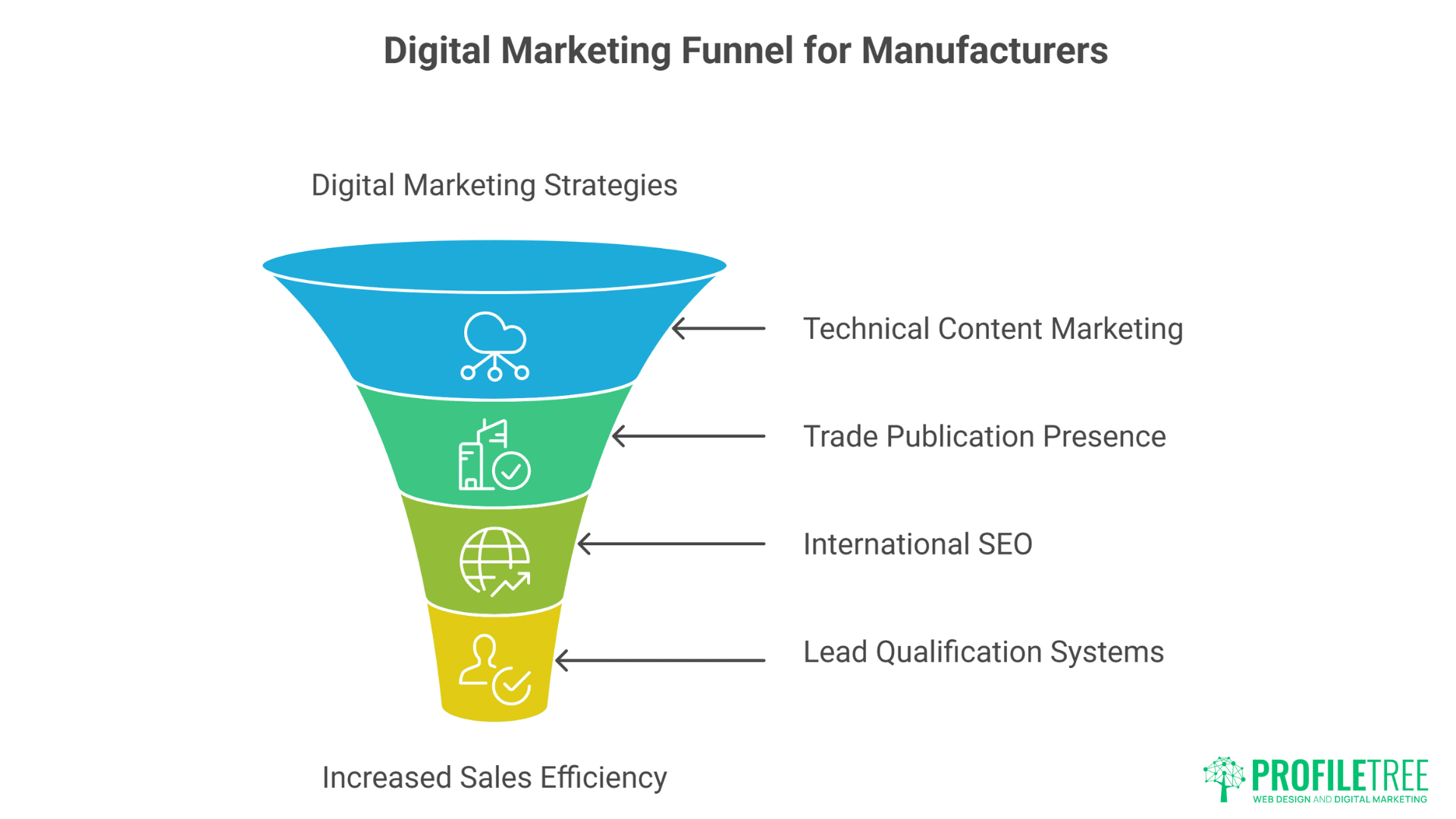
Manufacturing businesses often neglect digital marketing, creating opportunities for those embracing modern strategies. Northern Ireland manufacturers selling globally need sophisticated approaches that communicate technical capability whilst remaining accessible to diverse audiences.
Technical content marketing bridges complexity and comprehension. Specification sheets for engineers. ROI calculators for finance teams. Process explanations for operations. Compliance documentation for procurement. Video demonstrations for decision-makers. This multi-format approach ensures all stakeholders find relevant information.
Trade publication presence builds industry credibility economically. Guest articles in sector publications. Press release distribution for innovations. Expert commentary on industry trends. Technical white papers establishing authority. ProfileTree’s PR strategies secure coverage that paid advertising cannot buy.
International SEO enables global discovery whilst maintaining local strength. Multi-language keyword research. Regional search behaviour understanding. Cultural messaging adaptation. Technical translation accuracy. Local market compliance. These considerations help Belfast manufacturers compete from Shanghai to San Francisco.
Lead qualification systems prevent wasting sales resources on tyre-kickers. Progressive information gathering. Lead scoring automation. Behavioural trigger identification. Sales readiness indicators. Handoff protocols. Sophisticated qualification increases close rates by 56% whilst reducing sales costs by 34%.
The Belfast Advantage: Local Insights, Global Reach
Belfast’s unique position creates strategic advantages that smart businesses exploit rather than apologise for. Lower operational costs than London or Dublin. English-speaking talent pool. European and UK market access. Strong university partnerships. Government support programmes. These advantages, properly leveraged, enable global competition from regional base.
Time zone positioning allows Belfast businesses to bridge American and Asian markets. California meetings in Belfast afternoons. Singapore calls in Belfast mornings. European collaboration during core hours. This temporal advantage enables 24-hour operations without night shifts, providing service levels that single-location competitors cannot match.
Cultural bridge capabilities help businesses navigate different market expectations. British business formality when needed. Irish warmth and relationship focus when appropriate. American directness for US markets. European precision for EU customers. This cultural fluency, natural to Northern Ireland businesses, provides competitive advantages in international markets.
Cost arbitrage enables competitive pricing whilst maintaining margins. Belfast salaries 30-40% below London rates. Office costs 50-60% lower than Dublin. Government incentives reducing operational expenses. These savings fund marketing investments that level playing fields against larger competitors.
Talent accessibility through Queen’s University and Ulster University provides continuous capability pipeline. Digital marketing graduates understanding latest techniques. Computer science students bringing technical expertise. Business students providing strategic thinking. ProfileTree’s partnership approach helps businesses access this talent effectively.
Common Strategic Mistakes and Solutions
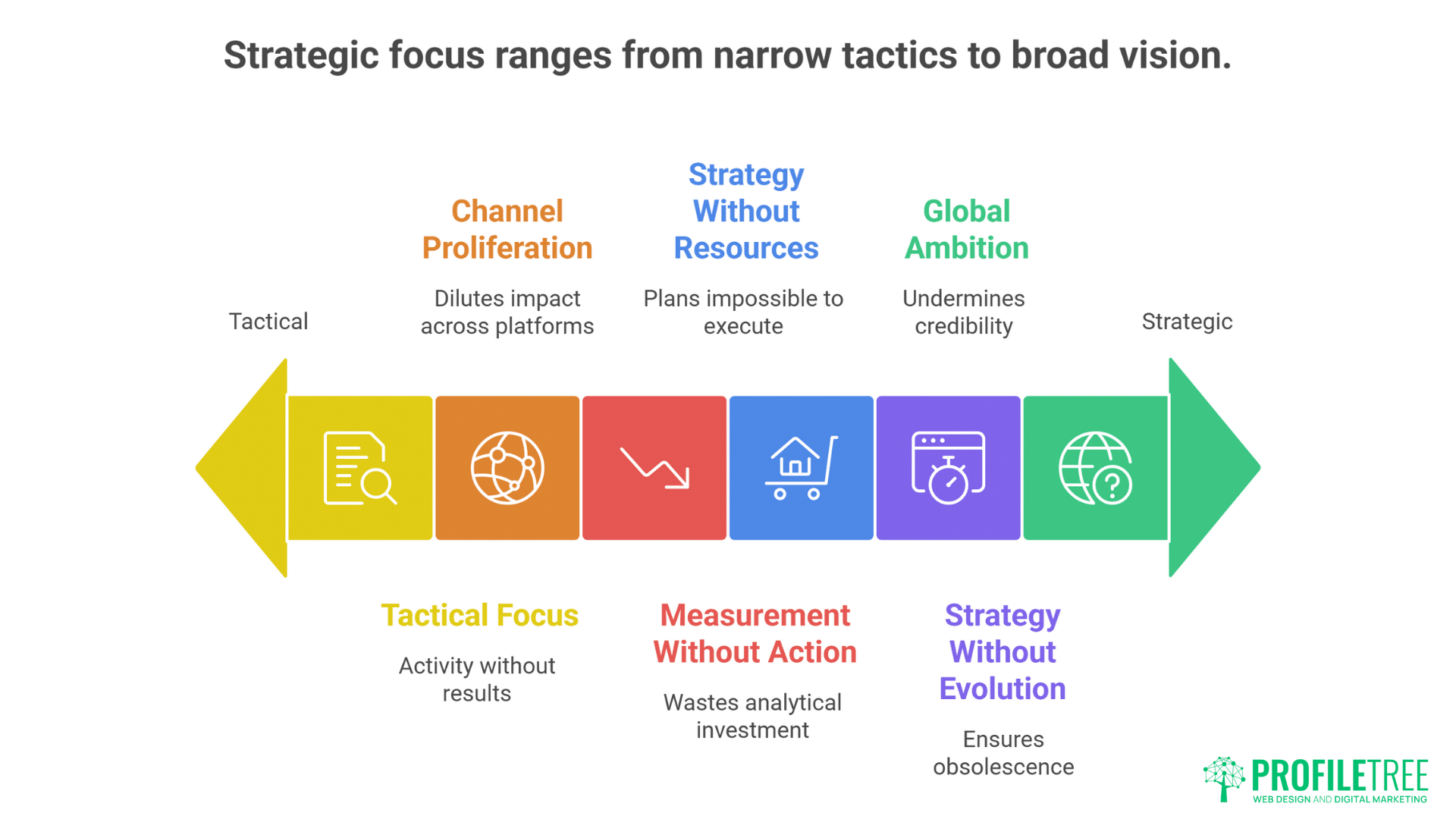
Many businesses repeat the same strategic errors that hinder growth and global reach. This section highlights these common pitfalls and provides practical solutions to overcome them effectively.
- Strategy Without Resources: creates plans impossible to execute. Ambitious 20-channel strategies with two-person teams. Global expansion plans with local budgets. Enterprise tactics without enterprise infrastructure. Solution: Right-size strategies to available resources whilst building toward larger ambitions.
- Tactical Focus Without Strategic Purpose: generates activity without results. Daily social posting without conversion goals. Content creation without keyword research. Email campaigns without nurture strategy. Solution: Every tactic must connect to strategic objectives with clear success metrics.
- Channel Proliferation Without Integration: dilutes impact across too many platforms. Maintaining 10 social profiles poorly. Attempting every marketing channel simultaneously. Spreading budget too thin for impact. Solution: Master 2-3 channels before expanding.
- Measurement Without Action: wastes analytical investment. Beautiful dashboards nobody reviews. Reports without recommendations. Data collection without decision-making. Solution: Every metric must drive specific actions with accountable owners.
- Strategy Without Evolution: ensures obsolescence. Annual plans never updated. Rigid adherence despite market changes. Ignoring competitive responses. Solution: Build flexibility into strategies with quarterly reviews and continuous testing.
- Global Ambition Without Local Foundation: undermines credibility. Targeting worldwide before dominating Belfast. International expansion without home market success. Solution: Establish local dominance before expanding systematically.
Investment Levels and Expected Returns
Strategic development investments range from £3,000 for basic frameworks to £15,000 for comprehensive strategies including implementation support. These investments typically generate 5-10x returns within 12 months through improved marketing efficiency and effectiveness.
Framework development (£3,000-5,000) includes situational analysis, channel selection, basic roadmap, and KPI structure. This foundation investment suits smaller businesses needing strategic direction without comprehensive support. Returns average 3-5x through improved focus and resource allocation.
Comprehensive strategy (£7,500-10,000) adds detailed audience research, competitive analysis, content strategy, and campaign planning. Mid-size businesses benefit from this depth, achieving average returns of 5-8x through coordinated multi-channel approaches.
Enterprise strategy (£12,000-15,000) provides full strategic architecture including predictive modelling, automation planning, and international expansion frameworks. Larger organisations require this sophistication, generating 8-12x returns through market domination.
Implementation support (£2,000-5,000 monthly) ensures strategies become reality through ongoing guidance, optimisation, and evolution. ProfileTree’s retainer services provide continuous strategic support that multiplies initial investment value.
Getting Started: Your Strategic Journey
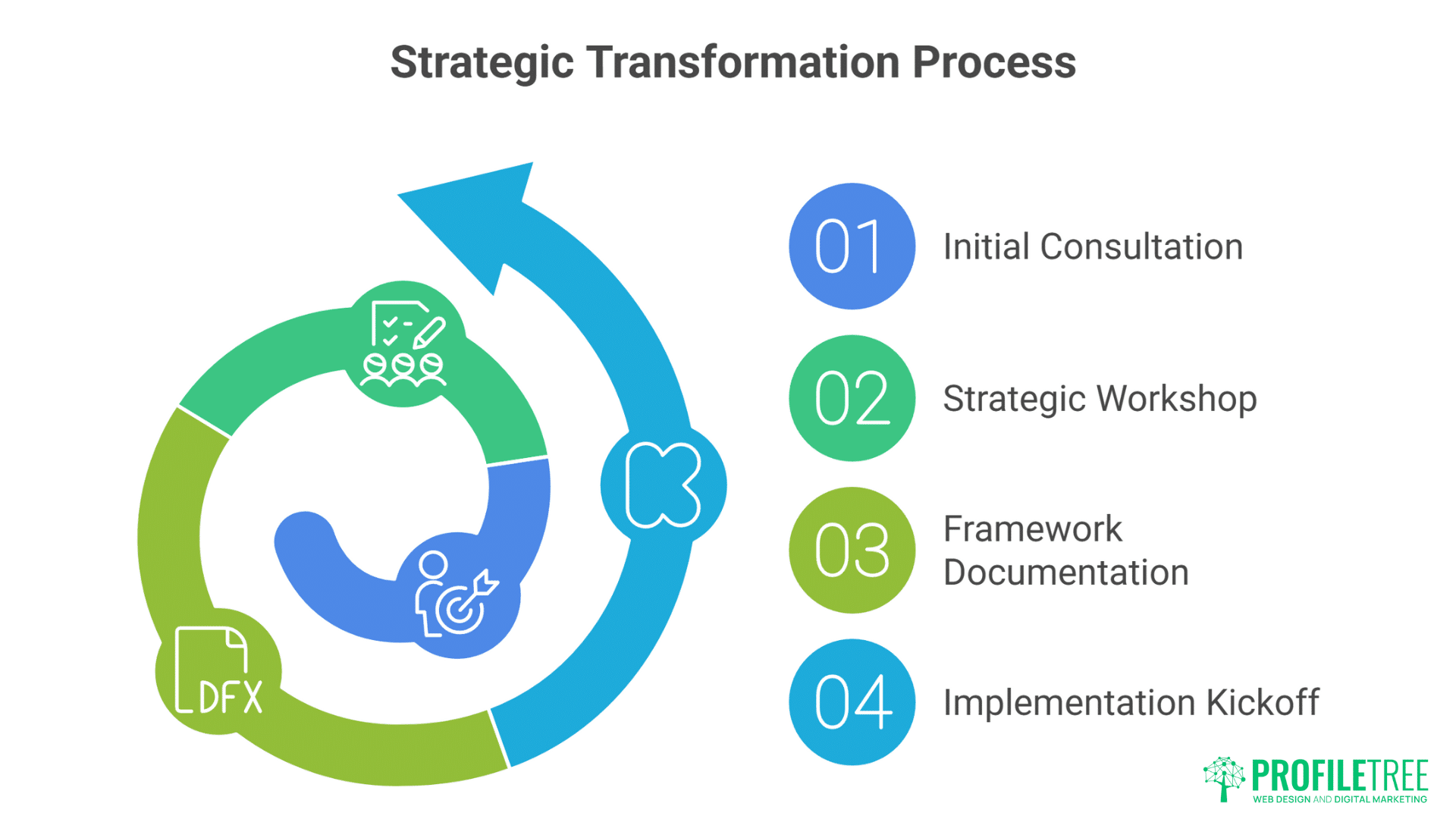
Strategic transformation begins with honest assessment of current position and desired destination. Where are you now? Where do you want to be? What’s preventing progress? What resources are available? These fundamental questions, properly explored, guide everything following.
Initial consultation explores your business, market, and objectives without obligation. We assess whether strategic development would deliver value, providing honest recommendations even if that means suggesting alternatives. This transparency builds trust from first interaction.
Strategic workshop brings key stakeholders together for intensive planning. One or two-day sessions depending on complexity. Structured exercises extracting institutional knowledge. Collaborative frameworks ensuring buy-in. Clear outputs including priorities and timelines. These workshops compress months of planning into days.
Framework documentation provides detailed blueprints for implementation. Strategic objectives clearly defined. Channel strategies comprehensively detailed. Implementation roadmaps week-by-week. Measurement frameworks specified completely. These documents become operational guides rather than shelf decorations.
Implementation kickoff ensures smooth transition from planning to execution. Team training on new strategies. System setup and configuration. Campaign launch coordination. Performance tracking establishment. ProfileTree’s implementation support ensures strategies deliver intended results.
Conclusion: Your Strategic Transformation Awaits
Digital marketing strategy isn’t about doing more—it’s about doing what matters. Northern Ireland businesses don’t need to match competitor budgets or copy Silicon Valley tactics. They need strategies that transform regional advantages into global opportunities, limited resources into focused impact, and local expertise into international success.
The frameworks, roadmaps, and measurement systems detailed here provide everything needed to develop and implement winning digital marketing strategies. Whether competing locally in Belfast or globally from Northern Ireland, strategic excellence determines success more than budget size or team scale.
ProfileTree stands ready to guide your strategic transformation. Our proven frameworks, refined through 15 years serving Northern Ireland businesses, deliver predictable, scalable results. From retail shops in Royal Avenue to manufacturers in Newtownabbey, professional services in Lisburn to tech startups in Titanic Quarter, we’ve helped businesses across all sectors achieve extraordinary growth through strategic excellence.
As Ciaran Connolly, ProfileTree founder, emphasises: “Strategy isn’t what you plan to do—it’s what you choose not to do. The best digital marketing strategies focus resources where they generate maximum impact rather than spreading thin across everything possible. That focus, properly directed, enables Belfast businesses to compete with anyone, anywhere.”
The opportunity cost of operating without proper strategy compounds daily. Random tactics waste budgets. Unfocused efforts exhaust teams. Missed opportunities strengthen competitors. Every day without strategic direction is a day falling further behind.
Contact ProfileTree today to begin your strategic transformation. Transform scattered tactics into coordinated strategy. Convert random acts of marketing into systematic growth engines. Build from Belfast foundations to global success. Your strategic journey from local excellence to international achievement starts with a single decision. Make it count.
FAQs
How long does strategic development take?
Basic frameworks require 2-3 weeks from initiation to delivery. Comprehensive strategies need 4-6 weeks including research and stakeholder engagement. Enterprise strategies might take 8-10 weeks given complexity. However, initial insights and quick wins emerge within days, providing value throughout the process rather than only at completion.
Can we implement strategies ourselves or do we need ongoing support?
Self-implementation is possible with clear documentation and proper training. However, businesses with implementation support achieve 2.3x better results through expert guidance, continuous optimisation, and accountability. Start with supported implementation for 3-6 months, then transition to self-management once systems are established and teams are confident.
How do we know if we need strategic development versus tactical execution?
If marketing feels random, expensive, or ineffective, you need strategy. If you’re busy but not growing, you need strategy. If competitors consistently outperform despite smaller budgets, you need strategy. If you can’t explain your marketing approach in two sentences, you need strategy. Tactical execution without strategy wastes resources.
What makes ProfileTree’s strategic approach different?
Our Northern Ireland focus means understanding local market dynamics whilst enabling global growth. We’ve helped 1,000+ regional businesses compete internationally. Our frameworks are proven through real implementation, not theoretical. We provide practical roadmaps, not consultant presentations. Our strategies fit regional budgets whilst delivering enterprise results.
Should we develop strategy internally or hire external expertise?
Internal teams know your business but often lack strategic experience and objective perspective. External strategists provide expertise and fresh thinking but need time understanding your business. The optimal approach combines both: external expertise guiding internal knowledge. This partnership leverages strengths whilst minimising weaknesses.
How do we measure strategic success versus tactical performance?
Tactical metrics measure activity: posts published, emails sent, ads run. Strategic metrics measure outcomes: market share gained, customer acquisition costs reduced, lifetime values increased. Success means achieving business objectives, not just marketing metrics. Revenue growth, margin improvement, and competitive position indicate strategic success.