
How to Foster a Culture of Innovation: Strategies for AI Integration
Table of Contents
British small businesses are caught between two pressures right now: a well-documented productivity gap and a workforce that is, understandably, anxious about what artificial intelligence means for their jobs. The technology is not the hard part. The people are.
A culture of innovation isn’t built through a single new tool or a policy announcement. For most SMEs today, it’s tested most directly through AI: whether staff feel safe trying something new, flagging what doesn’t work, and keeping the habits that actually help once the novelty wears off. That’s what a genuine culture of AI adoption looks like in practice. ProfileTree, a Belfast-based digital agency, works with SMEs across Northern Ireland, Ireland and the UK on exactly this kind of practical transition, and this guide sets out what it looks like for a small team without a dedicated IT department.
From overcoming staff resistance and structuring a leadership approach, to measuring success, handling hybrid teams, and managing the ethics and funding side, here is a grounded, practical path for UK SMEs ready to move from curiosity to genuine everyday use.
The State of AI in the UK SME Sector
Before building a culture around AI, it helps to understand where UK businesses actually stand. The picture is uneven. Larger organisations have had the budgets and the IT teams to experiment, while micro-businesses and small firms have largely watched from the sidelines. That gap is closing, but the journey looks different depending on size and sector.
Why AI Adoption Has Been Slow for Small Firms
Most AI adoption research focuses on medium or large enterprises, which skews the available advice toward solutions that assume dedicated technology budgets, specialist hires, and formal change management programmes. For a firm with fewer than 20 employees, those assumptions do not hold.
The barriers for smaller businesses tend to be practical rather than ideological. Cost uncertainty, a lack of in-house technical expertise, and a lack of a clear starting point are the most commonly cited obstacles. Add the fear of getting data privacy wrong under UK GDPR, and it’s easy to understand why many SME owners have deferred the decision entirely. ProfileTree’s guide to SMEs implementing AI solutions walks through how to move beyond that starting point without hiring a specialist.
None of this means AI adoption is impossible for small firms; it means a culture of AI adoption has to be built deliberately rather than assumed. What has shifted recently is the accessibility of the tools themselves. Products like Microsoft 365 Copilot and Canva AI no longer require developer deployment. The question has moved from “can we afford AI?” to “are we ready to change how we work?” That’s a cultural question, not a technical one. ProfileTree’s overview of Canva AI features is a useful starting point for businesses already using those platforms.
The UK Productivity Gap and the AI Opportunity
The UK’s productivity challenge is well established. Output per hour worked has consistently trailed that of comparable economies, and SMEs account for a large share of the shortfall. AI does not solve structural problems on its own, but it offers a way to get more from existing teams without adding headcount.
Automating repetitive administrative tasks, speeding up customer communications, and using data to make faster decisions are the most immediate gains available to small businesses. None of these requires advanced technical expertise. They do, however, require a workforce that trusts the tools and understands why they’re being introduced. A digital marketing strategy built around audit, plan, deliver, and monitor stages applies the same staged discipline to AI rollout as it does to a marketing plan.
What “AI-Ready” Actually Means for a Ten-Person Team
An AI-ready organisation is not one that has installed the most advanced software. It is one where staff understand the purpose behind new tools, feel safe raising concerns, and have enough basic digital literacy to adapt as those tools evolve.
For micro-businesses, AI readiness is less about infrastructure and more about mindset. A team of ten people, where everyone is open to trying new approaches, will outperform a team of fifty with a locked-in way of doing things. Culture comes before technology, not the other way around.
The Acceptance Gap: Why UK Staff Are Cautious About AI
Staff resistance is the single biggest reason AI initiatives stall inside small businesses. It rarely comes from a refusal to engage with new technology. More often, it comes from feeling left out of the decision, not understanding what the change means for their role, or having watched previous technology projects fail. Understanding that resistance is the first step toward addressing it.
Beyond Job Loss: The Real Fears at Play
The “AI will take our jobs” narrative dominates public conversation, but it’s rarely the most pressing concern inside small teams. What employees in tight-knit businesses tend to worry about more is loss of agency: the feeling that decisions are now being made by a system they don’t understand, and that their professional judgement is being bypassed.
Digital fatigue also plays a role. Many small-business employees have already been through at least one significant technology change in recent years, whether a move to cloud-based systems, a new CRM, or a shift to remote work. A further round of upheaval, with AI framed as a transformation rather than support, can feel like one change too many.
The job displacement narrative, while overblown for most SME roles, still needs to be addressed directly. The most effective reframe is not to deny the concern but to be specific: which tasks are being automated, which decisions remain with the person, and how will the time saved actually be used? Vague reassurances tend to make anxiety worse, not better.
Psychological Safety as the Foundation
Psychological safety, the sense that you can raise a concern or admit uncertainty without negative consequences, is the prerequisite for any genuine culture of AI adoption. Without it, staff will nod along in team meetings and quietly resist in practice.
Creating that safety in a small business context doesn’t require formal programmes. It starts with how leadership responds the first time someone admits they don’t understand how a new tool works or raises a concern about how the data is being used. A dismissive response closes down future honesty. A genuinely curious one builds the conditions for trust.
Encourage staff to flag when AI outputs seem wrong, incomplete, or inappropriate for the context. Treating those flags as useful quality control, rather than as criticism of the technology choice, changes the working relationship significantly. ProfileTree’s article on training staff on AI covers the practical side of this in more detail.
Overcoming the Job Displacement Narrative
The most credible counter to displacement anxiety is specificity. Walk through the actual workflow being changed. Show which steps will be automated, confirm which decisions remain with the team member, and be honest about what’s still being worked out.
Businesses that involve staff in selecting and testing AI tools consistently report lower resistance than those that present a finished solution. When someone has been part of choosing the tool, they have a stake in making it work. This isn’t about pretending the decision is democratic when it isn’t. It’s about giving people enough agency to feel engaged rather than acted upon.
The Four Pillars Behind Genuine AI Adoption
Strip away the tooling, and most successful AI rollouts in small teams rest on four things: leadership honesty about why a change is happening, a safe space to experiment before anything goes live, practical upskilling that doesn’t demand a technical qualification, and a feedback loop that actually changes how the business works. Miss any one of these and adoption tends to stall, regardless of how good the underlying tool is.
These four pillars aren’t abstract theory. They’re what a genuine culture of AI adoption looks like once it’s actually working, and they map directly onto the five-step framework below.
Building the Culture: A Five-Step Framework for AI Acceptance
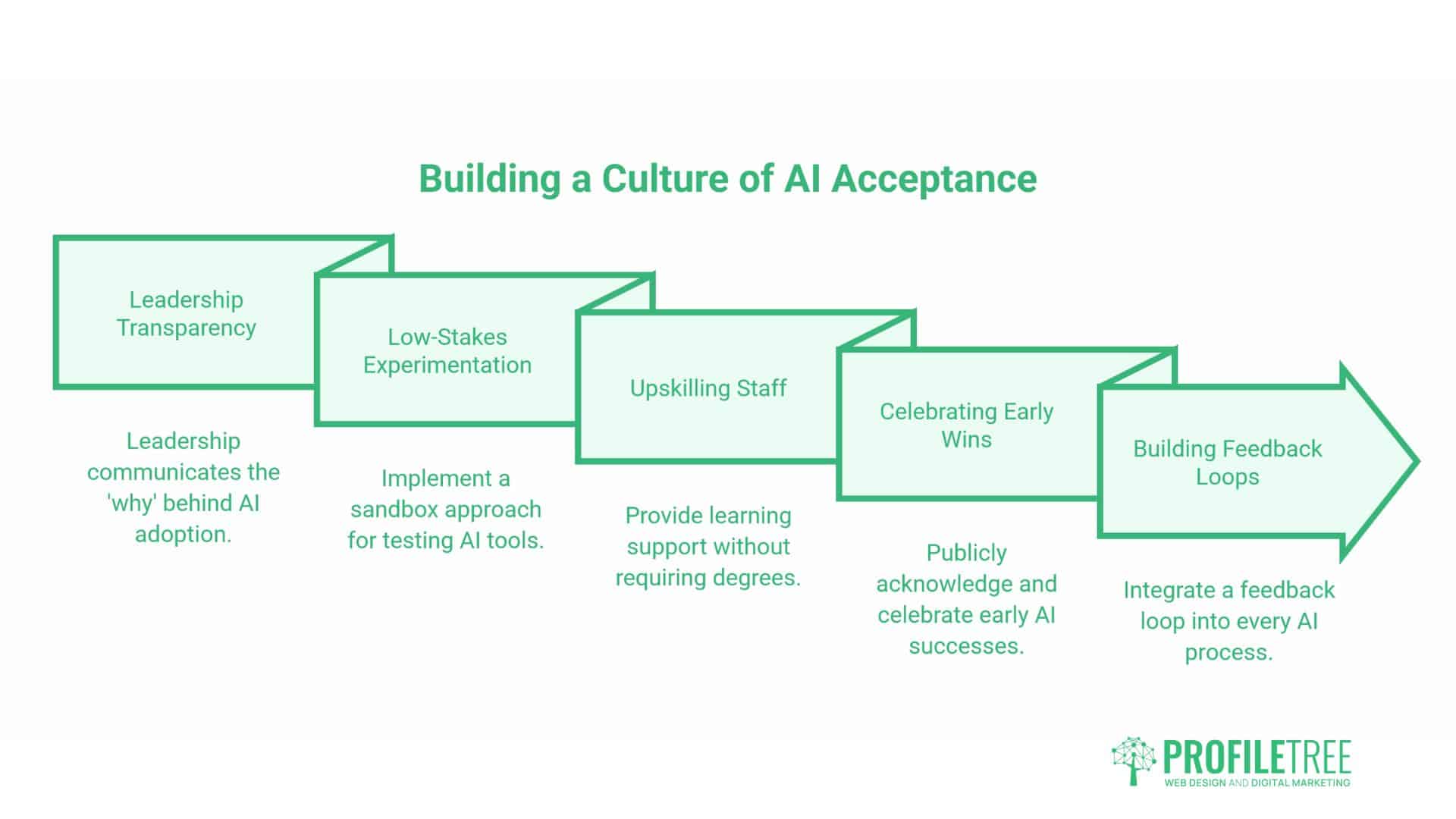
A culture of AI adoption doesn’t emerge from a policy announcement or a software licence. It develops through a series of deliberate choices about how leadership communicates, how learning is supported, and how the organisation responds when things go wrong. The following framework is designed specifically for small teams without a dedicated change management resource.
Step One: Leadership Transparency on the “Why”
Staff don’t resist AI. They resist feeling like subjects in a decision made without them. The first step is a clear, honest explanation of why AI is being considered: what problem it addresses, what the alternative is, and what success looks like.
That explanation doesn’t need to be polished or complete. A straightforward conversation about a specific operational bottleneck and why a particular tool might help is more credible than a vision statement about digital transformation. Ciaran Connolly, founder of ProfileTree, puts it plainly: “When we work with small businesses on AI adoption, the ones that succeed fastest are always the ones where the owner has been honest about what is changing and why, before a single tool is installed.”
Step Two: Low-Stakes Experimentation Through a Sandbox Approach
A sandbox is simply a contained space for testing something without affecting live operations or customer-facing outputs. For a small business, this might mean trialling an AI writing assistant for internal documents only, or using an AI scheduling tool for one team member before rolling it out more broadly.
The value of a sandbox isn’t just technical. It signals to staff that the organisation isn’t betting everything on an unproven tool. It gives people permission to find flaws, ask questions, and develop familiarity at a pace that feels manageable.
Mistakes in a sandbox have no consequences, which makes people far more willing to engage genuinely. ProfileTree’s piece on AI prompts for business shows how controlled experimentation delivers early wins without exposing anything customer-facing.
Step Three: Upskilling Without Requiring Degrees
One of the persistent misconceptions about AI in the workplace is that meaningful engagement with it requires technical qualifications. For the vast majority of SME staff, it doesn’t. The skills needed are largely interpretive: understanding what a tool is doing, recognising when its output is unreliable, and knowing when human judgement should take precedence.
Short, practical training sessions focused on specific tools tend to work better than broad digital literacy programmes. The goal isn’t to produce AI experts but to give every team member enough confidence to use the tools available to them without anxiety. ProfileTree’s digital skills training and AI training and implementation services are built around exactly this principle: short, tool-specific sessions rather than lengthy courses that a small team can’t spare the time for.
Step Four: Celebrating Early Wins Publicly
When a team member uses an AI tool effectively and saves real time on a weekly report, that story is worth sharing. It reframes AI from a theoretical benefit to a practical one, and it gives other staff a concrete example of what adoption looks like in their specific context.
Early wins don’t have to be dramatic. A faster first draft, a more accurate data summary, a customer query resolved more quickly: these are the outcomes that persuade sceptical colleagues more effectively than any presentation about AI’s long-term potential. Documenting a handful of these moments as short internal case studies, the same way a content marketing plan would document a client result, gives the business something concrete to point to the next time someone is unsure.
Step Five: Build a Feedback Loop Into Every AI Process
Once AI tools are in regular use, the cultural work doesn’t stop. The organisations that sustain genuine adoption are the ones that treat it as an ongoing conversation rather than a completed project.
Set a regular, lightweight review cadence: monthly for the first quarter, then quarterly. Ask staff directly what’s working, what’s producing unreliable outputs, and where the tool is creating new friction rather than removing it. These conversations surface problems early, before they harden into quiet workarounds that undermine the whole initiative.
The feedback loop also serves a motivational function. When staff see that their input leads to an adjustment, whether that’s switching tools, changing a workflow, or deciding that a particular AI application isn’t worth the overhead, they develop genuine ownership of the process. That ownership is the difference between a culture that sustains itself and one that depends entirely on top-down energy to keep going.
Measuring Success: KPIs for AI Adoption
Culture is hard to measure directly, but the behaviours underneath it aren’t. Rather than asking “has our culture improved?”, a small business can track a handful of concrete indicators that show whether adoption is actually taking hold.
| Indicator | What it shows | How to track it |
|---|---|---|
| Weekly active use rate | The share of the team actually opening and using the approved tool, not just aware of it | A simple usage log or the tool’s own admin dashboard |
| Time saved on a named task | Whether the tool is delivering the specific benefit it was introduced for | Before-and-after timing on that one task, not a general estimate |
| Outputs flagged for review | Whether staff are exercising judgement rather than accepting AI output blindly | A shared log of corrections or rejected outputs |
| Staff confidence score | Whether anxiety about the tools is falling over time | A short, anonymous quarterly survey with the same two or three questions each time |
None of these requires expensive software. A shared spreadsheet and a consistent review date are enough for most small teams. What matters is picking indicators tied to the specific task the AI tool was introduced for, rather than vague measures of “innovation” that nobody can act on. These indicators exist to show whether a culture of AI adoption is taking hold, not to judge individual staff members.
Common Barriers to AI Adoption in Small Teams
Even with the right framework, certain patterns reliably slow AI adoption down inside small businesses. Recognising them early makes them easier to manage.
Fear of getting it wrong in front of customers is the most common, and that’s why the sandbox approach in Step Two matters so much. A close second is simply a lack of protected time: staff are expected to learn a new tool on top of an unchanged workload, which guarantees it gets deprioritised. Siloed working is a smaller but real barrier too; if only one person in the business understands a tool, adoption depends entirely on that person staying and having time to explain it to others.
The least discussed barrier is inconsistent messaging from leadership. If the same business praises AI-driven efficiency in one meeting and criticises a staff member for using a tool imperfectly in the next, staff learn to hide their use of AI rather than improve it openly. Left unaddressed, these barriers don’t just slow down a single tool rollout; they undermine any attempt to build a lasting culture of AI adoption across the team.
AI Adoption in Hybrid and Remote Teams
Most guidance on building an AI-ready culture assumes everyone is in the same room, which doesn’t match how many UK and Irish SMEs actually operate. Hybrid and remote teams lose the informal, over-the-shoulder moments where one colleague shows another a shortcut, so that knowledge transfer needs to happen deliberately instead.
A shared, written log of AI use cases, even a simple one, does some of the same work that a desk-side demonstration would in an office. Recording short screen-capture walkthroughs for a specific task, rather than relying on a live meeting that not everyone can attend, tends to spread adoption more widely in a distributed team. ProfileTree’s video production work with SME clients often supports exactly this kind of internal training content, alongside the customer-facing video work the service is best known.
Asynchronous check-ins, a short written update rather than a scheduled call, also suit the feedback loop in Step Five better for teams split across locations or working different hours. None of this is complicated, but it needs to be deliberate; a culture of AI adoption doesn’t travel through a shared office the way it once did.
AI for Micro-Businesses and the View Beyond the M25
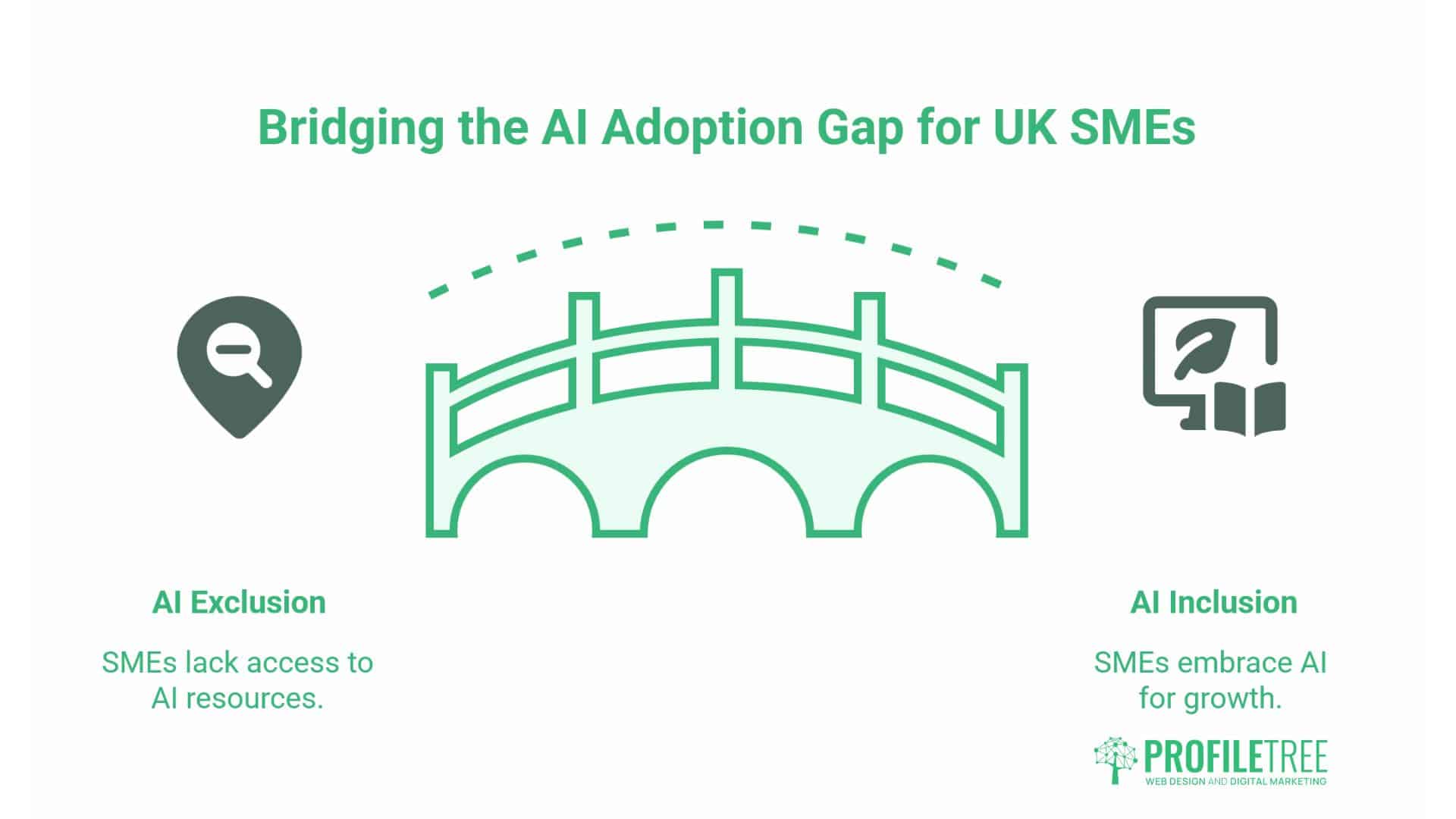
Most AI guidance for UK businesses is implicitly written for the South-East. It assumes proximity to accelerators, access to specialist recruitment markets, and familiarity with the London tech scene. For the majority of UK SMEs, none of those conditions applies. Here’s what AI adoption actually looks like outside that bubble.
Running AI With No Head of IT
A business with five or ten employees doesn’t have a technology function. The person closest to the AI decision is usually the owner, possibly alongside whoever handles the accounts or manages the website. That’s a very different starting point from a 200-person company with an IT director.
The good news is that the most immediately useful AI tools for micro-businesses are also the most accessible. Generative writing assistants, AI-enhanced scheduling, and automated customer response tools are available through platforms that many small businesses already pay for.
Microsoft 365, Google Workspace, and Canva all now include AI features at the standard subscription tier. There’s no separate procurement decision. The question is whether staff are using what’s already available.
Regional Spotlight: Innovation Beyond London
Northern Ireland, Scotland, the Midlands, and the North of England all have active business support ecosystems that rarely receive the same attention as London-focused coverage. Invest NI offers direct support for technology adoption among Northern Irish businesses, while Scottish Enterprise provides funded programmes for digital transformation. The UK-wide network of Growth Hubs, administered through Local Enterprise Partnerships in England, offers free business advice and can signpost relevant funding.
Belfast’s digital economy has grown substantially over the past decade, with a strong cluster of technology and professional services firms.
For SMEs based in the region, that network provides access to talent pipelines, peer networks, and sector-specific expertise that can support AI adoption without the need to look to London for answers. ProfileTree works with businesses across Northern Ireland, Ireland, and the UK on exactly this kind of practical digital transition, including web design, web development, and SEO work that increasingly sit alongside AI-related projects for the same clients.
Off-the-Shelf Versus Bespoke AI: A Practical Comparison
For most small businesses, the choice isn’t between AI and no AI. It’s between using the AI already embedded in existing software and commissioning something built specifically for their operations. The table below sets out the key differences.
| Factor | Off-the-Shelf AI | Bespoke AI |
|---|---|---|
| Cost | Included in existing subscriptions or a low monthly fee | Significant development and ongoing maintenance costs |
| Implementation time | Days to weeks | Months to a year or more |
| Cultural impact | Low friction; familiar interfaces | Requires dedicated training and change management |
| Fit for micro-businesses | High | Only where a specific need can’t be met elsewhere |
For the vast majority of businesses with fewer than 50 employees, off-the-shelf tools are the right starting point. Bespoke development makes sense only when a specific operational need can’t be met by existing products, and the volume of work justifies the investment. Some needs sit in between: an AI-assisted booking form or a chatbot built into an existing site is closer to a web development task than a full bespoke AI build, and is often the more realistic next step for a growing SME than either extreme.
Responsible AI: Ethics, Policy, and UK Funding
Getting the culture right internally is one part of the picture. The other is making sure AI use holds up to external scrutiny, whether from customers, regulators, or prospective employees. Responsible AI practice isn’t just a compliance exercise. It’s increasingly a competitive differentiator.
A Practical AI Acceptable Use Policy for Small Businesses
A formal AI acceptable use policy doesn’t need to be a lengthy legal document. For most small businesses, a one-page internal statement covering the following points is sufficient and can be updated as the organisation’s use of AI evolves.
- Which AI tools are approved for use and in what contexts
- What types of customer or client data may not be entered into AI systems
- Who is responsible for reviewing AI-generated content before it’s published or sent
- How staff should flag concerns about AI outputs or decisions
- What the organisation’s position is on disclosing AI use to customers
Drafting that policy with a team, rather than leaving an owner to write it alone, is itself a useful digital training exercise: it forces the same conversations about the “why” that Step One of the framework above calls for.
The Data Protection Act 2018 and UK GDPR both have implications for how personal data is processed through AI tools. If a chosen tool processes personal data on the business’s behalf, a data processing agreement with the provider is required. This applies to cloud-based AI tools as much as it does to any other software-as-a-service product. The ICO’s guidance on AI and data protection sets out the regulator’s current position in detail, and ProfileTree’s guide to GDPR training for teams covers the data handling obligations most relevant to small businesses.
Ethics in Practice: Fairness, Transparency, and Accountability
AI ethics in an SME context is primarily about three things: making sure the tools used don’t produce discriminatory outputs, being transparent with customers about when AI is involved in decisions that affect them, and having a clear line of accountability when something goes wrong.
The third point is the most overlooked: it’s about a genuine culture of AI adoption in practice: if an AI tool produces incorrect output that leads to a poor customer experience, “the AI got it wrong” is not an acceptable response. The business remains accountable, and having a named person responsible for reviewing AI decisions in each workflow makes that accountability real rather than theoretical. ProfileTree’s article on ethics in content creation explores related principles around transparency and responsibility.
UK Grants and Tax Credits for AI Adoption
Several funding routes are available to UK small businesses investing in AI and digital tools. Innovate UK runs regular funding competitions for SMEs developing or adopting new technologies, including AI applications. R&D Tax Credits through HMRC allow eligible businesses to claim back a percentage of qualifying research and development costs, including the cost of developing or trialling AI tools for business use.
Regional Growth Hubs, operating across England through Local Enterprise Partnerships, offer free business support and can advise on available grants specific to a given area and sector. Devolved administrations in Northern Ireland (Invest NI), Scotland (Scottish Enterprise), and Wales (Business Wales) each operate their own funding schemes with varying eligibility criteria.
The business case for AI adoption becomes considerably stronger when these funding routes are factored in. ProfileTree’s guide to project management training for teams covers how businesses structure the wider technology transition once funding is in place.
From Curiosity to Practical Change: Culture of Innovation
Building a culture of AI adoption is less about the technology and more about trust. Small businesses that communicate honestly, involve staff in the process, and start with contained, low-risk experiments consistently report smoother rollouts than those that lead with the software. The tools are accessible. The funding routes exist. The differentiating factor for UK SMEs navigating this shift is the quality of the human decisions made alongside the technology.
For businesses ready to take the next step, related reading on AI competitive analysis, AI marketing tools for UK SMEs, and using AI to track training outcomes covers what tends to come after the culture work is in place. ProfileTree Academy also runs shorter sessions for teams wanting to build AI and digital skills at their own pace.
FAQs
Will AI replace my small team?
No, not for most SME roles. AI takes over repetitive tasks, freeing staff to focus on work that requires judgement, relationships, and creativity.
What are the four pillars of a strong AI adoption culture?
Leadership transparency, a safe sandbox to experiment, practical upskilling, and a real feedback loop. Miss one, and adoption tends to stall.
What is the biggest barrier to AI adoption in a small team?
Fear of getting it wrong in front of a customer, closely followed by a lack of protected time to learn the tool. A sandbox approach and a short, focused training session address both.
Is using AI compliant with UK GDPR?
It can be, provided a data processing agreement is in place with any provider handling personal data. Staff should be trained not to enter identifiable customer data into general-purpose AI tools without one.