
What Is Guerrilla Marketing? Your Complete Digital Strategy Guide
Table of Contents
In the competitive landscape where businesses compete for attention amid constant digital noise, traditional advertising often fails to create a meaningful impact. For SMEs, startups, and ambitious brands operating on constrained budgets, guerrilla marketing offers a powerful alternative: achieving substantial exposure through creativity rather than capital.
Guerrilla marketing centres on unconventional, high-impact strategies that generate significant brand awareness without requiring substantial financial investment. From hijacking competitor events to creating viral social media moments, these tactics prioritise ingenuity and strategic thinking over advertising spend. The fundamental principle remains consistent: create memorable experiences that spark conversation, generate media coverage, and drive organic reach.
This comprehensive guide explores guerrilla marketing from both traditional and digital perspectives, providing actionable frameworks that business owners and marketing decision-makers can implement immediately. Whether you’re launching a new product, building brand recognition, or competing against established market leaders, these strategies offer practical pathways to amplify your message and accelerate business growth.
Understanding Guerrilla Marketing
Guerrilla marketing represents a strategic shift from budget-driven advertising to creativity-led campaigns that generate disproportionate impact. For businesses across Northern Ireland, Ireland, and the UK, understanding these foundational principles unlocks opportunities to compete effectively regardless of marketing budget constraints.
The term “guerrilla marketing” emerged in 1984 when Jay Conrad Levinson published his seminal book on unconventional marketing strategies. Borrowing from military guerrilla warfare tactics, the concept emphasises achieving objectives through surprise, ambush, and resourcefulness rather than relying on overwhelming force or substantial resources.
At its foundation, guerrilla marketing represents a strategic approach where businesses leverage creativity, timing, and unconventional thinking to capture attention and create buzz. Unlike traditional advertising that interrupts audiences through paid media placements, guerrilla tactics earn attention by surprising, delighting, or intriguing potential customers in unexpected contexts.
For businesses operating in Northern Ireland, Ireland, and across the UK, guerrilla marketing provides particular advantages. Regional markets often favour authentic, creative approaches over corporate messaging, making unconventional tactics especially effective for building local brand recognition and community engagement.
Core Principles Driving Guerrilla Success
Successful guerrilla marketing campaigns share several fundamental characteristics that distinguish them from conventional advertising approaches.
Low Cost, High Impact
The defining feature of guerrilla marketing lies in its exceptional return on investment. Rather than allocating substantial budgets to media buying, businesses invest in creative ideation and strategic execution. A compelling street installation might cost hundreds rather than thousands, while generating media coverage worth significantly more than the initial investment.
Element of Surprise
Disruption forms the cornerstone of effective guerrilla tactics. By presenting brands in unexpected contexts or through unconventional formats, these campaigns break through the mental filters audiences develop against traditional advertising. The surprise factor creates memorable moments that audiences naturally want to discuss and share.
Audience Engagement
Traditional advertising speaks to audiences; guerrilla marketing invites participation. Whether through interactive installations, social media challenges, or experiential activations, these campaigns transform passive viewers into active participants. This engagement creates stronger emotional connections and increases the likelihood of organic sharing.
Shareability and Virality
Modern guerrilla campaigns are designed for shareability from conception. Whether through visual impact, emotional resonance, or humour, effective tactics create content that audiences feel compelled to photograph, discuss, and distribute through their networks. This organic amplification extends reach far beyond the initial touchpoint.
Strategic Timing
Successful guerrilla marketing often involves capitalising on existing events, trending topics, or cultural moments. By aligning campaigns with relevant contexts, brands amplify their message while minimising costs. This requires agility and the capability to respond quickly to opportunities as they emerge.
What Is an Encirclement Attack in Marketing?
An encirclement attack represents a comprehensive guerrilla strategy where businesses simultaneously address multiple competitive weaknesses across different channels and touchpoints. Rather than focusing on a single vulnerability, this approach surrounds competitors through coordinated tactics that highlight their limitations while emphasising your strengths.
Implementing an encirclement strategy requires thorough competitive analysis. Identify gaps in competitor offerings, weaknesses in their customer service, limitations in their digital presence, or inconsistencies in their messaging. Once these vulnerabilities become clear, develop coordinated guerrilla tactics that highlight these shortcomings by contrasting them with your superior capabilities.
For SMEs competing against larger, established competitors, encirclement strategies prove particularly effective. While larger companies may possess greater resources, they often lack agility and authentic community connections. By simultaneously demonstrating superior customer service, more responsive digital engagement, stronger community involvement, and more innovative product features, smaller businesses create a compelling narrative that positions them as the preferred choice.
The key lies in coordination and consistency. Individual guerrilla tactics gain exponential effectiveness when combined into a cohesive strategy that reinforces a unified message across multiple touchpoints. This multi-pronged approach prevents competitors from easily countering your efforts while building momentum through accumulated impact.
Digital Guerrilla Tactics
Digital channels have fundamentally transformed guerrilla marketing, removing geographical barriers and creating unprecedented opportunities for brands to achieve massive reach with minimal investment. For businesses offering web design, digital strategy, video production, or content marketing services, mastering these tactics becomes both a competitive advantage and a compelling demonstration of expertise to potential clients.
The digital revolution has fundamentally transformed guerrilla marketing, creating unprecedented opportunities for businesses to achieve massive reach with minimal investment. Online channels eliminate geographical constraints, enable precise targeting, and provide immediate measurement capabilities that traditional tactics cannot match.
Digital guerrilla marketing extends beyond simply moving traditional tactics online. It requires understanding platform-specific dynamics, audience behaviours, and content formats that generate engagement within digital environments. For businesses offering web design, digital strategy, or content marketing services, mastering these tactics becomes both a competitive advantage and a demonstration of expertise.
Viral Content Creation
Creating content that spreads organically represents the holy grail of digital guerrilla marketing. Viral content achieves massive reach without paid promotion, driven by audiences who voluntarily share material they find compelling, entertaining, or valuable.
Successful viral content typically exhibits several characteristics: emotional resonance, surprise factor, practical utility, or entertainment value. Content that makes audiences laugh, feel inspired, learn something valuable, or experience genuine surprise naturally encourages sharing. The challenge lies in creating material that feels authentic rather than contrived, which requires a deep understanding of your audience.
For B2B companies or professional services firms, viral content often takes the form of insightful data visualisations, controversial but well-reasoned perspectives, or practical frameworks that solve genuine business challenges. ProfileTree’s approach to content marketing emphasises creating resources that audiences bookmark and share because they provide genuine value, building authority while generating organic reach.
Video content offers particular viral potential, especially short-form formats optimised for social platforms. A compelling 30-second video that demonstrates an unexpected use case, reveals surprising statistics, or showcases impressive results can generate millions of views when executed properly. The key lies in front-loading impact—capturing attention within the first three seconds and delivering value quickly enough to encourage complete viewing and sharing.
Social Media Hijacking and Real-Time Marketing
Social media platforms enable brands to insert themselves into trending conversations through timely, relevant responses. This tactic, often referred to as “newsjacking” or “trendjacking,” involves monitoring trending topics and creating content that authentically and valueably connects your brand to these conversations.
The most famous example remains Oreo’s “You can still dunk in the dark” tweet during the 2013 Super Bowl blackout. Created and published within minutes, this simple response generated massive engagement and set the standard for real-time marketing. The key lies in speed, relevance, and authenticity—responses must feel natural rather than forced.
Implementing real-time marketing requires preparation and agility. Establish clear brand guidelines that define which topics align with your values and messaging. Develop approval processes that facilitate rapid decision-making without compromising quality control. Monitor trending topics actively, but participate selectively, focusing on moments where your contribution adds genuine value rather than merely seeking attention.
For professional services firms or B2B companies, real-time marketing might involve contributing expert commentary during industry events, responding to breaking news that affects your sector, or participating in relevant conversations initiated by industry leaders. The goal isn’t simply visibility but positioning your brand as responsive, knowledgeable, and engaged with current developments.
Ambient Digital Experiences
Ambient digital marketing creates unexpected brand encounters within online environments where audiences don’t anticipate commercial messages. These tactics blend seamlessly into digital experiences, surprising users while delivering brand messages in contextually relevant ways.
Interactive website elements offer compelling ambient opportunities. Hidden “Easter eggs” that reward curious visitors, unexpected animations triggered by specific behaviours, or gamified experiences embedded within content all create memorable moments that encourage sharing and return visits. These elements demonstrate creativity and technical capability while providing entertainment value.
Augmented reality filters represent another powerful ambient tactic. Creating branded AR experiences for platforms like Instagram or Snapchat enables users to interact with your brand in playful, shareable ways. When executed well, these filters spread organically as users share their experiences, generating substantial reach without the need for paid promotion.
For businesses offering web design and development services, demonstrating these capabilities through your own digital presence builds credibility. Implementing sophisticated interactive elements showcases technical expertise while creating a differentiated user experience that makes your site memorable and shareable.
Guerrilla Email and Messenger Campaigns
Email marketing typically follows predictable patterns, including newsletters, promotional offers, and automated sequences. Guerrilla email tactics break these conventions through unexpected formats, interactive elements, or unconventional timing, capturing attention in crowded inboxes.
Consider sending an email with an intentionally blank subject line that intrigues recipients into opening it, revealing compelling content inside. Or create interactive emails featuring quizzes, calculators, or decision trees that provide personalised value based on user inputs. These approaches stand out against standard promotional messages, generating higher engagement rates.
Messenger marketing offers similar guerrilla opportunities. Rather than standard automated sequences, create conversational experiences that feel personalised and valuable. Implement unexpected humour, provide genuinely helpful information, or create choose-your-own-adventure style interactions that engage users beyond typical promotional messaging.
The key lies in striking a balance between creativity and respect for audience preferences. Guerrilla tactics should surprise and delight rather than frustrate or confuse. Always provide clear value and maintain brand consistency even while experimenting with unconventional approaches.
Micro-Influencer and Community Partnerships
While traditional influencer marketing involves substantial payments to individuals with massive followings, guerrilla approaches focus on authentic partnerships with micro-influencers and community leaders who possess highly engaged, relevant audiences.
Micro-influencers—typically defined as individuals with 1,000 to 100,000 followers—often generate higher engagement rates than celebrities or mega-influencers. Their audiences trust their recommendations and perceive them as authentic peers rather than paid promoters. For SMEs, partnering with multiple micro-influencers often proves more effective than single partnerships with larger accounts.
Guerrilla micro-influencer campaigns might involve sending products to relevant creators without demanding specific deliverables, trusting that genuine appreciation will lead to organic content. Or create exclusive experiences—behind-the-scenes access, early product releases, or collaborative content creation—that provide value to influencers while generating authentic promotional content.
Community partnerships extend this concept beyond individuals to groups, forums, and online communities. Identify where your target audiences gather online—specialist forums, Facebook groups, Reddit communities, LinkedIn groups—and find authentic ways to provide value. This might involve answering questions, sharing expertise, or sponsoring community events rather than overt promotion.
For B2B services, thought leadership within professional communities represents a powerful guerrilla tactic. Contributing valuable insights in industry forums, participating meaningfully in LinkedIn discussions, or offering free resources to community members builds authority and generates referrals without direct advertising spend.
Campaign Strategy Framework
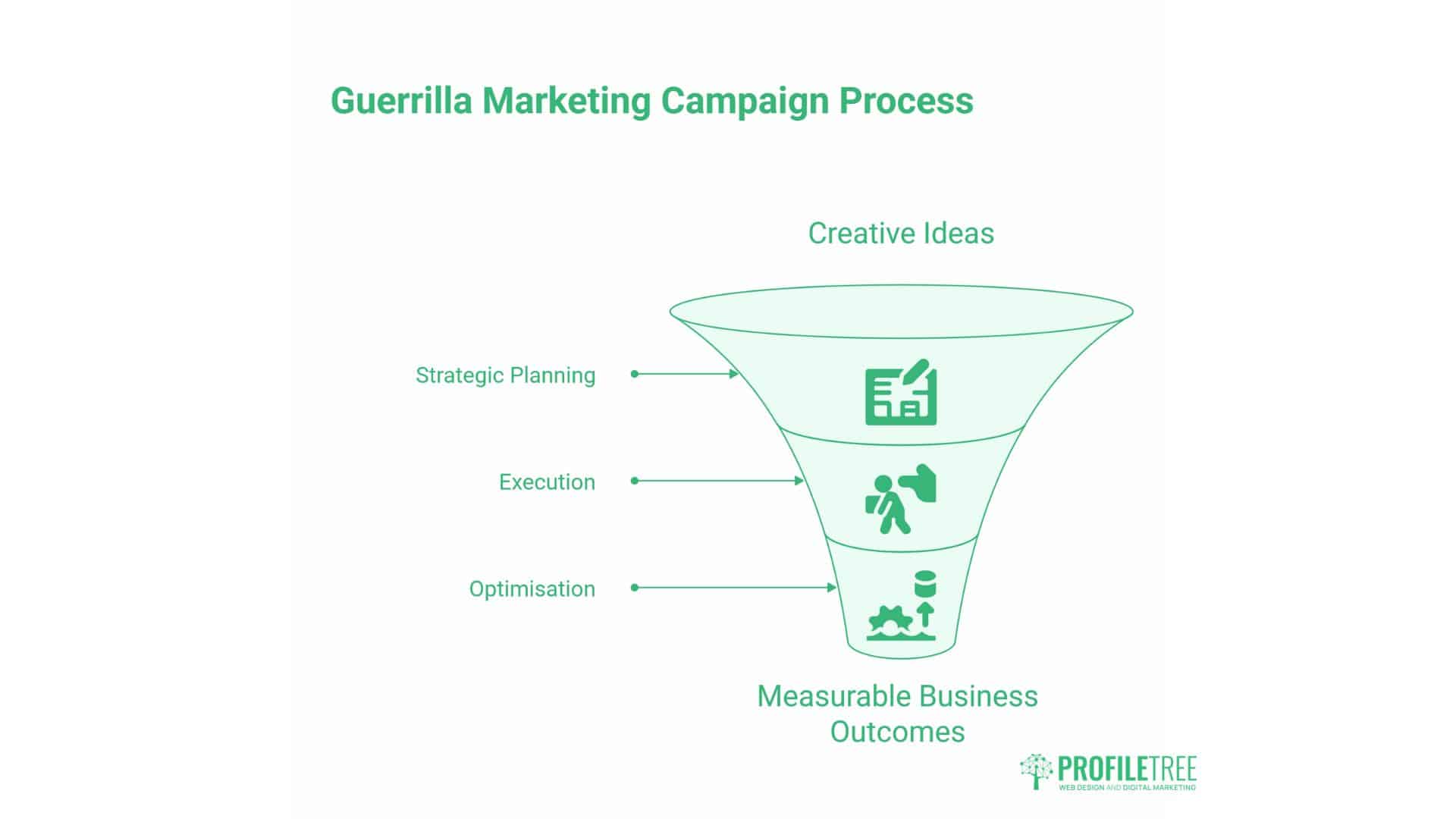
Moving from random creative acts to systematic guerrilla marketing requires structured frameworks that strike a balance between spontaneity and strategic discipline. This section provides a step-by-step approach for conceiving, executing, and optimising guerrilla campaigns that deliver measurable business outcomes while maintaining the creativity and flexibility that make these tactics effective.
Successful guerrilla marketing requires structured planning despite its unconventional nature. Random acts of creativity rarely generate consistent results; strategic frameworks provide the foundation for repeatable success.
This framework guides businesses through developing, executing, and optimising guerrilla campaigns that align with broader marketing objectives while maintaining the creativity and flexibility that make these tactics effective.
Step 1: Define Clear Objectives and Success Metrics
Guerrilla marketing should serve specific business objectives rather than pursuing attention for its own sake. Begin by articulating what you aim to achieve: brand awareness within a specific demographic, lead generation for a new service, positioning as an industry innovator, or driving traffic to a recent website launch.
Clear objectives enable focused strategy development and provide benchmarks for measuring success. Rather than vague goals like “increase awareness,” specify measurable targets: “Generate 50,000 social media impressions,” “Achieve coverage in three industry publications,” or “Drive 1,000 new visitors to our website.”
For businesses offering digital marketing services, demonstrating measurable results from guerrilla campaigns builds credibility and showcases strategic thinking. Every campaign becomes a case study that proves your capability to generate results through creative, cost-effective approaches.
Step 2: Audience Analysis and Platform Selection
Understanding your audience with precision enables targeted guerrilla tactics that resonate rather than fall flat. Move beyond basic demographics to psychographic insights: What challenges do they face? What content do they consume? Where do they spend time online? What surprises or delights them?
Platform selection naturally follows from understanding the audience. If your target audience comprises business owners seeking digital transformation, LinkedIn and industry-specific forums offer more potential than TikTok. If you’re reaching younger consumers interested in visual brands, Instagram and YouTube become priorities.
Different platforms reward different content formats and tactics. Twitter favours witty, timely responses to trending topics. Instagram emphasises visual impact and storytelling through images and short videos. LinkedIn values thought leadership and professional insights—TikTok rewards entertainment and authenticity. Matching your tactics to platform dynamics can significantly increase effectiveness.
For SMEs and startups, focusing resources on fewer platforms where you can execute excellently outperforms spreading efforts thinly across many channels. Choose platforms where your target audience is concentrated and where your content naturally aligns with the platform’s norms and expectations.
Step 3: Ideation and Creative Development
Effective guerrilla campaigns start with strong creative concepts that strike a balance between surprise and brand alignment. Brainstorming should be structured yet open, encouraging unconventional thinking while maintaining strategic focus.
Start by identifying tension points—gaps between customer expectations and industry norms, competitor weaknesses you can exploit, or emerging trends you can leverage. These tension points provide fertile ground for creative concepts that surprise audiences while delivering strategic messages.
Consider various guerrilla tactics, such as ambush marketing that piggybacks on competitor events, ambient installations that surprise audiences in unexpected locations, viral content that naturally encourages sharing, or interactive experiences that engage audiences directly. Evaluate each concept against your objectives, audience preferences, and resource constraints.
“The most effective guerrilla campaigns we’ve developed share a common characteristic,” notes Ciaran Connolly, Director of ProfileTree. “They feel authentic to the brand while surprising the audience. Forced creativity or concepts that don’t align with brand values rarely generate positive results. The sweet spot lies in finding unexpected ways to express what makes your business genuinely different.”
Prototyping concepts quickly enables testing ideas before full execution. Create mockups, storyboards, or small-scale tests that reveal potential issues or opportunities for refinement. This iterative approach reduces risk while increasing the likelihood of success.
Step 4: Execution Planning and Resource Allocation
Guerrilla marketing’s reputation for being low-cost can be misleading. While these tactics typically require less capital than traditional advertising, they demand significant creative energy, time, and coordination. Effective execution requires detailed planning and transparent allocation of resources.
Develop detailed project plans that specify responsibilities, timelines, required assets, and approval processes. Even spontaneous-seeming campaigns require preparation—having assets ready, approval processes streamlined, and team members briefed enables rapid execution when opportunities arise.
Budget allocation for guerrilla campaigns differs from traditional marketing. Rather than media buying, costs typically involve content creation, technology implementation, or materials for physical activations. Allocate sufficient budget for quality execution while maintaining the cost-effectiveness that makes guerrilla marketing attractive.
For businesses offering web development or video production services, guerrilla campaigns provide opportunities to showcase capabilities. Creating technically sophisticated interactive experiences or producing high-quality viral video content demonstrates expertise while generating marketing impact.
Risk assessment becomes particularly important for unconventional tactics. Consider potential negative reactions, legal implications, or unintended consequences. Having contingency plans and clear guidelines for responding to various outcomes reduces risk while maintaining creative ambition.
Step 5: Launch, Monitoring, and Amplification
Execution timing significantly impacts guerrilla campaign success. Consider cultural moments, industry events, trending topics, or seasonal factors that might amplify your message. Real-time marketing tactics require constant monitoring and rapid response capabilities.
During campaign launch, active monitoring enables quick adjustments and opportunistic amplification. Track social media mentions, website traffic spikes, and engagement metrics in real-time. Respond to audience reactions, answer questions, and participate in conversations that emerge around your campaign.
Amplification strategies extend campaign reach beyond initial touchpoints. Share user-generated content that emerges from your campaign, engage with journalists who cover your story, and leverage owned channels to highlight campaign success. Even guerrilla campaigns benefit from strategic amplification that maximises their impact.
For campaigns involving physical installations or events, capturing high-quality documentation enables extended digital amplification. Professional photography and video content transform temporary activations into lasting digital assets that continue generating value long after the initial campaign concludes.
Step 6: Analysis, Learning, and Iteration
Post-campaign analysis transforms individual tactics into institutional knowledge, improving future efforts. Comprehensive evaluation examines both quantitative metrics and qualitative outcomes.
Quantitative analysis tracks metrics established during objective setting, including reach, engagement, website traffic, lead generation, and media coverage. Compare results against benchmarks and calculate return on investment by weighing outcomes against resources invested.
Qualitative analysis examines audience sentiment, shifts in brand perception, and unexpected outcomes—both positive and negative. Review comments, mentions, and feedback to understand how audiences perceived and responded to your campaign. These insights inform future creative development and strategic decisions.
Document learnings systematically to create resources that guide future campaigns. What creative approaches resonated most strongly? Which platforms generated the best results? What timing factors influenced outcomes? Which aspects of execution could improve? Building institutional knowledge through structured learning accelerates capability development and improves long-term results.
Measuring Campaign Success
Guerrilla marketing’s unconventional nature creates unique measurement challenges that standard analytics frameworks often fail to address. Comprehensive evaluation requires looking beyond immediate conversions to capture the full spectrum of value these campaigns generate—from brand awareness and engagement to long-term reputation building and organic reach amplification.
Guerrilla marketing’s unconventional nature creates measurement challenges. Traditional metrics, such as click-through rates or direct conversions, often fail to capture the full value that these campaigns generate. Comprehensive measurement requires broader frameworks that account for awareness, engagement, and long-term brand impact.
Beyond Traditional Metrics: Tracking Engagement and Brand Impact
Successful guerrilla campaigns generate value across multiple dimensions that standard metrics miss. Comprehensive measurement frameworks track both immediate outcomes and longer-term brand effects.
Reach and Impressions
Track how many people encountered your campaign through various channels. Social media impressions, website visitors, media coverage, audience reach, and physical activation attendance all contribute to understanding campaign reach. Calculate potential impressions by combining owned, earned, and user-generated content distribution.
Engagement Depth
Move beyond vanity metrics to measure genuine engagement. Time spent viewing content, shares and comments, participation in interactive elements, and user-generated content creation all indicate a deeper level of engagement than passive viewing. These metrics reveal whether your campaign captured attention superficially or created meaningful connections.
Sentiment Analysis
Qualitative sentiment provides crucial context for quantitative metrics—Analyse comments, mentions, and reviews to understand how audiences perceived your campaign. Positive sentiment indicates successful execution; adverse reactions signal potential issues requiring attention or adjustment.
Earned Media Value
Calculate the equivalent advertising value of the media coverage your campaign generates. Publications covering your guerrilla tactics provide exposure that would otherwise require substantial paid media budgets. Tracking earned media value demonstrates tangible return on investment.
Website Traffic and Behaviour
Monitor spikes in website traffic during and after campaign launches. Track which pages visitors view, how long they stay, and what actions they complete. Guerrilla campaigns that drive website visits create opportunities for conversion beyond immediate campaign interactions.
Lead Generation and Sales Impact
Where possible, track leads or sales attributed to specific campaigns. Use unique URLs, promotional codes, or attribution tools to connect campaign exposure to business outcomes. Even awareness-focused campaigns should connect to measurable business impact wherever possible.
Quantifying Qualitative Impact: Brand Lift and Word-of-Mouth
Guerrilla marketing excels at generating intangible brand benefits that compound over time. Measuring these effects requires approaches that complement immediate performance metrics.
Brand lift studies evaluate changes in awareness, consideration, or preference following the execution of a campaign. Pre- and post-campaign surveys among target audiences reveal shifts in brand perception that can be attributed to your guerrilla tactics. Even modest sample sizes can provide valuable directional insights.
Word-of-mouth tracking monitors conversations about your brand beyond direct campaign metrics. Social listening tools capture mentions across platforms, revealing organic discussions sparked by your campaigns. Increased mention volume and positive sentiment indicate successful word-of-mouth generation.
Share of voice analysis compares your brand’s visibility to that of competitors within specific conversations or channels. Guerrilla campaigns that increase your share of voice demonstrate competitive advantage gained through creative tactics rather than increased spending.
For businesses offering SEO and content marketing services, demonstrating how guerrilla campaigns generate backlinks, social signals, and brand mentions that improve search visibility creates compelling value propositions. These campaigns contribute to technical SEO outcomes while building brand awareness.
Creating a Guerrilla Marketing ROI Framework
Comprehensive ROI calculation for guerrilla campaigns requires frameworks that account for diverse value creation. Traditional ROI formulas, which focus solely on direct revenue, often undervalue the actual contribution of guerrilla marketing.
Begin by cataloguing all campaign costs: creative development, content production, technology implementation, staff time, and any external resources. Calculate your total investment accurately to establish the denominator for your ROI.
Next, assign values to campaign outcomes:
- Media coverage: Calculate equivalent advertising costs for earned media impressions
- Social engagement: Assign values based on typical paid social media costs per engagement
- Website traffic: Value visits based on average visitor lifetime value or typical paid acquisition costs
- Lead generation: Use average lead value or customer acquisition cost metrics
- Brand awareness: Estimate value based on traditional brand advertising costs to achieve a similar reach
Sum these values to calculate total campaign benefit, then apply the standard ROI formula: (Total Benefit – Total Cost) / Total Cost × 100 = ROI %
This framework provides a more comprehensive ROI assessment than simplistic direct response calculations, capturing the full value guerrilla campaigns generate across awareness, engagement, and conversion dimensions.
Real-World Examples
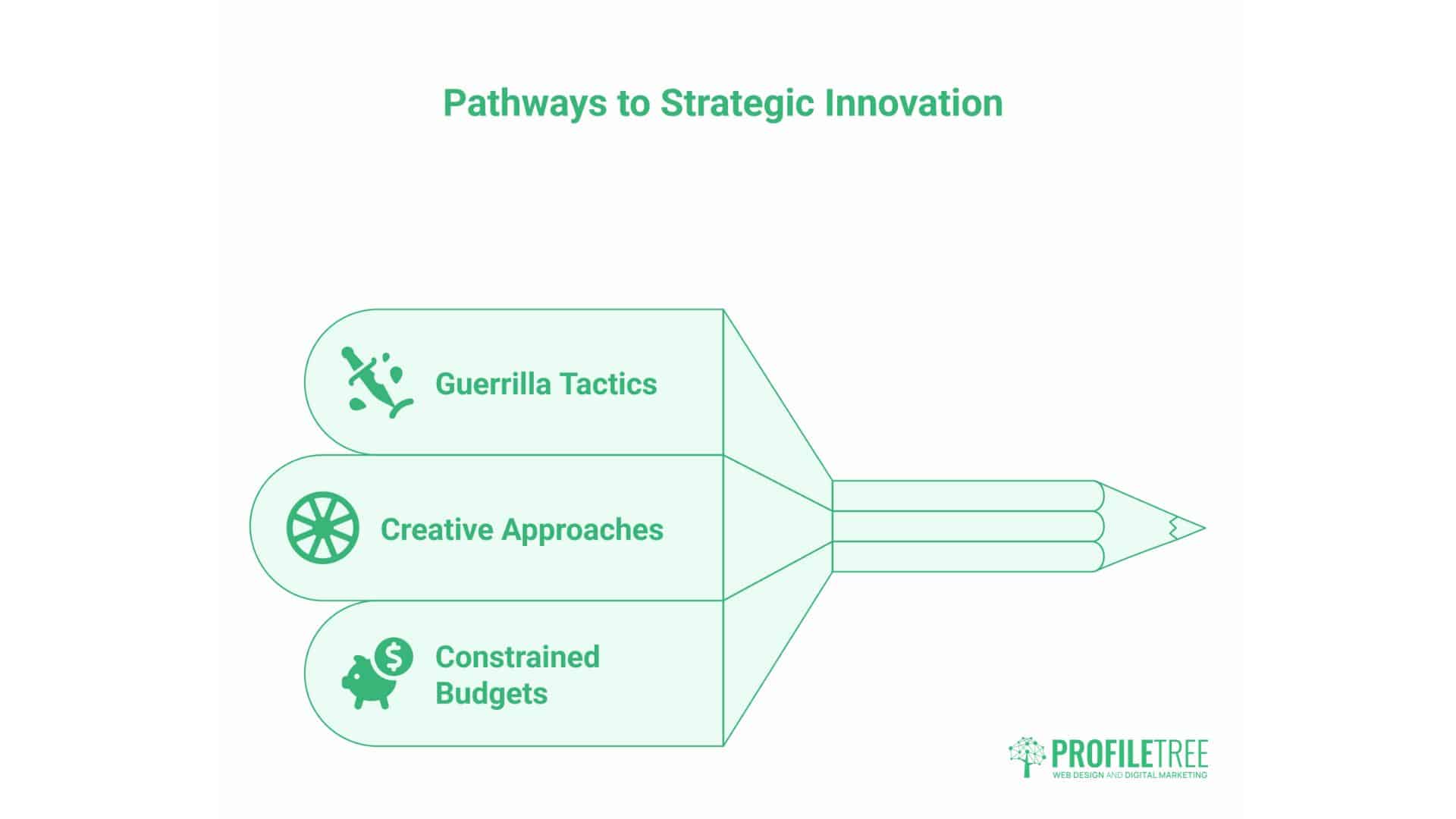
Examining successful guerrilla campaigns across industries and markets reveals practical patterns and creative approaches that inform strategy development. These examples demonstrate how businesses leverage unconventional tactics to achieve remarkable results with constrained budgets, providing inspiration and frameworks for developing your own campaigns.
Examining successful guerrilla campaigns reveals practical patterns and principles that inform strategy development. These examples demonstrate how businesses across sectors leverage unconventional tactics to achieve remarkable results with constrained budgets.
Classic Guerrilla Marketing Campaigns
These foundational examples established the principles of guerrilla marketing that continue to influence campaigns today. Each demonstrates how unconventional thinking, strategic positioning, and creative execution generate impact far exceeding financial investment.
Domino’s Pizza: The Noid Character
Domino’s created an iconic antagonist representing delivery delays and cold pizza. The Noid character appeared across advertising, becoming a cultural phenomenon that positioned Domino’s as the solution to pizza delivery frustrations. This campaign demonstrated how memorable characters can carry brand messages while generating organic conversation and media coverage.
The Noid succeeded by entertainingly personifying customer pain points. Rather than simply claiming fast delivery, Domino’s created a villain that represented everything customers disliked about pizza delivery, positioning their service as the hero. This approach made abstract service benefits concrete and memorable.
Red Bull: Stratos Space Jump
Red Bull sponsored Felix Baumgartner’s record-breaking free fall from the stratosphere, generating massive global media coverage and reinforcing the brand’s positioning as an advocate for extreme performance and boundary-pushing achievement. The event was live-streamed, creating a real-time shared experience across millions of viewers.
While this campaign required substantial investment, it exemplifies guerrilla marketing principles through its unconventional approach and earned media value that far exceeds direct costs. Traditional advertising could never generate comparable attention or create such strong brand associations with performance and achievement.
Dove: Real Beauty Sketches
Dove’s campaign asked women to describe themselves to a forensic sketch artist, then compared these sketches with descriptions provided by strangers. The resulting video highlighted discrepancies between self-perception and how others see us, sparking global conversation about beauty standards and self-acceptance.
This campaign succeeded due to its emotional resonance and shareability. By addressing genuine insecurities many women experience, Dove created content that felt valuable and meaningful beyond commercial messaging. The campaign generated millions of shares and extensive media coverage while aligning perfectly with Dove’s brand positioning.
Chipotle: Farms to Fork Campaign
Chipotle created guerrilla activations highlighting their commitment to sustainable ingredients, including planting fake vegetables in public parks that were later revealed as real and ready for harvest. These unexpected installations generated surprise and conversation while communicating brand values through experiential demonstration rather than mere claims.
The campaign worked by making abstract values concrete. Rather than simply stating a commitment to fresh ingredients, Chipotle created physical experiences that demonstrated these values in surprising, memorable ways, encouraging sharing and discussion.
Digital-First Guerrilla Campaigns
These campaigns leverage the unique capabilities of digital platforms—instant sharing, global reach, and real-time interaction—to create guerrilla moments that achieve viral spread and sustained engagement without substantial media investment.
Twitter’s Real-Time Marketing During Events
Numerous brands have mastered real-time marketing during significant events, creating timely content that inserts them into trending conversations. Beyond Oreo’s famous Super Bowl tweet, brands like Snickers, Arby’s, and Tide have developed reputations for crafting clever, real-time responses that generate engagement far exceeding that of typical social posts.
These campaigns succeed through speed, relevance, and wit. They demonstrate brand personality while staying current, creating shareable content that feels authentic rather than forced. The key lies in having prepared frameworks and approval processes that enable rapid response without sacrificing quality.
Spotify’s Data-Driven Outdoor Advertising
Spotify leveraged user data to create humorous outdoor advertisements highlighting unusual listening behaviours: “Dear person who played ‘Sorry’ 42 times on Valentine’s Day, what did you do?” This campaign bridged digital and physical channels, using digital insights to create compelling outdoor creative that generated significant social media sharing.
The campaign worked by finding humour in data while respecting privacy, creating ads that felt personal and shareable without revealing individual identities. This approach demonstrated Spotify’s data capabilities while creating entertaining content that reinforced the brand’s personality.
Airbnb’s Floating House on the Thames
Airbnb created a floating house on London’s River Thames to promote unique accommodation listings. The installation generated extensive media coverage and social sharing, demonstrating Airbnb’s brand promise of unique experiences through a physical manifestation that surprised Londoners and tourists alike.
This campaign exemplifies ambient guerrilla marketing—creating unexpected brand encounters in public spaces that generate organic coverage and sharing. The floating house provided compelling visual content that media outlets and social users eagerly shared, amplifying reach far beyond the physical installation’s immediate audience.
UK and European Guerrilla Successes
These regional examples illustrate how guerrilla tactics are tailored to local markets, cultural contexts, and audience sensibilities. They demonstrate that unconventional marketing is successful across diverse business sectors when tailored to audience expectations and market dynamics.
Paddy Power’s Ambush Marketing
Irish bookmaker Paddy Power has built a reputation for audacious ambush marketing during major sporting events. Their tactics often push boundaries, generating controversy and massive media attention without official event sponsorship. While some campaigns have drawn criticism, they consistently achieve awareness objectives with minimal investment.
These campaigns demonstrate the risks and rewards of boundary-pushing guerrilla tactics. Successful execution requires understanding the audience’s tolerance for provocation and having clear brand guidelines that maintain consistency, even while courting controversy.
Carlsberg’s “Probably” Campaign
Carlsberg transformed its tagline “Probably the best beer in the world” into experiential activations, including pop-up bars in unexpected locations and surprise “Carlsberg moments” for consumers. These activations brought the brand promise to life through experiences rather than mere messages.
The campaign succeeded by making advertising claims tangible through real experiences. Rather than simply claiming superiority, Carlsberg created moments that demonstrated their commitment to quality and customer experience, generating organic sharing and positive brand associations.
Innocent Drinks Village Fete
Innocent Drinks hosts an annual festival in London that combines music, activities, and brand experience in an accessible, family-friendly environment. The event generates significant local attention while reinforcing the brand’s values of fun, health, and community connection.
This campaign demonstrates how branded events can serve guerrilla objectives when executed authentically. Rather than overt promotion, the festival provides genuine value to attendees while naturally communicating its brand personality and values through the experience.
Taking Action: Implementing Your Guerrilla Strategy
Guerrilla marketing presents powerful opportunities for businesses that are willing to embrace creativity and unconventional approaches. For SMEs competing against larger competitors, these tactics provide pathways to visibility and impact that transcend budget constraints.
Success requires moving beyond random acts of creativity toward strategic frameworks that align guerrilla tactics with business objectives. Begin by clearly defining what you aim to achieve, understanding your audience deeply, and identifying gaps where unconventional approaches create competitive advantages.
Begin with small, manageable experiments that test concepts and build capabilities. Document learnings systematically to improve future efforts. As confidence grows, scale successful approaches while continuing to experiment with new tactics.
The competitive advantage lies not just in individual campaigns but in developing organisational capabilities for creative thinking, rapid execution, and measured experimentation. Companies that cultivate these capabilities position themselves to consistently surprise audiences, generate buzz, and achieve marketing objectives regardless of budget constraints.
If you’re ready to explore how guerrilla marketing tactics can accelerate your business growth, contact ProfileTree today. Our team specialises in developing creative digital strategies that generate measurable results for ambitious businesses across Northern Ireland, Ireland, and the UK. From web design and video production to digital training and AI implementation, we help companies to achieve remarkable outcomes through unconventional approaches.