
Teenage Use of Social Media Statistics: Unlocking Powerful UK Insights
Table of Contents
Social media continues to transform how teenagers communicate, learn, and engage with brands. For UK businesses aiming to connect with younger audiences, understanding these platforms isn’t just beneficial—it’s essential. This comprehensive examination of teenage social media usage offers valuable insights for organisations looking to develop effective youth marketing strategies.
Young people represent both current consumers and future brand advocates. Their social media behaviours provide a window into emerging trends that will shape digital engagement for years to come. By examining how teens use these platforms, businesses can better position their marketing efforts to resonate with this influential demographic.
Key Social Media Platforms Among UK Teenagers
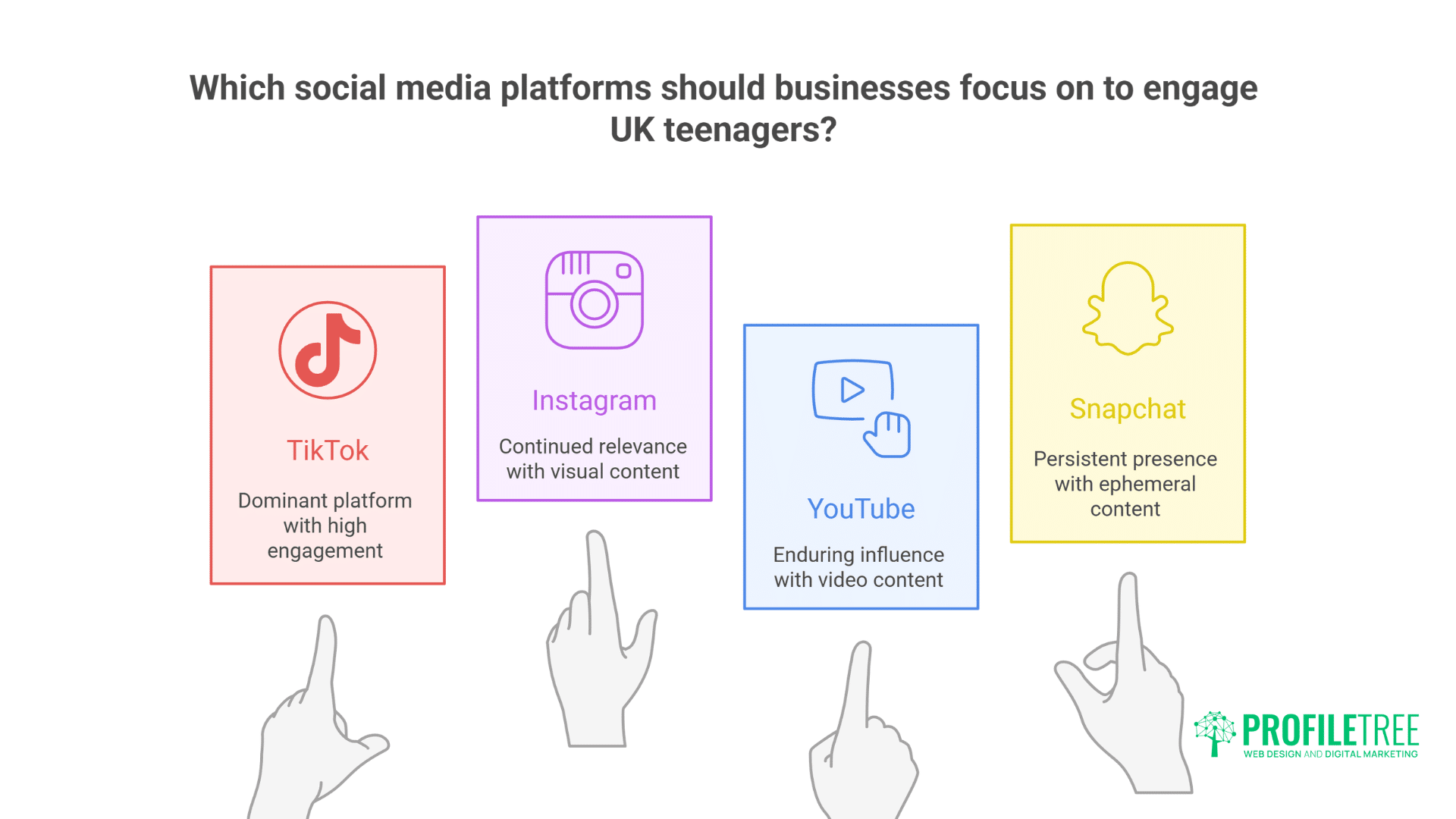
Understanding which platforms UK teenagers prefer helps businesses allocate resources effectively and create platform-appropriate content strategies.
The social media landscape for teens is constantly evolving, with new platforms emerging and existing ones adapting to changing preferences.
TikTok Dominance in Teenage Use of Social Media Statistics
TikTok has experienced unprecedented growth among British teenagers. Recent statistics show that 74% of UK teens aged 13-17 now use TikTok regularly, with average daily usage approaching 95 minutes. This explosive popularity stems from the platform’s algorithm-driven content discovery and short-form video format that aligns perfectly with teenagers’ preference for quick, engaging content.
“TikTok has fundamentally changed how young people consume content,” says Ciaran Connolly, Director of ProfileTree. “Businesses that understand its unique language and culture gain a significant advantage when communicating with teenage audiences.”
The platform’s rapid ascent offers valuable lessons about content consumption patterns. UK teens overwhelmingly prefer video content that feels authentic, humorous, and trendy—qualities that translate across multiple platforms but find particular resonance on TikTok.
Instagram’s Continued Relevance
Despite TikTok’s rise, Instagram maintains a strong position with 67% of UK teenagers using the platform regularly. Its evolution from a simple photo-sharing app to a multi-format content hub has helped maintain its appeal among young users.
Instagram’s introduction of Reels, Stories, and shopping features has created multiple touchpoints for businesses to engage teenage audiences. The platform remains particularly strong for brand discovery, with 53% of UK teens reporting they’ve discovered new products through Instagram.
YouTube’s Enduring Influence
YouTube remains a cornerstone of teenage media consumption, with 85% of UK teens visiting the platform weekly. The average UK teenager now spends approximately 60 minutes daily on YouTube, often using it as both entertainment and an educational resource.
The platform’s strength lies in its diverse content formats—from quick shorts to in-depth tutorials and vlogs. For businesses, YouTube offers opportunities for detailed product demonstrations, behind-the-scenes content, and educational material that can establish brand authority with younger audiences.
Snapchat’s Persistent Presence
Snapchat continues to maintain relevance among British teenagers, with approximately 59% of them using the platform regularly. Its ephemeral content model and strong privacy features appeal particularly to younger teens who value more private communication channels.
The platform’s augmented reality features present unique marketing opportunities, allowing businesses to create interactive, branded experiences that engage teenage users in novel ways.
Teenage Use of Social Media Statistics: Usage Patterns
Examining how teenagers interact with social media reveals important insights for timing, content types, and engagement strategies.
These patterns help businesses understand when and how to reach teenage audiences most effectively.
Time Spent on Platforms
UK teenagers now spend an average of 4.5 hours daily across social media platforms—a figure that has increased by 12% over the past two years. This substantial time investment underscores the importance of these channels for businesses looking to connect with younger demographics.
Morning and evening usage peaks are particularly notable, with 78% of teens checking social media within 30 minutes of waking and 84% using platforms in the hour before bedtime. Weekend usage typically increases by 25-30% compared to weekdays.
Content Consumption Trends
Video dominates teenage content preferences across platforms. Short-form video content (under 60 seconds) generates 3.2 times more engagement from UK teenagers than static images and 2.5 times more than text-based content.
User-generated content significantly outperforms branded material, with 71% of UK teens stating they trust content from peers or influencers more than direct brand messaging. This highlights the importance of authentic voices and collaborative approaches in youth marketing.
Multi-Platform Behaviour
Modern teenagers rarely limit themselves to a single platform. Research indicates the average UK teen actively uses 4.3 social media platforms regularly, switching between them for different purposes:
- TikTok for entertainment and trend discovery
- Instagram for following brands and influencers
- YouTube for longer educational content and tutorials
- Snapchat for private communication with close friends
- Twitter/X/X for news and real-time updates
This multi-platform approach necessitates coordinated marketing strategies that maintain consistent messaging while adapting to each platform’s unique environment.
Social Media’s Influence on Teen Purchasing Behaviour
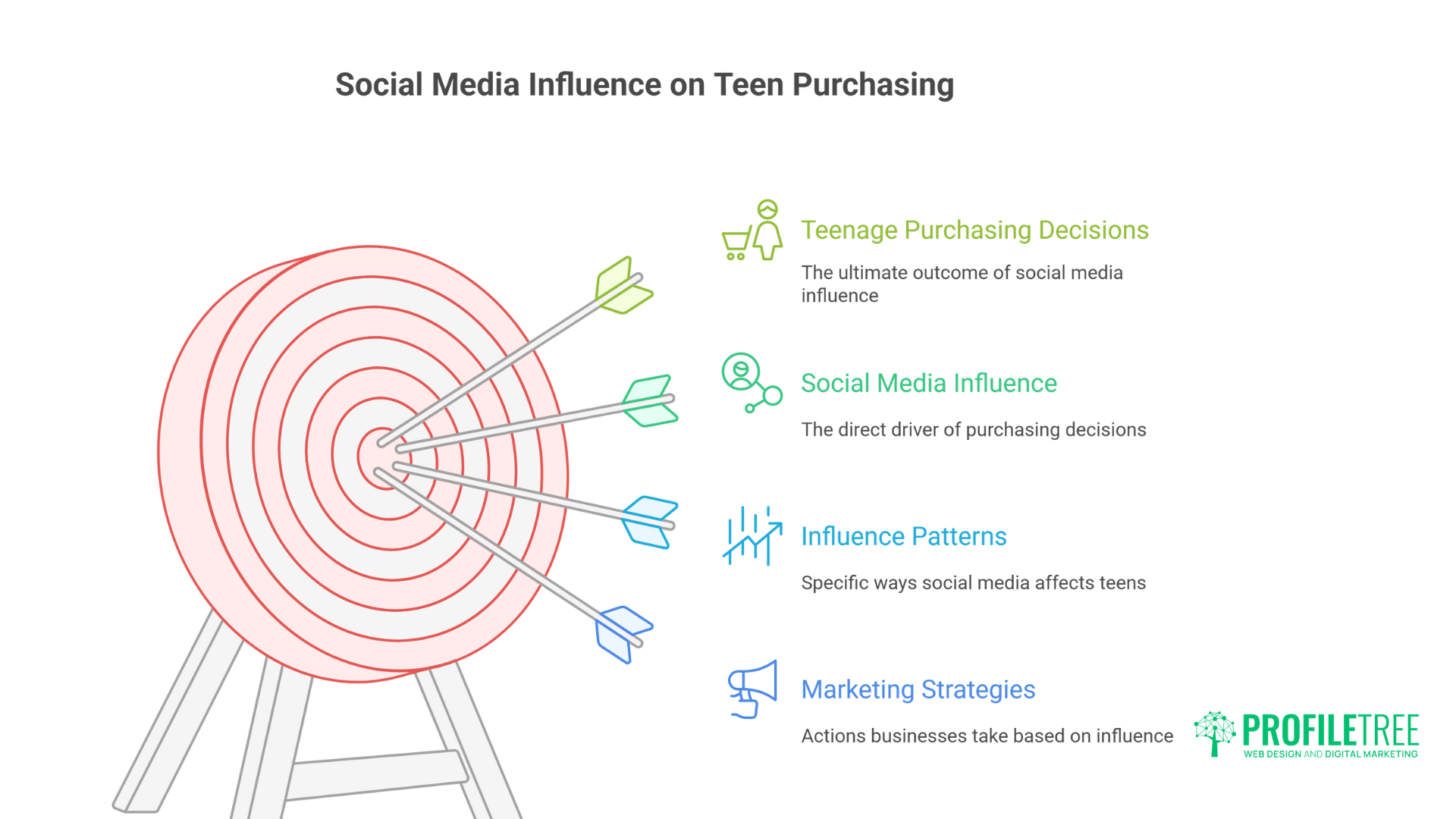
Understanding how social media drives teenage purchasing decisions is crucial for effective marketing strategy development.
Businesses that grasp these influence patterns can create more effective conversion pathways for teenage consumers.
The Rise of Social Commerce
Social commerce has transformed how teenagers discover and purchase products. Approximately 67% of UK teens have purchased products directly through social media platforms in the past year—a 23% increase from previous years.
Instagram and TikTok lead this trend, with their integrated shopping features streamlining the path from discovery to purchase. The ability to see products in use by peers or influencers creates powerful social proof that traditional advertising struggles to match.
Influencer Impact on Teen Purchasing
Influencer marketing continues to show remarkable effectiveness with teenage audiences. Studies indicate that 76% of UK teenagers have purchased products recommended by social media influencers, with micro-influencers (10,000-100,000 followers) often generating higher engagement rates than celebrity accounts.
The most effective influencer partnerships feature authentic integration of products into content that aligns with the influencer’s established style and values. Teenagers demonstrate increasing sophistication in identifying disingenuous endorsements, with 65% reporting they can easily spot “forced” partnerships.
User-Generated Content and Teen Trust
User-generated content significantly impacts teenage purchasing decisions. UK teenagers are 2.4 times more likely to trust brands that showcase real customers using their products. This trend highlights the importance of creating opportunities for authentic customer content creation and curation.
Brands that successfully encourage teenagers to create and share content related to their products benefit from both increased trust and organic reach within teen networks.
Teenage Use of Social Media Statistics: Role in Teen Identity Formation
Social media platforms serve as important spaces where teenagers develop and express their identities.
Understanding this aspect of teen social media use helps businesses create more resonant and respectful marketing approaches.
Digital Self-Expression
For teenagers, social media serves as a critical platform for identity formation and self-expression. Research shows that 83% of UK teens consider their social media presence an important aspect of their identity.
This self-expression takes various forms—from carefully curated Instagram feeds to spontaneous TikTok videos. Businesses that understand and respect this aspect of teen social media use can create marketing that resonates on a deeper level with young audiences.
Community Belonging and Niche Interests
Social media enables teenagers to find communities based on specific interests, regardless of geographic limitations. These digital communities provide spaces for teens to explore identities and interests that might not be supported in their immediate physical environment.
For businesses, these interest-based communities offer opportunities to connect with highly engaged teenage audiences. Brands that authentically participate in these spaces—by providing value rather than simply promoting products—can build meaningful connections with teenage consumers.
Privacy Concerns and Platform Safety
Safety and privacy considerations are increasingly important aspects of teenage social media engagement.
Businesses must navigate these concerns thoughtfully to build trust with both teens and their parents.
Growing Privacy Awareness
Today’s teenagers show increasing sophistication regarding data privacy. Recent surveys indicate that 68% of UK teens have adjusted their social media privacy settings, and 54% report being concerned about how their data is used by platforms.
This growing privacy consciousness impacts how teenagers interact with brands online. Transparent data practices and clear communication about how information will be used have become essential for building trust with younger audiences.
Online Safety and Well-being
Platform safety remains a significant concern for teenagers and their parents. Approximately 47% of UK teens report having negative experiences online, including exposure to inappropriate content, harassment, or privacy breaches.
Brands that explicitly prioritise safety in their social media presence can build trust with both teenagers and their parents. This includes moderating user-generated content, providing clear community guidelines, and ensuring all marketing materials promote positive interactions.
Regional Variations in UK Teen Social Media Use
Social media usage isn’t uniform across the UK, with notable differences based on geography and socioeconomic factors.
These variations require businesses to consider regional nuances when developing teenage-focused marketing strategies.
Urban vs. Rural Differences
Social media usage patterns show notable variations between urban and rural UK teenagers. Urban teens typically access platforms more frequently (averaging 5.2 hours daily compared to 3.7 hours for rural teens) and adopt new platforms more quickly.
Rural teenagers, however, often show stronger engagement with local community content and businesses on social media, presenting unique opportunities for regionally focused marketing initiatives.
Socioeconomic Factors
Socioeconomic backgrounds influence both access to and engagement with social media. While smartphone penetration among UK teenagers exceeds 95% across socioeconomic groups, premium content consumption, e-commerce activity, and engagement with paid features vary significantly.
Businesses should consider these variations when developing youth marketing strategies, ensuring their approaches remain accessible and relevant across diverse teenage audiences.
Actionable Insights for UK Businesses
Translating statistical insights into effective marketing strategies requires practical application approaches.
These platform-specific and general best practices help businesses implement youth-focused social media marketing effectively.
Platform-Specific Strategies
TikTok:
- Focus on trend participation rather than direct selling
- Create authentic, entertaining content that fits naturally into teens’ feeds
- Collaborate with creators who already understand the platform’s unique language
- Utilise trending sounds and formats that resonate with teenage users
Instagram:
- Combine polished brand content with more authentic behind-the-scenes material
- Leverage Stories for time-sensitive promotions and daily engagement
- Utilise shopping tags to reduce friction in the purchasing journey
- Create shareable content that teens will want to pass along to friends
YouTube:
- Develop both short-form and long-form content to serve different engagement preferences
- Focus on educational content that provides genuine value
- Optimise for both mobile viewing and search discoverability
- Consider series-based content to build ongoing engagement
Content Development Best Practices
Authenticity Over Production Value: UK teenagers consistently favour authentic content over highly polished production. Content that feels genuine and relatable generates approximately 2.7 times more engagement than content that appears too professional or corporate.
Interactive Elements: Content that invites participation—through questions, challenges, or customisation options—generates 3.1 times more engagement from teenage audiences than passive content. Brands should incorporate interactive elements that encourage teens to engage rather than simply consume.
Values-Based Messaging: Approximately 72% of UK teenagers report feeling more connected to brands that demonstrate an authentic commitment to social causes. However, this messaging must be backed by genuine action—76% of teens say they’ve stopped supporting brands they perceive as engaging in “values washing.”
Timing and Frequency Considerations
Optimal posting times for reaching UK teenagers vary by platform:
- TikTok: Peak engagement occurs between 7-9 PM on weekdays and 3-6 PM on weekends
- Instagram: Highest activity between 3-5 PM after school and 8-10 PM in the evening
- YouTube: Weekend viewership peaks between 1 and 4 PM, while weekday evening viewing rises after 7 PM
Regarding frequency, consistency trumps volume. Regular, predictable posting schedules perform better than sporadic high-volume posting. For most platforms, 3-5 quality posts weekly outperform daily content of lower quality.
Future Trends in Teen Social Media Usage
Anticipating upcoming shifts in teenage social media behaviour helps businesses stay ahead of the curve.
Forward-thinking brands can prepare for emerging platforms and evolving preferences to maintain relevance with young audiences.
Emerging Platforms and Features
Several emerging platforms are gaining traction among early-adopter UK teenagers:
- BeReal, with its emphasis on authenticity and unfiltered sharing
- Discord, moving beyond gaming to become a general social hub
- Newer AR-based social platforms that blend physical and digital experiences
Businesses should monitor these platforms without necessarily investing heavily until they demonstrate sustained popularity and alignment with marketing objectives.
Evolving Content Preferences
Current trends suggest continued dominance of video content, with particular growth in:
- Interactive video formats that allow viewer participation
- Episodic short-form content that builds narratives across multiple posts
- Hyper-personalised content delivered based on increasingly sophisticated algorithms
Brands that experiment with these formats now will be better positioned as they become mainstream expectations.
Privacy and Data Considerations
As data protection regulations continue to evolve and platform policies change in response, businesses must develop youth marketing strategies that can thrive in a more privacy-conscious environment. This includes:
- Building first-party data relationships through value exchanges
- Creating contextual targeting approaches that don’t rely on detailed personal data
- Developing content that performs well organically without requiring heavy targeting
How ProfileTree Can Help Your Business Connect with Teen Audiences
ProfileTree offers specialised expertise in youth-focused social media marketing and content development.
Our comprehensive approach ensures businesses can effectively reach teenage audiences while maintaining brand integrity.
Social Media Strategy Development
Our team creates comprehensive social media plans tailored to your specific business objectives and target teenage demographics. These strategies incorporate:
- Platform selection based on your specific youth audience segments
- Content calendars aligned with teen interests and platform-specific behaviours
- Performance metrics focused on meaningful engagement rather than vanity metrics
- Competitive analysis to identify gaps and opportunities in your market
Content Creation for Youth Audiences
ProfileTree’s content team understands the unique language and cultural references that resonate with UK teenagers. Our youth-focused content services include:
- Platform-optimised video production for TikTok, Instagram Reels, and YouTube
- Graphic design that balances brand guidelines with youth appeal
- Copywriting that speaks authentically to teenage audiences without trying too hard
- User-generated content campaigns that encourage teen participation
Influencer Partnership Management
We help businesses identify and collaborate with the right influencers for teenage market penetration:
- Micro-influencer identification in specific interest niches
- Partnership negotiation and campaign development
- Content approval workflows that balance brand control with authentic creator voice
- Performance tracking and ROI measurement
Analytics and Adaptation
Our data-driven approach ensures your youth marketing efforts continuously improve:
- Regular performance analysis against specific business objectives
- Sentiment tracking to monitor teen perception of your brand
- Trend monitoring to identify emerging opportunities
- Strategy refinement based on real-world engagement data
Conclusion
The social media landscape for UK teenagers continues to evolve rapidly, presenting both challenges and opportunities for businesses. Understanding the platforms, content preferences, and usage patterns of teenage audiences is essential for developing effective youth marketing strategies.
The statistics and insights outlined in this article provide a foundation for businesses looking to connect with teenage audiences. However, the most successful approaches will combine this knowledge with authentic brand values and a genuine understanding of what teenage consumers find valuable.
By focusing on creating meaningful connections rather than simply chasing platforms or trends, businesses can develop sustainable relationships with teenage audiences that deliver long-term value for both the brand and its young customers.
Call to Action
Ready to develop a teen-focused social media strategy that drives real business results? ProfileTree’s team of social media specialists can help your brand connect authentically with teenage audiences across the platforms that matter most.
Contact us today to schedule a consultation and discover how our data-driven approach to youth marketing can help your business thrive in this competitive landscape.