
Snapchat Marketing for UK Small Businesses: Strategy, Costs and Results
Table of Contents
Snapchat has roughly 21 million users in the UK, and the majority are between 18 and 34. For a small business trying to reach that age group on a budget that doesn’t stretch to Meta’s increasingly expensive ad auctions, that’s a significant opportunity. The platform is still widely underused by UK SMEs, which means less competition and lower costs per impression than you’d find on Instagram or TikTok right now.
ProfileTree, a Belfast-based web design and digital marketing agency, works with small and medium-sized businesses across Northern Ireland, Ireland, and the UK. What we see consistently is that businesses dismiss Snapchat too quickly, often because they’re comparing it to how they use Facebook or Instagram. Snapchat rewards a different approach: shorter, more spontaneous content, strong local targeting, and a clear funnel behind whatever you post.
This guide covers the practical side of Snapchat marketing for UK businesses: what it costs in GBP, which formats work for SMEs with limited budgets, how to use Snap Map for local footfall, and what a realistic content strategy looks like without a production studio.
Is Snapchat Still Worth It for UK SMEs?
The short answer is yes, but only for certain business types and with the right expectations.
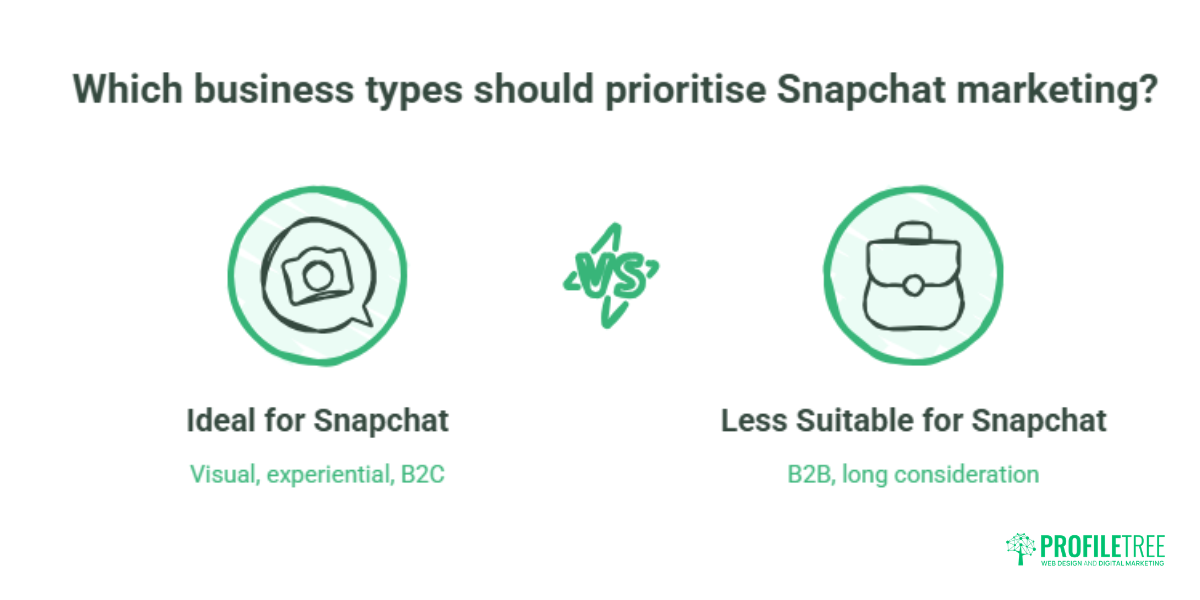
Snapchat’s daily active users in the UK have grown steadily, and the platform has invested heavily in tools for smaller advertisers: a simplified Instant Create tool, postcode-level targeting, and a minimum spend threshold that’s accessible for most budgets. If your customers include anyone in the 18–34 age bracket, and your product or service has a visual or experiential dimension, Snapchat deserves a place in your social media marketing strategy.
Where it tends to underperform for UK SMEs is in B2B lead generation and long consideration purchases. A solicitor or accountancy firm is unlikely to find Snapchat to be their primary acquisition channel. But a salon, a café, a clothing boutique, a fitness studio, a food and drink brand, or a retailer with a physical presence in a town centre? The platform’s local targeting and informal content culture can work very well.
The strongest case for Snapchat right now is the attention-to-cost ratio. CPM (cost per thousand impressions) for UK Snapchat ads typically runs lower than comparable Instagram placements, and there’s far less advertiser saturation in most regional UK markets outside London. That won’t last indefinitely as more brands catch on, so the window of relative cost efficiency is worth taking seriously.
How UK Businesses Use Snapchat: Core Formats
Stories
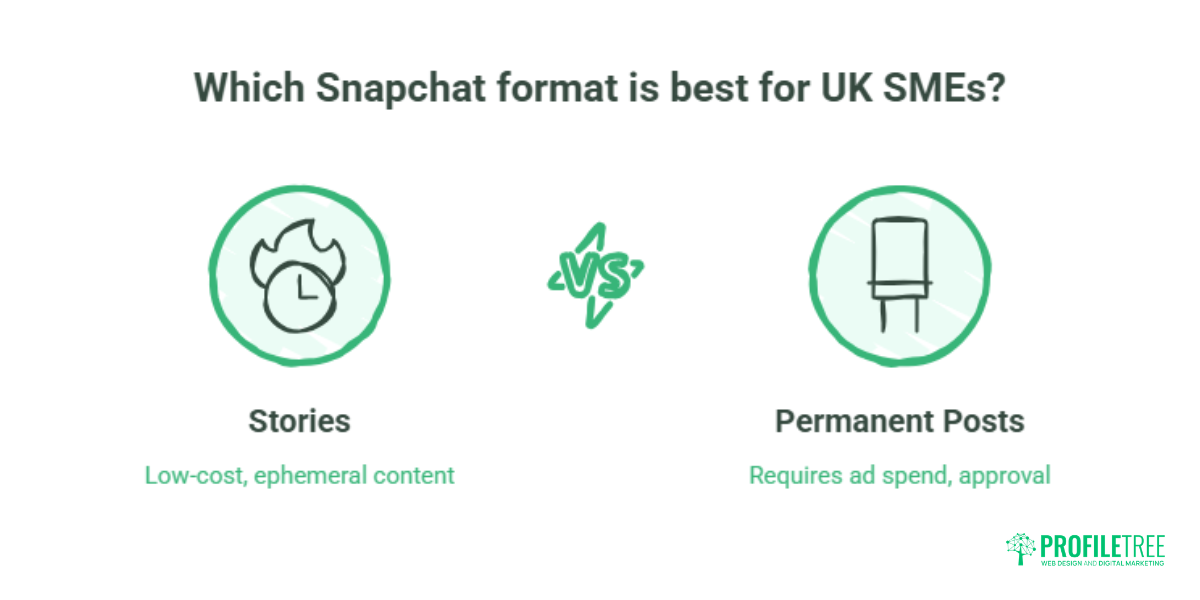
Stories are 24-hour sequences of photos and videos visible to anyone who follows your account. For UK SMEs, this is the lowest-cost entry point: no ad spend required, no approval process, just consistent posting. The content that performs well here is behind-the-scenes footage, product arrivals, team moments, and time-sensitive offers. The ephemeral format creates genuine urgency in a way that a permanent Instagram post doesn’t.
A retail business launching a weekend sale, a restaurant promoting a Thursday night special, a gym running a two-week challenge: all of these suit the Stories format because the temporary nature matches the temporary nature of the offer.
Snap Map and Promoted Places
Snap Map is one of the most underused tools in the platform for UK local businesses. Users can see which businesses are active near their current location. Promoted Places allows businesses to appear in that map view as a sponsored listing, with photos, opening hours, and a link through to a website or booking page.
For any business that depends on local footfall, including independent retailers, hospitality venues, and service businesses in town centres, this is the most direct local targeting Snapchat offers. It functions similarly to a Google Maps listing in terms of discovery, but reaches users who aren’t actively searching; they’re just browsing what’s around them.
Geofilters
Geofilters are custom graphic overlays that Snapchat users can apply to their photos and videos when they’re in a specific location. A business can create a branded Geofilter for their store, event, or neighbourhood, and users who apply it then share that branded content with their own followers.
The cost varies by geographic radius and duration. A small area filter for a weekend event can cost as little as £5–£15. Custom Geofilter design requires someone who understands Snapchat’s creative specifications (the files need to be transparent PNG files within specific dimension constraints), which is where professional creative support makes a tangible difference to the final output.
Snap Ads
Snap Ads are full-screen vertical video ads (9:16 format, 1080×1920 pixels) that appear between Stories or in the Discover section. For Stories placements, the video must be under 15 seconds; for Discover, up to 60 seconds. These are the paid formats most comparable to what you’d run on Instagram or TikTok.
The production requirement is real. Landscape video repurposed to vertical looks poor and performs worse. If you’re considering Snap Ads as a regular channel, the video content needs to be produced natively in vertical format from the start. ProfileTree’s video production and video marketing services exist specifically to help businesses avoid wasting ad spend on creative that isn’t built for the platform it’s running on.
Sponsored Lenses
Sponsored Lenses (augmented reality overlays that users apply to selfies or their surroundings) are the most expensive Snapchat ad format and are generally out of reach for most SMEs without significant budgets. Large-scale branded Lenses can cost tens of thousands of pounds for a national campaign. Smaller regional lens campaigns are available at lower minimums, but unless you have a specific campaign reason, this format is better filed under “aspirational future” for most UK small businesses.
Snapchat Ad Costs in the UK: What to Expect in GBP
This is where most UK-focused guides fall short. Here’s a realistic picture of what Snapchat advertising costs for small businesses operating in the UK market.
| Format | Minimum Daily Spend | Typical UK CPM (£) | Best For |
|---|---|---|---|
| Story Ads (Snap Ads) | £5 | £8–£18 | Awareness, product launches |
| Collection Ads | £5 | £10–£20 | E-commerce, product discovery |
| Promoted Places | Varies | Location-based | Local footfall, physical stores |
| Geofilters | ~£5 (small radius) | N/A (flat rate) | Events, store-level brand |
| Sponsored Lenses | £10,000+ | N/A | Large-scale brand campaigns |
The £5 minimum daily spend is technically correct, but practically limiting. At £5 a day in a UK regional market, you’ll generate impressions but not enough data to optimise your targeting or creative within a reasonable timeframe. A budget of £10–20 per day gives the algorithm enough room to learn, and running a campaign for a minimum of two weeks before drawing conclusions is a sensible baseline.
London CPMs run higher than most other UK regions due to advertiser density. For businesses in Northern Ireland, the Midlands, or the North of England, Snapchat’s cost efficiency is considerably better than equivalent placements in the capital.
A note on UK GDPR and the Snap Pixel: If you’re using Snapchat’s conversion tracking pixel on your website to retarget users or measure sales, you need to ensure your cookie consent framework covers this explicitly. Under UK GDPR, placing a pixel that tracks user behaviour requires active consent before the pixel fires. This is an area most guides skip over, but getting it wrong creates legal exposure. Your privacy policy and cookie consent banner need to be updated to reflect any Snap Pixel usage.
For help getting your website’s tracking setup right, ProfileTree’s website development team can review your consent implementation and make sure it’s compliant before any paid campaign goes live.
Building a Snapchat Content Strategy on a Limited Budget
The content question is usually where UK SMEs get stuck. They’ve seen the polished Snapchat campaigns from Nike or Pepsi and assumed that level of production is the baseline. It isn’t.
Snapchat users have a strong preference for content that feels unpolished and immediate. A 12-second vertical video filmed on a modern smartphone, with natural lighting and genuine personality, will typically outperform a corporate-looking produced video on this platform. That’s genuinely good news for small businesses that can’t justify a full production budget for every post.
What works for organic Snapchat content:
Behind-the-scenes footage of daily operations, new stock arriving, or work in progress is consistently one of the highest-engagement content types. It’s easy to produce and builds authenticity. A florist showing how a large wedding order comes together, a coffee roaster showing the morning batch, a boutique receiving a new delivery: all of these require nothing more than a phone.
Product previews work well when they create a genuine sense of exclusivity. A 24-hour Story showing a product before it’s listed on the website, or a limited-time discount code shared only via Snapchat, gives people a real reason to follow rather than just occasionally stumble across your account.
Live event coverage, including market days, pop-ups, seasonal events, and store openings, translates naturally to Snapchat’s format. It’s the kind of content that shows your business as part of a community, which resonates particularly well with UK audiences who have a strong local identity.
Integrating Snapchat with your wider strategy:
Snapchat works best when it’s one channel in a joined-up digital marketing strategy, not an isolated effort. Users who discover your business on Snap Map or see a Story need somewhere to go: a website that loads quickly on mobile, a clear way to contact you or make a purchase, and a reason to follow through.
If your website isn’t set up to convert mobile traffic, Snapchat spend is partly wasted. That’s the practical link between Snapchat marketing and a well-built website designed for mobile users: the two need to work together. ProfileTree builds sites with this in mind, ensuring that traffic from social channels lands on pages that actually convert.
For the content creation side, a documented content marketing strategy helps you plan Snapchat content alongside your other channels, so you’re not producing it in isolation, and you’re repurposing assets efficiently across platforms.
“Many UK businesses still view Snapchat as just a platform for teenagers, but they’re missing a real opportunity. The 18–34 demographic on Snapchat has serious purchasing power and responds well to authentic brand storytelling. When we help clients move away from polished corporate content and embrace the platform’s spontaneous culture, we consistently see engagement rates that outperform traditional social channels,” says Ciaran Connolly, founder of ProfileTree.
Using Snap Map to Drive Local Footfall
If your business serves customers in a specific location, Snap Map is worth understanding in detail.
When a user opens their Snap Map, they see a heat map of Snapchat activity around them and, where businesses have set up Promoted Places listings, they can tap on a business to see its profile, photos, opening hours, and a link to its website or booking page. It’s a form of social discovery rather than search-based discovery, which means it reaches people who aren’t actively looking for what you offer but happen to be nearby.
To get the most from Snap Map:
Set up your business listing through Snapchat for Business and ensure your profile information is complete, including accurate opening hours and a link to your website. Keep your Story active; businesses with recent Story activity appear more prominently on the Map than dormant accounts. Post content that’s genuinely local, referencing nearby landmarks, local events, or neighbourhood specifics, because this increases relevance to people browsing the Map in your area.
For businesses with multiple locations, each location can be registered separately, which is useful for chains or franchises wanting to drive footfall to specific sites rather than just the brand overall.
The Snap Map strategy connects directly to local SEO more broadly. Being visible on Snapchat’s Map is one signal in a wider picture that includes Google Business Profile, local citations, and on-page local SEO. ProfileTree’s SEO services cover this full picture, so local businesses aren’t optimising each platform in isolation.
Growing Your Snapchat Audience as a UK Business
Unlike most social platforms, Snapchat doesn’t have a discovery algorithm that pushes content to non-followers in the same way that Instagram Reels or TikTok’s For You page does. Building an audience requires more deliberate effort.
The most reliable approach for UK SMEs is cross-promotion. Share your Snapchat username and QR code (your “Snapcode”) on your other social profiles, in your email newsletter, on in-store signage, on packaging, and on your website. Anyone who follows you on Instagram or Facebook and sees your Snapchat Snapcode can follow you with a single camera scan rather than searching manually.
Influencer partnerships remain effective on Snapchat, particularly for regional UK audiences. A local lifestyle creator or food blogger with a few thousand engaged followers in your city can introduce your business to exactly the right people. The informal nature of Snapchat content means these partnerships often feel more genuine than equivalent Instagram sponsored posts.
For building organic reach over time, consistency matters more than frequency. Three Stories a week that are actually interesting outperform daily posts that become background noise. A simple digital strategy that plans your Snapchat content alongside your other channels prevents the common pattern of posting heavily for a month and then going quiet.
Measuring Snapchat Marketing Performance
Snapchat’s native analytics are available through the Business Manager account and cover the core metrics you need to assess both organic and paid performance.
For organic content (Stories):
Story completion rate tells you what proportion of viewers watched your Story to the end. A high completion rate on a multi-snap Story is a strong signal that the content is relevant. Screenshot rate is worth watching for offer-based content: if people are screenshotting your promotional posts, they’re saving the information to act on it.
For paid campaigns:
Swipe-up rate (now referred to as the attachment link click rate in updated Snapchat reporting) shows how many people took the next step after seeing your ad. Cost per swipe-up varies significantly by audience, creative quality, and objective, but tracking it consistently lets you identify which creative formats and audience segments are most efficient.
Website traffic from Snapchat is visible in Google Analytics 4 by filtering the source as “snapchat” within the social channel grouping. Connecting your GA4 data to your Snapchat ad campaigns via UTM parameters gives you a complete picture of what happens after someone leaves Snapchat and arrives on your site.
Return on ad spend (ROAS) is the ultimate measure for e-commerce businesses, and the Snap Pixel (subject to the GDPR considerations noted earlier) enables conversion tracking back to specific campaigns and ad sets.
ProfileTree’s digital training programme covers analytics setup across social channels, including how to configure UTM tracking, interpret GA4 social reports, and connect your ad platform data to your overall performance picture.
Should You Work with a Snapchat Marketing Agency?
For businesses new to paid social advertising, or those who’ve tried Snapchat and found it difficult to see results, working with an agency that understands both the platform and the UK market makes a practical difference.
The gap that most UK SMEs experience isn’t access to the platform; it’s the combination of strategy, creative production, and campaign management running together. A Snapchat campaign that has a clear brief, well-produced vertical video, correctly configured audience targeting, and a landing page designed to convert mobile traffic will outperform one that’s missing any one of those elements.
ProfileTree’s digital marketing services cover the full picture: channel strategy, content production, campaign setup and management, and performance reporting. For businesses that want to build internal capability rather than outsource everything, our digital training gives your team the skills to manage Snapchat and other channels independently over time.
Snapchat vs Other Platforms: Where Does It Fit?
The honest answer is that Snapchat isn’t a replacement for your other social channels; it serves a different function in the mix.
| Platform | Primary Strength | UK SME Use Case | Typical UK CPM (£) |
|---|---|---|---|
| Snapchat | Local discovery, 18–34 reach | Footfall, brand personality, product previews | £8–£18 |
| Visual brand, e-commerce | Product sales, brand building | £15–£25 | |
| TikTok | Organic reach, entertainment | Viral content, younger audiences | £8–£15 |
| Facebook/Meta | Targeting depth, lead gen | B2C sales, older demographics | £5–£12 |
Snapchat’s distinct value for UK local businesses is the combination of Snap Map discovery (which no other platform replicates), the lower competitive density in regional UK markets, and the 18–34 demographic that’s become harder to reach on Facebook.
For service businesses where relationship and trust matter, Snapchat’s behind-the-scenes content format also builds brand personality in a way that’s harder to fake. Showing your team, your process, and your work in an unedited format builds more credibility with this age group than any amount of polished advertising.
Your Snapchat Marketing Video Guide
The following video from ProfileTree covers the key principles of social media video marketing for small businesses, including how to create content that works natively on mobile-first platforms:
For businesses considering the creative production side of social media marketing, this overview of video marketing strategy for UK businesses is worth watching first:
If you’re thinking about how Snapchat fits within a wider digital marketing strategy, this session covers the planning process for SMEs:
For businesses at the stage of reviewing their overall digital presence before committing to any new channel, this overview of digital marketing training explains how ProfileTree approaches capability building:
And for context on the broader digital landscape for UK businesses, this episode from The ProfileTree Podcast covers the strategic picture:
Getting Started: A Practical 30-Day Roadmap
If you’re setting up Snapchat marketing from scratch, this sequence gives you a structured starting point without overwhelming your team:
Week one: Set up a Snapchat Business Manager account, create your business profile, link it to your website, and post three Stories covering your space, your product or service, and your team. Check your existing cookie consent setup to confirm you can deploy the Snap Pixel legally.
Week two: Set up Snap Map with your business location and accurate hours. Design a simple Geofilter for your store or premises. Post three more Stories and cross-promote your Snapchat Snapcode on your other social channels and email list.
Week three: Set up your first small paid campaign (£10–15 per day) using the Instant Create tool. Target a 5–10 mile radius around your business location, age 18–34, running for seven days. Use a simple Story Ad with one clear call to action.
Week four: Review the campaign data. Check story completion rates, swipe-up rate, and website traffic in GA4. Identify which creative format drove the most engagement and plan the next content cycle based on what worked rather than what felt good to produce.
ProfileTree’s AI-enhanced marketing services can also help automate parts of this reporting cycle, so you’re spending less time pulling numbers and more time acting on them.
FAQs
Is Snapchat marketing worth it for small businesses in the UK?
It depends on your audience and business type. If your customers include the 18–34 age group and your product or service has a visual or local dimension, Snapchat offers genuine cost efficiency and lower competition than Meta platforms in most UK regional markets. It’s less suited to B2B services or products with long consideration cycles.
How much does Snapchat advertising cost in the UK?
The minimum daily budget is £5, but £10–20 per day is more realistic for collecting enough data to optimise. CPM for UK Story Ads typically runs between £8 and £18, depending on audience, timing, and creative quality. Geofilters for small geographic areas can cost as little as £5–15 for a weekend event.
How do I target local customers on Snapchat?
Snap Map and Promoted Places allow you to appear as a listed business when users are nearby. For paid ads, Snapchat’s Ads Manager supports radius targeting around a specific UK postcode, so you can limit your spend to users within a defined area around your business.
What type of content performs best on Snapchat for UK businesses?
Authentic, unpolished video content performs consistently well: behind-the-scenes footage, product previews, team moments, and time-sensitive offers. Video outperforms static images, and vertical format is essential. Content that references local UK context, such as a local event, a neighbourhood landmark, or a regional seasonal event, tends to resonate more than generic brand content.
Do I need a large budget to see results from Snapchat marketing?
No. The organic tools (Stories, Snap Map) cost nothing beyond the time to create content. For paid campaigns, meaningful results are achievable from £70–140 per week, particularly in UK regional markets outside London where advertiser competition is lower. A realistic expectation is that it takes two to four weeks of paid activity before you have enough data to draw useful conclusions.
What is the difference between a Snap Ad and a Story Ad?
Snap Ads is the broader category covering all paid ad formats on the platform. Story Ads specifically appear within the Stories feed as a tile that users can tap to view a sequence of up to 20 Snaps. Single Snap Ads appear as interstitials between users’ own Stories. For most UK SMEs starting out, single Snap Ads through the Instant Create tool are the simplest entry point.
How does Snapchat differ from TikTok for UK SMEs?
Snapchat’s user behaviour is more private and social, focused on communicating with close connections and discovering local businesses. TikTok is built around public entertainment content pushed algorithmically to strangers. For local footfall and community-based marketing, Snapchat’s Snap Map and Geofilter tools have no equivalent on TikTok. For businesses trying to achieve viral organic reach, TikTok’s algorithm offers more opportunities. Most UK businesses that use both platforms use them for different content types and objectives.
Can Snapchat work for B2B businesses?
Rarely as a primary acquisition channel, but there are specific use cases. B2B companies use Snapchat for employer branding and recruitment, particularly to reach younger candidates. Some professional services businesses use it to humanise their team and culture in a way that reinforces trust with prospective clients who research them before making contact. It’s unlikely to replace LinkedIn or search for B2B lead generation.