
AI in the Workforce: A Practical Guide for UK and Ireland SMEs
Table of Contents
Most small business owners in the UK and Ireland understand that AI in the workforce is no longer a distant possibility. It is already reshaping how marketing gets done, how customer queries are handled, and how teams manage routine administrative work. Most owners have already decided to act. The harder question is where to start, and how to do it without unsettling their people.
This guide cuts through the theory. It covers where AI creates genuine opportunity for smaller businesses, how to address the skills and culture challenges that come with any change, and what a practical implementation plan looks like for teams without a dedicated IT department.
The Reality of AI in the Workforce Today
For most SMEs, AI in the workforce means automating repetitive tasks so that existing staff spend more time on work that needs judgement, creativity, and client relationships.
How you frame this matters, because resistance to AI adoption is almost always rooted in job security concerns. When business owners and managers frame AI as a productivity tool rather than a headcount-reduction exercise, the conversation with staff changes.
Which Tasks AI Takes On First
The roles most affected by AI in the near term are those built around repeatable, rule-based tasks: data entry, scheduling, first-line customer queries, and basic content production. Roles built around relationships, problem-solving, and contextual judgement are far less exposed.
For a typical SME in Northern Ireland or the Republic, this means AI can take on the admin load without touching the skilled work. A marketing coordinator who spends six hours a week on first drafts and social scheduling can redirect that time to campaign strategy and client communication, both areas where human input produces better outcomes.
Where UK and Ireland SMEs Currently Stand
AI adoption among UK SMEs remains lower than among larger businesses, with cost and skills the most commonly cited barriers to getting started. The gap represents an opportunity: SMEs that move early, even with modest implementations, build competitive advantages that are difficult for slower-moving competitors to close.
Identifying AI Opportunities in Your Business Operations
The most practical starting point is auditing your current workflows to identify which tasks are genuinely suitable for automation. Not every process is a good fit. The best candidates share a few characteristics: they are repetitive, they follow consistent rules, they do not call for fine-grained human judgement each time, and the cost of an occasional error is acceptable.
Customer Service and Communication
AI-powered chat tools and automated response systems now handle a broad range of customer queries without human intervention. For SMEs with a high volume of inbound enquiries, this reduces response times and frees up customer-facing staff for complex conversations.
The key is setting boundaries. AI handles FAQs, booking confirmations, and standard product queries well. It handles complaints, bespoke quotes, and relationship-sensitive conversations poorly. Knowing where to draw that line is the first decision any business owner needs to make.
Marketing and Content Workflows
AI tools for content drafting, image generation, and social scheduling are widely available at low cost. For SMEs without a full marketing team, these tools add real capacity. A business owner who previously outsourced every piece of written content can now produce first drafts internally. Turnaround shortens and agency spend drops.
That said, AI-generated content requires editorial oversight. Tools like ChatGPT and Claude produce plausible text, not accurate text. A human with subject-matter knowledge still needs to review the output before publication, particularly for anything client-facing or compliance-sensitive. The tools extend capacity. They do not remove the need for human judgement. ProfileTree’s guide to AI implementation for SMEs covers this distinction in practical detail.
Administrative and Back-Office Automation
Document management, invoice processing, meeting transcription, and data formatting are among the easiest candidates for AI automation. Tools in this space require little technical setup and produce immediate time savings.
The return here is often underestimated. A business spending four hours a week on data entry that can be automated in a single afternoon setup has freed up roughly 200 hours a year for higher-value work.
| Business Function | Suitable for AI | Human Oversight Required |
|---|---|---|
| Social media scheduling | Yes | Light (review before publish) |
| First-draft content creation | Yes | Significant (accuracy check) |
| Customer FAQ responses | Yes | Moderate (escalation logic) |
| Complex client proposals | No | Full |
| Data entry and formatting | Yes | Minimal |
| Strategic decision-making | No | Full |
Closing the Skills Gap: Building AI Literacy in Your Team
The skills gap around AI in the workforce is real, but it is often narrower than business owners expect. Most team members do not need to understand how large language models work. They need to know how to use specific tools confidently, identify when AI output is unreliable, and integrate new workflows without abandoning what already works.
What AI Literacy Actually Means for SME Staff
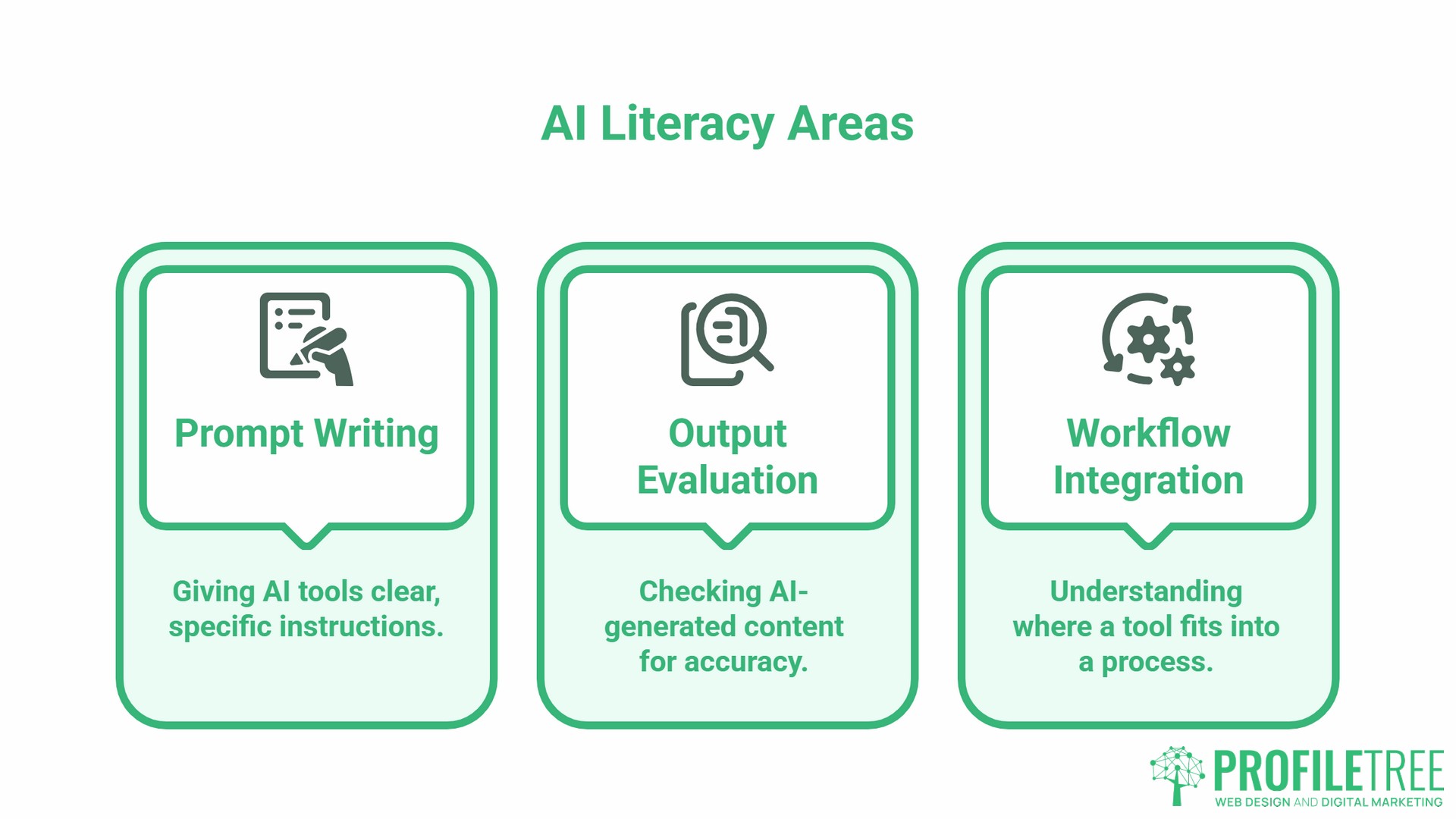
AI literacy at the SME level covers three practical areas. First, prompt writing: the ability to give AI tools clear, specific instructions that produce useful output. Second, output evaluation: the habit of checking AI-generated content for accuracy, tone, and relevance before using it. Third, workflow integration: understanding where a tool fits into an existing process rather than treating it as a standalone solution.
These are learnable skills. Most team members can reach a functional level of competence within a few structured sessions, particularly when training uses real examples from their actual job roles rather than generic scenarios.
Identifying Internal Champions
In most teams, one or two people will pick up AI tools quickly and start finding uses that others have not considered. Identifying these individuals early and giving them space to experiment is one of the most cost-effective things a business owner can do. They become informal trainers, and their enthusiasm reduces resistance across the rest of the team.
As Ciaran Connolly, founder of ProfileTree, notes: “The businesses we see getting the most from AI adoption are not the ones with the biggest budgets. They are the ones who invested early in getting their people comfortable with the tools and trusted them to find the applications that made sense for their specific work.”
ProfileTree’s AI training programmes are designed for teams at this stage: practical, role-specific, and built around the tools businesses are actually using rather than abstract concepts. For teams just beginning, the guide to training staff on AI tools covers how to structure internal upskilling without a large training budget.
A 5-Step Plan for AI Integration
Implementing AI in the workforce does not require a transformation programme. For most SMEs, a phased, low-risk approach produces better outcomes than a single large investment. The following framework is designed for businesses with fewer than 50 staff and no dedicated IT function.
Step 1: Audit Your Current Workflows
Map the tasks your team performs on a weekly basis and categorise them by how much they rely on rules versus judgement. Repetitive, rules-based tasks are your starting point. Anything requiring significant contextual interpretation stays with your people for now.
Step 2: Run a Contained Pilot
Choose one process and one tool. Give one or two team members four weeks to test it in a real work context. Do not deploy widely before you understand the failure modes. The pilot stage is where you learn what the tool does well, where it cuts corners, and what oversight it requires.
Step 3: Train Before You Scale
Once a pilot has shown genuine value, train the wider team before rolling out. Training at this point is much more effective than training before the pilot, because you have real examples, real outputs, and real answers to the questions staff will ask.
Step 4: Integrate into Standard Processes
Build the tool into your documented workflows. This is where most implementations stall: a tool gets used inconsistently because it was never properly embedded in how work actually gets done. Treat the integration step as deliberately as you would any other process change.
Step 5: Review and Adjust
Set a review date three to six months after full deployment. Measure time saved, quality of output, and staff confidence. Adjust your approach based on what you find. AI tools change quickly, and a review cycle keeps your implementation current rather than static.
For businesses that need external support at any stage of this process, ProfileTree’s AI adoption support for SMEs covers the common points where implementations stall and how to get past them.
UK and Ireland Legal and Ethical Considerations
AI in the workforce raises two distinct sets of concerns for UK and Irish businesses: data privacy obligations and transparency with staff and customers. Both are manageable, but neither should be addressed informally.
GDPR and Data Privacy When Using AI Tools
The most common compliance mistake SMEs make when adopting AI is inputting personal data into consumer-grade AI tools without checking whether doing so is permitted under UK GDPR or the Irish Data Protection Acts.
Consumer versions of tools like ChatGPT and Claude may use conversation data for model training by default, depending on settings and account type. Inputting client names, contact details, financial information, or employee records into these tools without appropriate data processing agreements is a compliance risk.
The practical solution is straightforward: use business or enterprise versions of AI tools that clearly define data processing terms, anonymise any real data before using it in AI prompts, and include AI tool usage in your data protection documentation. The UK Information Commissioner’s Office has published guidance on AI and data protection that is worth reviewing before any significant deployment.
The UK Regulatory Context Versus the EU AI Act
UK businesses operate under a different regulatory framework than their counterparts in the Republic of Ireland. The UK government’s approach to AI regulation is explicitly “pro-innovation,” favouring sector-specific guidance over a single overarching AI law. This means UK SMEs currently face less prescriptive AI regulation than businesses operating under the EU AI Act.
For businesses operating across both jurisdictions, the EU AI Act’s requirements are the more demanding baseline. High-risk AI applications, including those used in recruitment or performance monitoring, face specific transparency and human oversight requirements under the Act. Irish businesses adopting AI for HR or workforce management purposes should take legal advice on their specific situation.
Transparency with Your Team
Employees have a reasonable expectation of transparency when AI is used in ways that affect their work or evaluation. Introducing AI monitoring tools, AI-assisted performance assessment, or automated workload allocation without clear communication creates both legal exposure and a cultural problem that is difficult to recover from.
The safer approach is to communicate clearly: what tools are being introduced, what they do, what data they use, and what decisions remain in the hands of human managers. Organisations that handle this well find that transparency reduces resistance to AI in the workforce and makes the adoption process considerably smoother.
Measuring the Return on AI Implementation
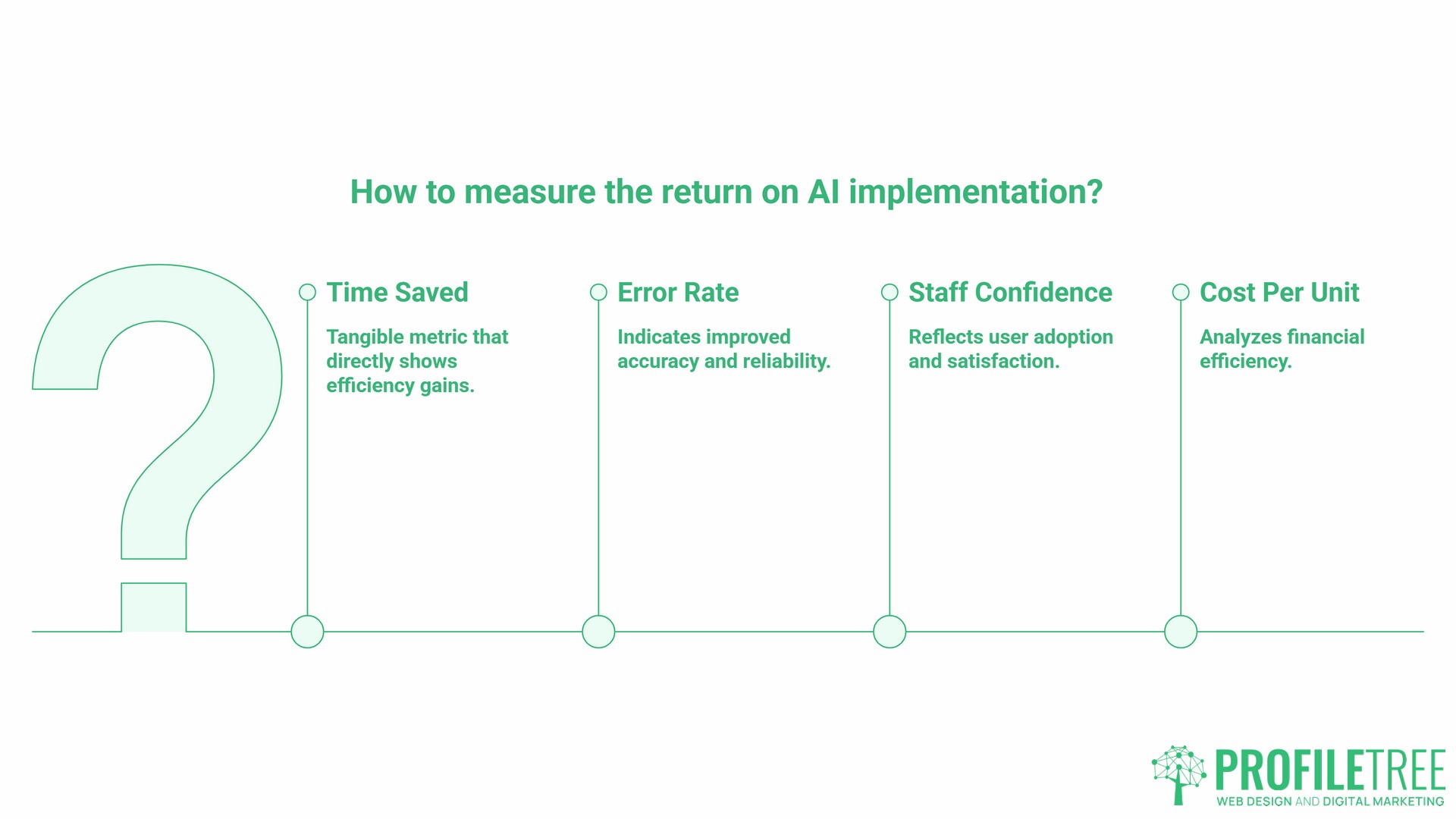
AI is worth tracking like any other business investment. The metrics most relevant to SMEs are time saved per task, error rate compared to the manual process, staff confidence with the tools (measured through simple feedback), and cost per unit of output for tasks the tool handles.
Time saved is the most tangible starting point. If a content tool reduces first-draft production from three hours to 45 minutes, the return is calculable. If a customer query tool handles 60% of inbound questions without human intervention, the capacity released is measurable.
The cost-benefit analysis of AI for SMEs covers the financial framing in detail, including how to account for the training and oversight costs that are often excluded from optimistic projections.
Quality is harder to quantify but matters more in the long run. AI tools that save time at the cost of output quality just move the problem somewhere else. Build quality checks into your review process from the start.
The Role of Your Website in an AI-Ready Business
One aspect that receives less attention than it should is the role of web infrastructure. AI tools that interact with customers, from chat widgets to automated booking systems, depend on a well-structured website to function effectively. A site with slow load times, inconsistent content, or a confusing navigation structure creates friction that AI tools cannot resolve on their own.
For SMEs planning AI-assisted customer communication, a website audit is a sensible first step. ProfileTree’s web development team works with businesses across Northern Ireland, Ireland, and the UK to build sites that support the kind of integrations AI customer service tools require. Getting the infrastructure right before deploying customer-facing AI avoids the more costly problem of retrofitting a poorly structured site later.
AI in the workforce is not a future-state concern for UK and Ireland SMEs. It is a current operational decision. The businesses that approach it methodically, starting with a clear audit, running contained pilots, investing in staff literacy, and building proper data governance, will find that the tools available today create genuine capacity without the disruption that more sweeping change programmes tend to produce. For SMEs that want support moving from awareness to implementation, ProfileTree’s AI resources for business are a practical starting point.
Frequently Asked Questions
How will AI affect the workforce in the UK by 2030?
Government reports and independent research consistently point to a shift rather than a reduction in employment. Roles built around repetitive, rules-based tasks will contract, while demand will grow for roles requiring critical thinking, relationship management, and technical oversight of AI systems. For most SME employees, the practical implication is that the tools they use will change a great deal over the next five years, and those who adapt early will be better placed. The transition is more gradual than media coverage suggests, and most businesses will have time to upskill incrementally rather than requiring immediate wholesale change.
Is AI a threat to small business employees?
Rarely, and less often than headlines suggest. Employees who learn to use AI tools gain a clear advantage over those who do not, and businesses that support that development retain staff more effectively. AI replacing a full role outright at the SME level remains rare; what is more common is AI changing the composition of a role, taking over the repetitive elements and leaving more time for the work that requires human input. Managing this transition well is primarily a communication and training challenge.
What are the GDPR risks of using AI in the workplace?
Three risks account for most SME exposure. First, processing without a lawful basis: staff paste client or employee details into a tool nobody assessed, so there is no consent record or legitimate interest test to fall back on. Second, loss of control: once personal data has trained a model you cannot reliably retrieve or delete it, which makes an erasure request hard to answer. Third, the processor relationship: free tiers rarely carry the contract terms UK GDPR and the Irish Data Protection Acts require, and some route data outside the UK and EEA. Client confidentiality clauses add contractual risk on top.
What is the best way to introduce AI to a team?
Start with transparency: explain what tools are being introduced, what they will be used for, and what will not change. Run a small pilot with willing participants before any wider rollout. Use the pilot to generate real examples that make training concrete rather than abstract. Give staff time to build confidence before measuring output. The businesses that handle this well treat AI adoption as a change management exercise, not a technology deployment.
How much does it cost an SME to implement AI?
Entry-level AI tools are available at low monthly cost or free, including the business tiers of widely used platforms. The more significant investment is time: staff training, process redesign, and the oversight that AI-generated output requires. For most SMEs, a realistic first-year cost that includes tools, training, and some external support sits well within the range of other marketing or technology investments. The cost-benefit analysis guide covers the full range of scenarios in detail.
Does AI in the workforce require new employment contracts or policies?
Existing employment contracts rarely need to be amended for standard AI tool adoption. What most businesses need is an updated acceptable use policy that covers how staff should and should not use AI tools, particularly around data input and client confidentiality. This sits alongside your data protection documentation rather than replacing existing contracts. For AI tools used in performance monitoring or recruitment, the requirements are more specific, and legal advice is worth seeking before deployment.