
Social Media Algorithm Updates: A Resilience Guide for UK SMEs
Table of Contents
Every few months, a social media manager opens their dashboard and finds their reach has dropped overnight. The content hasn’t changed. The posting schedule hasn’t changed. But the numbers tell a different story. Nine times out of ten, the cause is one of the ongoing social media algorithm changes that reshape what platforms choose to show and to whom, usually without warning.
Social media platforms run on algorithms that decide what users see and in what order. These systems are never static. They shift in response to user behaviour, platform revenue goals and, increasingly, regulatory pressure. For businesses in Northern Ireland, Ireland and the UK, understanding social media algorithm changes is no longer a nice-to-have. It’s the difference between a marketing plan that survives the next update and one that has to be rebuilt from nothing.
ProfileTree, a Belfast-based web design and digital marketing agency, works with SMEs across Northern Ireland, Ireland and the UK on exactly this problem. Our starting point is simple: social media is borrowed land. You don’t own the audience, the algorithm does, and it can change the terms at any time.
Businesses that treat every algorithm update as a five-alarm fire tend to burn out. Businesses that build a strategy which doesn’t depend entirely on any one platform’s goodwill come through each shift in noticeably better shape. That’s the shift we’ll walk through here, including where our content marketing services fit into building something more durable than a follower count.
From Social Graph to Interest Graph: Why Your Reach Is Dropping
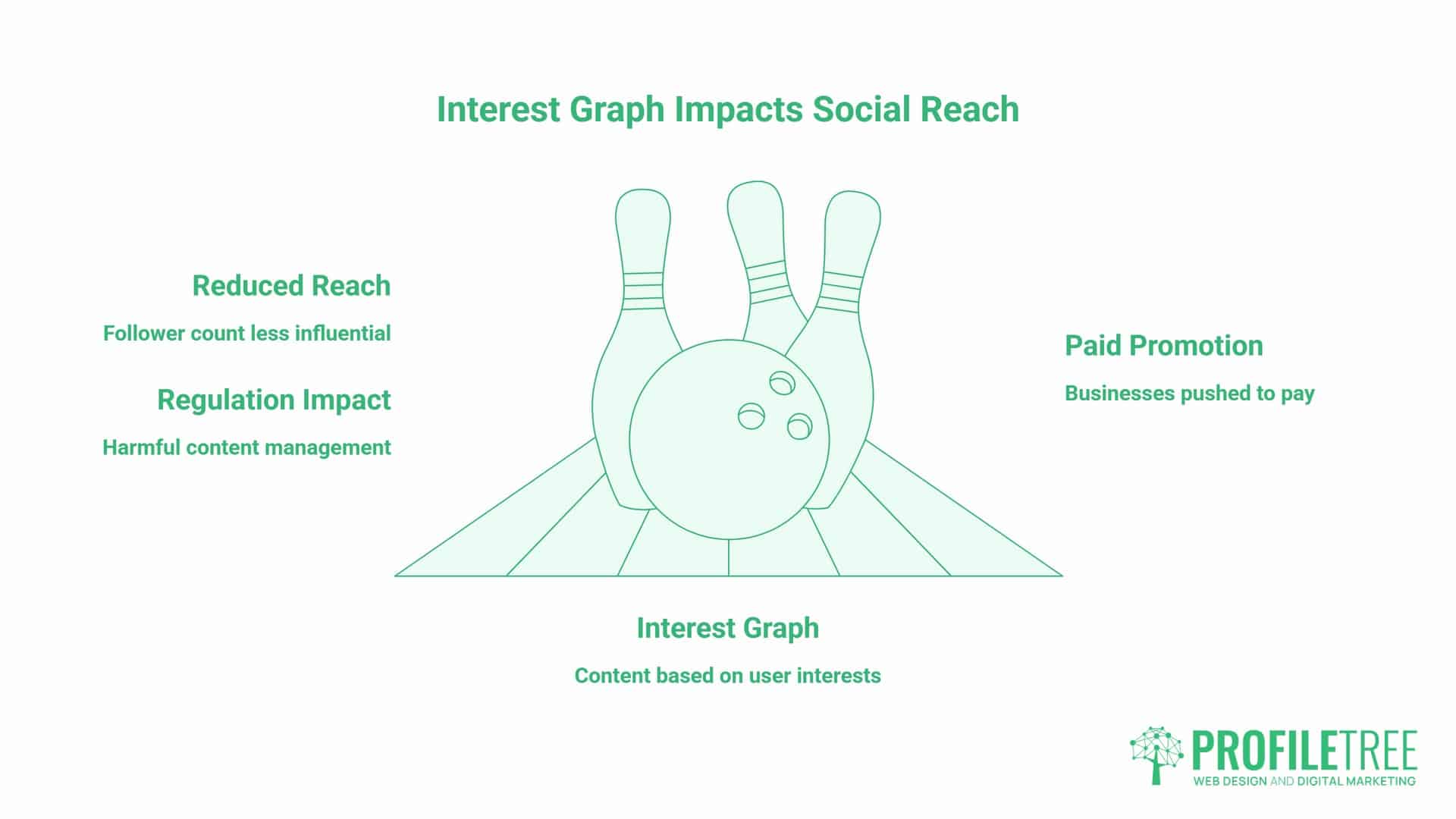
The single biggest shift behind recent social media algorithm changes is a move away from showing people content from accounts they follow (the social graph) and toward showing them content the platform predicts they’ll enjoy, regardless of who posted it (the interest graph). TikTok built its entire model around this idea, and every major platform has spent the past few years copying the approach.
This matters because it changes what a follower count is actually worth. Ten thousand followers used to mean guaranteed distribution to ten thousand people. Under an interest graph model, your follower count barely influences whether a new post gets shown to anyone at all. Each piece of content is auditioned fresh, judged on how people respond in the first few minutes, then either pushed further or left to die quietly in the feed.
Two other forces sit alongside this technical shift. The first is revenue: Facebook’s average organic reach for pages had already fallen to around 7% by the end of 2018 and has continued declining since, with some analyses putting the current reach for larger pages below 2%.
Businesses were nudged toward paid promotion as that decline set in, and it hasn’t reversed. The second, and the one most global guides skip entirely, is regulation. In the UK, the Online Safety Act places new obligations on platforms to manage harmful content, with direct knock-on effects on how ranking systems behave. We’ll come back to this in detail, because it’s one of the few genuinely UK-specific angles in this whole topic.
Platform-by-Platform: What Each Algorithm Actually Rewards
Understanding social media algorithm changes at the platform level is more useful than following generic “post more” advice. The signals differ meaningfully across platforms, and a strategy built for LinkedIn won’t translate to TikTok without changes.
Facebook: Connected vs Unconnected Reach
Facebook’s algorithm now operates across two distinct surfaces: content from accounts you follow (connected) and content surfaced through Reels and the Explore tab (unconnected). The shift toward unconnected content is a direct response to TikTok’s success with interest-based discovery, and it opens a genuine opportunity for brands, since Reels that perform well in the unconnected surface can reach people who’ve never heard of your business.
Facebook’s four core ranking signals remain Inventory, Signals, Predictions and Score. Predictions are where most brands lose ground: the algorithm reads past behaviour to guess what a user wants, and if your content has historically underperformed, it starts every new post from a lower baseline. This is one of the clearest examples of social media algorithm changes rewarding format over follower count.
Instagram: Saves and Shares Outweigh Likes
Instagram applies different logic across its surfaces. Feed posts lean on relationship signals and interest; Stories track how consistently someone views your content; Reels are ranked mainly on watch time and replays. Likes are the weakest signal Instagram tracks, since they take almost no effort and often reflect passive scrolling. Saves and shares carry far more weight, because they show the content had lasting or shareable value rather than a quick glance. If your saves are dropping while likes hold steady, that’s a sign your content is getting seen without being found genuinely useful.
TikTok: The Watch-Time Loop
TikTok runs the most aggressive interest graph system in mainstream social media, and it’s forced every other platform to adapt. The primary signal is completion rate: does someone watch to the end, or swipe away? Industry analysis puts the completion-rate threshold for wider distribution at around 70%, up from roughly 50% a couple of years ago, meaning videos below that bar rarely get pushed to a wider audience, regardless of the account’s follower count. This makes TikTok genuinely different from Facebook’s relationship-weighted model. For UK SMEs, it also means a well-made short video can reach a real audience with no existing following at all, something that’s harder to pull off consistently anywhere else.
LinkedIn: The Expertise Signal
LinkedIn shifted in 2023 toward what it calls knowledge and expertise content and now deprioritises low-effort posts, such as context-free polls, reposts without commentary, or short updates with nothing substantive. What it rewards is content that generates meaningful comments: responses longer than a few words that show genuine engagement with the subject. For B2B businesses across Northern Ireland and the UK, LinkedIn remains the most commercially useful organic channel when posts are genuinely useful to a professional reader rather than promotional.
X and Threads: Recency Over Relationships
X continues to favour recency and participation in live conversation, rewarding accounts that reply, repost with commentary and join threads over accounts that only broadcast. Threads, Meta’s alternative, is still finding its footing, but early signals suggest it favours original posts over shares, with reply velocity acting as a strong early distribution signal.
YouTube Shorts: A Search-Backed Gateway
YouTube Shorts sits inside a platform that is fundamentally search-driven, which changes the dynamic compared with TikTok or Instagram Reels. Its algorithm weighs swipe-away rate and like-to-dislike ratio most heavily, but because Shorts live within YouTube’s wider structure, a strong-performing Short can also pull viewers toward a channel’s long-form videos, something TikTok and Instagram can’t replicate. For businesses in Northern Ireland and the UK already producing longer video, Shorts function as a discovery layer that feeds a broader video presence rather than a standalone channel.
The UK Regulatory Angle: The Online Safety Act and Beyond
This is the section most competitor guides skip entirely, and it’s where social media algorithm changes look genuinely different if you’re a UK or Irish business rather than a US one.
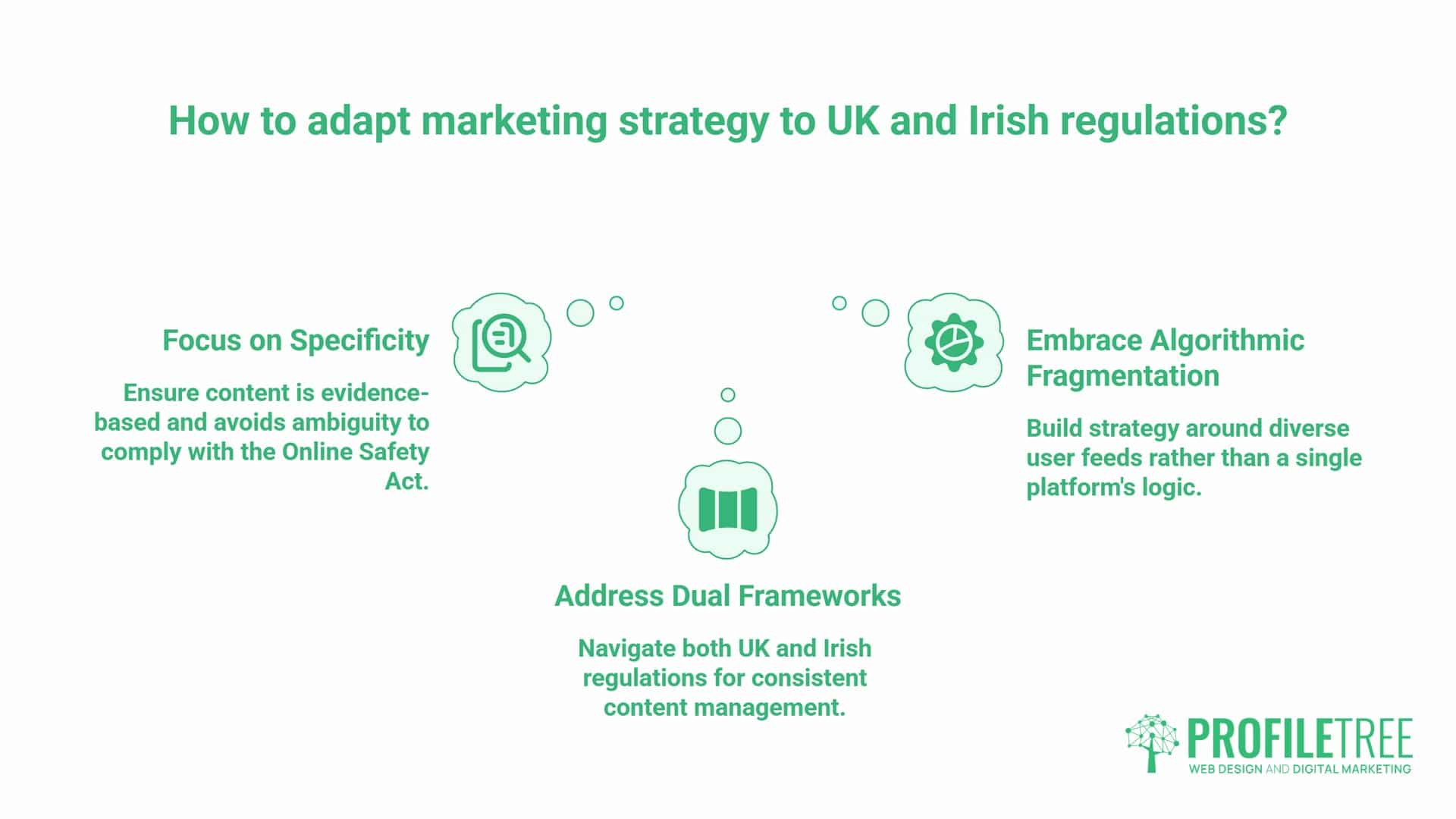
The Online Safety Act has come into force in stages since late 2024, placing legal obligations on platforms to manage “legal but harmful” content. In practice, that means platforms serving UK users have had to build moderation signals directly into their ranking systems, not just their content removal processes.
Content sitting in ambiguous territory, such as strong opinions, health claims or financial commentary, can see reduced distribution as part of that compliance effort, even without breaching any specific platform rule. That’s not a reason to avoid expertise or opinion; it’s a reason to be specific and evidence-based rather than provocative without substance.
Ireland’s regulatory picture adds a further layer. Coimisiún na Meán, Ireland’s online safety and media regulator, works alongside the EU’s Digital Services Act to shape how platforms handle recommendation transparency and content moderation for Irish users. For a business operating across both Northern Ireland and the Republic, this means content decisions increasingly fall under two overlapping regulatory frameworks rather than one, and neither is mentioned in the US-authored guides that dominate this topic.
The practical effect for marketers is straightforward: as users gain more control over their algorithmic feeds under these rules, the “one algorithm to rule them all” model is gradually fragmenting into more chronological and interest-specific views. Businesses that build strategy around a single platform’s current ranking logic are building on shifting ground for legal reasons as much as commercial ones.
The Borrowed Land Problem: Why Algorithm-Proofing Means Owning Your Audience
Here’s the uncomfortable truth behind every social media algorithm change: organic reach on any platform is borrowed, not owned. The platform can remove it at any time, adjust the terms with no notice, and you have no recourse when it does. Treating a follower count as an asset is like treating rented space as a mortgage.
The most resilient businesses we work with don’t try to out-guess the current algorithm. They build channels the algorithm can’t touch.
The Website as Your Digital Headquarters
Every social platform is, at best, a discovery layer. The destination for that traffic should be a website you control, not a profile page you’re renting. A well-built site converts a fleeting social impression into something durable: an enquiry, a newsletter signup, a booking. If your current site isn’t set up to capture that traffic properly, that’s a website design or website development problem worth solving before you spend more on social content.
Email: The Only Algorithm You Control
First-party channels, email lists chief among them, aren’t subject to algorithmic distribution. When a platform update cuts your reach overnight, a business with a solid email list loses visibility on that one channel but keeps direct access to its audience everywhere else. Moving followers toward an owned list is slow, unglamorous work, but it compounds. Businesses that started building email lists back when Facebook reached its first collapse were in a considerably stronger position a few years later.
Video: An Asset, Not Just a Post
Every platform discussed above now rewards video in some form, but the smartest approach treats video as a reusable asset rather than a disposable post. One well-produced piece can become a long-form YouTube upload, a Short, a Reel and an Instagram carousel, giving it several separate chances to perform across different algorithms without a second production cost. This is where video marketing earns its place in the plan rather than sitting as an afterthought.
“The businesses that struggle with algorithm changes are usually the ones that built their entire strategy around a single platform’s organic reach,” says Ciaran Connolly, founder of ProfileTree. “A good website compounds in value every year you invest in it. A social profile can lose half its reach overnight and there’s nothing you can do about it. Social should feed your owned channels, not replace them.”
Republishing and Posting Cadence: What the Behaviour Actually Rewards
One question that comes up repeatedly as clients navigate social media algorithm changes is whether republishing content helps or hurts. The answer depends on the platform and format. On LinkedIn, reposting the same text verbatim can suppress reach, since the algorithm flags duplicate content, while reframing the same insight with a new angle or updated data performs noticeably better. On Instagram, repurposing across formats, turning a carousel into a Reel or a blog post into a series of Story slides, is a well-documented way to extend reach without creating entirely new material.
Posting frequency follows a similar logic. The old advice to post three times a day is now actively counterproductive on most platforms, since frequency without quality dilutes engagement rate, and a lower engagement rate trains the algorithm to show your content to fewer people over time. For most UK SMEs, two to three substantive posts per platform per week outperform daily low-effort posting over a six-month period.
Responding to Social Media Algorithm Changes: The Practical Shift
Getting through the next set of social media algorithm changes comes down to a handful of consistent adjustments rather than chasing whatever tactic worked last month.
The metrics worth optimising are watch time, saves, shares, and replies, not raw reach or impressions. A video that holds 80% of viewers for 45 seconds will consistently outperform a post that racks up 500 passive likes, across every platform’s current ranking logic. When ProfileTree audits social accounts for clients across Northern Ireland and beyond, shifting the reporting focus onto these signals is usually the single change that most improves strategic decisions.
Diversifying channel mix matters just as much as any single tactic. A business built entirely on Instagram reach has no fallback when Instagram changes its priorities. A business that treats social as one input among website traffic, email and direct community channels has options when any one platform has a bad quarter. If your team needs support building that muscle in-house, our digital strategy and digital training services are built around exactly this kind of capability transfer, rather than permanent dependency on an agency.
Platform Comparison: Volatility, Signals and What to Prioritise
The table below tracks social media algorithm changes by platform, combining how often each one shifts its core ranking signals (volatility) with what those signals currently reward. Volatility tells you how often a strategy needs to be revisited. A high-volatility platform such as TikTok may need quarterly reassessment; a lower-volatility platform such as LinkedIn can sustain a consistent approach for longer.
| Platform | Volatility | Primary Ranking Signal | Format Rewarded | Watch Out For |
|---|---|---|---|---|
| TikTok | 5/5, High | Completion rate | Short-form video | Ignoring audio trends |
| 4/5, High | Saves, shares, watch time | Reels, carousels | Chasing likes over saves | |
| 3/5, Moderate | Predicted engagement | Reels, video | Posting frequency without quality | |
| X | 3/5, Moderate | Recency, conversation participation | Replies, threads | Broadcast-only approach |
| YouTube Shorts | 2/5, Lower | Swipe-away rate, like ratio | Vertical short-form video | Ignoring the link to long-form content |
| 2/5, Lower | Quality of comments generated | Long-form posts, articles | Promotional tone without substance |
10-Point Algorithm Audit Checklist
If your reach or engagement has dropped and you’re not sure why, work through this before changing your entire strategy.
- Check your engagement rate, not just reach. A drop in raw reach can be normal; a sustained drop in engagement divided by reach signals that the algorithm is deprioritising you specifically.
- Identify when the drop started, and cross-reference the date with any published platform update.
- Review your last 20 posts by format. Are static posts underperforming Reels, or the reverse?
- Check the save and share rates on Instagram. If likes hold but saves fall, the content is being seen but not valued.
- Review video completion rates. Consistent drop-off before the halfway point points to a weak opening hook.
- Assess posting frequency. More than four or five posts a week can dilute engagement if quality is inconsistent.
- Check for any policy flags on your account, since even a single warning can suppress distribution for weeks.
- Look at audience activity timing. Posting when your audience is offline reads as low-interest content to the algorithm.
- Review hashtag and keyword use. Overused broad hashtags can suppress Instagram reach; keyword-stuffed posts underperform on LinkedIn.
- Compare performance against a three-month baseline rather than week-on-week, since short-term fluctuation is normal.
Understanding social media algorithm changes as they happen, rather than reacting after reach has already dropped, is what separates businesses that adapt quickly from those that scramble. Every platform will keep adjusting how it ranks content, and the businesses that stay visible are the ones that treat social as one channel among several rather than the whole strategy. Use the audit checklist above as your first diagnostic step, and if you’d like a fuller review of how ready your business is for the next round of social media algorithm changes, get in touch with ProfileTree to talk it through.
Frequently Asked Questions
What causes social media algorithm changes?
Social media algorithm changes are driven mainly by platforms seeking to increase time spent in-app, thereby increasing advertising revenue. Shifts in user behaviour, particularly toward short-form video, and UK-specific regulation such as the Online Safety Act, also play a growing role.
How often do social media algorithms change?
Major changes tend to happen a few times a year, with smaller adjustments to ranking signals happening far more often, sometimes weekly. This is why a strategy built around one specific tactic tends to have a short shelf life.
Does the UK Online Safety Act affect my social media reach?
It can. Platforms must factor moderation and compliance signals into what they distribute to UK users, which means content in ambiguous territory can see reduced reach even without breaking a specific platform rule. Being specific and evidence-based, rather than provocative, tends to perform better under this framework.
Is it better to focus on one platform or build an owned audience?
Focusing effort on a single platform where your audience is genuinely active makes operational sense, but relying on it entirely leaves you exposed to the next algorithm update. The stronger approach uses that platform to build an audience, and then you move toward channels you control, like a website or an email list.
Which platform currently offers the best organic reach for UK businesses?
TikTok offers the most opportunity for reach without an existing following, provided completion rates are strong. LinkedIn remains the most reliable channel for B2B content that generates substantive engagement. Facebook is generally the most difficult, with organic reach typically well under 5% of followers without paid support.