
Platform-Specific AI Prompts for Social Media Success
Table of Contents
Getting AI to create effective social media content is not about using the same prompt across all platforms. Each social network has developed its own cultural norms, content preferences, and algorithmic priorities that determine what succeeds and what gets ignored. When Belfast businesses approach their social media strategy, understanding these platform-specific requirements transforms AI from a basic writing tool into a sophisticated content strategist.
The difference between content that resonates and content that disappears lies in how precisely you craft your platform-specific AI prompts. A LinkedIn post that performs brilliantly would likely fall flat on TikTok, whilst Instagram’s visual-first approach requires entirely different considerations than Facebook’s community-focused environment. Northern Ireland SMEs that master platform-specific AI prompting gain a real competitive edge in an increasingly fragmented digital landscape.
This guide covers the prompting frameworks, structural differences, and localisation considerations that distinguish generic AI output from content that actually works.
Why Generic Prompts Fail on Social Media
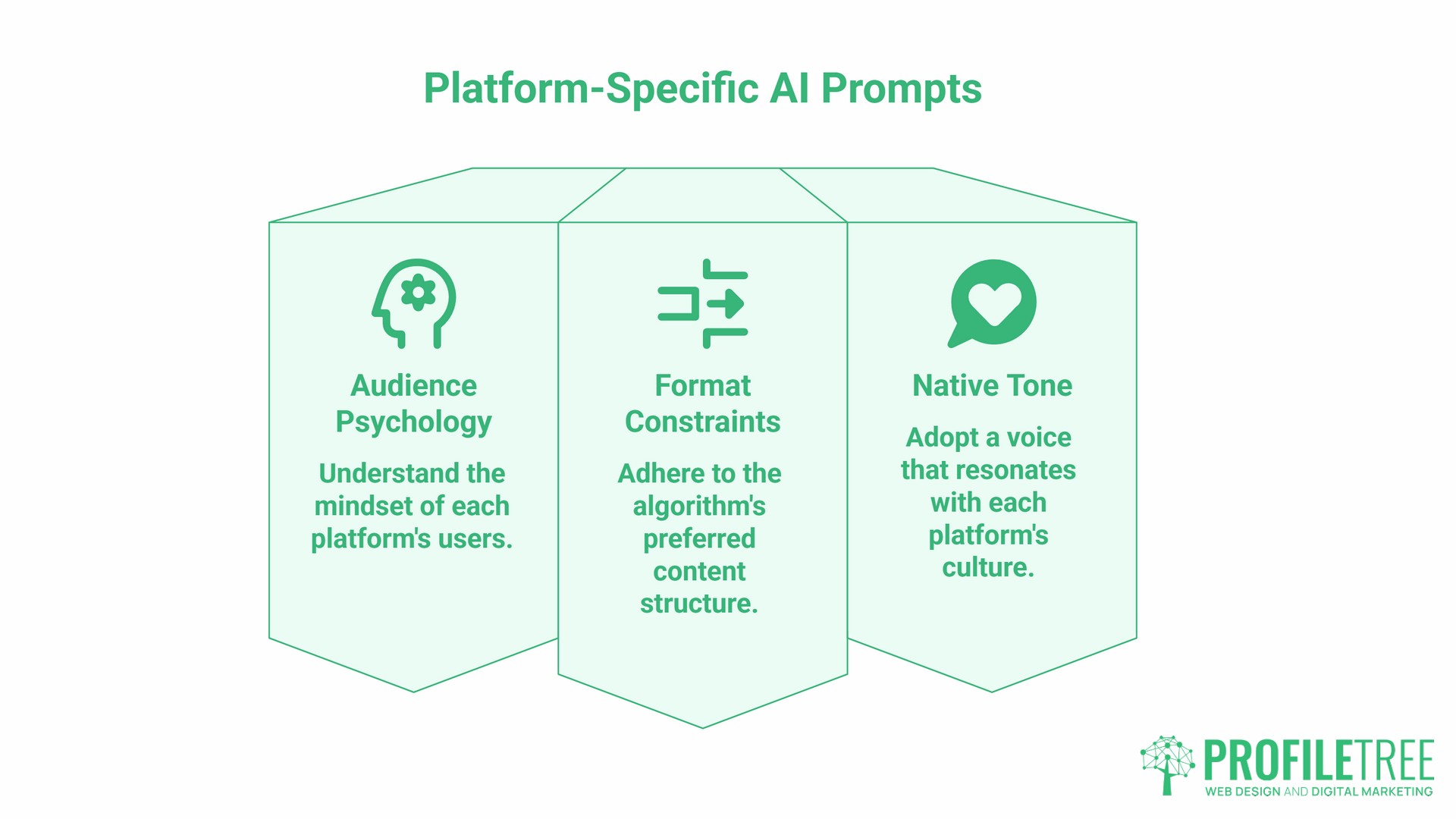
Most AI-generated social media content underperforms because the prompts treat every platform identically. LinkedIn audiences expect industry substance. TikTok viewers reward entertainment above all else. Instagram users make decisions based on visual appeal before reading a single word. The same brief sent across five platforms produces five pieces of content that feel misplaced on four of them.
The fix is not a better AI tool. It is a more precise prompt.
Effective platform-specific AI prompts define three things before any content is generated: the platform’s audience psychology, the format constraints the algorithm favours, and the tone that feels native rather than imported. Without those three inputs, AI defaults to a generic, mid-range style that fits nowhere particularly well. That is the core problem that platform-specific AI prompts solve.
For a deeper look at how AI prompting works across business contexts, see our guide to AI prompts for business.
The 4-P Framework for Platform-Specific AI Prompts
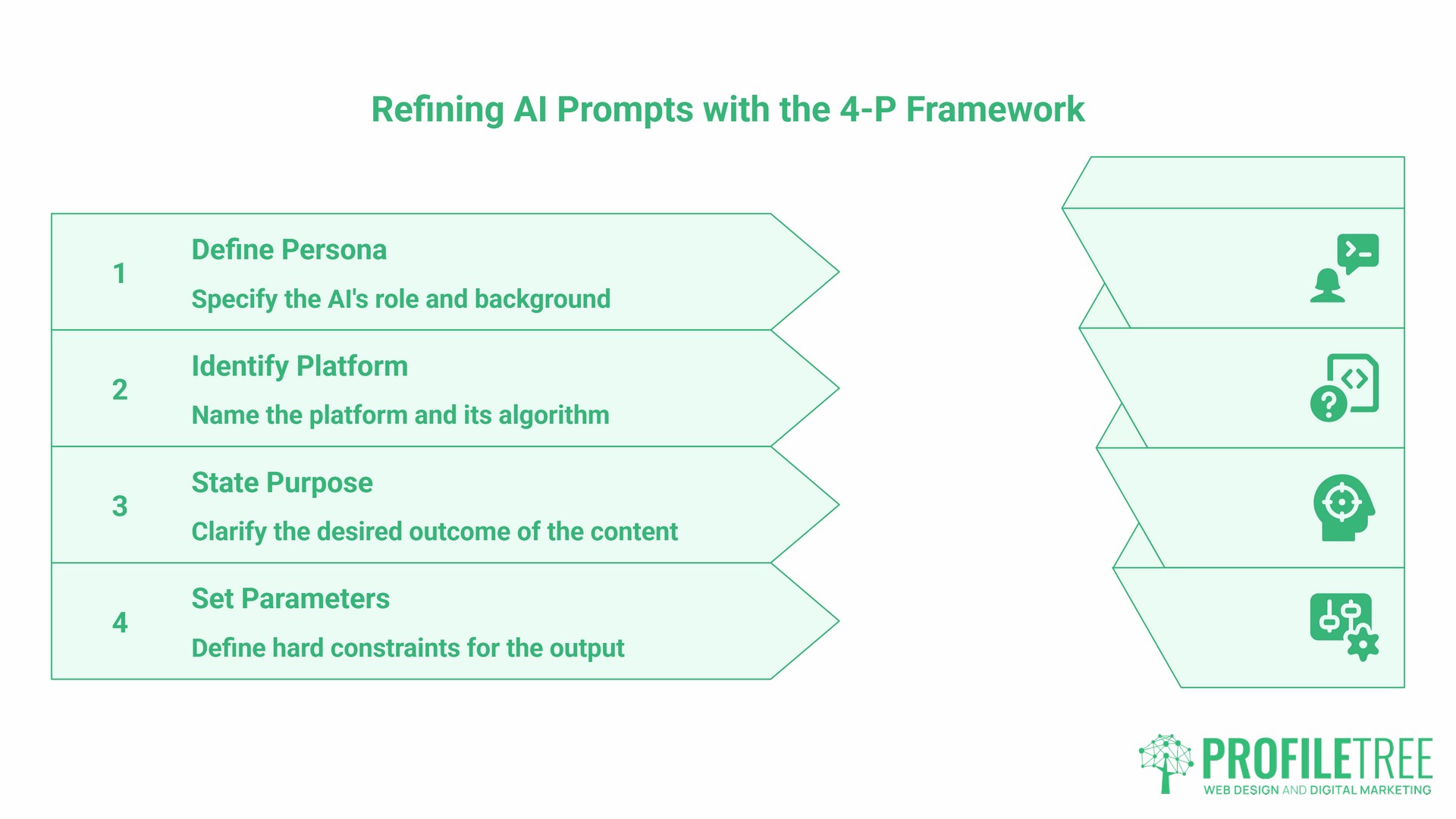
Before writing any platform-specific prompt, run it through four filters: Persona, Platform, Purpose, and Parameters. This structure, used in ProfileTree’s AI training workshops for SMEs, consistently produces more usable output than open-ended prompts.
- Persona: Define who is speaking. A prompt that begins “Write as a Belfast-based digital agency owner with ten years of experience working with Northern Ireland SMEs” produces fundamentally different output than a prompt that begins “Write a professional post.” The more specific the persona, the more the AI can draw on relevant framing.
- Platform: Name the platform and state its primary constraint. LinkedIn’s algorithm rewards dwell time and professional discussion. TikTok’s rewards completion rate and rewatches. Instagram’s rewards, saves, and shares. Including that context directly in the prompt adjusts the AI’s approach to structure, length, and tone.
- Purpose: State what you want the content to achieve. Generating a connection request, driving a link click, prompting a comment, and encouraging a save. Purpose determines the call to action and the way the content builds toward it.
- Parameters: Define the hard constraints. Character limits, hashtag counts, UK English spelling, a specific tone register, or a requirement to avoid particular claims. Parameters prevent AI from defaulting to its training data biases, which tend toward American English and generic marketing language.
A prompt built on this framework looks like: “Write as the founder of a Belfast digital agency [Persona] for a LinkedIn company update [Platform]. The goal is to generate comments from local business owners about their experience with AI tools [Purpose]. Use UK English throughout, aim for 1,300 to 1,600 characters, and include three relevant professional hashtags [Parameters].”
That level of specificity is what separates platform-specific AI prompts from generic content requests.
| Platform | Primary Audience Goal | Algorithm Priority | Tone Register | Ideal Post Length |
|---|---|---|---|---|
| Professional insight | Dwell time, meaningful engagement | Authoritative, personable | 1,300-2,500 characters | |
| Inspiration, aspiration | Saves and shares | Conversational, visual-first | 150-300 characters (caption) | |
| TikTok | Entertainment, quick learning | Completion rate, rewatches | Direct, energetic | 150 characters (caption) |
| Community, connection | Meaningful social interactions | Warm, conversational | 40-80 words (organic posts) | |
| Threads | Casual conversation | Engagement, replies | Low-pressure, opinion-led | 500 characters |
LinkedIn AI Prompting: Professional Authority Without Corporate Stuffiness
LinkedIn rewards thought leadership and professional insights. Platform-specific AI prompts for LinkedIn need to reflect this, but the platform’s users have developed strong filters to detect and dismiss corporate language.
Effective LinkedIn prompts must instruct AI to adopt a tone that is professional yet personable. Instead of prompting “Write a LinkedIn post about digital marketing trends,” Northern Ireland businesses should use prompts like: “Write a LinkedIn post from the perspective of a Belfast digital agency owner sharing three digital marketing shifts observed working with local SMEs. Include specific examples without naming clients, use data where relevant, and end with a question that invites other professionals to share their experiences.”
That level of specificity transforms generic AI output into content that feels genuinely authored by someone with real experience. LinkedIn’s algorithm prioritises posts that generate meaningful professional discussions, so your prompts should explicitly request content that invites thoughtful responses rather than passive likes.
Structure matters significantly on LinkedIn. Effective prompts should specify formatting that works within the platform’s constraints: “Format this with a compelling first line that works as a hook within the first 140 characters visible on mobile, use line breaks every two to three sentences for mobile readability, and include three to five relevant hashtags that professionals actually search for.”
For LinkedIn company page content, the approach shifts slightly. These prompts should request content that showcases expertise whilst maintaining approachability: “Create a LinkedIn company update announcing a new AI training workshop for Northern Ireland SMEs. Highlight practical outcomes rather than features, include specific dates and booking information, and maintain a tone that is authoritative but welcoming to business owners who are new to AI technology.”
Prompts for thought leadership posts:
Write a LinkedIn post as [role] at a Belfast digital agency. Share [specific observation] from working with [type of client]. Use a first-person perspective, include one data point or example, and end with a question that invites responses from other [target professional audience]. Use UK English, keep under 1,200 characters, include four relevant professional hashtags.
Prompts for data-driven industry analysis:
Write a LinkedIn post presenting [specific finding or trend] relevant to [industry] in Northern Ireland. Structure with a surprising opening statement, three supporting points with specific detail, and a conclusion that invites professional discussion. Avoid generic marketing language. UK English throughout.
Instagram AI Prompting: Visual Storytelling Through Strategic Caption Creation
Instagram success depends on the relationship between visuals and words. Platform-specific AI prompts for Instagram must account for both the platform’s visual nature and its growing role as a search and discovery engine.
Instagram caption prompts must account for the platform’s unique reading patterns. Users engage with images first, then decide whether to read captions based on initial interest. Your prompts should reflect this: “Write an Instagram caption for a carousel post about web design trends. Start with a hook that connects to the first slide’s visual, maintain momentum through five to seven slides of insights, use conversational language that feels like advice from a knowledgeable friend, and include a call to action that encourages saving or sharing.”
Instagram’s algorithm increasingly favours content that keeps users on the platform longer. Prompts should explicitly request engaging, valuable captions: “Create an Instagram caption that provides practical advice about local SEO for Belfast businesses. Include three to four actionable tips formatted with emojis as bullet points, write in an approachable tone that does not assume technical knowledge, and end with a question that encourages comments.”
Hashtag strategy requires dedicated attention in Instagram prompts. Rather than generic hashtag requests, effective prompts specify: “Suggest 30 hashtags for this web design post: five high-competition industry hashtags (500K or more posts), ten medium-competition niche hashtags (50K to 500K posts), ten low-competition specific hashtags (under 50K posts), and five Belfast or Northern Ireland location-based hashtags. Focus on hashtags that attract business owners rather than other designers.”
Stories require a different approach entirely. AI prompts for Instagram Stories should acknowledge the format’s temporary, casual nature: “Write five Instagram Story slides promoting a new blog post about AI implementation for SMEs. Each slide should be one to two sentences maximum, use casual language with personality, include interactive elements such as polls, questions, or quizzes, and create a narrative arc that builds interest toward the swipe-up link.”
TikTok AI Prompting: Capturing Attention in the Age of Infinite Scroll
TikTok’s algorithm rewards content that captures attention within the first two to three seconds. Platform-specific AI prompts for TikTok that do not prioritise the hook produce content that gets scrolled past before it can deliver value.
The platform’s culture requires prompts that embrace its specific communication style: “Write a TikTok video script about common website mistakes that harm conversion rates. Start with a controversial or surprising statement in the first three seconds, structure as a countdown or list that maintains pace, use casual language that sounds natural when spoken aloud, include specific verbal cues for visual transitions, and end with a clear directive to follow for more tips.”
TikTok thrives on trends, requiring prompts that adapt quickly: “Create a TikTok script using a trending format for digital marketing agencies. Include five points that are genuinely problematic in the industry but presented with humour, maintain the platform’s characteristic directness without becoming preachy, and incorporate terminology that resonates with business owners whilst remaining accessible.”
Educational content performs well on TikTok when formatted correctly. Prompts should specify this approach: “Write a 30-second TikTok script teaching one specific SEO technique for local businesses. Explain it as if talking to someone who has never heard of SEO, use an analogy that makes the concept instantly understandable, include exact timing markers for on-screen text overlays, and end with a simple action viewers can take immediately.”
The platform’s comment culture significantly impacts reach. Your prompts should account for this: “Create a TikTok video script about web design pricing that is likely to generate discussion in comments. Include one slightly controversial but defensible position, ask viewers a specific question that is easy to answer, and structure the content to naturally lead to follow-up videos based on comment responses.”
Facebook AI Prompting: Building Community Through Conversational Content
Facebook’s role as a community-centric platform requires platform-specific AI prompts that produce content designed for genuine interaction rather than broadcasting.
Facebook posts need to feel personal whilst maintaining professional credibility. Effective prompts balance these needs: “Write a Facebook post about the challenges of running a small business in Northern Ireland’s current economy. Share a genuine observation without being pessimistic, include a brief example that local business owners will relate to, maintain an encouraging tone, and ask an open-ended question that invites people to share their own experiences.”
The platform’s groups feature offers significant reach for businesses that approach it correctly. Group-specific prompts require different parameters: “Create a Facebook group post for a Northern Ireland business networking group about experience implementing AI tools. Write as a peer sharing insights rather than a company promoting services, include specific tools and realistic costs to provide genuine value, acknowledge both benefits and challenges honestly, and invite others to share their own experiences.”
Facebook’s longer-form content capabilities enable more detailed posts than those on other platforms. Prompts should make use of this: “Write a detailed Facebook post explaining how a recent Google algorithm update affects local businesses. Structure with clear paragraphs for easy mobile reading, use plain language that non-technical business owners will understand, include three to four specific examples of what businesses should check on their websites, and provide actionable steps they can take without needing professional help.”
Localising Platform-Specific AI Prompts for UK and Irish Audiences
This is the section most AI prompt guides miss entirely, and it is where UK and Irish businesses lose the most value from AI-generated content.
AI models default to American English. Without explicit instruction, you will get “color,” “optimize,” “trash,” and “sidewalk” in content intended for Belfast business owners. The fix is simple: add “Use UK English spelling and grammar throughout” to the Parameters section of every prompt. But localisation goes further than spelling.
- Tone calibration for UK audiences: British and Irish professional communication tends to be more self-deprecating and less overtly promotional than American equivalents. A prompt that produces “We’re the #1 choice for Northern Ireland SMEs” for a US audience needs to be reframed: “Highlight our experience working with over 1,000 businesses across Northern Ireland and Ireland without using superlatives or ranking claims.”
- UK ASA compliance for AI-generated ad copy: The Advertising Standards Authority requires that promotional claims be substantiated and that paid content be clearly labelled. When prompting AI to write sponsored social posts or content that could be construed as advertising, include: “This post will be labelled as promotional content. Avoid unsubstantiated claims, do not use superlatives such as ‘best’ or ‘leading’ without a verifiable basis, and frame benefits in terms of what the business does rather than how it compares to competitors.”
- Regional relevance for Northern Ireland: AI has limited knowledge of Northern Ireland-specific business conditions. Prompts that reference local context should explicitly provide it: “Include a reference to the challenges of trading across the Irish Sea for businesses based in Northern Ireland, without taking a political position on the reasons for those challenges.”
- Seasonal and cultural context: UK bank holidays, Irish cultural events, and local business cycles differ significantly from US calendars. Build these into your prompts explicitly. AI will not assume St Patrick’s Day is relevant to a Belfast business without being told.
For businesses looking to build a broader approach to regional social media performance, our social media content strategy guide covers the planning layer that sits beneath these prompting techniques.
The Batching Workflow: One Idea, Five Platform-Specific Prompts
The most efficient social media approach repurposes a single core message into platform-specific content rather than creating content from scratch for each channel. Done well with AI, this takes one good prompt and produces five pieces of native-feeling content.
The master prompt structure for batching:
Core message: [State the single idea, insight, or announcement in 2-3 sentences]
Brand voice: [Professional but approachable. UK English. No superlatives. First-person where appropriate.]
Audience: [Northern Ireland SMEs, business owners aged 30-55]

From this core message, create five platform-specific versions:
1. LinkedIn: Thought leadership post, under 1,300 characters, 3-4 professional hashtags, ends with a discussion question
2. Instagram: Caption for a single image, 150-200 characters, emojis where appropriate, 10-15 hashtags
3. TikTok: 30-second video script with opening hook, 3 main points, and a clear call to action
4. Facebook: Community-focused post, 60-80 words, ends with an open question for discussion
5. Threads: Conversational observation, under 200 characters, no hashtags

UK English throughout. No em dashes. No superlatives.
Here is how a single-core message translates across platforms:
| Platform | Core Message Translation |
|---|---|
| “Three things we noticed about how Northern Ireland SMEs are using AI in 2025, and what it means for your content strategy. [data point]. [example]. [insight]. What’s your experience been?” | |
| “AI content that actually sounds like you. Three prompting mistakes we see Belfast businesses make (and how to avoid them). Save this for your next content session.” | |
| TikTok | “STOP using the same AI prompt for every platform. Here’s why it’s hurting your reach. [3-second hook]. [3 quick points]. Follow for more.” |
| “We’ve been testing AI content prompts with businesses across Northern Ireland for the past year. Here’s the one mistake we see most often. And it’s an easy fix. Has anyone else noticed this?” | |
| Threads | “One AI prompt does not fit all platforms. LinkedIn and TikTok need completely different inputs. Are you adapting yours?” |
This workflow is what ProfileTree covers in its AI training for business teams: the practical implementation layer that sits beneath tool selection.
Cross-Platform Content Adaptation: Teaching AI to Translate Between Networks
Beyond batching from a core message, you can adapt existing long-form content for new platforms using the same platform-specific AI prompting logic. Sophisticated prompts can do this effectively without losing the original’s substance.
Adaptation prompts must account for platform-specific constraints: “Convert this detailed Facebook post about SEO basics into a TikTok script series. Break the content into three to four separate 30-second videos that can stand alone but work as a series, prioritise the most immediately actionable advice for the first video, remove all technical terminology except what is absolutely necessary, and add hooks that make viewers want to watch the complete series.”
Timing and cultural context matter when adapting content. Effective prompts acknowledge this: “Adapt this Instagram post about e-commerce trends for LinkedIn, considering that LinkedIn users tend to engage during work hours. Shift from inspiration-focused to ROI-focused messaging, add relevant statistics and data points, replace casual expressions with professional equivalents that still feel human, and expand the caption to provide more strategic context for decision-makers.”
For more on how prompt engineering principles apply across content contexts, see our guide to prompt engineering best practices.
Advanced Prompting: Using Platform Analytics to Improve AI Output
Platform-specific performance data should directly inform your prompting strategy, creating a feedback loop that continuously improves content quality.
Analytics-informed prompts produce better results: “Based on our LinkedIn analytics showing highest engagement on posts about AI implementation challenges, write a LinkedIn post about the top three AI misconceptions preventing Northern Ireland SMEs from adopting automation. Use the same conversational but authoritative tone that performed well previously, incorporate specific cost concerns our audience frequently raises in comments, and use a numbered format rather than paragraphs.”
Engagement patterns should shape prompt construction: “Create an Instagram caption for our web design portfolio post, considering our analytics show highest engagement in the early evening when business owners are browsing after work. Write in a tone that acknowledges the reader might be ready to wind down but is still thinking about business improvements, and include a call to action like ‘Save this for tomorrow’s planning session.'”
Competitive observation can sharpen prompting strategies: “Write a TikTok script about choosing a digital agency, noting that many competing videos focus heavily on price. Differentiate by focusing on the value indicators SMEs should look for, use specific examples that highlight expertise, and maintain TikTok’s characteristic directness whilst establishing professional credibility.”
Platform-Specific Hashtag Strategy Through AI Prompting
Hashtag strategies vary significantly between platforms, and your platform-specific AI prompts must reflect these differences to maximise discoverability.
LinkedIn hashtag prompts should focus on professional discovery: “Generate LinkedIn hashtags for a post about digital transformation in traditional industries. Include three to five hashtags maximum, prioritise terms that professionals actually follow rather than generic business terms, blend broad industry hashtags with specific niche tags, and include one Belfast or Northern Ireland professional hashtag.”
Instagram’s hashtag strategy requires more layered approaches: “Create an Instagram hashtag strategy for a post about responsive web design. Structure as: five broad design hashtags to tap into the larger community, five specific web design hashtags for targeted reach, five small business hashtags to reach ideal clients, five Northern Ireland business hashtags for local discovery, five branded or campaign-specific hashtags, and five currently trending but relevant hashtags.”
TikTok hashtags serve different purposes than other platforms: “Suggest TikTok hashtags that balance trending topics with evergreen discovery. Include two to three educational hashtags, two to three specific niche hashtags for the industry, and one to two location hashtags only if genuinely relevant to the content.”
Facebook hashtag use requires restraint: “For this Facebook post about local SEO tips, suggest one to two hashtags maximum. Choose hashtags that people might actually search for on Facebook, and prioritise terms that connect to active Facebook communities.”
Optimising for Platform Algorithms Through Strategic Prompting
Understanding each platform’s algorithmic priorities allows you to craft platform-specific AI prompts that produce content the algorithm is more likely to distribute.
LinkedIn’s algorithm favours dwell time and meaningful engagement: “Write a LinkedIn post about automation tools that encourages extended reading time. Structure with a compelling opener that promises specific value, build complexity gradually to keep readers engaged throughout, include a supportable opinion that sparks thoughtful discussion, and end with a question that requires readers to reflect on their own experience before responding.” This is the dwell-time logic that platform-specific AI prompts for LinkedIn should always encode.
Instagram’s algorithm prioritises diverse engagement signals: “Create an Instagram caption that optimises for saves and shares rather than likes alone. Include information people will want to reference later, format key points for easy screenshotting and sharing, and explicitly encourage saving with phrases like ‘Save this for your next website review.'”
TikTok’s algorithm responds to completion rates and rewatches: “Write a TikTok script optimised for watch time and replay value. Include a quick payoff in the first few seconds to prevent scrolling, build to a satisfying conclusion that feels worth the time investment, and add details that viewers might notice on a second viewing.”
Facebook’s algorithm favours meaningful social interactions: “Create a Facebook post designed to generate genuine conversation rather than simple reactions. Share something specific enough to have opinions about, include multiple valid perspectives to encourage nuanced discussion, and ask questions that invite personal experiences rather than yes or no answers.”
Common AI Prompting Mistakes by Platform
Knowing what to avoid is as useful as knowing what to include when building platform-specific AI prompts.
- LinkedIn: Prompting for overly casual content or Instagram-style formatting. Excessive hashtags, heavy emoji use, or motivational quote structures feel out of place and signal that the content was not written for the platform. Prompt instead for substance-driven content that respects the reader’s time.
- Instagram: Prompting for content that feels like a corporate press release. Perfectly polished language without personality, generic inspiration quotes without a unique perspective, or captions that ignore the visual element entirely. Prompts for Instagram should reference the image or visual concept the caption accompanies.
- TikTok: Prompting to use slang or trend references that will date quickly. Scripts that sound like a corporate marketer’s impression of TikTok rather than natural platform communication. Prompt for authentic expertise delivered in TikTok’s characteristic direct style. Getting this right is what separates effective platform-specific AI prompts from content that feels like it was imported.
- Facebook: Prompting for engagement bait that Facebook’s algorithm actively penalises. Content that explicitly asks for likes and shares, uses clickbait headlines, or creates artificial urgency all reduces organic reach. Prompt for genuine value that naturally encourages interaction.
Measuring Success: Platform-Specific KPIs for AI Content
Different platforms require different success metrics, and your platform-specific AI prompting strategy should align with what each platform’s algorithm rewards.
LinkedIn success extends beyond vanity metrics. Prompt for content that drives profile visits and connection requests: “Include insights that position the author as a thought leader worth following, mention specific expertise that would appeal to potential clients, and include a soft call to action that encourages profile exploration.”
Instagram engagement quality matters more than volume. Prompt for content that attracts your target audience rather than maximising reach: “Use industry-specific language that self-selects for business owners, include questions that only your target audience could answer meaningfully, and focus on building authority with a relevant audience.”
TikTok virality requires specific structural elements. Prompt for content with share potential: “Include elements that encourage sharing, such as a surprising statistic or counterintuitive advice, and structure for easy response by other creators.”
Facebook community building requires consistency. Prompt for content that encourages ongoing conversation: “Include multiple discussion points that can spawn separate comment threads, acknowledge different viewpoints to keep discussion constructive.” Across all platforms, the best AI prompts are those built specifically for each platform’s audience and algorithm.
ProfileTree’s social media marketing services for Northern Ireland businesses cover the strategic layer that sits above prompting. If you want support in building the full content system rather than just the individual pieces.
Ciaran Connolly, founder of ProfileTree, notes that the businesses seeing the best results from AI-assisted social media are not those with the most sophisticated tools but those who invest time in writing precise, platform-aware prompts: “The prompt is the strategy. If you hand AI a vague instruction, you get vague content. When our clients build proper prompt templates with persona, platform, purpose, and parameters defined, the quality of output changes completely.”
ProfileTree’s work with Northern Ireland businesses across social media strategy and AI implementation has consistently shown that platform-specific AI prompting is not simply a matter of adjusting tone. It is about understanding the fundamental psychology driving user behaviour on each network and encoding that understanding into a repeatable prompting system. As social platforms continue to fragment into increasingly specialised communities, building that system now is one of the more practical investments a Belfast business can make in its content operation.
For businesses ready to move from individual prompts to a full AI content workflow, the ProfileTree guide to social media marketing that drives sales covers how AI-assisted content fits into a broader performance strategy.
FAQs
How do I write platform-specific AI prompts that maintain a consistent brand voice?
The key is the Persona pillar of the 4-P Framework. Before writing any platform-specific prompt, write a two to three-sentence brand voice brief: “Write as [role] at [company]. The tone is [specific descriptors]. Avoid [specific language patterns].” Paste this brief at the top of every prompt, regardless of platform. The platform-specific instructions then sit below it. This separates the brand voice layer (which remains constant) from the platform adaptation layer (which varies by network). You can also create a saved “voice instruction block” and prepend it to every prompt rather than rewriting it each time.
How should Northern Ireland businesses adjust AI prompts for local versus global platform audiences?
Local audience prompts should incorporate specific regional references, business challenges, and cultural nuances that resonate with users in Northern Ireland. Include mentions of local business conditions, Belfast-specific examples, and UK English spelling requirements whilst maintaining relevance for broader audiences who might discover your content through hashtags or shares. Adding “Include a reference relevant to businesses in Northern Ireland or Belfast” to your Parameters section is usually sufficient for most posts.
How can SMEs personalise AI-generated content whilst maintaining efficiency?
Create prompt templates that include variable fields for personalisation. Develop a LinkedIn prompt structure that maintains consistent quality whilst allowing easy insertion of specific client examples, recent industry news, or local business references. Keep the 4-P Framework constant and change only the Purpose and the specific content detail per post. This approach maintains efficiency without producing content that reads as generic.
Should B2B companies avoid TikTok or adapt their AI prompting strategy?
B2B companies can succeed on TikTok by prompting AI to create educational content that addresses business challenges in an entertaining format. Focus prompts on solving real problems, sharing industry insights, and making expertise accessible rather than forcing traditional B2B messaging into TikTok’s entertainment-first environment. The constraint is that TikTok content requires significantly more post-production refinement than LinkedIn or Facebook content; the AI output is a starting script, not a finished piece.
How do platform-specific character limits affect AI prompting strategies?
Include specific character constraints in your prompts: LinkedIn’s 3,000-character post limit (with the algorithm favouring 1,300 to 2,500 characters based on AuthoredUp’s analysis of over 370,000 posts), Instagram’s 2,200-character caption limit, or TikTok’s 2,200-character caption limit. Request content that front-loads value for platforms that truncate text in the feed, and specify when content should maximise the available character count versus when brevity is preferred.
Do I need to disclose AI-generated content on social media in the UK?
No. The Committee of Advertising Practice confirmed in May 2025 that existing CAP and BCAP Codes apply to all content regardless of how it was produced. AI authorship does not create a new disclosure obligation on its own.
What does apply is the existing requirement to identify paid advertising. Sponsored posts, paid partnerships, and influencer content must carry a clear disclosure (“Ad” or “#ad”) whether AI was used or not. CAP’s practical test is straightforward: would the audience be misled if they did not know AI was involved? For most standard social posts drafted with AI tools, the answer is no. When prompting for any sponsored content, add to your Parameters: “This post carries a paid partnership label. Avoid unsubstantiated claims and comparative superlatives without a verifiable basis.”