
Social Media Strategies for Financial Services in the UK
Table of Contents
Social media strategies for financial services firms carry a weight that most other sectors don’t have to think about. Every post sits at the intersection of marketing ambition and regulatory constraint. ProfileTree, a Belfast-based digital marketing agency working with financial services clients across Northern Ireland, Ireland, and the UK, sees this tension play out in almost every account: the FCA has views on what firms say, UK GDPR has views on how firms track who reads it, and clients hold financial brands to a standard of credibility that forgives very little.
Done well, social media strategies for financial services build the kind of trust that drives referrals, retains clients through volatile markets, and positions a firm as a credible voice in a crowded industry. Done badly, they create compliance exposure and erode the authority they were meant to build. This guide sets out what actually works for financial services social media in the UK and Irish markets, from compliant foundations through to platform choice, content, and measurement.
Why Financial Services Firms Need a Different Approach to Social
The case for social media strategy in financial services isn’t built on viral reach or follower counts. It rests on trust, consistency, and reaching clients where they already spend their time. UK adults spend a substantial share of their day across social platforms, including professionals, business owners, and pre-retirees who make up the core client base for most advisory and wealth firms.
The platforms themselves have matured, too. LinkedIn has become the default channel for B2B financial services in the UK. YouTube increasingly serves as a research tool for clients seeking to understand a product before committing to it. Facebook retains a strong hold on the 45-plus demographic, a group that controls a disproportionate share of investable assets. None of this is incidental, and none of it responds well to a generic content template borrowed from a consumer brand.
Platform choice should follow audience data rather than assumptions. For UK financial services, the rough picture looks like this: LinkedIn skews professional and B2B, with particular strength among corporate finance, accountancy, and wealth management audiences. Facebook’s strongest financial-content demographic sits between 35 and 55. Instagram and TikTok reach younger audiences, which matters for mortgage brokers and financial education providers targeting first-time buyers. WhatsApp Business has grown quickly as a client communication tool for IFAs and smaller advisory firms managing existing relationships, a pattern that general social media guides written for a US audience rarely mention but that matters a great deal for firms operating across the island of Ireland.
The mistake most finance brands make is treating social media as a broadcast channel. Clients don’t follow a bank or an IFA to receive promotions. They follow because they want to understand markets, learn about products, and feel confident that the people managing their money know what they’re doing. Content that explains a rate change or a Budget announcement in plain language consistently outperforms content that sells, which is worth remembering given the evidence that social media marketing can increase sales precisely because trust comes before conversion, not after it.
Building a Compliant Foundation Before Anything Else
A social media strategy for financial services that doesn’t account for FCA rules and UK data protection law isn’t a strategy. It’s a liability waiting to surface, and getting it wrong doesn’t just embarrass a firm; it can trigger regulatory action.
What FCA Guidance Actually Requires
The Financial Conduct Authority’s rules on financial promotions apply to social media in the same way they apply to any other marketing channel. A post that promotes a financial product or service is a financial promotion, and it must be fair, clear, and not misleading. That sounds simple until you consider how social media actually works in practice.
Character limits, the pressure to publish quickly, and the tendency to oversimplify complex products all introduce risk. A LinkedIn post describing the returns available from a particular investment, published without appropriate risk disclosure, can constitute a non-compliant financial promotion. The FCA’s finalised guidance on financial promotions on social media, published in March 2024, replaced earlier guidance from 2015 and set out clearer expectations for how firms communicate on these channels. It doesn’t create new obligations, but it does show how far the regulator’s attention on this area has moved since social platforms were treated as an afterthought.
In practice, this means financial firms need an approval workflow for social content that sits apart from the creative process. Pre-approved content libraries, staff training on what constitutes a financial promotion, and a clear escalation path for anything related to regulated activity aren’t optional extras. They’re the baseline for operating safely on social media, and firms that skip this step tend to find out why the hard way.
GDPR and Social Advertising in Financial Services
UK GDPR and the Data Protection Act 2018 affect financial services and social media in ways that go well beyond cookie banners. Running paid social on Meta or LinkedIn using pixel tracking, custom audiences, or lookalike audiences built from client data means processing personal data, and the lawful basis for that processing needs to be established before the campaign runs, not after.
Firms uploading customer lists for custom audience targeting must confirm that those customers were informed that their data might be used this way. Many haven’t done this. The ethics of digital marketing are particularly acute in finance, where clients hold heightened expectations around data confidentiality, and a data misstep can do as much reputational damage as a poorly worded promotion.
The practical upshot for paid social strategy is that finance brands typically work with smaller, more targeted audiences than consumer brands, and those audiences need to be built compliantly. Contextual targeting, interest-based targeting, and LinkedIn’s firmographic options generally carry lower risk than data-upload approaches and often perform better for B2B financial services.
An Internal Workflow That Actually Works
A compliant social media operation in finance tends to follow the same shape: a content creator drafts a post, a compliance-aware reviewer checks it against FCA promotion rules, legal or compliance signs off on anything touching a regulated product, and only then does approved content move into a library the social team can publish from. Anything outside that library goes back through the review cycle.
This slows content production, which is exactly why many financial firms default to infrequent, cautious posting. The better answer is to invest in a large enough bank of pre-approved content so the social team always has something to work with, supplemented by real-time market commentary that’s templated and pre-approved for format, even if the specific content changes each time. Firms already running ASA-compliant advertising processes for other channels usually find this discipline transfers naturally to social.
Choosing the Right Platforms for UK Financial Services
Not every platform deserves equal investment, and the right mix depends on a firm’s client base, services, and content capabilities. Guidance that tells every business to be everywhere at once is a poor use of resources for most financial services firms, which typically have smaller marketing teams and tighter compliance overhead than the consumer brands for which most social media advice is written.
LinkedIn for B2B and Professional Services
LinkedIn is the primary platform for most B2B financial services firms in the UK. Corporate finance advisers, accountants, wealth managers serving business owners, and financial recruiters all find their core audience here. The platform’s professional context means content can offer greater depth and technical nuance than any other social channel.
Long-form posts that explain a regulatory change, walk through a valuation methodology, or analyse a shift in UK pension rules consistently generate meaningful engagement among professional audiences. Thought leadership from named individuals, partners, directors, and senior advisers tends to outperform branded company page content because people connect with people rather than logos. ProfileTree’s guide to LinkedIn for B2B marketing covers the mechanics of building this kind of presence in more detail, and much of it is directly transferable to advisory and wealth management audiences.
LinkedIn’s advertising platform offers targeting by job title, industry, seniority, and firm size that genuinely works for B2B in financial services. Cost per click runs higher than Meta, but audience quality is materially better for reaching finance directors, HR decision-makers, and business owners who actually make buying decisions. It’s worth reading up on how LinkedIn is reshaping B2B relationships in the UK if the platform is new to a firm’s marketing mix.
YouTube for Financial Education
YouTube behaves differently from other social platforms for finance brands. It functions as a search platform as much as a social one, and the queries people bring to it, such as how a SIPP works, what happens to a pension if an employer goes under, and how to invest an inheritance in the UK, are research queries with genuine purchase intent behind them.
Firms that invest in clear, accurate video explanations of complex topics build an asset that earns views and trust over years, not hours. The content doesn’t need an expensive production budget. It needs to be accurate, plainly explained, and genuinely useful to someone trying to work through a financial decision. Firms starting from scratch can follow a structured guide to creating a YouTube channel, and pairing that with proper YouTube SEO for video visibility makes a meaningful difference to whether the content gets found at all.
Facebook and the Over-35 Opportunity
Facebook’s declining popularity among younger demographics is well-documented. Less discussed is how this has concentrated a high-value audience on the platform: UK adults aged 35 to 65, the core market for pensions, mortgages, investment products, and IFA services. For retail-facing financial services, writing off Facebook is a strategic mistake.
Community-based content, local business groups, and targeted advertising using Meta’s demographic and behavioural data can reach this audience effectively. The compliance considerations for Facebook advertising in financial services mirror other Meta products, but audience quality for certain product categories remains strong, a point covered in more depth in ProfileTree’s guide to Facebook marketing and supported by current Facebook usage statistics for UK audiences.
Instagram, TikTok, and the Younger Financial Audience
Mortgage brokers, credit unions, financial education platforms, and firms targeting first-time buyers and younger savers have a genuine audience on Instagram and, increasingly, TikTok. Visual content that breaks down financial concepts, normalises saving and investing, or shows the human side of a firm’s team performs well here. The constraint doesn’t change: anything promoting a regulated product still needs FCA-compliant framing, even on a platform built for short, visual content. ProfileTree’s notes on mastering Instagram marketing apply directly, and firms exploring shorter formats should look at how TikTok usage among UK audiences has shifted before committing budget there.
Dark Social and the WhatsApp Question
WhatsApp Business deserves separate treatment because it doesn’t behave like a broadcast channel at all. For IFAs and smaller advisory firms, it has become a genuine client communication tool, used for document requests, quick updates, and answering straightforward questions outside a formal advice process. This is dark social in its purest form: valuable, largely untracked, and easy to overlook when a firm is measuring success through platform analytics alone. A firm that ignores this channel because it doesn’t show up neatly on a dashboard is missing where a meaningful share of client interaction now occurs.
X and Real-Time Market Commentary
X, still widely referred to by its old name, remains useful for real-time market commentary and reacting to breaking financial news, though it carries less weight for UK financial services than LinkedIn or YouTube. Firms that use it well tend to post templated, pre-approved commentary formats rather than improvising in the moment, which keeps compliance risk manageable. ProfileTree’s practical guide to X techniques is a reasonable starting point for firms deciding whether the platform earns a place in their mix at all.
Content That Works for Finance Brands
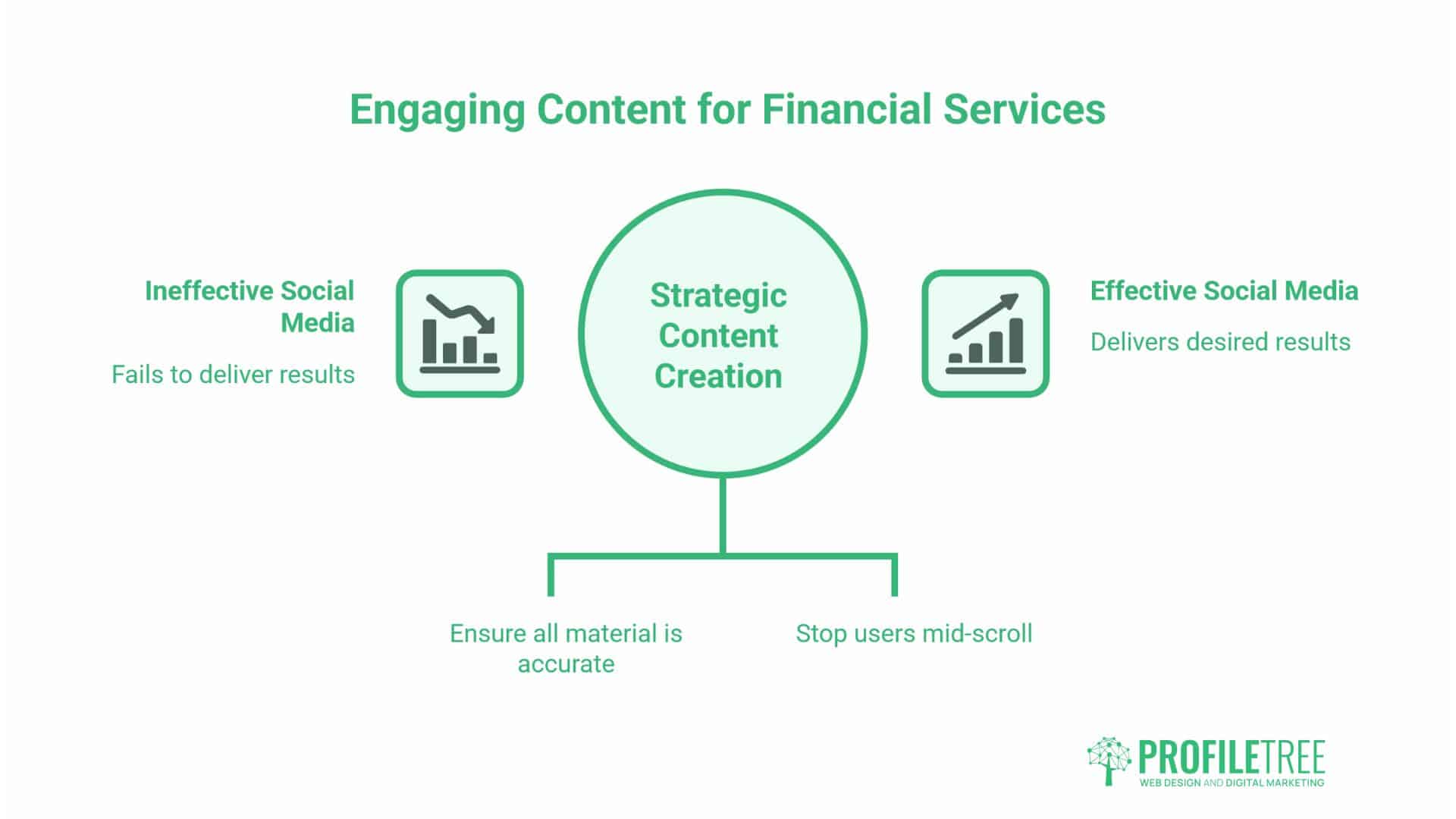
Content is where a social media strategy either delivers or fails. For financial services, the challenge is specific: how do you produce material that’s accurate and compliant, but engaging enough to stop someone mid-scroll?
A practical content mix for UK financial services looks roughly like this: around 40% educational content explaining financial concepts, market events, or regulatory changes in plain language; 30% firm content showing the team, sharing client outcomes with appropriate consent, and communicating the firm’s values; 20% timely commentary on news and market events; and 10% direct promotion of services, framed around client problems rather than product features. This isn’t a rigid formula, and a firm launching a new service or responding to a Budget announcement will shift the balance for a period. The underlying principle holds regardless: educational and trust-building content should always outnumber promotional content, because the audience needs a reason to follow before they’ll consider buying anything.
Where AI Fits, and Where It Doesn’t
AI tools have changed the economics of content production for financial services firms that previously couldn’t justify the resourcing. AI can accelerate first-draft production for educational explainers, generate variations of social posts from approved long-form content, and flag trending financial topics worth commenting on. What it can’t do is apply FCA compliance judgement, bring genuine expertise to a complex financial question, or produce the specific, experience-based insight that actually builds credibility. ProfileTree’s work on AI in social media marketing and the firm’s approach to AI-powered social media analytics both point to the same conclusion: AI is useful for volume and variation, not for judgement calls that carry regulatory weight.
The useful application, then, is AI for scale combined with human expertise and compliance review for accuracy. A compliance-reviewed long-form explainer on inheritance tax planning can generate a month of social content across formats: short posts, LinkedIn articles, YouTube scripts, and email snippets. The human expertise creates the asset; AI helps distribute it efficiently, not the other way round.
Named Individuals and Employee Advocacy
The most effective social media strategy for financial services firms in the UK is almost always built around named individuals rather than brand accounts. People follow people. The compliance considerations around what a named adviser can say on social media are real, but manageable with proper training and a clear content library to draw from.
Ciaran Connolly, founder of ProfileTree, has noted that financial services firms consistently underestimate the value of individual expertise online, pointing out that an adviser who explains a topic clearly on LinkedIn tends to generate enquiries from people who have never visited the firm’s website, which is the actual commercial value of person-led content that a branded page rarely achieves on its own.
For cross-border firms operating across Northern Ireland and the Republic of Ireland, named individuals who understand both regulatory environments, the FCA and the Central Bank of Ireland, tend to build particularly strong positioning on this front. This kind of employee advocacy reinforces broader brand credibility far more efficiently than company-page content alone, and it also feeds into wider community-focused engagement that many financial firms underinvest in.
Influencer and Partnership Marketing Under FCA Rules
Influencer marketing in finance operates under tighter constraints than in most other sectors, but there is real opportunity for firms that approach it correctly. The growth of personal finance content on YouTube, LinkedIn, and, increasingly, TikTok has created a category of credible, audience-trusted voices that financial services brands can work with, provided the partnership is structured in compliance.
Any paid partnership that promotes a regulated financial product counts as a financial promotion. That means the content needs to meet FCA standards, receive approval from an authorised person before publication, and include clear disclosure of the commercial relationship. A sponsored post recommending an investment product without appropriate risk disclosure is a breach, regardless of whether the firm or a third party produced it. For financial services brands, this rules out informal gifting and loose arrangements common in the lifestyle sector. Every influencer collaboration needs a clear brief, a compliance review before it goes live, and explicit disclosure of the relationship.
The UK has a growing community of personal finance content creators across YouTube and LinkedIn whose audiences actively seek financial guidance rather than lifestyle entertainment. These aren’t celebrity influencers with broad reach; they’re subject-matter voices whose credibility depends on accuracy and independence. Partnerships that align with that credibility, giving the creator genuine access to expertise or data rather than asking them to deliver a sales message, tend to produce better results and carry lower compliance risk.
For many financial services firms, formal industry partnerships deliver more value than individual influencer relationships. Co-producing content with an industry body, a professional association, or a complementary non-competing firm, a law firm or accountancy practice, for example, creates editorial credibility that a paid influencer arrangement doesn’t. A jointly produced guide to pension planning for SME directors, published in partnership with a regional accountancy firm, reaches a qualified audience and builds authority for both parties without the compliance burden associated with individual influencer marketing.
Measuring What Actually Matters
Social media metrics for financial services should anchor to business outcomes, not platform metrics. Follower counts, likes, and impressions indicate reach, not commercial performance. The metrics that matter are enquiries attributed to social channels, content that generates inbound contact from prospective clients, traffic from social to regulated landing pages, and cost per qualified lead from paid social campaigns.
For organic social, this means building clear attribution paths: UTM parameters on links, separate phone numbers or email addresses for social-driven enquiries, and asking new clients at onboarding where they first encountered the firm. All of this contributes to understanding what the social programme is actually producing, rather than what it merely appears to produce.
Chasing reputation and trust signals online matters more than chasing platform-specific vanity metrics, and it’s worth actively monitoring negative feedback on social channels too, since a single unresolved complaint thread can do more reputational damage in finance than in almost any other sector. A single LinkedIn post generating three qualified IFA enquiries is worth more than a post that reaches ten thousand people and produces nothing measurable.
Getting Started with Social Media Strategies
A social media strategy for finance doesn’t need to be complex to be effective. Start by auditing what already exists: which profiles are active, which carry outdated information, and which have content that wouldn’t pass a current FCA compliance review. Consolidate onto the platforms that matter to the audience and archive the rest.
Set goals tied to business outcomes rather than platform metrics, such as a set number of qualified enquiries per quarter through LinkedIn or a target cost per lead from paid social. This applies just as much to small businesses building a social media presence as to larger financial institutions.
Most firms lack the internal resources to manage a social programme, maintain FCA compliance, and produce consistent content at once. Working with an agency that understands both the marketing and regulatory environment reduces that risk. Firms weighing this up can review why businesses choose ProfileTree for context.
FAQs
What are the FCA rules for social media in financial services?
The FCA treats any social content promoting a regulated product as a financial promotion: it must be fair, clear, and not misleading. Firms need an internal approval process before anything is published.
How does GDPR affect social media advertising for financial services firms?
Pixel tracking, custom audiences, and retargeting all involve processing personal data, which needs a lawful basis under UK GDPR. Contextual and interest-based targeting on LinkedIn and Meta generally carries lower risk than uploading client lists.
Which social media platform works best for financial services in the UK?
LinkedIn leads for B2B financial services, and YouTube works well for long-form financial education. Facebook retains a strong reach among the 35-65 demographic, and WhatsApp has become essential for client communication at smaller firms.
How often should a financial services firm post on social media?
Consistency matters more than frequency. Two or three well-considered LinkedIn posts a week build more credibility than daily thin content, and one solid YouTube video a month can sustain views and enquiries.