
Social Media for Legal Professionals: The UK & Ireland Guide
Table of Contents
Social media has shifted from a nice-to-have to a genuine business development tool for law firms. Solicitors and barristers who maintain a credible online presence attract referrals, build trust before the first call, and stay visible in an increasingly competitive market. The challenge is doing it without risking your practising certificate.
This guide covers the platforms that actually work for legal professionals, the SRA and Law Society compliance rules you need to know, and practical content strategies that generate instructions without compromising confidentiality.
Why Social Media for Legal Professionals Has Become Non-Negotiable
Law firms that dismissed social media a decade ago as “not suited to the profession” are quietly catching up. The shift isn’t about trends. It’s about where clients now form their initial impressions of a solicitor or firm.
The Changed Client Journey
Before picking up the phone, prospective clients search for the solicitor’s name, read their LinkedIn profile, check the firm’s Facebook page, and look at Google reviews. By the time they make contact, they’ve already formed a view. A sparse or absent social media presence doesn’t read as professional discretion. It reads as a firm that isn’t active.
Research from the Law Society has consistently shown that personal recommendations remain the primary source of new instructions for most UK firms, but digital presence now plays a strong secondary role. A LinkedIn post shared by a contact, a helpful article on Instagram, or a clear explanation of a legal process on Facebook can all trigger a referral that wouldn’t have happened otherwise.
What Law Firms Actually Gain
The practical benefits for legal professionals using social media fall into three categories. Brand recognition builds over time as consistent, informative posting keeps the firm’s name in front of contacts and past clients. Referral networks expand because other professionals, accountants, financial advisers, and estate agents see the firm’s expertise demonstrated and are more likely to recommend them. Recruitment also benefits: junior solicitors and paralegals researching a firm before applying look at LinkedIn to judge culture and calibre.
ProfileTree has worked with professional services clients across Northern Ireland and Ireland who initially saw social media as outside their sector norms. In each case, a focused, ethics-first approach produced measurable results within six months.
The Reputational Stakes
The same platforms that build reputation can damage it. A poorly worded post, an inadvertent reference to a client matter, or a comment that violates SRA principles can result in a complaint to the regulator. For legal professionals, the risk calculus differs from that in other industries: the downside is not just embarrassment but also potential disciplinary action. That’s not a reason to avoid social media. It’s a reason to approach it with a clear policy.
Navigating SRA and Law Society Compliance
No guide to social media for legal professionals in the UK and Ireland can skip the regulatory framework. The rules are not ambiguous, but applying them to the fast-moving world of social media requires thought.
SRA Principles That Apply Online
The Solicitors Regulation Authority’s Code of Conduct applies to everything a solicitor does in a professional capacity, including what they post on social media. The key principles relevant to online activity are the requirements to act with integrity, maintain client confidentiality, and behave in a way that upholds public trust in the profession.
In practice, this means a few specific things. You cannot share any information about a client matter without express consent, including details that might seem too general to identify anyone. You cannot make misleading claims about your outcomes or success rates. You cannot create the impression, through a comment or direct message, that you are providing legal advice without establishing a proper engagement.
The SRA’s recent guidance on social media explicitly addresses the risk of inadvertently creating a solicitor-client relationship through online interactions. Responding to a legal question in a Facebook comment with more than generic signposting is the kind of activity that can blur this line.
Client Confidentiality in a Public Forum
Confidentiality is the area where legal professionals are most exposed on social media. The risk is not always obvious. A solicitor posting “Had a great result in court today” without naming anyone can still breach confidentiality if the matter is sufficiently distinctive that the client could be identified by those who know them.
The safest approach is a firm internal policy that specifies what can and cannot be referenced publicly. As a rule: no case details, no outcome references without explicit written consent, and no posts that even obliquely identify a client’s circumstances.
Rules on Advertising and Comparisons
SRA Transparency Rules require that certain information about price and service be published, including on websites. This doesn’t directly govern social media, but it sets the context: promotional content must be accurate, not misleading, and must not create unjustified expectations about results.
“Superiority claims” are a particular risk on social media. Posts implying that a firm achieves better results than competitors, or that a solicitor is the best in a given practice area without an evidential basis, can constitute misleading advertising under both SRA rules and ASA guidelines. The safe test is simple: if you couldn’t put a source or evidence against a claim, don’t make it.
For solicitors in Ireland, the Law Society of Ireland’s Marketing and Advertising guidelines broadly apply the same principles, with specific restrictions on certain types of claims and mandatory requirements for posts that could constitute advertising.
Choosing Platforms: Where Legal Clients Actually Are
Not every platform suits every practice area. The right choice depends on whether a firm primarily serves business clients, private individuals, or both.
LinkedIn: The Professional Services Standard
LinkedIn remains the most important social media platform for legal professionals in the UK. It serves multiple functions simultaneously: building referral networks with other professionals, demonstrating thought leadership to business clients, and creating a searchable record of expertise.
For corporate, commercial, and employment law practices, LinkedIn is where the primary audience spends professional time. A well-maintained LinkedIn presence that shares commentary on relevant case law, legislative changes, or sector-specific issues positions a solicitor as a knowledgeable contact worth referring to.
The LinkedIn algorithm currently favours personal profiles over company pages. Senior solicitors and partners publishing content in their own names will typically achieve more reach than posts from the firm’s company page. A hybrid approach, where individuals post, and the firm page amplifies, works well for most practices.
Instagram and Facebook: Humanising Private Client Services
For private client practices, family law, conveyancing, wills and probate, and personal injury, Instagram and Facebook serve a different purpose. These platforms allow a firm to show personality, explain processes in accessible terms, and build community familiarity.
Facebook, in particular, remains highly used by the 35–65 age demographic, which makes up a significant portion of private client instructions. A Facebook business page with regular posts about process, legal rights, and what to expect from common legal procedures builds trust over time with exactly the audience that needs it.
Instagram suits firms willing to invest in visual content: short explainer videos, behind-the-scenes glimpses of the office, or team posts that humanise the firm. It’s particularly effective for firms targeting younger first-time buyers or families navigating divorce or estate matters for the first time.
Is TikTok Viable for UK Law Firms?
Short-form video on TikTok and Instagram Reels is the fastest-growing content format among under-40 audiences. Some UK solicitors have built substantial followings by explaining legal concepts in plain English through 60-second videos. The perception that TikTok is incompatible with legal professionalism is increasingly outdated.
The key is subject selection. General legal education content, explaining what happens at a first court hearing, how to read a lease, what powers of attorney cover, sits comfortably within the platform’s norms without approaching anything that could be read as specific advice. The risk of appearing unprofessional is real but manageable with a clear content brief and a consistent tone.
Firms experimenting with TikTok should establish clear internal guidelines that distinguish educational content from content that touches on active matters, with all videos reviewed against SRA principles before posting.
Content Pillars for Law Firms: What to Actually Post
The most common reason legal professionals abandon social media is running out of ideas. A structured content approach solves this before it becomes a problem.
Educational Content: The High-Trust Foundation
Legal education content consistently outperforms promotional content on social media. Posts that explain a process, clarify a right, or demystify a legal concept provide genuine value and signal expertise simultaneously. This is content recipients share with others who need it, the most organic form of referral possible.
Practical examples include: a three-paragraph explanation of what a restrictive covenant in an employment contract means for a new employee; a brief guide to what “reasonable adjustments” require of employers; or a plain-English breakdown of what happens to an estate when someone dies without a will.
None of these involves case specifics. All of them demonstrate expertise. And each one speaks directly to the anxiety that drives people to search for a solicitor in the first place. The ethics and legalities of digital marketing for professional services follow similar principles: transparency and accuracy build more trust than any promotional claim.
Leveraging Reviews and Social Proof Carefully
Client reviews are valuable on social media but require careful handling. Under SRA rules, you cannot publish a testimonial that breaches confidentiality or creates unjustified expectations. You can, however, share Google or Trustpilot reviews that clients have posted publicly, provided you don’t add commentary that goes beyond what the review itself states.
Review management is an underserved area for most law firms. A proactive approach involves politely asking satisfied clients, after the matter closes, if they would be willing to leave a review on Google. Even a modest increase in review volume materially improves a firm’s local search visibility. ProfileTree’s online reputation management guidance covers the mechanics of this in detail.
Using AI Tools Within the Rules
Generative AI tools, including ChatGPT and Claude, are increasingly used to draft social media posts, create content calendars, and repurpose existing materials. Legal professionals can use these tools without breaching privilege, provided one principle is followed: no client data, matter references, or confidential information is entered into any AI prompt.
The safe workflow is to use AI for general content drafting, subject only to publicly available legal information, and then have a qualified solicitor review every post before it goes live. This is not AI-generated legal advice. It’s AI-assisted content about publicly known law, reviewed by an expert. The distinction matters both for compliance and for accuracy.
Risk Management: Handling Negative Feedback and PR Challenges
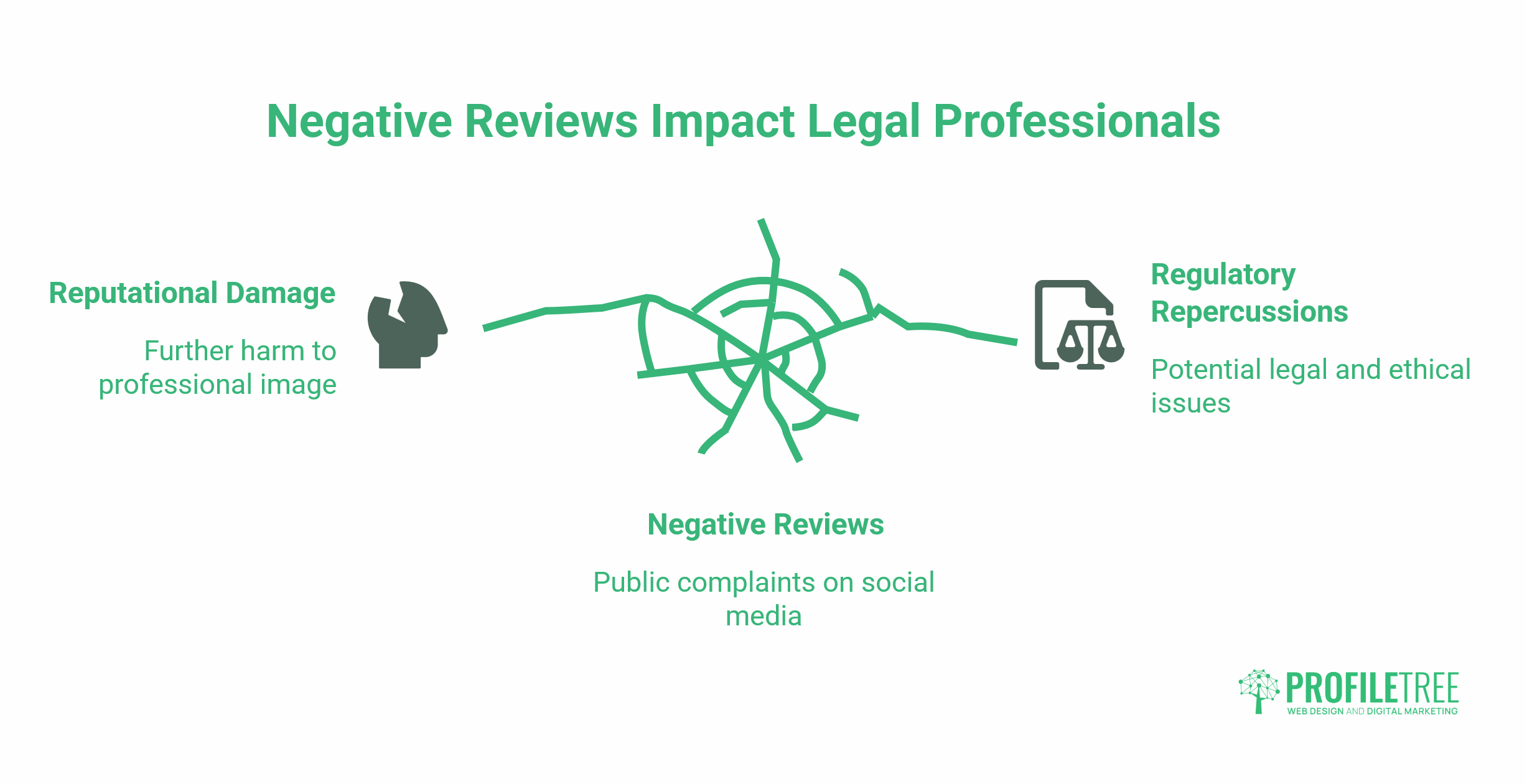
Negative reviews and public complaints are the social media scenario most legal professionals dread. The response strategy needs to balance reputation management with SRA compliance.
Responding to Negative Reviews Without Breaching Confidentiality
The core challenge is that you cannot confirm or deny that someone is a client. A response that says “We’re sorry you felt let down as a client” has already disclosed a confidential relationship. The standard approach for SRA-compliant responses to negative reviews is a neutral acknowledgement: something along the lines of “We take all feedback seriously and invite anyone with concerns to contact us directly so we can discuss them.”
This response neither confirms nor denies a client relationship, invites resolution through a private channel, and demonstrates to anyone else reading it that the firm takes complaints seriously.
Managing Misinformation and Inaccurate Posts
Occasionally, a post will contain factually incorrect claims about a firm: incorrect information about a case outcome, a false allegation, or a misleading description of services. Where the post is clearly defamatory and false, legal remedies may be available. In the short term, most platform reporting tools allow businesses to flag content for review.
Before escalating, consider whether a response is even warranted. Amplifying a fringe complaint by responding gives it visibility it wouldn’t otherwise have. The calculation depends on how widely the post has been seen and whether silence could be construed as implicit confirmation.
Measuring What Actually Matters
Social media metrics that don’t connect to business outcomes are noise. For legal professionals, meaningful indicators differ from those used in consumer marketing.
Metrics Worth Tracking
Profile views on LinkedIn correlate directly with how often your name appears in search results on the platform. A consistent rise in profile views following a posting campaign is a reliable indicator that the content is reaching new audiences. Connection request volume from relevant contacts (other professionals, potential clients in target sectors) is a stronger signal than raw follower numbers.
For Facebook and Instagram, reach and saves are more useful than likes. A post that gets saved is one someone has bookmarked to return to, which indicates genuine utility. Referral traffic to your website from social channels can be tracked in Google Analytics and is the clearest direct link between social activity and business intent.
A Sustainable Posting Frequency
The question legal professionals most often ask is how often they should post. The honest answer is that consistency matters more than frequency. A firm that posts once a week, every week, for two years builds more authority than one that posts daily for a month and then disappears.
A realistic, sustainable minimum for most practices is two to three LinkedIn posts per week for individual solicitors, and three to four posts per week across the firm’s Facebook and Instagram pages. Quality always takes precedence over volume: one genuinely useful post outperforms five generic ones.
ProfileTree’s content marketing services can help legal firms build this kind of consistent content infrastructure without placing the burden entirely on fee-earners’ time.
Building a Compliant Social Media Presence That Works
Social media for legal professionals doesn’t require a large budget or a dedicated marketing team. It requires consistency, a clear policy, and content that genuinely serves your audience rather than promoting your firm. The firms that build the strongest online presence in the UK legal sector are those that treat social media as a long-term reputation asset, not a short-term lead generation tool. If your practice needs support developing a content strategy that meets SRA requirements and delivers measurable results, get in touch with the ProfileTree team to discuss what’s realistic for your firm.
FAQs
Is it ethical for lawyers to use AI tools to write social media posts?
Yes, provided no client data is entered into the system. Use AI to draft general educational content based on publicly available law, then have a qualified solicitor review every post before it goes live.
Can solicitors advertise their services on Facebook?
Yes. SRA Transparency Rules permit social media advertising provided it is accurate, not misleading, and does not imply superiority over competitors without an evidential basis.
How do I handle a fake or malicious negative review?
Report it to the platform and document it. In your public response, use a neutral acknowledgement that neither confirms nor denies any client relationship. If the review is demonstrably false and damaging, seek legal advice before taking further action.
Which platform is best for solicitors?
LinkedIn for B2B, corporate, and employment law. Facebook for private client services. Instagram is increasingly relevant for firms targeting younger clients, and TikTok is worth exploring for educational content.